




Incoterms 2020 are the 11 three-letter trade rules published by the International Chamber of Commerce (ICC) that decide who pays for each step of an international shipment, who handles customs, and the exact point where the risk of loss or damage passes from the seller to the buyer. If you import from China to India, the Incoterm written on your proforma invoice decides your real landed cost and who takes the loss if a container is damaged at sea.
This guide explains every one of the Incoterms 2020 rules in plain language, with an interactive explorer, a full who-pays-what chart, an Incoterm finder and practical tips for Indian importers buying from Chinese suppliers.
Key takeaways
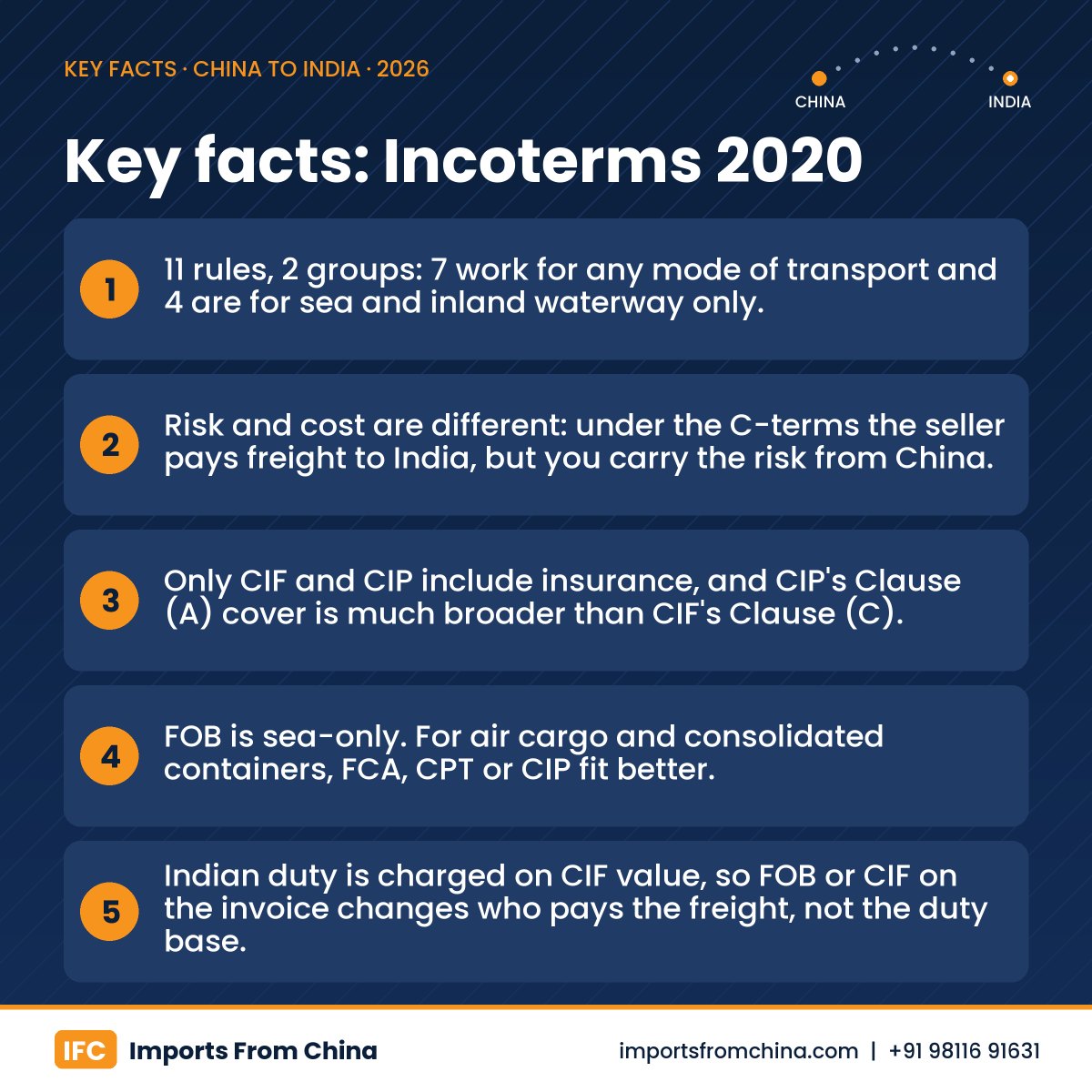
- 11 rules, 2 groups: 7 work for any mode of transport and 4 are for sea and inland waterway only.
- Risk and cost are different: under the C-terms the seller pays freight to India, but you carry the risk from China.
- Only CIF and CIP include insurance, and CIP’s Clause (A) cover is much broader than CIF’s Clause (C).
- FOB is sea-only. For air cargo and consolidated containers, FCA, CPT or CIP fit better.
- Indian duty is charged on CIF value, so FOB or CIF on the invoice changes who pays the freight, not the duty base.
Interactive
Incoterms 2020 explorer: tap a rule to see who pays and who carries the risk
The dashed line shows where risk passes from seller to buyer. The bars show who carries risk and who pays costs on the way from a factory in China to your door in India.
Any mode of transport
Sea & inland waterway only
Risk carried by
Costs paid by
Seller (exporter in China)Buyer (importer in India)
FOBFree On BoardSea & inland waterway
- Risk passes to buyer
- When the goods are loaded on board the vessel at the port of shipment, for example Ningbo or Shenzhen.
- Seller pays until
- Goods are export-cleared and on board at the origin port.
- Insurance
- Not required. The buyer usually insures the sea voyage.
- Best for
- Sea cargo where you want to choose your own forwarder to India.
Tip for Indian importers: FOB is the term Chinese suppliers quote most often. It lets you pick your own freight forwarder and control Indian destination charges, but the risk is yours as soon as the cargo is on board.
- Export packagingSeller
- Loading at originSeller
- Delivery to port/placeSeller
- Export customsSeller
- Origin terminalSeller
- Loading on main carrierSeller
- Main freightBuyer
- InsuranceNegotiable
- Destination terminalBuyer
- Delivery to destinationBuyer
- Unloading at destinationBuyer
- Import duty & customsBuyer
What are Incoterms 2020?
Incoterms is short for International Commercial Terms. Each rule is a short code, such as FOB or DDP, that buyers and sellers add to a sales contract so both sides know the same thing: where the seller delivers, who books and pays the transport, who clears export and import customs, who insures the goods and when the risk moves across.
The ICC published the first Incoterms in 1936 and has revised them about once every ten years since 1980. Incoterms 2020 is the ninth revision. It was released in September 2019 and came into force on 1 January 2020, and it remains the current edition used in trade contracts worldwide, including on most quotations from Chinese factories.
What Incoterms 2020 do not cover
Incoterms are often misunderstood, so it helps to know their limits. An Incoterm does not decide:
- when ownership (title) of the goods passes to the buyer
- the price, payment terms or currency, or how a letter of credit works
- what happens if one party breaches the contract, or which law applies
- the HS code, customs duty rate or product certifications such as BIS
Those points belong in the rest of your sales contract and purchase order. The Incoterm only allocates delivery, costs, risk, transport, insurance and customs tasks.
The 11 Incoterms 2020 rules at a glance
The 11 rules are split into two groups, depending on how the goods travel.
Rules for any mode or modes of transport (7): EXW (Ex Works), FCA (Free Carrier), CPT (Carriage Paid To), CIP (Carriage and Insurance Paid To), DAP (Delivered at Place), DPU (Delivered at Place Unloaded) and DDP (Delivered Duty Paid). Use these for air freight, road, rail, courier, containers and multimodal shipments.
Rules for sea and inland waterway transport only (4): FAS (Free Alongside Ship), FOB (Free On Board), CFR (Cost and Freight) and CIF (Cost, Insurance and Freight). These are meant for cargo loaded directly onto a ship, especially bulk and break-bulk goods.
E, F, C and D families: the easy way to remember
The first letter of each rule tells you how far the seller’s job goes. This is the fastest way to understand the whole Incoterms 2020 set.
EDepartureEXW. You collect the goods at the seller’s door.
FMain carriage unpaidFCA, FAS, FOB. Seller hands over in China; you pay the main freight.
CMain carriage paidCPT, CIP, CFR, CIF. Seller pays freight, but risk passes in China.
DArrivalDAP, DPU, DDP. Seller carries risk and cost to India.
The C-terms cause the most confusion. Under CFR, CIF, CPT and CIP the seller pays freight all the way to India, but the risk has already passed to you at the port or carrier in China. These are called the two critical points: one for risk, one for cost. Try CIF in the explorer above and you will see the risk bar turn blue in China while the cost bar stays orange until the Indian port.
Each of the Incoterms 2020 rules explained
Below is every Incoterms 2020 rule in the order of the seller’s growing responsibility, with a practical note for importers bringing goods from China to India.
EXW – Ex Works (named place)
The seller only makes the goods available at its premises or another named place, packed for export. It does not load them onto your truck and does not clear them for export. Risk passes to you the moment the goods are placed at your disposal.
EXW looks cheap on a quotation, but it gives the buyer the most work. In China, the export declaration has to be filed through a registered exporter, which an Indian buyer usually is not. Unless an agent in China handles pickup and export clearance for you, ask the supplier to quote FCA instead.
FCA – Free Carrier (named place)
The seller clears the goods for export and hands them to the carrier or forwarder you nominate at a named place. If that place is the seller’s own premises, the seller also loads your vehicle. If it is somewhere else, such as a forwarder’s warehouse in Yiwu or Guangzhou, the seller delivers on its own truck, ready for unloading.
FCA is the ICC’s recommended rule for containers and consolidated LCL cargo, because the goods are usually handed over at a warehouse or terminal days before the ship sails. Since 2020, the parties can also agree that the buyer’s carrier issues an on-board bill of lading to the seller, which helps when payment is made by letter of credit.
FAS – Free Alongside Ship (named port of shipment)
The seller places the goods alongside the vessel, on the quay or on a barge, at the named port of shipment and clears them for export. Risk and costs pass to the buyer at that point, so loading onto the ship is the buyer’s job.
FAS suits bulk and break-bulk cargo such as steel coils, timber or heavy machinery. It is rarely the right choice for containerised goods from China.
FOB – Free On Board (named port of shipment)
The seller clears the goods for export and loads them on board the vessel you nominate at the named port, such as FOB Ningbo, FOB Shanghai, FOB Shenzhen or FOB Qingdao. Risk passes once the goods are on board. From there, you pay the ocean freight, insurance, Indian destination charges, customs duty and delivery.
FOB is the term most Chinese suppliers quote, and it works well when you have your own forwarder, because you control the freight rate and the charges at the Indian port. Remember that FOB is a sea-only rule: “FOB Shenzhen Airport” is not a valid Incoterm. Use FCA for air cargo.
CFR – Cost and Freight (named port of destination)
The seller loads the goods on board and pays the ocean freight to the named Indian port, for example CFR Nhava Sheva or CFR Mundra. Even so, the risk passes to you when the goods are on board in China. Insurance is not included, so you should arrange cover for the sea voyage yourself.
CIF – Cost, Insurance and Freight (named port of destination)
CIF is CFR plus insurance. The seller must buy marine insurance for your benefit, but only minimum cover under Institute Cargo Clauses (C), for at least 110% of the contract value. Clause C covers listed major events such as fire, sinking or collision, not everyday handling damage or theft.
For electronics, machinery, furniture and other manufactured goods, ask the seller for Clause (A) cover or buy your own top-up policy. Also be careful with very low CIF prices to Indian ports: the seller’s forwarder may recover its margin through high destination charges that you pay on arrival.
CPT – Carriage Paid To (named place of destination)
The seller pays the carriage to a named place in India, such as Delhi air cargo terminal or ICD Tughlakabad, but the risk passes when the goods are handed to the first carrier in China. CPT works for any mode, so it is a natural choice for air freight, courier and container shipments where the seller books the transport.
CIP – Carriage and Insurance Paid To (named place of destination)
CIP is CPT plus insurance, and this is where Incoterms 2020 made a real change. The seller must now buy all-risks cover under Institute Cargo Clauses (A), for at least 110% of the contract value. That makes CIP the safer C-term for high-value goods such as electronics, instruments and spare parts.
DAP – Delivered at Place (named place of destination)
The seller delivers the goods to the named place in India on the arriving vehicle, ready for unloading, and carries the risk until then. You unload the goods, clear Indian customs and pay the duty and IGST. Under DAP you still need an Importer Exporter Code (IEC), a customs broker and funds for the duty when the cargo lands.
DPU – Delivered at Place Unloaded (named place of destination)
DPU replaced DAT (Delivered at Terminal) in 2020. It is the only Incoterm that makes the seller unload the goods at destination. Delivery can be at any place, not only a terminal, so make sure the seller is actually able to unload at the place you name. Import clearance and duty remain with you.
DDP – Delivered Duty Paid (named place of destination)
DDP puts the maximum obligation on the seller: transport, export and import clearance, customs duty, taxes and delivery to your named place. You simply receive the goods.
A Chinese factory usually cannot act as the importer in India by itself, so DDP shipments from China normally run through an Indian import agent who files the Bill of Entry and pays the duty. Before you agree, ask who the importer on record is and what GST invoice you will receive. Read more in our guide to DDP shipments from China to India and the comparison of DDP vs DAP shipping.
Incoterms 2020 chart: who pays what
The table below shows each Incoterms 2020 obligation and charge, from export packing in China to import clearance in India. Tap a rule code in the header to highlight it and update the explorer above.
| Obligation | |||||||||||
|---|---|---|---|---|---|---|---|---|---|---|---|
| Transport mode | Any | Any | Sea | Sea | Sea | Sea | Any | Any | Any | Any | Any |
| Risk passes | At seller’s premises | To buyer’s carrier | Alongside ship | On board vessel | On board vessel | On board vessel | To first carrier | To first carrier | At named place | Unloaded at named place | At named place |
| Export packaging | Seller | Seller | Seller | Seller | Seller | Seller | Seller | Seller | Seller | Seller | Seller |
| Loading at origin | Buyer | Seller | Seller | Seller | Seller | Seller | Seller | Seller | Seller | Seller | Seller |
| Delivery to port/place | Buyer | Seller | Seller | Seller | Seller | Seller | Seller | Seller | Seller | Seller | Seller |
| Export customs | Buyer | Seller | Seller | Seller | Seller | Seller | Seller | Seller | Seller | Seller | Seller |
| Origin terminal | Buyer | Buyer | Seller | Seller | Seller | Seller | Seller | Seller | Seller | Seller | Seller |
| Loading on main carrier | Buyer | Buyer | Buyer | Seller | Seller | Seller | Seller | Seller | Seller | Seller | Seller |
| Main freight | Buyer | Buyer | Buyer | Buyer | Seller | Seller | Seller | Seller | Seller | Seller | Seller |
| Insurance | Negotiable | Negotiable | Negotiable | Negotiable | Negotiable | Seller (C) | Negotiable | Seller (A) | Negotiable | Negotiable | Negotiable |
| Destination terminal | Buyer | Buyer | Buyer | Buyer | Buyer | Buyer | Seller | Seller | Seller | Seller | Seller |
| Delivery to destination | Buyer | Buyer | Buyer | Buyer | Buyer | Buyer | Buyer | Buyer | Seller | Seller | Seller |
| Unloading at destination | Buyer | Buyer | Buyer | Buyer | Buyer | Buyer | Buyer | Buyer | Buyer | Seller | Seller |
| Import duty & customs | Buyer | Buyer | Buyer | Buyer | Buyer | Buyer | Buyer | Buyer | Buyer | Buyer | Seller |
(C) = minimum cover, Institute Cargo Clauses (C). (A) = all-risks cover, Institute Cargo Clauses (A). Under CPT and CIP, destination terminal charges fall on the seller when they are part of its carriage contract. Scroll sideways on mobile to see all 11 rules.
What changed from Incoterms 2010 to Incoterms 2020?
Most of the rules stayed the same, but Incoterms 2020 made several practical changes that matter for importers:
- DAT became DPU. Delivered at Terminal was renamed Delivered at Place Unloaded, so the seller can unload at any agreed place, not only a terminal.
- Higher insurance under CIP. CIP now requires all-risks cover under Institute Cargo Clauses (A). CIF still requires only the minimum Clauses (C).
- FCA and on-board bills of lading. Buyer and seller can agree that the buyer’s carrier issues an on-board bill of lading to the seller, which makes FCA work with letters of credit.
- Own means of transport. The rules now accept that a buyer may collect with its own vehicle under FCA, and a seller may deliver with its own vehicle under DAP, DPU and DDP.
- Security costs. Security-related requirements such as container screening are now allocated clearly between buyer and seller.
- Clearer cost lists. All costs are listed together in articles A9 and B9 of each rule, which reduces disputes over terminal handling charges.
- Explanatory notes and a new order. Each rule now starts with user notes, and delivery and risk appear earlier in the text.
FOB vs CIF vs EXW vs DDP: which is best for imports from China to India?
Choosing between the Incoterms 2020 rules is really a choice about control, cost and convenience. Here is how the four Incoterms 2020 terms Indian importers see most often compare:
| Term | Who books freight | Risk passes in | Who pays Indian duty | Good for |
|---|---|---|---|---|
| EXW | Buyer | China, at the factory | Buyer | Buyers with an agent in China who handles pickup and export |
| FOB | Buyer | China, on board the ship | Buyer | Regular importers with their own forwarder |
| CIF | Seller | China, on board the ship | Buyer | One price to an Indian port (check insurance and destination charges) |
| DDP | Seller or import agent | India, at your door | Seller or import agent | Hassle-free delivery of small and mixed loads |
Does a CIF invoice reduce customs duty in India?
No. Indian customs duty is charged on the assessable value, which is based on the CIF value of the goods at the Indian port, whatever term appears on your invoice. Under the Customs Valuation Rules, 2007, if you buy FOB, customs adds the actual freight and insurance. If the freight cannot be ascertained, it is taken as 20% of the FOB value, and insurance as 1.125% of the FOB value.
Example: goods bought at USD 10,000 FOB Ningbo, with actual sea freight of USD 800 and no insurance proof, have an assessable value of 10,000 + 800 + 112.50 = USD 10,912.50. Basic customs duty, the Social Welfare Surcharge and IGST are then calculated on that value. The fastest way to see your real figure is the free IFC shipment calculator or the HS code duty pages.
Which Incoterm should a small importer choose?
If you have your own forwarder and import regularly, FOB (or FCA for consolidated cargo) gives the best control over cost. If you want a single price to your shop or warehouse and no customs paperwork, a DDP door-to-door service from an import agent is simpler. Wholesalers and retailers in Delhi markets such as Sadar Bazaar, Karol Bagh, Chandni Chowk, Gandhi Nagar, Nehru Place and Bhagirath Palace often choose DDP for mixed cartons from Yiwu and Guangzhou, while factories and distributors in Mumbai, Ahmedabad, Surat, Ludhiana, Bengaluru and Chennai often buy FOB and clear through their own CHA.
Interactive
Incoterm finder: which rule fits your shipment?
Answer three questions to get a suggested Incoterms 2020 rule.
How to write Incoterms 2020 in a contract or proforma invoice
Always use the format: rule + named place or port + “Incoterms® 2020”. The more precise the place, the fewer disputes about who pays loading or terminal charges. Good examples:
- FOB Ningbo, China, Incoterms® 2020
- FCA forwarder’s warehouse, Futian, Yiwu, Zhejiang, China, Incoterms® 2020
- CIF Nhava Sheva (JNPT), India, Incoterms® 2020
- CPT Delhi Air Cargo Terminal, India, Incoterms® 2020
- DAP ICD Tughlakabad, New Delhi, Incoterms® 2020
- DDP your warehouse address, Karol Bagh, New Delhi, Incoterms® 2020
Parties can still choose an older edition such as Incoterms 2010 instead of Incoterms 2020, so always write the year. If you leave it out, the rules of the edition that applied at the contract date may be assumed, which can lead to arguments later.
8 common Incoterms 2020 mistakes Indian importers make
- Using FOB for air cargo. FOB, FAS, CFR and CIF are sea-only rules. Use FCA, CPT or CIP for air freight.
- Not naming an exact place. “FCA Guangzhou” is too vague. Name the warehouse, terminal or address.
- Assuming C-terms move risk to India. Under CFR, CIF, CPT and CIP, risk passes in China even though the seller pays freight.
- Relying on CIF’s minimum insurance. Clause (C) cover rarely protects manufactured goods against handling damage.
- Accepting EXW without export support. Someone must be able to file the Chinese export declaration.
- Ignoring destination charges. Terminal handling, delivery order and CFS charges at the Indian port can wipe out a cheap CIF or CFR price.
- Forgetting the edition year. Always write “Incoterms® 2020” after the rule.
- Treating Incoterms as a payment or ownership clause. They are not. Cover payment, title and quality in the contract.
How IFC handles Incoterms 2020 for China to India imports
IFC – Imports From China works with buyers on whichever rule suits the deal. Our team in China can collect goods EXW or FCA from suppliers, check and consolidate them in our warehouses, and ship by sea or air. For buyers who want one price, our door-to-door shipping from China to India service works on a DDP basis, with customs duty and delivery included, across Delhi NCR, Mumbai, Kolkata, Chennai, Bengaluru, Hyderabad, Jaipur, Lucknow, Ahmedabad, Pune and other cities.
Not sure what your landed cost will be under FOB, CIF or DDP? Estimate it in the shipment calculator, convert carton weight with the weight to CBM calculator, or contact IFC for a quote.
Incoterms 2020 FAQs
What are Incoterms 2020 in simple words?
Incoterms 2020 are 11 standard trade rules from the International Chamber of Commerce. They tell the buyer and seller who pays for transport, insurance and customs, and where the risk of loss passes from the seller to the buyer.
How many Incoterms are there in Incoterms 2020?
There are 11 rules. Seven work for any mode of transport (EXW, FCA, CPT, CIP, DAP, DPU and DDP) and four are for sea and inland waterway transport only (FAS, FOB, CFR and CIF).
What is the difference between FOB and CIF?
Under FOB the buyer pays the sea freight and insurance from the port of shipment. Under CIF the seller pays the freight and minimum insurance to the destination port. In both cases the risk passes to the buyer once the goods are on board at the origin port.
Which Incoterm is best for importing from China to India?
FOB, or FCA for containers and consolidated cargo, if you have your own forwarder and want control over freight costs. DDP through an import agent if you want one landed price with customs duty and delivery included.
Is customs duty in India calculated on FOB or CIF value?
On the CIF-based assessable value. If you buy FOB, the actual freight and insurance are added. If they cannot be ascertained, freight is taken as 20% and insurance as 1.125% of the FOB value under the Customs Valuation Rules, 2007.
Which Incoterms 2020 rules include insurance?
Only CIF and CIP. CIF requires minimum cover under Institute Cargo Clauses (C), while CIP requires all-risks cover under Institute Cargo Clauses (A). Under every other rule insurance is optional and must be agreed separately.
What replaced DAT in Incoterms 2020?
DPU, Delivered at Place Unloaded. It works like the old DAT rule but allows delivery at any agreed place, not only a terminal, with the seller unloading the goods.
Are Incoterms 2020 still valid in 2026?
Yes. Incoterms 2020 is the current ICC edition. Parties can still agree to use an older edition, so always write the year after the rule, for example FOB Ningbo Incoterms 2020.
This guide is general information about the Incoterms 2020 rules and Indian customs practice. It is not legal advice. For the official text, see the ICC Incoterms® rules page. For another detailed walkthrough, see the IncoDocs Incoterms guide. Incoterms® is a registered trademark of the International Chamber of Commerce.