

Import mobile accessories from china to india

Import Mobile Accessories from China to India: BIS, WPC and Duty Guide (2026)

Can you import mobile accessories from China to India? Yes, and most of India’s phone cases, cables, chargers, power banks and earbuds already come from China. But the rules differ by product: cases and cables need only the right HS code and duty, while chargers, power banks and wireless earbuds need BIS registration, and anything with Bluetooth needs WPC approval before customs will release it.

If you plan to import mobile accessories from China to India, this guide shows the duty and compliance profile for each product, how to ship lithium batteries legally, where to source in China, a quality checklist, and a worked rupee example for a mixed order.

Key takeaways

  • Two groups of products: cases, covers, cables and holders are simple imports; chargers, power banks, earbuds and smartwatches are regulated.
  • BIS before payment: regulated items need the factory’s BIS CRS registration (R-number) for your brand and model, and the Standard Mark on the product.
  • WPC for wireless: Bluetooth earbuds, speakers and smartwatches need a WPC Equipment Type Approval (ETA), filed by an Indian entity.
  • Duty is 15–20% BCD: plus 10% SWS and 18% IGST for most accessories (as of October 2026; confirm your HS code).
  • Batteries are dangerous goods: power banks ship as Class 9 cargo with UN38.3 and MSDS papers, and many consolidators will not mix them with general cargo.
  • Labels and EPR: retail packs need Legal Metrology details, and importers of batteries and listed electronics must register for EPR with CPCB.

Which mobile accessories can you import from China to India?

All common phone accessories are freely importable under India’s import policy, which means no DGFT import licence is needed. What decides how hard the import will be is whether the product falls under a technical regulation. A simple way to think about it:

  • Low-compliance accessories: phone cases and covers, screen guards, USB data cables, car and desk holders, pop sockets, selfie sticks without Bluetooth, ring lights without adapters. You need the correct HS code, duty and Legal Metrology labels.
  • Regulated accessories: mobile chargers and adapters, power banks, wired and wireless earphones, neckbands, Bluetooth speakers and smartwatches. These need BIS registration, and wireless versions also need WPC approval.

Many sellers start with the first group because a mistake costs less and the margins are good. The second group sells more by value, but every model has to be checked before you pay the factory.
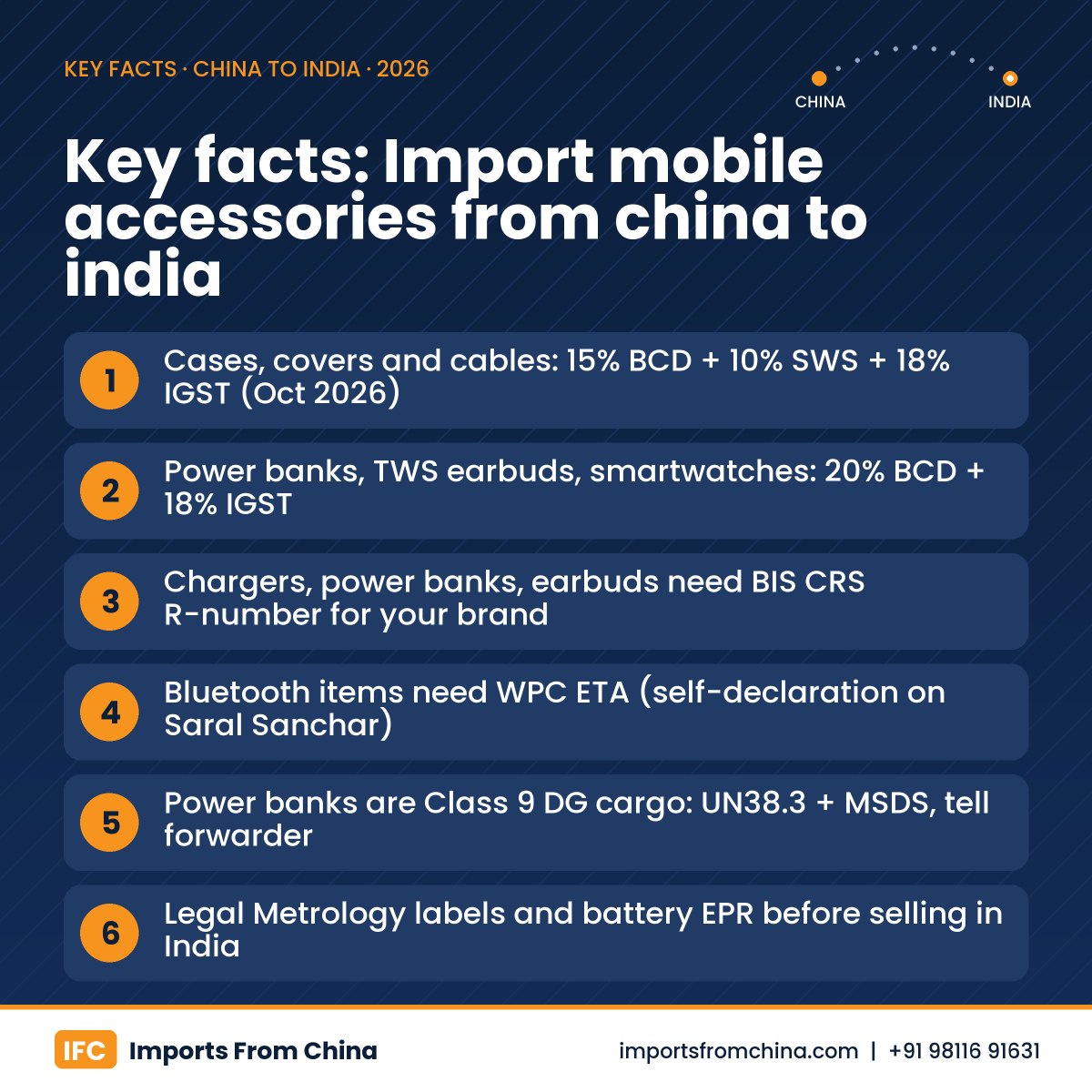
Import mobile accessories from china to india infographic – key facts for Indian importers
Import mobile accessories from china to india: key facts at a glance (IFC – Imports From China)

What is the import duty on mobile accessories from China?

The table shows typical HS codes and duty rates from the IFC India import duty database. Social Welfare Surcharge (SWS) is 10% of BCD, and IGST is charged on assessable value plus BCD plus SWS. There is no AIDC or anti-dumping duty on these codes in the database. Rates as of October 2026; confirm for your exact HS code on the India import duty rates by HS code page, because material, function and wireless features can change the code.

AccessoryTypical HS codeBCDIGSTBIS (CRS)WPC
Phone cases and covers (plastic, silicone, TPU)3926909915%18%NoNo
USB and data cables8544429915%18%Not as a standalone item (verify)No
Mobile chargers and adapters8504403015%18%Yes, IS 13252 (Part 1)No (yes for wireless chargers, verify)
Power banks8507600020%18%Yes, IS 13252 (Part 1); cells IS 16046No
TWS earbuds8518301120%18%Yes, IS 616Yes
Wired earphones and headphones8518302020%18%Check: IFC database flags IS 616; confirm on the CRS listNo
Smartwatches and fitness bands8517629020%18%Yes, IS 13252 (Part 1)Yes

Screen guards are classified by material: tempered glass usually falls in chapter 70 and plastic film in chapter 39, so confirm the code with your customs broker. Leather or fabric wallet covers may move to heading 4202. The 15% BCD on chargers applies to chargers and adapters of cellular mobile phones; other battery chargers attract 20%. For how each duty is calculated, see our import duty from China to India guide.

Which mobile accessories need BIS registration?

Under the Compulsory Registration Scheme (CRS), run by BIS for MeitY, listed electronics cannot be imported or sold in India unless the manufacturer holds a BIS registration for that factory, brand and model, and the product carries the Standard Mark with the R-number. For mobile accessories, the categories that matter most are:

  • Power adapters for IT equipment (phone chargers), IS 13252 (Part 1).
  • Power banks for portable applications, IS 13252 (Part 1), with the lithium cells inside also registered under IS 16046.
  • Wireless headphones and earphones, IS 616; confirm whether your wired model is also covered.
  • Smartwatches, IS 13252 (Part 1).
  • Bluetooth speakers, usually tested to IS 616; confirm the scope for your model.

The Chinese factory is the applicant, through an Authorised Indian Representative (AIR), and testing must be done at a BIS-recognised lab in India. A new registration commonly takes one to three months, so the R-number must be confirmed before you place the bulk order, not after the goods reach the port. Our detailed guide to BIS registration for electronics from China explains the process, costs and how to verify an R-number. Always check the current list on the BIS website, because MeitY adds products from time to time.

The private-label trap

Most Indian sellers put their own brand on Chinese earbuds or power banks. A factory’s existing registration covers its own brand, not yours. Unless your brand is added to the registration, the goods are non-compliant even if the identical product is registered under another name. Sort this out in writing before paying the deposit.

When do you need WPC approval for Bluetooth accessories?

Any product with a radio module, such as Bluetooth or Wi-Fi, needs an Equipment Type Approval (ETA) from the Wireless Planning and Coordination (WPC) wing of the Department of Telecommunications. This covers TWS earbuds, neckbands, Bluetooth speakers, smartwatches, wireless chargers and Bluetooth selfie remotes.

  • Route: for products working in de-licensed bands such as 2.4 GHz Bluetooth, the ETA is a self-declaration filed online on the Saral Sanchar portal. No separate WPC import licence is needed for these bands.
  • Who applies: an Indian legal entity, usually the importer or brand owner, using an RF test report from an ISO/IEC 17025 accredited lab.
  • Time and fee: usually a few working days once documents are complete, with a government fee per model; check the current fee on the portal.
  • At customs: the ETA certificate is uploaded with the Bill of Entry. Without it, Bluetooth goods are detained and demurrage starts running.

BIS and WPC are separate approvals. A Bluetooth earbud needs both: BIS for electrical safety and WPC for the radio. Keep both certificates, the test reports and photos of the marking in your import file, along with the papers in our documents required for import from China checklist.

How do you ship power banks and battery products from China?

Power banks are lithium-ion batteries in a case, so they travel as dangerous goods (Class 9). Power banks shipped on their own fall under UN3480, while batteries packed with or inside a device, such as earbuds in a charging case, fall under UN3481. This changes how you ship:

ModePower banks (UN3480)Devices with built-in batteries (UN3481)Indicative cost and time (October 2026)
Sea LCLAccepted by some consolidators as declared DG cargo; needs UN38.3 test summary, MSDS and DG declarationUsually accepted with battery documents₹9,000–16,000 per CBM door to door for general cargo, DG surcharge extra; about 3–6 weeks
Air cargoCargo aircraft only, strict packing and state-of-charge limits; few forwarders accept small lotsAccepted with proper labels and documents₹350–600/kg door to door for general cargo, DG costs extra; about 5–10 days
CourierUsually refusedRestricted; check with the courier₹450–900/kg for samples

The practical lesson: tell your forwarder about every battery product before booking. A power bank hidden in a general LCL shipment is a safety risk, can be refused at loading, and can hold up everyone else’s cargo in the same container. Our air freight vs sea freight guide explains chargeable weight and transit times in more detail.

Where do Indian importers source mobile accessories in China?

  • Shenzhen: the main manufacturing base for chargers, power banks, earbuds and smartwatches. Factories here are most likely to already hold BIS registrations for India.
  • Guangzhou: wholesale markets and trading companies for cases, covers, cables and mixed accessory ranges, often with low MOQs.
  • Yiwu: cheaper cases, holders, selfie sticks and gift-type accessories for small mixed orders. Electrical items found in Yiwu shops rarely carry BIS registration; see our list of products to buy from Yiwu market.
  • Online platforms: Alibaba and 1688 list thousands of accessory suppliers, but listing photos say nothing about Indian compliance. Use them to shortlist, then verify.

Quality checks that matter for mobile accessories

  1. Real battery capacity: test power banks for actual mAh output; overstated capacity is the most common complaint and return reason.
  2. Charging standard: confirm the fast-charge protocol (for example USB PD) and wattage with a USB tester, not just the box print.
  3. Cable build: check wire gauge, connector fit and a bend test; thin copper causes slow charging and heat.
  4. Case fit: test cases on the actual phone model, including camera cut-outs and button feel.
  5. Markings and labels: BIS Standard Mark with R-number on product and box, and the Legal Metrology declaration ready before shipment.
  6. Golden sample: keep a signed approved sample and inspect bulk goods against it before loading.

Worked example: duty on a mixed mobile accessories order

Assumptions: an online seller in Bengaluru imports four lines from Shenzhen and Guangzhou. The earbuds and power banks come from factories whose BIS registrations cover the seller’s brand, and the earbuds have a WPC ETA. Total FOB value USD 6,400; sea freight and insurance to Nhava Sheva of USD 250 are spread by value, so CIF is USD 6,650. Exchange rate ₹95.90 per USD, the CBIC import rate under Notification 29/2026-Customs (N.T.), effective 16 October 2026. Assessable value is taken as CIF. Rates as of October 2026; confirm for your exact HS code.

Line (HS code)Assessable value (₹)BCD (₹)SWS (₹)IGST 18% (₹)Total at customs (₹)
500 TWS earbuds at USD 6.50 (85183011), BCD 20%3,23,85064,7706,47771,1171,42,364
1,000 USB-C cables at USD 0.60 (85444299), BCD 15%59,7888,96889712,53822,403
2,000 TPU phone cases at USD 0.45 (39269099), BCD 15%89,68113,4521,34518,80633,603
300 power banks at USD 5.50 (85076000), BCD 20%1,64,41632,8833,28836,10672,277
Total6,37,7351,20,07312,0071,38,5672,70,647

If the Bill of Entry carries your GSTIN, the IGST of ₹1,38,567 is normally claimed as input tax credit. Your real duty cost is BCD plus SWS of ₹1,32,080, about 21% of the assessable value. Per unit, that is roughly ₹142 per pair of earbuds and ₹120 per power bank. Freight comes on top: general cargo LCL is about ₹9,000–16,000 per CBM door to door (indicative, October 2026), and the power banks may need a separate DG booking with an extra surcharge.

Now compare the cost of a compliance miss. If the earbuds arrived without WPC approval or with an R-number that does not cover your brand, ₹3.2 lakh of goods could sit at the port while storage and demurrage build up, and the outcome could be re-export or destruction. That is why BIS and WPC checks come before price negotiation. Test your own mix in the IFC shipment calculator.

What labels, EPR and marketplace rules apply after import?

  • Legal Metrology: retail packs must show the importer’s name and address, country of origin, MRP, net quantity, month and year of import and customer care details. For imports, the declaration must be on the pack before customs clearance, so print or sticker it in China.
  • Battery EPR: under the Battery Waste Management Rules, 2022, importers of batteries, including those inside power banks and earbuds, are treated as producers and must register with CPCB.
  • E-waste EPR: under the E-Waste (Management) Rules, 2022, importers of listed electrical and electronic equipment must register for EPR; check whether your product is listed.
  • Marketplaces: Amazon and Flipkart commonly ask for BIS registration details before you can list regulated electronics, so keep the R-number, WPC ETA and importer details ready.

Pre-order checklist for mobile accessories

  1. HS code and duty confirmed for each product.
  2. BIS R-number verified for the exact factory, brand and model, valid beyond your arrival date.
  3. WPC ETA in hand for every Bluetooth or Wi-Fi product.
  4. UN38.3 test summary and MSDS for battery products, and the forwarder told in advance.
  5. Legal Metrology artwork approved and printed before shipment.
  6. EPR registrations done for batteries and listed electronics.
  7. Pre-shipment inspection booked against the golden sample.

How IFC helps you import mobile accessories from China to India

IFC – Imports From China has more than 20 years (since 2004) in China–India import and export and has served 5000+ businesses. It is founded and led by Mayank Dang (CA Sahab), a Chartered Accountant (FCA, ICAI). IFC’s own offices in Guangzhou and Yiwu have translators and English-speaking staff who can ask suppliers for BIS and WPC documents, check markings on samples and cartons, verify the supplier and run a quality inspection before loading.

IFC gives BIS, HSN, duty and customs/GST compliance guidance before you order, then handles sourcing, LCL and FCL sea freight, air cargo and customs clearance in India. Mixed containers and air cargo are loaded daily, and IFC has a warehouse at its headquarters. With DDP shipments from China to India, accessories are delivered door to door to major cities including Delhi, Gurugram, Noida, Mumbai, Pune, Bengaluru, Hyderabad, Chennai and Ahmedabad.

Bottom line

Mobile accessories are one of the most profitable China-to-India categories, but only when compliance is handled first. Start with cases and cables if you are new, and move into chargers, power banks and earbuds once you can verify BIS registrations for your brand, get WPC approval for wireless items and ship batteries correctly. With those checks done, duty of 15–20% BCD is a predictable cost, not a risk.

Mayank Dang (CA Sahab), Founder and CEO of IFC

Guide on importing mobile accessories from China reviewed by Mayank Dang (CA Sahab), Founder & CEO of IFC

Chartered Accountant (FCA, ICAI) who has helped 5000+ Indian businesses import from China since 2004 – sourcing, BIS, HSN classification, import duty, customs and GST compliance. mayankdang.in

Get your real landed cost: enter your product, weight and CBM in the IFC shipment calculator, check your HS code on the India import duty rates page, or call IFC on +91 98116 91631 for a door-to-door DDP quote from China to your city.

Frequently asked questions

Is BIS certification required to import mobile accessories from China to India?

Only for products on the BIS Compulsory Registration Scheme list. Mobile chargers, power banks, wireless earphones and smartwatches need the factory’s BIS registration for your brand and model, with the Standard Mark on the product. Phone cases, covers, holders and plain data cables do not need BIS as standalone items, but confirm the current list before ordering.

What is the import duty on mobile accessories from China?

Most accessories attract 15% or 20% Basic Customs Duty, 10% Social Welfare Surcharge on the BCD and 18% IGST. For example, phone cases, data cables and mobile chargers carry 15% BCD, while power banks, earbuds and smartwatches carry 20% (as of October 2026). The IGST can usually be claimed as input tax credit.

Do Bluetooth earbuds need WPC approval for import into India?

Yes. Any product with Bluetooth or Wi-Fi needs a WPC Equipment Type Approval. For de-licensed bands it is a self-declaration filed on the Saral Sanchar portal by an Indian entity, using an RF test report from an accredited lab. Customs can detain Bluetooth goods that arrive without it, so get the ETA before shipping.

Can power banks be shipped from China to India by air?

Power banks shipped on their own are Class 9 dangerous goods under UN3480 and can only fly on cargo aircraft with strict packing and charge limits, so few forwarders accept small lots. Sea freight with a UN38.3 test summary, MSDS and DG declaration is usually the practical route. Couriers generally refuse power banks.

Which is the best place in China to buy mobile accessories?

Shenzhen is the main manufacturing base for chargers, power banks, earbuds and smartwatches, and its factories are most likely to hold BIS registrations for India. Guangzhou wholesale markets suit cases, covers and cables, and Yiwu suits cheap holders and gift-type accessories in small mixed orders.

Can I import mobile accessories under my own brand?

Yes, but for regulated items the BIS registration must cover your brand, not just the factory’s own brand, and the Bluetooth products need a WPC approval in your or your representative’s name. Your Legal Metrology label must also show you as the importer. Settle these points before paying the deposit.

What labels are required on imported mobile accessories?

Retail packs need the Legal Metrology declaration: importer name and address, country of origin, MRP, net quantity, month and year of import and customer care details, applied before customs clearance. Regulated electronics also need the BIS Standard Mark with the R-number on the product and the packaging.
Import robots and robotic arms from China to India

Import Robots from China to India: Duty, Landed Cost (2026 Guide)

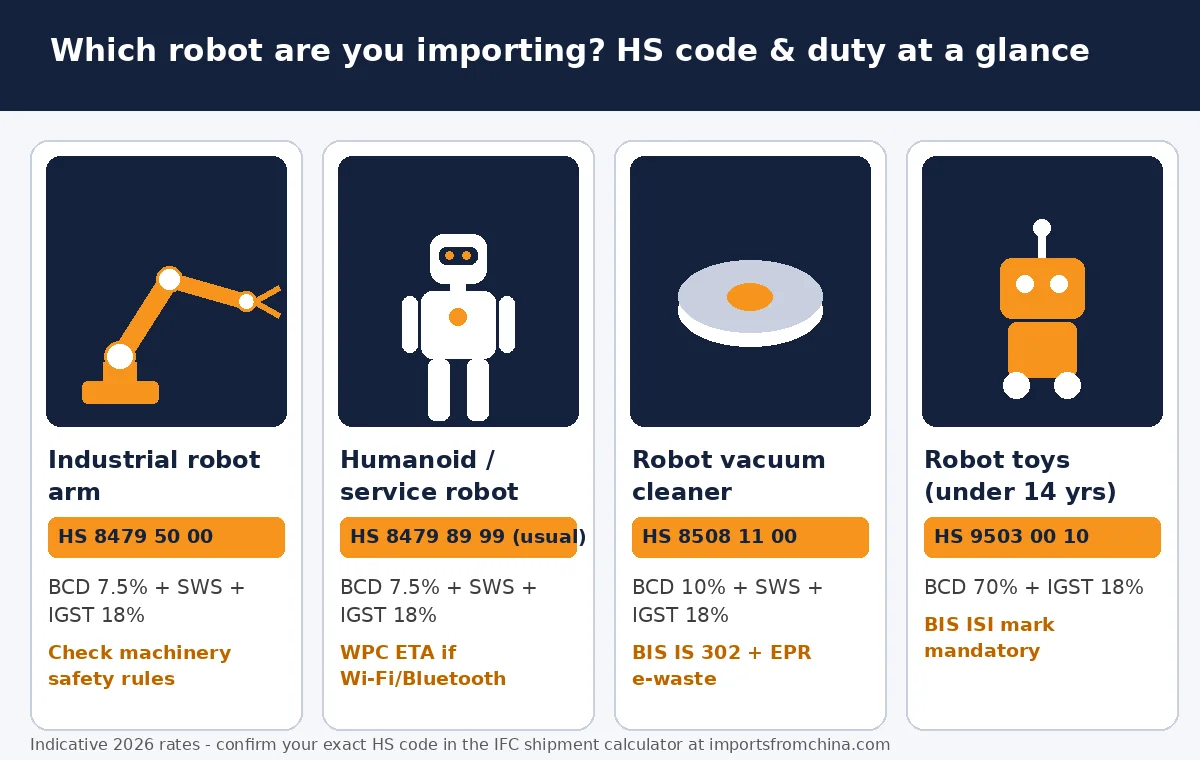
Yes, you can import robots from China to India legally, and most robots need no import licence. Industrial robot arms and service robots pay about 7.5% basic customs duty plus 18% IGST, while robot toys pay about 70% duty and need a BIS licence. Your real cost is the landed cost: price + freight + duty + GST + clearance.

This 2026 guide covers every kind of robot Indian buyers ask us about: 6-axis robotic arms for factories, collaborative robots (cobots), warehouse robots, humanoid and “servant” service robots for hotels, restaurants and homes, robot vacuum cleaners and robot toys for kids. You will learn the HS code and duty for each, the BIS and WPC rules, how to calculate landed cost with the IFC shipment calculator, how big this industry will become in the next 10 years, and the honest answer to the big question: will robots take our jobs?

Key takeaways

  • Free to import: industrial and service robots are “Free” under India’s import policy. You need an IEC and GSTIN, not a special licence.
  • Duty depends on the robot: robotic arms (HS 8479 50 00) and most service robots pay about 7.5% BCD + 10% SWS + 18% IGST. Robot toys (HS 9503 00 10) pay 70% BCD + 18% IGST.
  • Compliance matters: robot toys need a BIS licence (ISI mark), robot vacuums need BIS, and anything with Wi-Fi or Bluetooth needs a WPC ETA.
  • China leads the world: China installed 59% of all new factory robots in 2025, and Chinese companies make over 80% of the world’s humanoid robots.
  • Landed cost is the real price: a USD 15,000 robotic arm costs about Rs 18.3 lakh at your door, of which about Rs 2.7 lakh is GST you can claim back.
  • Jobs will change, not vanish: the World Economic Forum expects 170 million jobs created and 92 million displaced worldwide by 2030, a net gain of 78 million.

Can you import robots from China to India?

Yes. India does not ban or restrict robots. Any business with an Importer Exporter Code (IEC) and a GST number can import them. What changes from product to product is the HS code, the duty rate and the product-safety rules. Before you place an order, put your robot in one of these groups:

  • Industrial robotic arms: 4-axis and 6-axis arms for welding, painting, palletising, CNC loading and packing.
  • Collaborative robots (cobots): lighter arms that work safely next to people. Popular with MSMEs because they are easy to program.
  • Warehouse and logistics robots: AGVs and AMRs that move pallets and trolleys, plus sorting robots for e-commerce.
  • Humanoid and service robots (“robot servants”): waiter robots for restaurants, reception robots for hotels and showrooms, cleaning robots, and the new generation of small humanoids used for research, education and demos.
  • Home robots: robot vacuum cleaners, floor-mopping robots, pool and window cleaning robots.
  • Robot toys and STEM kits: remote-control robots, transforming robots and programmable kits for children.

Why buy robots from China?

China is now the factory of the robot world. According to the International Federation of Robotics (IFR) World Robotics 2026 report, China installed 354,000 industrial robots in 2025, which is 59% of all new installations in the world, and Chinese brands now supply more than half of their own home market. In humanoid robots, Chinese makers such as AgiBot and Unitree together held more than half of global installations in 2025.

Prices have fallen fast. Unitree’s R1 humanoid was launched at about USD 5,900 and its bigger G1 model sells for above USD 13,000. Chinese cobots and robot arms are often 30–50% cheaper than European or Japanese brands for similar payloads. For an Indian MSME, that is the difference between “too expensive” and “pays back in two years”.

What is the HS code and import duty on robots in India?

Robot HS code and import duty in India - robotic arm, humanoid, robot vacuum, robot toys
Robot HS codes and import duty in India at a glance (indicative, November 2026)

Customs duty in India has three parts: Basic Customs Duty (BCD), Social Welfare Surcharge (SWS, 10% of BCD where it applies) and IGST. IGST is charged on the CIF value plus BCD plus SWS, and GST-registered importers can claim it back as input tax credit. Here are the usual codes for robots imported from China:

Robot typeUsual HS codeBCDSWSIGSTKey compliance
Industrial robot arm / cobot8479 50 007.5%10% of BCD18%Check machinery safety rules, CE/test reports
Humanoid / service / waiter robot8479 89 99 (if no specific heading fits)7.5%10% of BCD18%WPC ETA if Wi-Fi/Bluetooth; lithium battery papers
Robot vacuum cleaner8508 11 0010%10% of BCD18%BIS (IS 302), WPC ETA, EPR e-waste
Electronic robot toys9503 00 1070%Nil18%BIS licence + ISI mark (mandatory)
Indicative 2026 rates. Confirm your exact 8-digit code before shipping.

Classification is where many first-time importers lose money. A robot that is “for industry” in the supplier’s catalogue can still be classified differently by customs if it has a specific function, for example a robot that is really a vacuum cleaner or a toy. Always describe the function, power, controller and use clearly on the invoice. You can check codes on our Know Your HSN Code page, the HS 8479 89 99 duty page and the electronic toys HS 9503 00 10 page. For the official tariff, see CBIC.

Which licences and certificates do you need to import robots?

  • IEC and GSTIN: needed for every commercial import. The Bill of Entry is filed on ICEGATE in your name.
  • BIS licence for robot toys: under the Toys Quality Control Order, every toy for children under 14 must carry the ISI mark. The Chinese factory must hold a BIS licence under the Foreign Manufacturers Certification Scheme (IS 9873 for toy safety and IS 15644 for electric toys). Without it, customs will not release the goods. Read our full guide to importing toys from China.
  • BIS for household robots: robot vacuum cleaners and many home appliances fall under BIS rules, and power adapters or chargers sold with the robot may need BIS CRS registration. Check the latest list on bis.gov.in.
  • WPC Equipment Type Approval (ETA): any robot with Wi-Fi, Bluetooth or another radio module needs an ETA from the WPC wing of the Department of Telecommunications.
  • Lithium battery documents: most service robots, humanoids and robot toys run on lithium batteries. Ask the supplier for the MSDS and UN38.3 test report. Air cargo with batteries is shipped as special cargo and costs more.
  • EPR for e-waste: electronic robots sold in India may need Extended Producer Responsibility registration with the CPCB.
  • Used or refurbished robots: second-hand robot arms are popular, but carry a chartered engineer certificate showing the year of make, residual life and fair value, and check the current DGFT policy before you buy.

How to calculate the landed cost of robots imported from China

Landed cost is the total cost of the robot when it reaches your factory or shop. The formula used by Indian customs is simple:

  1. CIF value = supplier price (FOB) + international freight + insurance, converted to rupees at the customs exchange rate.
  2. BCD = CIF value × BCD rate.
  3. SWS = 10% of BCD (where it applies).
  4. IGST = (CIF + BCD + SWS) × IGST rate.
  5. Landed cost = CIF + BCD + SWS + IGST + port, CHA and delivery charges.

Example 1: a 6-axis robotic arm by sea

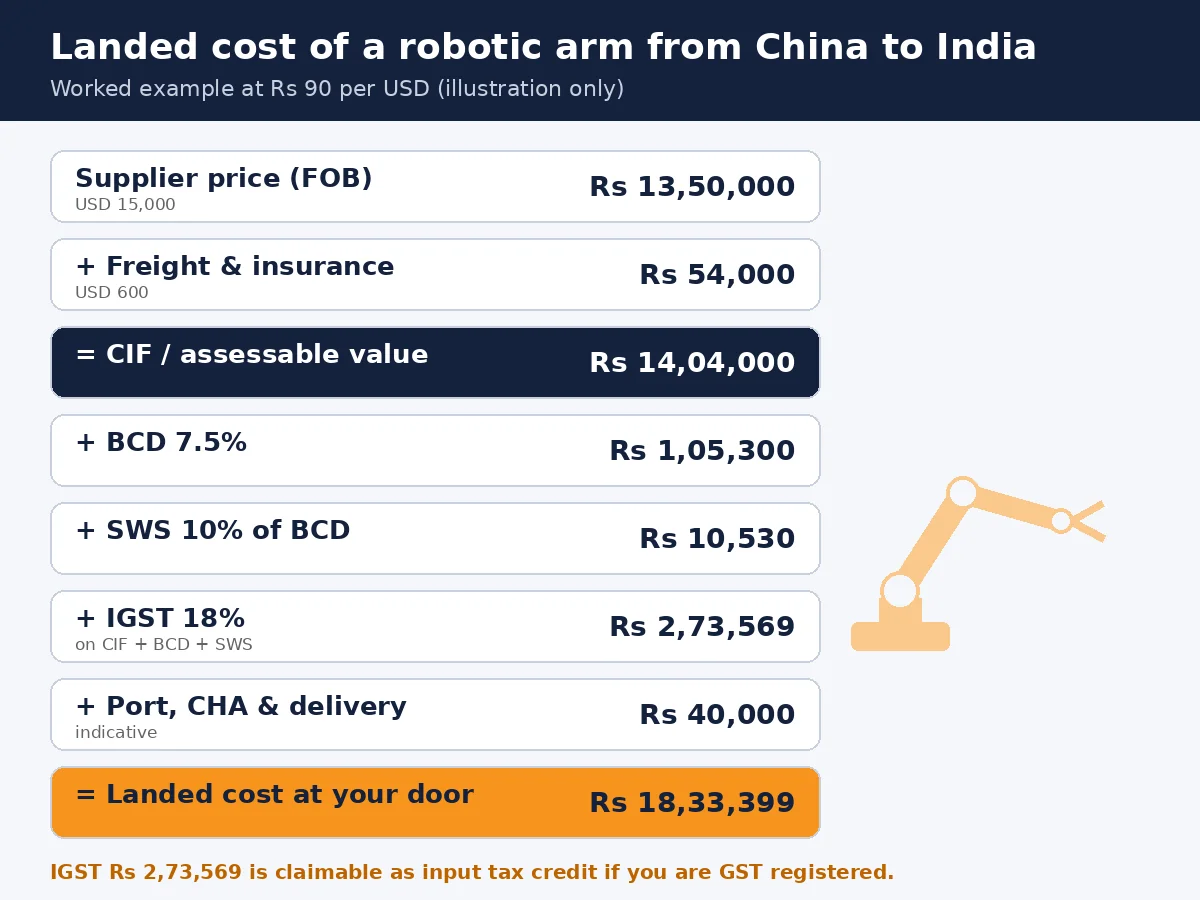
Landed cost of importing a robotic arm from China to India - worked example
Worked example: USD 15,000 robotic arm, Rs 90 per USD (illustration only)

A factory in Pune buys a 6-axis welding robot with controller for USD 15,000 FOB. Sea freight and insurance add USD 600. At an illustrative rate of Rs 90 per USD, the CIF value is Rs 14,04,000. BCD at 7.5% is Rs 1,05,300, SWS is Rs 10,530 and IGST at 18% is Rs 2,73,569. With about Rs 40,000 for port, CHA and delivery, the robot lands at about Rs 18,33,399. If the factory is GST-registered, it claims back the IGST, so the real cost is close to Rs 15.6 lakh.

Example 2: 500 robot toys vs one humanoid robot

Cost line500 electronic robot toys (sea, LCL)1 small humanoid robot (air)
Supplier price (FOB)USD 3,000 (USD 6 each)USD 5,900
Freight + insuranceUSD 300USD 400 (battery cargo)
CIF value at Rs 90/USDRs 2,97,000Rs 5,67,000
BCD70% = Rs 2,07,9007.5% = Rs 42,525
SWSNilRs 4,253
IGST 18%Rs 90,882Rs 1,10,480
Port, CHA and delivery (indicative)Rs 25,000Rs 15,000
Landed costRs 6,20,782 (about Rs 1,242 per toy)Rs 7,39,258
Illustrative examples. BIS licence cost for toys and WPC/testing costs are extra.

Look at the difference. The toy costs USD 6 in China but over Rs 1,200 at your warehouse, because 70% duty is charged on top of freight. The humanoid robot pays only 7.5% BCD. This is why the right HS code and the right product category decide whether your business makes money.

How to use the IFC shipment calculator for robots

  1. Open the IFC shipment calculator.
  2. Type the product name, for example “robotic arm” or “robot toy”. The calculator suggests the HS code and shows the BCD, SWS, IGST and any BIS rule for that code.
  3. Enter the invoice value from your supplier in USD, CNY or INR.
  4. Enter the gross weight and CBM from the supplier’s packing list. Robot arms are heavy; toys are light but bulky, so CBM matters more.
  5. Choose sea or air. The calculator gives a door-to-door cost sheet: freight, insurance, CIF, duty, GST and the total you pay.
  6. Call IFC to confirm the final quote before you pay your supplier.

Step-by-step: how to import robots from China to India safely

  1. Define the job, not the robot. Write the payload, reach, speed, cycle time and the task. A supplier can then suggest the right model instead of the most expensive one.
  2. Shortlist and verify suppliers. Check the business licence on China’s official company registry (gsxt.gov.cn), export history and whether they are a real maker or a trader.
  3. Ask for test reports and a demo video of your exact model doing a task like yours. For robots with radios or batteries, ask for WPC-ready reports, MSDS and UN38.3.
  4. Fix after-sales support in writing: warranty, spare parts list with prices, remote support hours, software updates and English manuals. This is the most ignored step and the most expensive one to get wrong.
  5. Inspect before shipment. Test the robot running at the factory and check the packing, because a dropped arm loses its calibration.
  6. Ship and clear customs. Heavy arms usually go by sea (LCL or FCL); small service robots often go by air. Your CHA files the Bill of Entry, pays duty and gets Out of Charge. See how customs clearance works for imports in India.
  7. Install, train and claim GST credit. Book installation and operator training, and claim the IGST in your GST return.

How will the robotics industry grow in the next 10 years?

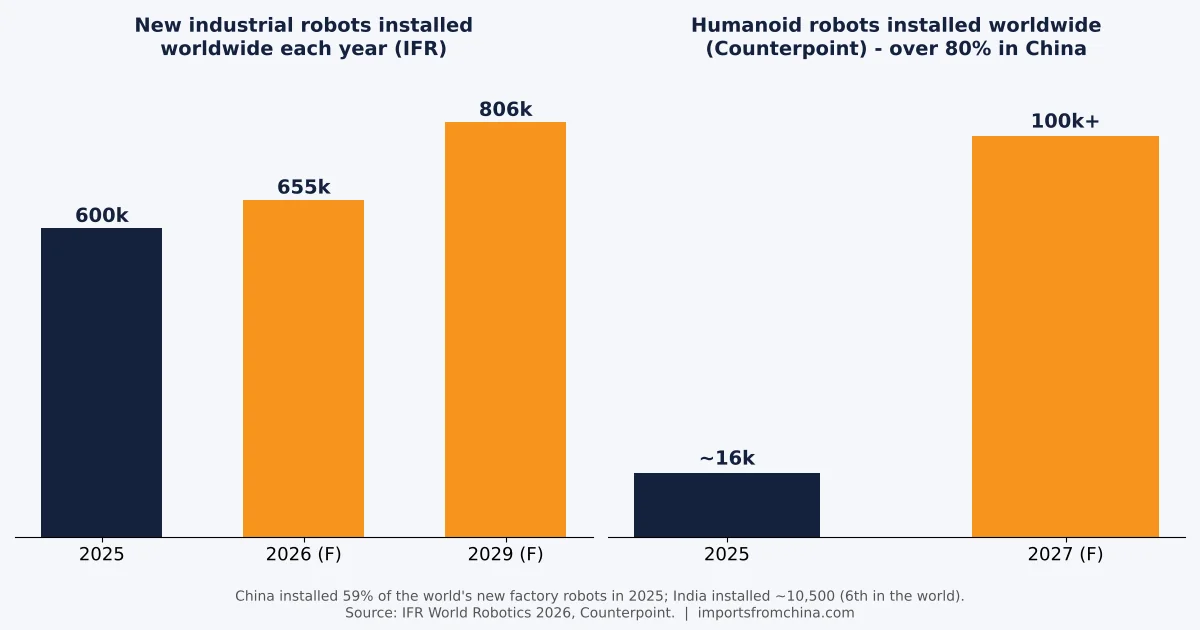
Robotics industry growth - industrial and humanoid robot installations forecast
Industrial and humanoid robot installations: 2025 and forecasts (IFR, Counterpoint)

The numbers show an industry that is growing every year, with humanoids as the next big wave:

  • Factory robots: more than 600,000 industrial robots were installed worldwide in 2025, and 5 million now work in factories. IFR expects 655,000 installations in 2026 and 806,000 a year by 2029.
  • India is rising fast: India installed almost 10,500 industrial robots in 2025 and is now 6th in the world. Installations grew about 27% a year from 2020 to 2025, led by cars, auto parts, electronics and metal work.
  • Humanoids are taking off: about 16,000 humanoid robots were installed worldwide in 2025, over 80% in China. Counterpoint Research expects more than 100,000 by 2027.
  • Long-term forecasts: Goldman Sachs has estimated the humanoid robot market could reach USD 38 billion by 2035, and Morgan Stanley has projected a USD 5 trillion market by 2050. Forecasts this far ahead differ a lot, but every major study points the same way: up.

Three things drive this growth over the next decade. First, prices keep falling as Chinese factories make robots at scale. Second, AI gives robots a “brain”: robots can now see, understand spoken instructions and learn a task from a demo instead of months of coding. Third, labour is getting scarce in China, Japan, Korea and Europe because populations are ageing. India’s opportunity is to use robots to raise quality and export more, and to become a big market for robot sales, service and integration.

What changes will robots bring to the world?

  • Factories: smaller “lights-out” lines that run at night, with fewer defects. Even 10–20 person MSMEs will use cobots for packing, welding and machine loading.
  • Warehouses and e-commerce: robots will pick, sort and move goods, making same-day delivery cheaper.
  • Hotels, restaurants and shops: waiter, reception and cleaning robots are already common in China and are arriving in Indian malls, cafés and showrooms.
  • Homes and elder care: robot vacuums are just the start. Home helper robots that fold clothes, fetch items and keep an eye on elderly parents are the long-term goal of most humanoid companies.
  • Healthcare: surgical robots, pharmacy robots and rehabilitation robots will spread from big city hospitals to tier-2 cities.
  • Agriculture and construction: spraying drones, fruit-picking robots and bricklaying robots will take on heavy and risky work.
  • Education: robot kits will make coding and engineering hands-on in schools, creating a big market for STEM robots.

Will robots take jobs in India?

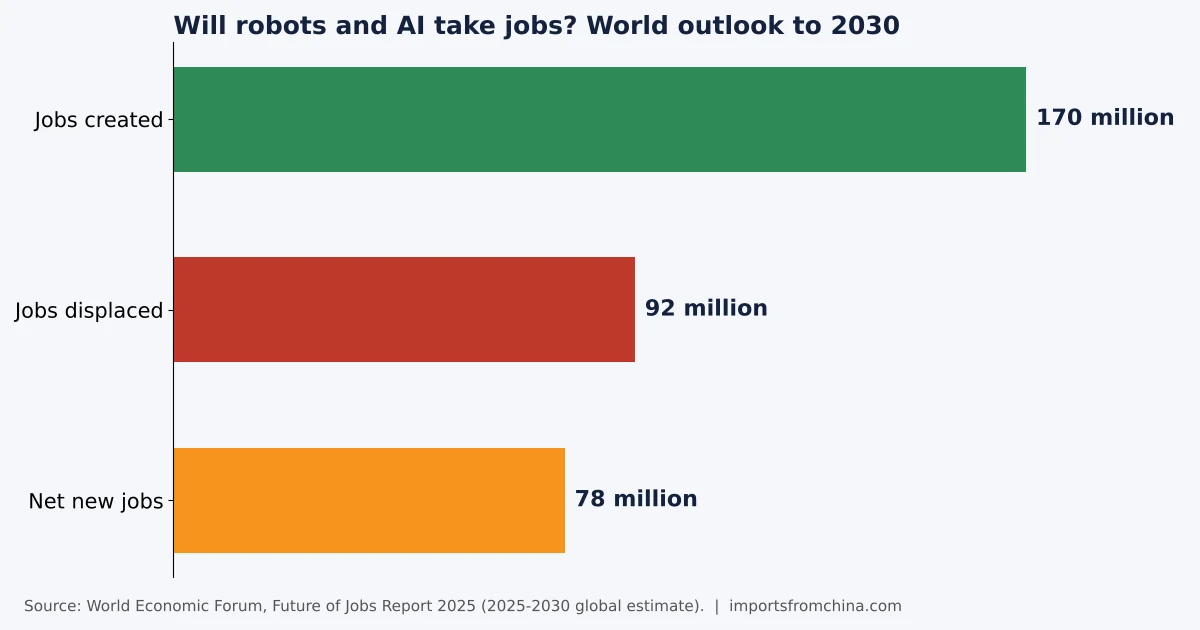
Will robots take jobs - WEF jobs created vs displaced by 2030
World Economic Forum, Future of Jobs Report 2025: global jobs outlook 2025–2030

Some jobs will be affected, yes. But history and the latest data say robots and AI change jobs more than they wipe them out. The World Economic Forum’s Future of Jobs Report 2025 expects about 170 million new jobs and 92 million jobs displaced worldwide between 2025 and 2030, a net gain of 78 million jobs.

Jobs most at riskJobs that will grow
Repetitive assembly and packingRobot operators and programmers
Spot welding and spray paintingMaintenance and service technicians
Warehouse picking and loadingAutomation integrators and installers
Basic quality checks by eyeRobot sales, import and distribution
Simple cleaning and serving rolesAI, data and vision engineers

India is in a different position from China or Japan. We have a young workforce, so robots here will mostly do the dangerous, dirty and precise work while people move to supervision, service and sales. The risk is real for workers who do not reskill, so ITIs, polytechnics and companies need to train operators and technicians now. For proud MSME owners, the bigger opportunity is to become the robot seller, installer and service partner in your city before the market gets crowded.

How IFC helps you import robots from China

IFC (Imports From China) has worked in China–India import since 2004, with its own offices in Guangzhou and Yiwu and staff who speak Chinese and English. For robot buyers, IFC can:

  • Find and verify robot manufacturers in China and compare quotes.
  • Arrange factory checks and quality inspection before shipment.
  • Ship by sea (LCL/FCL) or air, including battery-powered robots.
  • Handle customs clearance and help with BIS and WPC paperwork.
  • Deliver door to door (DDP) to major Indian cities such as Delhi, Mumbai, Bengaluru, Pune, Chennai, Hyderabad and Ahmedabad.

See more about importing machinery and machinery parts from China, and watch practical import tips on the IFC YouTube channel.

Conclusion

Robots are no longer only for big car plants. Chinese prices have made robotic arms, cobots, service robots and even humanoids affordable for Indian MSMEs, schools, hotels and traders. Before you order, fix the HS code, check BIS and WPC rules, and work out the landed cost, not just the supplier price. Do that, and importing robots from China to India can be one of the best business decisions of the next 10 years.

Get your real landed cost: enter your product, weight and CBM in the IFC shipment calculator, or call IFC on +91 98116 91631 for a door-to-door DDP quote from China to your city.

Frequently asked questions

Is a licence required to import robots from China to India?

No special import licence is needed for industrial or service robots; they are freely importable with an IEC and GSTIN. Product rules still apply: robot toys need a BIS licence and ISI mark, robot vacuums need BIS, and robots with Wi-Fi or Bluetooth need a WPC Equipment Type Approval.

What is the customs duty on a robotic arm in India?

Industrial robotic arms are usually classified under HS 8479 50 00, with 7.5% Basic Customs Duty, 10% Social Welfare Surcharge on the BCD and 18% IGST. The total tax is about 27.7% of the CIF value, of which the IGST can be claimed back as input tax credit.

What is the import duty on robot toys from China?

Electronic robot toys under HS 9503 00 10 pay 70% Basic Customs Duty and 18% IGST, about 100.6% of the CIF value in total. The Chinese factory must also hold a BIS licence and the toys must carry the ISI mark, or customs will not release them.

How much does a humanoid robot from China cost in India?

Entry-level Chinese humanoids start at about USD 5,900 (Unitree R1) and bigger models cost USD 13,000 and more. After air freight, 7.5% BCD, SWS and 18% IGST, a USD 5,900 robot lands at roughly Rs 7.4 lakh at Rs 90 per USD. Use the IFC shipment calculator for your exact model.

Should robots be shipped by air or sea from China?

Heavy robot arms, AGVs and bulk orders are cheaper by sea (LCL or FCL). Single service robots, samples and urgent spare parts usually go by air. Robots with lithium batteries need MSDS and UN38.3 papers and are shipped as special cargo.

Will robots take away jobs in India?

Some repetitive jobs in packing, welding, painting and warehouse picking will be automated, but new jobs grow in robot operation, programming, maintenance, integration and sales. The World Economic Forum expects 170 million jobs created and 92 million displaced worldwide by 2030, a net gain of 78 million.

Life in China for Indians

What Is Life Really Like in China for an Indian? Is It as Bad as People Say? (2026)

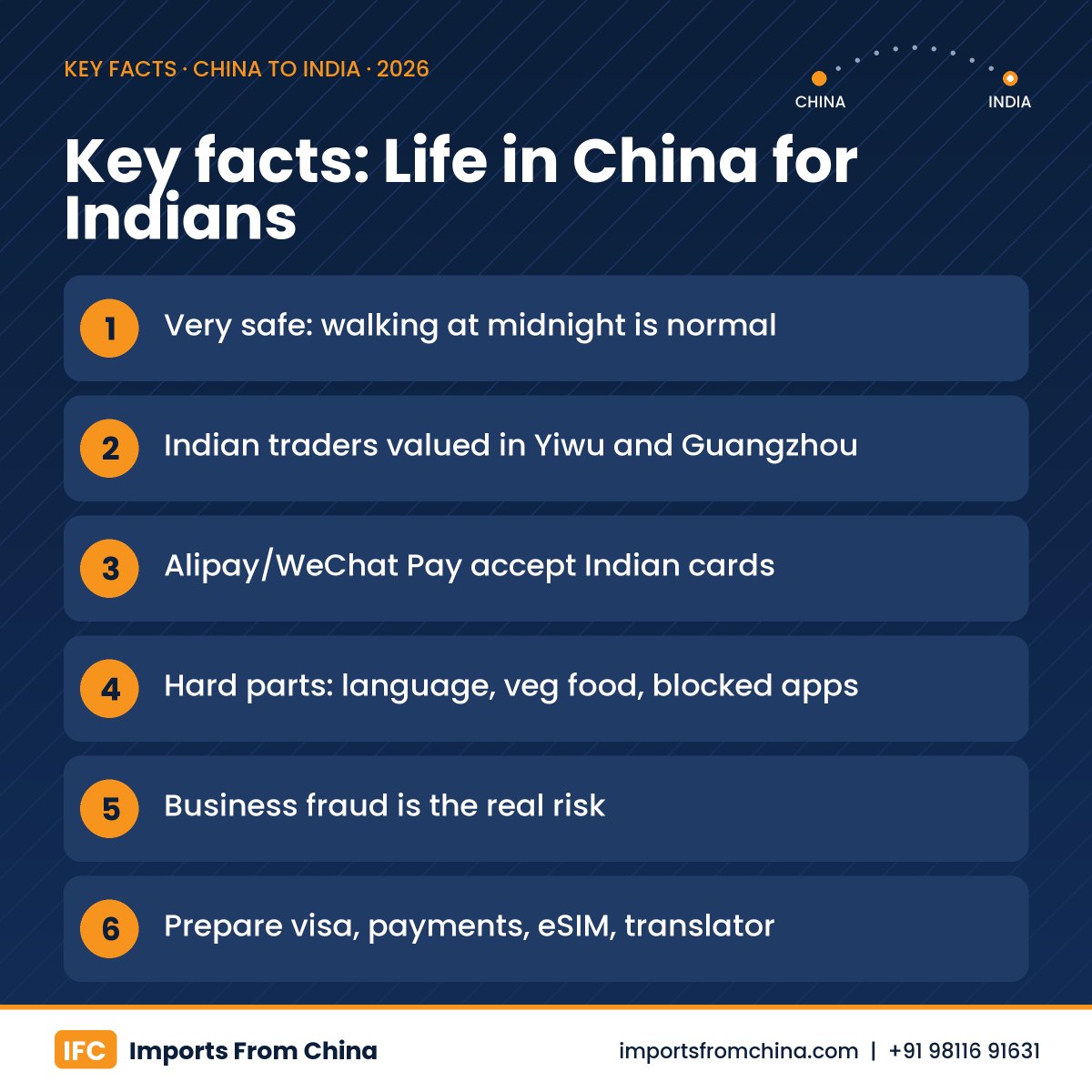
What is life really like in China for an Indian? Safer, more convenient and more business-friendly than most Indians expect. Street crime is rare, phones replace wallets, trains run at 300 km/h, and Indian traders are valued customers in Guangzhou and Yiwu. The hard parts are the language, vegetarian food, blocked apps like Google and WhatsApp, long working hours and business fraud. China is not as bad as social media shows, and not as perfect as some travel vlogs claim.

I have lived and worked in China, I speak Mandarin, and for 20+ years my company IFC has run offices in Guangzhou and Yiwu, hosting thousands of Indian buyers. Here is an honest, first-hand picture for Indian businessmen, visitors and anyone curious.

Key takeaways

  • Safety: one of the safest places to live; walking alone at midnight in Guangzhou or Yiwu is normal.
  • Indian traders: valued customers in Yiwu and Guangzhou, with Indian restaurants nearby.
  • Payments: Alipay and WeChat Pay accept Indian Visa/Mastercard.
  • Hard parts: language, vegetarian food, blocked apps, long hours and business fraud.
  • Chinese society: comfortable daily life, but young people face job and housing pressure.
  • Prepare: business visa, mobile payments, roaming/eSIM, translator, verified suppliers.

The surprising good parts of life in China

  • Safety: China is one of the safest places I have lived. Walking alone at midnight in Guangzhou or Yiwu is completely normal.
  • Respect for Indian traders: in Yiwu and Guangzhou, Indian buyers are valued customers. Many shopkeepers know a few Hindi words, and Indian restaurants are easy to find.
  • Convenience: your phone is your wallet. Alipay and WeChat Pay now accept Indian Visa and Mastercard cards, and food or parcels arrive within an hour.
  • Infrastructure: high-speed trains at 300 km/h, spotless metros and airports that feel like malls.
  • Business speed: you can visit a factory in the morning, approve a sample in the afternoon and ship a container within a few weeks.
Life in China for Indians infographic – key facts for Indian importers
Life in China for Indians: key facts at a glance (IFC – Imports From China)

The genuinely hard parts

  • Language: outside hotels and big companies there is very little English. A translation app and a local contact are essential.
  • Food: pure vegetarian food takes planning. Many dishes use meat stock or lard, even when they look vegetarian.
  • Apps: Google, WhatsApp, Instagram and YouTube are blocked on local networks. Life runs on WeChat, or you keep Indian roaming on.
  • Work culture: Chinese suppliers work very long hours and expect fast replies, even on Sundays.
  • Business risk: the country is safe, but business fraud is real: fake factories, bait-and-switch samples and “change of bank account” emails. Never pay 100% advance to an unverified supplier. Read how to avoid China supplier scams.

Life in China for an Indian: quick comparison with home

AspectIn ChinaTip for Indians
SafetyVery highStill carry your passport and use official taxis
PaymentsAlmost cashlessSet up Alipay / WeChat Pay with your card before you fly
InternetGoogle, WhatsApp blocked locallyUse Indian roaming or a roaming eSIM
FoodMeat-heavy cuisineUse Indian restaurants in Guangzhou, Yiwu, Shanghai
LanguageLittle EnglishTranslation app + local contact
BusinessVery fast, very competitiveVerify suppliers and inspect before final payment

Is life bad for the Chinese themselves?

Not bad, but under pressure. Housing in big cities costs many years of income, youth unemployment was about 17.7% in September 2026, and births fell to a record low of 7.92 million in 2025 as young people delay marriage. Daily life is comfortable; the future feels uncertain for many young people. More in how bad is life in China and China’s economy vs India.

My honest verdict for Indians

China is not as bad as social media shows, and not as perfect as some travel vlogs claim. For an Indian businessman it is one of the best places in the world to learn how manufacturing works, and to find products for your business back home.

5 things to prepare before your first China trip

  • Business (M) visa with an invitation letter from a Chinese company or the Canton Fair.
  • Alipay and WeChat Pay linked to your international card, plus some yuan in cash.
  • Indian international roaming or a roaming eSIM, and WeChat installed.
  • A translator or local contact for markets and factory visits.
  • A verified supplier list, so you visit real factories, not just showrooms.

Planning the trip: China safety guide for Indian travellers, Canton Fair guide and Yiwu market guide.

How IFC helps Indians in China

IFC (Imports From China) has worked in China–India imports for 20+ years, since 2004, and has served 5000+ Indian businesses. Our own offices in Guangzhou and Yiwu, with English-speaking staff and translators, help Indian buyers with market visits, factory checks, supplier verification, quality inspection, shipping and customs clearance back to India. Call +91 98116 91631 before you plan your trip.

Mayank Dang (CA Sahab), Founder and CEO of IFC

Written by Mayank Dang (CA Sahab), Founder & CEO of IFC

Chartered Accountant (FCA, ICAI) who has lived and worked in China, speaks Mandarin, and has helped 5000+ Indian businesses import from China since 2004. mayankdang.in

Frequently asked questions

What is life like in China for an Indian?

Safe, convenient and business-friendly. Street crime is rare, payments are mobile, and Indian traders are welcome in Guangzhou and Yiwu. The challenges are language, vegetarian food, blocked apps and long working hours.

Is China safe for Indians?

Yes. China is generally very safe, including at night in cities like Guangzhou and Yiwu. The main risk for Indian businessmen is supplier fraud, not physical danger.

Can Indians get vegetarian food in China?

Yes, but it takes planning. Many Chinese dishes use meat stock or lard. Indian restaurants are common in Guangzhou, Yiwu, Shanghai and Beijing.

Do WhatsApp and Google work in China?

Not on local Chinese networks. Indian international roaming or a roaming eSIM usually works. Most people in China use WeChat.

Is China a good place for Indian businessmen?

Yes. It is one of the best places to find products and factories, from small commodities in Yiwu to electronics in Shenzhen, as long as you verify suppliers and inspect goods before final payment.

How bad is life in China

How Bad Is Life in China? Daily Life, Costs & Work Culture vs India (2026)

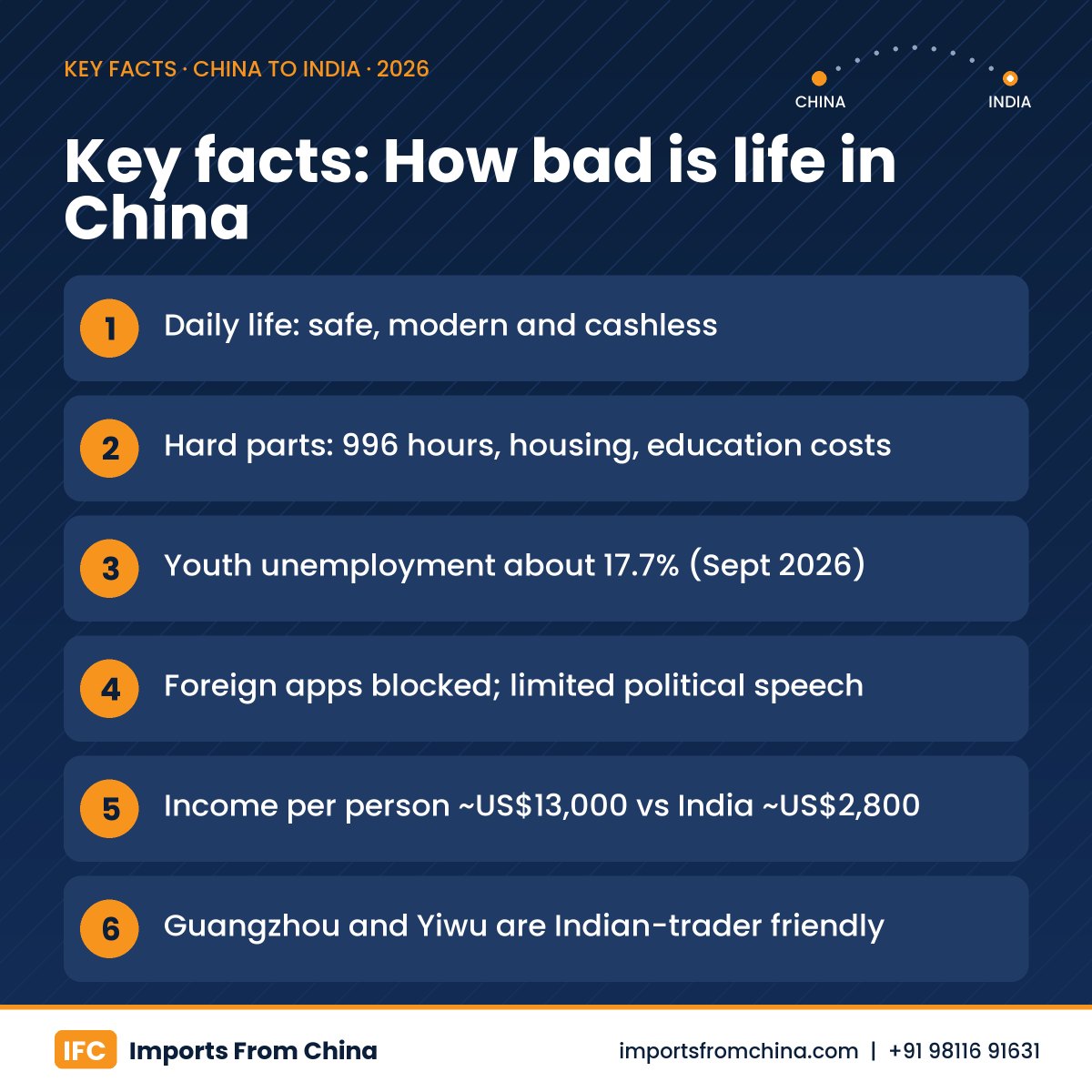
How bad is life in China? For most people it is not “bad”, but it is demanding. Daily life is safe, convenient and modern: fast trains, cashless payments, instant delivery and clean cities. The hard parts are long working hours, high housing and education costs in big cities, tough competition for young graduates, internet restrictions and limited freedom of political expression. Life is much easier for the well-educated urban middle class than for migrant workers and rural families.

IFC’s founder, CA Mayank Dang, has lived and worked in China and speaks Mandarin, and IFC has run offices in Guangzhou and Yiwu for years. This is a balanced, practical picture of everyday life in China today, and what it is like for Indians who visit or work there.

Key takeaways

  • Convenience: cashless payments, food delivery, high-speed rail and efficient public services.
  • Safety: low street crime; most people feel safe at night.
  • Pressure: long hours (“996”), costly housing and intense competition for jobs and schools.
  • Young people: youth unemployment about 17.7% (Sept 2026); many delay marriage and children.
  • Restrictions: Google, WhatsApp and many foreign sites blocked; limited political expression.
  • For Indians: safe and business-friendly, but language, food and apps need preparation.

What is good about life in China?

  • Safety: heavy policing and CCTV mean low street crime.
  • Infrastructure: the world’s largest high-speed rail network, modern metros, airports and highways.
  • Convenience: almost everything is paid by phone through Alipay or WeChat; food, groceries and parcels arrive within hours.
  • Cleanliness and order in most cities.
  • Affordable everyday goods, especially outside the biggest cities.
How bad is life in China infographic – key facts for Indian importers
How bad is life in China: key facts at a glance (IFC – Imports From China)

What is difficult about life in China?

  • Work pressure: long hours, the “996” culture (9 am to 9 pm, 6 days a week) in many private companies, and few holidays.
  • Housing costs: flats in Shanghai, Beijing and Shenzhen cost many years of income, even after the property slump.
  • Education pressure: the gaokao (university entrance exam) drives intense, expensive coaching from early childhood.
  • Jobs for youth: youth unemployment was about 17.7% in September 2026; many graduates take jobs below their skills.
  • Hukou system: household registration rules can limit migrant workers’ access to city schools and services.
  • Internet and speech: foreign apps and sites are blocked, and criticism of the government is restricted.
  • Ageing families: many only children support two parents and four grandparents.

How difficult is life in mainland China now (2026)?

Life has become harder for many families since the pandemic. The property slump has reduced household wealth, salaries are growing more slowly, and young people face a tough job market. Marriages fell 7.5% in the first half of 2026 and births hit a record low of 7.92 million in 2025, partly because young people feel financially insecure. At the same time, incomes are still far higher than a generation ago, and China’s cities remain among the most modern in the world. See how bad is China’s economy right now.

Life in China vs India: quick comparison

AspectChinaIndia
Income per personRoughly US$13,000Roughly US$2,700–2,900
InfrastructureVery advancedImproving fast
Street safetyVery highVaries by city
Work hoursLong in private sectorLong in many sectors
Digital paymentsAlipay / WeChat Pay everywhereUPI everywhere
Internet freedomMany foreign sites blockedOpen internet
Political freedomLimitedDemocratic, free press
Population trendAgeing and shrinkingYoung and growing

What is life like for Indians in China?

  • Business-friendly: Guangzhou and Yiwu have large communities of Indian traders and buyers.
  • Language: English is limited outside hotels and big companies; translation apps and local staff help a lot.
  • Food: vegetarian food takes planning, but Indian restaurants exist in Guangzhou, Yiwu, Shanghai and Beijing.
  • Apps and payments: set up WeChat, Alipay and a roaming plan before travel.
  • Visas: tourist visas for Indians resumed in 2025; business visas need an invitation letter.

Planning a visit? Read how safe is China for Indian travellers and our Canton Fair guide.

How IFC helps Indian businesses in China

IFC (Imports From China) has worked in China–India imports for 20+ years, since 2004, and has served 5000+ Indian businesses. Our own offices in Guangzhou and Yiwu help Indian buyers with sourcing, supplier verification, quality inspection, shipping and customs clearance, door to door. Check your landed cost on the IFC shipment calculator or call +91 98116 91631.

Frequently asked questions

How bad is life in China really?

Daily life is safe, modern and convenient, but many people face long working hours, costly housing and education, a tough job market for young people, and restrictions on internet use and political expression.

Is life in China better than in India?

Average incomes and infrastructure are higher in China, and cities are very safe. India offers more political and internet freedom, a younger population and faster growth. Which is better depends on what you value.

Why is life difficult for young people in China?

Youth unemployment was about 17.7% in September 2026, housing is expensive, and work pressure is high. Many young people delay marriage and children.

Is it easy for Indians to live or do business in China?

It is safe and business-friendly, especially in Guangzhou and Yiwu, but you need to prepare for the language, vegetarian food, blocked apps and mobile payments.

Can foreigners use WhatsApp and Google in China?

Not on local Chinese networks. International roaming or a roaming eSIM usually works. Local life runs on WeChat and Alipay.

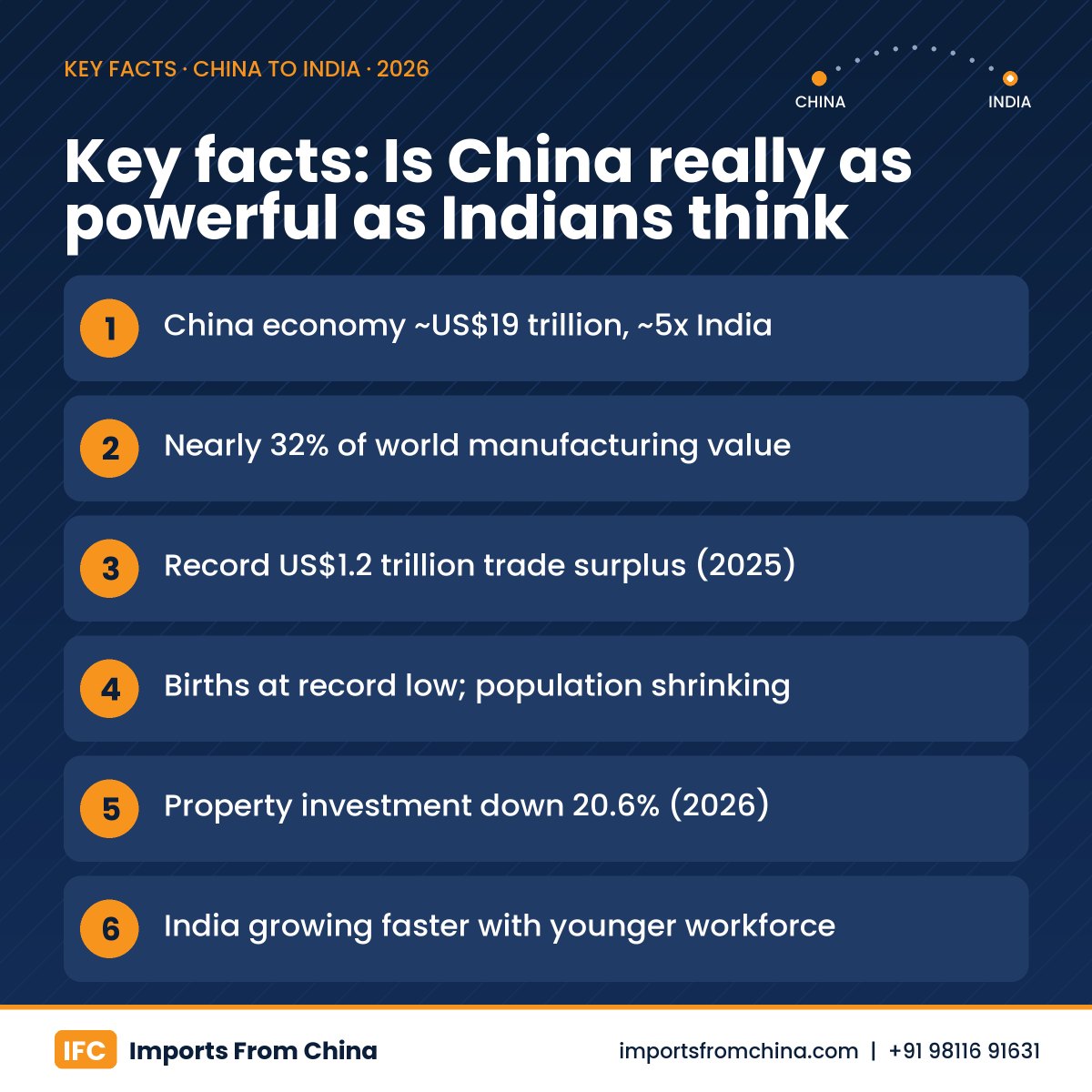
Is China really as powerful as Indians think

Is China Really as Powerful as Indians Think? A 2026 Reality Check

Is China really as powerful as Indians think? In economic and industrial terms, yes, and often more. China makes nearly a third of the world’s manufactured value, earned a record US$1.2 trillion trade surplus in 2025, spends about three times India’s defence budget and leads in EVs, batteries, solar and shipbuilding. But China also has serious weaknesses: a shrinking, ageing population, a long property slump, high local-government debt, weak consumer demand and limits on advanced chip technology.

Here is a balanced, data-based reality check, with what it means for India and for Indian businesses that buy from China.

Key takeaways

  • Economy: about US$19 trillion, roughly five times India’s.
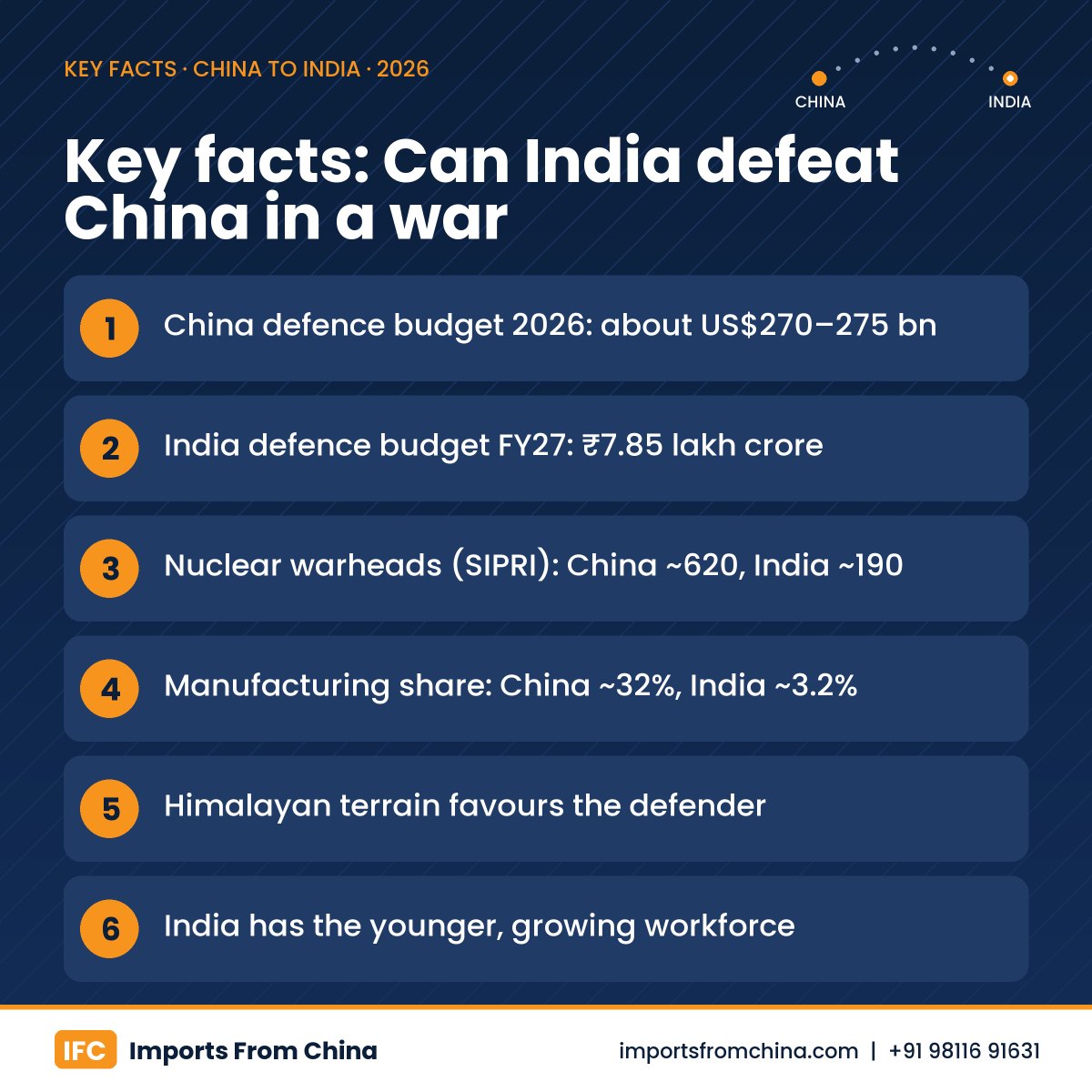
  • Manufacturing: nearly 32% of global manufacturing value; India about 3.2%.
  • Trade: record US$1.2 trillion surplus in 2025.
  • Military: 2026 defence budget 1.91 trillion yuan (about US$270–275 bn).
  • Weak spots: population falling, births at a record low, property investment down 20.6% in Jan–Sep 2026.
  • India’s edge: faster growth (about 7.4% in FY26) and a young workforce.

Where China is truly powerful

AreaChina’s position
Economy sizeAbout US$19 trillion, second-largest in the world
ManufacturingNearly 32% of global manufacturing value (2023)
TradeRecord US$1.2 trillion surplus in 2025
Clean energyWorld leader in solar panels, batteries and electric vehicles
InfrastructureLargest high-speed rail network; many of the world’s busiest ports
Defence2026 budget about US$270–275 billion; about 620 nuclear warheads (SIPRI, Jan 2026)
Supply chainsDominant in electronics components, rare-earth processing and many chemicals

For importers, this power is visible every day: almost any product can be made in China, at scale, quickly and at competitive prices. See why China manufactures so cheaply.

Is China really as powerful as Indians think infographic – key facts for Indian importers
Is China really as powerful as Indians think: key facts at a glance (IFC – Imports From China)

Where China is weaker than it looks

  • Demographics: births fell to a record-low 7.92 million in 2025 and the population has shrunk for four years running.
  • Property slump: real-estate investment fell 20.6% in January–September 2026, hurting household wealth.
  • Weak consumers: retail sales grew only 2.6% in Jan–Sep 2026; youth unemployment was about 17.7% in September 2026.
  • Debt: local governments and developers carry heavy debts after years of building.
  • Technology limits: export controls restrict China’s access to the most advanced chips and chip-making tools.
  • Dependence on exports: trade tensions and tariffs make its growth model vulnerable.

Full details: how bad is China’s economy right now.

China vs India: power snapshot (2026)

IndicatorChinaIndia
GDPAbout US$19 trillionAbout US$4 trillion
Growth4.6% (Jan–Sep 2026)About 7.4% (FY 2025-26)
Manufacturing share of worldNearly 32%About 3.2%
Defence budgetAbout US$270–275 bnAbout US$90 bn (₹7.85 lakh crore)
Population trendShrinking and ageingYoung and growing
Trade balanceLarge surplusDeficit, about US$99 bn with China in FY25

So, is China as powerful as Indians think?

Economically and industrially, China is even more powerful than many Indians assume. Its factories, infrastructure and supply chains are unmatched. But it is not invincible: its population, property market and debt are real long-term problems, and India’s faster growth and young workforce are genuine advantages. The sensible view is respect without fear, and learning from China’s strengths while India builds its own. Also read can India defeat China in a war?

What this means for Indian businesses

  • Use China’s strength: source products, machinery and components where China is best.
  • Negotiate well: weak demand at home makes many Chinese factories eager for export orders.
  • Diversify: watch anti-dumping duties and keep backup suppliers.
  • Build in India: import machines and inputs to grow your own manufacturing and brand.

How IFC helps

IFC (Imports From China) has worked in China–India imports for 20+ years, since 2004, and has served 5000+ Indian businesses. Our own offices in Guangzhou and Yiwu help Indian buyers with sourcing, supplier verification, quality inspection, shipping and customs clearance, door to door. Check your landed cost on the IFC shipment calculator or call +91 98116 91631.

Frequently asked questions

Is China really a superpower?

Economically and industrially, yes. China has the world’s second-largest economy, nearly a third of global manufacturing and a record trade surplus. Its military is the second-best funded in the world.

What are China’s biggest weaknesses?

A shrinking and ageing population, a long property slump, high local-government debt, weak consumer demand, youth unemployment and limits on advanced chip technology.

How does India compare with China in power?

China’s economy is about five times larger and its manufacturing about ten times larger by share, but India is growing faster and has a much younger workforce.

Should Indians be afraid of China?

Respect rather than fear is the sensible view. China is strong in industry and trade, but has real weaknesses, and India has its own advantages in growth and demographics.

How can Indian businesses benefit from China’s strength?

By sourcing products, machinery and components smartly from China, negotiating well, and using those inputs to build Indian manufacturing and brands.

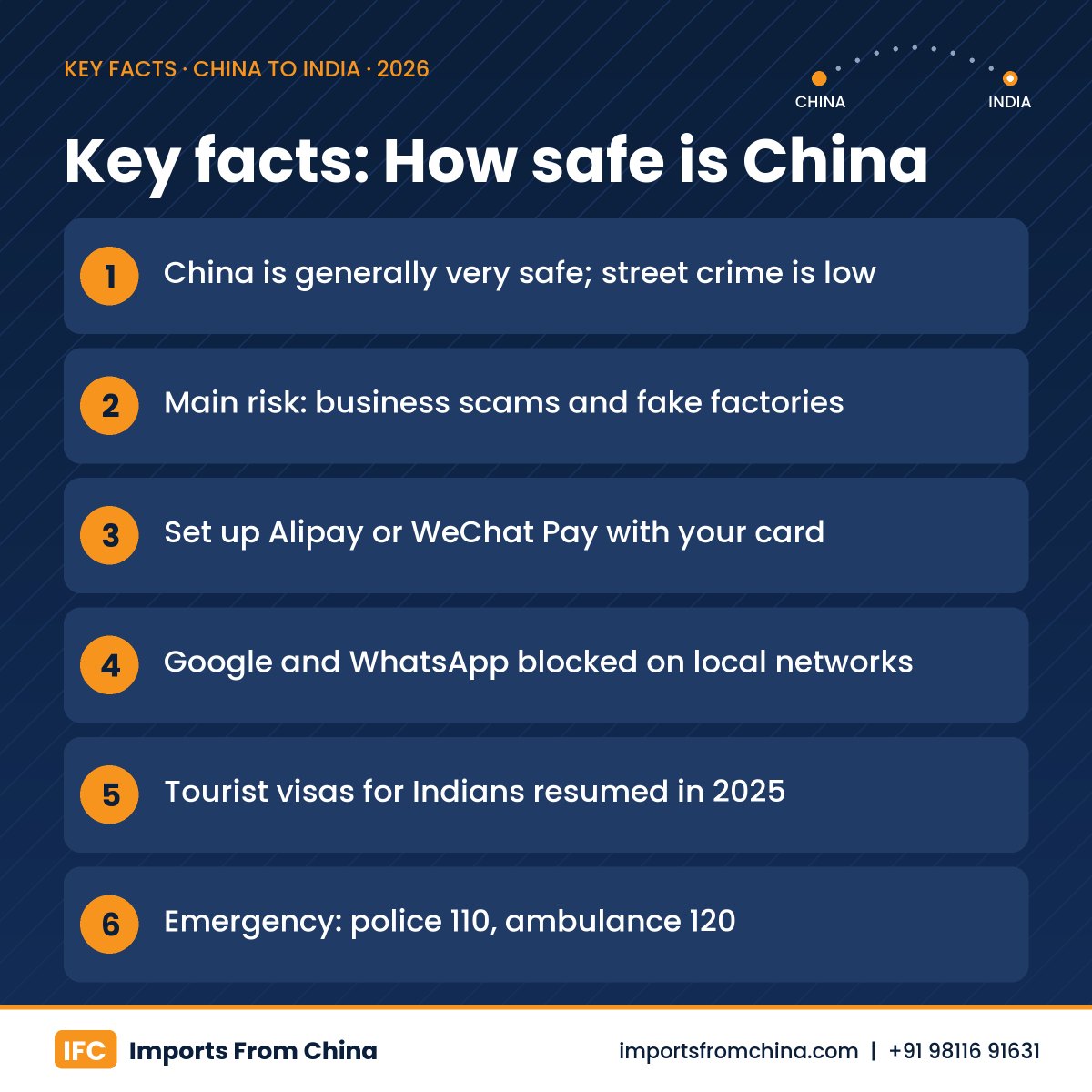
How safe is China

How Safe Is China? Safety Guide for Indian Business Travellers (2026)

How safe is China for visitors? China is generally very safe for travellers, including Indian business visitors. Violent crime against foreigners is rare, cities are heavily monitored, and walking at night in Guangzhou, Yiwu or Shanghai is normal. The real risks are different: business scams, fake suppliers, payment problems, blocked apps and language barriers. Prepare for those and a China trip is smooth.

This guide is written from IFC’s experience of running offices in Guangzhou and Yiwu and hosting Indian buyers for 20+ years. It covers personal safety, scams, money, apps, visas and what to do in an emergency.

Key takeaways

  • Personal safety: street crime and violent crime against foreigners are uncommon.
  • Main risk: business fraud: fake factories, bait-and-switch samples, advance-payment scams.
  • Money: China is almost cashless; set up Alipay or WeChat Pay with your international card.
  • Apps: Google, WhatsApp and many Western apps are blocked; plan your connectivity.
  • Visa: China resumed tourist visas for Indians in 2025; business visas need an invitation letter.
  • Emergency: police 110, ambulance 120, fire 119.

Is China safe for Indian travellers?

  • Low street crime: extensive CCTV and police presence make pickpocketing and robbery less common than in many big cities worldwide.
  • Safe public transport: metros and high-speed trains are clean, punctual and safe.
  • Women travellers: generally feel safe, including at night in city centres.
  • Respect local laws: carry your passport, register at hotels, avoid political protests and never carry drugs. Penalties are strict.
How safe is China infographic – key facts for Indian importers
How safe is China: key facts at a glance (IFC – Imports From China)

The real risks: business scams in China

  • Fake factories: traders pretending to be manufacturers, or showroom-only “factories”. Read how to spot a real factory.
  • Advance payment fraud: suppliers who ask for 100% advance, or change bank details by email. See how to avoid supplier scams.
  • Sample vs bulk mismatch: a good sample, poor bulk goods. Always get a pre-shipment inspection.
  • Tourist traps: friendly strangers inviting you to a “tea ceremony” or bar, followed by a huge bill.
  • Unlicensed taxis at airports and stations: use official taxi queues or ride-hailing apps.

Money and payments: how to pay safely in China

Most shops, restaurants and taxis use mobile payments. Foreign visitors can now link international Visa or Mastercard cards to Alipay and WeChat Pay. Carry some cash in yuan as backup, inform your bank before travel, and never pay supplier deposits in cash to individuals. For business payments, use bank transfer to the company account. More: how to pay Chinese suppliers from India.

Internet and apps: what works in China?

Google, Gmail, WhatsApp, YouTube, Instagram and Facebook are blocked on Chinese networks. International roaming from an Indian SIM usually still reaches them; otherwise travellers use a legally available roaming eSIM. Install WeChat, Alipay, a translation app and a map app such as Amap before you fly. See China apps for business travellers.

Visa and flights for Indians

  • China resumed tourist visas for Indian citizens in 2025, and direct flights between India and China restarted in late 2025.
  • For a business trip or the Canton Fair, apply for an M (business) visa with an invitation letter from a Chinese company or the fair organiser.
  • Check the latest rules with the Chinese visa centre before booking.

Planning the fair? Read our Canton Fair guide for Indian buyers and Yiwu market guide.

Safety checklist for Indian business visitors

Before you goIn China
Business visa and invitation letterCarry your passport at all times
Alipay / WeChat Pay set up with your cardUse official taxis or ride-hailing apps
Roaming or eSIM planVerify factories before paying deposits
Hotel near the market or fairUse a local guide or translator for negotiations
Travel insuranceSave emergency numbers: 110, 120, 119

How IFC helps Indian buyers visit China safely

IFC (Imports From China) has worked in China–India imports for 20+ years, since 2004, and has served 5000+ Indian businesses. Our own offices in Guangzhou and Yiwu, with English-speaking staff and translators, help Indian buyers with market visits, factory checks, translation, supplier verification, payments, quality inspection and shipping back to India. Call +91 98116 91631 before you plan your trip.

Frequently asked questions

Is China safe for tourists and business travellers?

Yes. China is generally very safe, with low street crime and strong policing. The main risks for business travellers are scams, fake suppliers, payment issues and blocked apps rather than physical danger.

Is China safe for Indians?

Yes. Indian business visitors travel regularly to Guangzhou, Yiwu, Shenzhen and the Canton Fair. Respect local laws, carry your passport and verify suppliers before paying.

Can Indians use WhatsApp and Google in China?

Not on local Chinese networks. International roaming from an Indian SIM or a roaming eSIM usually works. Install WeChat, Alipay and a translation app before travelling.

How do I pay in China as a foreigner?

Link your international Visa or Mastercard to Alipay or WeChat Pay, and carry some yuan in cash. For supplier payments, use bank transfer to the company account.

What are the emergency numbers in China?

Police 110, ambulance 120 and fire 119.

Why China developed faster than India

Why Has China Developed So Much Faster Than India? 6 Real Reasons (2026)

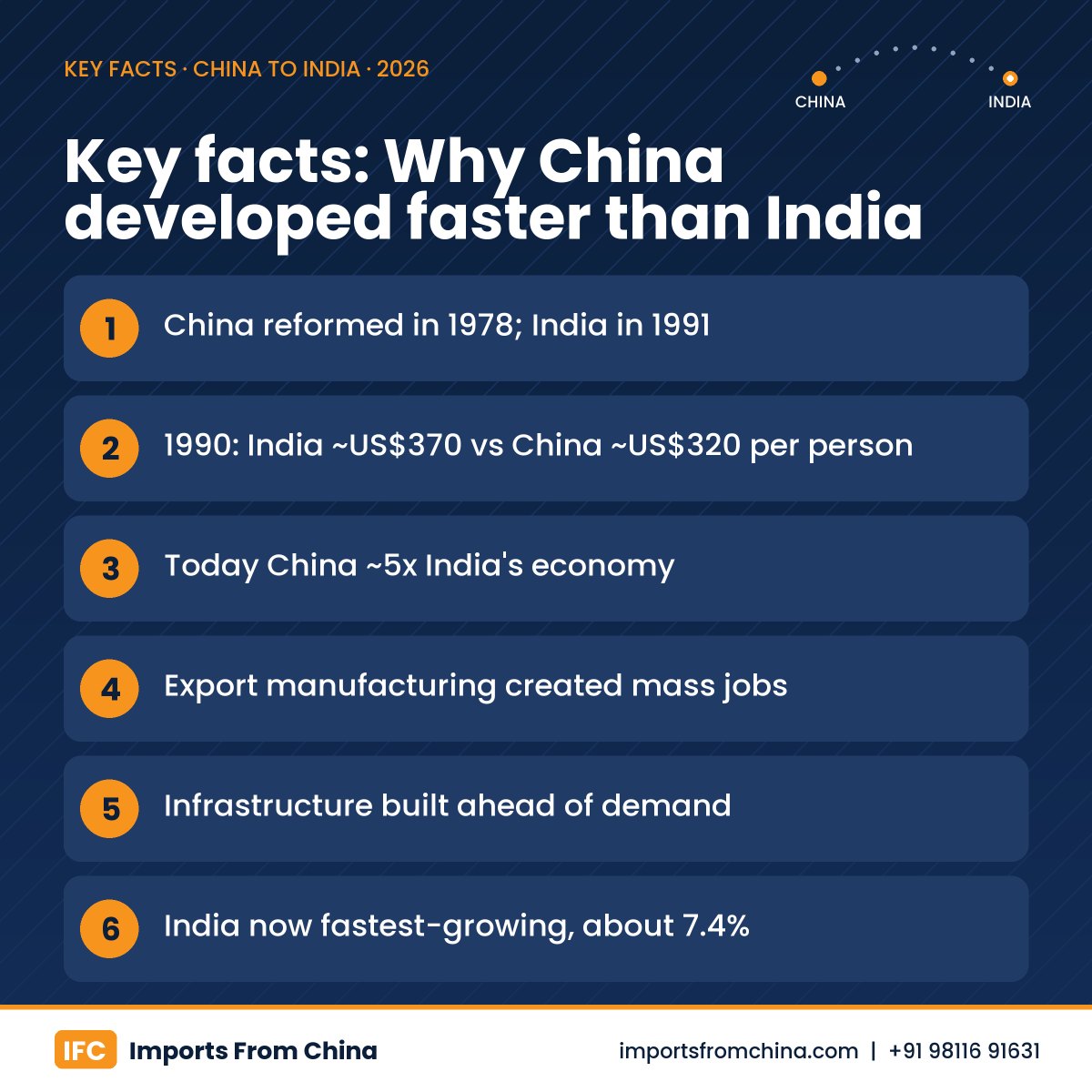
Why has China developed so much faster than India? China started market reforms in 1978, 13 years before India’s 1991 liberalisation, and bet everything on export manufacturing: special economic zones, massive infrastructure, foreign investment, and a huge, literate factory workforce with many women at work. In 1990 the two countries had similar incomes per person; today China’s is roughly four to five times India’s. India grew mainly through services, which created fewer mass jobs.

This article explains the main reasons for the gap, where India is now catching up, and what the China story teaches Indian MSMEs.

Key takeaways

  • Early start: China opened up in 1978; India in 1991.
  • Manufacturing first: China became the world’s factory; India grew through IT and services.
  • Infrastructure: China built ports, power, highways and rail ahead of demand.
  • People: earlier gains in literacy, health and women’s workforce participation.
  • Execution: fast, top-down decisions on land, projects and policy.
  • India now: the fastest-growing major economy, about 7.4% in FY26, with a young workforce.

India vs China: how the gap opened

MilestoneChinaIndia
Start of market reforms1978 (Deng Xiaoping)1991 (economic liberalisation)
Special economic zonesFrom 1980 (Shenzhen and others)SEZ Act in 2005
Income per person in 1990 (World Bank)About US$320About US$370
Income per person todayRoughly US$13,000Roughly US$2,700–2,900
Growth modelExport manufacturing + infrastructureServices, IT and domestic consumption
Share of global manufacturing (2023)Nearly 32%About 3.2%

Figures are approximate and rounded; income per person is nominal GDP per capita in US dollars.

Why China developed faster than India infographic – key facts for Indian importers
Why China developed faster than India: key facts at a glance (IFC – Imports From China)

6 reasons China grew faster than India

1. It started reforms 13 years earlier

Thirteen extra years of 9–10% growth compound into an enormous difference. By the time India opened up in 1991, China already had a working export machine in its coastal provinces.

2. Export manufacturing created mass jobs

China moved hundreds of millions of farmers into factories making toys, clothes, electronics and furniture for the world. Factory jobs raise incomes quickly for low-skilled workers. India’s growth came more from IT, finance and services, which are highly productive but employ far fewer people.

3. Infrastructure built ahead of demand

China invested heavily in ports, power plants, expressways, high-speed rail and industrial parks, often before they were needed. Cheap, reliable infrastructure lowered costs for every factory. India is now investing at record levels, but started later.

4. Health, education and women at work

China achieved near-universal primary education and basic healthcare early, giving factories a literate, healthy workforce. A much higher share of Chinese women joined the paid workforce, effectively doubling the labour available for industry.

5. Land, labour and fast decisions

China’s system allowed rapid land acquisition and project approvals. Democracy in India means more consultation, legal checks and slower execution. This has costs, but also protects rights and avoids some of China’s excesses, such as ghost cities and heavy local-government debt.

6. Foreign investment and technology

Hong Kong, Taiwanese and overseas Chinese businesses invested heavily in mainland factories from the 1980s, bringing capital, technology and export contacts. India attracted large FDI mainly after 2000.

Is India catching up?

  • India is the fastest-growing major economy, at about 7.4% in FY 2025-26, while China grew about 4.6% in the first nine months of 2026.
  • India’s workforce is young and growing; China’s is ageing and shrinking.
  • PLI schemes have made India a major smartphone exporter and are expanding into electronics, solar and auto parts.
  • Infrastructure spending in India is at record levels: expressways, freight corridors, ports and airports.

But the gap is large: China’s economy is still about five times India’s. Read how China’s economy compares with India’s today and why India can’t yet manufacture as cheaply as China.

What Indian MSMEs can learn from China’s growth

  • Think scale: Chinese factories won by producing large volumes of a few products extremely well.
  • Specialise in clusters: work with suppliers near you and share logistics.
  • Export early: even small exporters learn quality and pricing faster.
  • Use the best machines: import productive machinery and moulds where needed to raise output per worker.

How IFC helps Indian businesses grow with China

IFC (Imports From China) has worked in China–India imports for 20+ years, since 2004, and has served 5000+ Indian businesses. Our own offices in Guangzhou and Yiwu help Indian buyers with sourcing, supplier verification, quality inspection, shipping and customs clearance, door to door. Check your landed cost on the IFC shipment calculator or call +91 98116 91631.

Frequently asked questions

Why has China developed faster than India?

China started reforms in 1978, 13 years before India, and focused on export manufacturing, infrastructure, foreign investment and a literate workforce with high female participation. India grew mainly through services, which created fewer mass jobs.

Was India richer than China in the past?

Around 1990, India’s income per person was slightly higher than China’s, about US$370 against US$320 by World Bank data. China then grew much faster.

How much bigger is China’s economy than India’s?

China’s economy is roughly US$19 trillion and India’s about US$4 trillion, so China’s is around five times larger.

Is India catching up with China?

India is now the fastest-growing major economy and has a younger workforce, but China’s lead in size and manufacturing is very large and will take decades to close.

What can India learn from China’s development?

Build infrastructure ahead of demand, focus on manufacturing scale and exports, invest in skills and bring more women into the workforce.

Why India cannot manufacture cheaper than China

Why Can’t India Manufacture Cheaper Products Than China? 7 Real Reasons (2026)

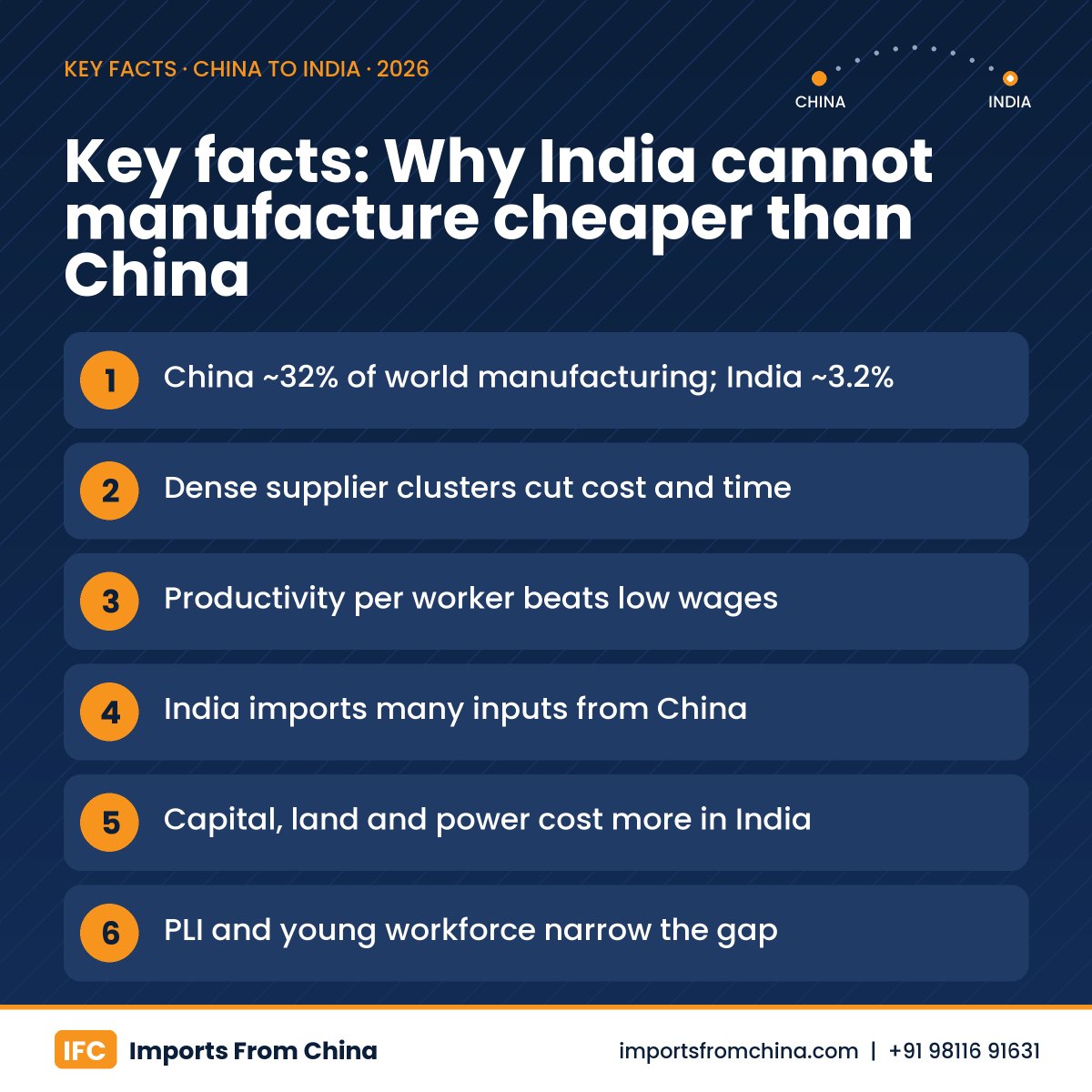
Why can’t India manufacture products as cheaply as China? Mainly because of scale and supply chains. China makes nearly 32% of the world’s manufactured value, against India’s 3.2%, so its factories buy materials in huge volumes, sit inside dense clusters of suppliers, and run on world-class ports, power and logistics. Indian factories are usually smaller, depend on imported components, and pay more for land, power, finance and freight.

This article explains the seven real cost gaps between Chinese and Indian manufacturing, and what Indian MSMEs can do to compete, including when it makes sense to import and when to make locally.

Key takeaways

  • Scale: China has nearly 32% of world manufacturing value; India about 3.2% (NITI Aayog, 2023 data).
  • Clusters: in China, every part a factory needs is often available within a few kilometres.
  • Infrastructure: decades of investment in ports, highways, rail and power cut costs per unit.
  • Inputs: India still imports many components and machines, often from China.
  • Cost of capital and land: borrowing, land and compliance usually cost more in India.
  • Opportunity: PLI schemes, a young workforce and rising Chinese wages are narrowing the gap.

7 reasons Chinese products are cheaper than Indian products

Why India cannot manufacture cheaper than China infographic – key facts for Indian importers
Why India cannot manufacture cheaper than China: key facts at a glance (IFC – Imports From China)

1. Massive scale

A Chinese factory making phone cases or LED bulbs may produce millions of pieces a month for buyers worldwide. Fixed costs such as moulds, machines and design are spread over huge volumes, so the cost per piece drops sharply. Most Indian units produce for the domestic market at far smaller volumes.

2. Industrial clusters and supply chains

China built specialised clusters: Yiwu for small commodities, Foshan for furniture, Shenzhen for electronics, Ningbo for appliances, Guangzhou for garments. Raw materials, components, packaging, moulds and testing labs are all nearby, often available the same day. An Indian manufacturer may wait weeks for an imported part.

3. Infrastructure and logistics

China invested heavily for four decades in deep-water ports, expressways, rail freight and reliable industrial power. Containers move quickly from factory to port. India has improved fast, with new expressways, freight corridors and ports, but logistics are still slower and costlier for many factories.

4. Labour productivity, not cheap labour

Chinese wages are now higher than Indian wages in most sectors. China stays cheaper because each worker produces more, thanks to automation, training, long production runs and experienced supervisors. Productivity per worker matters more than the wage.

5. Cost of capital, land and power

Chinese manufacturers have had access to cheaper credit, ready industrial land and stable power. In India, interest rates, land acquisition, approvals and industrial power tariffs (which often cross-subsidise other users) add to the cost of every product.

6. Dependence on imported inputs

Many Indian products use components, chemicals or machines imported from China. India imported about US$113.5 billion of goods from China in FY 2024-25. When you import the inputs and add duty and freight, it is hard to beat the finished Chinese product on price. See what India imports from China.

7. Government support and export focus

China supported exporters with tax rebates, cheap land and infrastructure for decades, and today has overcapacity in many sectors, so factories cut prices to keep running. India’s export push is more recent, through Production Linked Incentive (PLI) schemes and Make in India.

China vs India manufacturing: quick comparison

FactorChinaIndia
Share of global manufacturing value (2023)Nearly 32%About 3.2%
Supplier clustersVery dense, product-specificGrowing (Tiruppur, Morbi, Ludhiana, Noida, Chennai)
Typical factory scaleLarge, export-orientedMostly small and medium, domestic
WagesHigher than IndiaLower
Productivity per workerHighImproving
Workforce trendShrinking and ageingYoung and growing

Where India can already compete with China

  • Mobile phone assembly: India became a major smartphone exporter under the PLI scheme.
  • Pharmaceuticals and generic medicines.
  • Textiles, garments and home textiles in clusters such as Tiruppur and Panipat.
  • Ceramics and tiles from Morbi.
  • Auto components and two-wheelers.
  • Labour-intensive goods as Chinese wages rise.

What Indian MSMEs should do: import, make or both?

  • Import finished goods where China’s scale is unbeatable (many electronics, small commodities, decor).
  • Import machinery and moulds from China to make locally: many machines carry just 7.5% BCD and the IGST is claimable.
  • Import components, assemble in India and build your own brand.
  • Make locally where freight, duty, BIS and speed favour India (bulky, heavy or fast-changing products).

Check the duty side in legal ways to reduce import duty and the bigger picture in China’s economy vs India.

How IFC helps Indian manufacturers and traders

IFC (Imports From China) has worked in China–India imports for 20+ years, since 2004, and has served 5000+ Indian businesses. Our own offices in Guangzhou and Yiwu help Indian buyers with sourcing, supplier verification, quality inspection, shipping and customs clearance, door to door. Check your landed cost on the IFC shipment calculator or call +91 98116 91631.

Frequently asked questions

Why are Chinese products so cheap?

Because of huge scale, dense supplier clusters, efficient ports and logistics, high labour productivity, cheaper capital and decades of export support. Overcapacity also pushes Chinese factories to cut prices.

Is Chinese labour cheaper than Indian labour?

No, not any more in most sectors. Chinese wages are generally higher than Indian wages. China stays cheaper because each worker produces much more.

Why can’t India manufacture cheaper than China?

Indian factories are usually smaller, depend on imported inputs, and face higher costs for land, power, finance and logistics. Scale and supply chains are the biggest gaps.

Can India beat China in manufacturing?

In some sectors India already competes, such as smartphones, generic medicines, textiles and auto parts. With PLI schemes, a young workforce and rising Chinese wages, India can grow its share, but overtaking China will take decades.

Should Indian businesses import from China or make locally?

Often both: import where China’s scale is unbeatable, import machines and components to make locally, and manufacture in India where freight, duty and speed favour local production.

How bad is China economy right now

How Bad Is China’s Economy Right Now? Property, Business, Birth Rate & Economy vs India (2026)

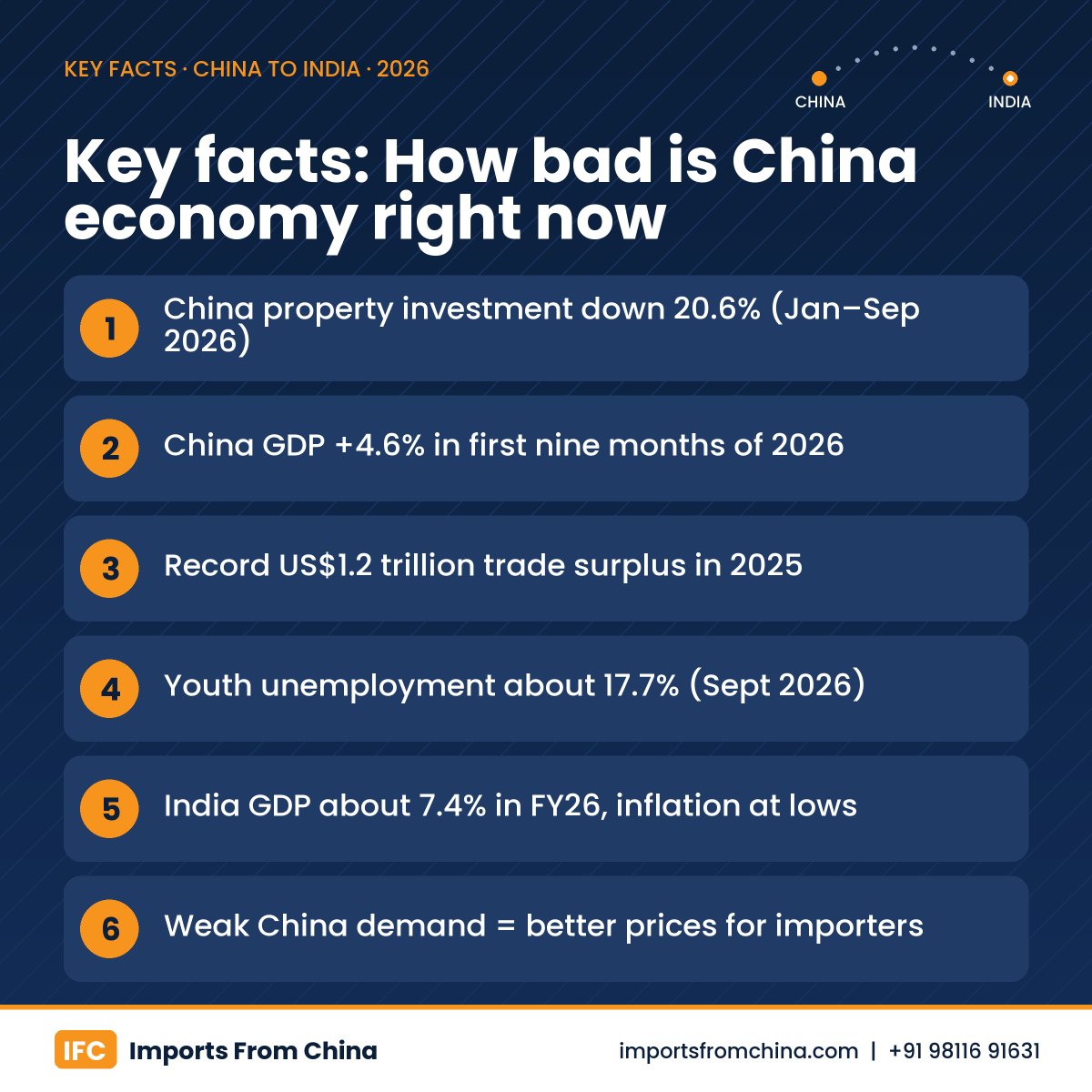
How bad is China’s economy right now? China is not collapsing, but it is clearly weaker at home than before. Its property sector is in a long slump, with real-estate investment down 20.6% in January–September 2026 and new home prices falling for more than three years. Consumer spending is soft and youth unemployment is around 17.7%. Yet GDP still grew 4.6% in the first nine months of 2026, driven by record exports and factories. India is growing faster, at about 7.4% in FY 2025-26, but from an economy roughly a quarter of China’s size.

This article compares China and India on three fronts: property, business and the overall economy, using the latest 2026 data, and explains what it means for Indian businesses that buy from China.

Key takeaways

  • Property: China’s real-estate investment fell 20.6% in Jan–Sep 2026; new construction fell 24.9%.
  • Growth: China grew 4.5% in Q3 2026 and 4.6% in the first nine months, within its 4.5–5% target.
  • Exports: China posted a record US$1.2 trillion trade surplus in 2025, and exports kept rising in 2026.
  • Consumers: retail sales grew only 2.6% in Jan–Sep 2026; youth unemployment about 17.7% in September.
  • India: fastest-growing major economy: about 7.4% GDP growth in FY26 with inflation at historic lows.
  • Demographics: births fell to a record-low 7.92 million in 2025 and marriages dropped 7.5% in H1 2026; the population is shrinking and ageing.
  • For importers: weak demand at home makes Chinese factories hungry for export orders, so buyers get better prices.

How bad is China’s property crisis?

Property was once about a quarter of China’s economy when related industries are included. Since developers such as Evergrande and Country Garden ran into debt trouble from 2021, the sector has shrunk year after year.

Indicator (China, 2026)Latest data
Real-estate development investment, Jan–Sep 2026Down 20.6% year on year
New construction starts, Jan–Sep 2026Down 24.9%
New home pricesFell again in September 2026, extending a slump of more than three years
Household impactMost household wealth is in property, so falling prices hurt spending

India’s housing market, by contrast, has been in an upcycle since 2021, with strong demand in major cities, although affordability is a growing concern. The key difference: Indian property is driven by first-time buyers and urbanisation, while China has a large stock of unsold and empty homes.

How bad is China economy right now infographic – key facts for Indian importers
How bad is China economy right now: key facts at a glance (IFC – Imports From China)

How are Chinese businesses doing?

  • Factories are strong: industrial output grew 5.3% in the first three quarters of 2026.
  • Exports are booming: China recorded a record US$1.2 trillion trade surplus in 2025, despite US tariffs, and kept growing exports in 2026.
  • Overcapacity: in steel, solar panels, EVs, batteries and many consumer goods, China produces far more than it can sell at home, so it pushes exports and cuts prices.
  • Price wars: heavy competition squeezes factory profits, especially in autos, solar and e-commerce.
  • Private sector caution: fixed-asset investment fell 7.2% in Jan–Sep 2026 as businesses held back.

China vs India economy: 2026 comparison

IndicatorChinaIndia
GDP sizeAbout US$19 trillionAbout US$4 trillion
Real GDP growth4.6% (Jan–Sep 2026); target 4.5–5%About 7.4% in FY 2025-26; 6.8–7.2% projected for FY27
InflationNear zero, with deflation pressureHistoric lows (about 1.7% average in Apr–Dec 2025)
PropertyLong slump, investment down 20.6%Upcycle in major cities
Consumer demandWeak: retail sales +2.6% (Jan–Sep 2026)Strong domestic demand
Youth unemploymentAbout 17.7% (Sept 2026, ages 16–24 excl. students)A challenge, measured differently
Manufacturing share of worldNearly 32%About 3.2%
TradeRecord surplus (US$1.2 trillion in 2025)Trade deficit, including about US$99 billion with China in FY25

Falling marriages and births: China’s demographic crisis

Beyond property and jobs, China’s biggest long-term problem is people. Fewer young Chinese are marrying, fewer babies are being born, and the population is shrinking and ageing fast.

IndicatorLatest data
Births in 20257.92 million, the lowest on record (birth rate 5.63 per 1,000)
Deaths in 202511.31 million
Population change 2025Down 3.39 million to 1.405 billion, the fourth straight yearly fall
MarriagesAbout 13.5 million at the 2013 peak; 6.1 million in 2024; 6.76 million in 2025 after a small rebound
Marriages, first half of 20263.275 million, down 7.5% year on year; divorces up 3.9%
People aged 60+23% of the population (323 million)

Why young Chinese don’t want to marry or have children

  • High costs: housing, education and childcare are very expensive, especially in big cities; a bride price and buying a flat are often expected before marriage.
  • Job insecurity: with youth unemployment near 17–18%, many young people delay marriage until they feel financially stable.
  • Long working hours: the “996” culture (9 am to 9 pm, 6 days a week) leaves little time for family life.
  • Changing values: more educated women are choosing careers and independence; “lying flat” (tang ping) reflects a wider rejection of the pressure to marry, buy property and raise children.
  • Legacy of the one-child policy: decades of small families and a gender imbalance mean fewer potential couples.

How the government is fighting back

  • Childcare subsidy: a national subsidy of 3,600 yuan per year for each child under three, introduced in 2025.
  • Free preschool: the final year of kindergarten made free from autumn 2025, benefiting about 24 million children.
  • Childbirth costs: a push for no out-of-pocket costs for childbirth from 2026.
  • Easier marriage registration: since 2025, couples can register their marriage anywhere in the country, not only in their home town.
  • Later retirement: the retirement age is being raised gradually from 2025 to keep older workers in the labour force.

So far, these incentives have produced only small changes. Marriages rose slightly in 2025 but fell again in the first half of 2026, and births kept falling.

What this means for China’s labour force vs India’s

China’s working-age population (16–59) was about 851 million in 2025, or 60.6% of the population, and it is shrinking every year as fewer young people enter work and more retire. That means rising wages, labour shortages in factories and more automation and robots. India is on the opposite path: a median age of roughly 28–29 years and a working-age population that will keep growing for years. This demographic dividend is one of India’s biggest advantages, but only if young Indians get skills and manufacturing jobs.

For Indian importers: China will keep making things competitively for years thanks to automation and scale, but labour-intensive products (garments, footwear, simple assembly) are slowly becoming costlier there. That is an opening for Indian manufacturing, and a reason to watch prices and diversify suppliers.

So, is China’s economy really in trouble?

China’s domestic economy is in a difficult phase: falling property, weak consumers, low prices and fewer jobs for young graduates. But its industrial and export machine is stronger than ever, and the government still has room to support growth. It is a slowdown, not a collapse.

India is the brighter growth story, with faster GDP growth, low inflation and rising domestic demand. But China’s economy is about five times bigger, and India still relies on China for electronics, machinery, chemicals and components. See what India imports from China.

What China’s slowdown means for Indian importers

  • Better prices: with weak home demand and overcapacity, many Chinese factories accept lower prices and smaller orders from Indian buyers.
  • More negotiating power: MOQs, payment terms and samples are easier to negotiate.
  • Watch supplier health: some factories are under financial stress, so verify suppliers and avoid 100% advance payments. Read how to avoid supplier scams.
  • Anti-dumping risk: cheap Chinese goods attract more Indian anti-dumping duties, so check before ordering. See anti-dumping duty on Chinese goods.
  • Machinery opportunity: Indian manufacturers can buy Chinese machines and inputs at good prices to grow local production.

How IFC helps Indian businesses source smartly from China

IFC (Imports From China) has worked in China–India imports for 20+ years, since 2004, and has served 5000+ Indian businesses. From our own offices in Guangzhou and Yiwu we track factory conditions on the ground, verify suppliers, negotiate prices, inspect quality and ship door to door with customs clearance. Check your landed cost on the IFC shipment calculator or call +91 98116 91631.

Frequently asked questions

How bad is China’s economy right now?

China is in a domestic slowdown, not a collapse. Property investment fell 20.6% in January to September 2026, consumer spending is weak and youth unemployment is about 17.7%, but GDP still grew 4.6% in the first nine months of 2026 thanks to strong exports and factories.

Is China’s property market still falling?

Yes. Real-estate development investment fell 20.6% in January to September 2026, new construction fell 24.9%, and new home prices kept falling in September 2026, extending a slump of more than three years.

Is India’s economy growing faster than China’s?

Yes. India grew about 7.4% in FY 2025-26, while China grew 4.6% in the first nine months of 2026. But China’s economy is still about five times larger.

Why are Chinese exports still strong if the economy is weak?

Weak demand at home and overcapacity push Chinese factories to sell abroad. China posted a record US$1.2 trillion trade surplus in 2025 and kept growing exports in 2026.

Is now a good time for Indian businesses to import from China?

Prices and terms are often favourable because Chinese factories need export orders. But verify suppliers carefully, avoid full advance payments and check anti-dumping duty before ordering.

Can India defeat China in a war

Can India Defeat China in a Full-Fledged War? Military, Technology, Manufacturing & Labour Compared (2026)

Can India defeat China in a full-fledged war? Most defence analysts say neither country could achieve a clear, decisive victory. China has big advantages in defence spending, navy, missiles, nuclear warheads and, above all, manufacturing capacity. India has strong advantages in mountain warfare, defensive terrain, combat experience, the Indian Ocean and a younger workforce. With both sides nuclear-armed, a full-scale war would be catastrophic for both, which is why the real contest is economic and industrial.

This article compares India and China across four areas that decide modern wars: military strength, technology, manufacturing and labour, using the latest 2026 data. It is an analysis, not a prediction or a call for conflict.

Key takeaways

  • Defence budget: China 1.91 trillion yuan (about US$270–275 billion) in 2026 vs India ₹7.85 lakh crore (about US$90 billion) for FY 2026-27.
  • Nuclear: SIPRI estimates about 620 Chinese warheads vs about 190 Indian warheads (January 2026). Both keep a no-first-use policy.
  • Manufacturing: China makes nearly 32% of the world’s manufactured value; India about 3.2% (NITI Aayog, 2023 data).
  • Terrain: the Himalayan border strongly favours the defender, which limits any quick offensive.
  • Labour: India has a younger, growing workforce; China’s is ageing but far more industrially skilled.
  • Bottom line: deterrence makes full war unlikely; the long-term race is in factories, technology and supply chains.

India vs China: military strength compared (2026)

FactorChinaIndia
Defence budget 20261.91 trillion yuan (about US$270–275 bn), up 7%₹7.85 lakh crore (about US$90 bn)
Active troopsAbout 2 millionAbout 1.4–1.5 million
Nuclear warheads (SIPRI, Jan 2026)About 620About 190
NavyWorld’s largest navy by number of ships; 3 aircraft carriers2 aircraft carriers; strong position in the Indian Ocean
MissilesVery large rocket and missile forceAgni, BrahMos and growing missile defence
Recent combat experienceLimitedExtensive, including high-altitude operations

On paper, China’s armed forces are larger and better funded: its defence budget is about three times India’s. But a war between them would not be fought “on paper”. It would be shaped by geography, logistics and the risk of escalation.

Can India defeat China in a war infographic – key facts for Indian importers
Can India defeat China in a war: key facts at a glance (IFC – Imports From China)

Would geography decide an India–China war?

  • The Himalayas favour defenders. High altitude, thin air and few roads make large offensives slow and costly. The 2020 Galwan clash showed how hard it is to push forward in Ladakh.
  • India has mountain experience. Indian troops have operated for decades in Siachen, Kargil and Ladakh, among the hardest terrains in the world.
  • China has better border infrastructure. Roads, rail and airbases in Tibet and Xinjiang let it move troops faster, although India has been building roads and tunnels quickly.
  • The Indian Ocean matters. Much of China’s energy and trade passes through the Indian Ocean and the Strait of Malacca, where the Indian Navy has a natural advantage.

Technology: who is ahead?

China leads in many dual-use technologies: drones, electronics, batteries, satellites, shipbuilding, 5G and artificial intelligence hardware. Its defence industry can design and mass-produce fighter jets, warships and missiles largely on its own.

India is strong in space (ISRO), missiles (BrahMos, Agni), software and IT services, and is growing its domestic defence production under Make in India. But it still imports key items such as engines, some semiconductors and many electronic components, and a large share of those inputs come from China.

Manufacturing: the biggest gap

Modern wars are won by whoever can produce shells, drones, vehicles, ships and spare parts fastest. Here China’s lead is enormous. According to a NITI Aayog report, China accounted for nearly 32% of global manufacturing value in 2023, while India’s share was about 3.2%. China is the world’s largest producer of steel, ships, electronics and batteries.

India also depends heavily on Chinese inputs: it imported about US$113.5 billion of goods from China in FY 2024-25, including electronics, machinery, chemicals and solar components. A long war would cut those supply chains on both sides, but India would feel the shortage of components and machinery faster. Read: what India imports from China.

Labour and population: India’s long-term edge

  • Younger population: India’s median age is roughly 28–29 years, China’s about 39–40. India’s working-age population is still growing, while China’s is shrinking.
  • Skills gap: China’s workforce is far more experienced in factory production, with dense industrial clusters and suppliers.
  • Military manpower: both countries have more than enough people; the limit is training, equipment and logistics, not numbers.

India’s demographic dividend is a real strategic asset, but only if it is turned into skilled manufacturing jobs.

So, can India defeat China in a full-fledged war?

A full-scale war is very unlikely to produce a clear winner. China would hold advantages in money, equipment, missiles and industrial output; India would hold the defender’s advantage in the mountains, a strong position at sea and battle-hardened troops. Above all, both are nuclear powers with no-first-use policies, so a total war would carry unacceptable costs for both. Most experts expect limited border standoffs rather than all-out war, with diplomacy and deterrence keeping the peace.

The decisive contest is therefore economic: who builds more factories, technology and skilled jobs over the next 20 years.

What this means for Indian businesses and MSMEs

For Indian MSME owners, the lesson is practical: stronger manufacturing makes India stronger. Many Indian factories today import machinery, moulds, components and raw materials from China to start producing locally, often at low duty. Importing the right machines and inputs smartly, and building your own brand in India, is part of growing India’s manufacturing base. See legal ways to import machinery at low or zero duty (EPCG) and BIS registration for electronics from China.

IFC (Imports From China) has helped 5000+ Indian businesses source machinery, components and products from China since 2004. Questions about sourcing for your factory? Call +91 98116 91631 or check your landed cost on the IFC shipment calculator.

Frequently asked questions

Can India defeat China in a war?

Most analysts say neither side could win a decisive victory. China is stronger in budget, equipment and manufacturing, while India has terrain, experience and naval advantages. Both have nuclear weapons, which makes a full-scale war very unlikely.

Who has a bigger military budget, India or China?

China. Its 2026 defence budget is about 1.91 trillion yuan, roughly US$270 to 275 billion, about three times India’s FY 2026-27 defence budget of ₹7.85 lakh crore.

How many nuclear weapons do India and China have?

SIPRI estimated in January 2026 that China has about 620 nuclear warheads and India about 190. Both countries follow a declared no-first-use policy.

Why is manufacturing important in a war?

Wars consume huge amounts of ammunition, vehicles, drones and spare parts. The country that can produce them faster can sustain a longer conflict. China makes nearly a third of the world’s manufactured value, India about 3%.

What is India’s biggest advantage over China?

India’s main advantages are defensive mountain terrain, troops experienced in high-altitude warfare, its strategic position in the Indian Ocean and a younger, growing workforce.