

Import Packaging Materials from China to India: Guide

To import packaging materials from China to India, first confirm the exact product type and HS code, source from verified manufacturers in hubs such as Guangzhou and Yiwu, approve samples, arrange a factory check, pay through a secure method, and clear Indian customs with correct documents before door delivery.

What counts as packaging materials when importing from China?

Packaging materials are the boxes, bags, films, labels and protective items that wrap or ship a product. In trade terms this covers a wide range of goods, and each type can fall under a different HS code and duty treatment. Indian buyers usually import the following categories from China:

  • Corrugated shipping cartons and mailer boxes
  • Rigid gift boxes, paper bags and printed cartons
  • Polythene bags, zip-lock pouches and shrink film
  • Bubble wrap, foam sheets and corner protectors
  • Adhesive tapes, stickers, barcode and product labels
  • Plastic bottles, caps and tubes for cosmetics and food

Because the category decides the customs classification, check the HS code before you place a purchase order. Mixing up paper packaging and plastic packaging is one of the most common reasons for a delayed clearance at an Indian port.

Step 1: Define the specification before you search

Packaging suppliers quote against specifications, not against photos. Write down the size in millimetres, board grade or GSM for paper, wall thickness for plastic, print colours, print method, and the load your carton must carry. Add the product it will hold, because a glass item and a garment need very different protection. Clear specs reduce quote disputes and make the sample stage faster.

Step 2: Find and verify the packaging supplier in China

Many packaging suppliers list on 1688 and Alibaba, but a listing alone does not prove that a factory exists or can hold quality. Ask for the business licence, the factory address, production photos, machine lists and references from Indian or export customers. IFC, which has its own offices in Guangzhou and Yiwu, can verify suppliers on the ground before you commit money. This is especially useful for printed boxes, where colour matching and finishing quality vary widely between factories.

Common warning signs in packaging sourcing

  • A price far below every other quote for the same board grade
  • Refusal to share a factory video or to accept a third-party check
  • Sample quality that does not match the bulk production plan
  • No clear answer on minimum order quantity or lead time

Step 3: Approve a sample and run a basic test

Always approve a physical sample before bulk production. For cartons, test the burst strength and drop performance with your real product inside. For plastic bags, check the thickness and seal strength. For printed packaging, compare colour against your approved brand file under the same light. Record the approved sample with photos and a signed specification sheet, so the bulk order can be checked against it later.

Step 4: Arrange a pre-shipment inspection

A pre-shipment inspection checks the goods before they leave China. For packaging, the inspector typically checks dimensions, print accuracy, count per carton, and visible defects against the approved sample. Packaging is bulky, so a poor batch costs more to fix after it reaches Delhi or Mumbai. Read more about what each check covers in our guide on pre-shipment inspection versus a factory audit.

Step 5: Choose a safe payment method

Packaging orders are often large, so payment terms matter. Many buyers pay a deposit and the balance against shipping documents or after inspection. Avoid sending full payment to an unverified seller. Confirm the bank details independently and keep every quote, invoice and message on record. IFC supports payment safety for Indian buyers who want a structured process rather than a single transfer.

Step 6: Plan freight and customs clearance

Packaging type Typical shipping mode Main checks at Indian customs
Corrugated cartons (bulk) Sea freight (FCL or LCL) HS code, quantity, invoice value, origin documents
Printed gift boxes (small volume) Air or sea LCL Print content, declared value, packing list
Plastic pouches and film Sea freight Material type, HS code, any restricted-goods status
Labels and stickers (samples) Air courier Declaration accuracy, quantity, invoice

Bulk cartons are heavy and bulky, so sea freight usually works best for large orders, while air freight suits urgent samples. Compare options carefully, as our sea versus air freight guide explains. Keep a commercial invoice, packing list, bill of lading or airway bill, and a correct importer code ready before cargo lands.

Step 7: Get door delivery across India

Packaging is often bought in regular lots for a warehouse or factory. A door-to-door service that handles customs clearance and delivery to your premises saves time and reduces the number of parties you need to manage. IFC offers door delivery across India, along with shipping, customs clearance and warehousing support, so one team tracks the order from factory to your location.

Tips to avoid common packaging import mistakes

  • Order a small test lot before a full container of new packaging
  • Confirm the board, plastic or ink type in writing, not just the product name
  • Plan for storage, because cartons can warp in humid conditions
  • Keep a reorder specification sheet so every future batch matches

Frequently asked questions

Do I need a special licence to import packaging materials from China to India?

Packaging items are usually imported under a standard importer code, but the exact requirements depend on the goods and the HS code. Confirm the classification and any regulatory conditions before shipping. An experienced import company in Delhi can review the documents and tell you what applies to your product.

How do I find the correct HS code for packaging materials?

Start with the material and form of the packaging, such as paper cartons, plastic bags or adhesive labels. Then match the description against the Indian tariff schedule. If the product is a mix, such as a plastic box with printed paper, ask a customs specialist before filing. A wrong code can cause delays and extra checks at the port.

What is the minimum order quantity for imported packaging?

Minimum order quantity depends on the factory, the packaging type and whether the design is custom. Printed packaging often needs higher quantities because of plate and setup costs, while stock designs may be available in smaller lots. Ask the supplier to confirm MOQ in writing alongside the price and lead time.

Is sea freight or air freight better for packaging materials?

Sea freight is usually more economical for bulky cartons and large volumes, while air freight suits small urgent sample shipments. The right choice depends on volume, weight, urgency and budget. Compare total landed cost, including freight, clearance and delivery, rather than only the factory price.

Can IFC help me inspect packaging before it ships from China?

Yes. IFC works with its offices in Guangzhou and Yiwu to arrange supplier verification, factory audits and pre-shipment inspections for Indian buyers. Inspectors can check dimensions, print quality, count and defects against your approved sample before the goods leave China, which helps prevent costly rework after arrival in India.

Talk to IFC about your packaging import

IFC has helped Indian businesses import from China since 2004, with a head office in Kirti Nagar, New Delhi, and offices in Guangzhou and Yiwu. If you are planning a packaging sourcing project, WhatsApp +91 98116 91631 or visit importsfromchina.com to share your specification and get guidance on sourcing, inspection, payment safety, customs clearance and door delivery.
Import LED Lights from China to India: Buyer’s Guide

To import LED lights from China to India, you need a verified factory in a lighting manufacturing region such as Guangdong, a written product specification, a sample approval, a secure payment method, and a shipping plan by sea or air. Your landed cost includes the factory price, freight, customs duty, IGST and clearance charges. IFC (Imports From China), based in Kirti Nagar, New Delhi, supports Indian buyers with sourcing, inspection, shipping and customs clearance.

Why LED lights are a practical import from China to India

LED lighting is one of the most common product categories Indian businesses source from China. Buyers include retailers, electrical wholesalers, hotel and office fit-out contractors, housing societies, and online sellers. Because LED products are compact, they ship well in cartons and can be packed in standard master cartons for palletised sea freight.

The category also has many sub-types, including bulbs, tubes, panel lights, downlights, strip lights, floodlights, driver units and smart lighting. Each sub-type has different specifications, testing needs and margins, so the first decision is to define exactly which product you want to buy.

Step 1: Define the LED specification before you contact suppliers

Most sourcing problems start with a vague brief. Write a specification sheet that covers the points below. Share it with every supplier so quotes are comparable.

  • Power and lumen output: wattage and total lumens, plus the beam angle for downlights and floodlights.
  • Colour temperature (CCT): for example warm white, neutral white or cool white, stated in kelvin.
  • Input voltage and frequency: India’s mains supply is 230V at 50Hz, so confirm the driver supports this.
  • Driver and chip brand: the driver is often the component that fails first, so ask for named components and their datasheets.
  • IP rating: IP20 suits indoor dry areas; outdoor or bathroom fittings need a higher rating.
  • Warranty and failure policy: agree the warranty period and who pays for replacement and freight on defective units.
  • Packaging and labelling: carton size, inner packing, barcode and printed brand or model details.

Step 2: Check certification and compliance requirements

Before you commit to a model, check whether any Bureau of Indian Standards (BIS) requirement applies to your product and your intended sales channel. Requirements can change, so confirm the current position with your compliance adviser or the relevant authority rather than relying on a supplier’s verbal assurance. Ask the Chinese supplier for test reports, factory certificates and the product’s technical file. Keep copies with your import documents.

Step 3: Find and verify a LED supplier in China

Lighting manufacturing is concentrated in Guangdong province, where many factories produce LED products for export markets. Sourcing from a general trading company can add a margin layer, while buying direct from a factory usually gives better pricing control, provided the factory is genuine.

What to verify

  • Business licence and registered address, checked against the company name on the quotation.
  • Factory address, production lines and machinery, confirmed by a video call or an on-site visit.
  • Previous export customers and whether they ship to India or similar markets.
  • Written sample approval before bulk production starts.

IFC’s team in Guangzhou can visit a supplier’s factory, check production capacity and collect samples on your behalf. IFC also has an office in Yiwu for buyers sourcing from wider market networks.

Step 4: Approve samples and arrange pre-shipment inspection

Order samples in each variant you plan to buy, not just one model. Test brightness, colour consistency, flicker, heat, switching behaviour and packaging durability. Once the sample is approved, record it as the golden sample and ask the factory to match it in bulk.

A pre-shipment inspection (PSI) checks the bulk order before it leaves China. Inspectors typically verify quantities, packaging, labelling, visible defects and functional tests on a sample of units. A PSI report gives you evidence if the goods do not match the approved sample.

Step 5: Calculate landed cost for LED lights

Compare suppliers on landed cost, not only factory price. Landed cost includes every cost up to the point the goods are in your warehouse in India.

  • Ex-factory price in China and any payment charges
  • Inland transport in China to the port or airport
  • Export documentation and freight, by sea or air
  • Insurance, if you choose to buy it
  • Customs duty, IGST and any other levies applicable to your product classification
  • Customs clearance, port handling and delivery to your premises
  • Inspection, testing and agent service fees

Your customs duty depends on the correct HS code for your specific LED product, so confirm the classification before you finalise costs.

Sea freight or air freight for LED lights?

The right mode depends on order size, deadline and product value. The table below shows general differences to help you choose.

Factor Sea freight Air freight
Best for Full container or large pallet orders Small, urgent or high-value lots
Cost per unit Generally lower for bulk volumes Generally higher
Transit time Longer, planned in advance Shorter
Packing need Palletised cartons in a container Lighter, compact packing for air cargo

Many buyers use sea freight for their main restock and air freight for top-up orders or new-model samples.

Common mistakes Indian buyers make when importing LED lights

  • Buying on the lowest price without comparing driver quality or warranty terms.
  • Accepting a sample that is not matched by the bulk order.
  • Skipping a pre-shipment inspection on a large first order.
  • Not confirming the HS code, which can affect duty and clearance.
  • Forgetting that outdoor or wet-area products need the correct IP rating.
  • Paying the full amount upfront to an unverified seller.

Frequently asked questions

Do I need a certificate to import LED lights from China into India?

It depends on your product and where you sell it. Some electrical products fall under Indian standards or quality control orders. Check the current requirements with your compliance adviser and ask your supplier for test reports, factory certificates and a technical file before shipment.

Which area in China is best for sourcing LED lights?

Guangdong province is a major centre for LED lighting manufacturing. Many factories there produce for export markets. The best supplier depends on your product specification, order volume and quality requirements, so compare several verified factories before choosing one.

How long does it take to import LED lights from China to India?

Timelines vary with production lead time, the shipping mode you choose and customs processing. Sea freight usually takes longer but costs less per unit for bulk orders. Air freight is faster for smaller urgent lots. Plan your order at least several weeks ahead, and confirm the schedule with your forwarder.

Is a pre-shipment inspection necessary for LED lights?

It is strongly recommended, especially for a first order or a new supplier. A pre-shipment inspection checks quantities, packaging, labelling and functional performance against your approved sample. The report gives you documented evidence before goods leave China, which helps you resolve disputes early.

Can IFC handle sourcing, inspection and customs clearance for LED lights?

Yes. IFC provides door-to-door China to India imports, including supplier sourcing, factory checks, inspection, air and sea shipping, customs clearance and delivery across India. IFC is headquartered in Kirti Nagar, New Delhi, with offices in Guangzhou and Yiwu, and has served more than 5000 Indian businesses.

Talk to IFC before you place your LED order

If you are planning your first LED import from China to India, or want to move an existing supplier relationship onto a safer footing, IFC can help you define the specification, verify the factory, arrange inspection and manage shipping and customs clearance. Message +91 98116 91631 on WhatsApp or visit importsfromchina.com to discuss your requirement.

Import Toys from China to India: Safety & Buyer Checklist

Importing toys from China to India is possible for most toy categories, but toys face closer safety scrutiny than many other goods. Before you order, confirm whether BIS standards apply, check material and labelling requirements, verify the supplier, and prepare your import documents. IFC, a China import company based in Kirti Nagar, New Delhi, supports Indian buyers with sourcing, inspection and door delivery.

How to import toys from China to India: the short answer

To import toys from China to India, you need an Importer Exporter Code (IEC), a verified Chinese supplier, a commercial invoice, packing list, bill of lading or airway bill, and proof that the toys meet applicable Indian safety rules. Customs clearance then depends on the correct HS code, duty calculation and compliance documents matched to the shipment.

Step 1: Check whether your toy falls under a BIS Quality Control Order

Toys are regulated for safety in India, and buyers should check whether a Bureau of Indian Standards (BIS) requirement applies to the specific product before shipment. Do not assume that a toy sold freely in China or on 1688 and Alibaba is automatically cleared for the Indian market. Ask your supplier for test reports and certificates that match the exact model you are buying, and confirm the requirements with your customs broker or a qualified compliance consultant.

Step 2: Verify the toy supplier before you pay

Toy sourcing in China involves thousands of factories, from small workshops to large export manufacturers. A supplier verification step helps you confirm the business licence, export history, production capacity and whether the factory can produce the same spec on repeat orders. IFC verifies suppliers in China through its Guangzhou and Yiwu offices, which helps Indian buyers reduce the risk of paying for goods that do not match the sample.

Step 3: Get a pre-shipment check on materials and labelling

Toys are often rejected or delayed because of small defects, unclear labels or materials that do not match the approved sample. A pre-shipment inspection in China can check the following points before goods leave the factory:

  • Material type and paint or coating used on the toy
  • Small parts, sharp edges and choking hazard risks
  • Packaging, barcodes and any required labels for the Indian market
  • Quantity, colour, size and packing matching the purchase order
  • Carton marking so that customs documents match the physical cargo

Step 4: Match your documents to the HS code and duty

Customs duty on toys depends on the HS code assigned to the product, its declared value and applicable taxes. Toys can be classified differently depending on whether they are electric, educational, ride-on, plush or made of a specific material, so the code should be checked against the actual product rather than copied from another shipment. Mismatched descriptions between the invoice, packing list and bill of lading are a common cause of clearance delays at Indian ports and airports.

Document or check Why it matters for toy imports
IEC (Importer Exporter Code) Required to import into India in your business name
Commercial invoice Shows value, product description and supplier details for duty assessment
Packing list Confirms carton count, weights and marks that match the cargo
Bill of lading or airway bill Proves shipment and is needed for customs clearance
Test reports and certificates Support compliance with applicable Indian safety requirements
HS code and duty calculation Determines the customs duty and taxes payable

Step 5: Choose sea or air freight based on the product and timeline

Toys are often shipped by sea freight when volumes are large and delivery time is flexible, and by air freight when seasonal stock or a sample order needs to arrive quickly. Sea freight usually suits full container loads, while air freight can work for smaller test orders. Whatever method you choose, ask whether the quote includes destination clearance, duty handling and delivery to your warehouse, because these charges can differ significantly between offers.

Should you use DDP for toy imports from China?

DDP (Delivered Duty Paid) shipping can simplify toy imports because the seller or forwarder handles freight, duty and delivery to your address. This suits buyers who want a single quote and fewer surprises at the port. Always confirm in writing what is included, including customs clearance, duty, inland transport and any compliance paperwork.

Common mistakes Indian buyers make when importing toys

  • Ordering from a product photo without approving a physical sample
  • Assuming a toy is compliant because it is sold widely in China
  • Not checking small parts, paint, battery or age-grading requirements
  • Using a generic HS code that does not match the product
  • Paying the full amount before an inspection or pre-shipment check

How IFC helps with toy sourcing from China

IFC helps Indian businesses source toys from China through supplier research, sample coordination, factory audit, pre-shipment inspection, payment guidance, sea and air shipping, customs clearance and door delivery across India. With head office in Kirti Nagar, New Delhi, and offices in Guangzhou and Yiwu, China, IFC has served more than 5000 Indian businesses since 2004. Buyers can also review how sourcing and inspection work before placing a larger order.

Frequently asked questions

Can I import toys from China to India without BIS certification?

It depends on whether a BIS requirement applies to the specific toy you are importing. Some toys may be subject to safety standards, so you should check the applicable rules before shipment. Ask your supplier for valid test reports and confirm the requirement with a customs broker or compliance adviser to avoid holds or rejection at the port.

Do I need an IEC to import toys from China into India?

Yes, in most cases an Importer Exporter Code (IEC) is required to import goods into India for business purposes. The IEC should be registered in the name of the importing entity. Without it, customs clearance is generally not possible, so obtain it before placing your first toy order from China.

What documents are needed to import toys from China to India?

The core documents are the commercial invoice, packing list, bill of lading or airway bill, and your IEC. You may also need test reports, certificates and product details that match the HS code. All documents should describe the goods consistently, because mismatches between paperwork and the physical cargo are a common reason for clearance delays.

How can I check a toy supplier in China before paying?

Verify the supplier’s business licence, export experience, production capacity and product certifications. Request samples and a factory video, and consider a factory audit or pre-shipment inspection by a local team. Avoid paying the full amount upfront, and use a payment method that offers some protection for both sides of the transaction.

Is DDP shipping better for importing toys from China to India?

DDP shipping can be useful for first-time buyers because the forwarder handles freight, customs duty and delivery to your address under one quote. It reduces the risk of hidden charges at the port. However, you should confirm the exact inclusions in writing, such as clearance, duty, inland transport and any compliance documents, before you accept the offer.

Planning to import toys from China to India? Contact IFC on WhatsApp at +91 98116 91631 or visit importsfromchina.com to discuss sourcing, inspection, shipping and door delivery across India.

Import Tools from China to India: Sourcing Guide for Buyers

To import tools from China to India, you buy hand tools, power tools, measuring instruments or hardware from a verified Chinese factory, confirm the HS code and duty rate, check any Indian compliance rules, pay through a safe method, ship by air or sea, and clear customs with an Importer Exporter Code (IEC). Each step affects your landed cost, so most Indian buyers handle them in order before placing a bulk order. IFC, based in Kirti Nagar, New Delhi, supports this process door to door from China.

Why tools are a practical category to import from China

China is one of the largest manufacturing bases for hand tools, fasteners, fittings, cutting tools and general hardware. Indian retailers, contractors, workshops and online sellers often source these goods because the product range is wide and sample orders are easy to test. Buyers commonly search for suppliers on Alibaba and 1688, but the listing price is only one part of the cost. Freight, inspection, duty, clearance and delivery to India can change the final figure considerably.

Step-by-step: how to import tools from China to India

  • Define the exact tool specification, including material, size tolerance, finish, voltage and packaging.
  • Find suppliers and verify the business licence, factory details and export history.
  • Order a sample and test it against your Indian buyer or client requirement.
  • Confirm the HS code and check whether any BIS or other product rule applies.
  • Agree on price terms (EXW, FOB, DAP or DDP) and the payment schedule in writing.
  • Arrange pre-shipment inspection in China before goods are packed.
  • Book air or sea freight, then prepare commercial invoice, packing list and transport document.
  • Clear customs in India using your IEC and deliver to your warehouse in Delhi or elsewhere.

Classify your tools before you buy: HS code and customs duty

Customs duty on tools depends on the Harmonized System (HS) code assigned to the product, not on the seller’s description. Two tools that look similar can fall under different codes if one is a hand tool and the other is powered, or if the material or function differs. Ask your Chinese supplier for the technical specification, then have your customs broker confirm the classification before you finalise the purchase. Duty rates can change, so check the current tariff at the time of import.

Tool type What to check before ordering Why it matters
Hand tools (spanners, pliers, screwdrivers) Material, function, whether sold as a set Set packaging and material can change classification
Power tools (drills, grinders, saws) Voltage, motor rating, electrical safety marking Electrical products may need additional compliance checks in India
Measuring instruments (gauges, levels) Accuracy class, calibration certificate Buyers often need documents to support quality claims
Fasteners and hardware Grade, coating, dimensions, quantity per pack Weight and packing affect freight cost

Compliance: IEC, BIS and product-specific rules

Most commercial imports into India require an Importer Exporter Code (IEC) issued by the Directorate General of Foreign Trade. Without an IEC, your customs clearance can be delayed or blocked. Separately, some products fall under Bureau of Indian Standards (BIS) Quality Control Orders. Before buying power tools or electrical accessories, check whether your specific product is covered. A customs broker in Delhi or your sourcing partner can help you confirm this for your HS code.

Do tools need BIS registration for import?

Not all tools require BIS registration. Whether a product needs it depends on whether it falls under a notified Quality Control Order. Electrical tools are the most likely category to need checks. Confirm the current requirement for your exact HS code before ordering, because a wrong assumption can hold goods at port.

Supplier verification and factory inspection

A low quote from an unverified supplier is one of the most common causes of problems for tool importers. Verification should cover the business licence, the factory address, production capacity and references from other export buyers. A factory audit confirms whether the workshop can produce the tools consistently. Pre-shipment inspection then checks the actual goods against your sample, including dimensions, finish, labelling, carton marking and quantity. IFC offers supplier verification, factory audit and pre-shipment inspection through its offices in Guangzhou and Yiwu, China.

Payment safety for tool imports

Avoid paying the full amount upfront to a new supplier. Many importers use a deposit followed by a balance after inspection or before shipment. Telegraphic transfer (TT) is common, and some buyers use trade assurance platforms. Keep every payment linked to a written agreement that states product specification, inspection terms and delivery date. Confirm bank details by phone or video call with a known contact, since payment fraud is a known risk in cross-border trade.

Air or sea freight for tools

Sea freight usually suits bulk orders of hardware, fasteners and heavier tools, where the cost per unit is lower. Air freight suits urgent restocking, samples and small, high-value instruments. Weight and volume drive the cost, so compare the chargeable weight of each option before choosing. Ask for a quote that includes origin charges, freight, insurance and destination charges so you can compare like for like.

Customs clearance and delivery in India

Your shipment will need a commercial invoice, packing list, bill of lading or airway bill, IEC, and the correct HS code declared on the bill of entry. Under DDP terms, the supplier or forwarder handles duty and clearance, and you receive goods at your address. Under DAP, you clear customs yourself. Choose the term that matches your team’s capacity and the level of risk you are willing to take. IFC handles customs clearance and door delivery across India as part of its service.

Frequently asked questions

Can I import tools from China to India without an IEC?

For most commercial imports, an IEC is required, so you should obtain one before shipment. Without it, customs clearance can be held up or refused. Some low-value personal imports may follow different rules, but tool shipments for resale or business use generally need an IEC. Confirm the requirement with a customs broker for your specific order.

How do I find the HS code for tools imported from China?

Start with the supplier’s technical specification, including material, function, power source and whether the item is sold alone or as a set. Then match this description to the Indian tariff schedule. A licensed customs broker can confirm the code, which is important because duty depends on classification. Keep the supplier’s specification sheet with your import documents.

Do power tools need BIS certification before import?

Some electrical products are covered by BIS Quality Control Orders, and power tools may fall within these rules depending on their type and rating. Check whether your exact product is listed before placing the order. If it is covered, the supplier or importer must meet the applicable standard and obtain the required registration before the goods are cleared.

What is the safest way to pay a Chinese tool supplier?

Use a staged payment plan rather than full prepayment. A common approach is a deposit, then a balance after pre-shipment inspection. Use a traceable method such as telegraphic transfer or a trade assurance platform, and keep all terms in a signed agreement. Verify bank details through a second channel before sending any money.

Should I choose DDP or DAP when importing tools from China?

DDP means the seller or forwarder handles duty, clearance and delivery to your address, so your cost is more predictable but may be higher. DAP means you handle import clearance and duty yourself, which can reduce the upfront quote but requires your own customs process. Choose based on your IEC status, clearance experience and how much cost certainty you need.

Ready to import tools from China to India?

If you want help with supplier verification, factory inspection, safe payment, freight and customs clearance in India, WhatsApp IFC at +91 98116 91631 or visit importsfromchina.com. Share your product list and target quantity, and the team can outline the steps for your order.

Import Kitchenware from China to India: Buyer’s Guide

To import kitchenware from China to India, you need to confirm the product’s material and safety compliance, find the correct HS code, check the customs duty for that code, arrange packaging suited to a long sea or air journey, and pay the supplier through a secure method. Importers in Delhi and across India usually work with a sourcing company such as Imports From China (IFC), which handles supplier checks, inspection, shipping and customs clearance from its offices in Guangzhou and Yiwu.

What counts as kitchenware in an India import?

Kitchenware covers a wide range of everyday cooking and serving items. For import purposes, the category is usually split by material and function, because each split can carry a different HS code and duty treatment. Common examples include:

  • Stainless steel cookware such as pans, pots, kadhai and pressure cooker parts
  • Non-stick and aluminium cookware
  • Glass, borosilicate and ceramic bakeware and serveware
  • Plastic containers, storage jars and lunch boxes
  • Cutlery, knives, peelers and small hand tools
  • Silicone bakeware, moulds and utensils

Before placing an order on 1688 or Alibaba, write down the exact material, coating, capacity and intended use of each product. Customs officers classify goods by what they are, so a vague description on the invoice can cause delays at the port.

How to find the right HS code for kitchenware

The Harmonised System (HS) code tells Indian customs how to classify your goods and which duty rate applies. Kitchenware is spread across several chapters, depending on whether the item is metal, glass, plastic or ceramic. A stainless steel pan and a plastic storage box will not share the same code.

Item type Key classification detail to confirm Why it matters
Stainless steel cookware Metal grade, coating and whether it is sold as a set Changes the classification and duty treatment
Plastic containers Plastic type and whether it is food-contact Affects the chapter and possible labelling checks
Glass bakeware Glass type, such as borosilicate or soda-lime Determines the correct HS heading
Cutlery and knives Blade material and handle material Different codes for blades and sets
Silicone moulds Whether it is a mould, utensil or container Can move the item to a different heading

Once you have the code, check the current basic customs duty, any additional duties and any other applicable rules for that code. Do not rely on a rate from an old article or a supplier’s quotation. Your customs broker or import agent should confirm it before you commit to a landed cost.

Compliance and labelling checks for kitchenware

Kitchenware often touches food, so buyers should check whether the product needs particular standards or labelling. Ask your supplier for material test reports and product specifications, and keep them with your import file. For items that contact food, confirm that the coating and material are described accurately in the product listing and on the commercial invoice.

  • Get the exact material composition in writing from the factory
  • Ask whether the coating is PFOA-free or similar, and request a test report if you need one
  • Check that the packaging carries the information your buyers in India expect, such as capacity, material and care instructions
  • Keep product photos and specification sheets matched to the purchase order

Factory inspection before the kitchenware leaves China

Kitchenware is easy to damage in transit. Dents, scratched non-stick coatings, cracked glass and broken handles are common complaints. A pre-shipment inspection at the factory, before the carton is sealed, catches most of these issues. IFC’s inspection team checks quantity, appearance, size, colour, packaging and functional items such as lids and handles against your sample.

For a new supplier, a factory audit adds a second layer of protection. It confirms that the factory exists, has the production capacity you need and can run consistent quality. Buyers who skip this step often find that the first sample is good but later batches differ.

Packaging for kitchenware shipped from China to India

Good packaging protects the product and reduces disputes. Use inner boxes or sleeves for each piece, corner protection for glass and ceramic, and sturdy outer cartons. Mark the cartons clearly with the item code, quantity and carton weight. Pallets should be wrapped and labelled for the port or airport.

Plan the packaging before you finalise the price. Extra protection adds cost, and the supplier should include it in the quotation rather than charging later.

Choosing a shipping method: sea, air or DDP

Most kitchenware orders travel by sea freight because the products are heavy and bulky. Air freight suits smaller, urgent or high-value batches. If you prefer a single price that covers freight, duty and delivery to your door, ask for a DDP quotation. DDP means the seller or forwarder handles import clearance and delivery, so you know the full cost in advance. IFC offers door delivery across India, covering customs clearance and last-mile transport.

Payment safety for kitchenware orders

Kitchenware orders are often large and repeated. Use a payment method that protects both sides, such as a staged payment tied to inspection and shipping documents. Confirm the supplier’s bank details through a call or video meeting before sending any money. Never pay the full amount for a first order to an unverified account.

Frequently asked questions

Do I need an IEC to import kitchenware from China into India?

Generally, an Importer Exporter Code (IEC) is needed for commercial imports into India. If you are importing for resale or business use, check with your customs broker or IFC about whether you need your own IEC or can clear goods under an arrangement such as DDP through an agent.

Which HS code applies to kitchenware from China?

There is no single code for all kitchenware. The correct HS code depends on the material, function and whether the item is sold as a set. Confirm the code with a customs broker before ordering, because the duty and classification depend on it.

How long does sea freight take for kitchenware from China to India?

Transit time depends on the port of loading, the port of discharge, the shipping line and the schedule. Ask your forwarder for current timelines for your specific route rather than relying on a general estimate. Add time for customs clearance and inland transport to your city.

Can IFC inspect kitchenware before it is shipped?

Yes. IFC offers pre-shipment inspection at the factory in China, with checks on quantity, appearance, size, packaging and functional items. Inspection results help you decide whether to release the final payment and load the goods.

What should I do if the kitchenware arrives damaged?

Photograph the damage on delivery, note it on the delivery receipt and inform your forwarder or agent immediately. Keep the carton and packaging as evidence. If your inspection report and packing list show the goods were in good condition at dispatch, that record supports your claim with the supplier.

Start your kitchenware import with IFC

If you are planning to import kitchenware from China to India, IFC can help you confirm the product specification, check the HS code, inspect the goods before they leave China and deliver them to your door in India. Our team has been helping Indian businesses import from China since 2004, with offices in Kirti Nagar, New Delhi, Guangzhou and Yiwu. Call or WhatsApp +91 98116 91631, or visit importsfromchina.com to get started.

Container cost from China to India

Container Cost from China to India: 20 ft & 40 ft Rates Explained (2026)

How much does it cost to ship a container from China to India? In mid-to-late 2026, port-to-port ocean freight for a 20 ft or 40 ft container from main Chinese ports to Nhava Sheva, Mundra or Chennai was quoted at roughly US$1,500–4,000 per container, depending on route, month and space. Indian port charges, CHA, customs duty, IGST and inland delivery are extra, so the door-to-door cost is much higher than the ocean freight.

This guide explains 20 ft vs 40 ft capacity, what is and is not included in a container quote, transit times, and when LCL is cheaper than a full container.

Key takeaways

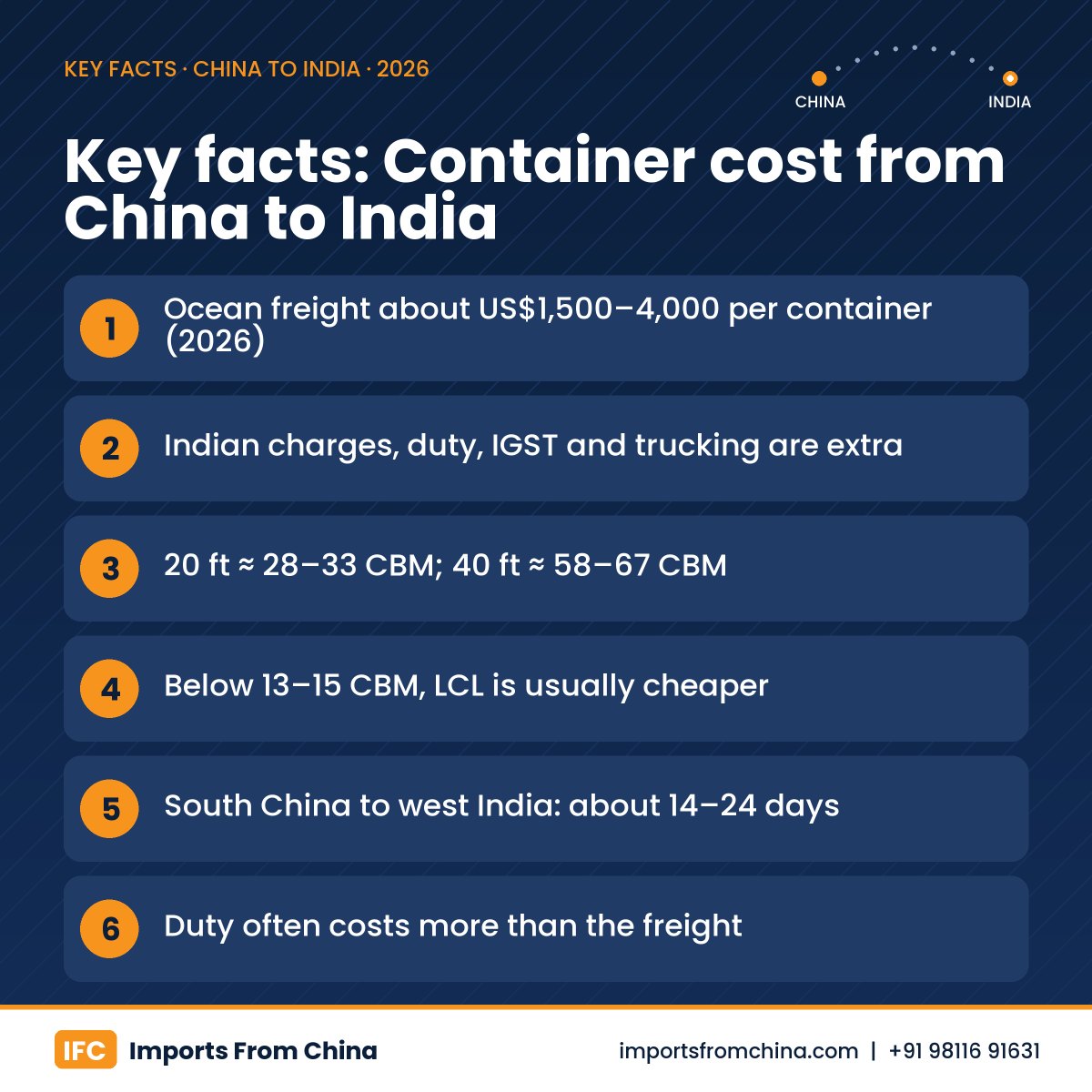
  • Ocean freight: about US$1,500–4,000 per container port-to-port in 2026 (indicative, changes weekly).
  • Extra costs: China local charges, Indian THC, DO, CFS, CHA, duty, IGST and trucking.
  • Capacity: 20 ft holds about 28–33 CBM; 40 ft about 58–67 CBM; 40 ft HC about 68–76 CBM.
  • Break-even: below about 13–15 CBM, LCL is usually cheaper than a 20 ft container.
  • Transit: South China to west India about 14–24 days port to port; north China adds a few days.
  • Duty is the big number: for many goods, duty and IGST exceed the freight itself.

How much does a 20 ft or 40 ft container cost from China to India?

Route (port to port)Indicative ocean freight (2026)
Nansha / Shekou (South China) → Nhava Shevaabout US$1,550–3,750 per 40 ft, depending on month
Shanghai / Qingdao / Xiamen → Mundraabout US$2,700–2,800 per container (Aug 2026 quotes)
Tianjin → Nhava Sheva / Mundraabout US$2,800–3,100 per container (Aug 2026 quotes)
Shenzhen → Chennaiabout US$2,400–2,600 per container (Sep 2026 quotes)

These are indicative market quotes reported by freight forwarders for 2026 and change weekly with demand, vessel space and fuel. Always take a fresh quote with validity dates. Rates rise before Diwali and Chinese New Year.

Container cost from China to India infographic – key facts for Indian importers
Container cost from China to India: key facts at a glance (IFC – Imports From China)

What is included in a container freight quote?

CostUsually in the ocean freight quote?
Ocean freight China port → Indian portYes
China-side charges (trucking to port, export clearance, THC)Depends on Incoterm (EXW vs FOB)
Indian terminal handling (THC), delivery order (DO), CFS chargesNo
Customs broker (CHA) and Bill of Entry filingNo
Customs duty and IGSTNo
Trucking from port to your warehouseNo

To compare quotes fairly, ask for a door-to-door DDP price or list every charge line. Read how DDP shipping works.

20 ft vs 40 ft container: which do you need?

ContainerApprox. volumeGood for
20 ft (20GP)28–33 CBMHeavy goods: machinery, tiles, hardware
40 ft (40GP)58–67 CBMBulky goods: furniture, home goods, mixed products
40 ft High Cube (40HQ)68–76 CBMLight, bulky goods: furniture, soft goods

Heavy cargo often fills a container by weight before volume. Check both the CBM and the weight limit with your forwarder.

When is LCL cheaper than a full container?

LCL (Less than Container Load) is charged per CBM. As a rule of thumb, below about 13–15 CBM LCL is usually cheaper than booking a 20 ft container; above that, FCL usually wins and is also safer because your cargo is not handled with others. Compare in our FCL vs LCL guide and LCL shipping guide.

How long does container shipping from China to India take?

South China ports (Shenzhen, Nansha, Xiamen) to Nhava Sheva or Mundra usually take about 14–24 days port to port; north China ports (Qingdao, Tianjin) add a few days. Add time for loading, customs clearance and delivery. More detail: how long sea shipping takes.

Worked example: what really decides your container cost?

Say you fill a 40 ft container with furniture with a CIF value (goods + freight + insurance) of ₹30 lakh, of which the ocean freight at about US$3,000 is only around ₹2.6 lakh. Wooden furniture (9403 60 00) carries 20% BCD (₹6 lakh) plus 5% AIDC (₹1.5 lakh) and 18% IGST on ₹37.5 lakh (₹6.75 lakh), so duty and IGST come to about ₹14.25 lakh. The IGST part is usually claimable with a GSTIN. Duty, not freight, is the biggest number, so getting the HS code and value right matters more than saving US$200 on freight. Rates as of October 2026; confirm for your HS code on the India import duty rates page.

How to reduce container shipping costs

  • Book 3–4 weeks ahead, especially before Diwali and Chinese New Year.
  • Load efficiently: ask for a loading plan to use every CBM.
  • Consolidate several suppliers into one container at a China warehouse.
  • Compare Mundra, Nhava Sheva and Chennai depending on your city.
  • Check duty, BIS and anti-dumping before you ship.

How IFC helps with container shipping from China

IFC (Imports From China) has handled China–India imports for 20+ years, since 2004, and loads mixed containers and air cargo daily. From our own offices in Guangzhou and Yiwu we consolidate suppliers, inspect goods, book LCL or FCL, clear customs and deliver door to door across India. Plan your load with our sea freight service.

Conclusion

Ocean freight for a container from China to India is only one part of the bill. In 2026, expect roughly US$1,500–4,000 per container port to port, then Indian charges, duty, IGST and delivery on top. Get door-to-door quotes, choose LCL below about 13–15 CBM, and plan bookings around peak seasons.

Mayank Dang (CA Sahab), Founder and CEO of IFC

Guide reviewed by Mayank Dang (CA Sahab), Founder & CEO of IFC

Chartered Accountant (FCA, ICAI) who has helped 5000+ Indian businesses import from China since 2004 – sourcing, BIS, HSN classification, import duty, customs and GST compliance. mayankdang.in

Get your real landed cost: enter your product, weight and CBM in the IFC shipment calculator, check your HS code on the India import duty rates page, or call IFC on +91 98116 91631 for a door-to-door DDP quote from China to your city.

Frequently asked questions

How much does it cost to ship a container from China to India?

In 2026, port-to-port ocean freight for a 20 ft or 40 ft container from main Chinese ports to Nhava Sheva, Mundra or Chennai was quoted at roughly US$1,500 to 4,000, depending on route and month. Indian charges, duty and delivery are extra.

How many CBM fit in a 20 ft and a 40 ft container?

A 20 ft container holds about 28 to 33 CBM, a 40 ft about 58 to 67 CBM, and a 40 ft high cube about 68 to 76 CBM, depending on packing.

Is LCL or FCL cheaper from China to India?

Below about 13 to 15 CBM, LCL is usually cheaper. Above that, a full container is normally cheaper per CBM and safer for the cargo.

How long does a container take from China to India?

About 14 to 24 days port to port from South China to west Indian ports, plus a few days from north China, then customs clearance and delivery.

Does container freight include customs duty?

No. Ocean freight covers only port-to-port transport. Customs duty, IGST, CHA, port charges and trucking are extra unless you book a DDP door-to-door service.

Landed cost of a China product in India

Landed Cost of a $10 China Product in India: Worked Example (2026)

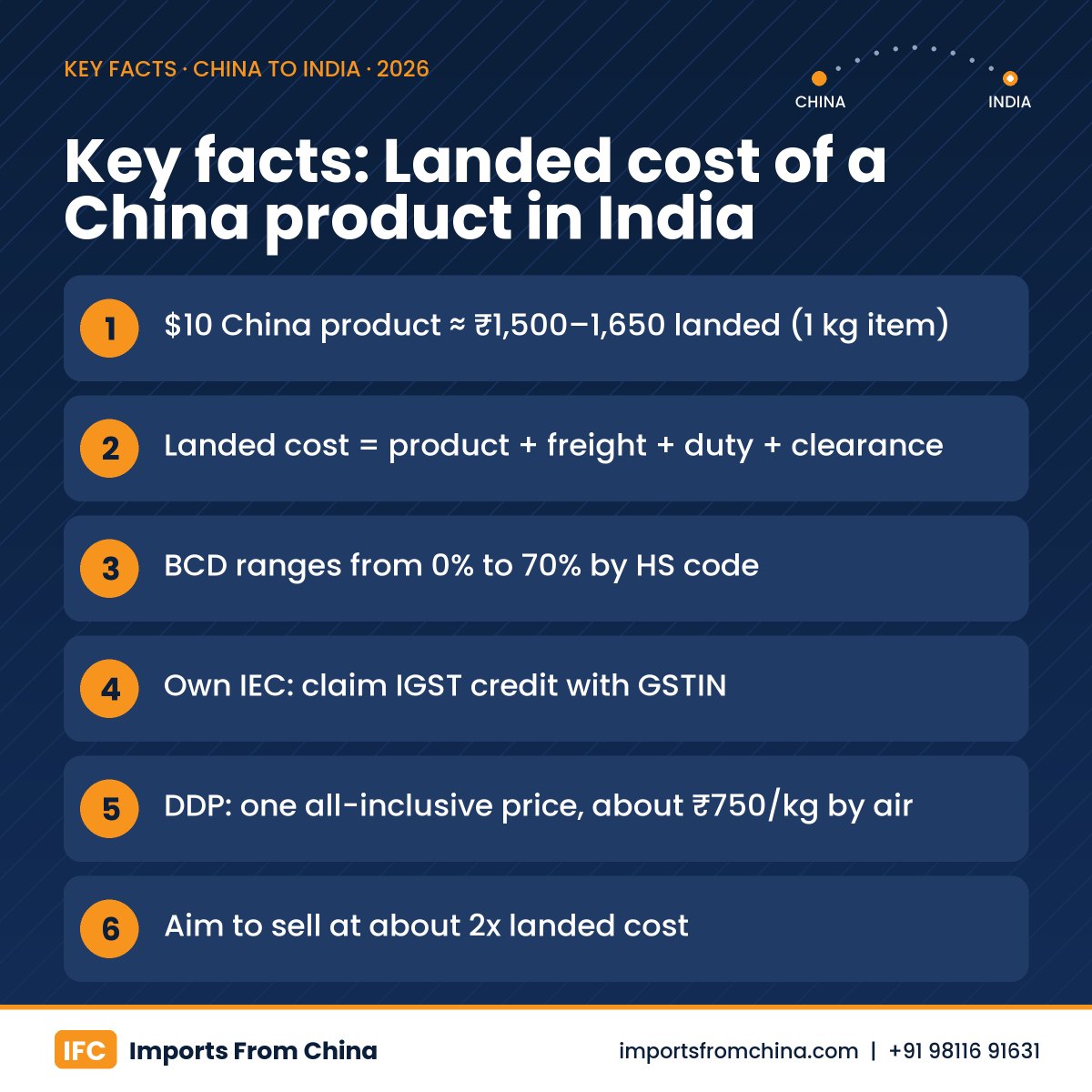
If a product costs US$10 in China, what will it cost landed in India? For a typical 1 kg consumer product bought in a lot of 100, the landed cost is roughly ₹1,500–1,650 per piece, about 1.7 to 1.9 times the China price, once freight, customs duty, IGST, clearance and delivery are added. The exact figure depends on the HS code, weight, value and shipping mode.

Below are two worked calculations for the same order: importing on your own IEC, and importing door to door (DDP). Use them as a template, then check your own product on the IFC shipment calculator.

Key takeaways

  • Rule of thumb: a China price often becomes 1.6–2x once it reaches your door in India.
  • Weight matters: light, high-value goods land cheaper per piece than heavy, low-value goods.
  • Duty depends on the HS code: BCD can be 0% to 70%; IGST is usually 5% or 18%.
  • IGST credit: with your own IEC and GSTIN you can usually claim the IGST back.
  • DDP is simpler: one per kg price covers freight, duty, clearance and delivery.
  • Always calculate first: work out landed cost before you pay the supplier.

Assumptions for the example

ItemValue
Product price in China (FOB)US$10 per piece
Quantity100 pieces
Weight1 kg per piece, 100 kg total
Exchange rate (assumed)₹88 per US$ – use the current CBIC customs rate
Goods valueUS$1,000 = ₹88,000 (₹880 per kg)
Duty (example HS code)BCD 20%, SWS 10% of BCD, IGST 18%
Landed cost of a China product in India infographic – key facts for Indian importers
Landed cost of a China product in India: key facts at a glance (IFC – Imports From China)

Method 1: Import on your own IEC (air freight + CHA)

CostAmount
Goods value (FOB)₹88,000
Air freight + insurance to Indian airport (assumed)₹25,000
Assessable value (CIF)₹1,13,000
BCD 20%₹22,600
SWS 10% of BCD₹2,260
IGST 18% on ₹1,37,860₹24,815
CHA, airport and delivery charges (assumed)₹10,000
Total outflow₹1,72,675
Less IGST credit (GST registered)– ₹24,815
Net landed cost₹1,47,860 = about ₹1,479 per piece

This route gives you the IGST credit, but you handle the freight booking, CHA, Bill of Entry and delivery yourself, and port charges can vary.

Method 2: Door-to-door DDP

CostAmount
Goods value₹88,000
Air DDP at about ₹750/kg × 100 kg (freight, duty, clearance, delivery)₹75,000
Total landed cost₹1,63,000 = about ₹1,630 per piece

The general ₹750/kg air DDP rate applies to general cargo of 50 kg+ valued under ₹2,000 per kg. Battery, liquid, cosmetic, magnet or higher-value goods are about ₹1,350/kg, and sea DDP is roughly half the air rate. DDP is a fixed, predictable cost with no CHA or port work for you. Because the goods are imported on the agent’s IEC, IGST credit is generally not available to you.

Which method is cheaper for you?

SituationUsually better
First import, small quantity, no CHADDP
GST registered, regular imports, own IECOwn IEC with IGST credit
Heavy goods, 500 kg+Sea (either method)
Urgent stockAir DDP

How to sell profitably after landing

In the example, the landed cost is about ₹1,480–1,630 per piece. For retail, aim to sell at about 2x the landed cost to cover marketplace fees, returns, advertising and your margin. If the market price is lower, choose a lighter product, ship by sea, or negotiate the China price. Ideas: what India imports from China and is importing from China profitable?

What changes the landed cost the most?

  • HS code: BCD can range from 0% (laptops) to 70% (toys).
  • Weight and volume: bulky goods pay volumetric weight.
  • Value per kg: high-value goods pay more duty and may move to a higher DDP slab.
  • Anti-dumping duty: some Chinese goods carry extra duty.
  • Exchange rate: customs uses the CBIC notified rate.
  • Shipping mode: sea costs roughly half of air.

Learn the duty maths in our import duty guide and check your product on the India import duty rates page.

How IFC helps you calculate and control landed cost

IFC (Imports From China) has worked in China–India imports for 20+ years, since 2004, and has served 5000+ Indian businesses. We confirm the HS code and duty before you order, consolidate goods at our China warehouse, and ship door to door with one all-inclusive DDP price, so your landed cost is fixed before you pay the supplier.

Conclusion

A US$10 China product typically lands in India at about ₹1,500–1,650 per piece for a 1 kg item, roughly 1.7–1.9x the China price. Run this calculation for every product before you order, and choose between your own IEC (with IGST credit) and simple DDP based on your volume and set-up.

Mayank Dang (CA Sahab), Founder and CEO of IFC

Guide reviewed by Mayank Dang (CA Sahab), Founder & CEO of IFC

Chartered Accountant (FCA, ICAI) who has helped 5000+ Indian businesses import from China since 2004 – sourcing, BIS, HSN classification, import duty, customs and GST compliance. mayankdang.in

Get your real landed cost: enter your product, weight and CBM in the IFC shipment calculator, check your HS code on the India import duty rates page, or call IFC on +91 98116 91631 for a door-to-door DDP quote from China to your city.

Frequently asked questions

If a product costs US$10 in China, what is the landed cost in India?

For a 1 kg general product bought in a lot of 100, the landed cost is roughly ₹1,500 to ₹1,650 per piece including freight, duty, IGST, clearance and delivery. It depends on HS code, weight, value and shipping mode.

How do I calculate landed cost from China to India?

Add the product price, freight and insurance to get CIF value, add BCD, SWS and IGST on it, then add clearance and delivery charges. Or use the IFC shipment calculator for a quick estimate.

Which exchange rate does Indian customs use?

Customs uses the exchange rate notified by CBIC for imports, which is updated regularly. It can differ slightly from the bank rate.

Can I claim the IGST paid on imports?

Yes, if the goods are imported on your own IEC and GSTIN, the IGST paid at customs can usually be claimed as input tax credit.

Is DDP shipping more expensive than importing myself?

DDP can cost a little more on paper because IGST credit is not available to you, but it removes CHA, port and delivery work and the risk of surprise charges, which suits small and first-time importers.

Cost to start an import business from China to India

Cost to Start an Import Business from China to India: ₹ Budget Guide (2026)

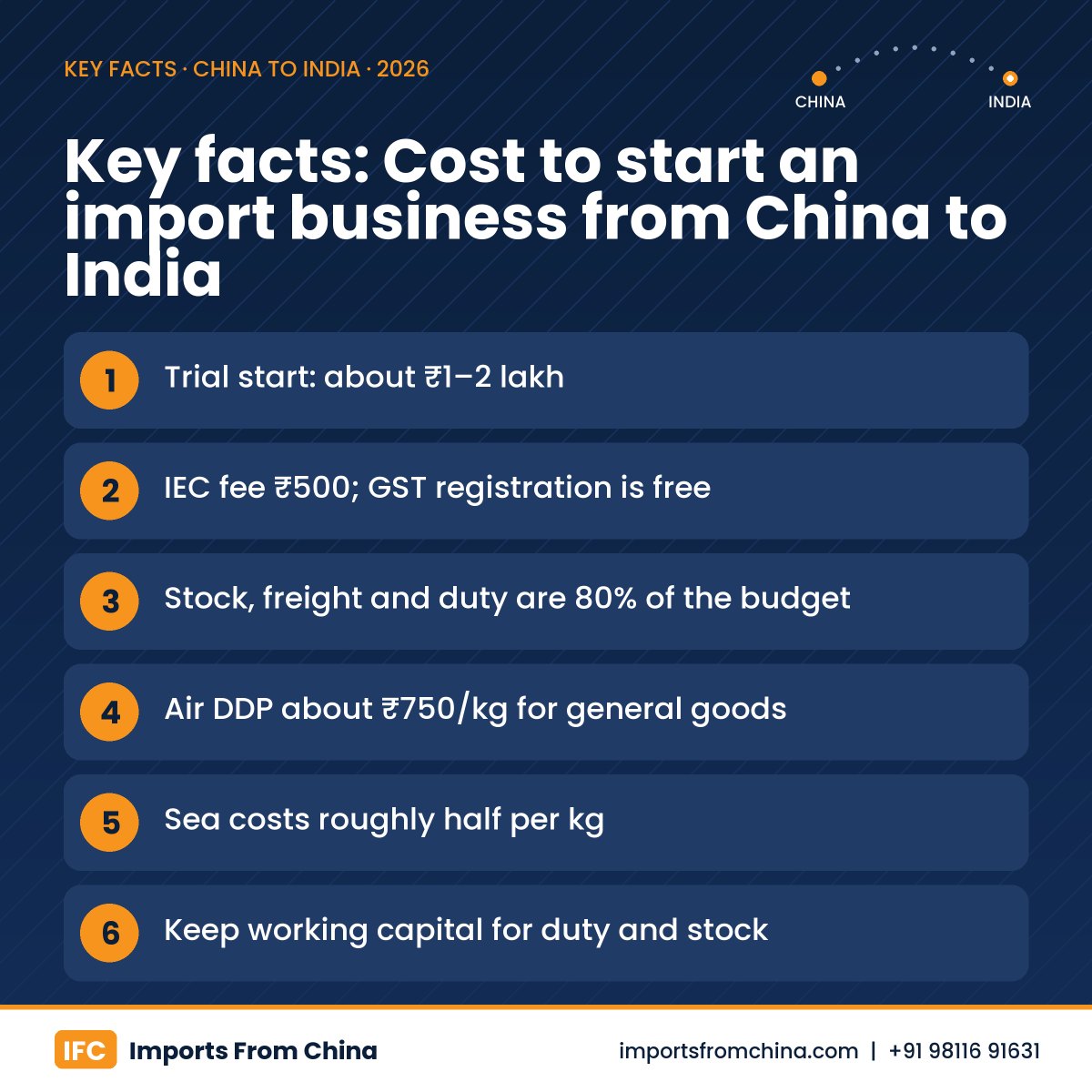
How much does it cost to start an import business from China to India? You can start with about ₹1–2 lakh: roughly ₹500 for an IEC, a free GST registration, ₹10,000–20,000 for samples, and ₹75,000–1.5 lakh for a first 50–100 kg trial stock shipped door to door. A serious trading start with sea cargo needs about ₹5–10 lakh, mostly for stock and working capital.

This guide breaks down every cost in rupees: registrations, product cost, freight, duty, checks and working capital, with three sample budgets.

Key takeaways

  • Registrations are cheap: IEC costs ₹500; GST registration is free on the GST portal.
  • Stock is the main cost: product cost plus freight and duty usually take 80% of the budget.
  • Start with a trial: test 50–100 kg by air DDP before ordering a container.
  • Plan for duty: duty can add 20–45% of the goods value depending on the HS code.
  • Keep working capital: new importers often run out of cash between paying the supplier and getting paid.
  • Check before you pay: use the IFC shipment calculator for the full landed cost.

What registrations do you need, and what do they cost?

RegistrationNeeded forIndicative cost
GSTINSelling in India, claiming IGST creditFree on the GST portal
IEC (Import Export Code)Commercial imports₹500 government fee on DGFT
Business entityProprietorship (simplest), LLP or companyProprietorship: no separate fee; company/LLP: roughly ₹7,000–20,000 with professional fees
Current bank accountPayments to ChinaBank charges as applicable
Product approvalsBIS, WPC, FSSAI, CDSCO for some productsProduct-specific; check before ordering

If you do not want your own IEC at the start, an import agent can import on its IEC under DDP terms. Compare both in agent IEC vs your own IEC.

Cost to start an import business from China to India infographic – key facts for Indian importers
Cost to start an import business from China to India: key facts at a glance (IFC – Imports From China)

What does the first shipment cost?

Your landed cost has five parts: product price + China-side charges + international freight + Indian duty and IGST + clearance and delivery. With DDP shipping, the last four come as one per kg price.

Cost itemTypical amount
Samples (3–5 suppliers, courier)₹10,000–20,000
Supplier checkRemote factory audit about ₹1,500; physical factory visit ₹15,000–25,000
Air DDP freight + duty + clearance (general goods, 50 kg+)About ₹750/kg
Air DDP for battery, liquid, cosmetic, magnet or high-value goodsAbout ₹1,350/kg
Sea DDPRoughly half the air rate; ₹50–150/kg above 5,000 kg

Three sample budgets for a China import business

BudgetWhat it buysBest for
₹1–2 lakh (trial)Samples + 50–100 kg of stock by air DDPTesting a product, Amazon/Flipkart trial, local shops
₹5–10 lakh (small trader)300–1,000 kg of stock, mostly by sea, with a quality checkRetailers, B2B suppliers, e-commerce sellers
₹20 lakh+ (growth)LCL or FCL shipments, several products, own brandWholesalers, brands, interior and project businesses

Worked example: a ₹1.5 lakh first import

  • Samples from 3 suppliers: ₹15,000
  • Remote factory audit of the chosen supplier: ₹1,500
  • Goods: 100 kg of home and kitchen items worth about ₹55,000
  • Air DDP door to door at about ₹750/kg: ₹75,000 (freight, duty and clearance included for general goods under ₹2,000/kg)
  • Buffer for packaging, listing and marketing: about ₹5,000

Total: about ₹1.5 lakh. If those goods sell at 2x to 2.5x the landed cost, the trial pays for itself and shows whether to scale by sea. Read Is importing from China profitable?

Hidden costs new importers forget

  • Duty differences by HS code (from 0% to 70% BCD).
  • BIS testing for notified products.
  • Storage and demurrage if documents are wrong.
  • Returns and damaged pieces.
  • Currency changes between order and payment. See how to pay Chinese suppliers.
  • Marketplace fees and advertising when you sell.

How to start an import business from China: step by step

  1. Pick a product you can sell and check its HS code and compliance.
  2. Register GST and IEC (or use an agent’s IEC).
  3. Order samples and verify the supplier.
  4. Calculate landed cost on the IFC shipment calculator.
  5. Ship a trial order by air DDP.
  6. Scale the winners by sea.

More detail: how to start importing from China to India.

How IFC helps new importers start small

IFC (Imports From China) has worked in China–India imports for 20+ years, since 2004, and has served 5000+ Indian businesses. From our own offices in Guangzhou and Yiwu we help first-time importers with sourcing, supplier checks, quality inspection, consolidated air and sea shipping, customs clearance and door-to-door DDP delivery, so even a 50 kg trial order is simple.

Conclusion

Starting an import business from China does not need crores. Registrations cost very little; the real budget is stock, freight and duty. Start with a ₹1–2 lakh trial, prove the product sells, keep cash for working capital, and scale by sea once demand is clear.

Mayank Dang (CA Sahab), Founder and CEO of IFC

Guide reviewed by Mayank Dang (CA Sahab), Founder & CEO of IFC

Chartered Accountant (FCA, ICAI) who has helped 5000+ Indian businesses import from China since 2004 – sourcing, BIS, HSN classification, import duty, customs and GST compliance. mayankdang.in

Get your real landed cost: enter your product, weight and CBM in the IFC shipment calculator, check your HS code on the India import duty rates page, or call IFC on +91 98116 91631 for a door-to-door DDP quote from China to your city.

Frequently asked questions

How much money do I need to start importing from China to India?

A trial import can start at about ₹1–2 lakh, covering samples and 50–100 kg of stock by air DDP. A small trading business usually needs ₹5–10 lakh for stock, sea freight, duty and working capital.

What is the cost of an IEC in India?

The government fee for an Import Export Code on the DGFT website is ₹500. GST registration is free.

Can I start importing without an IEC?

For commercial imports you need an IEC, or you can import through an agent that imports on its own IEC under DDP terms.

What is the biggest cost in an import business?

Stock is usually the largest cost, followed by freight and customs duty. Duty depends on the HS code and can add 20–45% of the goods value for many consumer products.

Should I start with air or sea shipping?

Start with a small air DDP trial to test the product quickly, then move repeat orders to sea, which costs roughly half per kg.

Private label electronics from China to India

Start Your Own Electronics Brand from China: Private Label Guide for India (2026)

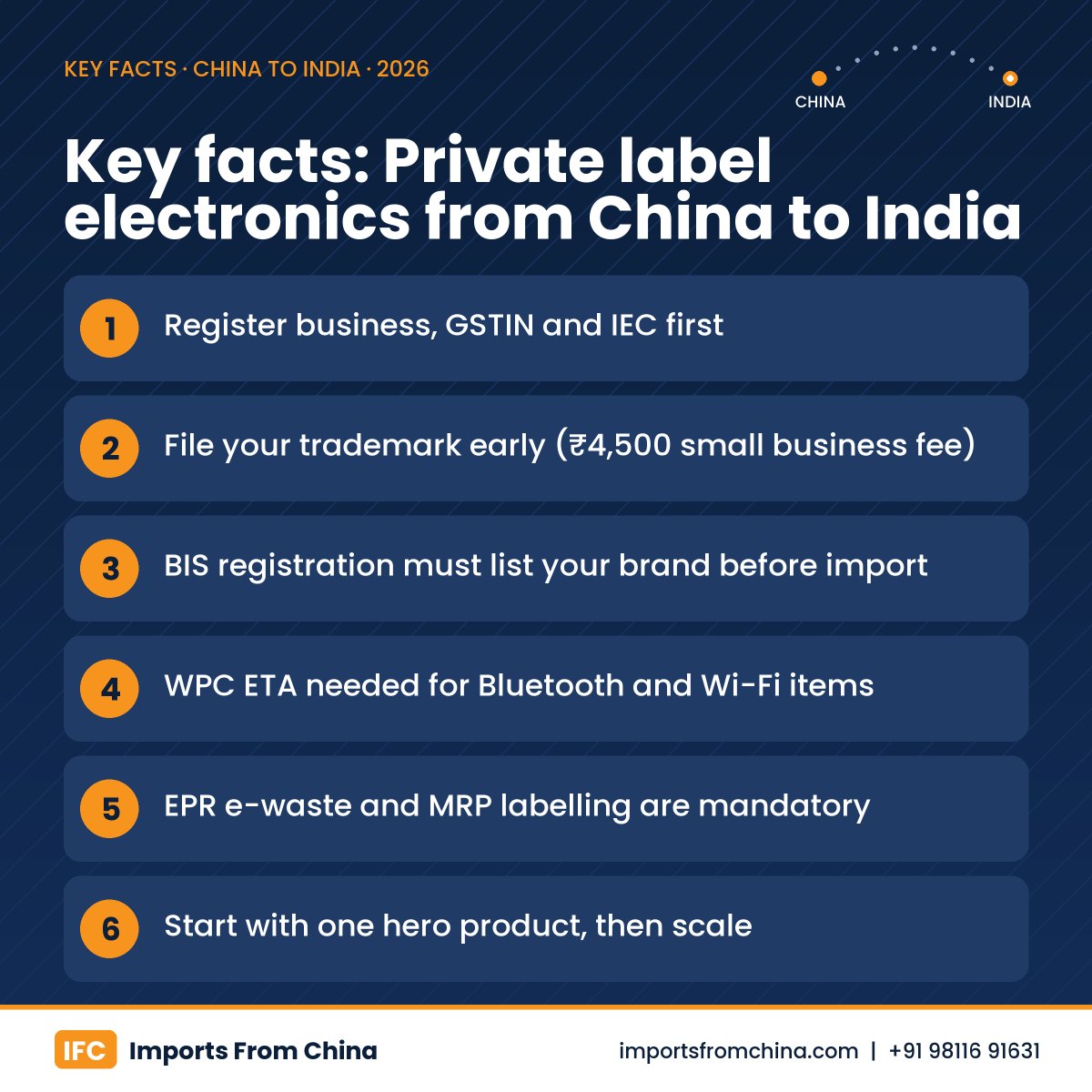
Can you import electronics from China and sell them in India under your own brand? Yes. Thousands of Indian brands do it. You need a registered business with IEC and GSTIN, your trademark, BIS registration of the product in your brand name (through the Chinese factory and an Indian representative), WPC approval for Bluetooth or Wi-Fi items, EPR e-waste registration, and correct MRP labelling.

This guide walks through the full private-label process step by step, with timelines, costs and the mistakes that get new brands stuck at customs.

Key takeaways

  • Legal entity first: proprietorship, LLP or company with GSTIN and IEC.
  • Trademark: file your brand in India early; e-filing fee is ₹4,500 for individuals and small businesses.
  • BIS CRS: most consumer electronics need BIS registration before import, listing your brand.
  • WPC: Bluetooth and Wi-Fi products need WPC equipment type approval (ETA).
  • EPR and labelling: e-waste EPR registration with CPCB and Legal Metrology labelling with MRP.
  • Start small: test one hero product before building a range.

Step 1: Set up your business and import registrations

  • Choose a structure: proprietorship (fastest), LLP or private limited company.
  • Get a GSTIN so you can claim IGST paid at customs as input tax credit.
  • Apply for an IEC on the DGFT website (government fee ₹500).
  • Open a current account for payments to China.
Private label electronics from China to India infographic – key facts for Indian importers
Private label electronics from China to India: key facts at a glance (IFC – Imports From China)

Step 2: Protect your brand name with a trademark

File a trademark application in the relevant class (usually Class 9 for electronics) with the Indian Trade Marks Registry. The e-filing fee is ₹4,500 per class for individuals, startups and small enterprises, and ₹9,000 for others. You can use the ™ symbol once you have applied; ® only after registration.

Step 3: Choose the product and the right factory

Pick one hero product with steady demand, for example a charger, power bank, smartwatch, earbuds, LED light or kitchen appliance. Shortlist factories (not traders) that already make the product for other brands and have BIS experience. Read how to check a real factory vs a trader.

Step 4: BIS registration in your brand name

Many electronics fall under the BIS Compulsory Registration Scheme (CRS). The registration is granted to the manufacturing factory, with an Authorised Indian Representative (AIR), and lists each brand and model. Samples are tested in a BIS-recognised lab in India. Your brand cannot be imported until its registration is live, and every unit must carry the BIS Standard Mark with the registration number. Full details: BIS registration for electronics from China.

Step 5: WPC approval, EPR and labelling

RequirementWhen it appliesWhere
WPC ETABluetooth, Wi-Fi and other wireless devicesSaral Sanchar portal (Department of Telecommunications)
EPR e-wasteProducers and importers of listed electrical and electronic itemsCPCB EPR portal
Legal MetrologyAll pre-packaged goods sold to consumersImporter registration, MRP, importer name and address, month of import on the label
Import authorisationLaptops, tablets, PCs (heading 8471)DGFT Import Management System

Step 6: Packaging, quality check and shipping

  1. Approve the box design with your brand, BIS mark, MRP and importer details.
  2. Do a pre-shipment inspection before the balance payment.
  3. Ship the first batch by air for speed, then move repeat orders to sea to cut cost.

What will a private-label electronics brand cost to start?

ItemIndicative cost (2026)
IEC₹500 government fee
Trademark (one class, small business)₹4,500 government fee + attorney fee if used
BIS CRS registrationLab testing + fees + AIR service, varies by product; often ₹50,000 to ₹2,00,000 per product family
First stock orderMOQ x unit price, often ₹2 to 10 lakh
Shipping and dutyAir DDP about ₹750/kg for general goods; ₹1,350/kg for battery items
Packaging design and samples₹20,000 to ₹1,00,000

BIS costs vary widely by product and lab, so get a written quote before you start. Duty example: mobile chargers carry 15% BCD plus SWS and 18% IGST (rates as of October 2026; confirm for your HS code on the India import duty rates page).

Common mistakes new electronics brands make

  • Placing the order before BIS registration is live: the goods are held at customs.
  • Using a trader whose factory will not do BIS in your brand.
  • Forgetting WPC for Bluetooth items.
  • No MRP or importer details on the box.
  • Ordering too many models at once instead of one hero product.

How IFC helps you build your own brand from China

IFC (Imports From China) has worked in China–India imports for 20+ years, since 2004, and has served 5000+ Indian businesses. From our offices in Guangzhou and Yiwu we find factories that do private label, coordinate samples and branding, guide you on BIS, WPC and HSN, inspect goods and ship door to door with customs clearance. Start with China product sourcing.

Conclusion

Building your own electronics brand from China is very doable for an Indian MSME. Register the business and trademark, pick one product and a real factory, get BIS and WPC in your brand name before ordering, label correctly, and scale once the first product sells.

Mayank Dang (CA Sahab), Founder and CEO of IFC

Guide reviewed by Mayank Dang (CA Sahab), Founder & CEO of IFC

Chartered Accountant (FCA, ICAI) who has helped 5000+ Indian businesses import from China since 2004 – sourcing, BIS, HSN classification, import duty, customs and GST compliance. mayankdang.in

Get your real landed cost: enter your product, weight and CBM in the IFC shipment calculator, check your HS code on the India import duty rates page, or call IFC on +91 98116 91631 for a door-to-door DDP quote from China to your city.

Frequently asked questions

Can I import electronics from China and sell them under my own brand in India?

Yes. You need a registered business with GSTIN and IEC, a trademark for your brand, BIS registration listing your brand for notified products, WPC approval for wireless items, EPR registration and correct MRP labelling.

Who holds the BIS registration for a private-label product?

BIS registration under the Compulsory Registration Scheme is granted to the manufacturing factory, with an Authorised Indian Representative, and it lists the brands and models covered, including yours.

How much does it cost to register a trademark in India?

The government e-filing fee is ₹4,500 per class for individuals, startups and small enterprises and ₹9,000 for others. Attorney fees are extra if you use one.

Do Bluetooth earbuds from China need WPC approval?

Yes. Bluetooth and Wi-Fi devices need WPC equipment type approval through the Saral Sanchar portal before import.

What is the best first product for an electronics brand from China?

Choose one product with steady demand and simple compliance, such as a charger, LED light or kitchen gadget, test the market, then expand the range.

Alibaba shipping cost to India

Alibaba Shipping Cost to India: Why It Is High & How to Cut It (2026)

How much does Alibaba charge for shipping to India? There is no fixed Alibaba rate. The shipping cost you see at checkout is quoted by the supplier or by Alibaba.com logistics partners, usually for express courier or freight up to an Indian port, and it often does not include Indian customs duty, IGST or clearance. For orders above about 50 kg, a China-based forwarder with door-to-door DDP pricing is usually much cheaper.

This guide shows what the Alibaba shipping price includes, why it is often high for India, and how Indian buyers cut the cost legally.

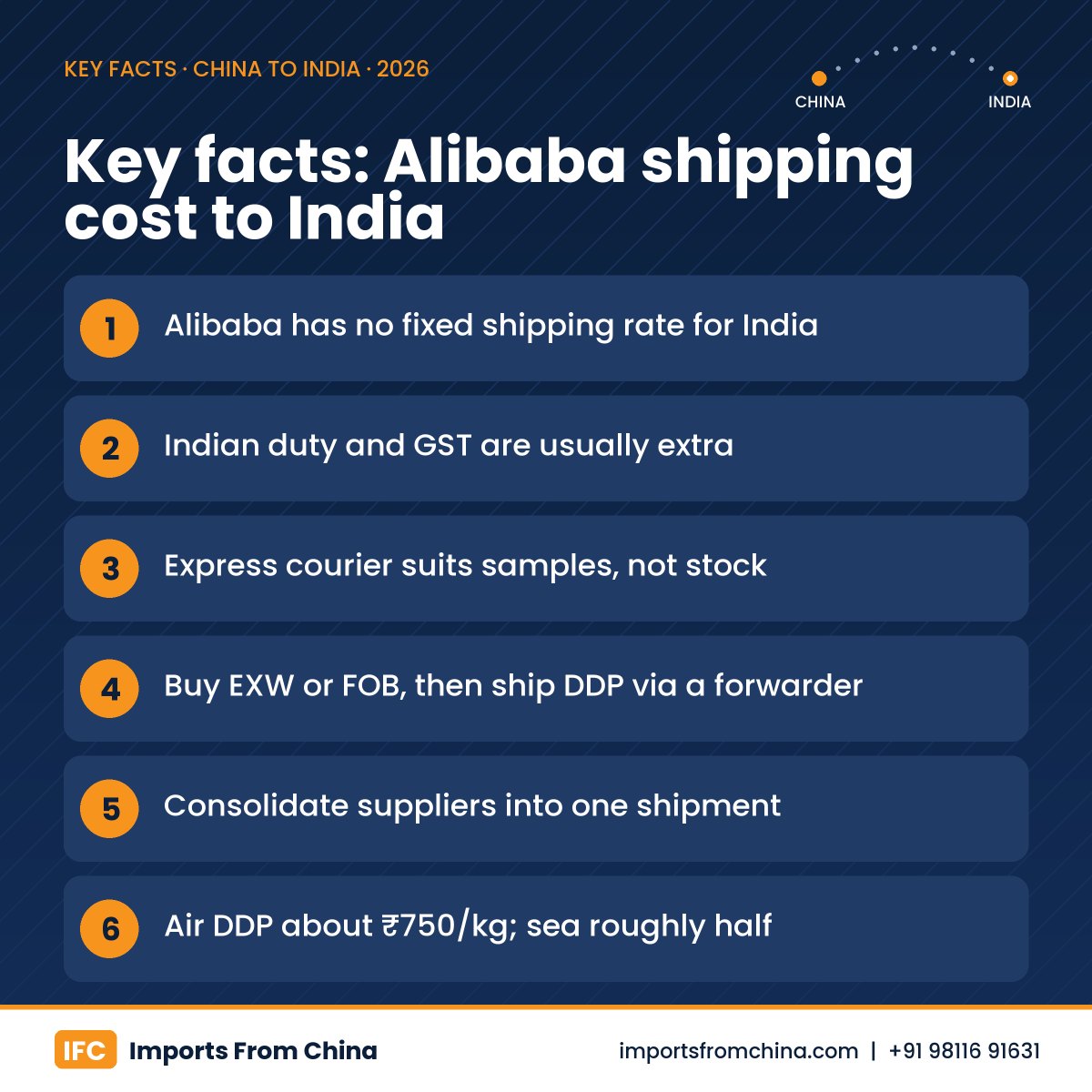
Key takeaways

  • No fixed rate: Alibaba shipping is quoted per order by the supplier or a logistics partner.
  • Duty usually extra: most quotes stop at delivery without Indian duty and GST, so you pay those on arrival.
  • Express is costly: supplier courier quotes suit samples, not stock orders.
  • Check the Incoterm: EXW, FOB, CIF and DDP mean very different total costs.
  • Use a forwarder for bulk: ask the supplier for an EXW or FOB price and ship through your own forwarder.
  • Compare landed cost: product + freight + duty + clearance + delivery.

What does the Alibaba shipping charge include?

On Alibaba.com you can pay for shipping in two ways: the supplier quotes a shipping price in the order, or you choose a logistics option offered by Alibaba.com partners. Either way, read the terms. Most options are express courier (DHL, FedEx, UPS) or freight to a port or airport. Indian customs duty, IGST, CHA charges, port charges and delivery from the port are usually not included, unless the quote clearly says DDP to your address.

Alibaba shipping cost to India infographic – key facts for Indian importers
Alibaba shipping cost to India: key facts at a glance (IFC – Imports From China)

Why is Alibaba shipping to India so expensive?

  • Express pricing: courier rates are built for small parcels; per kg cost rises fast with heavier cartons.
  • Volumetric weight: bulky cartons are charged on size (L × W × H cm ÷ 5,000 or 6,000), not actual weight.
  • Supplier mark-up: some suppliers add margin to the freight they quote.
  • Duty on arrival: duty and IGST are charged on top when the parcel reaches India.
  • Single-supplier shipping: each supplier ships separately, so you pay fixed charges again and again.

Incoterms explained: EXW, FOB, CIF and DDP for Indian buyers

TermSupplier pays up toYou pay
EXW (Ex Works)Goods ready at factoryEverything from the factory gate
FOB (Free on Board)Loading on the ship at the China portSea freight, insurance, Indian charges, duty, delivery
CIFFreight and insurance to the Indian portPort charges, CHA, duty, IGST, delivery
DDP (Delivered Duty Paid)Everything to your door including dutyOnly the agreed price

For most small and medium buyers, the cheapest and safest set-up is: buy EXW or FOB from the Alibaba supplier, then ship with a forwarder that offers DDP to your door. Read our DDP shipping guide.

Alibaba supplier shipping vs a China-India DDP forwarder

FactorSupplier or Alibaba expressIFC DDP forwarder
Best forSamples, under 20 kg50 kg+ stock orders
Indian duty and GSTUsually extra, paid on arrivalIncluded
Multiple suppliersEach ships separatelyConsolidated into one shipment
Quality check before dispatchRarelyAvailable at our China warehouse
Typical costHigh per kgAbout ₹750/kg air DDP for general goods; sea roughly half

How to cut your Alibaba shipping cost to India

  1. Ask suppliers for an EXW or FOB price and a separate shipping quote, so you can compare.
  2. Send all suppliers’ goods to one forwarder warehouse in China and ship together.
  3. Choose sea cargo once you cross a few hundred kg.
  4. Ask for compact packing and the exact carton size and weight before paying.
  5. Check the HS code, duty and BIS rules before ordering, so goods are not held at customs.
  6. Use the IFC shipment calculator to see your full landed cost.

For sourcing tips on Alibaba itself, read our Alibaba sourcing guide for India and the China to India shipping cost per kg breakdown.

How IFC helps Alibaba buyers in India

IFC (Imports From China) has handled China–India imports for 20+ years, since 2004, and has served 5000+ Indian businesses. Your Alibaba suppliers deliver to our China warehouse, our team in Guangzhou and Yiwu checks and consolidates the goods, and we ship by air or sea with customs clearance and door-to-door DDP delivery across India.

Conclusion

Alibaba does not have one shipping rate for India, and most checkout quotes leave out Indian duty and clearance. For anything beyond samples, buy EXW or FOB, consolidate your suppliers, and ship DDP so you know the full cost before you pay.

Mayank Dang (CA Sahab), Founder and CEO of IFC

Guide reviewed by Mayank Dang (CA Sahab), Founder & CEO of IFC

Chartered Accountant (FCA, ICAI) who has helped 5000+ Indian businesses import from China since 2004 – sourcing, BIS, HSN classification, import duty, customs and GST compliance. mayankdang.in

Get your real landed cost: enter your product, weight and CBM in the IFC shipment calculator, check your HS code on the India import duty rates page, or call IFC on +91 98116 91631 for a door-to-door DDP quote from China to your city.

Frequently asked questions

How much does Alibaba charge for shipping to India?

There is no fixed rate. The supplier or an Alibaba.com logistics partner quotes shipping per order, usually express courier or freight, and Indian duty and GST are often extra. For 50 kg and above, a DDP forwarder is usually cheaper.

Does Alibaba shipping include customs duty in India?

Usually not. Unless the quote clearly says DDP to your address, you pay customs duty, IGST and clearance charges when the goods reach India.

Which Incoterm is best when buying from Alibaba for India?

For small and medium buyers, buy EXW or FOB from the supplier and ship with a forwarder that offers DDP door-to-door delivery. You then see one all-inclusive cost.

Can I combine orders from different Alibaba suppliers?

Yes. Ask each supplier to deliver to one forwarder warehouse in China. The goods are consolidated into a single shipment, which lowers the per kg cost.

Is Alibaba shipping safe for Indian buyers?

Paying through Alibaba Trade Assurance protects the payment, but always check the supplier, get samples, and confirm the HS code and BIS rules before ordering.