

Shipping from China to Nhava Sheva

Shipping from China to Nhava Sheva (JNPT): Transit, Charges and Clearance (2026)

Shipping from China to Nhava Sheva (JNPT, Navi Mumbai) usually takes about 12–20 days port to port from the main Chinese ports, and about 3–6 weeks door to door for LCL. Ocean freight for a 20 ft or 40 ft container ran at roughly US$1,500–4,000 in 2026, but port charges, CFS fees, duty, IGST and trucking decide your real cost.

This guide covers transit times from each Chinese port, the five container terminals at JNPA, every charge you will see at Nhava Sheva, how customs clearance works at the Jawaharlal Nehru Custom House, and a full ₹ worked example.

Key takeaways

  • Transit: about 12–16 days from South China (Shekou, Nansha, Yantian) and 14–20 days from Ningbo or Shanghai, port to port (indicative, November 2026).
  • Freight: about US$1,500–4,000 per container port to port in 2026; LCL door to door about ₹9,000–16,000 per CBM.
  • Port code: Nhava Sheva is INNSA1 on ICEGATE; customs clearance is handled by the Jawaharlal Nehru Custom House (JNCH).
  • Hidden costs: THC, delivery order, CFS, examination and demurrage are not in the ocean freight quote.
  • File early: the Bill of Entry should be filed before the vessel arrives; late filing attracts charges.
  • Best for: Mumbai, Pune, Nashik, Goa and much of Maharashtra and Karnataka; North India often does better via Mundra or an ICD.

Why do importers ship from China to Nhava Sheva?

Nhava Sheva is the port of the Jawaharlal Nehru Port Authority (JNPA) in Navi Mumbai, Maharashtra. Importers often call it JNPT, its old name. It is one of India’s two biggest container ports (with Mundra) and has direct services from most major Chinese ports, so space is usually easy to find and transit is predictable.

For buyers in Mumbai, Thane, Navi Mumbai, Pune, Nashik, Aurangabad, Goa and north Karnataka, Nhava Sheva is usually the cheapest and fastest gateway, because the truck run after clearance is short. Delhi and North India importers also use it, often by rail to an inland container depot (ICD), but they should compare it with Mundra and ICD Tughlakabad routing.
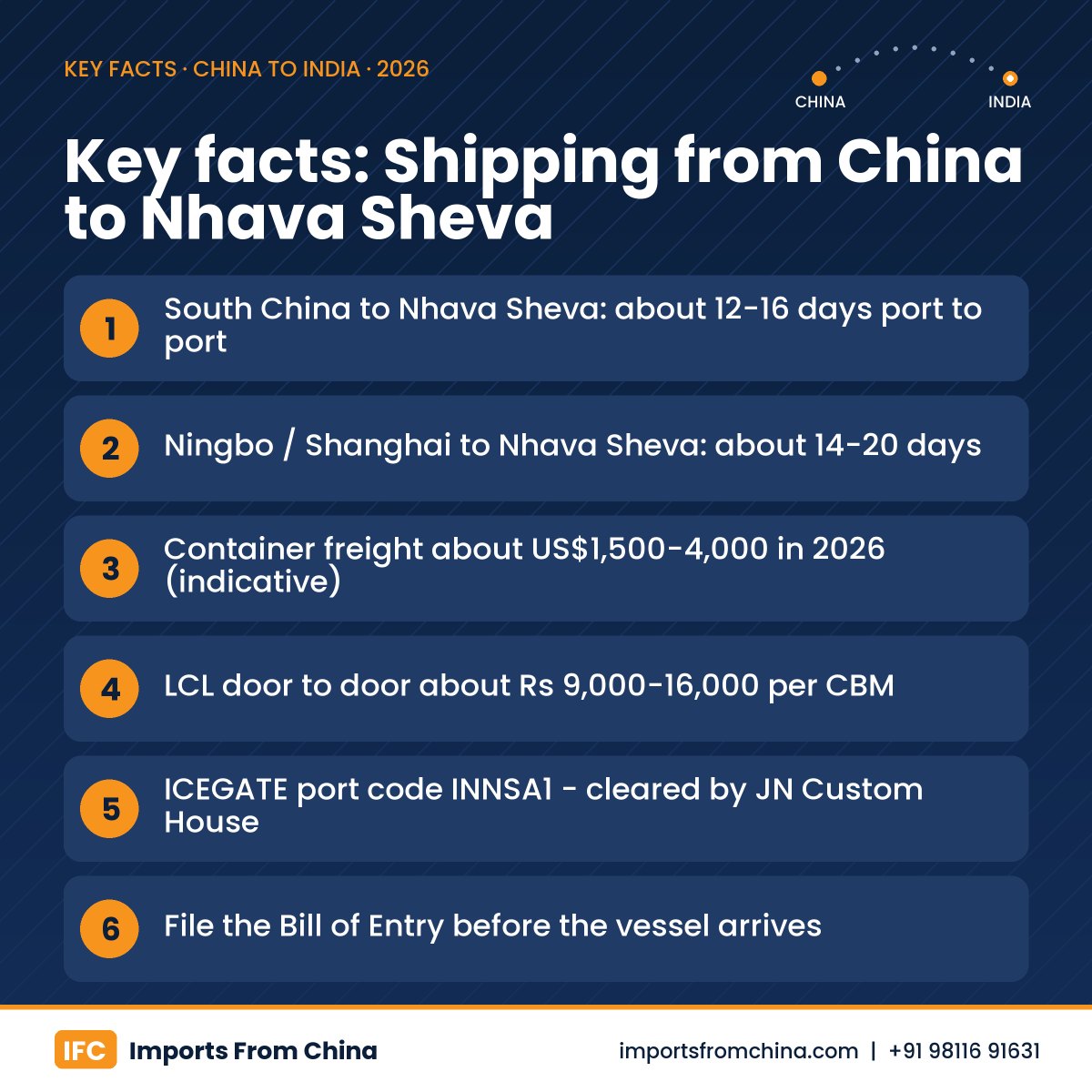
Shipping from China to Nhava Sheva infographic – key facts for Indian importers
Shipping from China to Nhava Sheva: key facts at a glance (IFC – Imports From China)

The five container terminals at JNPA

TerminalOperator (as listed by JNPA)
NSFT – Nhava Sheva Free Port TerminalJ. M. Baxi and CMA Terminals joint venture
NSICT – Nhava Sheva International Container TerminalDP World group (originally P&O Ports)
NSIGT – the standalone north-end terminalDP World Nhava Sheva
GTI – Gateway Terminals IndiaAPM Terminals and CONCOR joint venture
BMCT – Bharat Mumbai Container TerminalsPSA (Port of Singapore Authority) group

You do not choose the terminal; the shipping line’s vessel berths at its contracted terminal. It matters because terminal handling, free time and the CFS your container moves to can differ, so ask your forwarder which terminal and CFS your shipment will use.

How long does shipping from China to Nhava Sheva take?

Chinese portPort-to-port to Nhava Sheva (indicative, Nov 2026)Typical suppliers
Shekou / Yantian (Shenzhen)about 12–16 daysElectronics, mobile accessories, LED
Nansha (Guangzhou)about 12–16 daysFurniture, garments, home goods, cosmetics packaging
Xiamenabout 13–18 daysStone, ceramics, sports shoes
Ningbo / Shanghaiabout 14–20 daysYiwu goods, hardware, tools, machinery
Qingdao / Tianjin (north China)about 18–24 days, more if transhippedTyres, chemicals, heavy machinery

Port-to-port is only the sea part. Door to door, add 3–7 days in China (pickup, export customs and loading) and 3–7 days in India (unloading, CFS movement, customs and delivery). A realistic door-to-door plan is 4–5 weeks for FCL and 3–6 weeks for LCL. Air cargo, by comparison, takes 5–10 days door to door. More detail: how long sea shipping from China to India takes.

Expect delays before Chinese New Year and the Golden Week holiday, and in the weeks before Diwali, when space tightens and rates rise. Monsoon weather at Nhava Sheva (June–September) can also slow berthing.

What does shipping from China to Nhava Sheva cost?

A China–Nhava Sheva quote has three layers. Compare each layer, not only the ocean freight number.

Cost layerWhat it includesIndicative (Nov 2026)
China sidePickup from factory, export customs, China THC, documentsDepends on Incoterm – included if you buy FOB
Ocean freightPort to port, China → Nhava Shevaabout US$1,500–4,000 per 20 ft / 40 ft container
Nhava Sheva chargesTHC, delivery order (DO), BL fee, CFS handling, examination, storageQuoted per container or per CBM by line and CFS
CustomsCHA fee, Basic Customs Duty, SWS, AIDC, IGSTDuty depends on your HS code
DeliveryTruck from CFS or terminal to your warehouseDepends on city and vehicle size
LCL door to door (DDP)All of the above in one rateabout ₹9,000–16,000 per CBM

Ocean freight rates change every week. They rise before Diwali and Chinese New Year and fall in slack months, so always take a quote with a validity date. For a full breakdown of container rates and CBM capacity, see our guide on container cost from China to India. For small loads, read LCL shipping from China to India; LCL is usually cheaper below about 13–15 CBM.

Which charges will you pay at Nhava Sheva port?

These are the line items most first-time importers do not expect. Ask your forwarder to list each one in writing before the vessel sails.

  • Terminal Handling Charges (THC): charged by the shipping line for handling the container at the terminal.
  • Delivery Order (DO) and documentation: the line or its agent issues the DO after freight and local charges are paid; without it, your CHA cannot take delivery.
  • CFS charges: most import containers at Nhava Sheva move to a Container Freight Station for customs examination and, for LCL, de-stuffing. The CFS charges for handling, movement, storage and any examination.
  • Examination charges: if the Risk Management System marks your Bill of Entry for examination, there are extra labour and handling fees.
  • Demurrage and detention: after the free days end, the CFS charges storage (demurrage) and the shipping line charges for keeping its container (detention). These grow every day, so file documents early.
  • CHA (customs broker) fee: for filing the Bill of Entry and handling assessment and Out of Charge.

Direct Port Delivery (DPD): eligible importers, such as AEO-certified firms, can take FCL containers straight from the terminal to their premises without going through a CFS. This saves CFS charges and a day or two. Most small and new importers will still go through a CFS.

How does customs clearance work at Nhava Sheva (JNCH)?

Customs at Nhava Sheva is handled by the Jawaharlal Nehru Custom House. On ICEGATE, the port code is INNSA1. The process is the same as at other Indian seaports:

  1. IGM: the shipping line files the Import General Manifest before arrival.
  2. Bill of Entry: your CHA files it on ICEGATE with the commercial invoice, packing list, bill of lading and any licences (BIS, WPC, EPR, FSSAI, CDSCO, as applicable). The law now expects it to be filed before the end of the day before the vessel arrives; late filing attracts charges.
  3. Assessment: faceless assessment checks the HS code, value and duty. Queries are raised online.
  4. Duty payment: BCD, SWS, AIDC and IGST are paid online through ICEGATE.
  5. Examination: if selected by the Risk Management System, goods are examined at the CFS or terminal.
  6. Out of Charge: customs releases the goods, and after paying CFS and line charges the container or cargo is gated out for delivery.

With correct documents, clearance at Nhava Sheva usually takes 2–4 working days after arrival. Wrong HS codes, undervalued invoices and missing BIS or WPC approvals are the most common reasons for longer holds. Full details: how customs clearance works for imports in India and the documents required for import from China.

Worked example: a 40 ft container of furniture to Nhava Sheva

An interior design firm in Pune imports a 40 ft high cube container of wooden furniture from Foshan through Nansha. Assumptions: FOB value US$25,000; ocean freight US$3,000; insurance US$100; CIF US$28,100; exchange rate ₹95.35 per US$ (CBIC Notification 31/2026, effective 18 November 2026); HS code 9403 60 00 with 20% BCD, 5% AIDC, SWS nil and 18% IGST (rates as of November 2026; confirm for your exact HS code).

LineWorkingAmount (₹)
Assessable value (CIF)US$28,100 × 95.3526,79,335
Basic Customs Duty20% of AV5,35,867
AIDC5% of AV1,33,967
IGST baseAV + BCD + AIDC33,49,169
IGST18% of IGST base6,02,850
Duty + IGST at Nhava ShevaBCD + AIDC + IGST12,72,684

Notice that duty and IGST (about ₹12.7 lakh) are more than four times the ocean freight (about ₹2.9 lakh). The IGST of ₹6.03 lakh is usually claimable as input tax credit if the firm’s GSTIN is on the Bill of Entry; BCD and AIDC are a cost. Add Nhava Sheva charges, the CHA fee and a truck to Pune (about 120–150 km). Furniture also needs BIS compliance under the furniture QCO and plant quarantine clearance for wood, so check these before shipping. To work out duty and IGST on any product, read our guides on import duty from China to India and IGST on imports in India.

Nhava Sheva or Mundra: which port should you choose?

Your city / needUsually better portWhy
Mumbai, Thane, Navi Mumbai, Pune, NashikNhava ShevaShort truck run after clearance
Goa, Belagavi, KolhapurNhava ShevaRoad access down the west coast
Ahmedabad, Surat, RajkotMundra (or Hazira)Closer and often cheaper trucking
Delhi NCR, Punjab, Haryana, UPMundra or an ICD (Tughlakabad, Patparganj)Rail links; compare total door cost
Chennai, Bengaluru, HyderabadChennai or KattupalliEast coast is closer to South India

The cheapest ocean freight is not always the cheapest door cost. Ask for a door-to-door comparison for two ports. IFC delivers door to door to many Indian cities – see China to India delivery cities.

How to avoid delays and extra charges at Nhava Sheva

  • Confirm the HS code, BIS, WPC and other licences before the goods leave China.
  • Get the commercial invoice, packing list and bill of lading checked by your CHA before the vessel sails.
  • Pay the shipping line’s freight and local charges early so the DO is ready on arrival.
  • File the Bill of Entry in advance and keep funds ready in ICEGATE for duty and IGST.
  • Declare the real transaction value; undervaluation is the fastest way to a hold and a penalty.
  • Book trucks in advance during peak months, and track your container’s free days.
  • For small loads, use consolidated LCL with DDP delivery so one party handles every step.

How IFC helps with shipping from China to Nhava Sheva

IFC (Imports From China) has handled China–India import and export for 20+ years, since 2004. The company is founded and led by Mayank Dang (CA Sahab), a Chartered Accountant (FCA, ICAI), and has served 5000+ businesses.

  • Own offices in Guangzhou and Yiwu with translators and English-speaking staff for sourcing, supplier verification and quality inspection.
  • Daily loading of mixed containers and air cargo, plus LCL and FCL sea freight.
  • Customs clearance with HSN, BIS and duty guidance – see our custom clearance service.
  • Door-to-door DDP delivery to major cities including Mumbai, Pune, Delhi, Gurugram, Noida, Bengaluru, Hyderabad, Chennai and Ahmedabad. Read DDP shipments from China to India.
  • A warehouse at our headquarters for receiving and onward delivery.

If you do not want to deal with THC, DO, CFS and duty yourself, a DDP quote gives you one all-in price to your door. You can get a quote online.

Conclusion

Shipping from China to Nhava Sheva is the natural route for Mumbai, Pune and most of western India: about 12–20 days at sea from the main Chinese ports and 3–6 weeks door to door. The ocean freight is the smallest part of the bill; port charges, CFS fees, duty and IGST matter more. Plan documents early, file the Bill of Entry in advance and compare door-to-door costs across ports before you book.

Mayank Dang (CA Sahab), Founder and CEO of IFC

This guide on shipping from China to Nhava Sheva was reviewed by Mayank Dang (CA Sahab), Founder & CEO of IFC

Chartered Accountant (FCA, ICAI) who has helped 5000+ Indian businesses import from China since 2004 – sourcing, BIS, HSN classification, import duty, customs and GST compliance. mayankdang.in

Get your real landed cost: enter your product, weight and CBM in the IFC shipment calculator, check your HS code on the India import duty rates page, or call IFC on +91 98116 91631 for a door-to-door DDP quote from China to your city.

Frequently asked questions

How many days does it take to ship from China to Nhava Sheva?

About 12 to 16 days port to port from South China ports such as Shekou, Yantian and Nansha, and 14 to 20 days from Ningbo or Shanghai. North China ports can take longer. Door to door, plan 4 to 5 weeks for FCL and 3 to 6 weeks for LCL (indicative, November 2026).

What is the cost of a 20 ft container from China to Nhava Sheva?

In 2026, port-to-port ocean freight for a 20 ft or 40 ft container from main Chinese ports to Nhava Sheva was quoted at roughly 1,500 to 4,000 US dollars, depending on the month and route. Nhava Sheva THC, DO, CFS charges, customs duty, IGST and trucking are extra.

Is Nhava Sheva the same as JNPT?

Yes. Nhava Sheva is the location of the Jawaharlal Nehru Port in Navi Mumbai. It was earlier called JNPT and is now run by the Jawaharlal Nehru Port Authority (JNPA). Customs clearance there is handled by the Jawaharlal Nehru Custom House, port code INNSA1 on ICEGATE.

What is the port code of Nhava Sheva for the Bill of Entry?

On ICEGATE, Nhava Sheva sea port is INNSA1, and the UN location code is INNSA. Your CHA files the Bill of Entry for this location with the Jawaharlal Nehru Custom House.

What charges are paid at Nhava Sheva port for imports?

Typical charges are terminal handling (THC), delivery order and documentation fees from the shipping line, CFS handling and storage, examination charges if goods are checked, demurrage or detention after free days, the CHA fee, and customs duty with IGST. Ask your forwarder to list them before shipping.

How long does customs clearance take at Nhava Sheva?

With correct documents and an advance Bill of Entry, clearance usually takes 2 to 4 working days after the vessel arrives. Examination, valuation queries, wrong HS codes or missing BIS or WPC approvals can add several days and storage charges.

Should Delhi importers use Nhava Sheva or Mundra?

Delhi NCR importers often find Mundra or direct routing to an ICD such as Tughlakabad or Patparganj better for total door cost. Nhava Sheva can still work by rail. Compare door-to-door quotes for both routes, including inland transport and clearance.

Import Bicycle Parts from China: What Indian Buyers Check

To import bicycle parts from China to India, you find a verified manufacturer, confirm specifications and samples, pay through a secure method, ship by air or sea, and clear customs with the correct HS code and documents. Indian buyers in Delhi and across the country use this route for frames, forks, brakes, wheels, drivetrain parts and accessories because China has a large, mature cycle component industry. The key is checking each step before money moves.

What counts as bicycle parts in an import order

Bicycle parts is a broad term. Before you request quotes, split your order into clear component groups. Suppliers quote differently for each group, and customs treats some items separately.

  • Frames and forks, including steel, aluminium and carbon structures
  • Wheels, rims, hubs and spokes
  • Brake systems, such as calipers, disc rotors and levers
  • Drivetrain parts, including chainsets, cassettes, derailleurs and chains
  • Saddles, seat posts, handlebars, stems and grips
  • Tyres, inner tubes and rim tapes
  • Lights, bells, racks and other accessories

Listing parts by component, with material, finish, size and quantity, makes quotes comparable. It also helps your customs broker assign the right classification.

Why Indian buyers source bicycle parts from China

China has many component factories at different price points, from basic parts for entry-level bicycles to precision parts for export-grade products. Indian assemblers, distributors and online sellers often source from China to compare cost and range. The challenge is that prices vary widely, and a low quote can hide weaker material, poor finish or inconsistent tolerances. A structured sourcing process protects your margin.

Checks to complete before you place an order

Verify the supplier

Confirm the company name, business licence, factory address and production capacity. Ask for factory photos or a video call that shows the production line. Trading companies can be useful, but you should know whether you are buying from a factory or a middleman. Our guide on how IFC verifies suppliers in China explains this process in more detail.

Get a detailed specification sheet

Write down material grade, weight limits, dimensions, thread standards, coating type, colour and packaging requirements. For brakes, drivetrain and frame parts, ask for test reports or certificates where the supplier has them. Vague specifications lead to disputes after delivery.

Order and test samples

Order pre-production samples for every key component. Fit them on a test bicycle or measure them against your drawings. Check paint adhesion, weld quality, bolt torque and surface finish. Approve a sample in writing, and reference that approved sample in your purchase order.

Plan for inspection before shipment

Pre-shipment inspection checks quantity, finish, labelling and packing against the approved sample. This is especially important for bulk orders of wheels, tyres and brake parts, where a small defect rate can cause large losses. A local partner in China can attend the inspection and send photos before the goods leave the factory.

Duty, documents and customs clearance in India

Customs duty, IGST and any other applicable levies depend on the exact product, its HS classification and current notifications. Do not rely on a general rate from a blog. Confirm the position with your customs broker before finalising your landed cost. Keep these documents ready for every shipment:

Document Why it matters
Commercial invoice States value, description, quantity and terms, and is the basis for assessment
Packing list Shows cartons, weights and dimensions, and matches physical cargo
Bill of lading or airway bill Proof of transport contract from the origin to India
Certificate of origin Needed if you claim a preferential tariff under an applicable agreement
Import Export Code (IEC) Required for importing in your business name
Technical specifications or test reports Helps customs understand the goods and supports classification

Errors in description or classification are a common cause of delays. Matching the invoice, packing list and product description is one of the simplest ways to avoid clearance problems.

Air or sea freight for bicycle parts

The right mode depends on order size, urgency and product weight. Bicycle frames and wheels are bulky, so volume often matters more than weight. Sea freight suits planned restocking and full-container or consolidated loads. Air freight suits urgent top-ups, samples and smaller, high-value components. Ask your forwarder for a quote that includes origin charges, freight, destination handling, customs clearance and door delivery, so you can compare total cost rather than only the base freight rate.

Payment safety when buying from China

Do not send full payment to an unverified supplier. A common approach is a deposit before production and balance payment after pre-shipment inspection or against shipping documents. Check the payment terms, bank details and the company name on the invoice carefully. Payments in foreign currency have their own compliance requirements in India, so confirm them with your bank and advisor.

How IFC supports bicycle parts importers

IFC, established in 2004, supports Indian businesses importing from China, with head office in Kirti Nagar, New Delhi, and own offices in Guangzhou and Yiwu, China. Our team helps with product sourcing, supplier verification, factory audit and inspection, payment safety, air and sea shipping, customs clearance and door delivery across India. We have served more than 5000 Indian businesses. For bicycle parts, we help you define specifications, compare suppliers, approve samples and coordinate inspection before shipment.

Frequently asked questions

Can I import bicycle parts from China to India for my own business?

Yes, a registered Indian business can import bicycle parts from China, provided it has the required registrations, such as an IEC, and follows customs and foreign exchange rules. Check the specific product classification and any applicable restrictions with your customs broker before ordering.

How do I find reliable bicycle parts suppliers in China?

Start with a detailed specification sheet, then shortlist suppliers with verifiable business licences, factory addresses and production history. Request samples, check references where possible, and arrange a factory audit or inspection before placing a large order.

What documents do I need to clear bicycle parts at Indian customs?

You generally need a commercial invoice, packing list, bill of lading or airway bill, and your IEC. A certificate of origin may be needed for preferential duty claims, and technical specifications help with classification. Your customs broker can confirm the exact list for your shipment.

Is air or sea freight better for bicycle parts from China?

Sea freight is usually better for large, planned orders where transit time is less important. Air freight is suited to urgent restocking, samples and small, high-value shipments. Compare total landed cost, including clearance and door delivery in India, rather than only the freight rate.

How can I avoid payment risk when importing bicycle parts from China?

Avoid paying the full amount upfront to an unverified supplier. Use a staged payment structure tied to production milestones or inspection, verify bank details independently, and keep all approvals and payment records in writing.

Ready to source bicycle parts from China for your Indian business? WhatsApp IFC on +91 98116 91631 or visit importsfromchina.com to discuss your specifications, suppliers, inspection and door delivery across India.

IGST on imports in India

IGST on Imports in India: How It Is Calculated and Claimed (2026)

IGST on imports in India is the GST that customs collects on goods arriving from abroad. It is charged on the assessable value plus basic customs duty, Social Welfare Surcharge and any other customs duties, at the same GST rate as the item has in India (5%, 18% or 40% after GST 2.0). A GST-registered business can usually claim it back as input tax credit.

This guide explains the IGST formula step by step, shows a full ₹ worked example for a China shipment, lists the conditions to claim credit, and covers the mistakes that make importers lose money at the port or in their GST returns.

Key takeaways

  • Where it comes from: IGST on imported goods is levied under Section 3(7) of the Customs Tariff Act and collected on the Bill of Entry.
  • Formula: IGST = rate × (assessable value + BCD + SWS + AIDC + any anti-dumping or safeguard duty).
  • Rates: same as the domestic GST rate for that HS code – mostly 5% or 18% since 22 September 2025, 40% for luxury and sin goods.
  • Credit: IGST is claimable as ITC if your GSTIN is on the Bill of Entry and the goods are for business; BCD, SWS and AIDC are not.
  • Deadline: claim the credit by 30 November after the end of the financial year (or the annual return date, if earlier).
  • Cash flow: IGST is paid upfront at customs, so budget for it even though you get it back later.

What is IGST on imports in India?

When goods enter India, customs collects two broad types of charges. The first is customs duty: Basic Customs Duty (BCD), the Social Welfare Surcharge (SWS), the Agriculture Infrastructure and Development Cess (AIDC) where notified, and anti-dumping or safeguard duty on some products. The second is IGST (Integrated Goods and Services Tax).

Under GST law, an import of goods is treated as an inter-state supply. The IGST Act says IGST on imported goods is levied and collected in line with the Customs Tariff Act, and Section 3(7) of that Act adds an ‘additional duty’ equal to the GST on a like domestic product. In practice this means three things for an importer:

  • IGST is paid to customs, together with duty, before your goods get Out of Charge – not later in your GST return.
  • The rate is the same rate that applies to that product when sold inside India.
  • Because it is a GST, a registered business can use it as input tax credit, unlike BCD, SWS and AIDC, which are a pure cost.

If you are new to the duty structure, start with our guide on import duty from China to India, then come back here for the IGST part.

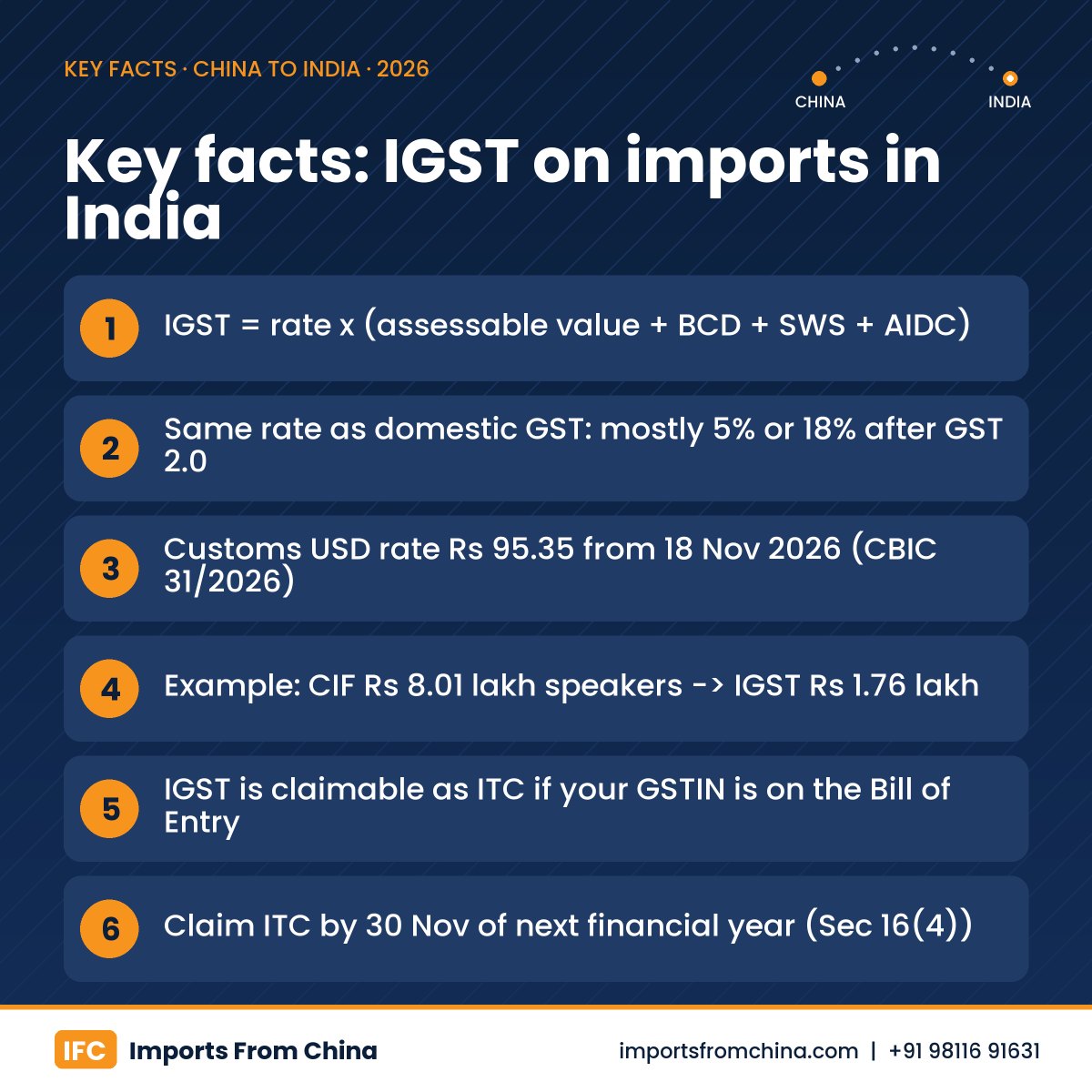
IGST on imports in India infographic – key facts for Indian importers
IGST on imports in India: key facts at a glance (IFC – Imports From China)

How is IGST on imported goods calculated?

Section 3(8) of the Customs Tariff Act fixes the value on which IGST is charged. It is not just the invoice value. It is the assessable value plus every customs duty charged before it, except IGST itself and the GST compensation cess.

Step-by-step formula

  1. Step 1 – Assessable value (AV): the CIF value (cost + insurance + freight up to the Indian port) converted to rupees at the CBIC customs exchange rate. If you buy FOB or EXW, customs adds the freight and insurance. There is no separate 1% landing charge since 2017.
  2. Step 2 – BCD: AV × BCD rate for your HS code.
  3. Step 3 – SWS: 10% of BCD, unless the item is exempt from SWS (many items that carry AIDC have SWS at nil).
  4. Step 4 – AIDC, anti-dumping or safeguard duty: add these where notified for your product and origin.
  5. Step 5 – IGST base: AV + BCD + SWS + AIDC + other duties.
  6. Step 6 – IGST: IGST base × IGST rate.

The exchange rate matters. CBIC notifies a fixed import rate, usually twice a month. Notification No. 31/2026-Customs (N.T.), effective 18 November 2026, sets the US dollar import rate at ₹95.35 and the Chinese yuan at ₹14.40. Customs uses the rate in force on the date your Bill of Entry is filed, not the bank’s rate.

What are the IGST rates on imports after GST 2.0?

From 22 September 2025, GST 2.0 moved most goods into two main slabs, 5% and 18%, with a 40% rate for luxury and sin goods. The old 12% and 28% slabs were removed. Because IGST on imports simply follows the domestic GST rate, these changes apply at customs too. The table shows common China imports with rates from IFC’s duty database.

Product (HS code)BCDSWSAIDCIGST
Bluetooth speaker (8518 21 10)20%10% of BCD–18%
LED lamp (8539 52 00)20%10% of BCD–18%*
Wooden furniture (9403 60 00)20%Nil5%18%
Plastic toys (9503 00 20)70%Nil–5%
Bicycles (8712 00 10)20%Nil15%5%
Solar panels (8541 43 00)20%Nil20%5%

*Some sources quote 5% for certain LED products after GST 2.0, so confirm the exact entry. Rates as of November 2026; confirm for your exact HS code on the India import duty rates page or in the current CBIC notification. Anti-dumping duty, where in force, is added before IGST is worked out.

What about GST compensation cess? For most goods it stopped after GST 2.0, and from 1 February 2026 the cess on tobacco products was also reduced to nil, with excise brought back for those items. For general merchandise imported from China, you should not see compensation cess on your Bill of Entry, but check the current notification if you import tobacco-type or luxury goods.

Worked example: IGST on a China shipment in ₹

Let us take 1,000 Bluetooth speakers bought from a Shenzhen factory at US$8 each FOB, shipped LCL to Nhava Sheva. Assumptions: FOB US$8,000; ocean freight and insurance US$400; CIF US$8,400; exchange rate ₹95.35 (CBIC, 18 November 2026); HS code 8518 21 10 with 20% BCD, SWS at 10% of BCD and 18% IGST.

LineHow it is worked outAmount (₹)
Assessable value (CIF)US$8,400 × 95.358,00,940
Basic Customs Duty20% of 8,00,9401,60,188
Social Welfare Surcharge10% of 1,60,18816,019
IGST base8,00,940 + 1,60,188 + 16,0199,77,147
IGST18% of 9,77,1471,75,886
Total paid to customsBCD + SWS + IGST3,52,093
IGST you can claim as ITCif conditions are met1,75,886
Real tax costBCD + SWS1,76,207

Two lessons from this example. First, many first-time importers calculate 18% on the CIF value only. That gives ₹1,44,169 – about ₹31,700 less than customs will actually ask for, because IGST is also charged on the duty. Second, on the day of clearance you need ₹3.52 lakh in your ICEGATE account, even though half of it comes back later as credit. Freight, CHA, CFS and delivery charges are extra. To see the full landed cost of your own product, use the IFC shipment calculator.

For a broader worked example that covers freight and clearance charges too, read landed cost of a $10 China product in India.

How do you claim input tax credit on IGST paid on imports?

The Bill of Entry is a valid document for claiming input tax credit under the CGST Rules. The IGST you pay at customs flows from ICEGATE to the GST portal and appears in the IMPG section of your GSTR-2B. You then claim it in GSTR-3B like any other credit.

Conditions to claim the credit

  • Your GSTIN must be on the Bill of Entry. If the Bill of Entry is filed with only an IEC, or with the wrong GSTIN or state, the credit will not show in your GSTR-2B.
  • The goods must be used for business. Personal imports and goods used for exempt supplies do not get credit, and blocked items under Section 17(5) of the CGST Act (for example, many motor vehicles for personal use) stay blocked.
  • The IGST must actually be paid and the goods received.
  • Claim it in time. Section 16(4) applies to IGST on Bills of Entry as well – the credit must be taken by 30 November of the following financial year, or the date you file the annual return, whichever is earlier. Advance rulings have refused late credit on imports.
  • Reconcile every month. Match each Bill of Entry number, date and IGST amount with GSTR-2B. Missing entries usually mean a GSTIN error on the Bill of Entry or a delay in ICEGATE data.

Only IGST is creditable. Basic Customs Duty, SWS and AIDC become part of the cost of the goods. So when you compare two products, judge the real tax cost by their BCD, SWS and AIDC, not by the IGST figure on the Bill of Entry.

Do you pay IGST on ocean freight separately?

Until 2022, CIF importers were also asked to pay 5% IGST under reverse charge on the ocean freight paid by the foreign supplier. In Union of India v. Mohit Minerals (May 2022), the Supreme Court struck this down. Ocean freight is already part of the CIF value on which customs charges IGST, so taxing it again was held invalid. Later High Court rulings have applied the same logic to FOB contracts. Today, you should not be paying a separate IGST on ocean freight for goods imported from China. If your forwarder or CA still adds it, ask them to check.

When can IGST on imports be deferred or exempted?

SituationWhat happens to IGSTWho it suits
Normal home consumption Bill of EntryPaid at clearance, credit laterMost traders and Amazon/Flipkart sellers
Customs bonded warehouse / MOOWRPaid only when goods are cleared from the bondImporters who sell in parts or re-export
Advance Authorisation (for exporters)Can be exempt, subject to conditionsManufacturers who export the finished product
EPCG scheme (capital goods)Duty-free import, subject to export obligationFactories importing machinery
DDP import through an agent’s IECAgent pays at customs; you get a local GST invoice and claim credit on thatSmall and first-time importers

Each scheme has conditions and paperwork, so check the current notification before you plan around it. For legal ways to reduce or recover duty, see 9 legal ways to import with zero or lower duty. To compare who pays IGST under different shipping terms, read DDP vs DAP shipping.

What mistakes do importers make with IGST?

  • Using the wrong HS code. The IGST rate follows the HS code. A misclassified product can mean a 5% versus 18% difference, plus penalty and interest if customs re-assesses it.
  • Calculating IGST on CIF only and running short of funds on clearance day.
  • Filing the Bill of Entry without the right GSTIN, so the credit never reaches GSTR-2B.
  • Using a bank exchange rate instead of the CBIC customs rate for duty estimates.
  • Undervaluing the invoice. Customs can reject the declared value and re-assess duty and IGST on a higher value; the extra IGST is creditable, but the extra BCD, interest and penalty are not.
  • Missing the Section 16(4) deadline for old Bills of Entry.

For the full clearance flow – IGM, Bill of Entry, assessment and Out of Charge – read how customs clearance works for imports in India.

How IFC helps with IGST and customs on China imports

IFC (Imports From China) has worked on China–India import and export for 20+ years, since 2004. It is founded and led by Mayank Dang (CA Sahab), a Chartered Accountant (FCA, ICAI), and has served 5000+ businesses. That CA background matters for IGST: classification, valuation and GST credit are where most import costs are won or lost.

  • HSN, duty and GST guidance before you order, so you know the BCD, SWS, AIDC and IGST for your product in advance.
  • Customs clearance with the correct HS code and documents, through our custom clearance service.
  • DDP door-to-door delivery to major Indian cities such as Delhi, Gurugram, Noida, Mumbai, Pune, Bengaluru, Hyderabad, Chennai and Ahmedabad, with duty and IGST handled at customs. See DDP shipments from China to India.
  • Own offices in Guangzhou and Yiwu with translators and English-speaking staff for sourcing, supplier verification and quality inspection.
  • Daily loading of mixed containers (LCL and FCL) and air cargo, with a warehouse at our headquarters.

If you import on IFC’s IEC under DDP, IFC pays the duty and IGST at customs and you receive a local GST invoice. Read importing on IFC’s IEC vs your own IEC to see which suits your business.

Conclusion

IGST on imports in India is easy once you remember one rule: it is charged on the assessable value plus all customs duties, at the same rate the product has under domestic GST. Plan the cash for it, make sure your GSTIN is on the Bill of Entry, reconcile GSTR-2B every month and claim the credit before the Section 16(4) deadline. Get the HS code right and IGST becomes a pass-through cost, not a loss.

Mayank Dang (CA Sahab), Founder and CEO of IFC

This guide on IGST on imports was reviewed by Mayank Dang (CA Sahab), Founder & CEO of IFC

Chartered Accountant (FCA, ICAI) who has helped 5000+ Indian businesses import from China since 2004 – sourcing, BIS, HSN classification, import duty, customs and GST compliance. mayankdang.in

Get your real landed cost: enter your product, weight and CBM in the IFC shipment calculator, check your HS code on the India import duty rates page, or call IFC on +91 98116 91631 for a door-to-door DDP quote from China to your city.

Frequently asked questions

How is IGST calculated on imported goods in India?

IGST is calculated on the assessable value (CIF in rupees) plus Basic Customs Duty, Social Welfare Surcharge, AIDC and any anti-dumping or safeguard duty. The total is multiplied by the IGST rate for the HS code, which is the same as the domestic GST rate, usually 5% or 18% after GST 2.0.

Can I claim input tax credit on IGST paid on imports?

Yes. A GST-registered business can claim the IGST paid on the Bill of Entry as input tax credit if its GSTIN is on the Bill of Entry, the goods are used for business and the credit is not blocked. It appears in the IMPG section of GSTR-2B. Basic Customs Duty and SWS cannot be claimed.

Is IGST on imports charged on CIF value or on value plus duty?

On value plus duty. Customs adds Basic Customs Duty, SWS, AIDC and other duties to the assessable value first, then charges IGST on that total. Calculating IGST on CIF alone underestimates what you will pay at the port.

What is the IGST rate on imports from China?

There is no special China rate. IGST on imports equals the GST rate for that product in India: since 22 September 2025 most goods are at 5% or 18%, and luxury or sin goods at 40%. Anti-dumping duty, where notified for Chinese goods, is added before IGST is worked out.

Which exchange rate is used to calculate IGST on imports?

Customs uses the import exchange rate notified by CBIC, not your bank rate. It is usually revised twice a month. From 18 November 2026, Notification 31/2026 sets the US dollar import rate at 95.35 rupees and the yuan at 14.40 rupees.

Is IGST payable on ocean freight for imports?

No separate IGST is payable on ocean freight for imported goods. In 2022 the Supreme Court, in the Mohit Minerals case, struck down the 5% reverse charge IGST on ocean freight for CIF imports, because the freight is already included in the value on which customs charges IGST.

What is the time limit to claim ITC on IGST paid on a Bill of Entry?

The Section 16(4) limit applies. Credit for a Bill of Entry must be taken by 30 November of the next financial year, or the date of filing the annual return if that is earlier. Late claims have been rejected, so reconcile GSTR-2B every month.

Import Machine Spare Parts from China to India: Buyer Guide

Importing machine spare parts from China to India cuts replacement costs for factories, workshops and fleet operators. Success depends on matching the exact part number or drawing, verifying the supplier, paying securely and planning customs clearance early. IFC, a China import agent based in Kirti Nagar, New Delhi, handles these steps from sourcing to door delivery.

What counts as a machine spare part?

Machine spare parts are replacement components that keep industrial equipment running. Common examples include bearings, gears, seals, belts, couplings, valves, filters, motor parts and wear parts for CNC, textile, packaging, pumping and food processing machines. Many Indian buyers look to China for these parts because the country has a broad manufacturing base for industrial components, which gives buyers more options on price and specification.

Step 1: Match the exact part number before you order

The biggest risk in importing spare parts is ordering something that does not fit. Before you contact any supplier, collect the original machine make, model, serial number and the part number printed on the old component. If the part is worn beyond reading, send clear photos with a ruler or caliper reference and the key dimensions.

OEM, aftermarket and compatible parts explained

  • OEM parts are made by or for the original machine manufacturer. They match the original drawing but usually cost more.
  • Aftermarket parts are made by third-party manufacturers to fit the original machine. Quality varies, so material and tolerance checks matter.
  • Compatible parts are cross-referenced to an OEM number but may differ in design. Confirm the fit with the machine’s technical team before bulk ordering.

Step 2: Verify the supplier and the factory

Many spare parts are sold through trading companies rather than factories. A trader can be useful, but you should know who actually makes the part. Ask for the factory name, address and business licence, and check that the same details appear on the invoice and quotation.

Check What to look for Why it matters
Business licence Company name matches the invoice Confirms who you are actually paying
Factory identity Real address, production floor photos or video Shows whether the seller manufactures the part
Sample test Dimensions, material and fit checked against your original part Prevents costly fitting failures
Factory audit On-site inspection before the first large order Confirms capacity and quality control
Pre-shipment inspection Count, markings and packaging checked before dispatch Catches errors before goods leave China

IFC offers supplier verification, factory audit and inspection services across its offices in Guangzhou and Yiwu, which helps Indian buyers confirm these points before paying.

Step 3: Pay safely

Payment terms protect you if the parts are wrong or late. For first orders, avoid paying the full amount upfront to an unverified seller. A common approach is a partial deposit, a balance against shipping documents or after inspection, and a clear record of every agreed specification. For larger orders, a letter of credit can add security. Payments to China must follow Indian foreign exchange rules, so confirm the process with your bank before the first transfer.

Step 4: Plan customs clearance and duty

Customs duty on spare parts depends on the product’s HS code, its description and any applicable rules for the item. Do not rely on a supplier’s guess. Ask your customs broker to confirm the HS code before shipment, and keep the description on your invoice accurate and consistent with the actual part.

Typical shipping documents include the commercial invoice, packing list, bill of lading or airway bill, and a certificate of origin where a preferential rate may apply. The importer needs a valid Importer Exporter Code (IEC) for imports into India. Parts that fall under any product certification requirement must be cleared before the goods reach port, so check this early.

Air or sea freight for spare parts?

The right mode depends on how urgent the part is and how much it weighs. Air freight suits small, high-value or breakdown-critical parts where a few days can save a production line. Sea freight suits larger orders, heavy castings or stock replenishment where lead time matters less than cost. Many buyers use both: air for emergency spares and sea for planned stock.

Common mistakes to avoid

  • Ordering without the machine serial number or a dimensioned drawing.
  • Accepting a supplier photo as proof of the factory.
  • Paying the full amount before any sample or inspection.
  • Using a vague product description that causes customs queries.
  • Ignoring packaging, which can lead to rust or breakage on long transit.
  • Not budgeting for door delivery and local handling charges in India.

How IFC supports machine spare parts imports

IFC, established in 2004, supports Indian buyers from the first enquiry to delivery. Its services cover product sourcing, supplier verification, factory audit and inspection, payment safety, air and sea shipping, customs clearance and door delivery across India. With its head office in Delhi and offices in Guangzhou and Yiwu, IFC has served more than 5000 Indian businesses.

Frequently asked questions

Can I import machine spare parts from China to India without a trader?

Yes, you can deal directly with a factory, but direct buying requires language support, price comparison, quality checks and export paperwork. Many buyers prefer an experienced agent for verification, inspection and customs coordination, especially for their first few orders with a new supplier.

Do I need an IEC to import spare parts from China?

Generally, an importer needs a valid Importer Exporter Code to bring goods into India commercially. Your customs broker or agent can confirm the requirement for your specific product and business structure before you place the order.

How do I know if a spare part is an exact match?

Compare the part with the original using dimensions, material, markings and a sample fitting test. Share the machine model and serial number with the supplier, and approve a sample before bulk production begins. Do not rely on a photo alone for critical components.

Is air freight better than sea freight for machine parts?

Air freight is better for urgent, small or breakdown-critical parts, because it reduces transit time. Sea freight is more economical for heavy or bulk orders with planned lead times. Many Indian buyers combine both, using air for emergency stock and sea for regular replenishment.

What should I check before paying a Chinese spare parts supplier?

Confirm the company name, factory address and business licence, check that they match your invoice, and request samples or a factory video. Agree on payment milestones tied to inspection, and keep written records of every specification, price and delivery commitment.

Ready to import machine spare parts from China?

Share your machine make, model and part number on WhatsApp at +91 98116 91631, or visit importsfromchina.com to start your enquiry. IFC will help you verify the supplier, inspect the goods and deliver them to your door across India.

Import Home Decor from China to India: Buyer Guide

To import home decor from China to India, you find a verified Chinese factory or wholesaler, confirm the HS code and duty for your product, pack items to survive long transit, and ship by sea or air to an Indian port or your door. IFC, based in Kirti Nagar, New Delhi, supports Indian buyers with sourcing, factory inspection, payment safety, shipping and customs clearance.

Where Indian buyers source home decor in China

Most home decor for the Indian market comes from a few manufacturing and wholesale hubs. Yiwu is known for small commodity goods, artificial plants, photo frames and seasonal decor. Guangzhou and the Pearl River Delta have strong lighting, furniture accessories and mid-range décor manufacturers. Many Indian buyers also compare listings on 1688 and Alibaba before shortlisting suppliers. IFC has its own offices in Guangzhou and Yiwu, so buyers can have local team members check samples and factories on the ground.

Platform listings are a starting point, not proof of quality. A low price on a marketplace can hide weak finishing, thin glass, poor paint or unstable packaging. Always request sample photos, material specifications and a production timeline before you commit to a bulk order.

Import home decor from China to India: key steps

  1. Define the product range, material (ceramic, glass, wood, metal, resin, fabric) and target price per unit.
  2. Shortlist suppliers and ask for company registration, factory photos and past export records.
  3. Order paid samples and test finish, colour, weight and packing.
  4. Confirm the HS code and duty with your customs broker before finalising the price.
  5. Arrange a pre-shipment inspection at the factory.
  6. Choose sea or air freight, book the shipment and prepare documents.
  7. Clear customs at the Indian port or airport and arrange delivery to your warehouse or store.

What to check before you place a bulk order

Home decor fails in predictable ways. Use the table below as a quick pre-order checklist.

Check Why it matters What to ask for
Material and finish Coatings, paints and plating can chip or fade in Indian heat and humidity Material datasheet, finish samples, photos under natural light
Breakage risk Glass and ceramic items are the most damaged in transit Carton drop-test details, inner partitions, corner protection
Dimensions and weight Affects freight cost and shelf fit Carton measurements, gross weight per carton, pieces per carton
Electrical parts Lamps, LED decor and battery items may need product certification Component specs, certificates where available, confirmation from your broker
Batch consistency Colour and size can drift between production runs Golden sample signed off by you, pre-shipment inspection

Packing home decor for long-distance shipping

Packing is where many first-time importers lose money. Ask the supplier to use double-wall export cartons, individual inner boxes for fragile pieces, and dividers or corner guards. Mark cartons with clear product codes and handling signs. For sea freight, ask about moisture protection, since containers can sit in humid conditions at ports. Good packing costs a little more per unit but usually saves far more in replacement and claims.

Sea or air freight for home decor

Sea freight suits large, mixed-SKU orders where cost per cubic metre matters more than speed. Air freight suits sample shipments, urgent restocking or small high-value lines. Because home decor is often bulky and light, volume weight can raise air costs, so check the chargeable weight before you choose air.

Understanding landed cost

The supplier price is not what you finally pay. Landed cost usually includes the product price, inland transport in China, export handling, international freight, insurance, customs duty and applicable taxes, port and clearance charges, and last-mile delivery in India. Duty depends on the exact HS code and the product’s classification, so confirm it before you finalise your margin. Do not rely on a general rate for the whole home decor category.

Common cost mistakes

  • Ignoring packaging and carton costs in the unit price
  • Using volume estimates without checking actual carton dimensions
  • Forgetting breakage allowance in the margin calculation
  • Assuming one HS code covers all decor items
  • Paying the full amount before a factory inspection

Payment and supplier safety

Pay in stages linked to production and shipping milestones, not in a single upfront transfer. Confirm the bank account name matches the supplier’s registered company. Keep all communication, specifications and approved samples in writing. IFC’s supplier verification and inspection services help Indian buyers reduce these risks before money leaves India.

How IFC supports home decor importers in India

IFC has served Indian businesses since 2004 and works as a door-to-door China-to-India import company. For home decor, that typically means sourcing from Yiwu or Guangzhou suppliers, verifying the factory, arranging pre-shipment inspection, managing sea or air freight, handling customs clearance in India and delivering to your Delhi, NCR or other Indian address. IFC serves more than 5000 Indian businesses, and buyers can reach the team through WhatsApp for quotes and timelines.

Frequently asked questions

Can I import home decor from China to India for my own store?

Yes. Individual retailers, online sellers and interior businesses can import home decor from China to India. You need a valid import setup, the correct HS code for each product, and a clearance partner who can handle documents. An agent such as IFC can manage supplier payment, shipping and customs so you focus on sales.

Which Chinese cities are best for home decor sourcing?

Yiwu and Guangzhou are the two most common starting points for Indian buyers. Yiwu suits small commodity and seasonal decor with very wide choice, while Guangzhou suits a broader range including lighting and mid-range decor. The best city depends on your product, order size and quality target, so compare samples from both before deciding.

Do home decor items need BIS certification in India?

It depends on the product. Items with electrical components, such as some lamps and LED decor, may fall under product certification rules, while many non-electrical decor items do not. Confirm the HS code, the applicable rules and any certificate requirement with your customs broker before ordering, so you are not surprised at the port.

How do I stop glass and ceramic decor from breaking in transit?

Ask the supplier for export-grade cartons, individual inner boxes, dividers and corner protection, and check packing with a sample carton before bulk production. Choose the right freight mode, avoid overpacking heavy items on top of fragile ones, and include a breakage allowance in your costing. Photograph cartons at the factory during the pre-shipment inspection.

Is sea or air freight better for importing home decor?

Sea freight is usually better for large, bulky home decor orders where cost per unit matters. Air freight is better for samples, urgent replenishment or small high-value shipments. Because decor is often light but bulky, check chargeable weight before choosing air, as volume can make it costlier than expected.

Start your home decor import with IFC

If you are planning to import home decor from China to India, IFC can help you source, verify, inspect, ship and clear your order from start to finish. WhatsApp +91 98116 91631 for a quote, or visit importsfromchina.com to learn more about IFC’s door-to-door import service.

Import Sports Equipment from China to India: Buyer Guide

To import sports equipment from China to India, buyers source products from verified factories, confirm specifications and sample quality, check the HS code and customs duty, pay through a secure method, and ship by air or sea with customs clearance to Delhi or any Indian city. Importers From China (IFC), based in Kirti Nagar, New Delhi, manages each of these steps for Indian businesses.

Why Indian sports brands and retailers import sports goods from China

China is a major manufacturing base for sports and fitness products, including yoga mats, skipping ropes, resistance bands, dumbbells, cricket accessories, badminton shuttles, football goods and home gym equipment. Indian gyms, schools, sports academies, online sellers and retail shops often source these items from China to compare range, packaging and unit cost against local options. IFC has served more than 5000 Indian businesses since 2004 and supports buyers who want to import from China with a structured process.

Step 1: Define the exact sports product before you contact a supplier

Sports goods look simple, but small differences in material, thickness, weight and finish change the product completely. Before requesting quotes, write a specification sheet that covers:

  • Product type, size, colour and logo requirements
  • Material grade (for example, TPE or PVC for yoga mats, steel or cast iron for dumbbells)
  • Weight tolerance and load rating where relevant
  • Packaging method, carton size and labelling needs for India
  • Target order quantity and expected delivery window

A clear brief reduces misunderstandings and makes supplier quotes easier to compare.

Step 2: Find and verify the supplier

Buyers commonly search for sports equipment on 1688 and Alibaba, but a listing alone does not confirm that a factory is real or capable. Verification should check business registration, factory address, production capacity, existing export experience and references. IFC can arrange a factory audit in China and verify whether the supplier matches the company profile before any payment is made. For a detailed method, read how IFC checks suppliers at importsfromchina.com.

Red flags to watch for with sports goods suppliers

  • Prices far below the rest of the market with no explanation of materials
  • Refusal to share factory photos, video tours or business licence details
  • Samples that differ noticeably from the final product photos
  • Pressure to pay full value upfront without any secure payment option

Step 3: Test samples before a bulk order

A sample order is the cheapest way to avoid a costly mistake. For sports goods, check the points that matter most to end users:

Product What to check in the sample
Yoga mats Grip, thickness accuracy, odour, tear resistance
Dumbbells and weights Actual weight against label, coating finish, handle grip
Skipping ropes Rope flexibility, handle joints, length accuracy
Resistance bands Elasticity, latex or material labelling, colour fastness
Cricket or badminton accessories Stitching, balance, finish, packing damage risk

Weigh, measure and test the sample against your written specification, then approve or request changes in writing before production starts.

Step 4: Check the HS code and customs duty before shipping

Every imported product is assigned an HS code, and that code determines the customs duty and any other import conditions that apply. Sports goods can fall under different chapters depending on whether they are complete items, parts or accessories, so the classification should be confirmed before you place the order. IFC can help review the HS code and documentation so that customs clearance in India is smoother. For a broader view, see IFC’s guide to customs clearance for China imports at importsfromchina.com.

Step 5: Choose sea or air freight for sports equipment

The right shipping mode depends on weight, volume, urgency and budget. Bulky items such as home gym equipment, large dumbbell sets and heavy bags usually suit sea freight, while small sample batches, urgent restocks or lightweight accessories may suit air freight.

  • Sea freight: better for large volumes and heavy or bulky sports goods
  • Air freight: faster for samples, small batches and time-sensitive orders
  • Door delivery: an option where the shipping partner handles the journey to your Indian address

Step 6: Pay the supplier safely

Payment terms should protect both sides. Avoid paying the full amount to an unverified supplier without a clear record of what is being bought. Common options include bank transfer with milestone payments, and buyers should understand the rules and documentation needed for each method. IFC supports buyers with payment safety guidance, including staged payments linked to production and inspection milestones.

Step 7: Inspect goods before they leave China

A pre-shipment inspection checks the finished goods against the approved sample, carton count, labelling and packing before dispatch. This is important for sports equipment because defects such as loose handles, uneven coatings or wrong weights are difficult to fix after the goods reach India. Inspection and audit are separate services: an audit checks the factory, while an inspection checks the goods.

Step 8: Plan Indian customs clearance and delivery

Customs clearance requires a complete set of documents, including the commercial invoice, packing list, bill of lading or airway bill, and the correct HS classification. Importers in India generally need an Import Export Code (IEC) from DGFT for commercial imports, unless a specific exemption applies. Confirm with your customs broker or import partner which product-specific requirements apply to your item before shipment.

Common mistakes Indian buyers make when importing sports goods

  • Ordering based on photos alone without approving a physical sample
  • Not specifying material grade, weight or safety requirements in writing
  • Ignoring HS code classification until goods reach port
  • Choosing the cheapest freight option without checking transit time for the season
  • Skipping pre-shipment inspection for a first bulk order

How IFC supports sports equipment importers in India

IFC offers a door-to-door China to India import service covering product sourcing, supplier verification, factory audit, pre-shipment inspection, payment safety, air and sea shipping, customs clearance and delivery across India. With head office in Kirti Nagar, New Delhi, and own offices in Guangzhou and Yiwu, China, IFC works with Indian buyers from first enquiry to final delivery.

Frequently asked questions

Is it legal to import sports equipment from China to India?

Yes, sports equipment can be imported from China into India, provided the importer follows Indian import rules, obtains the required registration such as an IEC for commercial imports, pays applicable customs duty and meets any product-specific requirements. Buyers should confirm the HS code and conditions for their exact product before ordering.

Should I use sea or air freight for sports goods from China?

Sea freight is usually better for large, heavy or bulky sports goods such as home gym equipment and large dumbbell sets, because it costs less per unit at volume. Air freight suits samples, small batches and urgent restocks. The best choice depends on weight, volume, timeline and budget for each shipment.

How can I check sports equipment quality before a bulk order?

Order a sample, measure and weigh it against your written specification, and test functional points such as grip, stitching, elasticity or handle strength. Request a pre-shipment inspection before dispatch, which checks the finished goods against the approved sample, carton count and labelling. Keep all approvals in writing.

Do I need an IEC to import sports goods from China into India?

In most commercial cases, an Import Export Code (IEC) issued by DGFT is required to import goods into India. Certain exemptions and personal import rules exist, so buyers should confirm their own situation with a customs broker or import partner before shipping.

What should I check in the HS code and customs duty for sports equipment?

Check that the HS code matches the exact product type, whether it is a complete item, part or accessory, and whether any import conditions apply. Confirm the customs duty and any other applicable charges for that code before finalising your landed cost. Correct classification helps avoid delays and disputes at customs clearance.

Talk to IFC before you import sports goods

If you are planning to import sports equipment from China to India, IFC can review your specification, verify the supplier, arrange sample testing and inspection, and manage shipping and customs clearance to your Indian address. Call or WhatsApp +91 98116 91631, or visit importsfromchina.com to start your enquiry.

Import Shoes from China to India: Buyer’s Guide

To import shoes from China to India, you need to find a verified footwear factory, approve samples, pay through a secure method, and clear the shipment at an Indian port with the correct HS code and documents. Most first-time buyers use an import agent such as IFC (Imports From China), which manages sourcing, factory checks, inspection, shipping and customs in one process.

Why Indian businesses import shoes from China

China has a large footwear manufacturing base with factories that handle everything from basic casual shoes to sports and safety footwear. Indian retailers, online sellers, wholesalers and school uniform suppliers often source from China to compare design options, price points and production capacity. The real challenge is not finding a factory, but finding a reliable one that matches your specification and delivers on time.

Step 1: Define the shoe type and specification

Before you contact any supplier, write a clear specification sheet. A good sheet covers the shoe type, upper material, sole material, sizes and size ratio, colours, logo method, packing style and target price. Vague briefs lead to wrong samples and costly revisions. If you plan to sell in India, also confirm the target market, such as Delhi retail, e-commerce marketplaces or institutional orders.

Step 2: Check the HS code and customs requirements

Every import needs an HS code, which determines the customs duty and any compliance requirement that applies. Footwear is classified in its own chapter of the Indian tariff, but the exact code depends on the material, whether the upper is leather or textile, and the type of sole. Confirm the code with your customs broker before you place an order, and check current duty rates on the official tariff, since rates can change in the Union Budget. You can also read IFC’s guides on customs duty basics and HS code checks for more detail.

Step 3: Find and verify the footwear factory

Sourcing from marketplaces such as 1688 or Alibaba gives you access to thousands of footwear suppliers, but it also makes verification essential. A trading company and a factory can look identical on screen, and prices can hide weak quality. Verify the business licence, factory address, production lines, staff numbers and past export records. Ask for factory photos or videos that show the actual production floor, not only showroom images.

Factory vs trading company

A factory usually gives better control over materials and lead times. A trading company can help with small orders and multiple product types, but you need to confirm which party actually produces your shoes. IFC’s supplier verification process checks these points before a buyer pays a deposit.

Step 4: Approve samples before bulk production

Never skip the sample stage. Ask for a pre-production sample in the exact material, colour and size you plan to order. Measure the sole thickness, check stitching, test glue strength and compare the sample against your specification sheet. Approve the sample in writing, with photos, so there is no confusion later.

Step 5: Quality checks and pre-shipment inspection

A pre-shipment inspection checks the finished goods before they leave China. It is one of the most useful steps for footwear, because defects such as uneven stitching, colour mismatch, wrong size runs and weak soles are often visible only after the shipment reaches India.

Check What to confirm Why it matters
Size ratio Quantity per size matches the order Wrong ratios leave unsold stock in India
Materials Upper, lining and sole match the approved sample Substitution is a common cost-cutting issue
Workmanship Stitching, glue lines, eyelets and finishing Defects cause returns and complaints
Labelling Carton labels, barcodes and product tags Needed for marketplace listings and customs
Packing Carton strength, pairs per carton, moisture protection Damage in transit affects the whole order

Step 6: Pay the supplier safely

Use payment methods that give you some protection. Common options include bank transfer against a proforma invoice, staged payments tied to production and inspection milestones, and trade assurance on platforms that offer it. Avoid paying the full amount upfront to an unverified contact. Keep all invoices, contracts and payment receipts, as you will need them for customs and for your books.

Step 7: Shipping and customs clearance in India

Footwear is commonly shipped by sea freight for bulk orders and by air for urgent or small orders. Sea freight is usually more economical for full containers, while air suits sample runs and fast-moving lines. Your shipment will need a commercial invoice, packing list, bill of lading or airway bill, and the correct import documents. Customs clearance in India requires an Importer Exporter Code (IEC) unless you use an agent with a suitable arrangement. IFC handles customs clearance and door delivery across India, so buyers in Delhi, Mumbai, Bengaluru and other cities do not need to manage each port step alone.

Common mistakes Indian buyers make

  • Ordering bulk production without an approved sample
  • Paying a large deposit to an unverified supplier
  • Skipping a pre-shipment inspection to save a small fee
  • Choosing the wrong HS code and facing a classification dispute
  • Not confirming the size ratio and colour breakdown in writing
  • Forgetting that landed cost includes freight, duty, clearance and local delivery

Frequently asked questions

Is it profitable to import shoes from China to India?

It can be, but profit depends on your product cost, freight, customs duty, clearance charges, local delivery and selling price. Calculate the full landed cost before you order, including every charge up to your warehouse in India, and compare it with your target retail or wholesale price.

Which documents are needed to import shoes from China to India?

Most shipments need a commercial invoice, packing list, bill of lading or airway bill, and an IEC for the importer, unless an agent handles the clearance under their arrangement. Your customs broker can confirm the exact documents required for your product and shipping mode.

How do I check a Chinese shoe supplier before paying?

Check the business licence, factory address, production capacity and export history. Ask for live factory video, sample approval and references where possible. A third-party factory audit or verification service adds another layer of protection before you transfer a deposit.

Should I use sea freight or air freight for shoes?

Sea freight is generally better for large, regular orders where cost per unit matters. Air freight suits samples, urgent restocking and smaller quantities. Compare total cost and transit time for your order size, and remember that lead times in production also affect when goods are available for sale.

Can IFC help with shoe imports from China to India?

Yes. IFC offers product sourcing, supplier verification, factory inspection, payment safety, air and sea shipping, customs clearance and door delivery across India. Its head office is in Kirti Nagar, New Delhi, with offices in Guangzhou and Yiwu, China, and it has served more than 5000 Indian businesses.

Start your footwear import with IFC

If you are planning to import shoes from China to India, IFC can help you define your specification, verify suppliers, arrange inspection, ship the goods and clear customs through to door delivery. Send your product details on WhatsApp at +91 98116 91631 or visit importsfromchina.com to discuss your requirement.

Import Textiles from China to India: Fabric Buyer Guide

To import textiles from China to India, buyers usually source fabric or finished garments from Chinese mills or wholesalers, approve a physical sample, confirm specifications such as GSM, width, composition and shrinkage, then ship by sea or air under a clear incoterm. Customs duty depends on the exact HS code and fabric type, so verify it before ordering. IFC (Imports From China), based in Kirti Nagar, New Delhi, supports Indian buyers with supplier checks, inspection, payment safety, shipping and customs clearance.

Why Indian buyers import textiles from China

China is one of the largest producers of synthetic and blended fabrics, and many Chinese mills offer a wide range of weights, finishes and colours. Indian garment makers, home-textile brands, bag and upholstery manufacturers, and online sellers often look at Chinese suppliers on platforms such as 1688 and Alibaba to compare fabric options that may not be easily available locally in the required quantity or price band.

The trade is not only about price. Buyers also look for consistent batch quality, faster access to new prints or weaves, and the ability to source technical fabrics such as lining, interlining, mesh, nylon or polyester blends. Each of these benefits depends on careful specification and sample control, which is where many first-time importers run into problems.

Step 1: Define the fabric specification in writing

Vague requests like "good quality cotton" lead to disputes. A usable specification sheet for a textile import normally includes:

  • Fibre composition, for example 65 per cent polyester and 35 per cent cotton
  • Weight in GSM (grams per square metre) with an acceptable tolerance
  • Width in inches or centimetres and selvedge requirements
  • Weave or knit type, twill, plain, jersey, rib and so on
  • Colour reference, usually a Pantone code or an approved lab-dip
  • Finish requirements such as anti-static, water-repellent or softened hand-feel
  • Shrinkage limits after washing, and colour fastness expectations
  • Packing method, roll length and core size

Step 2: Approve a physical sample before bulk production

For textiles, a photo is not a sample. Ask the supplier for a pre-production sample of the exact fabric in the exact width and weight, and test it locally. Check hand-feel, opacity, stretch recovery and colour under daylight. For garments made from the fabric, approve a size-set and a pre-production sample before cutting the full order. Keep signed approvals on file, because they become the reference for inspection later.

Step 3: Verify the supplier and the mill

Many Chinese fabric sellers are trading companies that buy from different mills. Ask who actually weaves or dyes the goods. A factory audit or video walk-through of the production floor can show whether the mill has the machines and quality lab it claims. IFC has offices in Guangzhou and Yiwu, China, which helps Indian buyers verify suppliers on the ground rather than relying only on online profiles. For a deeper approach, read our guide on how to check a Chinese supplier before you pay.

Step 4: Understand duty and HS classification

Textiles fall under different chapters of the Indian customs tariff depending on whether they are woven, knitted, synthetic, natural, or made-up into finished goods. Duty rates and any applicable additional levies can change, so do not rely on an old rate sheet. Ask a licensed customs broker to confirm the HS code for each product before you place the order, and make sure the commercial invoice describes the goods accurately. Incorrect descriptions can delay clearance at the port.

Fabric versus finished garments

A roll of fabric and a finished shirt attract different classifications and different considerations. If you import fabric to make garments in India, check whether the goods qualify for any relevant scheme and keep your documentation consistent across invoice, packing list and bill of entry.

Step 5: Choose the right shipping method

Textile rolls are bulky and relatively low in value per kilogram, so sea freight is usually the economical choice for regular volumes. Air freight can suit urgent sample shipments or small, high-value lots of technical fabric. The table below gives a simple comparison.

Factor Sea freight Air freight
Best for Regular bulk fabric orders Samples, urgent top-ups, small high-value lots
Cost per kg Generally lower for bulky rolls Generally higher
Transit time Longer, depends on port and schedule Shorter
Packing note Protect rolls from moisture during ocean transit Compress and pack to limit volumetric charges

Step 6: Protect your payment

Textile orders often involve sizeable deposits. Avoid paying the full amount to an unverified seller. Consider staged payments linked to milestones such as sample approval, production start, pre-shipment inspection and release of documents. Read our note on how to pay Chinese suppliers from India safely for the options and the compliance points to consider.

Step 7: Inspect before the goods leave China

A pre-shipment inspection checks the lot against the approved sample and specification. For fabric, inspectors typically look at roll length, width, GSM, colour match, visible defects, shade variation between rolls and packing quality. Problems found at this stage are far cheaper to fix than problems found in a Delhi warehouse.

Common mistakes Indian textile importers make

  • Approving colour from a phone photo instead of a physical lab-dip
  • Skipping shrinkage testing and then receiving garments that shrink after washing
  • Ordering without confirming the mill, which leads to inconsistent batches on reorder
  • Using a wrong HS code or vague invoice description, which causes customs queries
  • Ignoring packing requirements, so rolls arrive wet or crushed

How IFC supports textile importers in India

IFC is a China-to-India import and sourcing company established in 2004, serving more than 5000 Indian businesses. Our services cover product sourcing, supplier verification, factory audit and inspection, payment safety, air and sea shipping, customs clearance and door delivery across India. Our head office is in Kirti Nagar, New Delhi, with offices in Guangzhou and Yiwu, China.

Frequently asked questions

Is it legal to import textiles from China to India?

Yes, importing textiles from China into India is generally permitted, subject to the applicable customs tariff, any trade-related duties and the import rules in force on the date of import. Check the current HS code and rules with a licensed customs broker before shipping, because restrictions and duty rates can change.

What is the main difference between sample and bulk fabric quality?

Samples are often produced on a different line or with more hand finishing than bulk runs. That is why buyers should approve a pre-production sample, then inspect the bulk lot against it. Matching GSM, width, shade and shrinkage to the approved sample is the key test for consistent quality.

Which shipping method is better for importing fabric from China to India?

Sea freight is usually more economical for regular bulk fabric because rolls are bulky and heavy relative to value. Air freight suits urgent sample orders or small high-value technical fabrics. The right choice depends on volume, urgency and the cost of your inventory.

How do I avoid colour mismatch when importing textiles?

Ask for a lab-dip approved under standard light, then compare bulk rolls against that reference during pre-shipment inspection. Specify a Pantone code and an acceptable shade tolerance in your purchase order so the supplier and inspector work to the same standard.

Can IFC help with textile sourcing and customs clearance in Delhi?

Yes. IFC supports Indian buyers with supplier verification, sample coordination, inspection, air and sea shipping, customs clearance and door delivery across India. Buyers in Delhi and other cities can discuss their fabric requirements with the IFC team before placing an order.

Ready to import textiles from China?

Share your fabric specification, target quantity and destination city, and the IFC team will outline the sourcing, inspection and shipping steps. WhatsApp +91 98116 91631 or visit importsfromchina.com to start your textile import today.

Import Bags from China to India: Buyer’s Guide (2026)

To import bags from China to India, you need to verify a factory, check materials and labelling, confirm the HS code and duty, pay through a safe method, and arrange freight and customs clearance. IFC, a China import company in Delhi since 2004, supports Indian buyers through each of these steps, from supplier checks to door delivery across India.

What does it mean to import bags from China to India?

Importing bags from China to India means buying backpacks, handbags, travel bags, laptop sleeves or school bags from a Chinese manufacturer or wholesale market, then shipping them into India under customs rules. The buyer, usually a retailer, e-commerce seller or wholesaler in Delhi, Mumbai or elsewhere in India, is responsible for documents, duty payment and compliance unless a service provider handles these steps for them.

Bags look simple, but the product category has many variables: fabric, lining, hardware, stitching, printing and packaging. Each one affects quality, customs classification and final cost. A clear sourcing process protects your margin from the first sample to the final delivery.

Step 1: Choose the right bag type and material

Start by fixing the bag type, target price band and material before you contact suppliers. Material controls durability, weight, freight cost and the HS code classification. The table below shows what to check for common options.

Bag material Typical use What to check before ordering
Polyester School bags, daily backpacks, promotional bags Denier, coating, water resistance, colour fastness
Nylon Travel bags, sports bags, lightweight backpacks Tear strength, zip quality, seam strength
Canvas Tote bags, eco bags, casual bags GSM weight, shrinkage after washing, handle attachment
PU leather Handbags, wallets, fashion bags Peeling resistance, lining, edge finishing
Genuine leather Premium bags and luggage Leather grade, consistency of grain, hardware finish

Step 2: Verify the supplier before you pay

Many Indian buyers find bag suppliers on 1688, Alibaba or through wholesale markets such as Guangzhou and Yiwu. Before you send a deposit, confirm the factory is real and can produce your product at the quality you need. Useful checks include:

  • Business licence and registered company name matching the bank account
  • Factory photos and video tour, with proof the production line matches the claim
  • Past export experience to India or other markets
  • Minimum order quantity (MOQ) that fits your budget
  • Written quotation with material, size, colour, printing and packing details

A trading company can be useful for smaller orders, but ask who actually manufactures the bags. IFC’s offices in Guangzhou and Yiwu can help verify suppliers and arrange factory checks before payment.

Step 3: Approve samples and run a pre-shipment inspection

Never approve a bulk order from photos alone. Order a sample, test it yourself and then confirm the bulk run matches the approved sample. For bags, focus on the points that cause most returns:

  • Stitching density and straight seams, especially at handles and straps
  • Zip smoothness, teeth alignment and slider strength
  • Hardware such as buckles and rivets, which should not rust or loosen
  • Colour match against your approved sample under daylight
  • Weight of the bag, which affects freight cost
  • Carton count, carton marking and packing method

A pre-shipment inspection before loading gives you a checkpoint to catch defects while the factory can still fix them.

Step 4: Confirm the HS code, duty and labelling rules

Customs classifies bags by material, construction and use, and the HS code decides the applicable duty and any compliance requirement. Ask your supplier for the exact product specification, then have your customs broker confirm the classification before shipping. A wrong code can lead to delays, reassessment or extra charges at the port of entry.

Packaged goods sold in India are generally subject to Legal Metrology labelling requirements, which cover details such as declared quantity and manufacturer or importer information. Country of origin should also be shown where required. Confirm the exact labelling rules for your product category before you print retail packaging.

Step 5: Pay in stages, not all upfront

A common approach is a deposit before production, a balance after a successful pre-shipment inspection, and the final payment against shipping documents or delivery terms agreed in writing. Avoid paying the full amount to an unverified contact, and keep every quotation, invoice and payment proof. Compare payment options before you choose one, since fees, currency and bank charges vary.

Step 6: Choose freight and clearance

Bags are light but bulky, so freight cost depends heavily on volume and carton size. Compare the two main options:

  • Sea freight: usually lower cost per unit for larger volumes, with longer transit time. Suitable for planned restocking.
  • Air freight: faster, with higher cost. Suitable for urgent refills, test orders or seasonal lines.

Decide early between DDP (where the supplier or service provider handles clearance and duty, and delivers to your door) and DAP (where you handle import clearance). DDP can simplify the process for buyers who want one point of contact, while DAP may suit experienced importers with their own customs broker.

Calculate landed cost before you commit

Your landed cost is the total cost of getting the bag to your warehouse in India. Include the factory price, inland transport in China, freight, insurance, customs duty, applicable taxes, clearance charges and delivery within India. Divide by the number of bags to get the cost per unit, then compare it with your selling price after marketplace commission, packaging and returns. A simple landed-cost sheet prevents most margin surprises.

Common mistakes Indian buyers make when importing bags

  • Ordering from photos without a physical sample
  • Skipping a pre-shipment inspection to save a small fee
  • Choosing the HS code from a supplier’s suggestion without verification
  • Ignoring labelling requirements until the goods reach the port
  • Underestimating freight cost because bags look light
  • Paying a large advance to a supplier who cannot show factory proof

How IFC supports bag importers from Delhi

IFC (Imports From China) is a China-to-India import and sourcing company headquartered in Kirti Nagar, New Delhi, with offices in Guangzhou and Yiwu, China. The company provides product sourcing, supplier verification, factory audit and inspection, payment safety, air and sea shipping, customs clearance and door delivery across India. IFC has served more than 5,000 Indian businesses since 2004.

Frequently asked questions

What is the easiest way to import bags from China to India for a first order?

Start with a small sample order from a verified supplier. Check material, size, zip and stitching, and run a pre-shipment inspection. A China import agent or DDP service can handle customs clearance and delivery in one place, which keeps the first order lower risk while you learn the costs and timelines.

Do I need an HS code to import bags from China to India?

Yes. Customs classifies bags by material, construction and use, and the HS code determines the duty rate and any compliance requirement. Ask your supplier for detailed specifications, then have your customs broker confirm the classification before shipping. A wrong code can cause delays or reassessment at the port.

Are there labelling rules for bags imported into India?

Packaged goods sold in India are generally subject to Legal Metrology labelling rules, which cover items such as declared quantity and importer or manufacturer details. Country of origin should also be shown where required. Confirm the exact requirements for your product category with a customs or compliance adviser before printing your packaging.

How long does it take to import bags from China to India?

Timelines depend on production, inspection, freight mode and port clearance. Air freight is generally faster but costs more, while sea freight suits larger volumes at a lower unit cost but takes longer. Plan backwards from your selling season, include last-mile delivery in your schedule, and ask your forwarder for current transit estimates.

How do I calculate the landed cost of imported bags?

Add the factory price, inland transport in China, freight, insurance, customs duty, applicable taxes, clearance charges and delivery within India. Divide the total by the number of bags to get the cost per unit. Compare this with your selling price after platform commission, packaging and expected returns to confirm your margin.

Ready to import bags from China to India?

If you want help verifying bag suppliers, approving samples, checking HS codes or arranging door delivery across India, speak to the IFC team on WhatsApp at +91 98116 91631 or visit importsfromchina.com for a consultation.

Import Pet Products from China to India: Buyer Guide

You can import pet products from China to India by sourcing from verified manufacturers, testing samples for material safety and build quality, calculating landed cost with customs duty and GST, and shipping by sea or air under a clear delivery term. Most first-time buyers start with bowls, leashes, pet beds, grooming tools and toys, then approve a sample before placing a full bulk order.

India’s pet care market is growing, and many Delhi, Mumbai and Bengaluru retailers and online sellers source affordable accessories from China. Done well, this can improve margins. Done carelessly, it can lead to rejected stock, unsafe materials and unexpected costs at the port. This guide explains the steps IFC recommends for Indian buyers.

Which pet products are most commonly imported from China to India?

Chinese factories produce a wide range of pet supplies at scale. The categories Indian buyers ask about most often include:

  • Stainless steel and ceramic feeding bowls, slow feeders and water fountains
  • Collars, harnesses, leashes and ID tag accessories
  • Pet beds, mats, blankets and cushions
  • Grooming brushes, nail clippers, combs and bath accessories
  • Chew toys, plush toys, rope toys and interactive puzzle toys
  • Carriers, crates, travel bags and pet strollers
  • Aquarium accessories, decor and filters

Bulky items such as beds, crates and carriers take up a lot of container space, so freight cost per unit matters more for these than for small accessories like collars or brushes.

Step-by-step process to import pet products from China into India

A reliable import process for pet supplies follows the same core sequence as other consumer goods. The main steps are:

  • Define your product specification: size, material, colour, packaging and target price
  • Shortlist suppliers through 1688, Alibaba or trade fairs, then verify their licences and factory capacity
  • Request samples and test them for material safety, stitching, odour and durability
  • Confirm the HS code and estimate customs duty and GST for the product category
  • Agree on payment terms, typically a deposit followed by a balance against shipping documents or inspection
  • Arrange a pre-shipment inspection in China before the goods leave the factory
  • Choose sea or air freight, then complete customs clearance and door delivery in India

IFC’s offices in Guangzhou and Yiwu, China, and its head office in Kirti Nagar, New Delhi, support buyers across these stages, from supplier checks to inspection and clearance.

Material and safety checks for pet products

Pet products are used by animals that may chew, lick or eat from them, so material choice is critical. Before you approve any sample, confirm the following with the supplier and, where needed, an independent lab:

Product type What to check Common risk
Feeding bowls Food-grade stainless steel or certified ceramic, non-slip base Low-grade metal coating that chips or flakes
Chew and plush toys Non-toxic materials, secure seams, no small detachable parts Loose stitching or beads that can be swallowed
Collars and leashes Buckle strength, colourfast dyes, safe metal fittings Dye bleeding onto fur or skin, weak clasps
Pet beds and mats Filling type, washable covers, odour-free foam Strong chemical smell, filling that clumps
Grooming tools Rounded edges, sharp-tip safety, handle grip Sharp burrs that injure pets
Aquarium accessories Non-toxic plastics, safe for water contact, correct voltage on electrical parts Leaching materials, electrical faults

Ask every supplier for material composition details and test reports. Keep these documents with your purchase records, as Indian retail partners and marketplaces may request them.

Duty, GST and landed cost for pet products from China

Your real cost is not the factory price. It is the landed cost: factory price plus freight, insurance, customs duty, GST, clearance charges, inland transport and any inspection fees. The duty rate depends on the correct HS code, so classification should be checked before you finalise prices. Pet items can fall under different headings depending on material and function, for example a plastic bowl and a textile bed may be classified differently.

Build a landed cost sheet for each SKU. Compare a sea shipment with an air shipment for the same item, because a lower freight rate per unit can be offset by higher volume or longer transit times. For new products, consider a small test order first to measure actual sales velocity before committing to a container.

Sea or air freight for pet products to India

Sea freight usually suits bulky, lower-value items such as beds, crates, carriers and large toys, where the cost per unit is driven by volume. Air freight suits samples, urgent restocking and small, higher-value items such as grooming tools or branded accessories. Many buyers use both: sea for the main stock, air for samples and top-ups.

Plan packaging for the Indian retail channel from the start. Retail packs, barcodes and product labels should be designed for your sales channel, and labels should carry the information your marketplace or retailer requires. Packaging that protects products during long sea transit also reduces breakage and returns.

Common mistakes Indian buyers make when importing pet products

  • Ordering a full container without approving a pre-production sample
  • Skipping material checks because the product looks simple
  • Ignoring HS code classification, which leads to wrong duty estimates
  • Paying the full amount upfront to a supplier without verification
  • Forgetting that bulky items can make freight costs higher than expected
  • Not planning labels and packaging for the Indian market before production

Frequently asked questions

Is it legal to import pet products from China to India?

Most pet accessories such as bowls, leashes, beds and toys are commonly imported from China into India as general merchandise. Requirements can vary by product type and material, so confirm the HS code and any applicable regulations with a customs broker or your import agent before shipping.

Which pet product is best to start with for a small import business?

Lightweight, non-perishable items such as collars, leashes, grooming brushes and feeding bowls are often used as starting products. They ship easily, need limited storage, and allow you to test demand with smaller orders before scaling to bulky items like beds or crates.

How do I check a supplier before paying for pet products in China?

Verify the company’s business licence, factory address, production capacity and export history. Request recent photos or a video tour, check references where possible, and consider a factory audit or independent verification. Start with a small sample order and use milestone payments rather than paying the full amount upfront.

What should I include in landed cost when importing pet products from China to India?

Include the factory price, packaging, inland transport in China, freight, insurance, customs duty, GST, customs clearance charges, port handling, inspection fees and delivery to your warehouse in India. Compare totals for sea and air options before you choose a shipping method.

Can IFC help with inspection and customs clearance for pet product imports?

Yes. IFC offers supplier verification, factory audit and inspection, payment safety support, air and sea shipping, customs clearance and door delivery across India. Its team in Kirti Nagar, New Delhi, and its offices in Guangzhou and Yiwu help buyers manage the full import process from China to India.

Talk to IFC before your first pet product order

If you are planning to import pet products from China to India, IFC can help you verify suppliers, arrange inspection before shipment, and manage freight and customs clearance through to door delivery. Message our team on WhatsApp at +91 98116 91631 or visit importsfromchina.com to discuss your product list and get a clear landed cost estimate before you commit.