







IGST on Imports in India: How It Is Calculated and Claimed (2026)
IGST on imports in India is the GST that customs collects on goods arriving from abroad. It is charged on the assessable value plus basic customs duty, Social Welfare Surcharge and any other customs duties, at the same GST rate as the item has in India (5%, 18% or 40% after GST 2.0). A GST-registered business can usually claim it back as input tax credit.
This guide explains the IGST formula step by step, shows a full ₹ worked example for a China shipment, lists the conditions to claim credit, and covers the mistakes that make importers lose money at the port or in their GST returns.
Key takeaways
- Where it comes from: IGST on imported goods is levied under Section 3(7) of the Customs Tariff Act and collected on the Bill of Entry.
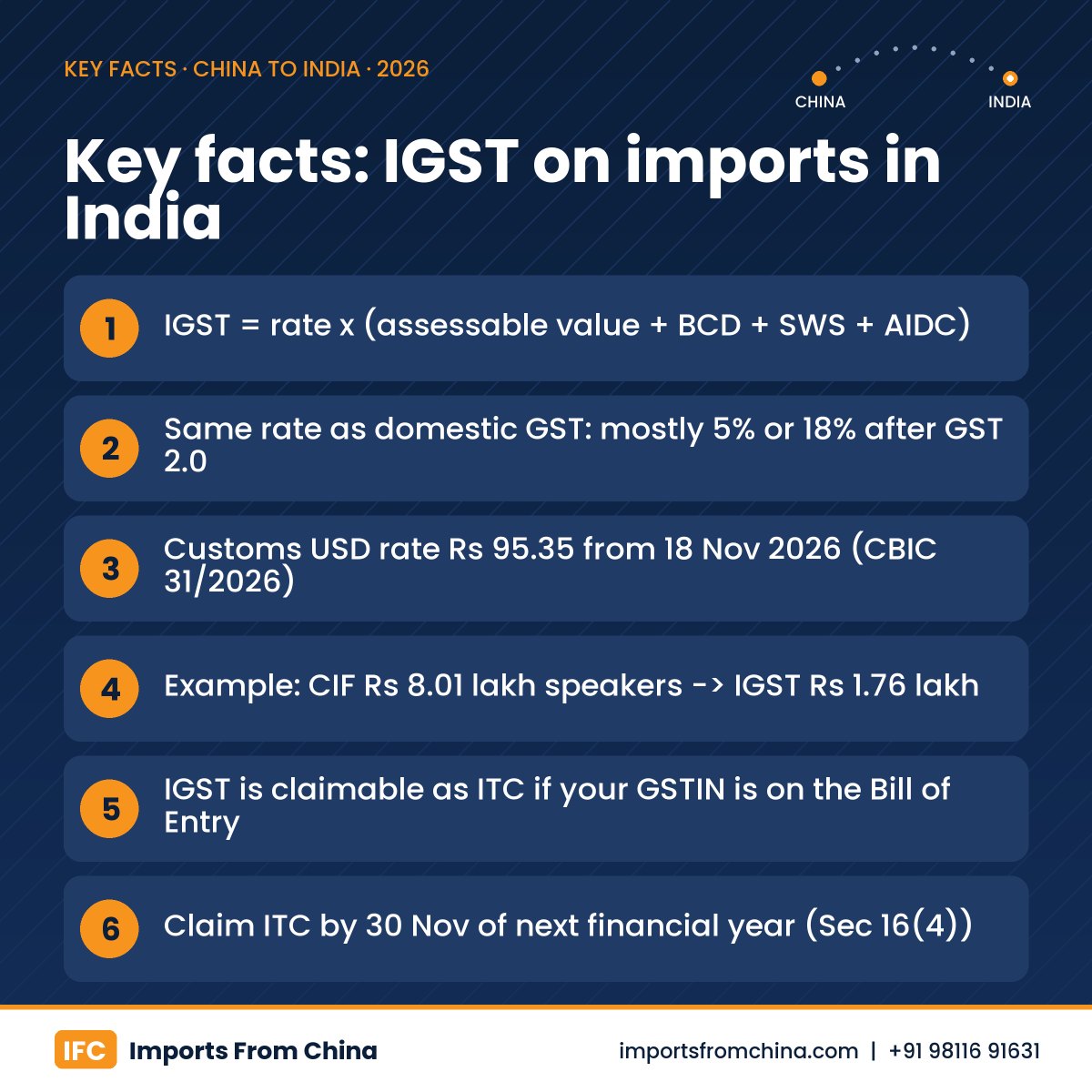
- Formula: IGST = rate × (assessable value + BCD + SWS + AIDC + any anti-dumping or safeguard duty).
- Rates: same as the domestic GST rate for that HS code – mostly 5% or 18% since 22 September 2025, 40% for luxury and sin goods.
- Credit: IGST is claimable as ITC if your GSTIN is on the Bill of Entry and the goods are for business; BCD, SWS and AIDC are not.
- Deadline: claim the credit by 30 November after the end of the financial year (or the annual return date, if earlier).
- Cash flow: IGST is paid upfront at customs, so budget for it even though you get it back later.
What is IGST on imports in India?
When goods enter India, customs collects two broad types of charges. The first is customs duty: Basic Customs Duty (BCD), the Social Welfare Surcharge (SWS), the Agriculture Infrastructure and Development Cess (AIDC) where notified, and anti-dumping or safeguard duty on some products. The second is IGST (Integrated Goods and Services Tax).
Under GST law, an import of goods is treated as an inter-state supply. The IGST Act says IGST on imported goods is levied and collected in line with the Customs Tariff Act, and Section 3(7) of that Act adds an ‘additional duty’ equal to the GST on a like domestic product. In practice this means three things for an importer:
- IGST is paid to customs, together with duty, before your goods get Out of Charge – not later in your GST return.
- The rate is the same rate that applies to that product when sold inside India.
- Because it is a GST, a registered business can use it as input tax credit, unlike BCD, SWS and AIDC, which are a pure cost.
If you are new to the duty structure, start with our guide on import duty from China to India, then come back here for the IGST part.
How is IGST on imported goods calculated?
Section 3(8) of the Customs Tariff Act fixes the value on which IGST is charged. It is not just the invoice value. It is the assessable value plus every customs duty charged before it, except IGST itself and the GST compensation cess.
Step-by-step formula
- Step 1 – Assessable value (AV): the CIF value (cost + insurance + freight up to the Indian port) converted to rupees at the CBIC customs exchange rate. If you buy FOB or EXW, customs adds the freight and insurance. There is no separate 1% landing charge since 2017.
- Step 2 – BCD: AV × BCD rate for your HS code.
- Step 3 – SWS: 10% of BCD, unless the item is exempt from SWS (many items that carry AIDC have SWS at nil).
- Step 4 – AIDC, anti-dumping or safeguard duty: add these where notified for your product and origin.
- Step 5 – IGST base: AV + BCD + SWS + AIDC + other duties.
- Step 6 – IGST: IGST base × IGST rate.
The exchange rate matters. CBIC notifies a fixed import rate, usually twice a month. Notification No. 31/2026-Customs (N.T.), effective 18 November 2026, sets the US dollar import rate at ₹95.35 and the Chinese yuan at ₹14.40. Customs uses the rate in force on the date your Bill of Entry is filed, not the bank’s rate.
What are the IGST rates on imports after GST 2.0?
From 22 September 2025, GST 2.0 moved most goods into two main slabs, 5% and 18%, with a 40% rate for luxury and sin goods. The old 12% and 28% slabs were removed. Because IGST on imports simply follows the domestic GST rate, these changes apply at customs too. The table shows common China imports with rates from IFC’s duty database.
| Product (HS code) | BCD | SWS | AIDC | IGST |
|---|---|---|---|---|
| Bluetooth speaker (8518 21 10) | 20% | 10% of BCD | – | 18% |
| LED lamp (8539 52 00) | 20% | 10% of BCD | – | 18%* |
| Wooden furniture (9403 60 00) | 20% | Nil | 5% | 18% |
| Plastic toys (9503 00 20) | 70% | Nil | – | 5% |
| Bicycles (8712 00 10) | 20% | Nil | 15% | 5% |
| Solar panels (8541 43 00) | 20% | Nil | 20% | 5% |
*Some sources quote 5% for certain LED products after GST 2.0, so confirm the exact entry. Rates as of November 2026; confirm for your exact HS code on the India import duty rates page or in the current CBIC notification. Anti-dumping duty, where in force, is added before IGST is worked out.
What about GST compensation cess? For most goods it stopped after GST 2.0, and from 1 February 2026 the cess on tobacco products was also reduced to nil, with excise brought back for those items. For general merchandise imported from China, you should not see compensation cess on your Bill of Entry, but check the current notification if you import tobacco-type or luxury goods.
Worked example: IGST on a China shipment in ₹
Let us take 1,000 Bluetooth speakers bought from a Shenzhen factory at US$8 each FOB, shipped LCL to Nhava Sheva. Assumptions: FOB US$8,000; ocean freight and insurance US$400; CIF US$8,400; exchange rate ₹95.35 (CBIC, 18 November 2026); HS code 8518 21 10 with 20% BCD, SWS at 10% of BCD and 18% IGST.
| Line | How it is worked out | Amount (₹) |
|---|---|---|
| Assessable value (CIF) | US$8,400 × 95.35 | 8,00,940 |
| Basic Customs Duty | 20% of 8,00,940 | 1,60,188 |
| Social Welfare Surcharge | 10% of 1,60,188 | 16,019 |
| IGST base | 8,00,940 + 1,60,188 + 16,019 | 9,77,147 |
| IGST | 18% of 9,77,147 | 1,75,886 |
| Total paid to customs | BCD + SWS + IGST | 3,52,093 |
| IGST you can claim as ITC | if conditions are met | 1,75,886 |
| Real tax cost | BCD + SWS | 1,76,207 |
Two lessons from this example. First, many first-time importers calculate 18% on the CIF value only. That gives ₹1,44,169 – about ₹31,700 less than customs will actually ask for, because IGST is also charged on the duty. Second, on the day of clearance you need ₹3.52 lakh in your ICEGATE account, even though half of it comes back later as credit. Freight, CHA, CFS and delivery charges are extra. To see the full landed cost of your own product, use the IFC shipment calculator.
For a broader worked example that covers freight and clearance charges too, read landed cost of a $10 China product in India.
How do you claim input tax credit on IGST paid on imports?
The Bill of Entry is a valid document for claiming input tax credit under the CGST Rules. The IGST you pay at customs flows from ICEGATE to the GST portal and appears in the IMPG section of your GSTR-2B. You then claim it in GSTR-3B like any other credit.
Conditions to claim the credit
- Your GSTIN must be on the Bill of Entry. If the Bill of Entry is filed with only an IEC, or with the wrong GSTIN or state, the credit will not show in your GSTR-2B.
- The goods must be used for business. Personal imports and goods used for exempt supplies do not get credit, and blocked items under Section 17(5) of the CGST Act (for example, many motor vehicles for personal use) stay blocked.
- The IGST must actually be paid and the goods received.
- Claim it in time. Section 16(4) applies to IGST on Bills of Entry as well – the credit must be taken by 30 November of the following financial year, or the date you file the annual return, whichever is earlier. Advance rulings have refused late credit on imports.
- Reconcile every month. Match each Bill of Entry number, date and IGST amount with GSTR-2B. Missing entries usually mean a GSTIN error on the Bill of Entry or a delay in ICEGATE data.
Only IGST is creditable. Basic Customs Duty, SWS and AIDC become part of the cost of the goods. So when you compare two products, judge the real tax cost by their BCD, SWS and AIDC, not by the IGST figure on the Bill of Entry.
Do you pay IGST on ocean freight separately?
Until 2022, CIF importers were also asked to pay 5% IGST under reverse charge on the ocean freight paid by the foreign supplier. In Union of India v. Mohit Minerals (May 2022), the Supreme Court struck this down. Ocean freight is already part of the CIF value on which customs charges IGST, so taxing it again was held invalid. Later High Court rulings have applied the same logic to FOB contracts. Today, you should not be paying a separate IGST on ocean freight for goods imported from China. If your forwarder or CA still adds it, ask them to check.
When can IGST on imports be deferred or exempted?
| Situation | What happens to IGST | Who it suits |
|---|---|---|
| Normal home consumption Bill of Entry | Paid at clearance, credit later | Most traders and Amazon/Flipkart sellers |
| Customs bonded warehouse / MOOWR | Paid only when goods are cleared from the bond | Importers who sell in parts or re-export |
| Advance Authorisation (for exporters) | Can be exempt, subject to conditions | Manufacturers who export the finished product |
| EPCG scheme (capital goods) | Duty-free import, subject to export obligation | Factories importing machinery |
| DDP import through an agent’s IEC | Agent pays at customs; you get a local GST invoice and claim credit on that | Small and first-time importers |
Each scheme has conditions and paperwork, so check the current notification before you plan around it. For legal ways to reduce or recover duty, see 9 legal ways to import with zero or lower duty. To compare who pays IGST under different shipping terms, read DDP vs DAP shipping.
What mistakes do importers make with IGST?
- Using the wrong HS code. The IGST rate follows the HS code. A misclassified product can mean a 5% versus 18% difference, plus penalty and interest if customs re-assesses it.
- Calculating IGST on CIF only and running short of funds on clearance day.
- Filing the Bill of Entry without the right GSTIN, so the credit never reaches GSTR-2B.
- Using a bank exchange rate instead of the CBIC customs rate for duty estimates.
- Undervaluing the invoice. Customs can reject the declared value and re-assess duty and IGST on a higher value; the extra IGST is creditable, but the extra BCD, interest and penalty are not.
- Missing the Section 16(4) deadline for old Bills of Entry.
For the full clearance flow – IGM, Bill of Entry, assessment and Out of Charge – read how customs clearance works for imports in India.
How IFC helps with IGST and customs on China imports
IFC (Imports From China) has worked on China–India import and export for 20+ years, since 2004. It is founded and led by Mayank Dang (CA Sahab), a Chartered Accountant (FCA, ICAI), and has served 5000+ businesses. That CA background matters for IGST: classification, valuation and GST credit are where most import costs are won or lost.
- HSN, duty and GST guidance before you order, so you know the BCD, SWS, AIDC and IGST for your product in advance.
- Customs clearance with the correct HS code and documents, through our custom clearance service.
- DDP door-to-door delivery to major Indian cities such as Delhi, Gurugram, Noida, Mumbai, Pune, Bengaluru, Hyderabad, Chennai and Ahmedabad, with duty and IGST handled at customs. See DDP shipments from China to India.
- Own offices in Guangzhou and Yiwu with translators and English-speaking staff for sourcing, supplier verification and quality inspection.
- Daily loading of mixed containers (LCL and FCL) and air cargo, with a warehouse at our headquarters.
If you import on IFC’s IEC under DDP, IFC pays the duty and IGST at customs and you receive a local GST invoice. Read importing on IFC’s IEC vs your own IEC to see which suits your business.
Conclusion
IGST on imports in India is easy once you remember one rule: it is charged on the assessable value plus all customs duties, at the same rate the product has under domestic GST. Plan the cash for it, make sure your GSTIN is on the Bill of Entry, reconcile GSTR-2B every month and claim the credit before the Section 16(4) deadline. Get the HS code right and IGST becomes a pass-through cost, not a loss.

This guide on IGST on imports was reviewed by Mayank Dang (CA Sahab), Founder & CEO of IFC
Chartered Accountant (FCA, ICAI) who has helped 5000+ Indian businesses import from China since 2004 – sourcing, BIS, HSN classification, import duty, customs and GST compliance. mayankdang.in
Get your real landed cost: enter your product, weight and CBM in the IFC shipment calculator, check your HS code on the India import duty rates page, or call IFC on +91 98116 91631 for a door-to-door DDP quote from China to your city.
Frequently asked questions
How is IGST calculated on imported goods in India?
IGST is calculated on the assessable value (CIF in rupees) plus Basic Customs Duty, Social Welfare Surcharge, AIDC and any anti-dumping or safeguard duty. The total is multiplied by the IGST rate for the HS code, which is the same as the domestic GST rate, usually 5% or 18% after GST 2.0.
Can I claim input tax credit on IGST paid on imports?
Yes. A GST-registered business can claim the IGST paid on the Bill of Entry as input tax credit if its GSTIN is on the Bill of Entry, the goods are used for business and the credit is not blocked. It appears in the IMPG section of GSTR-2B. Basic Customs Duty and SWS cannot be claimed.
Is IGST on imports charged on CIF value or on value plus duty?
On value plus duty. Customs adds Basic Customs Duty, SWS, AIDC and other duties to the assessable value first, then charges IGST on that total. Calculating IGST on CIF alone underestimates what you will pay at the port.
What is the IGST rate on imports from China?
There is no special China rate. IGST on imports equals the GST rate for that product in India: since 22 September 2025 most goods are at 5% or 18%, and luxury or sin goods at 40%. Anti-dumping duty, where notified for Chinese goods, is added before IGST is worked out.
Which exchange rate is used to calculate IGST on imports?
Customs uses the import exchange rate notified by CBIC, not your bank rate. It is usually revised twice a month. From 18 November 2026, Notification 31/2026 sets the US dollar import rate at 95.35 rupees and the yuan at 14.40 rupees.
Is IGST payable on ocean freight for imports?
No separate IGST is payable on ocean freight for imported goods. In 2022 the Supreme Court, in the Mohit Minerals case, struck down the 5% reverse charge IGST on ocean freight for CIF imports, because the freight is already included in the value on which customs charges IGST.
What is the time limit to claim ITC on IGST paid on a Bill of Entry?
The Section 16(4) limit applies. Credit for a Bill of Entry must be taken by 30 November of the next financial year, or the date of filing the annual return if that is earlier. Late claims have been rejected, so reconcile GSTR-2B every month.
Write a Comment