

Import Shoes from China to India: Buyer’s Guide

To import shoes from China to India, you need to find a verified footwear factory, approve samples, pay through a secure method, and clear the shipment at an Indian port with the correct HS code and documents. Most first-time buyers use an import agent such as IFC (Imports From China), which manages sourcing, factory checks, inspection, shipping and customs in one process.

Why Indian businesses import shoes from China

China has a large footwear manufacturing base with factories that handle everything from basic casual shoes to sports and safety footwear. Indian retailers, online sellers, wholesalers and school uniform suppliers often source from China to compare design options, price points and production capacity. The real challenge is not finding a factory, but finding a reliable one that matches your specification and delivers on time.

Step 1: Define the shoe type and specification

Before you contact any supplier, write a clear specification sheet. A good sheet covers the shoe type, upper material, sole material, sizes and size ratio, colours, logo method, packing style and target price. Vague briefs lead to wrong samples and costly revisions. If you plan to sell in India, also confirm the target market, such as Delhi retail, e-commerce marketplaces or institutional orders.

Step 2: Check the HS code and customs requirements

Every import needs an HS code, which determines the customs duty and any compliance requirement that applies. Footwear is classified in its own chapter of the Indian tariff, but the exact code depends on the material, whether the upper is leather or textile, and the type of sole. Confirm the code with your customs broker before you place an order, and check current duty rates on the official tariff, since rates can change in the Union Budget. You can also read IFC’s guides on customs duty basics and HS code checks for more detail.

Step 3: Find and verify the footwear factory

Sourcing from marketplaces such as 1688 or Alibaba gives you access to thousands of footwear suppliers, but it also makes verification essential. A trading company and a factory can look identical on screen, and prices can hide weak quality. Verify the business licence, factory address, production lines, staff numbers and past export records. Ask for factory photos or videos that show the actual production floor, not only showroom images.

Factory vs trading company

A factory usually gives better control over materials and lead times. A trading company can help with small orders and multiple product types, but you need to confirm which party actually produces your shoes. IFC’s supplier verification process checks these points before a buyer pays a deposit.

Step 4: Approve samples before bulk production

Never skip the sample stage. Ask for a pre-production sample in the exact material, colour and size you plan to order. Measure the sole thickness, check stitching, test glue strength and compare the sample against your specification sheet. Approve the sample in writing, with photos, so there is no confusion later.

Step 5: Quality checks and pre-shipment inspection

A pre-shipment inspection checks the finished goods before they leave China. It is one of the most useful steps for footwear, because defects such as uneven stitching, colour mismatch, wrong size runs and weak soles are often visible only after the shipment reaches India.

Check What to confirm Why it matters
Size ratio Quantity per size matches the order Wrong ratios leave unsold stock in India
Materials Upper, lining and sole match the approved sample Substitution is a common cost-cutting issue
Workmanship Stitching, glue lines, eyelets and finishing Defects cause returns and complaints
Labelling Carton labels, barcodes and product tags Needed for marketplace listings and customs
Packing Carton strength, pairs per carton, moisture protection Damage in transit affects the whole order

Step 6: Pay the supplier safely

Use payment methods that give you some protection. Common options include bank transfer against a proforma invoice, staged payments tied to production and inspection milestones, and trade assurance on platforms that offer it. Avoid paying the full amount upfront to an unverified contact. Keep all invoices, contracts and payment receipts, as you will need them for customs and for your books.

Step 7: Shipping and customs clearance in India

Footwear is commonly shipped by sea freight for bulk orders and by air for urgent or small orders. Sea freight is usually more economical for full containers, while air suits sample runs and fast-moving lines. Your shipment will need a commercial invoice, packing list, bill of lading or airway bill, and the correct import documents. Customs clearance in India requires an Importer Exporter Code (IEC) unless you use an agent with a suitable arrangement. IFC handles customs clearance and door delivery across India, so buyers in Delhi, Mumbai, Bengaluru and other cities do not need to manage each port step alone.

Common mistakes Indian buyers make

  • Ordering bulk production without an approved sample
  • Paying a large deposit to an unverified supplier
  • Skipping a pre-shipment inspection to save a small fee
  • Choosing the wrong HS code and facing a classification dispute
  • Not confirming the size ratio and colour breakdown in writing
  • Forgetting that landed cost includes freight, duty, clearance and local delivery

Frequently asked questions

Is it profitable to import shoes from China to India?

It can be, but profit depends on your product cost, freight, customs duty, clearance charges, local delivery and selling price. Calculate the full landed cost before you order, including every charge up to your warehouse in India, and compare it with your target retail or wholesale price.

Which documents are needed to import shoes from China to India?

Most shipments need a commercial invoice, packing list, bill of lading or airway bill, and an IEC for the importer, unless an agent handles the clearance under their arrangement. Your customs broker can confirm the exact documents required for your product and shipping mode.

How do I check a Chinese shoe supplier before paying?

Check the business licence, factory address, production capacity and export history. Ask for live factory video, sample approval and references where possible. A third-party factory audit or verification service adds another layer of protection before you transfer a deposit.

Should I use sea freight or air freight for shoes?

Sea freight is generally better for large, regular orders where cost per unit matters. Air freight suits samples, urgent restocking and smaller quantities. Compare total cost and transit time for your order size, and remember that lead times in production also affect when goods are available for sale.

Can IFC help with shoe imports from China to India?

Yes. IFC offers product sourcing, supplier verification, factory inspection, payment safety, air and sea shipping, customs clearance and door delivery across India. Its head office is in Kirti Nagar, New Delhi, with offices in Guangzhou and Yiwu, China, and it has served more than 5000 Indian businesses.

Start your footwear import with IFC

If you are planning to import shoes from China to India, IFC can help you define your specification, verify suppliers, arrange inspection, ship the goods and clear customs through to door delivery. Send your product details on WhatsApp at +91 98116 91631 or visit importsfromchina.com to discuss your requirement.
Import Textiles from China to India: Fabric Buyer Guide

To import textiles from China to India, buyers usually source fabric or finished garments from Chinese mills or wholesalers, approve a physical sample, confirm specifications such as GSM, width, composition and shrinkage, then ship by sea or air under a clear incoterm. Customs duty depends on the exact HS code and fabric type, so verify it before ordering. IFC (Imports From China), based in Kirti Nagar, New Delhi, supports Indian buyers with supplier checks, inspection, payment safety, shipping and customs clearance.

Why Indian buyers import textiles from China

China is one of the largest producers of synthetic and blended fabrics, and many Chinese mills offer a wide range of weights, finishes and colours. Indian garment makers, home-textile brands, bag and upholstery manufacturers, and online sellers often look at Chinese suppliers on platforms such as 1688 and Alibaba to compare fabric options that may not be easily available locally in the required quantity or price band.

The trade is not only about price. Buyers also look for consistent batch quality, faster access to new prints or weaves, and the ability to source technical fabrics such as lining, interlining, mesh, nylon or polyester blends. Each of these benefits depends on careful specification and sample control, which is where many first-time importers run into problems.

Step 1: Define the fabric specification in writing

Vague requests like "good quality cotton" lead to disputes. A usable specification sheet for a textile import normally includes:

  • Fibre composition, for example 65 per cent polyester and 35 per cent cotton
  • Weight in GSM (grams per square metre) with an acceptable tolerance
  • Width in inches or centimetres and selvedge requirements
  • Weave or knit type, twill, plain, jersey, rib and so on
  • Colour reference, usually a Pantone code or an approved lab-dip
  • Finish requirements such as anti-static, water-repellent or softened hand-feel
  • Shrinkage limits after washing, and colour fastness expectations
  • Packing method, roll length and core size

Step 2: Approve a physical sample before bulk production

For textiles, a photo is not a sample. Ask the supplier for a pre-production sample of the exact fabric in the exact width and weight, and test it locally. Check hand-feel, opacity, stretch recovery and colour under daylight. For garments made from the fabric, approve a size-set and a pre-production sample before cutting the full order. Keep signed approvals on file, because they become the reference for inspection later.

Step 3: Verify the supplier and the mill

Many Chinese fabric sellers are trading companies that buy from different mills. Ask who actually weaves or dyes the goods. A factory audit or video walk-through of the production floor can show whether the mill has the machines and quality lab it claims. IFC has offices in Guangzhou and Yiwu, China, which helps Indian buyers verify suppliers on the ground rather than relying only on online profiles. For a deeper approach, read our guide on how to check a Chinese supplier before you pay.

Step 4: Understand duty and HS classification

Textiles fall under different chapters of the Indian customs tariff depending on whether they are woven, knitted, synthetic, natural, or made-up into finished goods. Duty rates and any applicable additional levies can change, so do not rely on an old rate sheet. Ask a licensed customs broker to confirm the HS code for each product before you place the order, and make sure the commercial invoice describes the goods accurately. Incorrect descriptions can delay clearance at the port.

Fabric versus finished garments

A roll of fabric and a finished shirt attract different classifications and different considerations. If you import fabric to make garments in India, check whether the goods qualify for any relevant scheme and keep your documentation consistent across invoice, packing list and bill of entry.

Step 5: Choose the right shipping method

Textile rolls are bulky and relatively low in value per kilogram, so sea freight is usually the economical choice for regular volumes. Air freight can suit urgent sample shipments or small, high-value lots of technical fabric. The table below gives a simple comparison.

Factor Sea freight Air freight
Best for Regular bulk fabric orders Samples, urgent top-ups, small high-value lots
Cost per kg Generally lower for bulky rolls Generally higher
Transit time Longer, depends on port and schedule Shorter
Packing note Protect rolls from moisture during ocean transit Compress and pack to limit volumetric charges

Step 6: Protect your payment

Textile orders often involve sizeable deposits. Avoid paying the full amount to an unverified seller. Consider staged payments linked to milestones such as sample approval, production start, pre-shipment inspection and release of documents. Read our note on how to pay Chinese suppliers from India safely for the options and the compliance points to consider.

Step 7: Inspect before the goods leave China

A pre-shipment inspection checks the lot against the approved sample and specification. For fabric, inspectors typically look at roll length, width, GSM, colour match, visible defects, shade variation between rolls and packing quality. Problems found at this stage are far cheaper to fix than problems found in a Delhi warehouse.

Common mistakes Indian textile importers make

  • Approving colour from a phone photo instead of a physical lab-dip
  • Skipping shrinkage testing and then receiving garments that shrink after washing
  • Ordering without confirming the mill, which leads to inconsistent batches on reorder
  • Using a wrong HS code or vague invoice description, which causes customs queries
  • Ignoring packing requirements, so rolls arrive wet or crushed

How IFC supports textile importers in India

IFC is a China-to-India import and sourcing company established in 2004, serving more than 5000 Indian businesses. Our services cover product sourcing, supplier verification, factory audit and inspection, payment safety, air and sea shipping, customs clearance and door delivery across India. Our head office is in Kirti Nagar, New Delhi, with offices in Guangzhou and Yiwu, China.

Frequently asked questions

Is it legal to import textiles from China to India?

Yes, importing textiles from China into India is generally permitted, subject to the applicable customs tariff, any trade-related duties and the import rules in force on the date of import. Check the current HS code and rules with a licensed customs broker before shipping, because restrictions and duty rates can change.

What is the main difference between sample and bulk fabric quality?

Samples are often produced on a different line or with more hand finishing than bulk runs. That is why buyers should approve a pre-production sample, then inspect the bulk lot against it. Matching GSM, width, shade and shrinkage to the approved sample is the key test for consistent quality.

Which shipping method is better for importing fabric from China to India?

Sea freight is usually more economical for regular bulk fabric because rolls are bulky and heavy relative to value. Air freight suits urgent sample orders or small high-value technical fabrics. The right choice depends on volume, urgency and the cost of your inventory.

How do I avoid colour mismatch when importing textiles?

Ask for a lab-dip approved under standard light, then compare bulk rolls against that reference during pre-shipment inspection. Specify a Pantone code and an acceptable shade tolerance in your purchase order so the supplier and inspector work to the same standard.

Can IFC help with textile sourcing and customs clearance in Delhi?

Yes. IFC supports Indian buyers with supplier verification, sample coordination, inspection, air and sea shipping, customs clearance and door delivery across India. Buyers in Delhi and other cities can discuss their fabric requirements with the IFC team before placing an order.

Ready to import textiles from China?

Share your fabric specification, target quantity and destination city, and the IFC team will outline the sourcing, inspection and shipping steps. WhatsApp +91 98116 91631 or visit importsfromchina.com to start your textile import today.

Import Bags from China to India: Buyer’s Guide (2026)

To import bags from China to India, you need to verify a factory, check materials and labelling, confirm the HS code and duty, pay through a safe method, and arrange freight and customs clearance. IFC, a China import company in Delhi since 2004, supports Indian buyers through each of these steps, from supplier checks to door delivery across India.

What does it mean to import bags from China to India?

Importing bags from China to India means buying backpacks, handbags, travel bags, laptop sleeves or school bags from a Chinese manufacturer or wholesale market, then shipping them into India under customs rules. The buyer, usually a retailer, e-commerce seller or wholesaler in Delhi, Mumbai or elsewhere in India, is responsible for documents, duty payment and compliance unless a service provider handles these steps for them.

Bags look simple, but the product category has many variables: fabric, lining, hardware, stitching, printing and packaging. Each one affects quality, customs classification and final cost. A clear sourcing process protects your margin from the first sample to the final delivery.

Step 1: Choose the right bag type and material

Start by fixing the bag type, target price band and material before you contact suppliers. Material controls durability, weight, freight cost and the HS code classification. The table below shows what to check for common options.

Bag material Typical use What to check before ordering
Polyester School bags, daily backpacks, promotional bags Denier, coating, water resistance, colour fastness
Nylon Travel bags, sports bags, lightweight backpacks Tear strength, zip quality, seam strength
Canvas Tote bags, eco bags, casual bags GSM weight, shrinkage after washing, handle attachment
PU leather Handbags, wallets, fashion bags Peeling resistance, lining, edge finishing
Genuine leather Premium bags and luggage Leather grade, consistency of grain, hardware finish

Step 2: Verify the supplier before you pay

Many Indian buyers find bag suppliers on 1688, Alibaba or through wholesale markets such as Guangzhou and Yiwu. Before you send a deposit, confirm the factory is real and can produce your product at the quality you need. Useful checks include:

  • Business licence and registered company name matching the bank account
  • Factory photos and video tour, with proof the production line matches the claim
  • Past export experience to India or other markets
  • Minimum order quantity (MOQ) that fits your budget
  • Written quotation with material, size, colour, printing and packing details

A trading company can be useful for smaller orders, but ask who actually manufactures the bags. IFC’s offices in Guangzhou and Yiwu can help verify suppliers and arrange factory checks before payment.

Step 3: Approve samples and run a pre-shipment inspection

Never approve a bulk order from photos alone. Order a sample, test it yourself and then confirm the bulk run matches the approved sample. For bags, focus on the points that cause most returns:

  • Stitching density and straight seams, especially at handles and straps
  • Zip smoothness, teeth alignment and slider strength
  • Hardware such as buckles and rivets, which should not rust or loosen
  • Colour match against your approved sample under daylight
  • Weight of the bag, which affects freight cost
  • Carton count, carton marking and packing method

A pre-shipment inspection before loading gives you a checkpoint to catch defects while the factory can still fix them.

Step 4: Confirm the HS code, duty and labelling rules

Customs classifies bags by material, construction and use, and the HS code decides the applicable duty and any compliance requirement. Ask your supplier for the exact product specification, then have your customs broker confirm the classification before shipping. A wrong code can lead to delays, reassessment or extra charges at the port of entry.

Packaged goods sold in India are generally subject to Legal Metrology labelling requirements, which cover details such as declared quantity and manufacturer or importer information. Country of origin should also be shown where required. Confirm the exact labelling rules for your product category before you print retail packaging.

Step 5: Pay in stages, not all upfront

A common approach is a deposit before production, a balance after a successful pre-shipment inspection, and the final payment against shipping documents or delivery terms agreed in writing. Avoid paying the full amount to an unverified contact, and keep every quotation, invoice and payment proof. Compare payment options before you choose one, since fees, currency and bank charges vary.

Step 6: Choose freight and clearance

Bags are light but bulky, so freight cost depends heavily on volume and carton size. Compare the two main options:

  • Sea freight: usually lower cost per unit for larger volumes, with longer transit time. Suitable for planned restocking.
  • Air freight: faster, with higher cost. Suitable for urgent refills, test orders or seasonal lines.

Decide early between DDP (where the supplier or service provider handles clearance and duty, and delivers to your door) and DAP (where you handle import clearance). DDP can simplify the process for buyers who want one point of contact, while DAP may suit experienced importers with their own customs broker.

Calculate landed cost before you commit

Your landed cost is the total cost of getting the bag to your warehouse in India. Include the factory price, inland transport in China, freight, insurance, customs duty, applicable taxes, clearance charges and delivery within India. Divide by the number of bags to get the cost per unit, then compare it with your selling price after marketplace commission, packaging and returns. A simple landed-cost sheet prevents most margin surprises.

Common mistakes Indian buyers make when importing bags

  • Ordering from photos without a physical sample
  • Skipping a pre-shipment inspection to save a small fee
  • Choosing the HS code from a supplier’s suggestion without verification
  • Ignoring labelling requirements until the goods reach the port
  • Underestimating freight cost because bags look light
  • Paying a large advance to a supplier who cannot show factory proof

How IFC supports bag importers from Delhi

IFC (Imports From China) is a China-to-India import and sourcing company headquartered in Kirti Nagar, New Delhi, with offices in Guangzhou and Yiwu, China. The company provides product sourcing, supplier verification, factory audit and inspection, payment safety, air and sea shipping, customs clearance and door delivery across India. IFC has served more than 5,000 Indian businesses since 2004.

Frequently asked questions

What is the easiest way to import bags from China to India for a first order?

Start with a small sample order from a verified supplier. Check material, size, zip and stitching, and run a pre-shipment inspection. A China import agent or DDP service can handle customs clearance and delivery in one place, which keeps the first order lower risk while you learn the costs and timelines.

Do I need an HS code to import bags from China to India?

Yes. Customs classifies bags by material, construction and use, and the HS code determines the duty rate and any compliance requirement. Ask your supplier for detailed specifications, then have your customs broker confirm the classification before shipping. A wrong code can cause delays or reassessment at the port.

Are there labelling rules for bags imported into India?

Packaged goods sold in India are generally subject to Legal Metrology labelling rules, which cover items such as declared quantity and importer or manufacturer details. Country of origin should also be shown where required. Confirm the exact requirements for your product category with a customs or compliance adviser before printing your packaging.

How long does it take to import bags from China to India?

Timelines depend on production, inspection, freight mode and port clearance. Air freight is generally faster but costs more, while sea freight suits larger volumes at a lower unit cost but takes longer. Plan backwards from your selling season, include last-mile delivery in your schedule, and ask your forwarder for current transit estimates.

How do I calculate the landed cost of imported bags?

Add the factory price, inland transport in China, freight, insurance, customs duty, applicable taxes, clearance charges and delivery within India. Divide the total by the number of bags to get the cost per unit. Compare this with your selling price after platform commission, packaging and expected returns to confirm your margin.

Ready to import bags from China to India?

If you want help verifying bag suppliers, approving samples, checking HS codes or arranging door delivery across India, speak to the IFC team on WhatsApp at +91 98116 91631 or visit importsfromchina.com for a consultation.

Import LED Lights from China to India: Buyer’s Guide

To import LED lights from China to India, you need a verified factory in a lighting manufacturing region such as Guangdong, a written product specification, a sample approval, a secure payment method, and a shipping plan by sea or air. Your landed cost includes the factory price, freight, customs duty, IGST and clearance charges. IFC (Imports From China), based in Kirti Nagar, New Delhi, supports Indian buyers with sourcing, inspection, shipping and customs clearance.

Why LED lights are a practical import from China to India

LED lighting is one of the most common product categories Indian businesses source from China. Buyers include retailers, electrical wholesalers, hotel and office fit-out contractors, housing societies, and online sellers. Because LED products are compact, they ship well in cartons and can be packed in standard master cartons for palletised sea freight.

The category also has many sub-types, including bulbs, tubes, panel lights, downlights, strip lights, floodlights, driver units and smart lighting. Each sub-type has different specifications, testing needs and margins, so the first decision is to define exactly which product you want to buy.

Step 1: Define the LED specification before you contact suppliers

Most sourcing problems start with a vague brief. Write a specification sheet that covers the points below. Share it with every supplier so quotes are comparable.

  • Power and lumen output: wattage and total lumens, plus the beam angle for downlights and floodlights.
  • Colour temperature (CCT): for example warm white, neutral white or cool white, stated in kelvin.
  • Input voltage and frequency: India’s mains supply is 230V at 50Hz, so confirm the driver supports this.
  • Driver and chip brand: the driver is often the component that fails first, so ask for named components and their datasheets.
  • IP rating: IP20 suits indoor dry areas; outdoor or bathroom fittings need a higher rating.
  • Warranty and failure policy: agree the warranty period and who pays for replacement and freight on defective units.
  • Packaging and labelling: carton size, inner packing, barcode and printed brand or model details.

Step 2: Check certification and compliance requirements

Before you commit to a model, check whether any Bureau of Indian Standards (BIS) requirement applies to your product and your intended sales channel. Requirements can change, so confirm the current position with your compliance adviser or the relevant authority rather than relying on a supplier’s verbal assurance. Ask the Chinese supplier for test reports, factory certificates and the product’s technical file. Keep copies with your import documents.

Step 3: Find and verify a LED supplier in China

Lighting manufacturing is concentrated in Guangdong province, where many factories produce LED products for export markets. Sourcing from a general trading company can add a margin layer, while buying direct from a factory usually gives better pricing control, provided the factory is genuine.

What to verify

  • Business licence and registered address, checked against the company name on the quotation.
  • Factory address, production lines and machinery, confirmed by a video call or an on-site visit.
  • Previous export customers and whether they ship to India or similar markets.
  • Written sample approval before bulk production starts.

IFC’s team in Guangzhou can visit a supplier’s factory, check production capacity and collect samples on your behalf. IFC also has an office in Yiwu for buyers sourcing from wider market networks.

Step 4: Approve samples and arrange pre-shipment inspection

Order samples in each variant you plan to buy, not just one model. Test brightness, colour consistency, flicker, heat, switching behaviour and packaging durability. Once the sample is approved, record it as the golden sample and ask the factory to match it in bulk.

A pre-shipment inspection (PSI) checks the bulk order before it leaves China. Inspectors typically verify quantities, packaging, labelling, visible defects and functional tests on a sample of units. A PSI report gives you evidence if the goods do not match the approved sample.

Step 5: Calculate landed cost for LED lights

Compare suppliers on landed cost, not only factory price. Landed cost includes every cost up to the point the goods are in your warehouse in India.

  • Ex-factory price in China and any payment charges
  • Inland transport in China to the port or airport
  • Export documentation and freight, by sea or air
  • Insurance, if you choose to buy it
  • Customs duty, IGST and any other levies applicable to your product classification
  • Customs clearance, port handling and delivery to your premises
  • Inspection, testing and agent service fees

Your customs duty depends on the correct HS code for your specific LED product, so confirm the classification before you finalise costs.

Sea freight or air freight for LED lights?

The right mode depends on order size, deadline and product value. The table below shows general differences to help you choose.

Factor Sea freight Air freight
Best for Full container or large pallet orders Small, urgent or high-value lots
Cost per unit Generally lower for bulk volumes Generally higher
Transit time Longer, planned in advance Shorter
Packing need Palletised cartons in a container Lighter, compact packing for air cargo

Many buyers use sea freight for their main restock and air freight for top-up orders or new-model samples.

Common mistakes Indian buyers make when importing LED lights

  • Buying on the lowest price without comparing driver quality or warranty terms.
  • Accepting a sample that is not matched by the bulk order.
  • Skipping a pre-shipment inspection on a large first order.
  • Not confirming the HS code, which can affect duty and clearance.
  • Forgetting that outdoor or wet-area products need the correct IP rating.
  • Paying the full amount upfront to an unverified seller.

Frequently asked questions

Do I need a certificate to import LED lights from China into India?

It depends on your product and where you sell it. Some electrical products fall under Indian standards or quality control orders. Check the current requirements with your compliance adviser and ask your supplier for test reports, factory certificates and a technical file before shipment.

Which area in China is best for sourcing LED lights?

Guangdong province is a major centre for LED lighting manufacturing. Many factories there produce for export markets. The best supplier depends on your product specification, order volume and quality requirements, so compare several verified factories before choosing one.

How long does it take to import LED lights from China to India?

Timelines vary with production lead time, the shipping mode you choose and customs processing. Sea freight usually takes longer but costs less per unit for bulk orders. Air freight is faster for smaller urgent lots. Plan your order at least several weeks ahead, and confirm the schedule with your forwarder.

Is a pre-shipment inspection necessary for LED lights?

It is strongly recommended, especially for a first order or a new supplier. A pre-shipment inspection checks quantities, packaging, labelling and functional performance against your approved sample. The report gives you documented evidence before goods leave China, which helps you resolve disputes early.

Can IFC handle sourcing, inspection and customs clearance for LED lights?

Yes. IFC provides door-to-door China to India imports, including supplier sourcing, factory checks, inspection, air and sea shipping, customs clearance and delivery across India. IFC is headquartered in Kirti Nagar, New Delhi, with offices in Guangzhou and Yiwu, and has served more than 5000 Indian businesses.

Talk to IFC before you place your LED order

If you are planning your first LED import from China to India, or want to move an existing supplier relationship onto a safer footing, IFC can help you define the specification, verify the factory, arrange inspection and manage shipping and customs clearance. Message +91 98116 91631 on WhatsApp or visit importsfromchina.com to discuss your requirement.

Import Toys from China to India: Safety & Buyer Checklist

Importing toys from China to India is possible for most toy categories, but toys face closer safety scrutiny than many other goods. Before you order, confirm whether BIS standards apply, check material and labelling requirements, verify the supplier, and prepare your import documents. IFC, a China import company based in Kirti Nagar, New Delhi, supports Indian buyers with sourcing, inspection and door delivery.

How to import toys from China to India: the short answer

To import toys from China to India, you need an Importer Exporter Code (IEC), a verified Chinese supplier, a commercial invoice, packing list, bill of lading or airway bill, and proof that the toys meet applicable Indian safety rules. Customs clearance then depends on the correct HS code, duty calculation and compliance documents matched to the shipment.

Step 1: Check whether your toy falls under a BIS Quality Control Order

Toys are regulated for safety in India, and buyers should check whether a Bureau of Indian Standards (BIS) requirement applies to the specific product before shipment. Do not assume that a toy sold freely in China or on 1688 and Alibaba is automatically cleared for the Indian market. Ask your supplier for test reports and certificates that match the exact model you are buying, and confirm the requirements with your customs broker or a qualified compliance consultant.

Step 2: Verify the toy supplier before you pay

Toy sourcing in China involves thousands of factories, from small workshops to large export manufacturers. A supplier verification step helps you confirm the business licence, export history, production capacity and whether the factory can produce the same spec on repeat orders. IFC verifies suppliers in China through its Guangzhou and Yiwu offices, which helps Indian buyers reduce the risk of paying for goods that do not match the sample.

Step 3: Get a pre-shipment check on materials and labelling

Toys are often rejected or delayed because of small defects, unclear labels or materials that do not match the approved sample. A pre-shipment inspection in China can check the following points before goods leave the factory:

  • Material type and paint or coating used on the toy
  • Small parts, sharp edges and choking hazard risks
  • Packaging, barcodes and any required labels for the Indian market
  • Quantity, colour, size and packing matching the purchase order
  • Carton marking so that customs documents match the physical cargo

Step 4: Match your documents to the HS code and duty

Customs duty on toys depends on the HS code assigned to the product, its declared value and applicable taxes. Toys can be classified differently depending on whether they are electric, educational, ride-on, plush or made of a specific material, so the code should be checked against the actual product rather than copied from another shipment. Mismatched descriptions between the invoice, packing list and bill of lading are a common cause of clearance delays at Indian ports and airports.

Document or check Why it matters for toy imports
IEC (Importer Exporter Code) Required to import into India in your business name
Commercial invoice Shows value, product description and supplier details for duty assessment
Packing list Confirms carton count, weights and marks that match the cargo
Bill of lading or airway bill Proves shipment and is needed for customs clearance
Test reports and certificates Support compliance with applicable Indian safety requirements
HS code and duty calculation Determines the customs duty and taxes payable

Step 5: Choose sea or air freight based on the product and timeline

Toys are often shipped by sea freight when volumes are large and delivery time is flexible, and by air freight when seasonal stock or a sample order needs to arrive quickly. Sea freight usually suits full container loads, while air freight can work for smaller test orders. Whatever method you choose, ask whether the quote includes destination clearance, duty handling and delivery to your warehouse, because these charges can differ significantly between offers.

Should you use DDP for toy imports from China?

DDP (Delivered Duty Paid) shipping can simplify toy imports because the seller or forwarder handles freight, duty and delivery to your address. This suits buyers who want a single quote and fewer surprises at the port. Always confirm in writing what is included, including customs clearance, duty, inland transport and any compliance paperwork.

Common mistakes Indian buyers make when importing toys

  • Ordering from a product photo without approving a physical sample
  • Assuming a toy is compliant because it is sold widely in China
  • Not checking small parts, paint, battery or age-grading requirements
  • Using a generic HS code that does not match the product
  • Paying the full amount before an inspection or pre-shipment check

How IFC helps with toy sourcing from China

IFC helps Indian businesses source toys from China through supplier research, sample coordination, factory audit, pre-shipment inspection, payment guidance, sea and air shipping, customs clearance and door delivery across India. With head office in Kirti Nagar, New Delhi, and offices in Guangzhou and Yiwu, China, IFC has served more than 5000 Indian businesses since 2004. Buyers can also review how sourcing and inspection work before placing a larger order.

Frequently asked questions

Can I import toys from China to India without BIS certification?

It depends on whether a BIS requirement applies to the specific toy you are importing. Some toys may be subject to safety standards, so you should check the applicable rules before shipment. Ask your supplier for valid test reports and confirm the requirement with a customs broker or compliance adviser to avoid holds or rejection at the port.

Do I need an IEC to import toys from China into India?

Yes, in most cases an Importer Exporter Code (IEC) is required to import goods into India for business purposes. The IEC should be registered in the name of the importing entity. Without it, customs clearance is generally not possible, so obtain it before placing your first toy order from China.

What documents are needed to import toys from China to India?

The core documents are the commercial invoice, packing list, bill of lading or airway bill, and your IEC. You may also need test reports, certificates and product details that match the HS code. All documents should describe the goods consistently, because mismatches between paperwork and the physical cargo are a common reason for clearance delays.

How can I check a toy supplier in China before paying?

Verify the supplier’s business licence, export experience, production capacity and product certifications. Request samples and a factory video, and consider a factory audit or pre-shipment inspection by a local team. Avoid paying the full amount upfront, and use a payment method that offers some protection for both sides of the transaction.

Is DDP shipping better for importing toys from China to India?

DDP shipping can be useful for first-time buyers because the forwarder handles freight, customs duty and delivery to your address under one quote. It reduces the risk of hidden charges at the port. However, you should confirm the exact inclusions in writing, such as clearance, duty, inland transport and any compliance documents, before you accept the offer.

Planning to import toys from China to India? Contact IFC on WhatsApp at +91 98116 91631 or visit importsfromchina.com to discuss sourcing, inspection, shipping and door delivery across India.

Import Kitchenware from China to India: Buyer’s Guide

To import kitchenware from China to India, you need to confirm the product’s material and safety compliance, find the correct HS code, check the customs duty for that code, arrange packaging suited to a long sea or air journey, and pay the supplier through a secure method. Importers in Delhi and across India usually work with a sourcing company such as Imports From China (IFC), which handles supplier checks, inspection, shipping and customs clearance from its offices in Guangzhou and Yiwu.

What counts as kitchenware in an India import?

Kitchenware covers a wide range of everyday cooking and serving items. For import purposes, the category is usually split by material and function, because each split can carry a different HS code and duty treatment. Common examples include:

  • Stainless steel cookware such as pans, pots, kadhai and pressure cooker parts
  • Non-stick and aluminium cookware
  • Glass, borosilicate and ceramic bakeware and serveware
  • Plastic containers, storage jars and lunch boxes
  • Cutlery, knives, peelers and small hand tools
  • Silicone bakeware, moulds and utensils

Before placing an order on 1688 or Alibaba, write down the exact material, coating, capacity and intended use of each product. Customs officers classify goods by what they are, so a vague description on the invoice can cause delays at the port.

How to find the right HS code for kitchenware

The Harmonised System (HS) code tells Indian customs how to classify your goods and which duty rate applies. Kitchenware is spread across several chapters, depending on whether the item is metal, glass, plastic or ceramic. A stainless steel pan and a plastic storage box will not share the same code.

Item type Key classification detail to confirm Why it matters
Stainless steel cookware Metal grade, coating and whether it is sold as a set Changes the classification and duty treatment
Plastic containers Plastic type and whether it is food-contact Affects the chapter and possible labelling checks
Glass bakeware Glass type, such as borosilicate or soda-lime Determines the correct HS heading
Cutlery and knives Blade material and handle material Different codes for blades and sets
Silicone moulds Whether it is a mould, utensil or container Can move the item to a different heading

Once you have the code, check the current basic customs duty, any additional duties and any other applicable rules for that code. Do not rely on a rate from an old article or a supplier’s quotation. Your customs broker or import agent should confirm it before you commit to a landed cost.

Compliance and labelling checks for kitchenware

Kitchenware often touches food, so buyers should check whether the product needs particular standards or labelling. Ask your supplier for material test reports and product specifications, and keep them with your import file. For items that contact food, confirm that the coating and material are described accurately in the product listing and on the commercial invoice.

  • Get the exact material composition in writing from the factory
  • Ask whether the coating is PFOA-free or similar, and request a test report if you need one
  • Check that the packaging carries the information your buyers in India expect, such as capacity, material and care instructions
  • Keep product photos and specification sheets matched to the purchase order

Factory inspection before the kitchenware leaves China

Kitchenware is easy to damage in transit. Dents, scratched non-stick coatings, cracked glass and broken handles are common complaints. A pre-shipment inspection at the factory, before the carton is sealed, catches most of these issues. IFC’s inspection team checks quantity, appearance, size, colour, packaging and functional items such as lids and handles against your sample.

For a new supplier, a factory audit adds a second layer of protection. It confirms that the factory exists, has the production capacity you need and can run consistent quality. Buyers who skip this step often find that the first sample is good but later batches differ.

Packaging for kitchenware shipped from China to India

Good packaging protects the product and reduces disputes. Use inner boxes or sleeves for each piece, corner protection for glass and ceramic, and sturdy outer cartons. Mark the cartons clearly with the item code, quantity and carton weight. Pallets should be wrapped and labelled for the port or airport.

Plan the packaging before you finalise the price. Extra protection adds cost, and the supplier should include it in the quotation rather than charging later.

Choosing a shipping method: sea, air or DDP

Most kitchenware orders travel by sea freight because the products are heavy and bulky. Air freight suits smaller, urgent or high-value batches. If you prefer a single price that covers freight, duty and delivery to your door, ask for a DDP quotation. DDP means the seller or forwarder handles import clearance and delivery, so you know the full cost in advance. IFC offers door delivery across India, covering customs clearance and last-mile transport.

Payment safety for kitchenware orders

Kitchenware orders are often large and repeated. Use a payment method that protects both sides, such as a staged payment tied to inspection and shipping documents. Confirm the supplier’s bank details through a call or video meeting before sending any money. Never pay the full amount for a first order to an unverified account.

Frequently asked questions

Do I need an IEC to import kitchenware from China into India?

Generally, an Importer Exporter Code (IEC) is needed for commercial imports into India. If you are importing for resale or business use, check with your customs broker or IFC about whether you need your own IEC or can clear goods under an arrangement such as DDP through an agent.

Which HS code applies to kitchenware from China?

There is no single code for all kitchenware. The correct HS code depends on the material, function and whether the item is sold as a set. Confirm the code with a customs broker before ordering, because the duty and classification depend on it.

How long does sea freight take for kitchenware from China to India?

Transit time depends on the port of loading, the port of discharge, the shipping line and the schedule. Ask your forwarder for current timelines for your specific route rather than relying on a general estimate. Add time for customs clearance and inland transport to your city.

Can IFC inspect kitchenware before it is shipped?

Yes. IFC offers pre-shipment inspection at the factory in China, with checks on quantity, appearance, size, packaging and functional items. Inspection results help you decide whether to release the final payment and load the goods.

What should I do if the kitchenware arrives damaged?

Photograph the damage on delivery, note it on the delivery receipt and inform your forwarder or agent immediately. Keep the carton and packaging as evidence. If your inspection report and packing list show the goods were in good condition at dispatch, that record supports your claim with the supplier.

Start your kitchenware import with IFC

If you are planning to import kitchenware from China to India, IFC can help you confirm the product specification, check the HS code, inspect the goods before they leave China and deliver them to your door in India. Our team has been helping Indian businesses import from China since 2004, with offices in Kirti Nagar, New Delhi, Guangzhou and Yiwu. Call or WhatsApp +91 98116 91631, or visit importsfromchina.com to get started.

Private label electronics from China to India

Start Your Own Electronics Brand from China: Private Label Guide for India (2026)

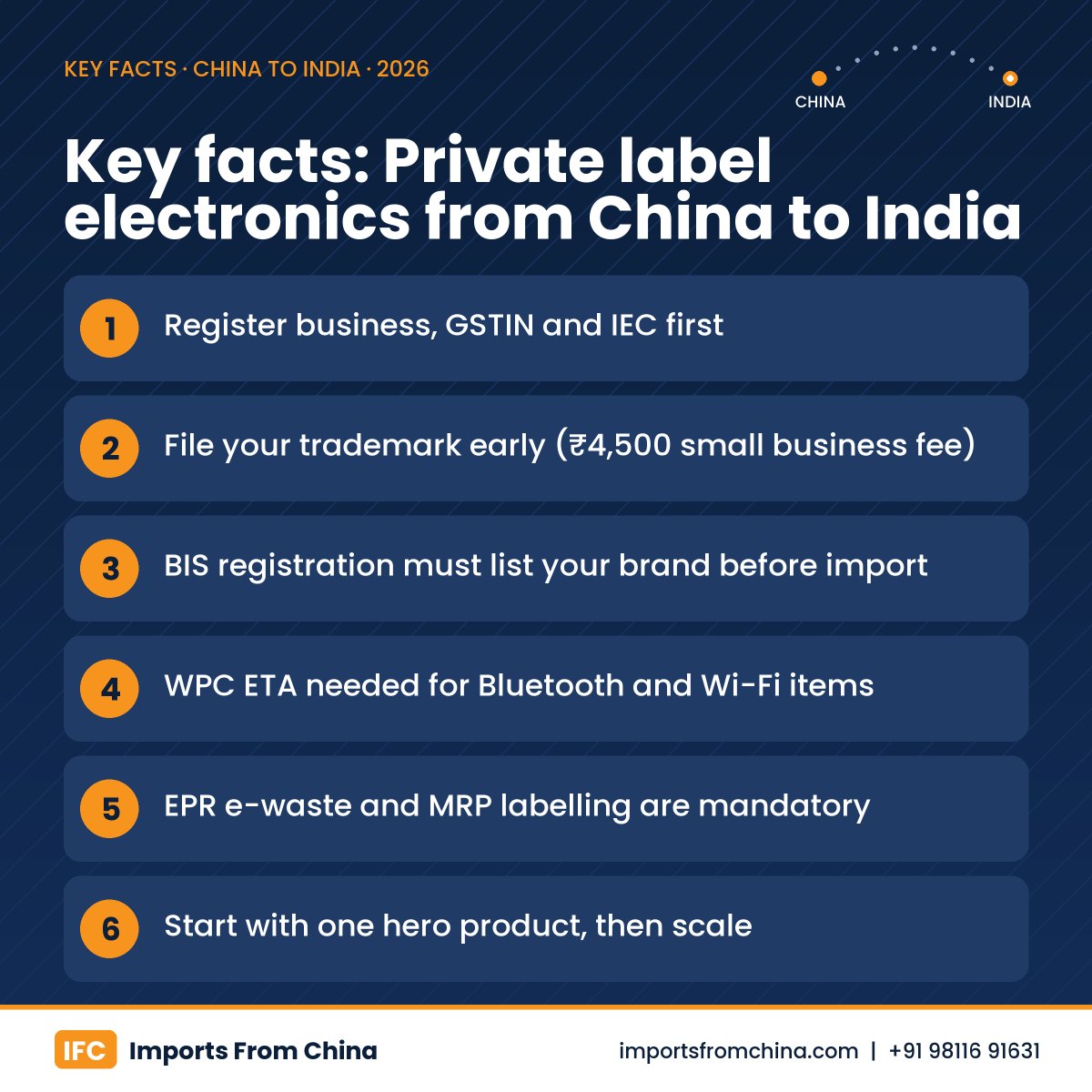
Can you import electronics from China and sell them in India under your own brand? Yes. Thousands of Indian brands do it. You need a registered business with IEC and GSTIN, your trademark, BIS registration of the product in your brand name (through the Chinese factory and an Indian representative), WPC approval for Bluetooth or Wi-Fi items, EPR e-waste registration, and correct MRP labelling.

This guide walks through the full private-label process step by step, with timelines, costs and the mistakes that get new brands stuck at customs.

Key takeaways

  • Legal entity first: proprietorship, LLP or company with GSTIN and IEC.
  • Trademark: file your brand in India early; e-filing fee is ₹4,500 for individuals and small businesses.
  • BIS CRS: most consumer electronics need BIS registration before import, listing your brand.
  • WPC: Bluetooth and Wi-Fi products need WPC equipment type approval (ETA).
  • EPR and labelling: e-waste EPR registration with CPCB and Legal Metrology labelling with MRP.
  • Start small: test one hero product before building a range.

Step 1: Set up your business and import registrations

  • Choose a structure: proprietorship (fastest), LLP or private limited company.
  • Get a GSTIN so you can claim IGST paid at customs as input tax credit.
  • Apply for an IEC on the DGFT website (government fee ₹500).
  • Open a current account for payments to China.
Private label electronics from China to India infographic – key facts for Indian importers
Private label electronics from China to India: key facts at a glance (IFC – Imports From China)

Step 2: Protect your brand name with a trademark

File a trademark application in the relevant class (usually Class 9 for electronics) with the Indian Trade Marks Registry. The e-filing fee is ₹4,500 per class for individuals, startups and small enterprises, and ₹9,000 for others. You can use the ™ symbol once you have applied; ® only after registration.

Step 3: Choose the product and the right factory

Pick one hero product with steady demand, for example a charger, power bank, smartwatch, earbuds, LED light or kitchen appliance. Shortlist factories (not traders) that already make the product for other brands and have BIS experience. Read how to check a real factory vs a trader.

Step 4: BIS registration in your brand name

Many electronics fall under the BIS Compulsory Registration Scheme (CRS). The registration is granted to the manufacturing factory, with an Authorised Indian Representative (AIR), and lists each brand and model. Samples are tested in a BIS-recognised lab in India. Your brand cannot be imported until its registration is live, and every unit must carry the BIS Standard Mark with the registration number. Full details: BIS registration for electronics from China.

Step 5: WPC approval, EPR and labelling

RequirementWhen it appliesWhere
WPC ETABluetooth, Wi-Fi and other wireless devicesSaral Sanchar portal (Department of Telecommunications)
EPR e-wasteProducers and importers of listed electrical and electronic itemsCPCB EPR portal
Legal MetrologyAll pre-packaged goods sold to consumersImporter registration, MRP, importer name and address, month of import on the label
Import authorisationLaptops, tablets, PCs (heading 8471)DGFT Import Management System

Step 6: Packaging, quality check and shipping

  1. Approve the box design with your brand, BIS mark, MRP and importer details.
  2. Do a pre-shipment inspection before the balance payment.
  3. Ship the first batch by air for speed, then move repeat orders to sea to cut cost.

What will a private-label electronics brand cost to start?

ItemIndicative cost (2026)
IEC₹500 government fee
Trademark (one class, small business)₹4,500 government fee + attorney fee if used
BIS CRS registrationLab testing + fees + AIR service, varies by product; often ₹50,000 to ₹2,00,000 per product family
First stock orderMOQ x unit price, often ₹2 to 10 lakh
Shipping and dutyAir DDP about ₹750/kg for general goods; ₹1,350/kg for battery items
Packaging design and samples₹20,000 to ₹1,00,000

BIS costs vary widely by product and lab, so get a written quote before you start. Duty example: mobile chargers carry 15% BCD plus SWS and 18% IGST (rates as of October 2026; confirm for your HS code on the India import duty rates page).

Common mistakes new electronics brands make

  • Placing the order before BIS registration is live: the goods are held at customs.
  • Using a trader whose factory will not do BIS in your brand.
  • Forgetting WPC for Bluetooth items.
  • No MRP or importer details on the box.
  • Ordering too many models at once instead of one hero product.

How IFC helps you build your own brand from China

IFC (Imports From China) has worked in China–India imports for 20+ years, since 2004, and has served 5000+ Indian businesses. From our offices in Guangzhou and Yiwu we find factories that do private label, coordinate samples and branding, guide you on BIS, WPC and HSN, inspect goods and ship door to door with customs clearance. Start with China product sourcing.

Conclusion

Building your own electronics brand from China is very doable for an Indian MSME. Register the business and trademark, pick one product and a real factory, get BIS and WPC in your brand name before ordering, label correctly, and scale once the first product sells.

Mayank Dang (CA Sahab), Founder and CEO of IFC

Guide reviewed by Mayank Dang (CA Sahab), Founder & CEO of IFC

Chartered Accountant (FCA, ICAI) who has helped 5000+ Indian businesses import from China since 2004 – sourcing, BIS, HSN classification, import duty, customs and GST compliance. mayankdang.in

Get your real landed cost: enter your product, weight and CBM in the IFC shipment calculator, check your HS code on the India import duty rates page, or call IFC on +91 98116 91631 for a door-to-door DDP quote from China to your city.

Frequently asked questions

Can I import electronics from China and sell them under my own brand in India?

Yes. You need a registered business with GSTIN and IEC, a trademark for your brand, BIS registration listing your brand for notified products, WPC approval for wireless items, EPR registration and correct MRP labelling.

Who holds the BIS registration for a private-label product?

BIS registration under the Compulsory Registration Scheme is granted to the manufacturing factory, with an Authorised Indian Representative, and it lists the brands and models covered, including yours.

How much does it cost to register a trademark in India?

The government e-filing fee is ₹4,500 per class for individuals, startups and small enterprises and ₹9,000 for others. Attorney fees are extra if you use one.

Do Bluetooth earbuds from China need WPC approval?

Yes. Bluetooth and Wi-Fi devices need WPC equipment type approval through the Saral Sanchar portal before import.

What is the best first product for an electronics brand from China?

Choose one product with steady demand and simple compliance, such as a charger, LED light or kitchen gadget, test the market, then expand the range.

Import mobile accessories from china to india

Import Mobile Accessories from China to India: BIS, WPC and Duty Guide (2026)

Can you import mobile accessories from China to India? Yes, and most of India’s phone cases, cables, chargers, power banks and earbuds already come from China. But the rules differ by product: cases and cables need only the right HS code and duty, while chargers, power banks and wireless earbuds need BIS registration, and anything with Bluetooth needs WPC approval before customs will release it.

If you plan to import mobile accessories from China to India, this guide shows the duty and compliance profile for each product, how to ship lithium batteries legally, where to source in China, a quality checklist, and a worked rupee example for a mixed order.

Key takeaways

  • Two groups of products: cases, covers, cables and holders are simple imports; chargers, power banks, earbuds and smartwatches are regulated.
  • BIS before payment: regulated items need the factory’s BIS CRS registration (R-number) for your brand and model, and the Standard Mark on the product.
  • WPC for wireless: Bluetooth earbuds, speakers and smartwatches need a WPC Equipment Type Approval (ETA), filed by an Indian entity.
  • Duty is 15–20% BCD: plus 10% SWS and 18% IGST for most accessories (as of October 2026; confirm your HS code).
  • Batteries are dangerous goods: power banks ship as Class 9 cargo with UN38.3 and MSDS papers, and many consolidators will not mix them with general cargo.
  • Labels and EPR: retail packs need Legal Metrology details, and importers of batteries and listed electronics must register for EPR with CPCB.

Which mobile accessories can you import from China to India?

All common phone accessories are freely importable under India’s import policy, which means no DGFT import licence is needed. What decides how hard the import will be is whether the product falls under a technical regulation. A simple way to think about it:

  • Low-compliance accessories: phone cases and covers, screen guards, USB data cables, car and desk holders, pop sockets, selfie sticks without Bluetooth, ring lights without adapters. You need the correct HS code, duty and Legal Metrology labels.
  • Regulated accessories: mobile chargers and adapters, power banks, wired and wireless earphones, neckbands, Bluetooth speakers and smartwatches. These need BIS registration, and wireless versions also need WPC approval.

Many sellers start with the first group because a mistake costs less and the margins are good. The second group sells more by value, but every model has to be checked before you pay the factory.

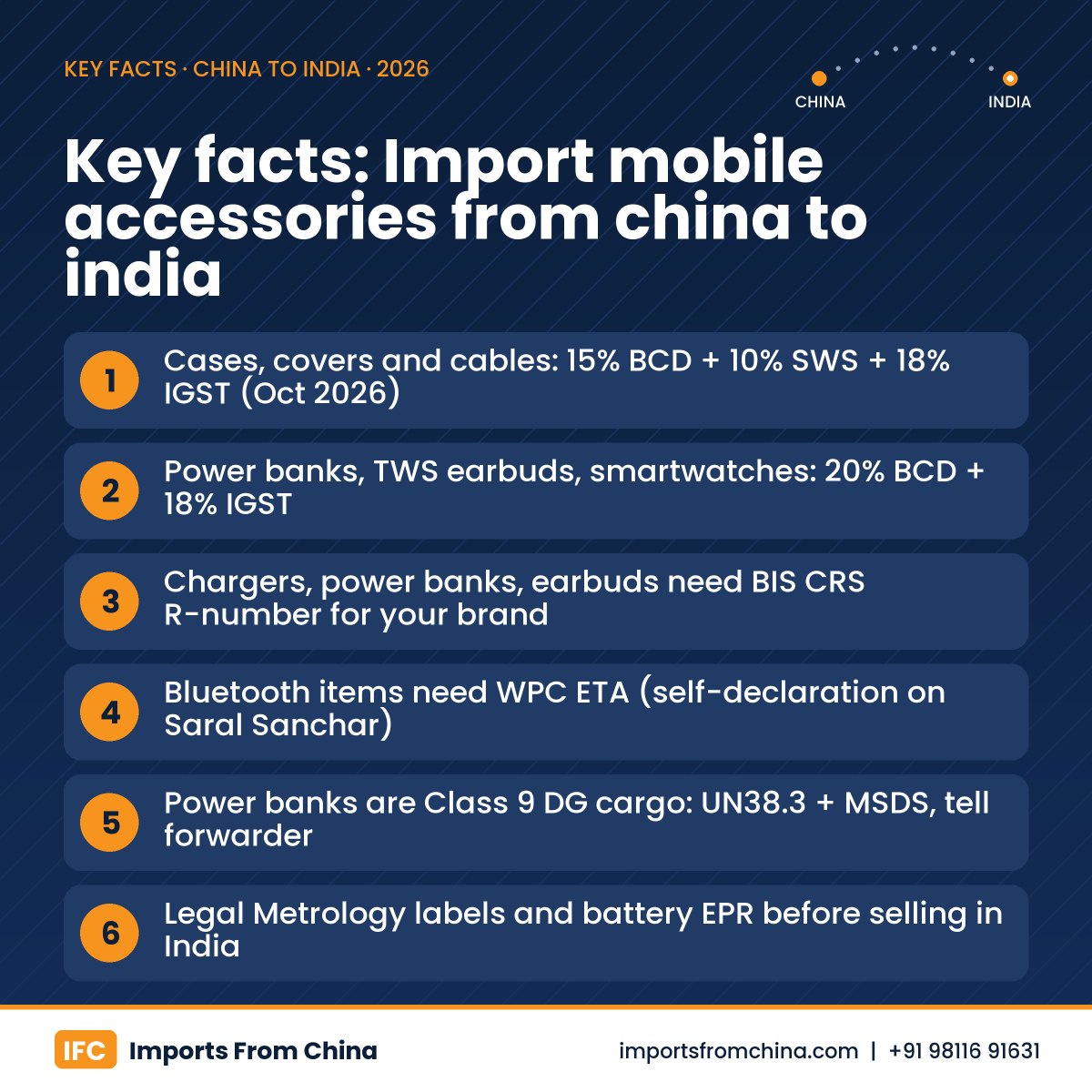
Import mobile accessories from china to india infographic – key facts for Indian importers
Import mobile accessories from china to india: key facts at a glance (IFC – Imports From China)

What is the import duty on mobile accessories from China?

The table shows typical HS codes and duty rates from the IFC India import duty database. Social Welfare Surcharge (SWS) is 10% of BCD, and IGST is charged on assessable value plus BCD plus SWS. There is no AIDC or anti-dumping duty on these codes in the database. Rates as of October 2026; confirm for your exact HS code on the India import duty rates by HS code page, because material, function and wireless features can change the code.

AccessoryTypical HS codeBCDIGSTBIS (CRS)WPC
Phone cases and covers (plastic, silicone, TPU)3926909915%18%NoNo
USB and data cables8544429915%18%Not as a standalone item (verify)No
Mobile chargers and adapters8504403015%18%Yes, IS 13252 (Part 1)No (yes for wireless chargers, verify)
Power banks8507600020%18%Yes, IS 13252 (Part 1); cells IS 16046No
TWS earbuds8518301120%18%Yes, IS 616Yes
Wired earphones and headphones8518302020%18%Check: IFC database flags IS 616; confirm on the CRS listNo
Smartwatches and fitness bands8517629020%18%Yes, IS 13252 (Part 1)Yes

Screen guards are classified by material: tempered glass usually falls in chapter 70 and plastic film in chapter 39, so confirm the code with your customs broker. Leather or fabric wallet covers may move to heading 4202. The 15% BCD on chargers applies to chargers and adapters of cellular mobile phones; other battery chargers attract 20%. For how each duty is calculated, see our import duty from China to India guide.

Which mobile accessories need BIS registration?

Under the Compulsory Registration Scheme (CRS), run by BIS for MeitY, listed electronics cannot be imported or sold in India unless the manufacturer holds a BIS registration for that factory, brand and model, and the product carries the Standard Mark with the R-number. For mobile accessories, the categories that matter most are:

  • Power adapters for IT equipment (phone chargers), IS 13252 (Part 1).
  • Power banks for portable applications, IS 13252 (Part 1), with the lithium cells inside also registered under IS 16046.
  • Wireless headphones and earphones, IS 616; confirm whether your wired model is also covered.
  • Smartwatches, IS 13252 (Part 1).
  • Bluetooth speakers, usually tested to IS 616; confirm the scope for your model.

The Chinese factory is the applicant, through an Authorised Indian Representative (AIR), and testing must be done at a BIS-recognised lab in India. A new registration commonly takes one to three months, so the R-number must be confirmed before you place the bulk order, not after the goods reach the port. Our detailed guide to BIS registration for electronics from China explains the process, costs and how to verify an R-number. Always check the current list on the BIS website, because MeitY adds products from time to time.

The private-label trap

Most Indian sellers put their own brand on Chinese earbuds or power banks. A factory’s existing registration covers its own brand, not yours. Unless your brand is added to the registration, the goods are non-compliant even if the identical product is registered under another name. Sort this out in writing before paying the deposit.

When do you need WPC approval for Bluetooth accessories?

Any product with a radio module, such as Bluetooth or Wi-Fi, needs an Equipment Type Approval (ETA) from the Wireless Planning and Coordination (WPC) wing of the Department of Telecommunications. This covers TWS earbuds, neckbands, Bluetooth speakers, smartwatches, wireless chargers and Bluetooth selfie remotes.

  • Route: for products working in de-licensed bands such as 2.4 GHz Bluetooth, the ETA is a self-declaration filed online on the Saral Sanchar portal. No separate WPC import licence is needed for these bands.
  • Who applies: an Indian legal entity, usually the importer or brand owner, using an RF test report from an ISO/IEC 17025 accredited lab.
  • Time and fee: usually a few working days once documents are complete, with a government fee per model; check the current fee on the portal.
  • At customs: the ETA certificate is uploaded with the Bill of Entry. Without it, Bluetooth goods are detained and demurrage starts running.

BIS and WPC are separate approvals. A Bluetooth earbud needs both: BIS for electrical safety and WPC for the radio. Keep both certificates, the test reports and photos of the marking in your import file, along with the papers in our documents required for import from China checklist.

How do you ship power banks and battery products from China?

Power banks are lithium-ion batteries in a case, so they travel as dangerous goods (Class 9). Power banks shipped on their own fall under UN3480, while batteries packed with or inside a device, such as earbuds in a charging case, fall under UN3481. This changes how you ship:

ModePower banks (UN3480)Devices with built-in batteries (UN3481)Indicative cost and time (October 2026)
Sea LCLAccepted by some consolidators as declared DG cargo; needs UN38.3 test summary, MSDS and DG declarationUsually accepted with battery documents₹9,000–16,000 per CBM door to door for general cargo, DG surcharge extra; about 3–6 weeks
Air cargoCargo aircraft only, strict packing and state-of-charge limits; few forwarders accept small lotsAccepted with proper labels and documents₹350–600/kg door to door for general cargo, DG costs extra; about 5–10 days
CourierUsually refusedRestricted; check with the courier₹450–900/kg for samples

The practical lesson: tell your forwarder about every battery product before booking. A power bank hidden in a general LCL shipment is a safety risk, can be refused at loading, and can hold up everyone else’s cargo in the same container. Our air freight vs sea freight guide explains chargeable weight and transit times in more detail.

Where do Indian importers source mobile accessories in China?

  • Shenzhen: the main manufacturing base for chargers, power banks, earbuds and smartwatches. Factories here are most likely to already hold BIS registrations for India.
  • Guangzhou: wholesale markets and trading companies for cases, covers, cables and mixed accessory ranges, often with low MOQs.
  • Yiwu: cheaper cases, holders, selfie sticks and gift-type accessories for small mixed orders. Electrical items found in Yiwu shops rarely carry BIS registration; see our list of products to buy from Yiwu market.
  • Online platforms: Alibaba and 1688 list thousands of accessory suppliers, but listing photos say nothing about Indian compliance. Use them to shortlist, then verify.

Quality checks that matter for mobile accessories

  1. Real battery capacity: test power banks for actual mAh output; overstated capacity is the most common complaint and return reason.
  2. Charging standard: confirm the fast-charge protocol (for example USB PD) and wattage with a USB tester, not just the box print.
  3. Cable build: check wire gauge, connector fit and a bend test; thin copper causes slow charging and heat.
  4. Case fit: test cases on the actual phone model, including camera cut-outs and button feel.
  5. Markings and labels: BIS Standard Mark with R-number on product and box, and the Legal Metrology declaration ready before shipment.
  6. Golden sample: keep a signed approved sample and inspect bulk goods against it before loading.

Worked example: duty on a mixed mobile accessories order

Assumptions: an online seller in Bengaluru imports four lines from Shenzhen and Guangzhou. The earbuds and power banks come from factories whose BIS registrations cover the seller’s brand, and the earbuds have a WPC ETA. Total FOB value USD 6,400; sea freight and insurance to Nhava Sheva of USD 250 are spread by value, so CIF is USD 6,650. Exchange rate ₹96 per USD, the CBIC import rate under Notification 29/2026-Customs (N.T.), effective 16 October 2026. Assessable value is taken as CIF. Rates as of October 2026; confirm for your exact HS code.

Line (HS code)Assessable value (₹)BCD (₹)SWS (₹)IGST 18% (₹)Total at customs (₹)
500 TWS earbuds at USD 6.50 (85183011), BCD 20%3,23,85064,7706,47771,1171,42,364
1,000 USB-C cables at USD 0.60 (85444299), BCD 15%59,7888,96889712,53822,403
2,000 TPU phone cases at USD 0.45 (39269099), BCD 15%89,68113,4521,34518,80633,603
300 power banks at USD 5.50 (85076000), BCD 20%1,64,41632,8833,28836,10672,277
Total6,37,7351,20,07312,0071,38,5672,70,647

If the Bill of Entry carries your GSTIN, the IGST of ₹1,38,567 is normally claimed as input tax credit. Your real duty cost is BCD plus SWS of ₹1,32,080, about 21% of the assessable value. Per unit, that is roughly ₹142 per pair of earbuds and ₹120 per power bank. Freight comes on top: general cargo LCL is about ₹9,000–16,000 per CBM door to door (indicative, October 2026), and the power banks may need a separate DG booking with an extra surcharge.

Now compare the cost of a compliance miss. If the earbuds arrived without WPC approval or with an R-number that does not cover your brand, ₹4 lakh of goods could sit at the port while storage and demurrage build up, and the outcome could be re-export or destruction. That is why BIS and WPC checks come before price negotiation. Test your own mix in the IFC shipment calculator.

What labels, EPR and marketplace rules apply after import?

  • Legal Metrology: retail packs must show the importer’s name and address, country of origin, MRP, net quantity, month and year of import and customer care details. For imports, the declaration must be on the pack before customs clearance, so print or sticker it in China.
  • Battery EPR: under the Battery Waste Management Rules, 2022, importers of batteries, including those inside power banks and earbuds, are treated as producers and must register with CPCB.
  • E-waste EPR: under the E-Waste (Management) Rules, 2022, importers of listed electrical and electronic equipment must register for EPR; check whether your product is listed.
  • Marketplaces: Amazon and Flipkart commonly ask for BIS registration details before you can list regulated electronics, so keep the R-number, WPC ETA and importer details ready.

Pre-order checklist for mobile accessories

  1. HS code and duty confirmed for each product.
  2. BIS R-number verified for the exact factory, brand and model, valid beyond your arrival date.
  3. WPC ETA in hand for every Bluetooth or Wi-Fi product.
  4. UN38.3 test summary and MSDS for battery products, and the forwarder told in advance.
  5. Legal Metrology artwork approved and printed before shipment.
  6. EPR registrations done for batteries and listed electronics.
  7. Pre-shipment inspection booked against the golden sample.

How IFC helps you import mobile accessories from China to India

IFC – Imports From China has more than 20 years (since 2004) in China–India import and export and has served 5000+ businesses. It is founded and led by Mayank Dang (CA Sahab), a Chartered Accountant (FCA, ICAI). IFC’s own offices in Guangzhou and Yiwu have translators and English-speaking staff who can ask suppliers for BIS and WPC documents, check markings on samples and cartons, verify the supplier and run a quality inspection before loading.

IFC gives BIS, HSN, duty and customs/GST compliance guidance before you order, then handles sourcing, LCL and FCL sea freight, air cargo and customs clearance in India. Mixed containers and air cargo are loaded daily, and IFC has a warehouse at its headquarters. With DDP shipments from China to India, accessories are delivered door to door to major cities including Delhi, Gurugram, Noida, Mumbai, Pune, Bengaluru, Hyderabad, Chennai and Ahmedabad.

Bottom line

Mobile accessories are one of the most profitable China-to-India categories, but only when compliance is handled first. Start with cases and cables if you are new, and move into chargers, power banks and earbuds once you can verify BIS registrations for your brand, get WPC approval for wireless items and ship batteries correctly. With those checks done, duty of 15–20% BCD is a predictable cost, not a risk.

Mayank Dang (CA Sahab), Founder and CEO of IFC

Guide on importing mobile accessories from China reviewed by Mayank Dang (CA Sahab), Founder & CEO of IFC

Chartered Accountant (FCA, ICAI) who has helped 5000+ Indian businesses import from China since 2004 – sourcing, BIS, HSN classification, import duty, customs and GST compliance. mayankdang.in

Get your real landed cost: enter your product, weight and CBM in the IFC shipment calculator, check your HS code on the India import duty rates page, or call IFC on +91 98116 91631 for a door-to-door DDP quote from China to your city.

Frequently asked questions

Is BIS certification required to import mobile accessories from China to India?

Only for products on the BIS Compulsory Registration Scheme list. Mobile chargers, power banks, wireless earphones and smartwatches need the factory’s BIS registration for your brand and model, with the Standard Mark on the product. Phone cases, covers, holders and plain data cables do not need BIS as standalone items, but confirm the current list before ordering.

What is the import duty on mobile accessories from China?

Most accessories attract 15% or 20% Basic Customs Duty, 10% Social Welfare Surcharge on the BCD and 18% IGST. For example, phone cases, data cables and mobile chargers carry 15% BCD, while power banks, earbuds and smartwatches carry 20% (as of October 2026). The IGST can usually be claimed as input tax credit.

Do Bluetooth earbuds need WPC approval for import into India?

Yes. Any product with Bluetooth or Wi-Fi needs a WPC Equipment Type Approval. For de-licensed bands it is a self-declaration filed on the Saral Sanchar portal by an Indian entity, using an RF test report from an accredited lab. Customs can detain Bluetooth goods that arrive without it, so get the ETA before shipping.

Can power banks be shipped from China to India by air?

Power banks shipped on their own are Class 9 dangerous goods under UN3480 and can only fly on cargo aircraft with strict packing and charge limits, so few forwarders accept small lots. Sea freight with a UN38.3 test summary, MSDS and DG declaration is usually the practical route. Couriers generally refuse power banks.

Which is the best place in China to buy mobile accessories?

Shenzhen is the main manufacturing base for chargers, power banks, earbuds and smartwatches, and its factories are most likely to hold BIS registrations for India. Guangzhou wholesale markets suit cases, covers and cables, and Yiwu suits cheap holders and gift-type accessories in small mixed orders.

Can I import mobile accessories under my own brand?

Yes, but for regulated items the BIS registration must cover your brand, not just the factory’s own brand, and the Bluetooth products need a WPC approval in your or your representative’s name. Your Legal Metrology label must also show you as the importer. Settle these points before paying the deposit.

What labels are required on imported mobile accessories?

Retail packs need the Legal Metrology declaration: importer name and address, country of origin, MRP, net quantity, month and year of import and customer care details, applied before customs clearance. Regulated electronics also need the BIS Standard Mark with the R-number on the product and the packaging.

Import electronics from china to india bis registration

Import Electronics from China to India: BIS Registration (CRS) Guide 2026

Do you need BIS registration to import electronics from China to India? For most everyday electronics, yes. Chargers, power banks, LED lights, laptops, Bluetooth speakers and CCTV cameras fall under BIS’s Compulsory Registration Scheme (CRS). The Chinese factory must hold a BIS registration (R-number) for that brand and model, and the goods must carry the BIS Standard Mark before they leave China.

If you plan to import electronics from China to India, BIS registration is the first thing to check, before price or freight. This guide explains which products are covered, who registers, the step-by-step process, indicative costs and timelines, how customs checks compliance at the port, and a worked duty example in rupees for 1,000 mobile chargers.

Key takeaways

  • The factory registers, not you: BIS CRS registration is granted to the manufacturer for each factory and brand, through an Authorised Indian Representative (AIR).
  • No R-number, no clearance: covered electronics without a valid registration and Standard Mark can be held, sent back or destroyed at the Indian port.
  • Testing is in India: samples must be tested at a BIS-recognised lab, and the test report must not be older than 90 days when the application is filed.
  • Plan 1–3 months: lab testing plus BIS processing usually takes several weeks for a new model, so start before you place the bulk order.
  • BIS is not the only check: wireless items need WPC approval, importers of electronics need EPR registration under the E-Waste Rules, and retail packs need Legal Metrology labels.
  • Duty still applies: mobile chargers (HS 85044030) attract 15% BCD, 10% SWS and 18% IGST (as of October 2026).

What is BIS CRS registration and who needs it?

The Compulsory Registration Scheme is run by the Bureau of Indian Standards (BIS) for the Ministry of Electronics and IT (MeitY). It is notified under the Electronics and Information Technology Goods (Requirements for Compulsory Registration) Order. Any product on the CRS list cannot be manufactured, imported, sold or distributed in India unless it is registered with BIS and carries the Standard Mark.

Three points confuse most first-time importers:

  • The applicant is the manufacturer. A trader or importer in India cannot register a Chinese factory’s product in its own name as the manufacturer. The Chinese factory applies, and appoints an Authorised Indian Representative (AIR) based in India.
  • Registration is factory-wise and brand-wise. Each manufacturing location gets its own registration number. Each brand is registered separately, although one test report can cover several brands when the product and factory are the same.
  • It is valid for two years. The registration must be renewed before expiry, and BIS can draw market samples for surveillance at any time.
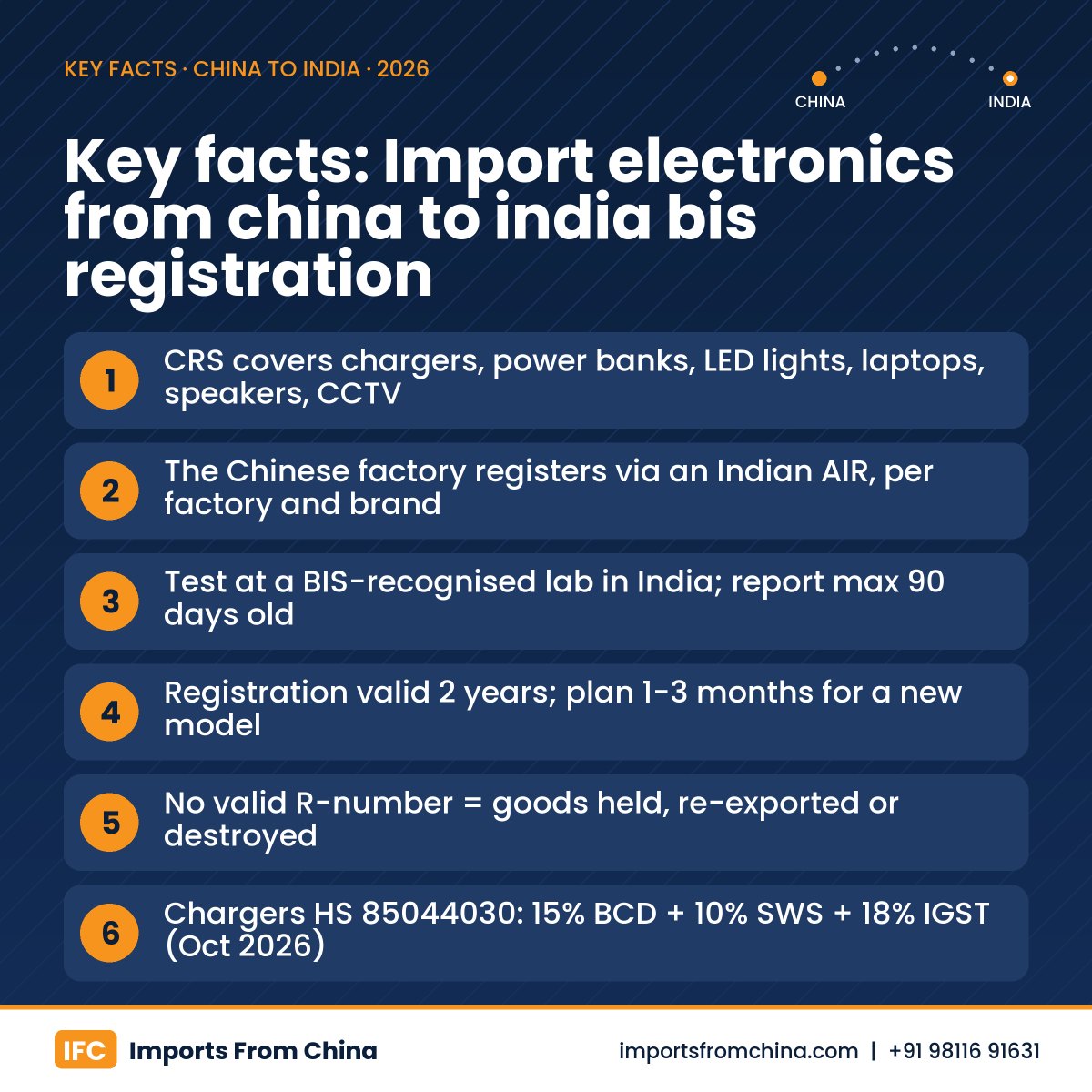
Import electronics from china to india bis registration infographic – key facts for Indian importers
Import electronics from china to india bis registration: key facts at a glance (IFC – Imports From China)

Which electronics from China need BIS registration?

The CRS list covers several dozen categories of electronics and IT goods, and MeitY adds items from time to time. The table shows the products Indian importers ask IFC about most often. Always confirm the current list on the BIS CRS portal before ordering, because the standard number and scope can change.

ProductTypical HS codeBIS standard (CRS)Other approvals to check
Mobile chargers and adapters85044030IS 13252 (Part 1)EPR (e-waste), Legal Metrology label
Power banks and lithium battery packs85076000IS 13252 (Part 1) and IS 16046 (Part 2)EPR, battery rules, dangerous-goods shipping
LED lamps and luminaires8539 / 9405IS 16102 / IS 10322 seriesEPR, Legal Metrology
Bluetooth speakers and audio amplifiers8518IS 616WPC approval (Bluetooth), EPR
Laptops, tablets, monitors8471 / 8528IS 13252 (Part 1)WPC (Wi-Fi), EPR
CCTV cameras and DVRs8525 / 8521IS 13252 (Part 1)Check current CCTV security requirements, EPR

Some electrical goods, such as switches, cables, fans and many household appliances, fall under separate BIS Quality Control Orders that need an ISI licence under the Foreign Manufacturers Certification Scheme (FMCS) instead of CRS. FMCS involves a factory audit and takes much longer. If you deal in a mix of products, see our electrical products from China page and check each item separately. You can look up the duty and compliance notes for any 8-digit code on the India import duty rates by HS code page.

Import electronics from China to India: BIS registration step by step

This is the usual sequence for a product that the Chinese factory has not yet registered for India.

  1. Confirm the product is on the CRS list and identify the Indian Standard that applies. Use the exact model and its technical sheet, not a marketplace title.
  2. Ask the factory for its existing R-number. Many large Chinese factories that already sell to India have one. Check that it covers your model, your brand and the factory address on your purchase order.
  3. Appoint an AIR. If a new registration is needed, the factory nominates an Authorised Indian Representative. For private-label goods this is often the Indian brand owner or importer, or a BIS consultant.
  4. Send samples to a BIS-recognised lab in India. Your own or the factory’s in-house test reports are not accepted. For a model series, the highest configuration is usually tested under MeitY’s series guidelines.
  5. Apply online on the BIS portal with the test report (not older than 90 days), the factory’s business licence, brand authorisation, AIR documents, label artwork and the fee.
  6. BIS grants the registration and issues the R-number for that factory and brand.
  7. Print the Standard Mark with the IS number and R-number on the product and its packaging (packaging alone only if the product is too small) before mass production.
  8. Keep the file ready for customs: registration letter, test report, photos of the marking and the brand authorisation travel with your shipping documents.

Who should be the AIR for your product?

The AIR answers to BIS and MeitY for the registration, so choose with care. If you sell under your own brand on Amazon or Flipkart, being the AIR yourself gives you control: the registration cannot be withdrawn by an agent you no longer work with. If you only buy a factory’s own branded goods, it is normally the factory’s existing AIR who holds the registration, and you simply verify it.

How much does BIS CRS registration cost and how long does it take?

Costs depend on the product, the standard and the lab. BIS publishes its own fee schedule, and labs and consultants quote separately. The figures below are indicative ranges for a single new model (indicative, October 2026).

Cost or time itemWho paysIndicative range
Lab testing at a BIS-recognised labFactory or AIRRoughly ₹25,000 to ₹1,50,000+ per model, more for complex products
BIS application and registration feesFactory or AIRAs per the current BIS fee schedule; check the BIS portal
Sample courier from China and customs for samplesFactory or importerCourier at about ₹450–900/kg plus duty on the samples
Consultant fee (optional)Whoever hires themVaries widely; ask for a written scope
Lab testing time–Usually 2–6 weeks, depending on lab workload
BIS processing after a complete application–Usually a few weeks if documents are in order

Add it up and a new registration commonly takes one to three months from sample dispatch. That is why the order of work matters: confirm the R-number or start registration first, approve the marked sample next, and only then pay the deposit for bulk production. Registration is also per factory, so if your supplier quietly moves your order to a different plant, the existing R-number may not cover it.

How does customs check BIS compliance when electronics land in India?

BIS compliance is checked as part of normal customs clearance in India. Your customs broker declares the goods on the Bill of Entry on ICEGATE, and for CRS products the registration details and documents are uploaded with it. If the shipment is selected for examination, officers at the CFS, ICD or air cargo terminal open cartons and look for:

  • The Standard Mark with the correct IS number and R-number on the product and the box.
  • A brand and model that match the registration, the invoice and the packing list.
  • Legal Metrology details on retail packs: importer name and address, MRP, net quantity, month and year of import and customer care details.
  • WPC approval for anything with Bluetooth or Wi-Fi.

If a covered product arrives without valid registration, customs can refuse clearance. In practice the importer then faces re-export at its own cost, or destruction, plus port storage and demurrage while the case is decided. Penalties under the BIS Act, 2016 are also possible. Mixed shipments are a common trap: one unregistered model in a container of registered goods can hold up the whole Bill of Entry. Our documents required for import from China checklist shows the full file your broker needs.

How to verify a supplier’s R-number

Ask the supplier for the registration letter, then search the R-number on the BIS CRS portal or in the BIS Care app. Match four things: factory name and address, brand, model numbers and the validity date. A screenshot of a certificate on WhatsApp is not proof. If the factory name on the BIS record differs from the company on your proforma invoice, ask why before paying; it often means you are dealing with a trading company. See also how to verify a China import agent.

Worked example: duty and compliance cost for 1,000 mobile chargers

Assumptions: 1,000 USB-C mobile chargers from a Shenzhen factory that already holds a valid BIS R-number for your brand. FOB price USD 2.20 each (USD 2,200). Sea freight to Nhava Sheva USD 120 and insurance USD 12, so CIF is USD 2,332. Exchange rate ₹96 per USD, the CBIC import rate under Notification 29/2026-Customs (N.T.), effective 16 October 2026. The IFC duty database shows HS 85044030 at 15% BCD (for chargers of cellular mobile phones), 10% SWS, no AIDC, 18% IGST and no anti-dumping duty. Rates as of October 2026; confirm for your exact HS code.

ItemHow it is calculatedAmount (₹)
Assessable value (AV)CIF USD 2,332 × 95.902,23,639
Basic Customs Duty15% of AV33,546
Social Welfare Surcharge10% of BCD3,355
Value for IGSTAV + BCD + SWS2,60,540
IGST18% of 2,60,54046,897
Total paid at customsBCD + SWS + IGST83,798

The IGST of ₹46,897 is normally available as input tax credit if your GSTIN is on the Bill of Entry. Your real duty cost is the BCD and SWS of ₹36,901, about ₹37 per charger. Add freight and Indian charges: this lot is about 1.2 CBM, and door-to-door LCL from China typically costs ₹9,000–16,000 per CBM (indicative, October 2026), with a minimum charge on small lots.

Now compare the cost of getting BIS wrong. If the factory had no valid registration for your brand, you would first spend roughly ₹25,000 or more on testing and wait several weeks. If you shipped anyway, the ₹3 lakh of goods could be refused entry, and you would still pay freight, storage and either re-export or destruction. Run your own product through the IFC shipment calculator, and read our import duty from China to India guide for how each duty is worked out.

What mistakes do Indian importers make with BIS for electronics?

  • Trusting a “CE” or “FCC” mark. European and US marks mean nothing for Indian customs. Only the BIS Standard Mark with a valid R-number counts.
  • Buying a registered model under a new brand. If you add your own logo, the registration must cover your brand too.
  • Ignoring the factory address. Registration is tied to the manufacturing location, not to the trading company that sends the invoice.
  • Forgetting accessories inside the box. A registered speaker shipped with an unregistered adapter can still be stopped, because the adapter needs its own registration.
  • Letting the registration lapse. Registrations are valid for two years. Check the expiry date against your shipment date.
  • Skipping EPR registration. Under the E-Waste (Management) Rules, 2022, importers of covered electrical and electronic equipment are treated as producers and must register on the CPCB EPR portal.

Pre-order checklist for electronics from China

  1. HS code and duty confirmed for each model.
  2. CRS coverage and the Indian Standard confirmed on the BIS portal.
  3. R-number verified for this factory, brand and model, with validity beyond your arrival date.
  4. WPC approval in hand for Bluetooth or Wi-Fi products.
  5. EPR registration and Legal Metrology label artwork ready.
  6. Marked golden sample approved before bulk production, and inspection booked before loading.

How IFC helps you import electronics from China with BIS compliance

IFC – Imports From China has more than 20 years (since 2004) in China–India import and export, and has served 5000+ businesses. The company is founded and led by Mayank Dang (CA Sahab), a Chartered Accountant (FCA, ICAI). Our own offices in Guangzhou and Yiwu have translators and English-speaking staff who can ask a factory for its BIS registration, check the marking on samples and cartons, and run a quality inspection before goods are loaded.

We give BIS, HSN, duty and customs/GST compliance guidance before you order, then handle sourcing, supplier verification, LCL and FCL sea freight, air cargo and customs clearance in India. We load mixed containers and air cargo daily and have a warehouse at our headquarters. With our DDP shipments from China to India, goods are delivered door to door to major cities including Delhi, Gurugram, Noida, Mumbai, Pune, Bengaluru, Hyderabad, Chennai and Ahmedabad.

Bottom line

For electronics from China, BIS registration decides whether your goods can enter India at all. Confirm the product’s CRS status, verify the factory’s R-number for your brand and model, add WPC and EPR where needed, and only then pay for bulk production. Done in that order, BIS becomes a routine check instead of a container stuck at the port.

Mayank Dang (CA Sahab), Founder and CEO of IFC

Guide on BIS registration for electronics imports reviewed by Mayank Dang (CA Sahab), Founder & CEO of IFC

Chartered Accountant (FCA, ICAI) who has helped 5000+ Indian businesses import from China since 2004 – sourcing, BIS, HSN classification, import duty, customs and GST compliance. mayankdang.in

Get your real landed cost: enter your product, weight and CBM in the IFC shipment calculator, check your HS code on the India import duty rates page, or call IFC on +91 98116 91631 for a door-to-door DDP quote from China to your city.

Frequently asked questions

Is BIS registration mandatory for importing electronics from China to India?

Yes, for every product on the BIS Compulsory Registration Scheme list, such as chargers, power banks, LED lights, laptops, Bluetooth speakers and CCTV cameras. The Chinese manufacturer must hold a valid registration for that factory, brand and model, and the goods must carry the BIS Standard Mark with the R-number before they reach an Indian port.

Can an Indian importer apply for BIS CRS registration?

The applicant is the manufacturer, not the trader. An Indian importer or brand owner can act as the Authorised Indian Representative (AIR) for the Chinese factory and handle the testing and application, but the registration is granted for the manufacturing location. Private-label sellers often take the AIR role to keep control of the registration.

How long does BIS registration take for electronics?

For a new model, lab testing at a BIS-recognised lab in India usually takes 2 to 6 weeks, and BIS processing a few more weeks if documents are complete. Plan roughly one to three months from sample dispatch. If the factory already has a valid R-number covering your brand and model, no new registration is needed.

What happens if electronics arrive at Indian customs without BIS registration?

Customs can refuse clearance for covered goods without valid registration and marking. The importer usually has to re-export the goods or have them destroyed, while paying port storage and demurrage. Penalties under the BIS Act, 2016 are also possible. One unregistered model can hold up an entire mixed shipment.

How do I check if a Chinese supplier’s BIS R-number is genuine?

Search the R-number on the BIS CRS portal or in the BIS Care app and match the factory name and address, brand, model numbers and validity date with your purchase order. Do not rely on a certificate image alone. If the BIS record shows a different company from your invoice, you may be dealing with a trading company.

Do I need WPC approval as well as BIS for Bluetooth products?

Yes. Products with Bluetooth, Wi-Fi or other wireless modules need WPC approval in addition to BIS registration where the product is on the CRS list. Importers of electronics also need EPR registration under the E-Waste (Management) Rules, 2022, and retail packs need Legal Metrology labelling.

Does BIS registration change the import duty on electronics?

No. BIS registration is a compliance requirement and does not reduce duty. Customs duty depends on the HS code. For example, mobile chargers under HS 85044030 attract 15% BCD, 10% SWS and 18% IGST as of October 2026. Confirm the rate for your exact code before ordering.

Cost of importing furniture from china to india

Cost of Importing Furniture from China to India: Duty, Freight and a Worked Example

The cost of importing furniture from China to India is usually 1.4 to 1.7 times the Chinese factory (FOB) price, excluding the GST a registered business can claim back. Customs duty on most chapter 94 furniture is 20% BCD plus 5% AIDC, then 18% IGST on top, and bulky items like sofas push freight up because you pay for volume, not weight.

Below: every cost line for a 40ft HQ of Foshan sofa sets, dining sets and TV units, with duty maths in rupees, freight options, BIS rules, local charges and cost per piece versus buying in India.

Key takeaways

  • Duty stack: furniture under HS 9401 and 9403 attracts 20% BCD + 5% AIDC, SWS nil, then 18% IGST (rates as of October 2026).
  • Cash at customs: about 47.5% of CIF; the IGST part is creditable for GST-registered buyers.
  • Volume decides freight: a 3+2+1 sofa set packs to roughly 3.5 to 4.5 CBM, so above about 15 CBM a full container usually beats LCL.
  • Worked example: a Rs 14 lakh FOB order from Foshan lands at about Rs 20 lakh before GST, or about 1.51 times FOB.
  • BIS is mandatory: chairs, tables, storage units and beds need a BIS-licensed factory and ISI mark.
  • Plan 10 to 14 weeks: 25 to 45 days of production plus 12 to 20 days at sea, then clearance and delivery.

What is the cost of importing furniture from China to India in 2026?

Your landed cost has eight parts; most buyers only ask the supplier for the first:

  1. Factory price, EXW or FOB (FOB includes trucking to the Chinese port and export clearance).
  2. Packing and crating for stone tops, glass and mirrors.
  3. Quality inspection before loading.
  4. Ocean freight by LCL, 20ft, 40ft or 40ft HQ container to Nhava Sheva (JNPT), Mundra, Chennai or Kolkata, or by rail to ICD Tughlakabad or Patparganj for Delhi NCR.
  5. Marine insurance, usually under 1% of cargo value.
  6. Customs duty and IGST on the Bill of Entry filed on ICEGATE.
  7. Destination charges: delivery order, terminal or CFS handling and CHA (customs broker) fees.
  8. Last mile: trucking to your warehouse or site, plus unloading.

Duty is the biggest add-on, but for bulky furniture the logistics lines often add another 15% to 25% of FOB. So a sofa that looks half the price on Alibaba can end up only modestly cheaper than a comparable Indian quote.

Cost of importing furniture from china to india infographic – key facts for Indian importers
Cost of importing furniture from china to india: key facts at a glance (IFC – Imports From China)

What is the import duty on furniture from China to India?

Most furniture falls in chapter 94 of the Indian Customs Tariff. Seats and sofas are under heading 9401, other furniture (tables, beds, cabinets, wardrobes) under 9403. After the Budget 2025 changes, these codes carry 20% Basic Customs Duty plus 5% Agriculture Infrastructure and Development Cess, with Social Welfare Surcharge exempt, and 18% IGST. No anti-dumping duty applies to these codes from China at the time of writing.

ProductHS codeBCDAIDCSWSIGSTBIS standard (Furniture QCO)
Upholstered sofa or chair, wooden frame9401610020%5%Nil18%IS 17632 may apply to chairs
Office swivel chair9401390020%5%Nil18%IS 17631 (work chairs)
Metal furniture (tables, frames)9403209020%5%Nil18%IS 17633 to 17636 as applicable
Wooden bed9403501020%5%Nil18%IS 17635 (beds)
Other wooden furniture (dining tables, TV units)9403600020%5%Nil18%IS 17633 or 17634 as applicable

Rates as of October 2026 from the IFC duty database; confirm for your exact HS code before you order. You can check each code on IFC’s India import duty rates by HS code page, for example the HS 94036000 wooden furniture page, and the official tariff on CBIC.

How the duty is calculated

  • Assessable value = CIF value in rupees (FOB + ocean freight + insurance), converted at the CBIC notified exchange rate for the week of the Bill of Entry. Indian customs no longer adds a separate 1% landing charge.
  • BCD = 20% of assessable value; AIDC = 5% of assessable value; SWS = nil for these lines.
  • IGST = 18% of (assessable value + BCD + AIDC).

On Rs 100 of CIF value that is Rs 20 BCD, Rs 5 AIDC and Rs 23 IGST, so Rs 48 in total. Older articles quoting 25% BCD plus 10% SWS are out of date. Our import duty from China to India guide explains the method for all product types.

Do you need BIS certification to import furniture from China?

Yes, for most commercial furniture. The Furniture (Quality Control) Order, 2025 made BIS certification and the ISI mark compulsory from 13 February 2026 (micro and small Indian manufacturers got time until 13 August 2026). It covers six Indian Standards:

  • IS 17631:2022 work chairs (office and task chairs)
  • IS 17632:2022 general purpose chairs and stools
  • IS 17633:2022 tables and desks
  • IS 17634:2022 storage units
  • IS 17635:2022 beds and IS 17636:2022 bunk beds

For imports, the licence must belong to the Chinese factory that makes the product (BIS Foreign Manufacturers Certification Scheme), and the goods must carry the ISI mark with that licence number. Customs can hold covered furniture without it. Before you pay a deposit, ask the supplier for its BIS licence number and check it on the BIS website. Not every Foshan factory holds one, which can narrow your supplier list for dining chairs, office chairs, tables, wardrobes and beds.

Sofas have no separate standard; whether a sofa or lounge chair falls under IS 17632 depends on design, so confirm each model with BIS or your CHA and check the current notification, as DPIIT amended several QCOs in 2026.

Wood and packing rules

Wooden crates and pallets must be ISPM-15 heat treated and stamped. Solid-wood furniture can be referred to plant quarantine, so get fumigation or heat-treatment certificates from the supplier.

How much does it cost to ship furniture from Foshan to India: LCL, 20ft or 40ft HQ?

Foshan, with Lecong (furniture markets) and Longjiang (upholstery) in Shunde district, is China’s largest furniture cluster. Cargo usually loads at Nansha (Guangzhou) or Shenzhen ports. Port-to-port sailing to Nhava Sheva takes about 12 to 20 days.

Furniture is light for its size, so freight is charged on CBM. Typical packed volumes from Foshan factories:

Item (packed)Approx. CBMApprox. gross weight
3-seater sofa1.6 to 2.255 to 80 kg
Sofa set 3+2+13.5 to 4.5120 to 180 kg
Dining table, knocked down0.3 to 0.640 to 90 kg (stone tops are heavier)
Dining chair (2 per carton)0.15 to 0.25 each7 to 12 kg each
King bed with headboard, knocked down0.8 to 1.260 to 110 kg
Office swivel chair0.2 to 0.312 to 20 kg

Because cartons are irregular and sofas cannot be stacked high, plan on loading less than the nominal container volume:

OptionPractical furniture loadIndicative ocean freight, South China to Nhava ShevaBest for
LCL (shared container)1 to 15 CBMRs 4,000 to Rs 7,500 per CBM, plus origin and CFS chargesSamples, a few sofa sets, home orders
20ft container25 to 28 CBMRs 50,000 to Rs 1,20,000One room set or a small showroom refill
40ft standard52 to 58 CBMRs 80,000 to Rs 1,70,000Mixed showroom orders
40ft HQ60 to 65 CBMRs 85,000 to Rs 1,80,000Sofas, beds, wardrobes, hotel projects

Freight figures are indicative, October 2026. Rates move with the market and the season; always take a written quote. LCL takes roughly 3 to 6 weeks door to door. Above about 15 CBM, a full container is usually cheaper and safer, as goods are loaded once at the factory. See FCL vs LCL shipping from China to India for the break-even method.

Worked example: landed cost of a 40ft HQ of Foshan furniture

Assume a Pune-based interior firm orders one 40ft HQ from two Foshan factories, priced FOB Nansha. Exchange rate is taken at an illustrative Rs 90 per USD; customs will use the CBIC rate for the week you file.

  • 8 sofa sets (3+2+1), wooden frame, upholstered, HS 94016100: USD 700 each, 4.1 CBM each
  • 10 dining sets (wooden table + 6 upholstered chairs), HS 94036000 and 94016100: USD 710 each, 1.55 CBM each
  • 10 wooden TV units, HS 94036000: USD 180 each, 0.45 CBM each
  • Total: USD 14,500 FOB (Rs 13,05,000), 52.8 CBM, about 2,900 kg
Cost lineHow it is worked outAmount (Rs)
FOB valueUSD 14,500 x 9013,05,000
Ocean freight, 40ft HQAssumed USD 1,5001,35,000
Marine insuranceActual premium, all-risk cover8,000
CIF = assessable valueFOB + freight + insurance14,48,000
BCD20% of 14,48,0002,89,600
AIDC5% of 14,48,00072,400
SWSExempt for these codes0
IGST18% of 18,10,000 (CIF + BCD + AIDC)3,25,800
Pre-shipment inspectionOne inspector-day plus loading check25,000
Extra crating and corner protectionNot included in FOB price20,000
Destination charges at Nhava ShevaDelivery order, terminal or CFS handling50,000
CHA and documentationBill of Entry, examination support15,000
Trucking to Pune warehouse40ft container, one trip35,000
Unloading and site deliveryLabour and small vehicle to sites15,000
Landed cost before GSTCIF + BCD + AIDC + local costs19,70,000
Total cash outflowIncluding IGST of 3,25,80022,95,800

Duty rates as of October 2026; confirm for your exact HS code. Local cost lines are indicative, October 2026, and service charges carry GST. The landed cost is about 1.51 times FOB. If the firm is GST-registered and resells or bills the furniture to clients, the Rs 3,25,800 IGST comes back as input tax credit. A hotel or end user that cannot use the credit should treat it as cost, so check this with your CA.

Cost per piece

Splitting freight and local costs by CBM and duty by value gives:

ItemFOB (Rs)Landed before GST (Rs)Approx. with 18% GST (Rs)
Sofa set 3+2+163,0001,04,8001,23,600
Dining set (table + 6 chairs)63,90090,0001,06,200
TV unit16,20023,20027,300

The sofa set costs about the same FOB as a dining set but lands about Rs 15,000 higher, purely because of volume. You can run your own numbers in the IFC shipment calculator.

Is it cheaper to import furniture from China or buy it in India?

Compare your landed cost per piece with a written quote from an Indian manufacturer for the same specification: frame wood, foam density, fabric or leather grade, hardware, finish and warranty. In the example above, importing makes sense only if comparable Indian quotes are clearly above about Rs 2 lakh for the sofa set and Rs 2 lakh for the dining set, including GST.

FactorImport from FoshanBuy from an Indian maker
Design rangeVery wide, current styles, many finishesNarrower for modern designs
Minimum orderOften a container, or a few pieces per modelSingle pieces possible
Lead time10 to 14 weeks from order to siteOften 3 to 8 weeks
Hidden costsDuty, freight, damage risk, BIS checksFewer, but price may be higher

Importing wins most on value-dense pieces made in quantity (stone-top tables, metal-frame chairs, hotel casegoods) and least on bulky, simple or urgent one-off items.

How do hotel and interior designer project orders change the cost?

Project orders mix many factories and models, so coordination and risk matter more than unit price.

  • Consolidation: collect goods from several Foshan, Guangzhou and other suppliers into one warehouse and load one container, instead of paying LCL for each supplier.
  • Samples: approve one sample or finish panel per model before mass production.
  • Room-wise labelling: mark cartons by room or floor for faster site unloading.
  • Specifications: hotel brands may need fire-retardant fabrics or contract-grade foam; put these in the purchase order and inspection checklist.
  • Spares: ship extra fabric, legs and fittings in the same container.
  • Timeline: link supplier balances to inspection reports and add a buffer around Chinese New Year and Golden Week.

How do you avoid damage, delays and extra costs?

  1. Fix the HS code and BIS position before ordering. A wrong code or missing ISI mark means daily detention and storage charges.
  2. Insist on export packing: five-layer cartons, foam corners, crates for stone and glass, desiccant bags in monsoon.
  3. Inspect before the balance payment: dimensions, colour against the sample, stitching, stability and loading photos.
  4. Buy all-risk marine insurance, photograph the cargo when the container is opened and report damage in writing quickly.
  5. Declare the real value. Suppliers who offer a “low invoice” put you at risk of reassessment, penalties and seizure. Customs compares values across similar imports.
  6. Keep documents consistent. Commercial invoice, packing list, Bill of Lading and BIS details must match so the CHA can file the Bill of Entry on ICEGATE without queries.

How IFC helps you import furniture from China to India

IFC (Imports From China) has 20+ years in China–India import and export, with its own offices in Guangzhou and Yiwu staffed by translators and English-speaking team members. For furniture buyers that means:

  • Sourcing and supplier verification for furniture from Foshan and other Chinese clusters.
  • Quality inspection before goods leave the factory.
  • LCL and FCL sea freight and air cargo, with daily loading of mixed containers, so small orders can join a shared container.
  • Customs clearance and door-to-door DDP delivery to Delhi, Gurugram, Noida, Mumbai, Pune, Bengaluru, Hyderabad, Chennai, Ahmedabad and other major cities. IFC also has a warehouse at its headquarters.

Conclusion

The real cost of importing furniture from China to India is the factory price plus about 25% customs duty on CIF, freight that depends on CBM, and a set of local charges that are easy to forget. Fix the HS code, confirm the supplier’s BIS licence, pick LCL or a container by volume, and compare landed cost per piece with an Indian quote for the same specification.

Mayank Dang (CA Sahab), Founder and CEO of IFC

Guide on furniture import costs reviewed by Mayank Dang (CA Sahab), Founder & CEO of IFC

Chartered Accountant (FCA, ICAI) who has helped 5000+ Indian businesses import from China since 2004 – sourcing, BIS, HSN classification, import duty, customs and GST compliance. mayankdang.in

Get your real landed cost: enter your product, weight and CBM in the IFC shipment calculator, check your HS code on the India import duty rates page, or call IFC on +91 98116 91631 for a door-to-door DDP quote from China to your city.

Frequently asked questions

What is the import duty on furniture from China to India?

For most furniture under HS headings 9401 and 9403, India charges 20% Basic Customs Duty and 5% AIDC on the CIF value, with Social Welfare Surcharge exempt, and then 18% IGST on CIF plus duty. That works out to about 47.5% of CIF paid at customs, of which 25% is a real cost and the IGST can be claimed as input tax credit. Rates as of October 2026; confirm for your exact HS code.

Is BIS certification required to import furniture into India?

Yes for most commercial furniture. The Furniture Quality Control Order made the ISI mark compulsory from 13 February 2026 for work chairs, general purpose chairs and stools, tables and desks, storage units, beds and bunk beds. The Chinese factory must hold its own BIS licence under the foreign manufacturers scheme. Check the licence number on the BIS website before paying and confirm sofa models case by case.

How many sofa sets fit in a 40ft HQ container?

A 3+2+1 sofa set usually packs to about 3.5 to 4.5 CBM, and a 40ft HQ practically takes about 60 to 65 CBM of furniture because sofas cannot be stacked high. That means roughly 13 to 18 full sofa sets, or fewer if you mix in tables and beds. Ask the supplier for the exact carton sizes and a loading plan.

Is it worth importing furniture from China to India?

It is worth it when the landed cost per piece, including duty, freight, local charges and GST, is clearly below a written Indian quote for the same specification. Value-dense items such as stone-top dining tables, metal-frame chairs and hotel furniture made in quantity gain the most. Bulky, simple items and urgent one-off pieces gain the least.

How long does it take to import furniture from Foshan to India?

Plan 10 to 14 weeks from order to delivery. Production typically takes 25 to 45 days, sailing from South China to Nhava Sheva about 12 to 20 days, and customs clearance plus trucking add one to two weeks. LCL shipments take roughly 3 to 6 weeks door to door after the goods are ready. Chinese New Year and Golden Week add delays.

Do I need an IEC to import furniture from China?

Yes. A business importing furniture for sale or client projects needs an Importer Exporter Code from DGFT, and a GSTIN to claim back the IGST paid at customs. Your CHA files the Bill of Entry on ICEGATE using these details. If you do not have an IEC, ask a DDP provider how it can handle the import for you.