

Import robots and robotic arms from China to India

Import Robots from China to India: Duty, Landed Cost (2026 Guide)

Yes, you can import robots from China to India legally, and most robots need no import licence. Industrial robot arms and service robots pay about 7.5% basic customs duty plus 18% IGST, while robot toys pay about 70% duty and need a BIS licence. Your real cost is the landed cost: price + freight + duty + GST + clearance.

This 2026 guide covers every kind of robot Indian buyers ask us about: 6-axis robotic arms for factories, collaborative robots (cobots), warehouse robots, humanoid and “servant” service robots for hotels, restaurants and homes, robot vacuum cleaners and robot toys for kids. You will learn the HS code and duty for each, the BIS and WPC rules, how to calculate landed cost with the IFC shipment calculator, how big this industry will become in the next 10 years, and the honest answer to the big question: will robots take our jobs?

Key takeaways

  • Free to import: industrial and service robots are “Free” under India’s import policy. You need an IEC and GSTIN, not a special licence.
  • Duty depends on the robot: robotic arms (HS 8479 50 00) and most service robots pay about 7.5% BCD + 10% SWS + 18% IGST. Robot toys (HS 9503 00 10) pay 70% BCD + 18% IGST.
  • Compliance matters: robot toys need a BIS licence (ISI mark), robot vacuums need BIS, and anything with Wi-Fi or Bluetooth needs a WPC ETA.
  • China leads the world: China installed 59% of all new factory robots in 2025, and Chinese companies make over 80% of the world’s humanoid robots.
  • Landed cost is the real price: a USD 15,000 robotic arm costs about Rs 19 lakh at your door, of which about Rs 3 lakh is GST you can claim back.
  • Jobs will change, not vanish: the World Economic Forum expects 170 million jobs created and 92 million displaced worldwide by 2030, a net gain of 78 million.

Can you import robots from China to India?

Yes. India does not ban or restrict robots. Any business with an Importer Exporter Code (IEC) and a GST number can import them. What changes from product to product is the HS code, the duty rate and the product-safety rules. Before you place an order, put your robot in one of these groups:

  • Industrial robotic arms: 4-axis and 6-axis arms for welding, painting, palletising, CNC loading and packing.
  • Collaborative robots (cobots): lighter arms that work safely next to people. Popular with MSMEs because they are easy to program.
  • Warehouse and logistics robots: AGVs and AMRs that move pallets and trolleys, plus sorting robots for e-commerce.
  • Humanoid and service robots (“robot servants”): waiter robots for restaurants, reception robots for hotels and showrooms, cleaning robots, and the new generation of small humanoids used for research, education and demos.
  • Home robots: robot vacuum cleaners, floor-mopping robots, pool and window cleaning robots.
  • Robot toys and STEM kits: remote-control robots, transforming robots and programmable kits for children.

Why buy robots from China?

China is now the factory of the robot world. According to the International Federation of Robotics (IFR) World Robotics 2026 report, China installed 354,000 industrial robots in 2025, which is 59% of all new installations in the world, and Chinese brands now supply more than half of their own home market. In humanoid robots, Chinese makers such as AgiBot and Unitree together held more than half of global installations in 2025.

Prices have fallen fast. Unitree’s R1 humanoid was launched at about USD 5,900 and its bigger G1 model sells for above USD 13,000. Chinese cobots and robot arms are often 30–50% cheaper than European or Japanese brands for similar payloads. For an Indian MSME, that is the difference between “too expensive” and “pays back in two years”.

What is the HS code and import duty on robots in India?
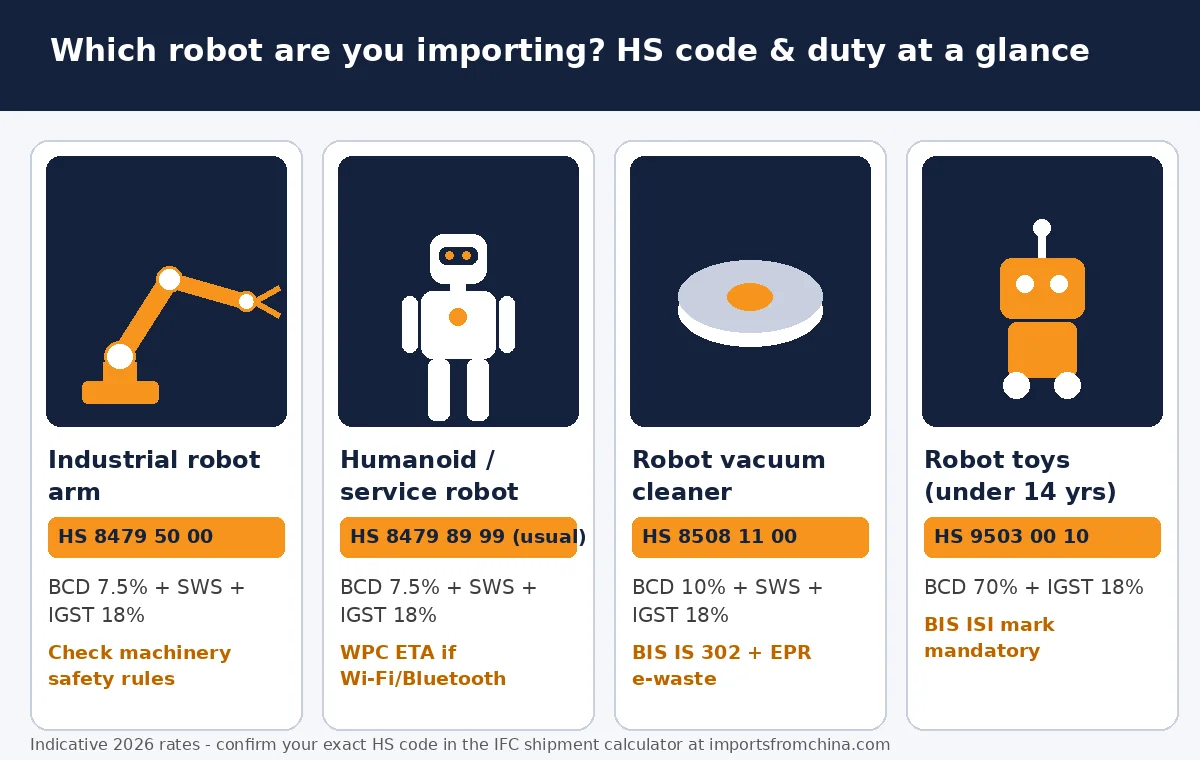
Robot HS code and import duty in India - robotic arm, humanoid, robot vacuum, robot toys
Robot HS codes and import duty in India at a glance (indicative, November 2026)

Customs duty in India has three parts: Basic Customs Duty (BCD), Social Welfare Surcharge (SWS, 10% of BCD where it applies) and IGST. IGST is charged on the CIF value plus BCD plus SWS, and GST-registered importers can claim it back as input tax credit. Here are the usual codes for robots imported from China:

Robot typeUsual HS codeBCDSWSIGSTKey compliance
Industrial robot arm / cobot8479 50 007.5%10% of BCD18%Check machinery safety rules, CE/test reports
Humanoid / service / waiter robot8479 89 99 (if no specific heading fits)7.5%10% of BCD18%WPC ETA if Wi-Fi/Bluetooth; lithium battery papers
Robot vacuum cleaner8508 11 0010%10% of BCD18%BIS (IS 302), WPC ETA, EPR e-waste
Electronic robot toys9503 00 1070%Nil18%BIS licence + ISI mark (mandatory)
Indicative 2026 rates. Confirm your exact 8-digit code before shipping.

Classification is where many first-time importers lose money. A robot that is “for industry” in the supplier’s catalogue can still be classified differently by customs if it has a specific function, for example a robot that is really a vacuum cleaner or a toy. Always describe the function, power, controller and use clearly on the invoice. You can check codes on our Know Your HSN Code page, the HS 8479 89 99 duty page and the electronic toys HS 9503 00 10 page. For the official tariff, see CBIC.

Which licences and certificates do you need to import robots?

  • IEC and GSTIN: needed for every commercial import. The Bill of Entry is filed on ICEGATE in your name.
  • BIS licence for robot toys: under the Toys Quality Control Order, every toy for children under 14 must carry the ISI mark. The Chinese factory must hold a BIS licence under the Foreign Manufacturers Certification Scheme (IS 9873 for toy safety and IS 15644 for electric toys). Without it, customs will not release the goods. Read our full guide to importing toys from China.
  • BIS for household robots: robot vacuum cleaners and many home appliances fall under BIS rules, and power adapters or chargers sold with the robot may need BIS CRS registration. Check the latest list on bis.gov.in.
  • WPC Equipment Type Approval (ETA): any robot with Wi-Fi, Bluetooth or another radio module needs an ETA from the WPC wing of the Department of Telecommunications.
  • Lithium battery documents: most service robots, humanoids and robot toys run on lithium batteries. Ask the supplier for the MSDS and UN38.3 test report. Air cargo with batteries is shipped as special cargo and costs more.
  • EPR for e-waste: electronic robots sold in India may need Extended Producer Responsibility registration with the CPCB.
  • Used or refurbished robots: second-hand robot arms are popular, but carry a chartered engineer certificate showing the year of make, residual life and fair value, and check the current DGFT policy before you buy.

How to calculate the landed cost of robots imported from China

Landed cost is the total cost of the robot when it reaches your factory or shop. The formula used by Indian customs is simple:

  1. CIF value = supplier price (FOB) + international freight + insurance, converted to rupees at the customs exchange rate.
  2. BCD = CIF value × BCD rate.
  3. SWS = 10% of BCD (where it applies).
  4. IGST = (CIF + BCD + SWS) × IGST rate.
  5. Landed cost = CIF + BCD + SWS + IGST + port, CHA and delivery charges.

Example 1: a 6-axis robotic arm by sea
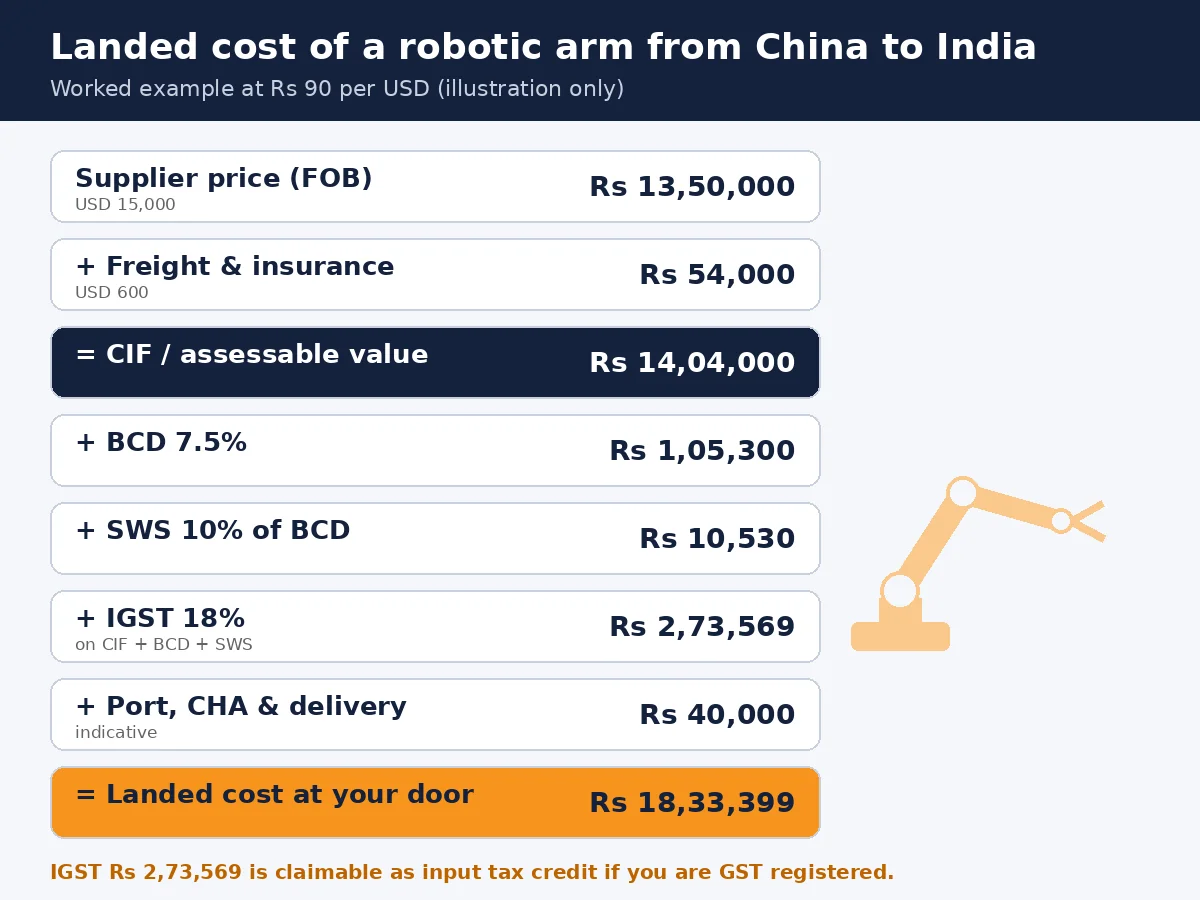
Landed cost of importing a robotic arm from China to India - worked example
Worked example: USD 15,000 robotic arm, Rs 90 per USD (illustration only)

A factory in Pune buys a 6-axis welding robot with controller for USD 15,000 FOB. Sea freight and insurance add USD 600. At an illustrative rate of Rs 90 per USD, the CIF value is Rs 14,04,000. BCD at 7.5% is Rs 1,05,300, SWS is Rs 10,530 and IGST at 18% is Rs 2,73,569. With about Rs 40,000 for port, CHA and delivery, the robot lands at about Rs 18,33,399. If the factory is GST-registered, it claims back the IGST, so the real cost is close to Rs 16 lakh.

Example 2: 500 robot toys vs one humanoid robot

Cost line500 electronic robot toys (sea, LCL)1 small humanoid robot (air)
Supplier price (FOB)USD 3,000 (USD 6 each)USD 5,900
Freight + insuranceUSD 300USD 400 (battery cargo)
CIF value at Rs 90/USDRs 2,97,000Rs 5,67,000
BCD70% = Rs 2,07,9007.5% = Rs 42,525
SWSNilRs 4,253
IGST 18%Rs 90,882Rs 1,10,480
Port, CHA and delivery (indicative)Rs 25,000Rs 15,000
Landed costRs 6,20,782 (about Rs 1,242 per toy)Rs 7,39,258
Illustrative examples. BIS licence cost for toys and WPC/testing costs are extra.

Look at the difference. The toy costs USD 6 in China but over Rs 1,200 at your warehouse, because 70% duty is charged on top of freight. The humanoid robot pays only 7.5% BCD. This is why the right HS code and the right product category decide whether your business makes money.

How to use the IFC shipment calculator for robots

  1. Open the IFC shipment calculator.
  2. Type the product name, for example “robotic arm” or “robot toy”. The calculator suggests the HS code and shows the BCD, SWS, IGST and any BIS rule for that code.
  3. Enter the invoice value from your supplier in USD, CNY or INR.
  4. Enter the gross weight and CBM from the supplier’s packing list. Robot arms are heavy; toys are light but bulky, so CBM matters more.
  5. Choose sea or air. The calculator gives a door-to-door cost sheet: freight, insurance, CIF, duty, GST and the total you pay.
  6. Call IFC to confirm the final quote before you pay your supplier.

Step-by-step: how to import robots from China to India safely

  1. Define the job, not the robot. Write the payload, reach, speed, cycle time and the task. A supplier can then suggest the right model instead of the most expensive one.
  2. Shortlist and verify suppliers. Check the business licence on China’s official company registry (gsxt.gov.cn), export history and whether they are a real maker or a trader.
  3. Ask for test reports and a demo video of your exact model doing a task like yours. For robots with radios or batteries, ask for WPC-ready reports, MSDS and UN38.3.
  4. Fix after-sales support in writing: warranty, spare parts list with prices, remote support hours, software updates and English manuals. This is the most ignored step and the most expensive one to get wrong.
  5. Inspect before shipment. Test the robot running at the factory and check the packing, because a dropped arm loses its calibration.
  6. Ship and clear customs. Heavy arms usually go by sea (LCL or FCL); small service robots often go by air. Your CHA files the Bill of Entry, pays duty and gets Out of Charge. See how customs clearance works for imports in India.
  7. Install, train and claim GST credit. Book installation and operator training, and claim the IGST in your GST return.

How will the robotics industry grow in the next 10 years?
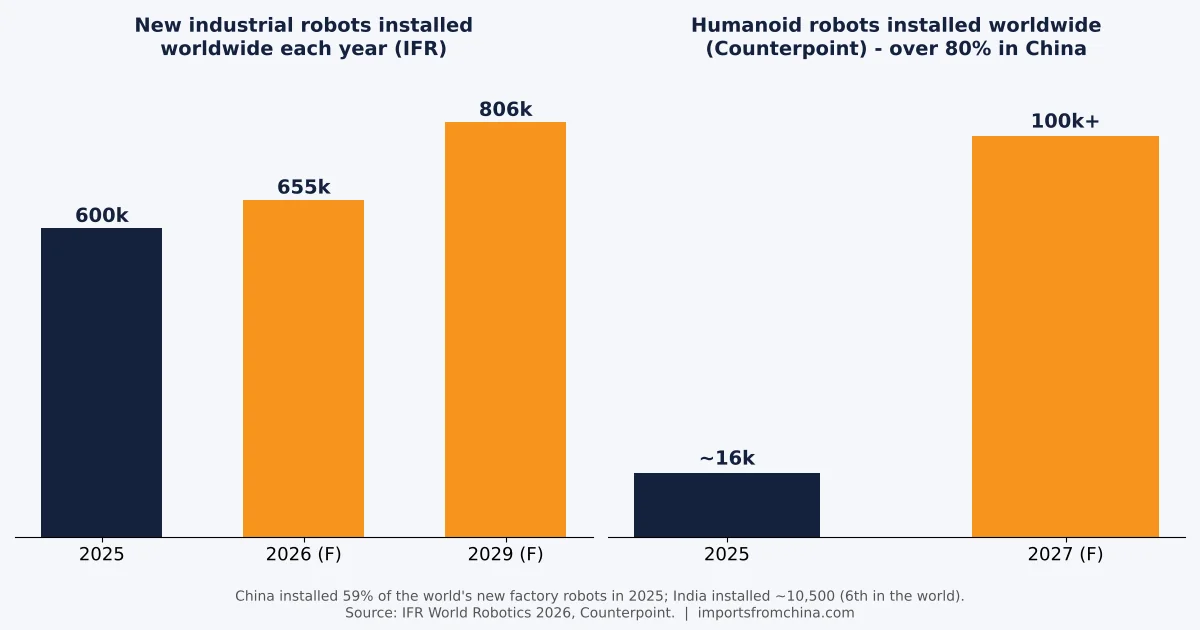
Robotics industry growth - industrial and humanoid robot installations forecast
Industrial and humanoid robot installations: 2025 and forecasts (IFR, Counterpoint)

The numbers show an industry that is growing every year, with humanoids as the next big wave:

  • Factory robots: more than 600,000 industrial robots were installed worldwide in 2025, and 5 million now work in factories. IFR expects 655,000 installations in 2026 and 806,000 a year by 2029.
  • India is rising fast: India installed almost 10,500 industrial robots in 2025 and is now 6th in the world. Installations grew about 27% a year from 2020 to 2025, led by cars, auto parts, electronics and metal work.
  • Humanoids are taking off: about 16,000 humanoid robots were installed worldwide in 2025, over 80% in China. Counterpoint Research expects more than 100,000 by 2027.
  • Long-term forecasts: Goldman Sachs has estimated the humanoid robot market could reach USD 38 billion by 2035, and Morgan Stanley has projected a USD 5 trillion market by 2050. Forecasts this far ahead differ a lot, but every major study points the same way: up.

Three things drive this growth over the next decade. First, prices keep falling as Chinese factories make robots at scale. Second, AI gives robots a “brain”: robots can now see, understand spoken instructions and learn a task from a demo instead of months of coding. Third, labour is getting scarce in China, Japan, Korea and Europe because populations are ageing. India’s opportunity is to use robots to raise quality and export more, and to become a big market for robot sales, service and integration.

What changes will robots bring to the world?

  • Factories: smaller “lights-out” lines that run at night, with fewer defects. Even 10–20 person MSMEs will use cobots for packing, welding and machine loading.
  • Warehouses and e-commerce: robots will pick, sort and move goods, making same-day delivery cheaper.
  • Hotels, restaurants and shops: waiter, reception and cleaning robots are already common in China and are arriving in Indian malls, cafés and showrooms.
  • Homes and elder care: robot vacuums are just the start. Home helper robots that fold clothes, fetch items and keep an eye on elderly parents are the long-term goal of most humanoid companies.
  • Healthcare: surgical robots, pharmacy robots and rehabilitation robots will spread from big city hospitals to tier-2 cities.
  • Agriculture and construction: spraying drones, fruit-picking robots and bricklaying robots will take on heavy and risky work.
  • Education: robot kits will make coding and engineering hands-on in schools, creating a big market for STEM robots.

Will robots take jobs in India?
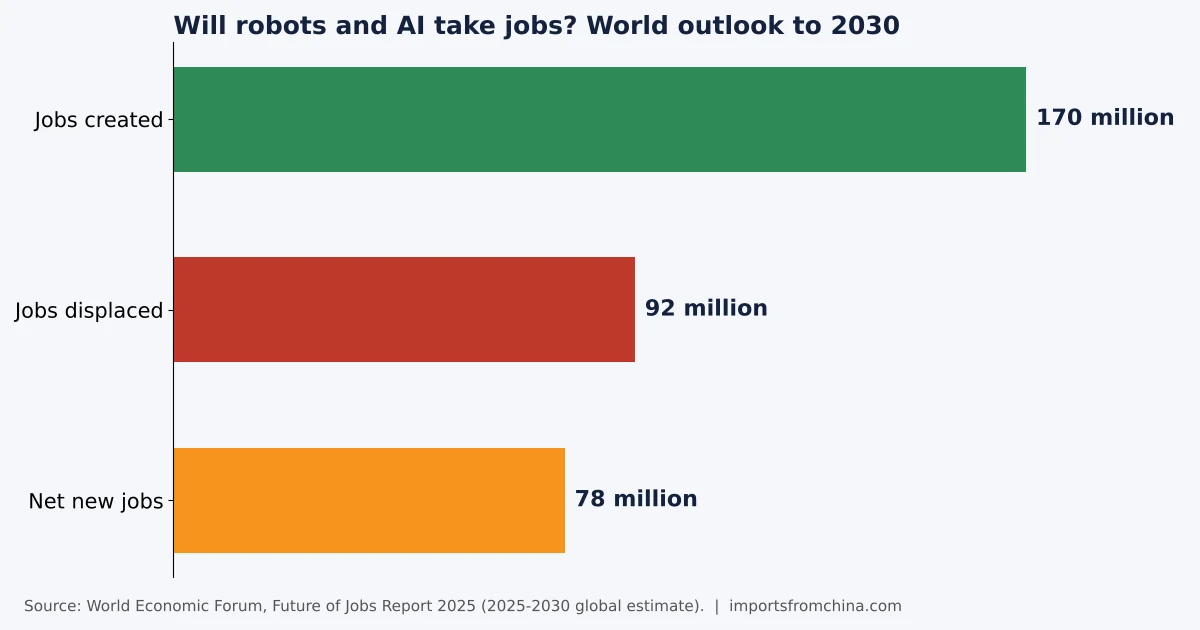
Will robots take jobs - WEF jobs created vs displaced by 2030
World Economic Forum, Future of Jobs Report 2025: global jobs outlook 2025–2030

Some jobs will be affected, yes. But history and the latest data say robots and AI change jobs more than they wipe them out. The World Economic Forum’s Future of Jobs Report 2025 expects about 170 million new jobs and 92 million jobs displaced worldwide between 2025 and 2030, a net gain of 78 million jobs.

Jobs most at riskJobs that will grow
Repetitive assembly and packingRobot operators and programmers
Spot welding and spray paintingMaintenance and service technicians
Warehouse picking and loadingAutomation integrators and installers
Basic quality checks by eyeRobot sales, import and distribution
Simple cleaning and serving rolesAI, data and vision engineers

India is in a different position from China or Japan. We have a young workforce, so robots here will mostly do the dangerous, dirty and precise work while people move to supervision, service and sales. The risk is real for workers who do not reskill, so ITIs, polytechnics and companies need to train operators and technicians now. For proud MSME owners, the bigger opportunity is to become the robot seller, installer and service partner in your city before the market gets crowded.

How IFC helps you import robots from China

IFC (Imports From China) has worked in China–India import since 2004, with its own offices in Guangzhou and Yiwu and staff who speak Chinese and English. For robot buyers, IFC can:

  • Find and verify robot manufacturers in China and compare quotes.
  • Arrange factory checks and quality inspection before shipment.
  • Ship by sea (LCL/FCL) or air, including battery-powered robots.
  • Handle customs clearance and help with BIS and WPC paperwork.
  • Deliver door to door (DDP) to major Indian cities such as Delhi, Mumbai, Bengaluru, Pune, Chennai, Hyderabad and Ahmedabad.

See more about importing machinery and machinery parts from China, and watch practical import tips on the IFC YouTube channel.

Conclusion

Robots are no longer only for big car plants. Chinese prices have made robotic arms, cobots, service robots and even humanoids affordable for Indian MSMEs, schools, hotels and traders. Before you order, fix the HS code, check BIS and WPC rules, and work out the landed cost, not just the supplier price. Do that, and importing robots from China to India can be one of the best business decisions of the next 10 years.

Get your real landed cost: enter your product, weight and CBM in the IFC shipment calculator, or call IFC on +91 98116 91631 for a door-to-door DDP quote from China to your city.

Frequently asked questions

Is a licence required to import robots from China to India?

No special import licence is needed for industrial or service robots; they are freely importable with an IEC and GSTIN. Product rules still apply: robot toys need a BIS licence and ISI mark, robot vacuums need BIS, and robots with Wi-Fi or Bluetooth need a WPC Equipment Type Approval.

What is the customs duty on a robotic arm in India?

Industrial robotic arms are usually classified under HS 8479 50 00, with 7.5% Basic Customs Duty, 10% Social Welfare Surcharge on the BCD and 18% IGST. The total tax is about 27.7% of the CIF value, of which the IGST can be claimed back as input tax credit.

What is the import duty on robot toys from China?

Electronic robot toys under HS 9503 00 10 pay 70% Basic Customs Duty and 18% IGST, about 100.6% of the CIF value in total. The Chinese factory must also hold a BIS licence and the toys must carry the ISI mark, or customs will not release them.

How much does a humanoid robot from China cost in India?

Entry-level Chinese humanoids start at about USD 5,900 (Unitree R1) and bigger models cost USD 13,000 and more. After air freight, 7.5% BCD, SWS and 18% IGST, a USD 5,900 robot lands at roughly Rs 8 lakh at Rs 90 per USD. Use the IFC shipment calculator for your exact model.

Should robots be shipped by air or sea from China?

Heavy robot arms, AGVs and bulk orders are cheaper by sea (LCL or FCL). Single service robots, samples and urgent spare parts usually go by air. Robots with lithium batteries need MSDS and UN38.3 papers and are shipped as special cargo.

Will robots take away jobs in India?

Some repetitive jobs in packing, welding, painting and warehouse picking will be automated, but new jobs grow in robot operation, programming, maintenance, integration and sales. The World Economic Forum expects 170 million jobs created and 92 million displaced worldwide by 2030, a net gain of 78 million.
Customs duty on online orders from China to India

Customs Duty on AliExpress & Online Orders from China to India (2026)

Do you pay customs duty on a single AliExpress or online order from China to India? Yes, usually. Goods ordered for personal use and delivered by courier or post are dutiable. Budget 2026 cut the tariff rate on dutiable personal imports (heading 9804) from 20% to 10%, and IGST is added on top. Only genuine low-value gifts within the notified limit are exempt.

This guide explains how duty works on single online orders from China, when a “personal” parcel becomes a commercial import, and the cheaper legal route if you want to buy in bulk for resale.

Key takeaways

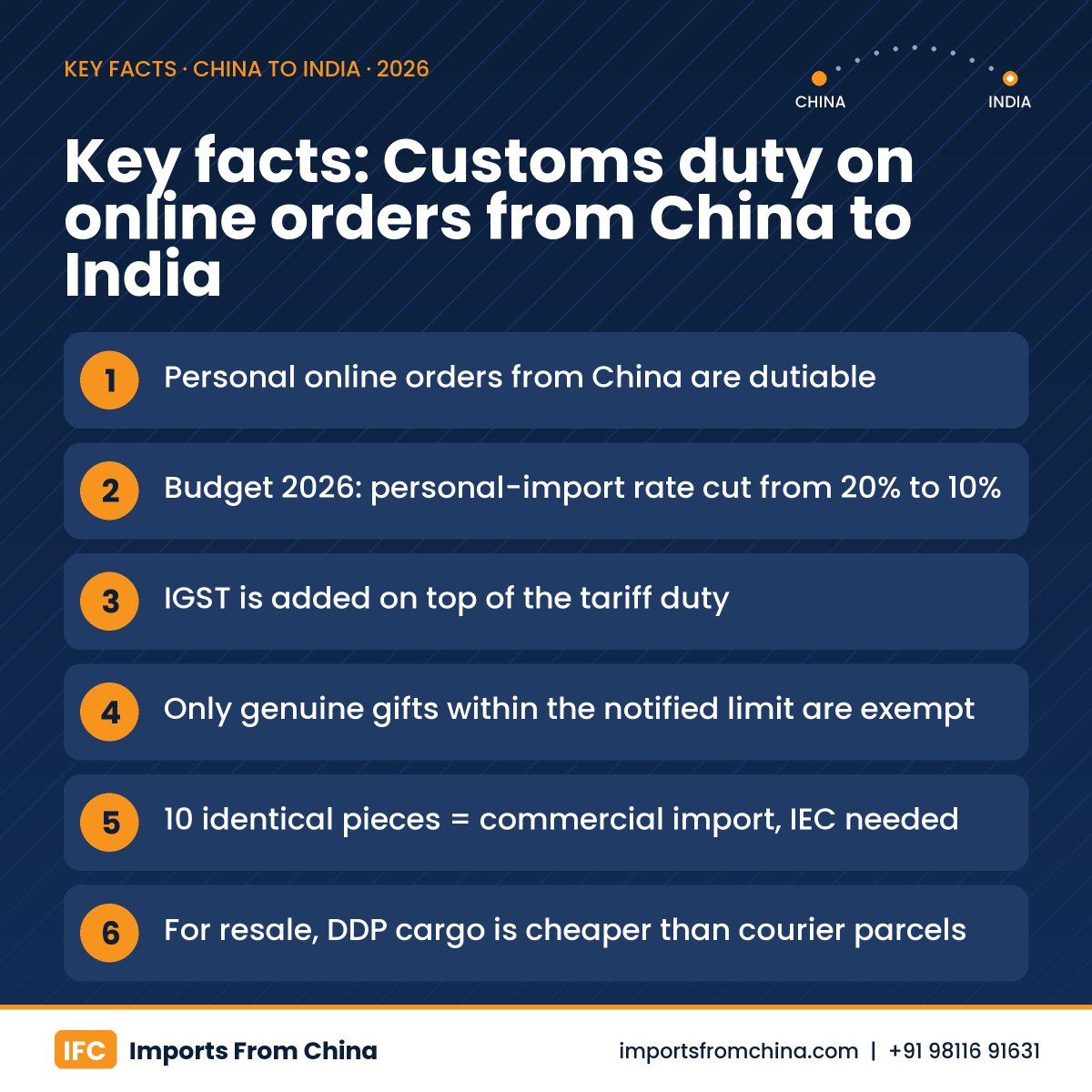
  • Personal orders are dutiable: courier and postal parcels for personal use attract duty under heading 9804.
  • Lower rate from 2026: Budget 2026 cut the personal-import tariff rate from 20% to 10%; IGST still applies.
  • Gifts: only genuine gifts within the notified value limit are exempt, not purchases.
  • Commercial quantity: 10 identical items is trade, not personal use: you need an IEC and normal duty rates.
  • KYC: couriers ask for Aadhaar/PAN before clearing parcels.
  • For resale: consolidated DDP cargo is far cheaper per kg than single courier parcels.

Do I have to pay customs duty on an AliExpress order to India?

Yes, in most cases. Indian customs treats any purchase delivered from abroad as an import. For goods meant for your personal use, customs applies the special tariff heading 9804 (all dutiable articles imported for personal use). In Budget 2026 the government reduced this tariff rate from 20% to 10%. IGST and any applicable surcharge are charged on top, so the total you pay is higher than 10%. The courier (DHL, FedEx, Blue Dart, India Post) collects the duty from you before delivery.

Note: the AliExpress app was blocked in India in 2020, and many sellers on Chinese marketplaces limit shipping to India. Most single orders now come through other marketplaces or direct from suppliers on Alibaba.

Customs duty on online orders from China to India infographic – key facts for Indian importers
Customs duty on online orders from China to India: key facts at a glance (IFC – Imports From China)

How is customs duty calculated on a personal online order?

ItemHow it works
ValueCustoms uses the transaction value: product price + shipping + insurance (CIF)
Tariff (heading 9804)10% for personal-use imports from Budget 2026 (earlier 20%)
IGSTAdded on the value plus duty, as per the GST rate of the item
Courier handlingCouriers often add a small duty-processing or clearance fee
PaymentPaid online or at delivery before the parcel is released

Example: a ₹4,000 smartwatch ordered for yourself. The tariff duty at 10% is ₹400, then IGST is added on ₹4,400 at the applicable rate (for example 18% = ₹792). Your total duty is about ₹1,192, plus any courier fee. Always check the final amount shown by the courier, since rates depend on the exact item and the current notification.

Are gifts from China duty free in India?

Only genuine gifts sent free of cost by a person abroad, within the value limit notified by CBIC, are exempt. A product you paid for online is a purchase, not a gift, even if the seller writes “gift” on the parcel. Misdeclaring a purchase as a gift can lead to the parcel being held, reassessed or confiscated.

When does a personal order become a commercial import?

  • You order several identical pieces (for example 10 phone cases or 20 watches).
  • The parcel value or frequency suggests resale.
  • The goods need product approvals such as BIS or WPC for sale in India.

In these cases customs can treat the parcel as a commercial import. You then need an IEC (or an importer who imports on their IEC), normal duty rates by HS code apply instead of heading 9804, and product compliance must be in place. Read documents required to import from China.

What items should you not order from China by courier?

  • Drones, walkie-talkies and many wireless devices without WPC approval.
  • Medicines, supplements and cosmetics in commercial quantity (CDSCO rules).
  • Branded replicas: seized under IPR rules.
  • Batteries and power banks in quantity: shipping restrictions and BIS rules.
  • E-cigarettes and other prohibited goods.

Courier parcels vs DDP cargo: what is cheaper for business buyers?

FactorSingle courier parcelIFC DDP cargo
Best for1 to 5 personal items50 kg+ business stock
CostHigh per kg + duty collected at doorAbout ₹750/kg air DDP for general goods (50 kg+), sea roughly half
DutyCollected by courier per parcelIncluded in the per kg price
PaperworkKYC per parcelHandled by IFC
Risk of holdHigher for multiple piecesPlanned clearance with correct HS code

If you plan to resell, combine your orders from several suppliers into one shipment. See our China to India shipping cost per kg guide and legal ways to reduce import duty.

How IFC helps online buyers move to bulk importing

IFC (Imports From China) has handled China–India imports for 20+ years, since 2004, and has served 5000+ Indian businesses. From our own offices in Guangzhou and Yiwu we buy from Alibaba, 1688 and wholesale markets for you, check quality, consolidate your orders and deliver door to door in India with duty and customs included. Start with our China product sourcing service.

Conclusion

A single online order from China for your own use is dutiable, but the personal-import rate is now lower at 10% plus IGST. Do not call purchases gifts, and do not order commercial quantities as personal parcels. If you are buying to sell, a consolidated DDP shipment is cheaper, safer and fully legal.

Mayank Dang (CA Sahab), Founder and CEO of IFC

Guide reviewed by Mayank Dang (CA Sahab), Founder & CEO of IFC

Chartered Accountant (FCA, ICAI) who has helped 5000+ Indian businesses import from China since 2004 – sourcing, BIS, HSN classification, import duty, customs and GST compliance. mayankdang.in

Get your real landed cost: enter your product, weight and CBM in the IFC shipment calculator, check your HS code on the India import duty rates page, or call IFC on +91 98116 91631 for a door-to-door DDP quote from China to your city.

Frequently asked questions

Do I need to pay customs duty on AliExpress orders in India?

Yes. Goods bought online from abroad for personal use are dutiable under heading 9804. Budget 2026 cut that tariff rate from 20% to 10%, and IGST is added on top. The courier collects the duty before delivery.

Is there a duty-free limit for online orders to India?

There is no general duty-free limit for purchases. Only genuine gifts sent free by a person abroad within the CBIC notified value limit are exempt. A paid order is not a gift.

Who pays the customs duty on a courier parcel from China?

The receiver in India. DHL, FedEx, Blue Dart or India Post will ask you to pay the duty, often online, before they deliver the parcel.

Can I order 10 pieces from China by courier for resale?

Customs may treat it as a commercial import. You then need an IEC, normal duty rates apply and the product must meet BIS or other rules. For resale, consolidated DDP cargo is usually cheaper.

Why was my China parcel held by customs?

Common reasons are missing KYC, a value that looks too low, commercial quantities, or restricted items such as wireless devices, medicines or branded replicas.

Import without paying customs duty in India

Import Without Paying Customs Duty in India? 9 Legal Ways (2026)

Can you import without paying customs duty in India? For normal commercial imports, no: customs duty must be paid. But you can legally pay zero or much lower duty by importing products with 0% BCD, claiming IGST as input tax credit, using export schemes like Advance Authorisation or EPCG, bonded warehousing, duty drawback on re-export, and genuine sample or gift exemptions.

Many online answers to this question suggest under-invoicing or calling goods “gifts”. That is customs fraud and leads to seizure and penalties. This guide covers only the legal routes Indian importers use, with a worked example in rupees.

Key takeaways

  • No duty-free shortcut: commercial imports always attract duty unless an exemption or scheme applies.
  • IGST credit is the biggest saving: GST-registered importers can usually claim the IGST paid at customs.
  • Some goods have 0% BCD: for example laptops (8471 30 10), though they still need IGST and import authorisation.
  • Exporters save most: Advance Authorisation, EPCG, SEZ/EOU and drawback can cut duty to nil.
  • Correct HS code: the right classification is legal; misclassification is not.
  • Never under-invoice: penalties, confiscation and a customs record cost far more than the duty.

Is it legal to import without paying customs duty in India?

Under the Customs Act, 1962, duty is payable on all imports unless a notification exempts the goods or you import under an approved scheme. So “import without paying duty” is legal only in specific cases: goods with nil duty rates, notified exemptions (such as bona fide samples or small gifts within limits), and schemes under the Foreign Trade Policy. Everything else, such as undervaluing the invoice or splitting a commercial order into gift parcels, is illegal.

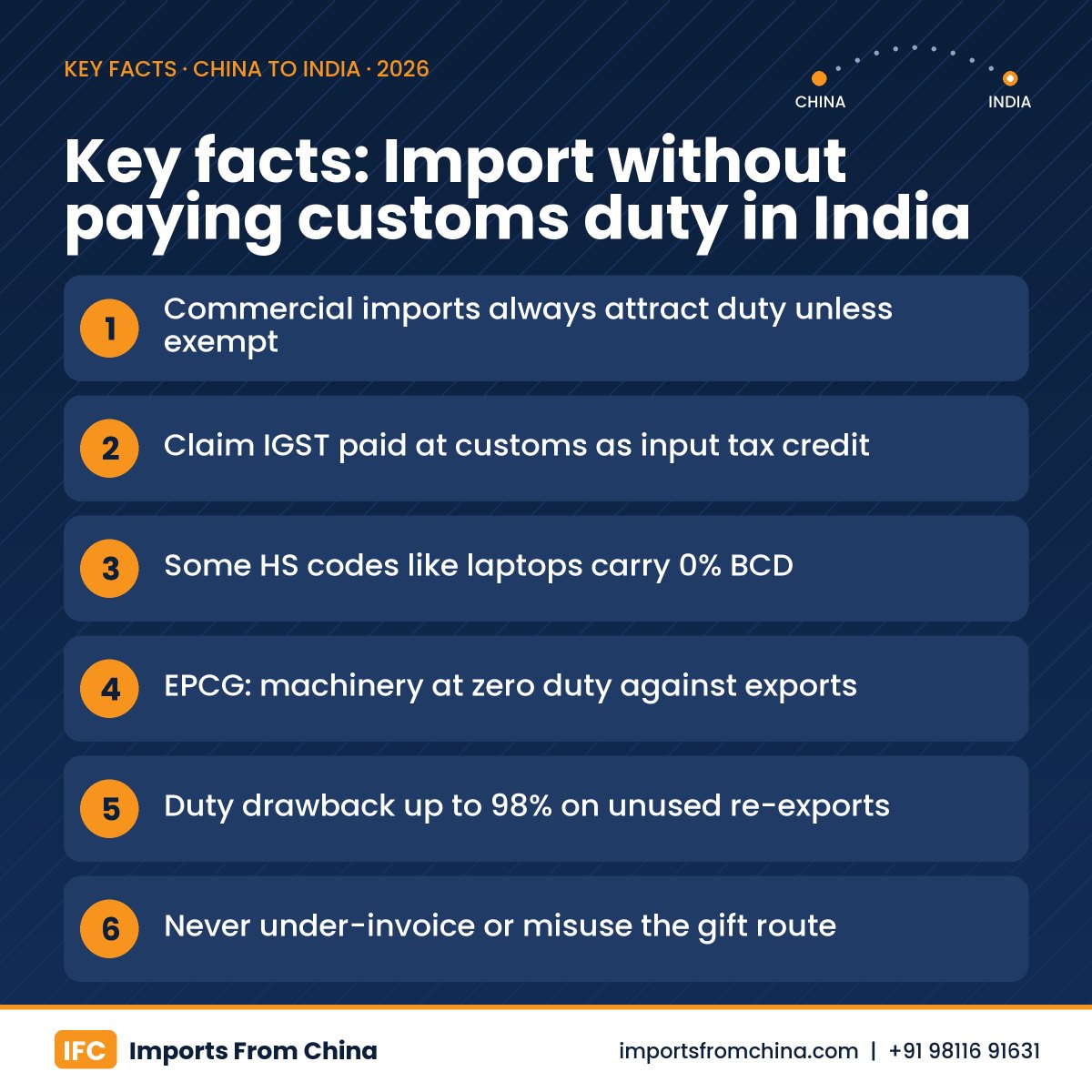
Import without paying customs duty in India infographic – key facts for Indian importers
Import without paying customs duty in India: key facts at a glance (IFC – Imports From China)

9 legal ways to pay less (or zero) import duty

1. Claim IGST as input tax credit

IGST is often the largest part of the duty bill. If you have a GSTIN and the Bill of Entry is in your name, the IGST paid at customs can usually be used as input tax credit against your GST output. Your real cost then becomes only BCD, SWS/AIDC and any anti-dumping duty.

2. Import products that carry 0% BCD

Some HS codes have nil basic customs duty, many of them IT products. For example, laptops and tablets (8471 30 10) carry 0% BCD with 18% IGST, but they also need DGFT import authorisation and BIS registration. Check your code on the India import duty rates page.

3. Classify the product correctly

Two similar products can sit under different HS codes with different duty. Choosing the code that genuinely describes your product, based on its material, function and use, is legal and can save money. Choosing a wrong code to pay less is misdeclaration. Read our HS code guide.

4. Use APTA concessions where available

India and China are both members of the Asia-Pacific Trade Agreement (APTA). For a limited list of tariff lines, goods with a valid APTA certificate of origin get a concessional duty rate. India has no full free trade agreement with China, so check whether your exact HS code is covered before relying on it.

5. Advance Authorisation for exporters

If you use imported inputs to make goods for export, an Advance Authorisation from DGFT lets you import those inputs duty-free, against an export obligation.

6. EPCG for machinery

Under the Export Promotion Capital Goods (EPCG) scheme, manufacturers and exporters can import capital goods such as machinery at zero customs duty, against an export obligation of six times the duty saved, to be met within six years.

7. SEZ, EOU and bonded warehousing

Units in a Special Economic Zone or registered as Export Oriented Units import duty-free for their authorised operations. Under the Manufacturing and Other Operations in Warehouse Regulations (MOOWR), goods can be kept in a customs-bonded warehouse with duty deferred, and no duty is paid if the finished goods are exported.

8. Duty drawback on re-export

Under Section 74 of the Customs Act, if imported goods are re-exported (for example rejected or unsold stock), you can claim back most of the duty paid, up to 98% if the goods were not used, subject to conditions and time limits.

9. Genuine samples and gifts (small quantities only)

Bona fide commercial samples and small personal gifts can be cleared duty-free within limits notified by CBIC. These exemptions are for genuine samples and gifts only, not for goods you will sell. Customs checks quantity, value and frequency.

Which products are duty free for import to India?

Very few products are fully duty free. Most “duty free” items have 0% BCD but still attract IGST. Common cases include certain IT products under the Information Technology Agreement, some life-saving drugs and medical equipment notified by the government, goods imported under export schemes, and goods for SEZ/EOU units. Always confirm the current rate for your 8-digit HS code on the CBIC tariff or with IFC.

Worked example: how much duty can you really save?

Compare ₹1,00,000 CIF of LED lamps (BCD 20%) with ₹1,00,000 CIF of laptops (BCD 0%), for a GST-registered importer (rates as of October 2026; confirm for your HS code):

ItemLED lampsLaptops
CIF value₹1,00,000₹1,00,000
BCD₹20,000₹0
SWS (10% of BCD)₹2,000₹0
IGST 18%₹21,960₹18,000
Total paid at customs₹43,960₹18,000
Less IGST credit– ₹21,960– ₹18,000
Real duty cost₹22,000₹0

The laptop import is effectively duty-free for a GST-registered business, but only with DGFT import authorisation and BIS compliance in place.

What happens if you under-declare value or misuse the gift route?

  • Customs can reject the declared value and reassess duty on the correct value.
  • Goods can be confiscated, with redemption fines and penalties under the Customs Act.
  • Your IEC gets flagged, so future shipments face more checks and delays.
  • Port storage and demurrage keep adding up while the case is open.

For small businesses, the safer way to keep costs predictable is DDP shipping: one per kg price that already includes duty and clearance. Read how customs clearance works in India and our import duty guide.

How IFC helps you pay the right duty, not extra

IFC (Imports From China) has handled China–India imports for 20+ years, since 2004, and has served 5000+ Indian businesses. Founded and led by Chartered Accountant Mayank Dang, our team guides you on HSN classification, BIS and duty before you order, then handles sourcing from our own offices in Guangzhou and Yiwu, quality inspection, shipping, customs clearance and door-to-door DDP delivery.

Conclusion

You cannot skip customs duty on commercial imports, but you can legally pay much less: claim IGST credit, use the correct HS code, check 0% BCD and APTA lines, and use export schemes if you export. Avoid under-invoicing and fake gift parcels. They are the most expensive mistakes an importer can make.

Mayank Dang (CA Sahab), Founder and CEO of IFC

Guide reviewed by Mayank Dang (CA Sahab), Founder & CEO of IFC

Chartered Accountant (FCA, ICAI) who has helped 5000+ Indian businesses import from China since 2004 – sourcing, BIS, HSN classification, import duty, customs and GST compliance. mayankdang.in

Get your real landed cost: enter your product, weight and CBM in the IFC shipment calculator, check your HS code on the India import duty rates page, or call IFC on +91 98116 91631 for a door-to-door DDP quote from China to your city.

Frequently asked questions

Can I import goods into India without paying customs duty?

Only in specific legal cases: products with nil duty, notified exemptions such as genuine samples or small gifts within limits, and Foreign Trade Policy schemes like Advance Authorisation, EPCG, SEZ or EOU. Normal commercial imports attract customs duty.

Which products are duty free for import to India?

Very few are fully duty free. Some IT products such as laptops have 0% basic customs duty but still attract 18% IGST. Certain notified medical items and goods under export schemes can also be exempt. Check the current rate for your HS code.

Can I claim the IGST paid on imports?

Yes. If you have a GSTIN and the Bill of Entry is in your name, the IGST paid at customs can usually be claimed as input tax credit, which reduces your real duty cost.

Is importing as a gift to save duty legal?

Only genuine personal gifts within the notified value limit are exempt. Sending commercial goods as gifts or splitting an order into gift parcels is misdeclaration and can lead to confiscation and penalties.

How can a manufacturer import machinery from China at zero duty?

Under the EPCG scheme, manufacturers and exporters can import capital goods at zero customs duty against an export obligation of six times the duty saved within six years.

Anti dumping duty on chinese goods in india

Anti Dumping Duty on Chinese Goods in India: What Importers Must Check (2026)

What is anti dumping duty on Chinese goods in India? It is an extra customs duty, on top of Basic Customs Duty and IGST, charged on specific Chinese products that India’s trade remedies authority finds are being sold below fair value. It applies only to the exact product, origin and producers named in a Finance Ministry notification, usually for five years, and is often a fixed amount in US dollars per tonne.

Because it is product-specific, many importers only discover it when their Bill of Entry is assessed. This guide explains how the duty works, current examples on Chinese goods, how it is calculated, how to check your HS code before ordering, and a worked example in rupees showing how anti-dumping duty can almost double the duty on a shipment.

Key takeaways

  • Product-specific, not country-wide: there is no general anti-dumping duty on all Chinese goods. Each duty covers a defined product, often only some HS codes.
  • DGTR investigates, Finance Ministry imposes: the duty starts only when a “Customs (ADD)” notification is published, normally for five years.
  • Often per tonne: many duties are fixed USD amounts per metric tonne, paid in rupees at the CBIC exchange rate.
  • Producer-wise rates: named Chinese producers may get lower rates; all others pay the highest “residual” rate.
  • It raises IGST too: IGST is charged on a value that includes anti-dumping duty, and the anti-dumping duty itself is not creditable.
  • Check before you pay the supplier: a new duty can be notified while your goods are at sea. The rate on the Bill of Entry date applies.

How does anti dumping duty on Chinese goods in India work?

“Dumping” means an exporter sells goods to India at a price lower than its normal value, usually the price in its home market, and this hurts Indian manufacturers. Under Section 9A of the Customs Tariff Act, 1975 and the Anti-Dumping Rules, India can impose a duty to offset that price gap. The process has two separate authorities:

  • DGTR (Directorate General of Trade Remedies, under the Commerce Ministry) receives an application from Indian industry, starts an investigation, collects data from Chinese exporters and Indian importers, and recommends a duty in its final findings.
  • The Ministry of Finance decides whether to accept the recommendation and, if so, issues a notification numbered like “26/2026-Customs (ADD)”. Only that notification creates a legal duty that customs can collect.

A DGTR recommendation alone does not change your duty. Some recommendations are never notified, and a notification may differ from what DGTR proposed. Always work from the notification published by CBIC, and treat a DGTR investigation as an early warning.

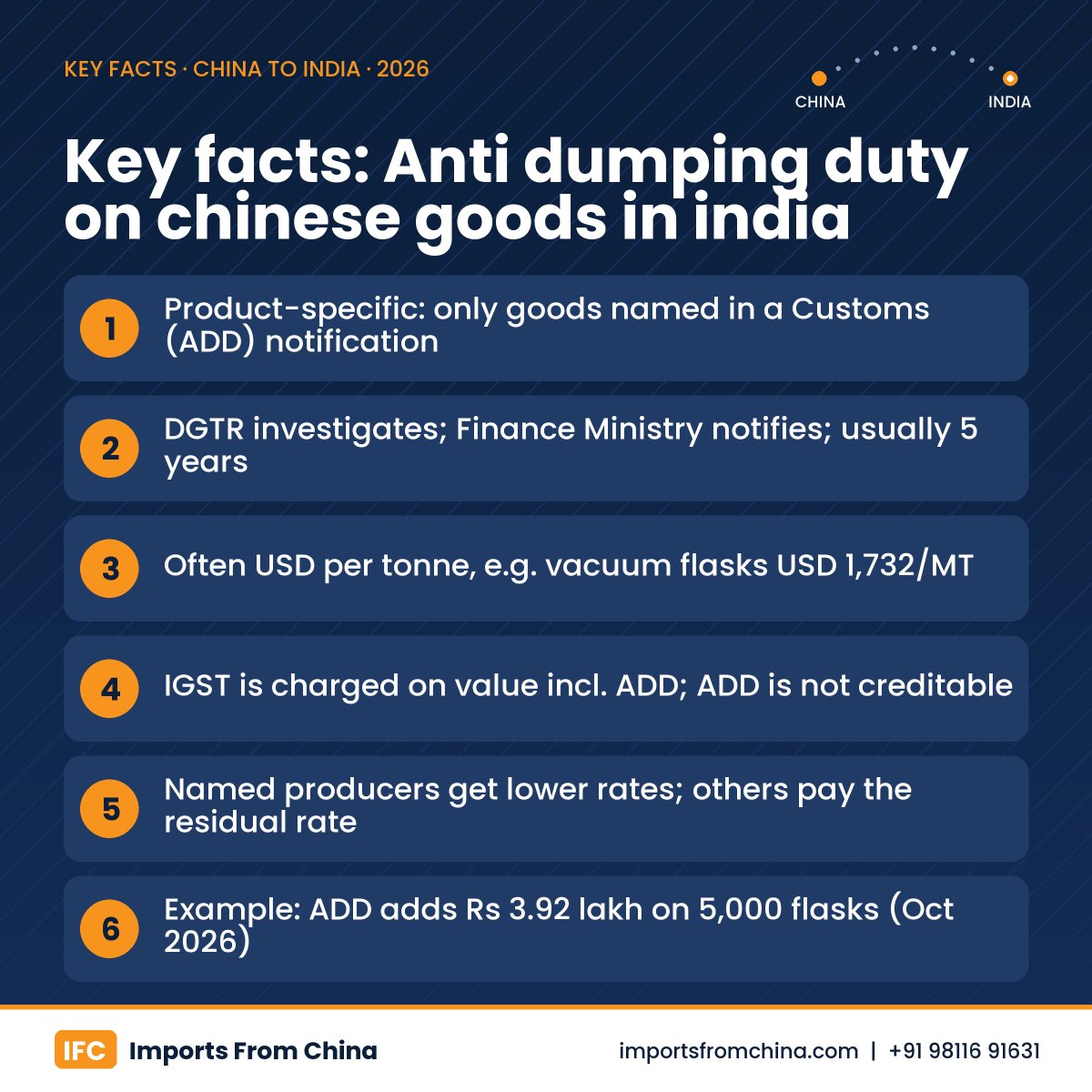
Anti dumping duty on chinese goods in india infographic – key facts for Indian importers
Anti dumping duty on chinese goods in india: key facts at a glance (IFC – Imports From China)

Anti-dumping vs other duties on Chinese imports

DutyApplies toWho decidesCreditable as GST input?
Basic Customs Duty (BCD)All imports, by HS codeCustoms Tariff and BudgetNo
Social Welfare Surcharge (SWS)10% of BCD unless exemptFinance MinistryNo
Anti-dumping duty (ADD)Specific product, origin and producersDGTR recommends, Finance Ministry notifiesNo
Countervailing (anti-subsidy) dutySubsidised products from a named countryDGTR and Finance MinistryNo
Safeguard dutyA sudden import surge from all countriesDGTR and Finance MinistryNo
IGSTAll importsGST lawYes, usually

Which Chinese products attract anti-dumping duty in 2026?

Anti-dumping measures on Chinese goods are concentrated in chemicals, steel and metals, glass, rubber, plastics and some consumer goods. The examples below show how varied the duties are. This is not a complete list; check the current notification for your exact product.

Product from ChinaHS codes (indicative)NotificationDuty
Titanium dioxide2823 00 10, 3206 11 10, 3206 11 9026/2026-Customs (ADD), 24 Oct 2026USD 460 to 681 per MT, producer-wise, for five years
Mica-based pearl industrial pigmentsChapter 32 (see notification)21/2026-Customs (ADD), 21 Aug 2026USD 214 to 5,529 per MT, producer-wise
Textured tempered solar glass (China, Vietnam)7007 19 0011/2025-Customs (ADD), 8 May 2025USD 570 to 664 per MT
Vacuum insulated flasks of stainless steel961703/2025-Customs (ADD), March 2025USD 1,732 per MT, for five years
Soft ferrite coresChapter 85 (see notification)Notified March 2025Up to 35% of CIF value
Aluminium foil up to 80 micron7607Duty notified in 2025; DGTR recommended continuation in September 2026Check the current notification

Rates as of October 2026. Each duty has a precise product description and exclusions, so an HS code match alone is not enough; read the description in the notification. Our guide to finding the right HS code explains why the classification must be right first.

New investigations to watch

In late September 2026, DGTR opened seven new anti-dumping investigations on Chinese products: Penicillin G and its salts, 6-aminopenicillanic acid, amoxycillin trihydrate, montelukast sodium, a tackifying resin used in tyres, T-section guide rails for lifts, and copolymer polyol used in mattress and bedding foam. If you import any of these, plan for the possibility of a duty within the next year. You can track cases on the DGTR website.

How is anti-dumping duty calculated on a Bill of Entry?

The notification states the form of the duty. You will see three common types:

  • Fixed amount per unit, usually USD per metric tonne. This is the most common form for Chinese goods. It is converted to rupees at the CBIC exchange rate on the date the Bill of Entry is filed.
  • Percentage of the CIF (landed) value, for example “up to 35% of CIF value”.
  • Reference price: the duty equals the gap between a reference price and your landed value, so it is zero if you pay above that price.

The duty then stacks with the normal duties. Assessable value is the CIF value in rupees (no 1% landing charge since 2017). BCD is charged on the assessable value. SWS is 10% of BCD and is not charged on anti-dumping duty. IGST is charged on the assessable value plus BCD, SWS and the anti-dumping duty. That last point is often missed: anti-dumping duty also raises your IGST outflow, even though that extra IGST is creditable and the anti-dumping duty is not. See our import duty from China to India guide for the basic formula.

Producer-specific rates and the invoice declaration

Most notifications list named Chinese producers and exporters with their own, lower rates, and a higher rate for “any other” producer. The lower rate applies only when the goods are made by that producer and exported by the named exporter. For titanium dioxide, for example, the producer-wise rate needs a valid commercial invoice carrying the prescribed signed declaration; without it, the highest rate of USD 681 per MT applies. Ask your supplier, before you order, which producer makes the goods and whether their invoice will carry the declaration.

Worked example: 5,000 vacuum flasks with and without anti-dumping duty

Assumptions: 5,000 stainless steel vacuum insulated bottles from Zhejiang, net weight 0.4 kg each (2.0 MT in total). FOB price USD 2.40 each (USD 12,000). Sea freight to Nhava Sheva USD 600 and insurance USD 60, so CIF is USD 12,660. Exchange rate ₹96 per USD, the CBIC import rate under Notification 29/2026-Customs (N.T.), effective 16 October 2026. The IFC duty database shows HS 96170011 at 20% BCD, 10% SWS and 18% IGST, with anti-dumping duty of USD 1,732 per MT on vacuum insulated flasks of stainless steel from China. Rates as of October 2026; confirm for your exact HS code and how the notification measures quantity.

ItemHow it is calculatedWith ADD (₹)Without ADD (₹)
Assessable value (AV)CIF USD 12,660 × 95.9012,14,09412,14,094
Basic Customs Duty20% of AV2,42,8192,42,819
Social Welfare Surcharge10% of BCD24,28224,282
Anti-dumping duty2.0 MT × USD 1,732 × 95.903,32,1980
Value for IGSTAV + BCD + SWS + ADD18,13,39314,81,195
IGST18% of value for IGST3,26,4112,66,615
Total paid at customsBCD + SWS + ADD + IGST9,25,7105,33,716
Non-creditable costBCD + SWS + ADD5,99,2992,67,101

Anti-dumping duty adds ₹3,91,994 to the cash you pay at customs, and ₹3,32,198 of that is a permanent cost. Per bottle, your non-creditable duty rises from about ₹53 to about ₹120. On a product that sells for ₹350–500 online, that can wipe out the margin. Because the duty is per tonne, it hurts cheaper and heavier products the most. Run your own numbers in the IFC shipment calculator.

How do you check if your product attracts anti-dumping duty?

  1. Fix the 8-digit HS code from the product’s material, function and specifications. Check it on the India import duty rates by HS code page, which shows anti-dumping notes where IFC has them.
  2. Search the CBIC “Customs (ADD)” notifications for your product name and HS heading. Read the full product description, technical scope and exclusions.
  3. Check the dates. Duties normally run for five years from notification. Note whether a sunset review is under way, because the duty continues during the review.
  4. Check the producer and exporter. Match the factory and exporter names on your proforma invoice with the table in the notification.
  5. Check DGTR for open investigations on your product, so a new duty does not surprise you mid-season.
  6. Get a written duty estimate from your customs broker or import agent that shows anti-dumping duty as a separate line.

What happens if you ignore or avoid anti-dumping duty?

Customs officers check anti-dumping duty during assessment. If your Bill of Entry leaves it out, it will be reassessed and you pay the duty, with interest if it is found later in an audit. Deliberate tricks make it worse:

  • Wrong HS code or vague description to escape the duty can lead to confiscation, penalties and a demand for the duty on past shipments.
  • Routing goods through a third country does not change origin if the goods are Chinese. Customs can ask for origin proof under the CAROTAR rules, and some notifications cover named routing cases directly, as the titanium dioxide notification does.
  • Using a named producer’s lower rate for goods made by another factory is misdeclaration.
  • Under-invoicing does not help with per-tonne duties and invites a valuation dispute.

The safe approach is to budget anti-dumping duty honestly, or change the product or supplier before you order. Our step-by-step guide to customs clearance in India shows where assessment and reassessment happen.

▶ Watch our step-by-step guide video

How long does a DGTR anti-dumping case take, and how should importers plan?

StageTypical timingWhat it means for you
Initiation notice by DGTRDay 0Early warning. Importers can register as interested parties and give comments.
Provisional duty (optional)Possible after a preliminary findingCan apply for up to six months, extendable in some cases.
Final findingsNormally within 12 months, extendable by up to 6 monthsDGTR recommends a duty, or none.
Finance Ministry notificationNormally within 3 months of final findingsThe duty becomes payable from the notification date.
Duty period and sunset reviewFive years, can be extended after reviewPlan sourcing for the full period.

For importers, the practical rule is to price long contracts with the duty risk in mind once an investigation starts. If a product is under investigation, keep stock levels moderate, ask the supplier whether they are cooperating with DGTR (cooperating producers usually get lower individual rates), and compare alternative sources. Our article on whether shipping from China is banned in India explains how restrictions differ from extra duties.

How IFC helps you plan for anti-dumping duty on China imports

IFC – Imports From China has more than 20 years (since 2004) in China–India import and export and has served 5000+ businesses. The company is founded and led by Mayank Dang (CA Sahab), a Chartered Accountant (FCA, ICAI), and gives HSN, duty, BIS and customs/GST compliance guidance before you order, so anti-dumping duty shows up in your landed cost on day one, not at the port.

Our own offices in Guangzhou and Yiwu have translators and English-speaking staff who can confirm which factory actually makes your goods, check invoices and declarations, and run supplier verification and quality inspection. We load mixed containers and air cargo daily, have a warehouse at our headquarters, and handle LCL and FCL sea freight, air cargo and customs clearance. With DDP shipments from China to India, we deliver door to door to major cities including Delhi, Gurugram, Noida, Mumbai, Pune, Bengaluru, Hyderabad, Chennai and Ahmedabad.

Bottom line

Anti-dumping duty is not a blanket tax on Chinese goods, but where it applies it can be the biggest line in your duty sheet. Fix the HS code, read the notification’s product scope and producer table, watch DGTR for new cases, and build the duty and its IGST effect into your price before you pay the supplier.

Mayank Dang (CA Sahab), Founder and CEO of IFC

Guide on anti-dumping duty reviewed by Mayank Dang (CA Sahab), Founder & CEO of IFC

Chartered Accountant (FCA, ICAI) who has helped 5000+ Indian businesses import from China since 2004 – sourcing, BIS, HSN classification, import duty, customs and GST compliance. mayankdang.in

Get your real landed cost: enter your product, weight and CBM in the IFC shipment calculator, check your HS code on the India import duty rates page, or call IFC on +91 98116 91631 for a door-to-door DDP quote from China to your city.

Frequently asked questions

Is there anti-dumping duty on all goods imported from China to India?

No. Anti-dumping duty applies only to specific products named in a Finance Ministry Customs (ADD) notification, such as titanium dioxide, solar glass or vacuum flasks. Most Chinese products pay only the normal BCD, SWS and IGST. Check your exact HS code and product description against current notifications before ordering.

How do I find out if my product has anti-dumping duty in India?

Fix the 8-digit HS code, then search CBIC Customs (ADD) notifications for that heading and product name, and read the product scope and exclusions. Check the DGTR website for open investigations. IFC’s HS code pages show anti-dumping notes where available, and a customs broker can confirm before you order.

Is anti-dumping duty included in the value for IGST?

Yes. IGST on imports is charged on the assessable value plus Basic Customs Duty, Social Welfare Surcharge and the anti-dumping duty. So anti-dumping duty also increases your IGST outflow. The extra IGST is usually creditable for GST-registered importers, but the anti-dumping duty itself is a permanent cost.

Can I claim input tax credit on anti-dumping duty?

No. Anti-dumping duty is a customs duty, not GST, so it cannot be claimed as input tax credit. Only the IGST paid at customs is normally creditable when your GSTIN is on the Bill of Entry. Add anti-dumping duty to your product cost when you set prices.

How long does anti-dumping duty last in India?

Usually five years from the date of the Finance Ministry notification, unless revoked or amended earlier. Before expiry, DGTR can hold a sunset review, and the duty can be extended for another five years if dumping and injury are likely to continue.

Does shipping Chinese goods through another country avoid anti-dumping duty?

No. Duty depends on the country of origin, not the route. Customs can ask for origin proof under the CAROTAR rules, and some notifications specifically cover goods routed through third countries. Misdeclaring origin can lead to confiscation, penalties and demands on past shipments.

Why does my supplier’s factory name matter for anti-dumping duty?

Many notifications give named Chinese producers lower individual rates, while all other producers pay the highest residual rate. The lower rate applies only if the named producer made the goods and the invoice meets the notification’s conditions. Confirm the producer and exporter before you order.

is shipping from china banned in india

Is Shipping From China Banned in India? 2026 Rules Explained

Is shipping from China banned in India? No. Shipping and importing goods from China to India is fully legal in 2026. China was India’s largest import source in FY 2025-26, with imports of about US$131.6 billion. What India restricts are specific products, Chinese apps and Chinese investment, not China as a country of origin.

This guide explains where the “ban” rumour comes from, which goods are really restricted, what individuals and businesses can order, and the step-by-step legal way to ship from China to India.

Key takeaways

  • No country ban: India has no blanket ban on goods from China. In Parliament, the Commerce Minister said any trade restriction must be WTO-compliant and that action is taken product by product.
  • Apps, not goods: the 2020 bans hit Chinese mobile apps under the IT Act. Press Note 3 controls Chinese investment (FDI). Neither one stops you importing products.
  • The product decides: your HS code and the DGFT ITC-HS import policy show whether an item is free, restricted (licence needed) or prohibited.
  • Certification matters: BIS (QCO/CRS), WPC-ETA, FSSAI, CDSCO and LMPC labelling apply to many common China products, and goods without them can be held at the port.
  • Business vs personal: commercial imports need an IEC and normally a GSTIN. Personal courier parcels need KYC and pay duty, and paid online orders are not “gifts”.
  • Budget for duty: BCD + 10% SWS + IGST, and in some cases anti-dumping duty. Check your landed cost before you place the order.

Is shipping from China banned in India in 2026?

No. There is no law, DGFT notification or CBIC circular that bans goods simply because they were made in China or shipped from a Chinese port. Every day, containers from Shanghai, Ningbo, Shenzhen and Guangzhou reach Nhava Sheva (JNPT), Mundra, Chennai and Kolkata, and move on to ICDs such as Tughlakabad and Patparganj.

The numbers make the point. Indian Express figures on Commerce Ministry data, reported in April 2026, put India’s FY 2025-26 imports from China at about US$131.63 billion, up roughly 16%. China became India’s largest trading partner that year, and the trade deficit hit a record of about US$112 billion. In the first nine months of 2026, Chinese customs data shows India bought another US$125 billion of Chinese goods (Maritime Gateway, Oct 2026). A banned trade does not grow by double digits.

So why do people think it is banned?

Most of the confusion dates from 2020, after the Galwan clash, when separate measures got mixed together:

  • App bans: the government blocked TikTok and many other Chinese apps under Section 69A of the IT Act. This was about software and data, not physical goods.
  • Press Note 3 (2020): FDI from countries that share a land border with India, including China, needs government approval. This controls investment, not imports.
  • Temporary extra port checks: some ports held China-origin shipments for extra inspection for a few weeks in 2020, and a few courier companies briefly paused pickups. Both were short-lived.
  • Product-specific rules: new BIS Quality Control Orders, anti-dumping duties and the laptop import authorisation were often reported as “curbs on China”, even though they apply to the product.

In Parliament, Commerce Minister Piyush Goyal said India has not imposed any country-specific ban on imports, because India and China are both WTO members. He added that goods must follow Indian law and safety norms. That is the rule that still matters today: the product is regulated, not the country.

Can I import from China to India in 2026? What is restricted?

Yes, you can, as long as your product is “Free” under India’s import policy and meets any product-specific certification. India’s import policy is published by the Directorate General of Foreign Trade as the ITC(HS) schedule. Every 8-digit HS code carries one of three policy conditions. You can check yours on the DGFT portal (ITC-HS search), or read our guide to finding the right HS code for China imports.

Allowed vs restricted vs prohibited: with examples

CategoryWhat it meansTypical China examplesWhat you need
Free (allowed)Import freely with IEC and normal customs clearanceFurniture, home decor, kitchenware, packaging, garments, bags, auto spare parts, machinery, hardware, many electronic partsIEC, GSTIN, correct HS code, invoice, packing list, BL/AWB, duty payment
Free, but certification neededAllowed only with a product licence or registrationToys (BIS), many electrical and electronic goods (BIS CRS), Bluetooth/Wi-Fi devices (WPC-ETA), food items (FSSAI), cosmetics and medical devices (CDSCO), pre-packed consumer goods (LMPC)Certificate or registration before shipping, plus correct marking and labelling
RestrictedImport only with a DGFT licence or authorisationSome laptops, tablets and servers under HS 8471 (Import Management System authorisation for 2026), certain seeds, plants and animals, some chemicals, used and second-hand goodsDGFT licence or authorisation, plus quarantine or other agency clearance where applicable
ProhibitedCannot be imported at all (or only under narrow government notification)Wild animal parts and products, counterfeit or fake-brand goods, obscene material, beef and certain animal fats such as tallow, arms without a licenceNot importable: don’t ship it
Extra duty (still allowed)Legal, but anti-dumping or safeguard duty appliesMany China-origin chemicals, steel products, glass, solar inputs and some consumer goodsBudget for ADD, which is notified per product and per exporter
Examples are indicative. Always confirm the policy for your exact 8-digit HS code on DGFT and the current duty on CBIC before ordering.

BIS Quality Control Orders (QCOs)

For Indian MSMEs, this is the most common reason a “legal” China shipment gets stuck. If a product falls under a QCO or the Compulsory Registration Scheme, the Chinese factory must hold a valid BIS licence, and the goods must carry the ISI mark or the R-number. Toys, many electrical appliances, LED products, power banks, chargers, adapters and several steel and footwear items have been covered. The government withdrew or suspended a number of QCOs in late 2025, mainly on chemicals, polymers, fibres, metals and steel inputs, and has extended some deadlines, such as footwear. Check the current status on bis.gov.in before you finalise a supplier.

WPC for anything wireless

Products that use Bluetooth, Wi-Fi, RF remotes or other radio frequencies need Equipment Type Approval (ETA) from the Department of Telecommunications’ WPC wing. For most licence-exempt devices this is a self-declaration on the Saral Sanchar portal. Smartwatches, earbuds and wireless speakers fall here.

FSSAI, CDSCO, plant quarantine and labelling

Food, beverages and food-contact items need an FSSAI import clearance. Cosmetics, drugs and medical devices need CDSCO registration or a licence. Seeds, plants and wooden items can face plant-quarantine checks. Pre-packed consumer goods need Legal Metrology (LMPC) labels showing the importer’s name, MRP and country of origin. None of these rules is China-specific.

Anti-dumping duty: legal, but more expensive

When the DGTR finds Chinese exporters selling below fair value, the Finance Ministry notifies anti-dumping duty (ADD), often with a different rate per exporter. ADD does not ban the goods, but it can wipe out your margin. CBIC publishes ADD notifications on cbic.gov.in.

Can I order from China to India as an individual?

Yes. Individuals can receive personal parcels from China by courier or post, as long as the item is not prohibited or restricted. Three practical rules apply:

  1. KYC: the courier needs one ID that shows your identity and address, such as Aadhaar, passport, PAN or voter ID, before customs can clear the parcel (Chennai Customs courier FAQ).
  2. Duty is payable: personal imports come under tariff heading 9804 at a concessional rate. Chennai Customs’ FAQ works this out at about 42% of the CIF value including IGST. Budget 2026 proposed halving the basic tariff on personal-use imports from 20% to 10%, so confirm the current rate with your courier.
  3. Paid orders are not gifts: a genuine gift is defined as one with no payment or foreign exchange involved. An order you paid for on a Chinese shopping app does not count. Customs FAQs also say there is no duty-free gift limit by courier or post: gifts pay full duty.

Personal parcels suit samples and one-off items, not resale. If you sell the goods, even on Amazon, Flipkart or your own website, import commercially under your IEC and GSTIN to get a Bill of Entry and IGST input credit.

Individual vs business importer: side by side

PointIndividual (personal use)Business (resale / use in business)
RegistrationKYC ID onlyIEC from DGFT + GSTIN
Usual modeCourier or postLCL/FCL sea, air cargo, commercial courier
Duty basisHeading 9804 personal-use rateProduct HS code: BCD + SWS + IGST (+ ADD if any)
IGST input creditNoYes, claimable against your GST output
Certifications (BIS/WPC etc.)Can still applyApply in full: plan before ordering
Suitable forSamples, personal itemsTrading, retail, e-commerce brands, manufacturing inputs

Is China connected to India for trade? Main shipping routes

Yes, China and India are closely connected by sea and air, although there is no regular road or rail cargo route across the Himalayas that MSMEs can use. Practically, goods move in four ways:

  • Sea freight to the west coast: Chinese ports to Nhava Sheva (JNPT) and Mundra, the main gateways for Mumbai, Gujarat and North India (via rail to ICDs). See sea transit times by port.
  • Sea freight to the east and south: Chennai, Kattupalli and Kolkata/Haldia for South and East India.
  • Air cargo: Guangzhou, Shenzhen, Shanghai and Hong Kong to Delhi, Mumbai, Bengaluru, Chennai and other airports, for urgent or high-value goods.
  • Express courier: samples and small cartons.

Freight is market-driven. As an indicative range, logged September 2026 quotes for a 20ft container from South China (Nansha/Shekou) to Nhava Sheva or Mundra were roughly US$3,400-4,000, before destination charges and duty (indicative, Oct 2026; changes weekly). Small shipments usually move as LCL by the cubic metre. Our LCL vs FCL guide explains when each makes sense.

How to ship from China to India legally: step by step

This is the process an Indian business follows for a commercial shipment. Our beginner’s guide to start importing from China covers each step in more depth.

Step 1: Get your IEC and GSTIN

Apply for the Importer Exporter Code online on the DGFT portal using your PAN. It is linked to your business. Keep your GSTIN active as well, so the IGST you pay at customs comes back as input credit.

Step 2: Fix the HS code and check the import policy

Classify the product to 8 digits. Then check three things: the ITC-HS policy (Free/Restricted/Prohibited), any BIS/WPC/FSSAI/CDSCO requirement, and the duty, including ADD.

Step 3: Choose and verify the supplier

Whether you source on 1688, Alibaba or in Yiwu market, verify the supplier before you pay. If your product needs BIS, confirm that this factory holds a valid BIS licence for this model. Read how to avoid supplier scams.

Step 4: Agree the Incoterm and freight mode

EXW and FOB leave freight and customs with you, CIF stops at the Indian port, and DDP covers everything to your door. Choose air, LCL or FCL by volume and urgency.

Step 5: Prepare documents

You need a commercial invoice, packing list, Bill of Lading or Airway Bill, and any certificates (BIS, ETA, FSSAI). Insurance and a certificate of origin are needed where relevant. Values and descriptions must match the real goods exactly. Full checklist: documents required to import from China to India.

Step 6: Customs clearance in India

Your customs broker (CHA) files the Bill of Entry on ICEGATE. Customs assesses the duty, you pay it online, the goods may be examined, and then they get Out of Charge. Details: customs clearance for imports in India.

Step 7: Delivery to your door

After clearance, the goods are trucked to your warehouse with an e-way bill. Keep the Bill of Entry for GST records.

What duty will I pay? A worked example in ₹

Say you import a batch of a “Free” household product from China with a CIF value of ₹5,00,000. Assume 10% BCD, 18% IGST and no anti-dumping duty (your rates depend on your HS code).

LineHow it is calculatedAmount (₹)
CIF valueGoods + freight + insurance5,00,000
Assessable value (AV)CIF + 1% landing charge5,05,000
Basic Customs Duty (BCD)10% of AV50,500
Social Welfare Surcharge (SWS)10% of BCD5,050
IGST18% of (AV + BCD + SWS) = 18% of 5,60,5501,00,899
Total customs payableBCD + SWS + IGST1,56,449
Illustrative only. If you are GST-registered, the ₹1,00,899 IGST is usually claimable as input tax credit, so your real duty cost here is about ₹55,550.

Add port, CFS, CHA and transport costs for the full landed cost. For actual rates, see our import duty guide or run the numbers in the shipment calculator.

How IFC helps

IFC – Imports From China has handled China-to-India imports for 20+ years, since 2004, working with business importers. We have our own offices in Guangzhou and Yiwu, with English-speaking staff and translators. Our head office and warehouse are in Kirti Nagar, New Delhi.

  • Before you buy: supplier search and verification, factory and quality inspection, and payment support.
  • In China: pickup and consolidation in Guangzhou and Yiwu, with daily loading of mixed LCL containers and air cargo.
  • In India: customs clearance with duty paid, then door-to-door DDP delivery to Delhi, Gurugram, Noida, Mumbai, Bengaluru, Hyderabad, Pune, Chennai, Ahmedabad and more.

Share your product early so HS code, BIS or WPC questions are sorted before you pay the supplier.

Conclusion: China imports are open. Compliance is the real gate

Shipping from China to India is not banned. It is one of India’s largest trade flows. What you must manage is the product: the right HS code, a “Free” import policy, the required BIS/WPC/FSSAI/CDSCO approvals, an honest invoice value and a duty budget that includes any anti-dumping duty. Avoid undervalued invoices, wrong HS codes and copies of branded goods, because those cause most seizures.

Get your real landed cost: enter your product, weight and CBM in the IFC shipment calculator, or call IFC on +91 98116 91631 for a door-to-door DDP quote from China to your city.

Frequently asked questions

Is shipping from China banned in India?

No. India has no country-wide ban on goods from China. Imports from China were about US$131.6 billion in FY 2025-26, making China India’s largest supplier. Only specific products are prohibited or restricted under DGFT’s ITC-HS policy, and many others need BIS, WPC, FSSAI or CDSCO approval before they can be cleared.

Did India ban Chinese products in 2020?

No. In 2020 India banned many Chinese mobile apps under the IT Act and brought in Press Note 3, which requires approval for Chinese FDI. Neither stopped goods. Product rules such as BIS Quality Control Orders and anti-dumping duties apply to the product, not the country, and trade with China kept growing afterwards.

Can I order from China to India for personal use?

Yes. You can receive personal parcels by courier or post if the item is not prohibited or restricted. You must complete KYC with an ID such as Aadhaar, PAN or passport, and pay customs duty under heading 9804. A paid online order is not treated as a gift, and there is no duty-free gift limit for courier or post.

Do I need an IEC to import from China to India?

Yes, for any commercial import. The Importer Exporter Code from DGFT is mandatory for business shipments, together with your GSTIN, so the IGST paid at customs can be claimed as input credit. Individuals importing strictly for personal use do not need an IEC, but they still need KYC documents for the courier.

Which items cannot be imported from China to India?

Prohibited items include wild animal products, counterfeit branded goods, beef and certain animal fats such as tallow, and obscene material. Restricted items, such as some laptops and tablets under HS 8471 and certain seeds, plants and used goods, need a DGFT licence or authorisation. Check your exact 8-digit HS code on the DGFT ITC-HS schedule.

Are toys and electronics from China allowed in India?

Yes, but only with the right certification. Toys need a BIS licence held by the Chinese factory. Many electronics need BIS registration (CRS), and wireless devices need a WPC Equipment Type Approval. Without these, customs can detain the goods or order them re-exported, even though the product itself is legal to import.

Is there extra duty on Chinese goods?

There is no general “China duty”, but many China-origin products carry anti-dumping duty on top of BCD, SWS and IGST. ADD is notified product by product, often with different rates for different exporters. Check the CBIC notifications for your HS code before fixing a price with your supplier.

Documents required for import from china to india

Documents Required for Import from China to India: Complete 2026 Checklist

The documents required for import from China to India are an IEC, a GSTIN, the supplier’s commercial invoice and packing list, a bill of lading or airway bill, and the Bill of Entry your customs broker files on ICEGATE. Add an insurance certificate, a certificate of origin when you claim a lower duty, and product approvals such as BIS or WPC.

Below is the full checklist in one table, with who issues each document, when you need it and the mistakes that hold cargo at Nhava Sheva, Mundra or ICD Tughlakabad, plus a rupee example and what changes under DDP.

Key takeaways

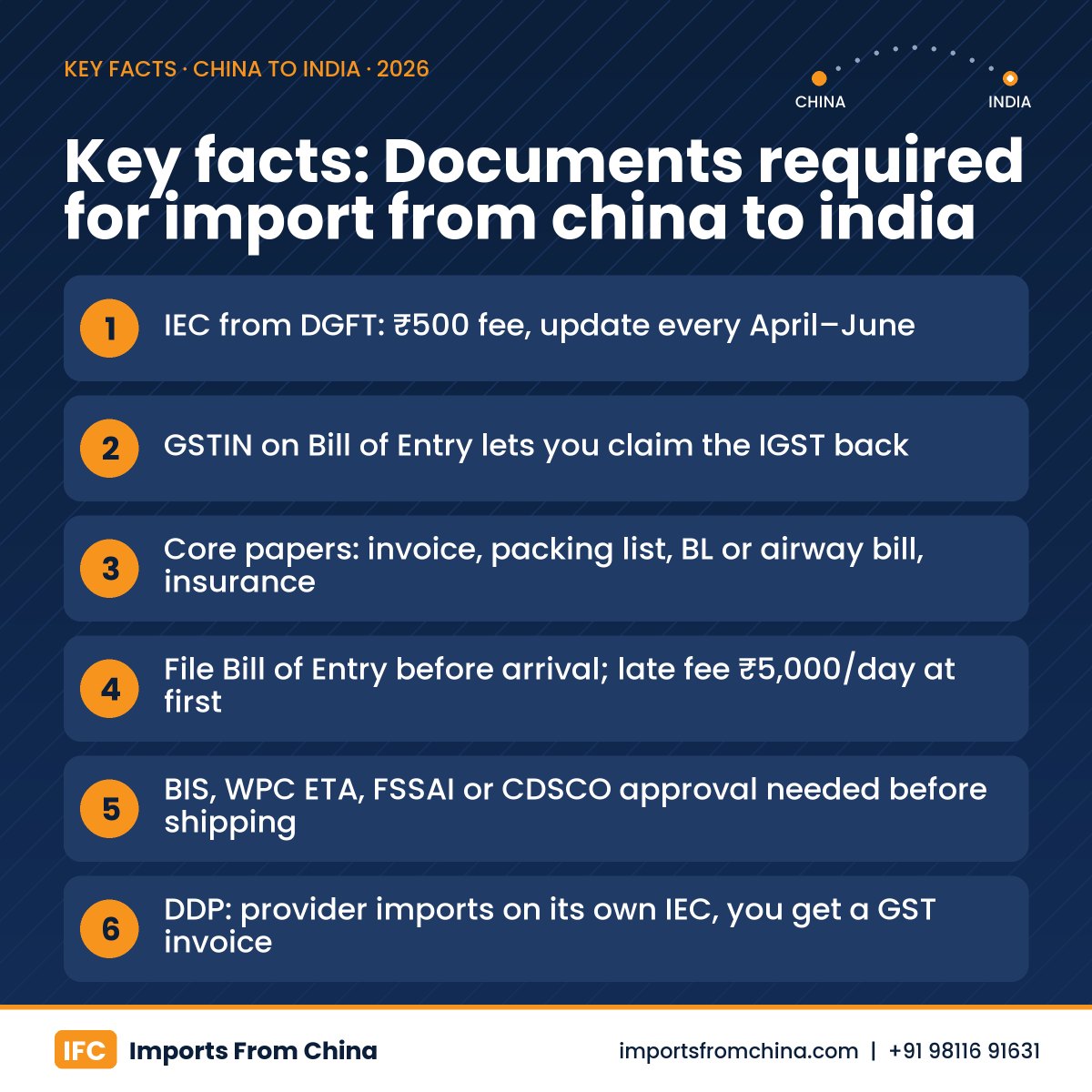
  • Two registrations first: an IEC from DGFT and a GSTIN. Without a GSTIN on the Bill of Entry you cannot claim back the IGST paid at customs.
  • Four core shipping papers: commercial invoice, packing list, bill of lading (sea) or airway bill (air), and an insurance certificate.
  • The Bill of Entry is the key document: your CHA files it on ICEGATE, ideally before the ship arrives, and uploads supporting papers on e-Sanchit.
  • Product approvals are checked at the port: BIS for many electronics and toys, WPC ETA for Bluetooth and Wi-Fi goods, FSSAI for food, CDSCO for medical devices and cosmetics.
  • Small mismatches cause big delays: names, HS codes or weights that differ across invoice, packing list and BL trigger queries.
  • DDP removes most of the paperwork: the DDP provider imports on its own IEC and delivers to you with a GST invoice.

What documents are required for import from China to India? (Complete checklist)

Some documents you arrange once, some your supplier sends with every shipment, and some are created in India during clearance.

DocumentWho issues itWhen you need itCommon mistakes
IEC (Importer Exporter Code)DGFT, onlineBefore your first commercial importMissing the April–June yearly update, so the IEC is deactivated
GSTINGST departmentBefore import, if you will resell or use goods in businessGSTIN missing on the Bill of Entry, so no IGST credit
AD code (bank)Your bank (Authorised Dealer)Mainly exports; keep the letter ready for importsPaying from an account not linked to your IEC
Commercial invoiceChina supplierEvery shipmentVague description, value not matching the payment
Packing listChina supplierEvery shipmentCarton count, gross weight or CBM different from the bill of lading
Bill of lading (sea) or airway bill (air)Shipping line, NVOCC or airlineEvery shipmentConsignee not matching IEC name; original BL not surrendered
Insurance certificateInsurer (India or China)Every shipment (strongly advised)No policy: customs adds 1.125% of FOB and you have no cover
Certificate of originChina CCPIT or customs authorityOnly when claiming a preferential rate (for example under APTA)Claim rejected for not meeting CAROTAR rules
Bill of EntryFiled by your CHA on ICEGATE, assessed by Indian CustomsEvery shipment, before or on arrivalLate filing, wrong HS code, value lower than the payment proof
Product approvals (BIS, WPC ETA, FSSAI, CDSCO, EPR)BIS, DoT WPC wing, FSSAI, CDSCO, CPCBBefore the goods are shipped from ChinaTreating a CE or FCC report as an Indian approval
KYC and authorisation for CHAYou (the importer)Before your first job with a customs brokerMissing authorisation or address proof
Delivery order and gate passShipping line or CFS / airline terminalAfter customs Out of ChargeUnpaid local charges adding demurrage
Documents required for import from china to india infographic – key facts for Indian importers
Documents required for import from china to india: key facts at a glance (IFC – Imports From China)

Which registrations do you need before your first import?

IEC: the import licence most people mean

India does not issue a general import licence for normal goods. What you need is the 10-digit IEC, applied online on the DGFT website using your PAN. The government fee is ₹500. You must update your IEC every year between April and June, even if nothing has changed; an IEC that is not updated is deactivated and your CHA cannot file a Bill of Entry on it. Goods imported for personal use, not for trade, are exempt from IEC. If you are unsure whether you need one at all, read our guide on IEC and import licences.

GSTIN: needed to claim IGST back

Most commercial imports pay IGST at customs. With your GSTIN on the Bill of Entry, that IGST flows into your GSTR-2B as input tax credit; without it, the IGST becomes a cost. For resellers and Amazon/Flipkart sellers a GSTIN is effectively compulsory.

AD code, ICEGATE and Legal Metrology

AD code registration at the port is mandatory for exporters. For imports it is not a standard requirement at every port, but keep your bank’s AD code letter ready in case your CHA asks. You do not need your own ICEGATE login if your CHA files for you, though one helps you track filings and duty. To sell packaged goods at retail, you also need importer registration under the Legal Metrology (Packaged Commodities) Rules and labels showing importer name and address, MRP, net quantity and country of origin.

KYC for your customs broker (CHA)

Customs brokers must verify each client before filing. Expect to give: IEC copy, GST certificate, PAN, address proof of the business, an authorisation letter on letterhead naming the broker, and ID of the signatory. Send this pack before the goods leave China. IFC’s custom clearance service in India collects this once and keeps it on file for later shipments.

Which shipping documents must your China supplier send?

Commercial invoice

Customs values your goods mainly from this document, so check the draft before the supplier ships. It should show buyer name and address exactly as on your IEC, invoice number and date, Incoterm (FOB, CIF, EXW), currency, a clear description with model and material, quantity, unit price, total value and ideally the HS code. A description such as household items invites a query or examination. The value must match what you actually pay; customs compares it with remittance records and past imports of similar goods.

Packing list

The packing list shows how many cartons, what is in each, net and gross weight and dimensions or CBM. During examination, the officer checks cartons against this list, so carton marks should match it.

Bill of lading or airway bill

Sea cargo moves on a bill of lading (BL) from the shipping line or NVOCC; air cargo on an airway bill (AWB). The consignee must be you, in your IEC name (or your bank, under an LC). For sea shipments the supplier couriers the original BL or arranges a telex release after balance payment; until then the line will not issue a delivery order, even after customs clearance.

Insurance certificate and certificate of origin

If you buy on FOB or EXW terms, insure the cargo yourself. Under the Customs Valuation Rules, when actual insurance cost is not available, customs adds 1.125% of FOB value to the assessable value; when freight is not known it adds 20% of FOB. Since 2017, landing charges are no longer added. A certificate of origin is not needed for every China shipment. China and India are both in the Asia-Pacific Trade Agreement (APTA), and some tariff lines get a concession with a valid APTA certificate, claimed under CAROTAR 2020 rules (origin details in the Bill of Entry, records kept five years). Check the current APTA notification for your HS code.

How is the Bill of Entry filed and what does customs check?

The Bill of Entry is the import declaration. Your CHA prepares it from your invoice, packing list and BL, files it on ICEGATE and uploads supporting documents on e-Sanchit.

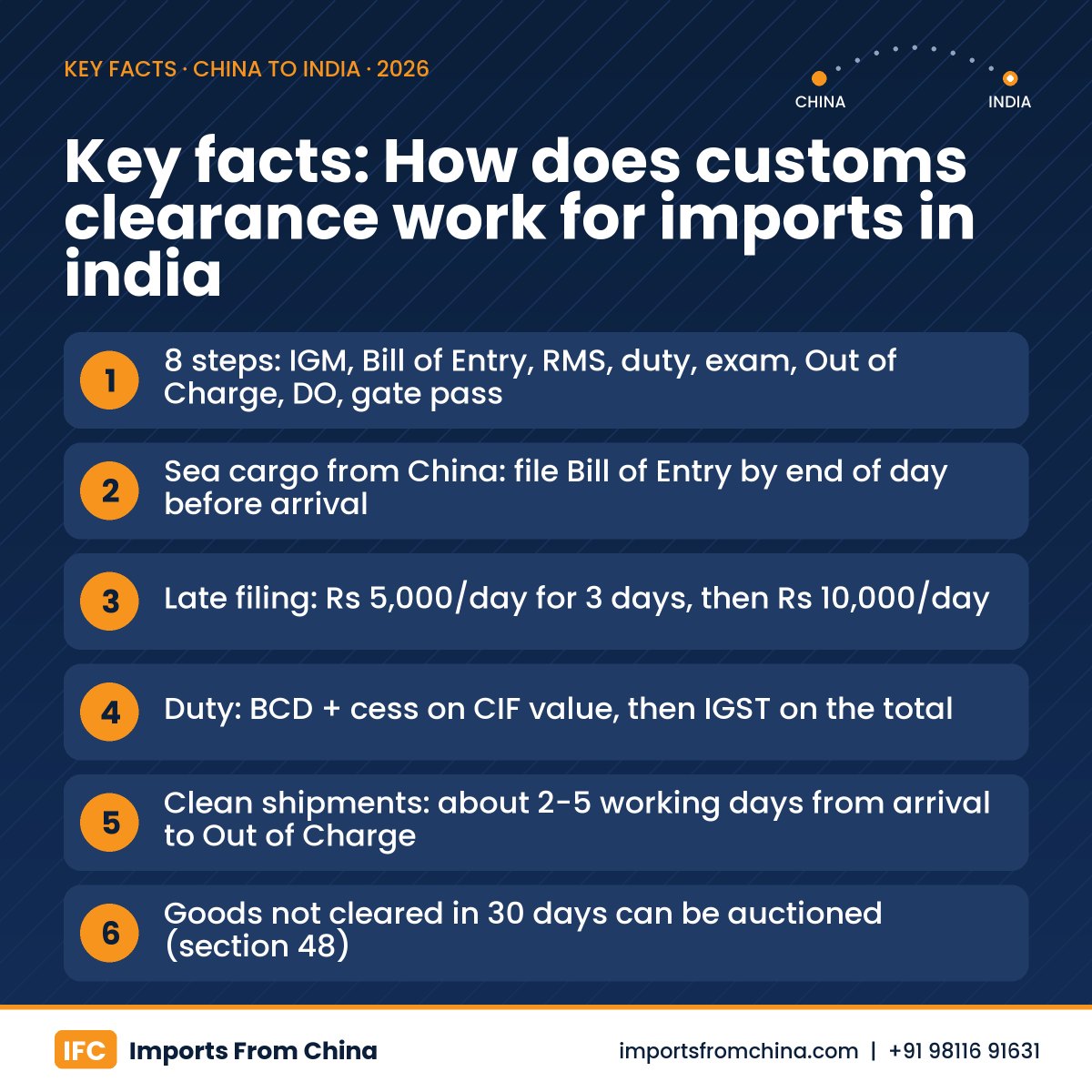
  1. Advance filing: the law requires filing before the end of the day preceding the vessel’s arrival (up to 30 days ahead is allowed). Late filing charges are currently ₹5,000 per day for the first three days and ₹10,000 per day after, with a cap; check the current notification.
  2. Assessment: accepted by the system or sent to an officer; queries usually concern HS code, value or a missing approval.
  3. Duty payment: paid online through ICEGATE. Late payment attracts interest.
  4. Examination: some shipments are opened and checked, especially electronics and first-time importers.
  5. Out of Charge (OOC): customs releases the goods; your CHA pays CFS charges, collects the delivery order and gate pass, and the cargo moves out.

With complete documents, clearance usually takes a few working days after arrival. Missing approvals or a valuation query can stretch this to weeks while demurrage adds up. Indicative, October 2026: sea port to port from China to Nhava Sheva about 12–20 days, LCL roughly 3–6 weeks door to door, and air cargo 5–10 days door to door.

Which products need extra approvals (BIS, WPC, FSSAI, CDSCO, EPR)?

Customs checks product approvals at the port, so they must be in place before goods are shipped. Check your 8-digit code on our India import duty rates page, which lists compliance notes for each code.

ApprovalTypical productsWho issuesWhat it means for you
BIS (CRS registration or ISI licence)Power banks, adapters, LED lights, speakers, toys, many QCO itemsBureau of Indian StandardsHeld by the Chinese factory per model; goods must carry the mark
WPC ETABluetooth, Wi-Fi, RF remotes, smart watchesDoT WPC wing (Saral Sanchar portal)Equipment Type Approval, often by self-declaration
FSSAIFood, beverages, supplementsFSSAICentral licence plus clearance of each consignment
CDSCOMedical devices, cosmetics, drugsCDSCO (SUGAM portal)Import licence or registration certificate before shipping
EPR registrationPlastic packaging, electronics (e-waste), batteriesCPCB portalImporters count as producers and must register
Import monitoring (e.g. SIMS)Iron and steel items in chapters 72, 73, 86DGFT / Ministry of Steel portalRegistration number before arrival

Check the BIS website for whether your product is under a Quality Control Order. A supplier’s CE or FCC test report is not a BIS registration. If the model is not registered, change the model or supplier before paying the deposit.

How do your import documents change the duty you pay? (Worked example in ₹)

Example: 500 Bluetooth speakers, HS code 85182110, LCL from Shenzhen to Nhava Sheva. Rates as of October 2026: BCD 20%, SWS 10% of BCD, no AIDC, IGST 18%, no anti-dumping duty; the product needs BIS (CRS), WPC ETA and e-waste EPR. Assumptions: values converted at the customs exchange rate; no landing charges (removed in 2017). Confirm rates for your exact HS code.

ItemCalculationAmount (₹)
FOB value (invoice)500 × ₹4802,40,000
Sea freight to Nhava ShevaFreight invoice36,000
InsuranceInsurance policy1,000
Assessable value (CIF)FOB + freight + insurance2,77,000
Basic Customs Duty20% of 2,77,00055,400
Social Welfare Surcharge10% of 55,4005,540
IGST18% of (2,77,000 + 55,400 + 5,540 = 3,37,940)60,829
Total paid to customsBCD + SWS + IGST1,21,769
Cost after IGST credit (GSTIN on BoE)2,77,000 + 55,400 + 5,5403,37,940 (about ₹676 per speaker)
Cost without IGST credit (no GSTIN)3,37,940 + 60,8293,98,769 (about ₹798 per speaker)

Lessons: the GSTIN on your Bill of Entry is worth ₹60,829 here, about ₹122 per speaker. Without an insurance certificate customs would add ₹2,700 (1.125% of FOB) instead of ₹1,000, and you would have no cover for lost cartons. A missing BIS registration or ETA would stop clearance completely, and CFS storage would cost far more than any duty difference. Local charges (CFS, DO, CHA fees, transport) come on top; see our import duty guide for China to India for how each duty works, or enter your own numbers in the IFC shipment calculator.

What changes for DDP vs self-import?

Under self-import, you handle every document above on your IEC. Under DDP shipping from China to India, the provider is the importer on record, pays duty on its own IEC and delivers with a GST invoice.

PointSelf-import (your IEC)DDP (provider’s IEC)
IEC neededYesNo
GSTIN neededYes, to claim IGSTYes, if you want input credit on the GST invoice you receive
CHA KYC and authorisationYes, from youHandled by provider
Invoice, packing list, BL checksYou and your CHAProvider, with your supplier
Bill of Entry and duty paymentOn your IEC; you pay dutyOn provider’s IEC; duty included in the DDP price
Product approvals (BIS, WPC, FSSAI)Your responsibilityStill needed for regulated goods
Best forRegular high-volume importersFirst-timers, small mixed orders, no IEC

DDP does not make a non-compliant product legal: BIS or ETA is still needed, whoever files the Bill of Entry.

What should you have ready before the shipment leaves China?

Save this checklist and tick it off for every order.

  • Registrations: IEC active and updated this year; GSTIN active; Legal Metrology importer registration if selling packaged goods.
  • CHA pack: KYC documents and signed authorisation letter sent to your customs broker.
  • HS code: agreed 8-digit code, duty rate and any anti-dumping duty checked.
  • Approvals: BIS, WPC ETA, FSSAI, CDSCO, EPR or SIMS in place, where your product needs them.
  • Drafts checked: invoice, packing list and draft BL match on consignee, description, quantity, weight and CBM.
  • Payment proof: bank remittance copies match the invoice value and currency.
  • Insurance: policy or certificate issued before departure.
  • Release: original BL couriered or telex release arranged after balance payment.
  • Labels: origin, importer details and MRP ready for retail goods.

How IFC helps with documents required for import from China to India

IFC – Imports From China has worked in China–India import and export for more than 15 years. Our own offices in Guangzhou and Yiwu have translators and English-speaking staff who coordinate with suppliers on invoices, packing lists and carton marks. We load mixed containers and air cargo daily and run a warehouse at our headquarters.

Our services cover sourcing, supplier verification, quality inspection, LCL and FCL sea freight, air cargo and customs clearance on your IEC. With DDP, we deliver door to door to major cities including Delhi, Gurugram, Noida, Mumbai, Pune, Bengaluru, Hyderabad, Chennai and Ahmedabad.

Conclusion

Importing from China to India needs fewer documents than most people fear, but each must be correct and consistent. Sort out IEC and GSTIN, confirm product approvals before paying the supplier, match the draft invoice, packing list and BL, and file the Bill of Entry early. If you would rather not manage the paperwork, a DDP shipment moves most of it to the provider.

Mayank Dang (CA Sahab), Founder and CEO of IFC

Guide on import documents from China reviewed by Mayank Dang (CA Sahab), Founder & CEO of IFC

Chartered Accountant (FCA, ICAI) who has helped 5000+ Indian businesses import from China since 2004 – sourcing, BIS, HSN classification, import duty, customs and GST compliance. mayankdang.in

Get your real landed cost: enter your product, weight and CBM in the IFC shipment calculator, check your HS code on the India import duty rates page, or call IFC on +91 98116 91631 for a door-to-door DDP quote from China to your city.

Frequently asked questions

Can I import goods from China to India without an IEC?

For personal use, yes: goods not meant for trade are exempt from IEC. For any commercial import you need an IEC from DGFT, or you can use a DDP service where the provider imports on its own IEC and sells the goods to you in India on a GST invoice.

Is GST registration mandatory to import from China?

Customs collects IGST on most commercial imports. If your GSTIN is on the Bill of Entry, that IGST shows in your GSTR-2B and you can claim it as input tax credit. Without a GSTIN the IGST becomes a cost, and you will usually need GST registration anyway to resell the goods.

When should the Bill of Entry be filed?

The law requires the Bill of Entry to be filed before the end of the day before the vessel arrives, and advance filing up to 30 days ahead is allowed. Late filing attracts per-day charges, currently 5,000 rupees a day for the first three days and 10,000 rupees a day after that. Check the current notification.

Do I need a certificate of origin for goods from China?

Not for every shipment. You need it only when you claim a preferential duty rate, for example under the Asia-Pacific Trade Agreement, and you must meet CAROTAR rules for that claim. Customs may also ask for origin proof where anti-dumping duty depends on the country or producer.

What is the difference between telex release and an original bill of lading?

An original bill of lading is a paper document the supplier couriers to you, and you hand it to the shipping line to get a delivery order. A telex release means the supplier surrenders the original in China, so the line releases cargo in India without paper. Suppliers usually arrange either one only after balance payment.

Do I need BIS certification to import electronics from China?

Many electronics such as power banks, adapters, LED lights and speakers are under BIS compulsory registration. The registration is held by the Chinese manufacturer for each model, and the goods must carry the BIS mark. Customs can hold the shipment if the model is not registered, so check before you pay the supplier.

How to Find the Right HS Code for Goods Imported from China to India

The HS code decides how much customs duty and GST you pay when goods arrive from China. A wrong code can mean a wrong duty estimate, a query from customs, or a delay at the port. This guide explains how Indian importers should approach HS classification before they place an order.

What an HS code is

The Harmonized System (HS) is an international product classification. India uses an 8-digit version for import tariff lines. The code sets the basic customs duty, any additional duties, and the IGST rate that applies to your shipment.

Steps to find the right code

Start with the exact product description: material, function, size and use. Check the supplier’s invoice wording against the Indian tariff description. Compare with Bills of Entry for similar goods you have already cleared. If two codes look possible, get the product specification sheet and ask your customs partner to confirm before shipping.

Common mistakes

Using the code written by the Chinese supplier without checking it is the most common mistake, because Chinese export codes and Indian import tariff lines do not always match. Other mistakes include classifying a set as separate items, and ignoring the material or function that decides the heading.

IFC – Imports From China, with 20+ years of import experience since 2004, helps B2B importers check classification and estimate landed cost before they pay a supplier.

Frequently Asked Questions

What is an HS code in import?

It is a standard product classification number used by customs to decide duty and tax on imported goods.

How many digits is an Indian import HS code?

India uses an 8-digit code for import tariff lines, built on the international 6-digit HS system.

Can I use the HS code my Chinese supplier gives me?

Do not rely on it alone. Chinese export codes can differ from Indian import tariff lines, so verify the code against the Indian tariff before shipping.

What happens if the HS code is wrong?

The duty may be calculated wrongly, customs may raise a query, and the shipment can be delayed or reassessed.

Does IFC help with HS code and duty estimates?

Yes. IFC helps B2B importers check classification and prepare a landed cost estimate before ordering. IFC does not serve individual retail buyers.

How does customs clearance work for imports in india

How Does Customs Clearance Work for Imports in India? Step-by-Step Guide for China Shipments (2026)

How does customs clearance work for imports in India? Your customs broker (CHA) files a Bill of Entry on ICEGATE before the ship arrives. Customs checks it through its risk system and faceless assessment. You pay duty online, the goods are examined if selected, and the officer gives Out of Charge. After that, the CFS or ICD releases your cargo against the delivery order.

This guide follows a China shipment through each stage. It covers Bill of Entry types and deadlines, a duty calculation in rupees, realistic timelines, indicative CHA, CFS and DO charges, and the mistakes that most often hold up Chinese cargo at Indian ports and ICDs.

Key takeaways

  • File early: for sea cargo from China, the Bill of Entry is due by the end of the day before the vessel arrives. Late filing attracts charges.
  • Have three things ready: IEC, GSTIN and the correct 8-digit HS code.
  • Assessment is faceless: an officer anywhere in India may assess your Bill of Entry. The port handles examination.
  • Duty is stacked: BCD and any cess are charged on the CIF value, then IGST on the total. GST-registered importers can usually claim the IGST back as input credit.
  • Typical timeline: about 2–5 working days from arrival to Out of Charge with clean documents. LCL needs extra days for de-stuffing at the CFS.
  • Biggest delays: document mismatches, wrong HS codes, missing BIS or WPC approval and undervalued invoices.

How does customs clearance work for imports in India, step by step?

Commercial imports are cleared under the Customs Act, 1962, and almost all paperwork goes through ICEGATE, the customs e-filing portal. For a sea shipment from Shenzhen, Ningbo or Shanghai to Nhava Sheva, the steps run in this order:

  1. Documents from the supplier: the commercial invoice, packing list and bill of lading reach you and your CHA before the vessel arrives.
  2. IGM filed: the shipping line (and the consolidator for LCL) files the Import General Manifest, the list of all cargo on board. Your Bill of Entry is linked to your cargo’s line on it.
  3. Bill of Entry filed: your CHA declares the HS code, value, quantity, IEC, GSTIN and any licence or BIS details. Supporting documents are uploaded on e-Sanchit.
  4. Risk check and assessment: the Risk Management System (RMS) decides whether the Bill of Entry is accepted as filed, sent for assessment, marked for examination, or both.
  5. Duty payment: you pay BCD, cess and IGST online on ICEGATE.
  6. Examination (if selected): officers at the CFS or ICD open and check the cargo against the declaration.
  7. Out of Charge (OOC): the officer releases the goods from customs control. Legally, customs clearance is now complete.
  8. Delivery order and CFS release: you collect the delivery order (DO) from the shipping line or forwarder and pay CFS charges. The CFS issues a gate pass and the truck leaves.
How does customs clearance work for imports in india infographic – key facts for Indian importers
How does customs clearance work for imports in india: key facts at a glance (IFC – Imports From China)

What documents and registrations do you need before the ship arrives?

Registrations on your side

  • IEC: the Importer Exporter Code from DGFT, linked to your PAN. It is needed for any commercial import.
  • GSTIN: it must be declared on the Bill of Entry so the IGST you pay is available as input tax credit.
  • Product approvals: BIS registration or an ISI licence for goods under a Quality Control Order (many electronics, toys, furniture and steel items), WPC approval for Bluetooth and Wi-Fi devices, FSSAI for food and CDSCO for medical devices and cosmetics.
  • A licensed customs broker: you may legally file your own Bill of Entry, but most small and mid-size importers use a CHA. The work needs ICEGATE access and staff at the port.

Documents for each shipment

  • Commercial invoice: your name, address and GSTIN as consignee, the real price paid, the Incoterm and a clear description of each item. Vague words like “parts” or “accessories” invite queries.
  • Packing list: carton count, net and gross weight and marks. These must match the invoice and bill of lading exactly.
  • Bill of lading or air waybill: for LCL this is usually a house bill of lading. The original must be surrendered, or a telex release issued, before you get a delivery order in India.
  • Freight and insurance details, plus a catalogue or technical sheet: these support the CIF value and the HS code.
  • Certificate of origin: India has no free trade agreement with China. You need one only to claim an Asia-Pacific Trade Agreement (APTA) concession on an eligible item, following the CAROTAR origin rules.

Fix the HS code before you place the order, not when the cargo is at the port. You can check duty and compliance notes for any 8-digit code on IFC’s India import duty rates by HS code page.

Which Bill of Entry should you file, and by when?

The Bill of Entry is your formal declaration to customs. Its type depends on what you will do with the goods and when you file it.

Bill of Entry typeWhen it is usedWhat it means for you
Home consumptionGoods will be sold or used in India nowThe normal choice for traders, online sellers and project buyers. All duty is paid now.
Into-bond and ex-bondGoods enter, then leave, a bonded warehouseDuty is paid later, on each quantity taken out.
Advance filingUp to 30 days before arrivalRecommended. Assessment can start before the vessel berths.
Filed after arrivalOnce the cargo has landedFor sea cargo from China, this is late and attracts late presentation charges.

The filing deadline most importers miss

Since the Finance Act 2021 change to section 46, the Bill of Entry for sea cargo from China must be filed before the end of the day before the vessel arrives, whether the cargo clears at the port or at an ICD. Air cargo can be filed until the end of the arrival day. So your CHA needs final documents 3–4 days before the ETA. Late filing attracts charges: currently ₹5,000 a day for the first three days and ₹10,000 a day after that, unless the officer accepts your reason. Check the current CBIC notification, because these amounts can change.

How does customs assess and examine your goods?

Self-assessment and the Risk Management System

Indian customs works on self-assessment: you declare the HS code, value and duty yourself through your CHA. The RMS then scores each Bill of Entry on importer history, product, origin and value. A facilitated Bill of Entry needs no assessment or examination. You pay duty and get Out of Charge. Others go for assessment, examination, or both.

Faceless assessment

Since October 2020, assessment has been faceless across India. A Bill of Entry for Nhava Sheva may be assessed by officers in another city. If they have doubts, a query is raised on ICEGATE asking for a catalogue, proof of payment, freight details or a BIS licence. Each query adds a day or two, so a clean first filing saves time.

If the officer disagrees with your value or HS code, the Bill of Entry is reassessed and you pay the difference. An invoice far below the price of similar recent imports is likely to be rejected.

Examination and Out of Charge

When examination is ordered, officers at the CFS, ICD or air cargo terminal open the cargo. They check quantity, description, markings, origin and BIS/ISI marks. For retail packs, they also check the Legal Metrology declaration: importer name and address, MRP and month of import. Your CHA arranges labour and pays the examination charges. When everything matches and duty is paid, the officer gives Out of Charge.

The cargo stays at the CFS until you collect the delivery order and pay the CFS charges. Under section 48, goods not cleared within 30 days of unloading can be auctioned by the custodian after notice. Do not leave cargo at the port while payments are sorted out.

How is import duty calculated and paid at customs?

Duty is charged on the assessable value. This is the CIF value (cost + insurance + freight to the Indian port), converted to rupees at the CBIC customs exchange rate. The old 1% landing charge was removed from the valuation rules in 2017. Customs adds Basic Customs Duty (BCD), the Social Welfare Surcharge (10% of BCD unless exempt), AIDC where applicable and any anti-dumping duty, then IGST on the total. Our guide to import duty from China to India explains each part.

Worked example: 200 office chairs from Foshan to Nhava Sheva

Assumptions: 200 swivel office chairs (HS 94013900) at FOB USD 25 each, or USD 5,000. Sea freight is USD 400 and insurance USD 50, so CIF is USD 5,450. The exchange rate is ₹97 per USD, the CBIC import rate notified on 2 October 2026. The IFC duty database shows BCD 20%, AIDC 5%, no SWS on this line, IGST 18% and no anti-dumping duty. Rates as of October 2026; confirm for your exact HS code.

ItemHow it is calculatedAmount (₹)
Assessable value (AV)USD 5,450 × 96.955,28,378
Basic Customs Duty20% of AV1,05,676
AIDC5% of AV26,419
Social Welfare SurchargeExempt on this line (normally 10% of BCD)0
Value for IGSTAV + BCD + AIDC6,60,473
IGST18% of 6,60,4731,18,885
Total paid at customsBCD + AIDC + IGST2,50,980

The IGST of ₹1,18,885 is usually claimable as input tax credit when your GSTIN is on the Bill of Entry. Your real duty cost is the ₹1,32,095 of BCD and AIDC, about 25% of the assessable value. Office chairs also fall under a BIS furniture Quality Control Order, so check the current ISI requirement before shipping.

Duty is paid online on ICEGATE. For a self-assessed Bill of Entry it is due on the day of filing. After reassessment, it is due within one working day, and interest applies after that. Try your own product in the IFC shipment calculator.

How long does customs clearance take in India, and what does it cost?

These timelines are counted from the day of arrival for a shipment with clean documents. Indicative, October 2026.

ShipmentFacilitated (no exam)With assessment or examinationWhat adds time
FCL at Nhava Sheva, Mundra or Chennai1–3 working days3–6 working daysMoving the container to the CFS, scanning, queries
LCL at a port CFS3–5 working days5–8 working daysDe-stuffing the shared container
Cargo for ICD Tughlakabad or PatparganjAs above, after the rail moveAs above, after the rail moveRail transfer from the port, often 4–10 days
Air cargo at Delhi, Mumbai or BengaluruSame day to 2 working days2–4 working daysQueries, WPC or BIS checks

For the full journey, plan on roughly 12–20 days port to port by sea, 3–6 weeks door to door for LCL and 5–10 days door to door by air (indicative, October 2026). See how LCL shipping from China to India works for small cargo.

Indian-side clearance charges (besides duty)

ChargeWho bills itIndicative range, October 2026
CHA agency feeCustoms broker₹3,000–₹10,000 per Bill of Entry, more with queries or licences
Delivery order and documentationShipping line or LCL consolidator₹2,500–₹8,000 per bill of lading
Terminal handling (FCL)Shipping lineRoughly ₹8,000–₹15,000 per 20ft container
CFS handling and storageCFS operatorLCL: about ₹4,000–₹15,000 for a small lot; FCL: ₹10,000–₹25,000, plus storage after free days
Examination and labourCFS, through the CHA₹1,000–₹5,000 when examination is ordered
Transport to your warehouseTransporterDepends on distance and truck size

These vary by port, line and CFS, and GST is added to most. Ask for an itemised estimate before shipping.

Why do China shipments get stuck in Indian customs?

  • Undervalued invoice: a low invoice meant to save duty is compared with similar imports, rejected and raised, and penalties are possible. Declare the real price.
  • Wrong or vague HS code: a code chosen for a lower rate, or a description like “household items”, leads to reassessment. Classify each product separately.
  • Missing BIS, WPC or other approvals: goods under a Quality Control Order cannot be cleared without the licence, and some must be re-exported.
  • Documents that do not match the cargo: a different carton count, weight or marks triggers examination. Mixed-supplier LCL lots are prone to this.
  • Anti-dumping duty not budgeted: many Chinese products carry it. Check the current notification for your HS code on the CBIC website.
  • No telex release or unpaid freight: no delivery order is issued, even after Out of Charge.

Pre-shipment checklist

  1. IEC active, and your GSTIN correct on the invoice.
  2. 8-digit HS code agreed with your CHA, with anti-dumping duty checked.
  3. BIS, WPC, FSSAI or CDSCO approval in hand if needed.
  4. Invoice, packing list and bill of lading checked against each other before loading.
  5. Documents with your CHA 3–4 days before ETA.
  6. Funds ready for duty, DO and CFS charges on arrival.

How IFC helps with customs clearance in India

IFC – Imports From China has more than 15 years in China–India import and export. Our own offices in Guangzhou and Yiwu have translators and English-speaking staff who can check supplier invoices, packing lists and markings before goods leave China, which is where most clearance problems can be stopped. We load mixed containers and air cargo daily and have a warehouse at our headquarters.

We handle sourcing, supplier verification, quality inspection, LCL and FCL sea freight, air cargo and customs clearance in India. If you prefer not to handle Bills of Entry, CFS charges and duty payments yourself, our DDP shipments from China to India deliver door to door to major cities, including Delhi, Gurugram, Noida, Mumbai, Pune, Bengaluru, Hyderabad, Chennai and Ahmedabad.

Bottom line

Customs clearance in India is predictable when the work is done before the cargo lands: a correct HS code, the real value, matching documents, the right approvals and an early Bill of Entry. Get those right and most China shipments reach Out of Charge within a few working days.

Related guide: Air Freight vs Sea Freight from China to India: Cost, Time and Which to Choose

Mayank Dang (CA Sahab), Founder and CEO of IFC

Guide reviewed by Mayank Dang (CA Sahab), Founder & CEO of IFC

Chartered Accountant (FCA, ICAI) who has helped 5000+ Indian businesses import from China since 2004 – sourcing, BIS, HSN classification, import duty, customs and GST compliance. mayankdang.in

Get your real landed cost: enter your product, weight and CBM in the IFC shipment calculator, check your HS code on the India import duty rates page, or call IFC on +91 98116 91631 for a door-to-door DDP quote from China to your city.

Frequently asked questions

How many days does customs clearance take in India for goods from China?

With clean documents and an early Bill of Entry, FCL sea cargo usually gets Out of Charge in 1 to 3 working days after arrival and LCL in 3 to 5, because LCL is de-stuffed at the CFS first. Examination adds 2 to 4 days. Indicative, October 2026.

Can I do customs clearance myself without a CHA?

Yes. An importer can register on ICEGATE and file the Bill of Entry in their own name. Most small and mid-size importers still use a licensed customs broker, because the work needs daily ICEGATE handling, query replies and someone at the CFS or ICD for examination and release.

What is the difference between an advance and a regular Bill of Entry?

An advance Bill of Entry is filed up to 30 days before the vessel or flight arrives, so assessment can start early. For sea cargo from China, the law requires filing by the end of the day before arrival, so early filing is effectively the norm. Filing later attracts late presentation charges.

What happens if customs selects my shipment for examination?

Officers at the CFS, ICD or air cargo terminal open the packages and check quantity, description, markings, origin and BIS or Legal Metrology labelling against your Bill of Entry. Your CHA arranges labour and pays examination charges. If everything matches, Out of Charge is given; if not, the goods may be reassessed or held.

Is the IGST paid at customs refundable?

It is not refunded in cash, but a GST-registered importer can usually claim the IGST paid at customs as input tax credit, provided the correct GSTIN is on the Bill of Entry. Basic Customs Duty, AIDC, Social Welfare Surcharge and anti-dumping duty are not creditable.

What happens if I do not clear my goods within 30 days?

Under section 48 of the Customs Act, goods not cleared within 30 days of unloading can be sold by the custodian after notice to the importer. Long before that, CFS storage, demurrage and detention charges add up every day, so arrange duty and freight payments before the cargo arrives.

Do I need an IEC to import a small shipment from China?

Yes, commercial imports need an IEC from DGFT, even for a small shipment. Goods for personal use are exempt. Small buyers who prefer not to manage clearance themselves often use a DDP service, where the logistics provider handles clearance and delivery.

Import duty from China to India

Import Duty from China to India: How to Prepare a Landed-Cost Estimate

Import duty from China to India depends on the product classification, customs value, origin and applicable notifications. There is no single percentage that reliably prices every shipment. Use this guide to prepare a duty enquiry and a complete landed-cost estimate before paying your supplier.

Start with the actual product

Provide the product description, material, function, technical specification, model, photographs and intended use. A supplier’s suggested HS code is a starting point for review rather than a final Indian classification. Similar-looking products can have different classifications and requirements.

Use official duty tools

The ICEGATE Trade Guide on Imports supports tariff enquiries. ICEGATE also provides a Custom Duty Calculator. Check the relevant tariff item, origin and effective notifications for the proposed import. Save the date and assumptions used in the estimate, and have the classification and applicable measures reviewed before declaration.

What may appear in the duty calculation?

The assessment may include Basic Customs Duty, Social Welfare Surcharge, import IGST and product-specific cesses or trade-remedy duties where applicable. Exemptions and additional measures can change the result. Do not assume a rate quoted for a broad category applies to every product within it.

Check the relevant official notifications rather than relying on an old price list, a marketplace listing or another importer’s past shipment. A duty estimate and a product approval are separate checks: paying duty does not by itself establish that goods may be imported.

A practical quotation checklist

  1. Identify the goods: confirm specifications, quantity, origin and proposed classification.
  2. Document value and terms: provide the supplier invoice, currency, freight and insurance information, and agreed delivery basis.
  3. Review valuation: ask the customs broker to confirm the applicable valuation adjustments and customs exchange rate.
  4. Check duty measures: review the effective tariff, exemptions and any additional product or origin-specific duties.
  5. Check product requirements: identify any required approvals, certification, labelling or import authorisation before shipping.
  6. Record the result: separate estimated customs payments from freight, handling, storage, broker and final-delivery charges.

Duty is only part of the landed cost

Your budget should also account for goods, China domestic transport, inspection, repacking, consolidation, international freight, insurance arrangements, handling and delivery to your Indian address. Ask which charges are included in the quotation and which could arise separately.

For a simple budgeting illustration, goods costing INR 100,000 plus INR 20,000 in agreed logistics charges and INR 30,000 in hypothetical customs payments total INR 150,000 before any other excluded charges. These are invented inputs showing addition only; they are not a duty rate, IFC quotation or customs valuation calculation.

Can import IGST be claimed as input tax credit?

Eligibility depends on the importer, documentation, use of goods and applicable GST conditions. Ask your tax adviser to confirm your position before treating tax as recoverable. Keep cash outlay and any eligible credit separate in your pricing model; do not subtract a potential credit from the money you need to complete an import.

How IFC can help prepare your enquiry

IFC – Imports From China Inc coordinates China sourcing and import enquiries, including inspection, consolidation, air or sea shipping, customs-clearance support and delivery. Share your cargo information for an assessment and a written quotation. Confirm the importer of record, documentation, service responsibilities, inclusions, exclusions and estimated timing.

Use our shipment calculator for an initial estimate and then confirm the result for the actual shipment. Read our LCL guide, FCL versus LCL comparison and DDP service page.

Frequently asked questions

Can I use one duty percentage for all Chinese products?

No. Obtain an estimate for the actual classification, value, origin and applicable measures.

Does a DDP quotation mean product checks can be skipped?

No. Confirm the shipment’s eligibility and documentation as well as the quoted delivery and import responsibilities.

What should I send to request a landed-cost estimate?

Send product specifications and links, quantity, invoice value and currency, supplier location, packed weight and dimensions, and the delivery pincode.

WhatsApp IFC: +91 99119 51631 or submit an import enquiry. See our India office and delivery city guides.

trading smarter rather than harder.

With IFC’s AI-Trained Customs Data Extractor, Transform Your Imports

Introducing a game-changer for importers – IFC’s Ai-Trained Customs Data Extractor. Say goodbye to the complexities of customs clearance and import data research. Now, you can simply enter your product name, and our revolutionary tool does the rest, providing you with a wealth of information to streamline your import process.

Ai-Trained Customs Data Extractor’s Key Features

1.Instant HS Code Identification

The days of figuring out HS codes are long gone. Our artificial intelligence (AI) system quickly determines the proper standardized system (HS) code for your goods. Smooth customs declarations are guaranteed by this precision.

2.Access to Past Import Data

Knowledge is power, and with IFC’s tool, you gain access to valuable insights. Explore past import data related to your product, giving you a deeper understanding of market trends and pricing strategies.

3.Rates of Customs Duty at Your Fingertips

Our extractor provides you with precise information on customs tariff rates, including basic custom duty, Social welfare surcharge (SWS), and GST rates. This data empowers you to calculate your import costs with confidence.

4.extensive Import Policy Information

It used to be difficult to navigate import restrictions, but not any longer. With the help of our tool, you can learn more about important regulations like the BIS (Bureau of Indian Standards), ISI (Indian Standards Institute), ADC (Additional Drug Controller), WPC (Wireless Planning and Coordination), EPR (Extended Producer Responsibility), testing requirements, and any DGFT (Directorate General of Foreign Trade) permissions required for your product.

Simplify the Import Process

You have a strong ally in IFC’s Ai-Trained Customs Data Extractor for your import activities. It not only saves you time, but it also lowers the possibility of expensive mistakes related to customs compliance. Our tool makes sure you have access to the knowledge you need to succeed in the import industry.

Are you prepared to transform your imports? Use our Ai-Trained Customs Data Extractor right away to import your goods in a smarter, more effective manner.