

Import Pet Products from China to India: Buyer Guide

You can import pet products from China to India by sourcing from verified manufacturers, testing samples for material safety and build quality, calculating landed cost with customs duty and GST, and shipping by sea or air under a clear delivery term. Most first-time buyers start with bowls, leashes, pet beds, grooming tools and toys, then approve a sample before placing a full bulk order.

India’s pet care market is growing, and many Delhi, Mumbai and Bengaluru retailers and online sellers source affordable accessories from China. Done well, this can improve margins. Done carelessly, it can lead to rejected stock, unsafe materials and unexpected costs at the port. This guide explains the steps IFC recommends for Indian buyers.

Which pet products are most commonly imported from China to India?

Chinese factories produce a wide range of pet supplies at scale. The categories Indian buyers ask about most often include:

  • Stainless steel and ceramic feeding bowls, slow feeders and water fountains
  • Collars, harnesses, leashes and ID tag accessories
  • Pet beds, mats, blankets and cushions
  • Grooming brushes, nail clippers, combs and bath accessories
  • Chew toys, plush toys, rope toys and interactive puzzle toys
  • Carriers, crates, travel bags and pet strollers
  • Aquarium accessories, decor and filters

Bulky items such as beds, crates and carriers take up a lot of container space, so freight cost per unit matters more for these than for small accessories like collars or brushes.

Step-by-step process to import pet products from China into India

A reliable import process for pet supplies follows the same core sequence as other consumer goods. The main steps are:

  • Define your product specification: size, material, colour, packaging and target price
  • Shortlist suppliers through 1688, Alibaba or trade fairs, then verify their licences and factory capacity
  • Request samples and test them for material safety, stitching, odour and durability
  • Confirm the HS code and estimate customs duty and GST for the product category
  • Agree on payment terms, typically a deposit followed by a balance against shipping documents or inspection
  • Arrange a pre-shipment inspection in China before the goods leave the factory
  • Choose sea or air freight, then complete customs clearance and door delivery in India

IFC’s offices in Guangzhou and Yiwu, China, and its head office in Kirti Nagar, New Delhi, support buyers across these stages, from supplier checks to inspection and clearance.

Material and safety checks for pet products

Pet products are used by animals that may chew, lick or eat from them, so material choice is critical. Before you approve any sample, confirm the following with the supplier and, where needed, an independent lab:

Product type What to check Common risk
Feeding bowls Food-grade stainless steel or certified ceramic, non-slip base Low-grade metal coating that chips or flakes
Chew and plush toys Non-toxic materials, secure seams, no small detachable parts Loose stitching or beads that can be swallowed
Collars and leashes Buckle strength, colourfast dyes, safe metal fittings Dye bleeding onto fur or skin, weak clasps
Pet beds and mats Filling type, washable covers, odour-free foam Strong chemical smell, filling that clumps
Grooming tools Rounded edges, sharp-tip safety, handle grip Sharp burrs that injure pets
Aquarium accessories Non-toxic plastics, safe for water contact, correct voltage on electrical parts Leaching materials, electrical faults

Ask every supplier for material composition details and test reports. Keep these documents with your purchase records, as Indian retail partners and marketplaces may request them.

Duty, GST and landed cost for pet products from China

Your real cost is not the factory price. It is the landed cost: factory price plus freight, insurance, customs duty, GST, clearance charges, inland transport and any inspection fees. The duty rate depends on the correct HS code, so classification should be checked before you finalise prices. Pet items can fall under different headings depending on material and function, for example a plastic bowl and a textile bed may be classified differently.

Build a landed cost sheet for each SKU. Compare a sea shipment with an air shipment for the same item, because a lower freight rate per unit can be offset by higher volume or longer transit times. For new products, consider a small test order first to measure actual sales velocity before committing to a container.

Sea or air freight for pet products to India

Sea freight usually suits bulky, lower-value items such as beds, crates, carriers and large toys, where the cost per unit is driven by volume. Air freight suits samples, urgent restocking and small, higher-value items such as grooming tools or branded accessories. Many buyers use both: sea for the main stock, air for samples and top-ups.

Plan packaging for the Indian retail channel from the start. Retail packs, barcodes and product labels should be designed for your sales channel, and labels should carry the information your marketplace or retailer requires. Packaging that protects products during long sea transit also reduces breakage and returns.

Common mistakes Indian buyers make when importing pet products

  • Ordering a full container without approving a pre-production sample
  • Skipping material checks because the product looks simple
  • Ignoring HS code classification, which leads to wrong duty estimates
  • Paying the full amount upfront to a supplier without verification
  • Forgetting that bulky items can make freight costs higher than expected
  • Not planning labels and packaging for the Indian market before production

Frequently asked questions

Is it legal to import pet products from China to India?

Most pet accessories such as bowls, leashes, beds and toys are commonly imported from China into India as general merchandise. Requirements can vary by product type and material, so confirm the HS code and any applicable regulations with a customs broker or your import agent before shipping.

Which pet product is best to start with for a small import business?

Lightweight, non-perishable items such as collars, leashes, grooming brushes and feeding bowls are often used as starting products. They ship easily, need limited storage, and allow you to test demand with smaller orders before scaling to bulky items like beds or crates.

How do I check a supplier before paying for pet products in China?

Verify the company’s business licence, factory address, production capacity and export history. Request recent photos or a video tour, check references where possible, and consider a factory audit or independent verification. Start with a small sample order and use milestone payments rather than paying the full amount upfront.

What should I include in landed cost when importing pet products from China to India?

Include the factory price, packaging, inland transport in China, freight, insurance, customs duty, GST, customs clearance charges, port handling, inspection fees and delivery to your warehouse in India. Compare totals for sea and air options before you choose a shipping method.

Can IFC help with inspection and customs clearance for pet product imports?

Yes. IFC offers supplier verification, factory audit and inspection, payment safety support, air and sea shipping, customs clearance and door delivery across India. Its team in Kirti Nagar, New Delhi, and its offices in Guangzhou and Yiwu help buyers manage the full import process from China to India.

Talk to IFC before your first pet product order

If you are planning to import pet products from China to India, IFC can help you verify suppliers, arrange inspection before shipment, and manage freight and customs clearance through to door delivery. Message our team on WhatsApp at +91 98116 91631 or visit importsfromchina.com to discuss your product list and get a clear landed cost estimate before you commit.
Import Packaging Materials from China to India: Guide

To import packaging materials from China to India, first confirm the exact product type and HS code, source from verified manufacturers in hubs such as Guangzhou and Yiwu, approve samples, arrange a factory check, pay through a secure method, and clear Indian customs with correct documents before door delivery.

What counts as packaging materials when importing from China?

Packaging materials are the boxes, bags, films, labels and protective items that wrap or ship a product. In trade terms this covers a wide range of goods, and each type can fall under a different HS code and duty treatment. Indian buyers usually import the following categories from China:

  • Corrugated shipping cartons and mailer boxes
  • Rigid gift boxes, paper bags and printed cartons
  • Polythene bags, zip-lock pouches and shrink film
  • Bubble wrap, foam sheets and corner protectors
  • Adhesive tapes, stickers, barcode and product labels
  • Plastic bottles, caps and tubes for cosmetics and food

Because the category decides the customs classification, check the HS code before you place a purchase order. Mixing up paper packaging and plastic packaging is one of the most common reasons for a delayed clearance at an Indian port.

Step 1: Define the specification before you search

Packaging suppliers quote against specifications, not against photos. Write down the size in millimetres, board grade or GSM for paper, wall thickness for plastic, print colours, print method, and the load your carton must carry. Add the product it will hold, because a glass item and a garment need very different protection. Clear specs reduce quote disputes and make the sample stage faster.

Step 2: Find and verify the packaging supplier in China

Many packaging suppliers list on 1688 and Alibaba, but a listing alone does not prove that a factory exists or can hold quality. Ask for the business licence, the factory address, production photos, machine lists and references from Indian or export customers. IFC, which has its own offices in Guangzhou and Yiwu, can verify suppliers on the ground before you commit money. This is especially useful for printed boxes, where colour matching and finishing quality vary widely between factories.

Common warning signs in packaging sourcing

  • A price far below every other quote for the same board grade
  • Refusal to share a factory video or to accept a third-party check
  • Sample quality that does not match the bulk production plan
  • No clear answer on minimum order quantity or lead time

Step 3: Approve a sample and run a basic test

Always approve a physical sample before bulk production. For cartons, test the burst strength and drop performance with your real product inside. For plastic bags, check the thickness and seal strength. For printed packaging, compare colour against your approved brand file under the same light. Record the approved sample with photos and a signed specification sheet, so the bulk order can be checked against it later.

Step 4: Arrange a pre-shipment inspection

A pre-shipment inspection checks the goods before they leave China. For packaging, the inspector typically checks dimensions, print accuracy, count per carton, and visible defects against the approved sample. Packaging is bulky, so a poor batch costs more to fix after it reaches Delhi or Mumbai. Read more about what each check covers in our guide on pre-shipment inspection versus a factory audit.

Step 5: Choose a safe payment method

Packaging orders are often large, so payment terms matter. Many buyers pay a deposit and the balance against shipping documents or after inspection. Avoid sending full payment to an unverified seller. Confirm the bank details independently and keep every quote, invoice and message on record. IFC supports payment safety for Indian buyers who want a structured process rather than a single transfer.

Step 6: Plan freight and customs clearance

Packaging type Typical shipping mode Main checks at Indian customs
Corrugated cartons (bulk) Sea freight (FCL or LCL) HS code, quantity, invoice value, origin documents
Printed gift boxes (small volume) Air or sea LCL Print content, declared value, packing list
Plastic pouches and film Sea freight Material type, HS code, any restricted-goods status
Labels and stickers (samples) Air courier Declaration accuracy, quantity, invoice

Bulk cartons are heavy and bulky, so sea freight usually works best for large orders, while air freight suits urgent samples. Compare options carefully, as our sea versus air freight guide explains. Keep a commercial invoice, packing list, bill of lading or airway bill, and a correct importer code ready before cargo lands.

Step 7: Get door delivery across India

Packaging is often bought in regular lots for a warehouse or factory. A door-to-door service that handles customs clearance and delivery to your premises saves time and reduces the number of parties you need to manage. IFC offers door delivery across India, along with shipping, customs clearance and warehousing support, so one team tracks the order from factory to your location.

Tips to avoid common packaging import mistakes

  • Order a small test lot before a full container of new packaging
  • Confirm the board, plastic or ink type in writing, not just the product name
  • Plan for storage, because cartons can warp in humid conditions
  • Keep a reorder specification sheet so every future batch matches

Frequently asked questions

Do I need a special licence to import packaging materials from China to India?

Packaging items are usually imported under a standard importer code, but the exact requirements depend on the goods and the HS code. Confirm the classification and any regulatory conditions before shipping. An experienced import company in Delhi can review the documents and tell you what applies to your product.

How do I find the correct HS code for packaging materials?

Start with the material and form of the packaging, such as paper cartons, plastic bags or adhesive labels. Then match the description against the Indian tariff schedule. If the product is a mix, such as a plastic box with printed paper, ask a customs specialist before filing. A wrong code can cause delays and extra checks at the port.

What is the minimum order quantity for imported packaging?

Minimum order quantity depends on the factory, the packaging type and whether the design is custom. Printed packaging often needs higher quantities because of plate and setup costs, while stock designs may be available in smaller lots. Ask the supplier to confirm MOQ in writing alongside the price and lead time.

Is sea freight or air freight better for packaging materials?

Sea freight is usually more economical for bulky cartons and large volumes, while air freight suits small urgent sample shipments. The right choice depends on volume, weight, urgency and budget. Compare total landed cost, including freight, clearance and delivery, rather than only the factory price.

Can IFC help me inspect packaging before it ships from China?

Yes. IFC works with its offices in Guangzhou and Yiwu to arrange supplier verification, factory audits and pre-shipment inspections for Indian buyers. Inspectors can check dimensions, print quality, count and defects against your approved sample before the goods leave China, which helps prevent costly rework after arrival in India.

Talk to IFC about your packaging import

IFC has helped Indian businesses import from China since 2004, with a head office in Kirti Nagar, New Delhi, and offices in Guangzhou and Yiwu. If you are planning a packaging sourcing project, WhatsApp +91 98116 91631 or visit importsfromchina.com to share your specification and get guidance on sourcing, inspection, payment safety, customs clearance and door delivery.

Landed cost of a China product in India

Landed Cost of a $10 China Product in India: Worked Example (2026)

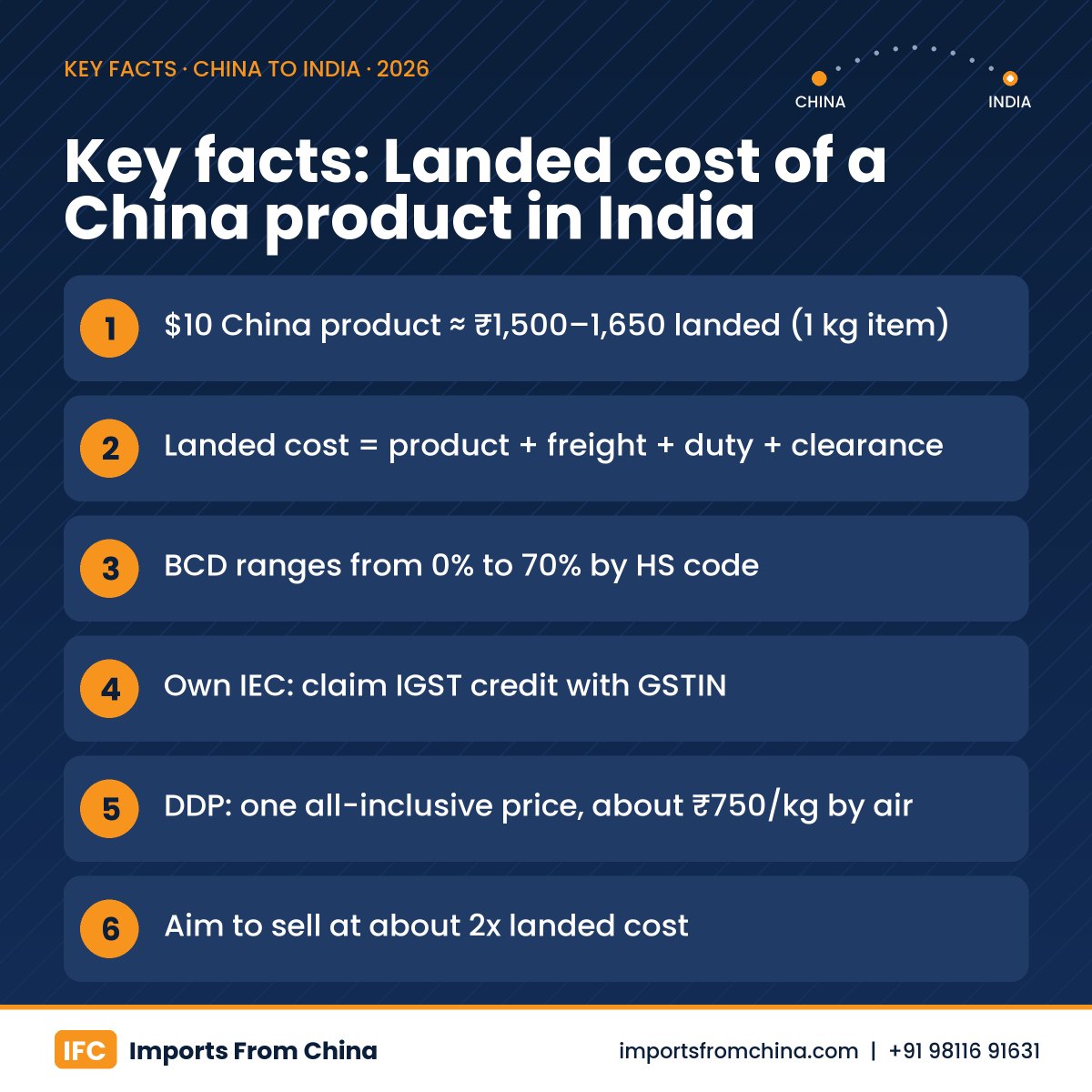
If a product costs US$10 in China, what will it cost landed in India? For a typical 1 kg consumer product bought in a lot of 100, the landed cost is roughly ₹1,500–1,650 per piece, about 1.7 to 1.9 times the China price, once freight, customs duty, IGST, clearance and delivery are added. The exact figure depends on the HS code, weight, value and shipping mode.

Below are two worked calculations for the same order: importing on your own IEC, and importing door to door (DDP). Use them as a template, then check your own product on the IFC shipment calculator.

Key takeaways

  • Rule of thumb: a China price often becomes 1.6–2x once it reaches your door in India.
  • Weight matters: light, high-value goods land cheaper per piece than heavy, low-value goods.
  • Duty depends on the HS code: BCD can be 0% to 70%; IGST is usually 5% or 18%.
  • IGST credit: with your own IEC and GSTIN you can usually claim the IGST back.
  • DDP is simpler: one per kg price covers freight, duty, clearance and delivery.
  • Always calculate first: work out landed cost before you pay the supplier.

Assumptions for the example

ItemValue
Product price in China (FOB)US$10 per piece
Quantity100 pieces
Weight1 kg per piece, 100 kg total
Exchange rate (assumed)₹88 per US$ – use the current CBIC customs rate
Goods valueUS$1,000 = ₹88,000 (₹880 per kg)
Duty (example HS code)BCD 20%, SWS 10% of BCD, IGST 18%
Landed cost of a China product in India infographic – key facts for Indian importers
Landed cost of a China product in India: key facts at a glance (IFC – Imports From China)

Method 1: Import on your own IEC (air freight + CHA)

CostAmount
Goods value (FOB)₹88,000
Air freight + insurance to Indian airport (assumed)₹25,000
Assessable value (CIF)₹1,13,000
BCD 20%₹22,600
SWS 10% of BCD₹2,260
IGST 18% on ₹1,37,860₹24,815
CHA, airport and delivery charges (assumed)₹10,000
Total outflow₹1,72,675
Less IGST credit (GST registered)– ₹24,815
Net landed cost₹1,47,860 = about ₹1,479 per piece

This route gives you the IGST credit, but you handle the freight booking, CHA, Bill of Entry and delivery yourself, and port charges can vary.

Method 2: Door-to-door DDP

CostAmount
Goods value₹88,000
Air DDP at about ₹750/kg × 100 kg (freight, duty, clearance, delivery)₹75,000
Total landed cost₹1,63,000 = about ₹1,630 per piece

The general ₹750/kg air DDP rate applies to general cargo of 50 kg+ valued under ₹2,000 per kg. Battery, liquid, cosmetic, magnet or higher-value goods are about ₹1,350/kg, and sea DDP is roughly half the air rate. DDP is a fixed, predictable cost with no CHA or port work for you. Because the goods are imported on the agent’s IEC, IGST credit is generally not available to you.

Which method is cheaper for you?

SituationUsually better
First import, small quantity, no CHADDP
GST registered, regular imports, own IECOwn IEC with IGST credit
Heavy goods, 500 kg+Sea (either method)
Urgent stockAir DDP

How to sell profitably after landing

In the example, the landed cost is about ₹1,480–1,630 per piece. For retail, aim to sell at about 2x the landed cost to cover marketplace fees, returns, advertising and your margin. If the market price is lower, choose a lighter product, ship by sea, or negotiate the China price. Ideas: what India imports from China and is importing from China profitable?

What changes the landed cost the most?

  • HS code: BCD can range from 0% (laptops) to 70% (toys).
  • Weight and volume: bulky goods pay volumetric weight.
  • Value per kg: high-value goods pay more duty and may move to a higher DDP slab.
  • Anti-dumping duty: some Chinese goods carry extra duty.
  • Exchange rate: customs uses the CBIC notified rate.
  • Shipping mode: sea costs roughly half of air.

Learn the duty maths in our import duty guide and check your product on the India import duty rates page.

How IFC helps you calculate and control landed cost

IFC (Imports From China) has worked in China–India imports for 20+ years, since 2004, and has served 5000+ Indian businesses. We confirm the HS code and duty before you order, consolidate goods at our China warehouse, and ship door to door with one all-inclusive DDP price, so your landed cost is fixed before you pay the supplier.

Conclusion

A US$10 China product typically lands in India at about ₹1,500–1,650 per piece for a 1 kg item, roughly 1.7–1.9x the China price. Run this calculation for every product before you order, and choose between your own IEC (with IGST credit) and simple DDP based on your volume and set-up.

Mayank Dang (CA Sahab), Founder and CEO of IFC

Guide reviewed by Mayank Dang (CA Sahab), Founder & CEO of IFC

Chartered Accountant (FCA, ICAI) who has helped 5000+ Indian businesses import from China since 2004 – sourcing, BIS, HSN classification, import duty, customs and GST compliance. mayankdang.in

Get your real landed cost: enter your product, weight and CBM in the IFC shipment calculator, check your HS code on the India import duty rates page, or call IFC on +91 98116 91631 for a door-to-door DDP quote from China to your city.

Frequently asked questions

If a product costs US$10 in China, what is the landed cost in India?

For a 1 kg general product bought in a lot of 100, the landed cost is roughly ₹1,500 to ₹1,650 per piece including freight, duty, IGST, clearance and delivery. It depends on HS code, weight, value and shipping mode.

How do I calculate landed cost from China to India?

Add the product price, freight and insurance to get CIF value, add BCD, SWS and IGST on it, then add clearance and delivery charges. Or use the IFC shipment calculator for a quick estimate.

Which exchange rate does Indian customs use?

Customs uses the exchange rate notified by CBIC for imports, which is updated regularly. It can differ slightly from the bank rate.

Can I claim the IGST paid on imports?

Yes, if the goods are imported on your own IEC and GSTIN, the IGST paid at customs can usually be claimed as input tax credit.

Is DDP shipping more expensive than importing myself?

DDP can cost a little more on paper because IGST credit is not available to you, but it removes CHA, port and delivery work and the risk of surprise charges, which suits small and first-time importers.

Cost to start an import business from China to India

Cost to Start an Import Business from China to India: ₹ Budget Guide (2026)

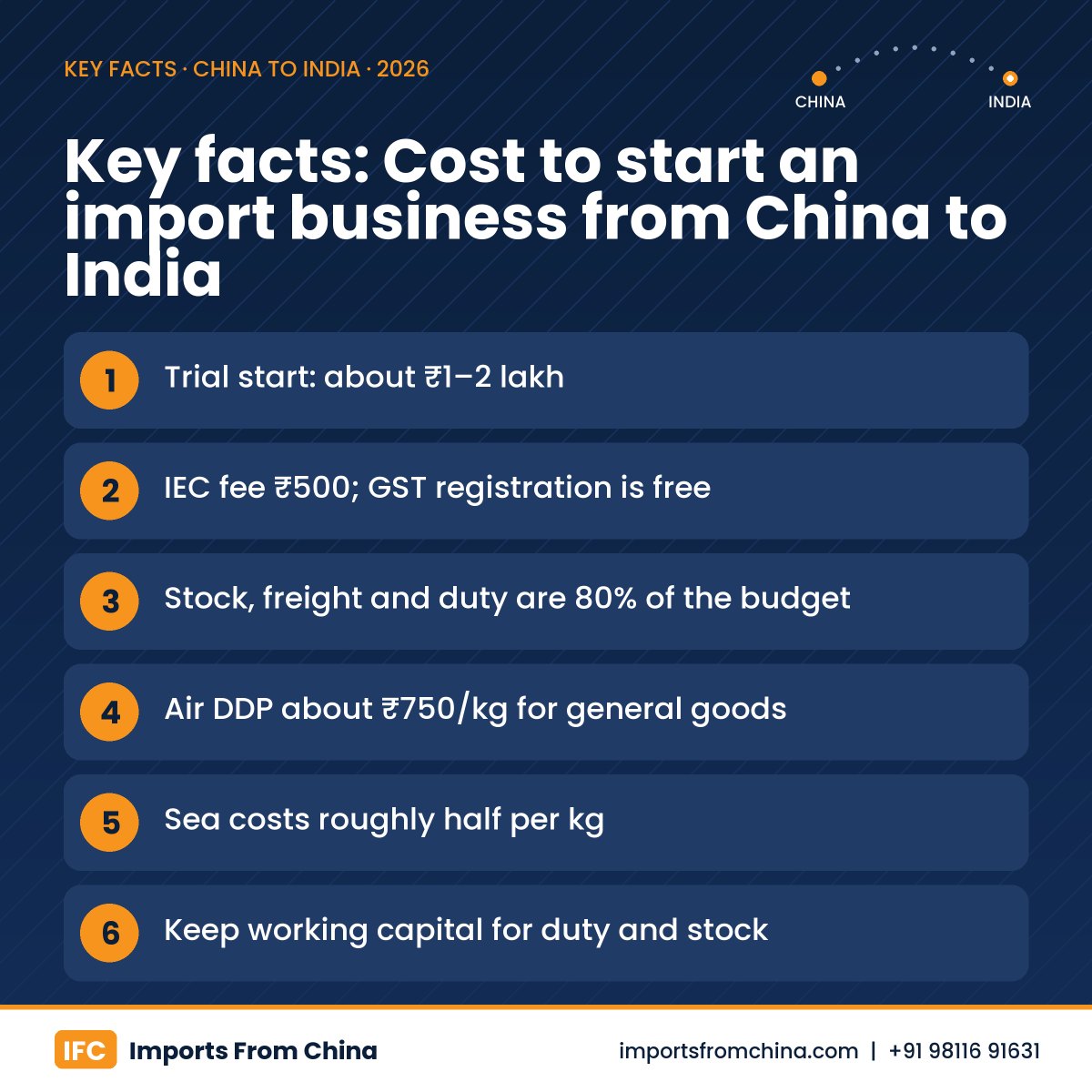
How much does it cost to start an import business from China to India? You can start with about ₹1–2 lakh: roughly ₹500 for an IEC, a free GST registration, ₹10,000–20,000 for samples, and ₹75,000–1.5 lakh for a first 50–100 kg trial stock shipped door to door. A serious trading start with sea cargo needs about ₹5–10 lakh, mostly for stock and working capital.

This guide breaks down every cost in rupees: registrations, product cost, freight, duty, checks and working capital, with three sample budgets.

Key takeaways

  • Registrations are cheap: IEC costs ₹500; GST registration is free on the GST portal.
  • Stock is the main cost: product cost plus freight and duty usually take 80% of the budget.
  • Start with a trial: test 50–100 kg by air DDP before ordering a container.
  • Plan for duty: duty can add 20–45% of the goods value depending on the HS code.
  • Keep working capital: new importers often run out of cash between paying the supplier and getting paid.
  • Check before you pay: use the IFC shipment calculator for the full landed cost.

What registrations do you need, and what do they cost?

RegistrationNeeded forIndicative cost
GSTINSelling in India, claiming IGST creditFree on the GST portal
IEC (Import Export Code)Commercial imports₹500 government fee on DGFT
Business entityProprietorship (simplest), LLP or companyProprietorship: no separate fee; company/LLP: roughly ₹7,000–20,000 with professional fees
Current bank accountPayments to ChinaBank charges as applicable
Product approvalsBIS, WPC, FSSAI, CDSCO for some productsProduct-specific; check before ordering

If you do not want your own IEC at the start, an import agent can import on its IEC under DDP terms. Compare both in agent IEC vs your own IEC.

Cost to start an import business from China to India infographic – key facts for Indian importers
Cost to start an import business from China to India: key facts at a glance (IFC – Imports From China)

What does the first shipment cost?

Your landed cost has five parts: product price + China-side charges + international freight + Indian duty and IGST + clearance and delivery. With DDP shipping, the last four come as one per kg price.

Cost itemTypical amount
Samples (3–5 suppliers, courier)₹10,000–20,000
Supplier checkRemote factory audit about ₹1,500; physical factory visit ₹15,000–25,000
Air DDP freight + duty + clearance (general goods, 50 kg+)About ₹750/kg
Air DDP for battery, liquid, cosmetic, magnet or high-value goodsAbout ₹1,350/kg
Sea DDPRoughly half the air rate; ₹50–150/kg above 5,000 kg

Three sample budgets for a China import business

BudgetWhat it buysBest for
₹1–2 lakh (trial)Samples + 50–100 kg of stock by air DDPTesting a product, Amazon/Flipkart trial, local shops
₹5–10 lakh (small trader)300–1,000 kg of stock, mostly by sea, with a quality checkRetailers, B2B suppliers, e-commerce sellers
₹20 lakh+ (growth)LCL or FCL shipments, several products, own brandWholesalers, brands, interior and project businesses

Worked example: a ₹2 lakh first import

  • Samples from 3 suppliers: ₹15,000
  • Remote factory audit of the chosen supplier: ₹1,500
  • Goods: 100 kg of home and kitchen items worth about ₹55,000
  • Air DDP door to door at about ₹750/kg: ₹75,000 (freight, duty and clearance included for general goods under ₹2,000/kg)
  • Buffer for packaging, listing and marketing: about ₹5,000

Total: about ₹2 lakh. If those goods sell at 2x to 2.5x the landed cost, the trial pays for itself and shows whether to scale by sea. Read Is importing from China profitable?

Hidden costs new importers forget

  • Duty differences by HS code (from 0% to 70% BCD).
  • BIS testing for notified products.
  • Storage and demurrage if documents are wrong.
  • Returns and damaged pieces.
  • Currency changes between order and payment. See how to pay Chinese suppliers.
  • Marketplace fees and advertising when you sell.

How to start an import business from China: step by step

  1. Pick a product you can sell and check its HS code and compliance.
  2. Register GST and IEC (or use an agent’s IEC).
  3. Order samples and verify the supplier.
  4. Calculate landed cost on the IFC shipment calculator.
  5. Ship a trial order by air DDP.
  6. Scale the winners by sea.

More detail: how to start importing from China to India.

How IFC helps new importers start small

IFC (Imports From China) has worked in China–India imports for 20+ years, since 2004, and has served 5000+ Indian businesses. From our own offices in Guangzhou and Yiwu we help first-time importers with sourcing, supplier checks, quality inspection, consolidated air and sea shipping, customs clearance and door-to-door DDP delivery, so even a 50 kg trial order is simple.

Conclusion

Starting an import business from China does not need crores. Registrations cost very little; the real budget is stock, freight and duty. Start with a ₹1–2 lakh trial, prove the product sells, keep cash for working capital, and scale by sea once demand is clear.

Mayank Dang (CA Sahab), Founder and CEO of IFC

Guide reviewed by Mayank Dang (CA Sahab), Founder & CEO of IFC

Chartered Accountant (FCA, ICAI) who has helped 5000+ Indian businesses import from China since 2004 – sourcing, BIS, HSN classification, import duty, customs and GST compliance. mayankdang.in

Get your real landed cost: enter your product, weight and CBM in the IFC shipment calculator, check your HS code on the India import duty rates page, or call IFC on +91 98116 91631 for a door-to-door DDP quote from China to your city.

Frequently asked questions

How much money do I need to start importing from China to India?

A trial import can start at about ₹1–2 lakh, covering samples and 50–100 kg of stock by air DDP. A small trading business usually needs ₹5–10 lakh for stock, sea freight, duty and working capital.

What is the cost of an IEC in India?

The government fee for an Import Export Code on the DGFT website is ₹500. GST registration is free.

Can I start importing without an IEC?

For commercial imports you need an IEC, or you can import through an agent that imports on its own IEC under DDP terms.

What is the biggest cost in an import business?

Stock is usually the largest cost, followed by freight and customs duty. Duty depends on the HS code and can add 20–45% of the goods value for many consumer products.

Should I start with air or sea shipping?

Start with a small air DDP trial to test the product quickly, then move repeat orders to sea, which costs roughly half per kg.

Life in China for Indians

What Is Life Really Like in China for an Indian? Is It as Bad as People Say? (2026)

What is life really like in China for an Indian? Safer, more convenient and more business-friendly than most Indians expect. Street crime is rare, phones replace wallets, trains run at 300 km/h, and Indian traders are valued customers in Guangzhou and Yiwu. The hard parts are the language, vegetarian food, blocked apps like Google and WhatsApp, long working hours and business fraud. China is not as bad as social media shows, and not as perfect as some travel vlogs claim.

I have lived and worked in China, I speak Mandarin, and for 20+ years my company IFC has run offices in Guangzhou and Yiwu, hosting thousands of Indian buyers. Here is an honest, first-hand picture for Indian businessmen, visitors and anyone curious.

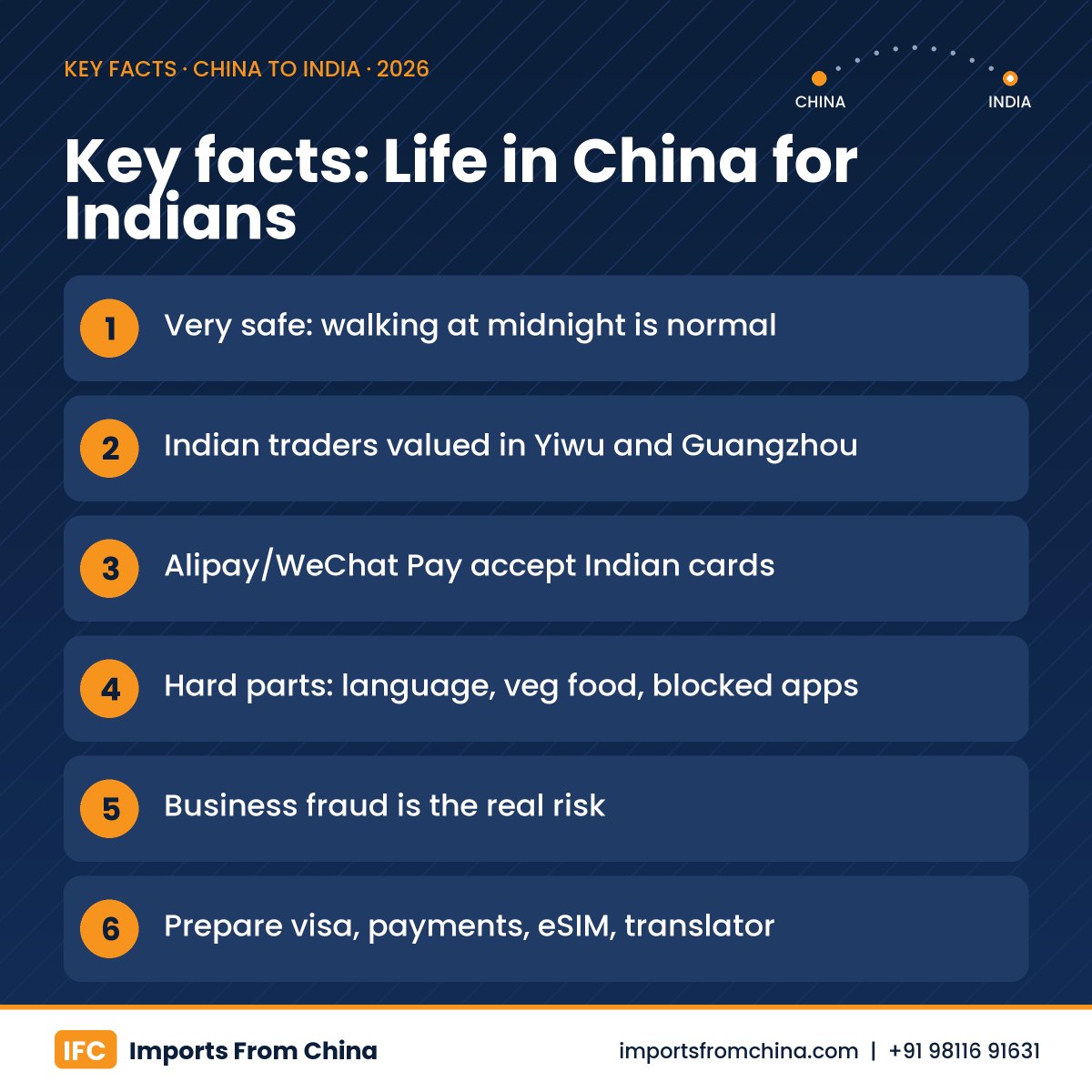
Key takeaways

  • Safety: one of the safest places to live; walking alone at midnight in Guangzhou or Yiwu is normal.
  • Indian traders: valued customers in Yiwu and Guangzhou, with Indian restaurants nearby.
  • Payments: Alipay and WeChat Pay accept Indian Visa/Mastercard.
  • Hard parts: language, vegetarian food, blocked apps, long hours and business fraud.
  • Chinese society: comfortable daily life, but young people face job and housing pressure.
  • Prepare: business visa, mobile payments, roaming/eSIM, translator, verified suppliers.

The surprising good parts of life in China

  • Safety: China is one of the safest places I have lived. Walking alone at midnight in Guangzhou or Yiwu is completely normal.
  • Respect for Indian traders: in Yiwu and Guangzhou, Indian buyers are valued customers. Many shopkeepers know a few Hindi words, and Indian restaurants are easy to find.
  • Convenience: your phone is your wallet. Alipay and WeChat Pay now accept Indian Visa and Mastercard cards, and food or parcels arrive within an hour.
  • Infrastructure: high-speed trains at 300 km/h, spotless metros and airports that feel like malls.
  • Business speed: you can visit a factory in the morning, approve a sample in the afternoon and ship a container within a few weeks.
Life in China for Indians infographic – key facts for Indian importers
Life in China for Indians: key facts at a glance (IFC – Imports From China)

The genuinely hard parts

  • Language: outside hotels and big companies there is very little English. A translation app and a local contact are essential.
  • Food: pure vegetarian food takes planning. Many dishes use meat stock or lard, even when they look vegetarian.
  • Apps: Google, WhatsApp, Instagram and YouTube are blocked on local networks. Life runs on WeChat, or you keep Indian roaming on.
  • Work culture: Chinese suppliers work very long hours and expect fast replies, even on Sundays.
  • Business risk: the country is safe, but business fraud is real: fake factories, bait-and-switch samples and “change of bank account” emails. Never pay 100% advance to an unverified supplier. Read how to avoid China supplier scams.

Life in China for an Indian: quick comparison with home

AspectIn ChinaTip for Indians
SafetyVery highStill carry your passport and use official taxis
PaymentsAlmost cashlessSet up Alipay / WeChat Pay with your card before you fly
InternetGoogle, WhatsApp blocked locallyUse Indian roaming or a roaming eSIM
FoodMeat-heavy cuisineUse Indian restaurants in Guangzhou, Yiwu, Shanghai
LanguageLittle EnglishTranslation app + local contact
BusinessVery fast, very competitiveVerify suppliers and inspect before final payment

Is life bad for the Chinese themselves?

Not bad, but under pressure. Housing in big cities costs many years of income, youth unemployment was about 17.7% in September 2026, and births fell to a record low of 7.92 million in 2025 as young people delay marriage. Daily life is comfortable; the future feels uncertain for many young people. More in how bad is life in China and China’s economy vs India.

My honest verdict for Indians

China is not as bad as social media shows, and not as perfect as some travel vlogs claim. For an Indian businessman it is one of the best places in the world to learn how manufacturing works, and to find products for your business back home.

5 things to prepare before your first China trip

  • Business (M) visa with an invitation letter from a Chinese company or the Canton Fair.
  • Alipay and WeChat Pay linked to your international card, plus some yuan in cash.
  • Indian international roaming or a roaming eSIM, and WeChat installed.
  • A translator or local contact for markets and factory visits.
  • A verified supplier list, so you visit real factories, not just showrooms.

Planning the trip: China safety guide for Indian travellers, Canton Fair guide and Yiwu market guide.

How IFC helps Indians in China

IFC (Imports From China) has worked in China–India imports for 20+ years, since 2004, and has served 5000+ Indian businesses. Our own offices in Guangzhou and Yiwu, with English-speaking staff and translators, help Indian buyers with market visits, factory checks, supplier verification, quality inspection, shipping and customs clearance back to India. Call +91 98116 91631 before you plan your trip.

Mayank Dang (CA Sahab), Founder and CEO of IFC

Written by Mayank Dang (CA Sahab), Founder & CEO of IFC

Chartered Accountant (FCA, ICAI) who has lived and worked in China, speaks Mandarin, and has helped 5000+ Indian businesses import from China since 2004. mayankdang.in

Frequently asked questions

What is life like in China for an Indian?

Safe, convenient and business-friendly. Street crime is rare, payments are mobile, and Indian traders are welcome in Guangzhou and Yiwu. The challenges are language, vegetarian food, blocked apps and long working hours.

Is China safe for Indians?

Yes. China is generally very safe, including at night in cities like Guangzhou and Yiwu. The main risk for Indian businessmen is supplier fraud, not physical danger.

Can Indians get vegetarian food in China?

Yes, but it takes planning. Many Chinese dishes use meat stock or lard. Indian restaurants are common in Guangzhou, Yiwu, Shanghai and Beijing.

Do WhatsApp and Google work in China?

Not on local Chinese networks. Indian international roaming or a roaming eSIM usually works. Most people in China use WeChat.

Is China a good place for Indian businessmen?

Yes. It is one of the best places to find products and factories, from small commodities in Yiwu to electronics in Shenzhen, as long as you verify suppliers and inspect goods before final payment.

How bad is life in China

How Bad Is Life in China? Daily Life, Costs & Work Culture vs India (2026)

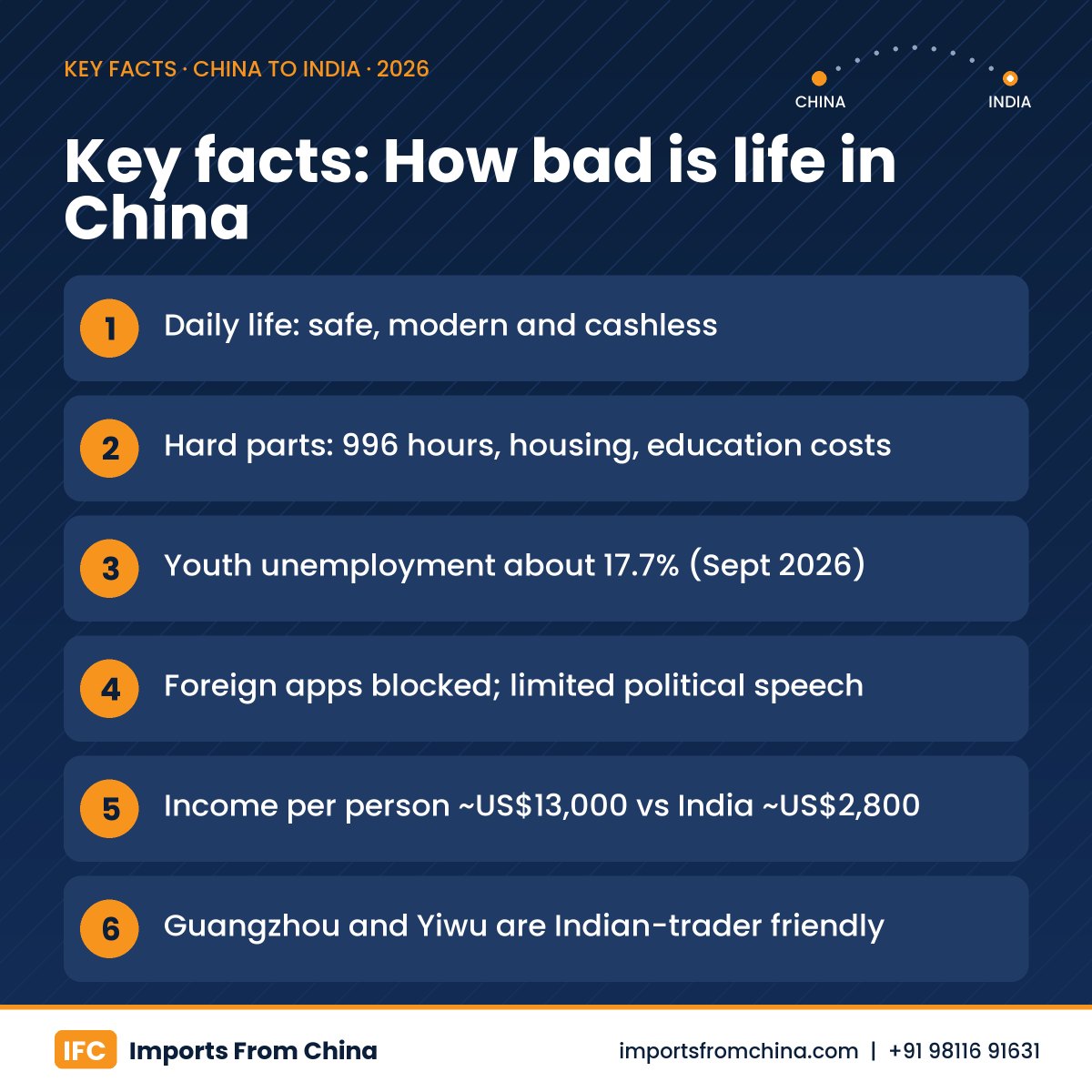
How bad is life in China? For most people it is not “bad”, but it is demanding. Daily life is safe, convenient and modern: fast trains, cashless payments, instant delivery and clean cities. The hard parts are long working hours, high housing and education costs in big cities, tough competition for young graduates, internet restrictions and limited freedom of political expression. Life is much easier for the well-educated urban middle class than for migrant workers and rural families.

IFC’s founder, CA Mayank Dang, has lived and worked in China and speaks Mandarin, and IFC has run offices in Guangzhou and Yiwu for years. This is a balanced, practical picture of everyday life in China today, and what it is like for Indians who visit or work there.

Key takeaways

  • Convenience: cashless payments, food delivery, high-speed rail and efficient public services.
  • Safety: low street crime; most people feel safe at night.
  • Pressure: long hours (“996”), costly housing and intense competition for jobs and schools.
  • Young people: youth unemployment about 17.7% (Sept 2026); many delay marriage and children.
  • Restrictions: Google, WhatsApp and many foreign sites blocked; limited political expression.
  • For Indians: safe and business-friendly, but language, food and apps need preparation.

What is good about life in China?

  • Safety: heavy policing and CCTV mean low street crime.
  • Infrastructure: the world’s largest high-speed rail network, modern metros, airports and highways.
  • Convenience: almost everything is paid by phone through Alipay or WeChat; food, groceries and parcels arrive within hours.
  • Cleanliness and order in most cities.
  • Affordable everyday goods, especially outside the biggest cities.
How bad is life in China infographic – key facts for Indian importers
How bad is life in China: key facts at a glance (IFC – Imports From China)

What is difficult about life in China?

  • Work pressure: long hours, the “996” culture (9 am to 9 pm, 6 days a week) in many private companies, and few holidays.
  • Housing costs: flats in Shanghai, Beijing and Shenzhen cost many years of income, even after the property slump.
  • Education pressure: the gaokao (university entrance exam) drives intense, expensive coaching from early childhood.
  • Jobs for youth: youth unemployment was about 17.7% in September 2026; many graduates take jobs below their skills.
  • Hukou system: household registration rules can limit migrant workers’ access to city schools and services.
  • Internet and speech: foreign apps and sites are blocked, and criticism of the government is restricted.
  • Ageing families: many only children support two parents and four grandparents.

How difficult is life in mainland China now (2026)?

Life has become harder for many families since the pandemic. The property slump has reduced household wealth, salaries are growing more slowly, and young people face a tough job market. Marriages fell 7.5% in the first half of 2026 and births hit a record low of 7.92 million in 2025, partly because young people feel financially insecure. At the same time, incomes are still far higher than a generation ago, and China’s cities remain among the most modern in the world. See how bad is China’s economy right now.

Life in China vs India: quick comparison

AspectChinaIndia
Income per personRoughly US$13,000Roughly US$2,700–2,900
InfrastructureVery advancedImproving fast
Street safetyVery highVaries by city
Work hoursLong in private sectorLong in many sectors
Digital paymentsAlipay / WeChat Pay everywhereUPI everywhere
Internet freedomMany foreign sites blockedOpen internet
Political freedomLimitedDemocratic, free press
Population trendAgeing and shrinkingYoung and growing

What is life like for Indians in China?

  • Business-friendly: Guangzhou and Yiwu have large communities of Indian traders and buyers.
  • Language: English is limited outside hotels and big companies; translation apps and local staff help a lot.
  • Food: vegetarian food takes planning, but Indian restaurants exist in Guangzhou, Yiwu, Shanghai and Beijing.
  • Apps and payments: set up WeChat, Alipay and a roaming plan before travel.
  • Visas: tourist visas for Indians resumed in 2025; business visas need an invitation letter.

Planning a visit? Read how safe is China for Indian travellers and our Canton Fair guide.

How IFC helps Indian businesses in China

IFC (Imports From China) has worked in China–India imports for 20+ years, since 2004, and has served 5000+ Indian businesses. Our own offices in Guangzhou and Yiwu help Indian buyers with sourcing, supplier verification, quality inspection, shipping and customs clearance, door to door. Check your landed cost on the IFC shipment calculator or call +91 98116 91631.

Frequently asked questions

How bad is life in China really?

Daily life is safe, modern and convenient, but many people face long working hours, costly housing and education, a tough job market for young people, and restrictions on internet use and political expression.

Is life in China better than in India?

Average incomes and infrastructure are higher in China, and cities are very safe. India offers more political and internet freedom, a younger population and faster growth. Which is better depends on what you value.

Why is life difficult for young people in China?

Youth unemployment was about 17.7% in September 2026, housing is expensive, and work pressure is high. Many young people delay marriage and children.

Is it easy for Indians to live or do business in China?

It is safe and business-friendly, especially in Guangzhou and Yiwu, but you need to prepare for the language, vegetarian food, blocked apps and mobile payments.

Can foreigners use WhatsApp and Google in China?

Not on local Chinese networks. International roaming or a roaming eSIM usually works. Local life runs on WeChat and Alipay.

Is China really as powerful as Indians think

Is China Really as Powerful as Indians Think? A 2026 Reality Check

Is China really as powerful as Indians think? In economic and industrial terms, yes, and often more. China makes nearly a third of the world’s manufactured value, earned a record US$1.2 trillion trade surplus in 2025, spends about three times India’s defence budget and leads in EVs, batteries, solar and shipbuilding. But China also has serious weaknesses: a shrinking, ageing population, a long property slump, high local-government debt, weak consumer demand and limits on advanced chip technology.

Here is a balanced, data-based reality check, with what it means for India and for Indian businesses that buy from China.

Key takeaways

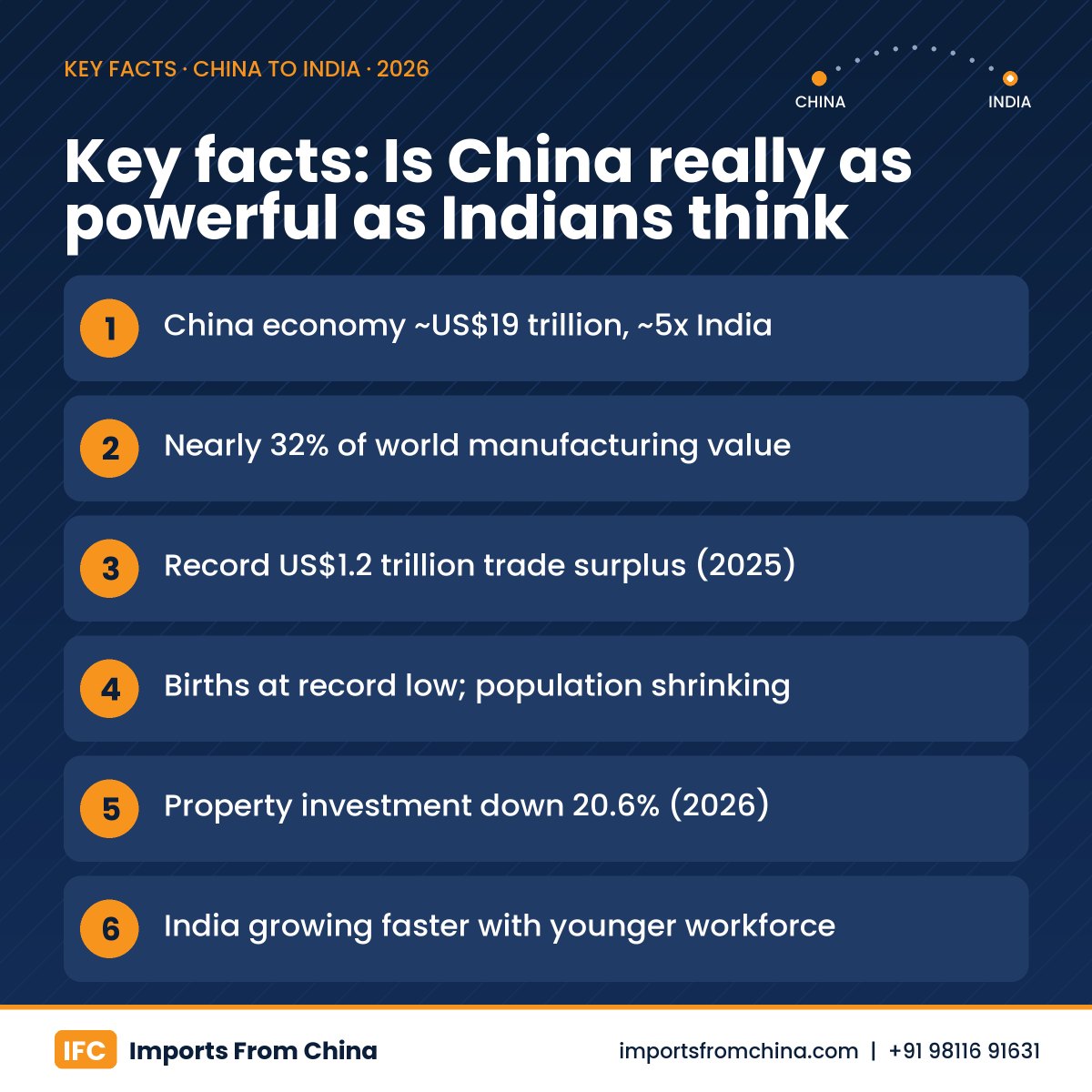
  • Economy: about US$19 trillion, roughly five times India’s.
  • Manufacturing: nearly 32% of global manufacturing value; India about 3.2%.
  • Trade: record US$1.2 trillion surplus in 2025.
  • Military: 2026 defence budget 1.91 trillion yuan (about US$270–275 bn).
  • Weak spots: population falling, births at a record low, property investment down 20.6% in Jan–Sep 2026.
  • India’s edge: faster growth (about 7.4% in FY26) and a young workforce.

Where China is truly powerful

AreaChina’s position
Economy sizeAbout US$19 trillion, second-largest in the world
ManufacturingNearly 32% of global manufacturing value (2023)
TradeRecord US$1.2 trillion surplus in 2025
Clean energyWorld leader in solar panels, batteries and electric vehicles
InfrastructureLargest high-speed rail network; many of the world’s busiest ports
Defence2026 budget about US$270–275 billion; about 620 nuclear warheads (SIPRI, Jan 2026)
Supply chainsDominant in electronics components, rare-earth processing and many chemicals

For importers, this power is visible every day: almost any product can be made in China, at scale, quickly and at competitive prices. See why China manufactures so cheaply.

Is China really as powerful as Indians think infographic – key facts for Indian importers
Is China really as powerful as Indians think: key facts at a glance (IFC – Imports From China)

Where China is weaker than it looks

  • Demographics: births fell to a record-low 7.92 million in 2025 and the population has shrunk for four years running.
  • Property slump: real-estate investment fell 20.6% in January–September 2026, hurting household wealth.
  • Weak consumers: retail sales grew only 2.6% in Jan–Sep 2026; youth unemployment was about 17.7% in September 2026.
  • Debt: local governments and developers carry heavy debts after years of building.
  • Technology limits: export controls restrict China’s access to the most advanced chips and chip-making tools.
  • Dependence on exports: trade tensions and tariffs make its growth model vulnerable.

Full details: how bad is China’s economy right now.

China vs India: power snapshot (2026)

IndicatorChinaIndia
GDPAbout US$19 trillionAbout US$4 trillion
Growth4.6% (Jan–Sep 2026)About 7.4% (FY 2025-26)
Manufacturing share of worldNearly 32%About 3.2%
Defence budgetAbout US$270–275 bnAbout US$90 bn (₹8 lakh crore)
Population trendShrinking and ageingYoung and growing
Trade balanceLarge surplusDeficit, about US$99 bn with China in FY25

So, is China as powerful as Indians think?

Economically and industrially, China is even more powerful than many Indians assume. Its factories, infrastructure and supply chains are unmatched. But it is not invincible: its population, property market and debt are real long-term problems, and India’s faster growth and young workforce are genuine advantages. The sensible view is respect without fear, and learning from China’s strengths while India builds its own. Also read can India defeat China in a war?

What this means for Indian businesses

  • Use China’s strength: source products, machinery and components where China is best.
  • Negotiate well: weak demand at home makes many Chinese factories eager for export orders.
  • Diversify: watch anti-dumping duties and keep backup suppliers.
  • Build in India: import machines and inputs to grow your own manufacturing and brand.

How IFC helps

IFC (Imports From China) has worked in China–India imports for 20+ years, since 2004, and has served 5000+ Indian businesses. Our own offices in Guangzhou and Yiwu help Indian buyers with sourcing, supplier verification, quality inspection, shipping and customs clearance, door to door. Check your landed cost on the IFC shipment calculator or call +91 98116 91631.

Frequently asked questions

Is China really a superpower?

Economically and industrially, yes. China has the world’s second-largest economy, nearly a third of global manufacturing and a record trade surplus. Its military is the second-best funded in the world.

What are China’s biggest weaknesses?

A shrinking and ageing population, a long property slump, high local-government debt, weak consumer demand, youth unemployment and limits on advanced chip technology.

How does India compare with China in power?

China’s economy is about five times larger and its manufacturing about ten times larger by share, but India is growing faster and has a much younger workforce.

Should Indians be afraid of China?

Respect rather than fear is the sensible view. China is strong in industry and trade, but has real weaknesses, and India has its own advantages in growth and demographics.

How can Indian businesses benefit from China’s strength?

By sourcing products, machinery and components smartly from China, negotiating well, and using those inputs to build Indian manufacturing and brands.

How safe is China

How Safe Is China? Safety Guide for Indian Business Travellers (2026)

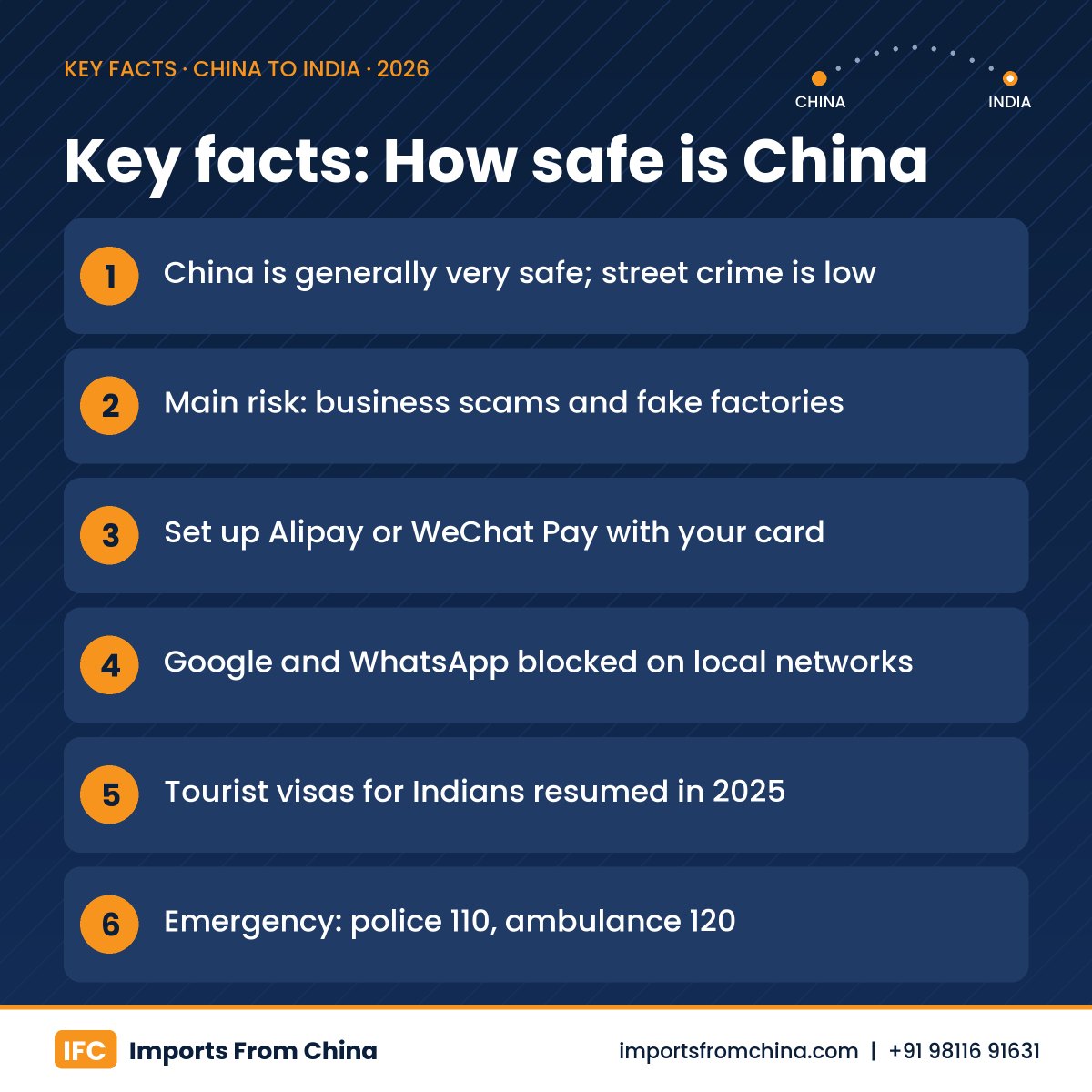
How safe is China for visitors? China is generally very safe for travellers, including Indian business visitors. Violent crime against foreigners is rare, cities are heavily monitored, and walking at night in Guangzhou, Yiwu or Shanghai is normal. The real risks are different: business scams, fake suppliers, payment problems, blocked apps and language barriers. Prepare for those and a China trip is smooth.

This guide is written from IFC’s experience of running offices in Guangzhou and Yiwu and hosting Indian buyers for 20+ years. It covers personal safety, scams, money, apps, visas and what to do in an emergency.

Key takeaways

  • Personal safety: street crime and violent crime against foreigners are uncommon.
  • Main risk: business fraud: fake factories, bait-and-switch samples, advance-payment scams.
  • Money: China is almost cashless; set up Alipay or WeChat Pay with your international card.
  • Apps: Google, WhatsApp and many Western apps are blocked; plan your connectivity.
  • Visa: China resumed tourist visas for Indians in 2025; business visas need an invitation letter.
  • Emergency: police 110, ambulance 120, fire 119.

Is China safe for Indian travellers?

  • Low street crime: extensive CCTV and police presence make pickpocketing and robbery less common than in many big cities worldwide.
  • Safe public transport: metros and high-speed trains are clean, punctual and safe.
  • Women travellers: generally feel safe, including at night in city centres.
  • Respect local laws: carry your passport, register at hotels, avoid political protests and never carry drugs. Penalties are strict.
How safe is China infographic – key facts for Indian importers
How safe is China: key facts at a glance (IFC – Imports From China)

The real risks: business scams in China

  • Fake factories: traders pretending to be manufacturers, or showroom-only “factories”. Read how to spot a real factory.
  • Advance payment fraud: suppliers who ask for 100% advance, or change bank details by email. See how to avoid supplier scams.
  • Sample vs bulk mismatch: a good sample, poor bulk goods. Always get a pre-shipment inspection.
  • Tourist traps: friendly strangers inviting you to a “tea ceremony” or bar, followed by a huge bill.
  • Unlicensed taxis at airports and stations: use official taxi queues or ride-hailing apps.

Money and payments: how to pay safely in China

Most shops, restaurants and taxis use mobile payments. Foreign visitors can now link international Visa or Mastercard cards to Alipay and WeChat Pay. Carry some cash in yuan as backup, inform your bank before travel, and never pay supplier deposits in cash to individuals. For business payments, use bank transfer to the company account. More: how to pay Chinese suppliers from India.

Internet and apps: what works in China?

Google, Gmail, WhatsApp, YouTube, Instagram and Facebook are blocked on Chinese networks. International roaming from an Indian SIM usually still reaches them; otherwise travellers use a legally available roaming eSIM. Install WeChat, Alipay, a translation app and a map app such as Amap before you fly. See China apps for business travellers.

Visa and flights for Indians

  • China resumed tourist visas for Indian citizens in 2025, and direct flights between India and China restarted in late 2025.
  • For a business trip or the Canton Fair, apply for an M (business) visa with an invitation letter from a Chinese company or the fair organiser.
  • Check the latest rules with the Chinese visa centre before booking.

Planning the fair? Read our Canton Fair guide for Indian buyers and Yiwu market guide.

Safety checklist for Indian business visitors

Before you goIn China
Business visa and invitation letterCarry your passport at all times
Alipay / WeChat Pay set up with your cardUse official taxis or ride-hailing apps
Roaming or eSIM planVerify factories before paying deposits
Hotel near the market or fairUse a local guide or translator for negotiations
Travel insuranceSave emergency numbers: 110, 120, 119

How IFC helps Indian buyers visit China safely

IFC (Imports From China) has worked in China–India imports for 20+ years, since 2004, and has served 5000+ Indian businesses. Our own offices in Guangzhou and Yiwu, with English-speaking staff and translators, help Indian buyers with market visits, factory checks, translation, supplier verification, payments, quality inspection and shipping back to India. Call +91 98116 91631 before you plan your trip.

Frequently asked questions

Is China safe for tourists and business travellers?

Yes. China is generally very safe, with low street crime and strong policing. The main risks for business travellers are scams, fake suppliers, payment issues and blocked apps rather than physical danger.

Is China safe for Indians?

Yes. Indian business visitors travel regularly to Guangzhou, Yiwu, Shenzhen and the Canton Fair. Respect local laws, carry your passport and verify suppliers before paying.

Can Indians use WhatsApp and Google in China?

Not on local Chinese networks. International roaming from an Indian SIM or a roaming eSIM usually works. Install WeChat, Alipay and a translation app before travelling.

How do I pay in China as a foreigner?

Link your international Visa or Mastercard to Alipay or WeChat Pay, and carry some yuan in cash. For supplier payments, use bank transfer to the company account.

What are the emergency numbers in China?

Police 110, ambulance 120 and fire 119.

Why China developed faster than India

Why Has China Developed So Much Faster Than India? 6 Real Reasons (2026)

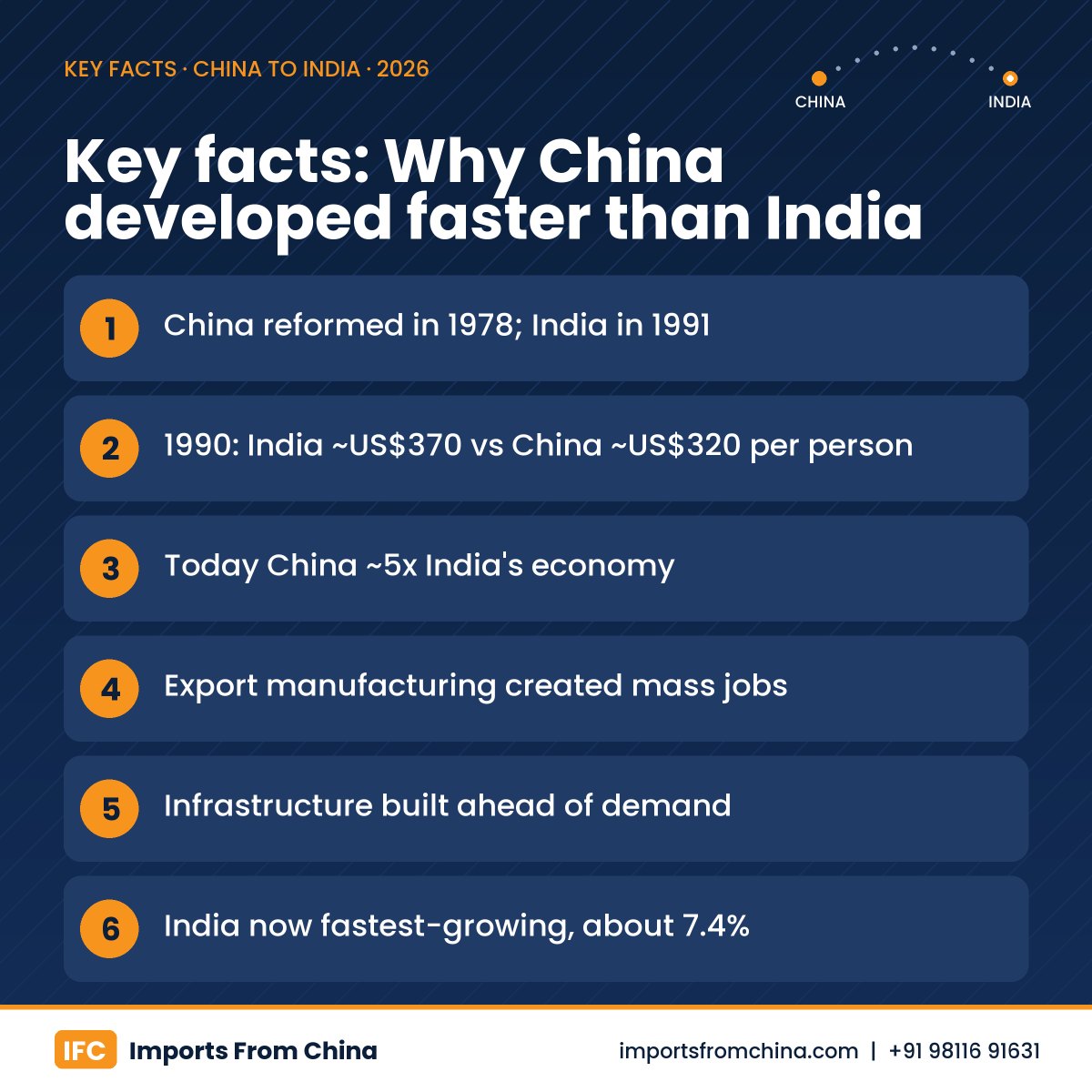
Why has China developed so much faster than India? China started market reforms in 1978, 13 years before India’s 1991 liberalisation, and bet everything on export manufacturing: special economic zones, massive infrastructure, foreign investment, and a huge, literate factory workforce with many women at work. In 1990 the two countries had similar incomes per person; today China’s is roughly four to five times India’s. India grew mainly through services, which created fewer mass jobs.

This article explains the main reasons for the gap, where India is now catching up, and what the China story teaches Indian MSMEs.

Key takeaways

  • Early start: China opened up in 1978; India in 1991.
  • Manufacturing first: China became the world’s factory; India grew through IT and services.
  • Infrastructure: China built ports, power, highways and rail ahead of demand.
  • People: earlier gains in literacy, health and women’s workforce participation.
  • Execution: fast, top-down decisions on land, projects and policy.
  • India now: the fastest-growing major economy, about 7.4% in FY26, with a young workforce.

India vs China: how the gap opened

MilestoneChinaIndia
Start of market reforms1978 (Deng Xiaoping)1991 (economic liberalisation)
Special economic zonesFrom 1980 (Shenzhen and others)SEZ Act in 2005
Income per person in 1990 (World Bank)About US$320About US$370
Income per person todayRoughly US$13,000Roughly US$2,700–2,900
Growth modelExport manufacturing + infrastructureServices, IT and domestic consumption
Share of global manufacturing (2023)Nearly 32%About 3.2%

Figures are approximate and rounded; income per person is nominal GDP per capita in US dollars.

Why China developed faster than India infographic – key facts for Indian importers
Why China developed faster than India: key facts at a glance (IFC – Imports From China)

6 reasons China grew faster than India

1. It started reforms 13 years earlier

Thirteen extra years of 9–10% growth compound into an enormous difference. By the time India opened up in 1991, China already had a working export machine in its coastal provinces.

2. Export manufacturing created mass jobs

China moved hundreds of millions of farmers into factories making toys, clothes, electronics and furniture for the world. Factory jobs raise incomes quickly for low-skilled workers. India’s growth came more from IT, finance and services, which are highly productive but employ far fewer people.

3. Infrastructure built ahead of demand

China invested heavily in ports, power plants, expressways, high-speed rail and industrial parks, often before they were needed. Cheap, reliable infrastructure lowered costs for every factory. India is now investing at record levels, but started later.

4. Health, education and women at work

China achieved near-universal primary education and basic healthcare early, giving factories a literate, healthy workforce. A much higher share of Chinese women joined the paid workforce, effectively doubling the labour available for industry.

5. Land, labour and fast decisions

China’s system allowed rapid land acquisition and project approvals. Democracy in India means more consultation, legal checks and slower execution. This has costs, but also protects rights and avoids some of China’s excesses, such as ghost cities and heavy local-government debt.

6. Foreign investment and technology

Hong Kong, Taiwanese and overseas Chinese businesses invested heavily in mainland factories from the 1980s, bringing capital, technology and export contacts. India attracted large FDI mainly after 2000.

Is India catching up?

  • India is the fastest-growing major economy, at about 7.4% in FY 2025-26, while China grew about 4.6% in the first nine months of 2026.
  • India’s workforce is young and growing; China’s is ageing and shrinking.
  • PLI schemes have made India a major smartphone exporter and are expanding into electronics, solar and auto parts.
  • Infrastructure spending in India is at record levels: expressways, freight corridors, ports and airports.

But the gap is large: China’s economy is still about five times India’s. Read how China’s economy compares with India’s today and why India can’t yet manufacture as cheaply as China.

What Indian MSMEs can learn from China’s growth

  • Think scale: Chinese factories won by producing large volumes of a few products extremely well.
  • Specialise in clusters: work with suppliers near you and share logistics.
  • Export early: even small exporters learn quality and pricing faster.
  • Use the best machines: import productive machinery and moulds where needed to raise output per worker.

How IFC helps Indian businesses grow with China

IFC (Imports From China) has worked in China–India imports for 20+ years, since 2004, and has served 5000+ Indian businesses. Our own offices in Guangzhou and Yiwu help Indian buyers with sourcing, supplier verification, quality inspection, shipping and customs clearance, door to door. Check your landed cost on the IFC shipment calculator or call +91 98116 91631.

Frequently asked questions

Why has China developed faster than India?

China started reforms in 1978, 13 years before India, and focused on export manufacturing, infrastructure, foreign investment and a literate workforce with high female participation. India grew mainly through services, which created fewer mass jobs.

Was India richer than China in the past?

Around 1990, India’s income per person was slightly higher than China’s, about US$370 against US$320 by World Bank data. China then grew much faster.

How much bigger is China’s economy than India’s?

China’s economy is roughly US$19 trillion and India’s about US$4 trillion, so China’s is around five times larger.

Is India catching up with China?

India is now the fastest-growing major economy and has a younger workforce, but China’s lead in size and manufacturing is very large and will take decades to close.

What can India learn from China’s development?

Build infrastructure ahead of demand, focus on manufacturing scale and exports, invest in skills and bring more women into the workforce.

Why India cannot manufacture cheaper than China

Why Can’t India Manufacture Cheaper Products Than China? 7 Real Reasons (2026)

Why can’t India manufacture products as cheaply as China? Mainly because of scale and supply chains. China makes nearly 32% of the world’s manufactured value, against India’s 3.2%, so its factories buy materials in huge volumes, sit inside dense clusters of suppliers, and run on world-class ports, power and logistics. Indian factories are usually smaller, depend on imported components, and pay more for land, power, finance and freight.

This article explains the seven real cost gaps between Chinese and Indian manufacturing, and what Indian MSMEs can do to compete, including when it makes sense to import and when to make locally.

Key takeaways

  • Scale: China has nearly 32% of world manufacturing value; India about 3.2% (NITI Aayog, 2023 data).
  • Clusters: in China, every part a factory needs is often available within a few kilometres.
  • Infrastructure: decades of investment in ports, highways, rail and power cut costs per unit.
  • Inputs: India still imports many components and machines, often from China.
  • Cost of capital and land: borrowing, land and compliance usually cost more in India.
  • Opportunity: PLI schemes, a young workforce and rising Chinese wages are narrowing the gap.

7 reasons Chinese products are cheaper than Indian products

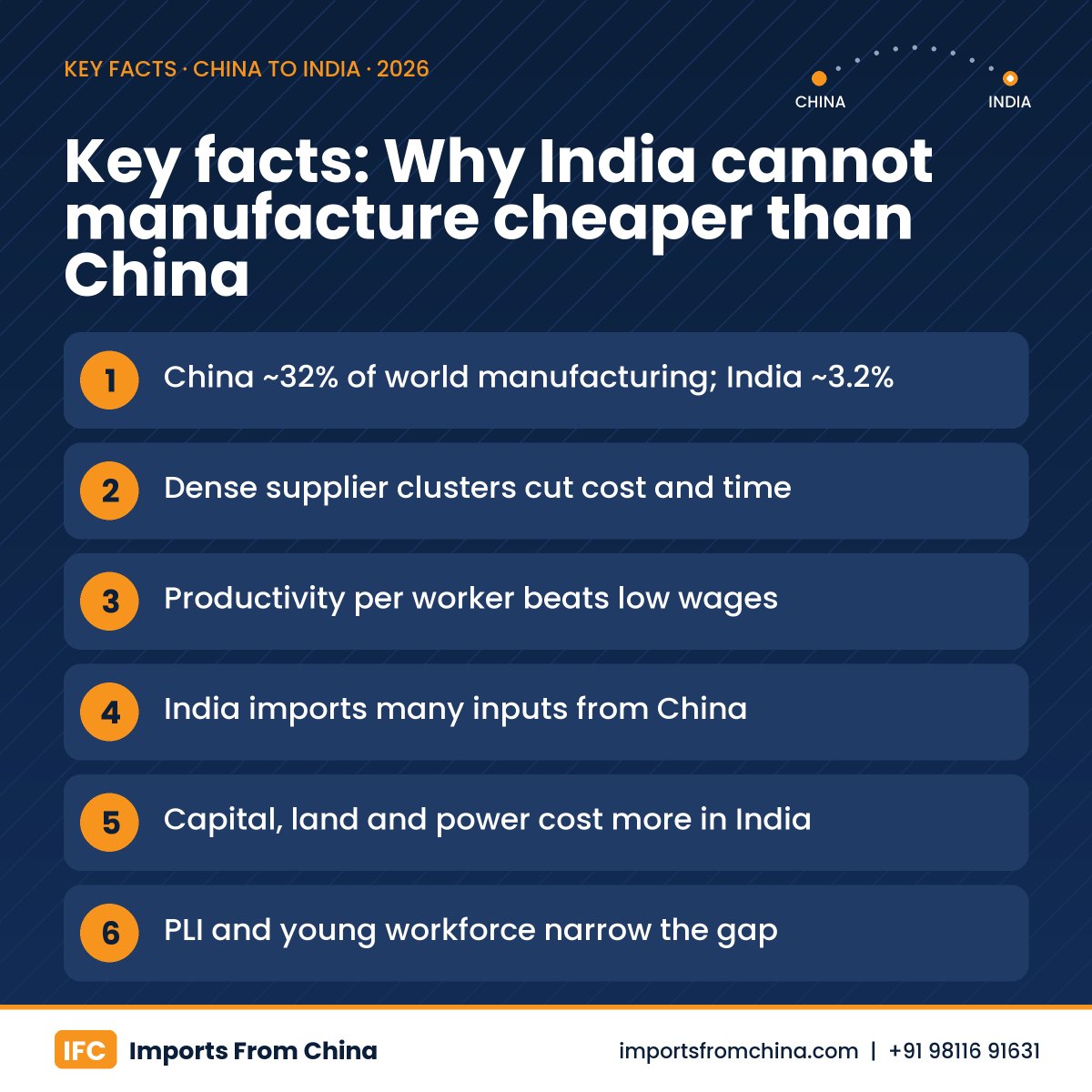
Why India cannot manufacture cheaper than China infographic – key facts for Indian importers
Why India cannot manufacture cheaper than China: key facts at a glance (IFC – Imports From China)

1. Massive scale

A Chinese factory making phone cases or LED bulbs may produce millions of pieces a month for buyers worldwide. Fixed costs such as moulds, machines and design are spread over huge volumes, so the cost per piece drops sharply. Most Indian units produce for the domestic market at far smaller volumes.

2. Industrial clusters and supply chains

China built specialised clusters: Yiwu for small commodities, Foshan for furniture, Shenzhen for electronics, Ningbo for appliances, Guangzhou for garments. Raw materials, components, packaging, moulds and testing labs are all nearby, often available the same day. An Indian manufacturer may wait weeks for an imported part.

3. Infrastructure and logistics

China invested heavily for four decades in deep-water ports, expressways, rail freight and reliable industrial power. Containers move quickly from factory to port. India has improved fast, with new expressways, freight corridors and ports, but logistics are still slower and costlier for many factories.

4. Labour productivity, not cheap labour

Chinese wages are now higher than Indian wages in most sectors. China stays cheaper because each worker produces more, thanks to automation, training, long production runs and experienced supervisors. Productivity per worker matters more than the wage.

5. Cost of capital, land and power

Chinese manufacturers have had access to cheaper credit, ready industrial land and stable power. In India, interest rates, land acquisition, approvals and industrial power tariffs (which often cross-subsidise other users) add to the cost of every product.

6. Dependence on imported inputs

Many Indian products use components, chemicals or machines imported from China. India imported about US$113.5 billion of goods from China in FY 2024-25. When you import the inputs and add duty and freight, it is hard to beat the finished Chinese product on price. See what India imports from China.

7. Government support and export focus

China supported exporters with tax rebates, cheap land and infrastructure for decades, and today has overcapacity in many sectors, so factories cut prices to keep running. India’s export push is more recent, through Production Linked Incentive (PLI) schemes and Make in India.

China vs India manufacturing: quick comparison

FactorChinaIndia
Share of global manufacturing value (2023)Nearly 32%About 3.2%
Supplier clustersVery dense, product-specificGrowing (Tiruppur, Morbi, Ludhiana, Noida, Chennai)
Typical factory scaleLarge, export-orientedMostly small and medium, domestic
WagesHigher than IndiaLower
Productivity per workerHighImproving
Workforce trendShrinking and ageingYoung and growing

Where India can already compete with China

  • Mobile phone assembly: India became a major smartphone exporter under the PLI scheme.
  • Pharmaceuticals and generic medicines.
  • Textiles, garments and home textiles in clusters such as Tiruppur and Panipat.
  • Ceramics and tiles from Morbi.
  • Auto components and two-wheelers.
  • Labour-intensive goods as Chinese wages rise.

What Indian MSMEs should do: import, make or both?

  • Import finished goods where China’s scale is unbeatable (many electronics, small commodities, decor).
  • Import machinery and moulds from China to make locally: many machines carry just 7.5% BCD and the IGST is claimable.
  • Import components, assemble in India and build your own brand.
  • Make locally where freight, duty, BIS and speed favour India (bulky, heavy or fast-changing products).

Check the duty side in legal ways to reduce import duty and the bigger picture in China’s economy vs India.

How IFC helps Indian manufacturers and traders

IFC (Imports From China) has worked in China–India imports for 20+ years, since 2004, and has served 5000+ Indian businesses. Our own offices in Guangzhou and Yiwu help Indian buyers with sourcing, supplier verification, quality inspection, shipping and customs clearance, door to door. Check your landed cost on the IFC shipment calculator or call +91 98116 91631.

Frequently asked questions

Why are Chinese products so cheap?

Because of huge scale, dense supplier clusters, efficient ports and logistics, high labour productivity, cheaper capital and decades of export support. Overcapacity also pushes Chinese factories to cut prices.

Is Chinese labour cheaper than Indian labour?

No, not any more in most sectors. Chinese wages are generally higher than Indian wages. China stays cheaper because each worker produces much more.

Why can’t India manufacture cheaper than China?

Indian factories are usually smaller, depend on imported inputs, and face higher costs for land, power, finance and logistics. Scale and supply chains are the biggest gaps.

Can India beat China in manufacturing?

In some sectors India already competes, such as smartphones, generic medicines, textiles and auto parts. With PLI schemes, a young workforce and rising Chinese wages, India can grow its share, but overtaking China will take decades.

Should Indian businesses import from China or make locally?

Often both: import where China’s scale is unbeatable, import machines and components to make locally, and manufacture in India where freight, duty and speed favour local production.