To import tools from China to India, you buy hand tools, power tools, measuring instruments or hardware from a verified Chinese factory, confirm the HS code and duty rate, check any Indian compliance rules, pay through a safe method, ship by air or sea, and clear customs with an Importer Exporter Code (IEC). Each step affects your landed cost, so most Indian buyers handle them in order before placing a bulk order. IFC, based in Kirti Nagar, New Delhi, supports this process door to door from China.
Why tools are a practical category to import from China
China is one of the largest manufacturing bases for hand tools, fasteners, fittings, cutting tools and general hardware. Indian retailers, contractors, workshops and online sellers often source these goods because the product range is wide and sample orders are easy to test. Buyers commonly search for suppliers on Alibaba and 1688, but the listing price is only one part of the cost. Freight, inspection, duty, clearance and delivery to India can change the final figure considerably.
Step-by-step: how to import tools from China to India
Define the exact tool specification, including material, size tolerance, finish, voltage and packaging.
Find suppliers and verify the business licence, factory details and export history.
Order a sample and test it against your Indian buyer or client requirement.
Confirm the HS code and check whether any BIS or other product rule applies.
Agree on price terms (EXW, FOB, DAP or DDP) and the payment schedule in writing.
Arrange pre-shipment inspection in China before goods are packed.
Book air or sea freight, then prepare commercial invoice, packing list and transport document.
Clear customs in India using your IEC and deliver to your warehouse in Delhi or elsewhere.
Classify your tools before you buy: HS code and customs duty
Customs duty on tools depends on the Harmonized System (HS) code assigned to the product, not on the seller’s description. Two tools that look similar can fall under different codes if one is a hand tool and the other is powered, or if the material or function differs. Ask your Chinese supplier for the technical specification, then have your customs broker confirm the classification before you finalise the purchase. Duty rates can change, so check the current tariff at the time of import.
Tool type
What to check before ordering
Why it matters
Hand tools (spanners, pliers, screwdrivers)
Material, function, whether sold as a set
Set packaging and material can change classification
Power tools (drills, grinders, saws)
Voltage, motor rating, electrical safety marking
Electrical products may need additional compliance checks in India
Measuring instruments (gauges, levels)
Accuracy class, calibration certificate
Buyers often need documents to support quality claims
Fasteners and hardware
Grade, coating, dimensions, quantity per pack
Weight and packing affect freight cost
Compliance: IEC, BIS and product-specific rules
Most commercial imports into India require an Importer Exporter Code (IEC) issued by the Directorate General of Foreign Trade. Without an IEC, your customs clearance can be delayed or blocked. Separately, some products fall under Bureau of Indian Standards (BIS) Quality Control Orders. Before buying power tools or electrical accessories, check whether your specific product is covered. A customs broker in Delhi or your sourcing partner can help you confirm this for your HS code.
Do tools need BIS registration for import?
Not all tools require BIS registration. Whether a product needs it depends on whether it falls under a notified Quality Control Order. Electrical tools are the most likely category to need checks. Confirm the current requirement for your exact HS code before ordering, because a wrong assumption can hold goods at port.
Supplier verification and factory inspection
A low quote from an unverified supplier is one of the most common causes of problems for tool importers. Verification should cover the business licence, the factory address, production capacity and references from other export buyers. A factory audit confirms whether the workshop can produce the tools consistently. Pre-shipment inspection then checks the actual goods against your sample, including dimensions, finish, labelling, carton marking and quantity. IFC offers supplier verification, factory audit and pre-shipment inspection through its offices in Guangzhou and Yiwu, China.
Payment safety for tool imports
Avoid paying the full amount upfront to a new supplier. Many importers use a deposit followed by a balance after inspection or before shipment. Telegraphic transfer (TT) is common, and some buyers use trade assurance platforms. Keep every payment linked to a written agreement that states product specification, inspection terms and delivery date. Confirm bank details by phone or video call with a known contact, since payment fraud is a known risk in cross-border trade.
Air or sea freight for tools
Sea freight usually suits bulk orders of hardware, fasteners and heavier tools, where the cost per unit is lower. Air freight suits urgent restocking, samples and small, high-value instruments. Weight and volume drive the cost, so compare the chargeable weight of each option before choosing. Ask for a quote that includes origin charges, freight, insurance and destination charges so you can compare like for like.
Customs clearance and delivery in India
Your shipment will need a commercial invoice, packing list, bill of lading or airway bill, IEC, and the correct HS code declared on the bill of entry. Under DDP terms, the supplier or forwarder handles duty and clearance, and you receive goods at your address. Under DAP, you clear customs yourself. Choose the term that matches your team’s capacity and the level of risk you are willing to take. IFC handles customs clearance and door delivery across India as part of its service.
Frequently asked questions
Can I import tools from China to India without an IEC?
For most commercial imports, an IEC is required, so you should obtain one before shipment. Without it, customs clearance can be held up or refused. Some low-value personal imports may follow different rules, but tool shipments for resale or business use generally need an IEC. Confirm the requirement with a customs broker for your specific order.
How do I find the HS code for tools imported from China?
Start with the supplier’s technical specification, including material, function, power source and whether the item is sold alone or as a set. Then match this description to the Indian tariff schedule. A licensed customs broker can confirm the code, which is important because duty depends on classification. Keep the supplier’s specification sheet with your import documents.
Do power tools need BIS certification before import?
Some electrical products are covered by BIS Quality Control Orders, and power tools may fall within these rules depending on their type and rating. Check whether your exact product is listed before placing the order. If it is covered, the supplier or importer must meet the applicable standard and obtain the required registration before the goods are cleared.
What is the safest way to pay a Chinese tool supplier?
Use a staged payment plan rather than full prepayment. A common approach is a deposit, then a balance after pre-shipment inspection. Use a traceable method such as telegraphic transfer or a trade assurance platform, and keep all terms in a signed agreement. Verify bank details through a second channel before sending any money.
Should I choose DDP or DAP when importing tools from China?
DDP means the seller or forwarder handles duty, clearance and delivery to your address, so your cost is more predictable but may be higher. DAP means you handle import clearance and duty yourself, which can reduce the upfront quote but requires your own customs process. Choose based on your IEC status, clearance experience and how much cost certainty you need.
Ready to import tools from China to India?
If you want help with supplier verification, factory inspection, safe payment, freight and customs clearance in India, WhatsApp IFC at +91 98116 91631 or visit importsfromchina.com. Share your product list and target quantity, and the team can outline the steps for your order.
How much does Alibaba charge for shipping to India? There is no fixed Alibaba rate. The shipping cost you see at checkout is quoted by the supplier or by Alibaba.com logistics partners, usually for express courier or freight up to an Indian port, and it often does not include Indian customs duty, IGST or clearance. For orders above about 50 kg, a China-based forwarder with door-to-door DDP pricing is usually much cheaper.
This guide shows what the Alibaba shipping price includes, why it is often high for India, and how Indian buyers cut the cost legally.
Key takeaways
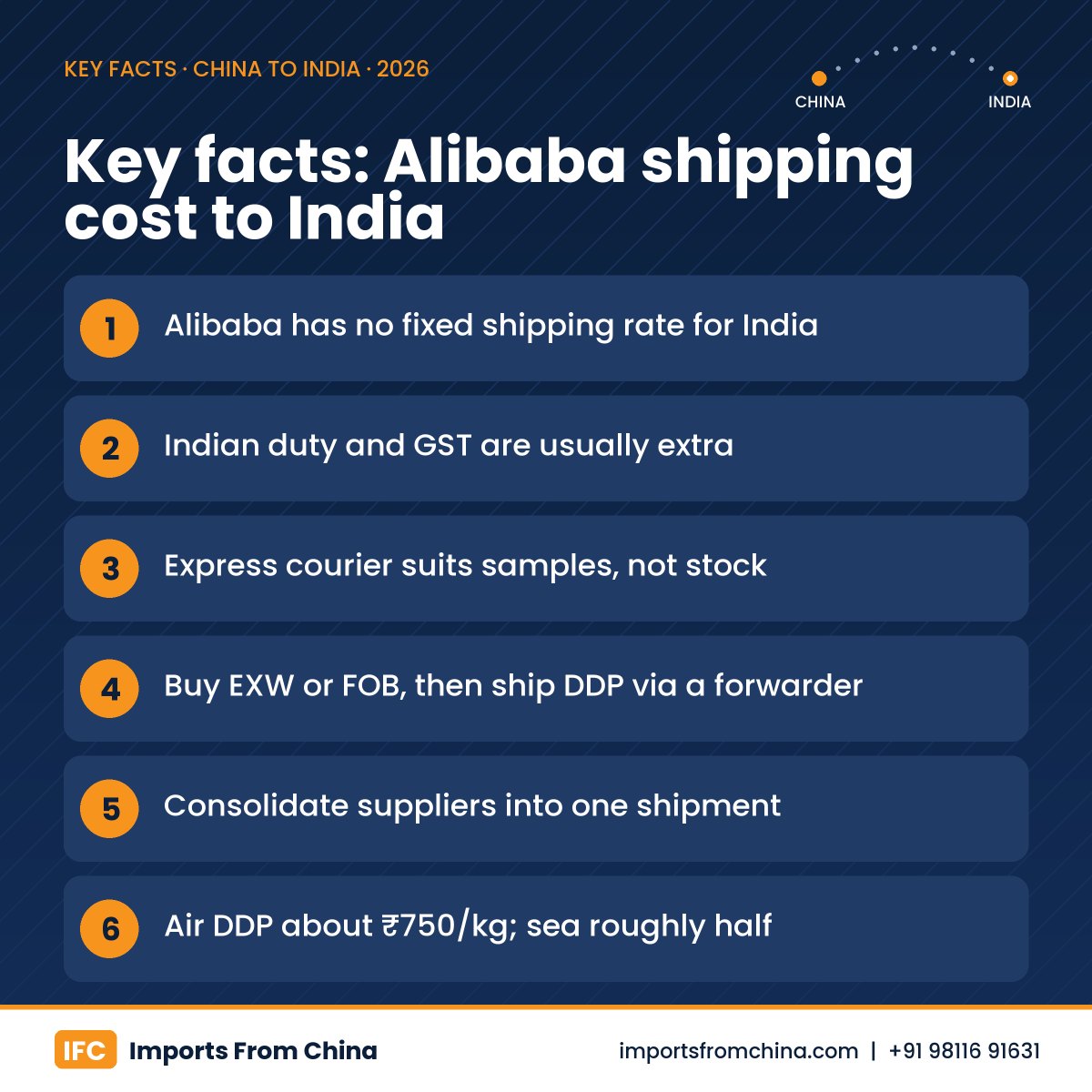
No fixed rate: Alibaba shipping is quoted per order by the supplier or a logistics partner.
Duty usually extra: most quotes stop at delivery without Indian duty and GST, so you pay those on arrival.
Express is costly: supplier courier quotes suit samples, not stock orders.
Check the Incoterm: EXW, FOB, CIF and DDP mean very different total costs.
Use a forwarder for bulk: ask the supplier for an EXW or FOB price and ship through your own forwarder.
On Alibaba.com you can pay for shipping in two ways: the supplier quotes a shipping price in the order, or you choose a logistics option offered by Alibaba.com partners. Either way, read the terms. Most options are express courier (DHL, FedEx, UPS) or freight to a port or airport. Indian customs duty, IGST, CHA charges, port charges and delivery from the port are usually not included, unless the quote clearly says DDP to your address.
Alibaba shipping cost to India: key facts at a glance (IFC – Imports From China)
Why is Alibaba shipping to India so expensive?
Express pricing: courier rates are built for small parcels; per kg cost rises fast with heavier cartons.
Volumetric weight: bulky cartons are charged on size (L × W × H cm ÷ 5,000 or 6,000), not actual weight.
Supplier mark-up: some suppliers add margin to the freight they quote.
Duty on arrival: duty and IGST are charged on top when the parcel reaches India.
Single-supplier shipping: each supplier ships separately, so you pay fixed charges again and again.
Incoterms explained: EXW, FOB, CIF and DDP for Indian buyers
Term
Supplier pays up to
You pay
EXW (Ex Works)
Goods ready at factory
Everything from the factory gate
FOB (Free on Board)
Loading on the ship at the China port
Sea freight, insurance, Indian charges, duty, delivery
CIF
Freight and insurance to the Indian port
Port charges, CHA, duty, IGST, delivery
DDP (Delivered Duty Paid)
Everything to your door including duty
Only the agreed price
For most small and medium buyers, the cheapest and safest set-up is: buy EXW or FOB from the Alibaba supplier, then ship with a forwarder that offers DDP to your door. Read our DDP shipping guide.
Alibaba supplier shipping vs a China-India DDP forwarder
Factor
Supplier or Alibaba express
IFC DDP forwarder
Best for
Samples, under 20 kg
50 kg+ stock orders
Indian duty and GST
Usually extra, paid on arrival
Included
Multiple suppliers
Each ships separately
Consolidated into one shipment
Quality check before dispatch
Rarely
Available at our China warehouse
Typical cost
High per kg
About ₹750/kg air DDP for general goods; sea roughly half
How to cut your Alibaba shipping cost to India
Ask suppliers for an EXW or FOB price and a separate shipping quote, so you can compare.
Send all suppliers’ goods to one forwarder warehouse in China and ship together.
Choose sea cargo once you cross a few hundred kg.
Ask for compact packing and the exact carton size and weight before paying.
Check the HS code, duty and BIS rules before ordering, so goods are not held at customs.
IFC (Imports From China) has handled China–India imports for 20+ years, since 2004, and has served 5000+ Indian businesses. Your Alibaba suppliers deliver to our China warehouse, our team in Guangzhou and Yiwu checks and consolidates the goods, and we ship by air or sea with customs clearance and door-to-door DDP delivery across India.
Conclusion
Alibaba does not have one shipping rate for India, and most checkout quotes leave out Indian duty and clearance. For anything beyond samples, buy EXW or FOB, consolidate your suppliers, and ship DDP so you know the full cost before you pay.
Chartered Accountant (FCA, ICAI) who has helped 5000+ Indian businesses import from China since 2004 – sourcing, BIS, HSN classification, import duty, customs and GST compliance. mayankdang.in
How much does Alibaba charge for shipping to India?
There is no fixed rate. The supplier or an Alibaba.com logistics partner quotes shipping per order, usually express courier or freight, and Indian duty and GST are often extra. For 50 kg and above, a DDP forwarder is usually cheaper.
Does Alibaba shipping include customs duty in India?
Usually not. Unless the quote clearly says DDP to your address, you pay customs duty, IGST and clearance charges when the goods reach India.
Which Incoterm is best when buying from Alibaba for India?
For small and medium buyers, buy EXW or FOB from the supplier and ship with a forwarder that offers DDP door-to-door delivery. You then see one all-inclusive cost.
Can I combine orders from different Alibaba suppliers?
Yes. Ask each supplier to deliver to one forwarder warehouse in China. The goods are consolidated into a single shipment, which lowers the per kg cost.
Is Alibaba shipping safe for Indian buyers?
Paying through Alibaba Trade Assurance protects the payment, but always check the supplier, get samples, and confirm the HS code and BIS rules before ordering.
How to pay Chinese suppliers from India: most Indian businesses pay by bank wire (telegraphic transfer or TT) from their current account through an authorised bank, usually in US dollars, straight to the supplier company’s own account, quoting purpose code S0101 for an advance or S0102 for the balance. Alibaba Trade Assurance, RBI-licensed payment platforms and letters of credit are the main alternatives.
This guide compares every method, walks through a TT payment step by step, explains the RBI rules Indian importers must follow, shows the real cost of a USD 10,000 payment in rupees, and lists the checks that stop payment fraud.
Key takeaways
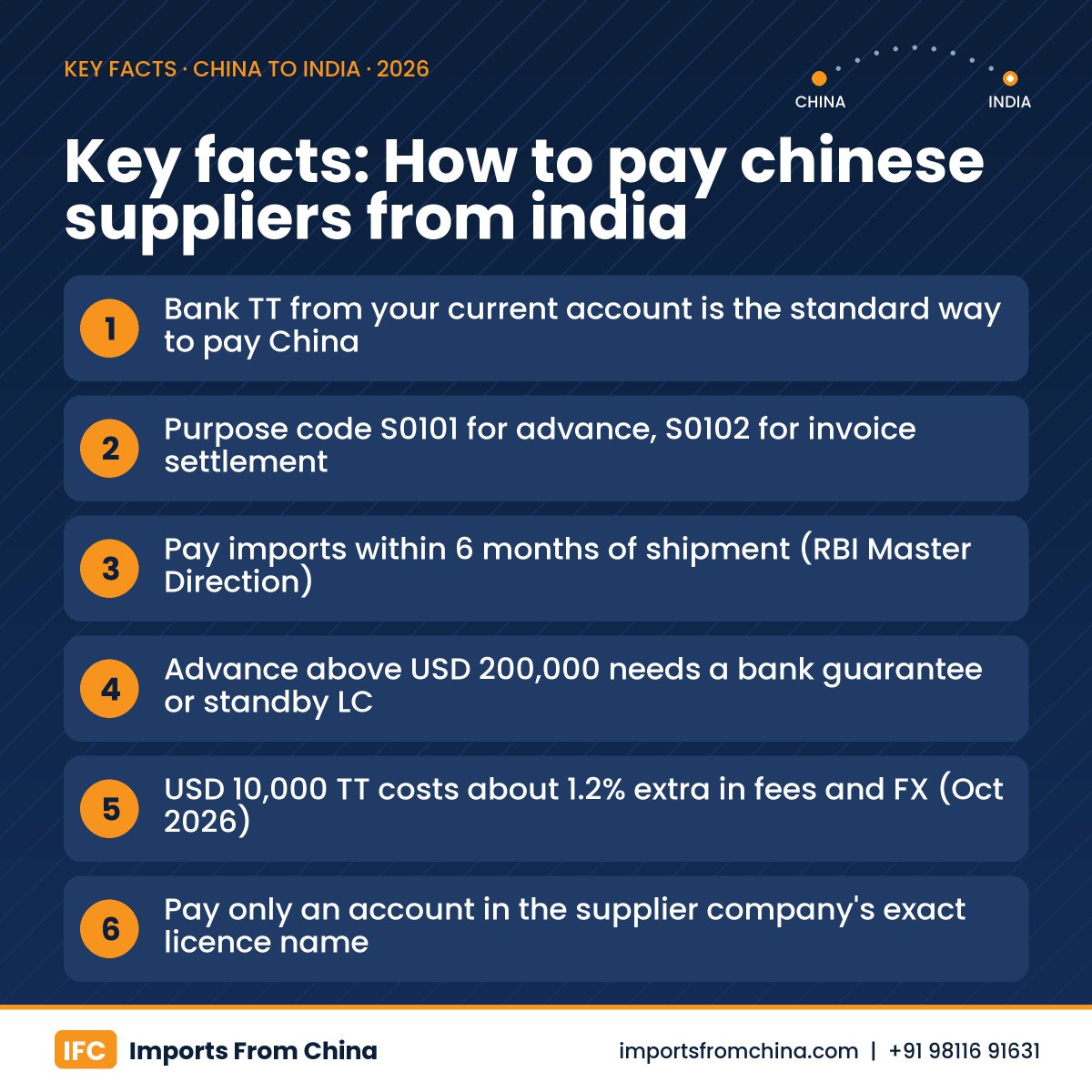
Bank TT is the standard: a SWIFT transfer from your business current account, in USD or CNY, to the supplier company’s account.
Use the right purpose code: S0101 for advance payment against imports, S0102 for settling an invoice after shipment.
RBI time limits apply: import payments are normally due within six months of shipment, and goods paid in advance must arrive within six months.
Advances above USD 200,000 need cover: a bank guarantee or standby LC is required, unless your bank grants an exemption.
A USD 10,000 TT costs about 1–1.5% extra in exchange margin, bank fees, GST on currency conversion and correspondent charges (indicative, October 2026).
Name match is your best protection: pay only an account in the exact name on the supplier’s Chinese business licence, and call to confirm any change of bank details.
What are the ways to pay Chinese suppliers from India?
There are five legal routes for a business. Each suits a different order size and level of trust.
Method
How it works
Indicative cost (October 2026)
Speed
Buyer protection
Best for
Bank TT (SWIFT wire)
Your AD Category-I bank sends USD or CNY to the supplier’s bank
None built in; depends on supplier checks and terms
Most regular orders
Alibaba Trade Assurance
You pay through Alibaba.com; the order is covered by Alibaba’s terms
Card around 3%; bank transfer fees vary
Card 2–3 days; transfer 3–7 days
Refund claims for late shipment or quality not as agreed
First orders with Alibaba suppliers
RBI-licensed payment platforms (PA-CB)
A licensed cross-border payment aggregator converts and pays
Often lower than banks; compare the full rate
Same day to 3 days
Limited
Payments up to ₹25 lakh per transaction
Letter of credit (LC)
Your bank pays only when the supplier presents the agreed shipping documents
Opening, amendment and document charges; costly for small orders
Set up in days, paid on document presentation
Strong on documents, not on quality
Large orders, new suppliers, machinery
Business credit card
Card payment on a platform or supplier gateway
Card forex markup plus platform fee
Instant
Chargeback rules may help
Samples and very small orders
Avoid paying a supplier’s personal Alipay or WeChat account, cash through “agents”, or any informal channel. These payments leave you no bank record for customs or GST, no FEMA trail, and no way to recover money if goods never arrive.
How to pay chinese suppliers from india: key facts at a glance (IFC – Imports From China)
How do you make a TT payment to China from India? (step by step)
Get a proforma invoice (PI) with the supplier’s full company name, address, product details, price, Incoterm, payment terms and bank details.
Fill your bank’s import remittance request in its trade or net-banking portal (some banks still call it Form A1). Use your business current account and IEC.
Choose the purpose code: S0101 for an advance against imports, S0102 for paying an invoice for goods already shipped.
Attach documents: PI for an advance; commercial invoice and bill of lading or airway bill copy for a balance payment.
Pick the charges option: OUR (you pay all bank charges, supplier receives the full amount), SHA (charges shared) or BEN (supplier pays). Chinese suppliers usually ask for OUR or for you to add USD 30–50 to cover deductions.
Book the exchange rate and confirm. Ask your bank for a better rate on larger amounts; the card rate is negotiable.
Send the SWIFT copy (MT103) to the supplier so they can trace the money.
After the goods arrive, give your bank the Bill of Entry details so the payment is matched in RBI’s IDPMS system.
Bank details to ask your Chinese supplier for
Beneficiary name, exactly as on the business licence (in English, and the Chinese name if possible)
Beneficiary address
Account number and currency (USD account or CNY account)
Bank name, branch address and SWIFT/BIC code
Intermediary bank details, if the supplier’s bank needs one for USD
What RBI rules apply when paying Chinese suppliers from India?
Pay for normal imports within six months of the shipment date. Extensions are possible through your bank.
Advance payments
No upper limit, but above USD 200,000 you need a bank guarantee or standby LC from the supplier’s bank, unless your bank exempts you (allowed up to USD 5 million based on its assessment).
Goods must follow the advance
Goods paid in advance should be imported within six months of the remittance (three years for capital goods).
Evidence of import
Your bank matches each payment with the Bill of Entry in IDPMS. If evidence is not received within three months, the bank will follow up with you.
Third-party payments
Paying a party other than the supplier is allowed only with conditions, including the invoice naming that party. Ask why before you agree.
Business import payments are current-account remittances made by an IEC holder, not personal remittances under the Liberalised Remittance Scheme (LRS). Do not use a personal LRS transfer to pay for business stock; the payment will not match your Bill of Entry and GST records. Confirm the exact documentation with your bank.
Payment platforms licensed by RBI as cross-border payment aggregators (PA-CB) can handle import payments of up to ₹25 lakh per transaction under the 2025 Payment Aggregator Directions. Bigger invoices go through your bank.
Should you pay Chinese suppliers in USD or Chinese yuan?
Most Chinese exporters quote and receive US dollars, so USD is the default. Some suppliers, especially smaller factories and 1688 sellers, prefer yuan (CNY or RMB).
Pay USD when the PI is in USD and the supplier has a USD account. It is accepted everywhere and easy for your bank.
Pay CNY when the price is in yuan. Paying CNY directly can avoid one conversion, but check that your bank offers CNY remittance and that the supplier’s account accepts it.
Never mix them up: sending USD to a CNY-only account can cause a forced conversion at a poor rate, or a return of funds weeks later.
As a reference, market rates in late October 2026 were about ₹95 per USD and ¥6.67 per USD, which puts one yuan at roughly ₹15. Your bank’s selling rate will be a little higher. For customs, the duty is calculated at the CBIC-notified rate (₹96 per USD for imports from 16 October 2026), not your bank rate.
How much does it cost to send money to China from India? (₹ example)
An interior designer in Bengaluru pays a Foshan lighting supplier USD 10,000 by bank TT under the OUR option. Assumptions: interbank rate ₹95, bank selling rate ₹96, bank remittance fee ₹1,000 plus 18% GST, and USD 30 correspondent charges. All figures are indicative, October 2026; your bank’s charges may differ.
Item
Calculation
Amount (₹)
Amount debited for USD 10,000
10,000 × ₹96
9,56,000
Of which exchange margin
(₹96 − ₹95) × 10,000
6,600
Bank remittance fee + GST
₹1,000 + 18%
1,180
GST on currency conversion
18% of (₹1,000 + 0.5% of amount above ₹1 lakh = ₹5,280)
950
Correspondent charges (OUR)
USD 30 × ₹96
2,868
Total paid
Debit + fees + GST + charges
9,60,998
Extra over the interbank value
₹9,60,998 − ₹9,49,400
11,598 (about 1.2%)
The GST on the bank fee and on currency conversion can usually be claimed as input tax credit if the bank invoices your GSTIN. If the same order were paid by card on a platform charging about 3%, the fee alone would be around ₹28,000. Splitting a payment into a 30% deposit and 70% balance doubles the fixed fees, so negotiate the exchange rate on both.
Bank charges are only one part of your landed cost. Add freight, duty and IGST in the IFC shipment calculator before you confirm the order.
Is Alibaba Trade Assurance a safe way to pay from India?
Trade Assurance is Alibaba.com’s order-protection programme. If you pay through Alibaba’s checkout and the supplier ships late or the goods do not match the agreed specifications, you can raise a dispute and claim a refund. It is a sensible option for a first order with a new Alibaba supplier.
Protection only applies when you pay through the Alibaba order. A TT sent straight to the supplier outside the platform is not covered.
Write the details into the order: specifications, packing, inspection terms and ship date. Claims are judged against what is written.
It does not cover India-side issues: BIS registration, wrong HS codes, customs holds or damage after delivery to the forwarder.
Fees vary by method: card payments cost more than bank transfers; check the current fee at checkout.
How do you avoid payment fraud with Chinese suppliers?
Most payment losses are not “bad quality” cases. They are payments sent to the wrong account. Use these checks every time:
Bank details changed by email? Treat it as fraud until proven otherwise. Hackers copy supplier emails and send “new account” letters. Confirm by phone or video call with the person you know.
Name mismatch: the beneficiary must be the company on your PI and contract, not an individual or a different company.
Account in a different place: a mainland factory asking you to pay a Hong Kong or overseas company needs an explanation and a written invoice from that company. Verify both.
Pressure and discounts: “pay today for a special price” is a classic push. Real suppliers wait for your checks.
No contract: agree specifications, delivery date and penalties in writing before the deposit.
How IFC helps before you pay a Chinese supplier
IFC – Imports From China has more than 20 years of experience in China–India import and export, since 2004. Our own offices in Guangzhou and Yiwu, with translators and English-speaking staff, can verify a supplier before you send a deposit and run a quality inspection before you release the balance, so your money moves only when the goods are right.
We also handle what happens after payment: daily loading of mixed containers and air cargo, LCL and FCL sea freight, customs clearance and door-to-door DDP delivery from our warehouse at headquarters to major Indian cities including Delhi, Gurugram, Noida, Mumbai, Pune, Bengaluru, Hyderabad, Chennai and Ahmedabad.
Conclusion
To pay Chinese suppliers from India safely, use a bank TT from your business account for regular orders, Trade Assurance for first Alibaba orders, a licensed payment platform for smaller invoices if it is cheaper, and an LC for large risky orders. Quote the right purpose code, keep the balance until inspection, match the beneficiary name every time, and give your bank the Bill of Entry once goods land.
What is the best way to pay a Chinese supplier from India?
For most business orders, a bank telegraphic transfer (TT) from your current account through an authorised bank is the standard and safest way, because it creates a clear FEMA and customs record. For a first order on Alibaba, paying through Trade Assurance adds refund protection. For large orders with a new supplier, a letter of credit reduces risk.
Which purpose code should I use to pay a Chinese supplier?
Use S0101 when you pay an advance against imports before the goods are shipped, and S0102 when you settle an invoice for goods already shipped. Your bank asks for the purpose code in its import remittance form. Using the right code helps the bank match the payment with your Bill of Entry later.
Can I pay a Chinese supplier through Alipay or WeChat from India?
Paying a supplier’s personal Alipay or WeChat account is risky and leaves no proper bank record for customs, GST or RBI rules. Indian businesses should pay the supplier company’s bank account by bank transfer or use a regulated platform. Some licensed payment providers can pay Chinese accounts formally; check that they are RBI-authorised.
How long does a bank transfer from India to China take?
A SWIFT transfer from India to a Chinese bank usually reaches the supplier in 1 to 3 working days, sometimes longer if an intermediary bank is involved or details are wrong. Send the SWIFT copy, also called MT103, to the supplier so they can trace the payment with their bank.
Is there a limit on advance payment to Chinese suppliers?
There is no upper limit on advance payment for imports, but under RBI rules an advance above USD 200,000 needs a bank guarantee or standby letter of credit from the supplier’s bank, unless your bank exempts it. Goods paid for in advance should normally be imported within six months.
Should I pay my Chinese supplier in dollars or yuan?
Pay in the currency on the proforma invoice and to an account that accepts it. Most Chinese exporters use US dollars. If the supplier quotes in yuan, paying CNY directly can save one conversion, but confirm that your bank can send CNY and that the supplier’s account can receive it.
What documents does my bank need to pay a supplier in China?
For an advance, banks usually ask for the proforma invoice, your IEC and the import remittance application. For a balance payment, add the commercial invoice and bill of lading or airway bill copy. After the goods arrive, give the bank the Bill of Entry details so the payment is closed in the IDPMS system.
Canton Fair 2027 will be held as two sessions at the China Import and Export Fair Complex in Pazhou, Guangzhou: the 141st session in spring (expected mid-April to early May 2027) and the 142nd session in autumn (expected mid-October to early November 2027). Each session runs in three phases of about five days. As of 28 October 2026, the organiser has not officially announced the 2027 dates, so treat every 2027 date below as expected, not confirmed.
This guide for Indian MSME owners covers dates, phases, venue, buyer badge, the new visa process, and what most guides skip: shipping your orders to India, with a landed-cost example in ₹.
Key takeaways
Dates not official yet: 2027 dates follow the 2026 pattern (spring 15 April to 5 May, autumn 15 October to 4 November) but must be confirmed on cantonfair.org.cn before you book.
Pick the right phase: Phase 1 is electronics, machinery and hardware; Phase 2 is home, kitchen, gifts and furniture; Phase 3 is garments, toys, shoes, bags and personal care.
No paid “ticket”: overseas buyers enter on a buyer badge. Online pre-registration is free and also gives you the e-invitation letter for your visa.
Visa process changed in October 2026: Indians now apply online and submit the passport directly at the Chinese Embassy in New Delhi or the Consulate in Mumbai. Start 4 to 6 weeks early.
The fair is only the start: real profit depends on supplier checks, inspection, consolidation, correct HS code and duty, and DDP delivery to your city.
Plan the landed cost before you order: a ₹5 lakh (CIF) order of steel kitchenware can attract more than ₹2 lakh in customs duty and IGST.
What are the Canton Fair 2027 dates?
The China Import and Export Fair (the Canton Fair’s official name) is held twice a year in Guangzhou. Until the 2027 calendar is published, the best guide is the 2026 schedule.
Canton Fair 2026: the pattern 2027 is expected to follow
The 139th session (spring 2026) ran Phase 1 on 15-19 April, Phase 2 on 23-27 April and Phase 3 on 1-5 May 2026. The 140th session (autumn 2026) runs Phase 1 on 15-19 October, Phase 2 on 23-27 October and Phase 3 on 31 October to 4 November 2026, with three-day gaps between phases for changing the halls. Halls are open roughly 9:30 am to 6:00 pm.
Session
Phase 1
Phase 2
Phase 3
Status
139th (Spring 2026)
15-19 Apr 2026
23-27 Apr 2026
1-5 May 2026
Held
140th (Autumn 2026)
15-19 Oct 2026
23-27 Oct 2026
31 Oct-4 Nov 2026
Official
141st (Spring 2027)
~15-19 Apr 2027
~23-27 Apr 2027
~1-5 May 2027
Expected, not announced
142nd (Autumn 2027)
~15-19 Oct 2027
~23-27 Oct 2027
~31 Oct-4 Nov 2027
Expected, not announced
Canton Fair 2026 actual dates and expected Canton Fair 2027 dates (status as of 28 October 2026).
Canton Fair 2027 autumn: why it matters for Indian traders
Spring orders (April-May) suit Diwali, wedding season and year-end stock, with time for production, inspection and sea transit. Autumn orders (October) suit India’s spring and summer selling season.
Before booking, check dates on the official Canton Fair website; some listing sites show 2027 dates as if confirmed.
Which products are in Canton Fair 2027 Phase 1, Phase 2 and Phase 3?
Each phase fills the complex with different industries, so going in the wrong phase is a costly mistake. The lists below follow the official 140th session categories; 2027 is expected to be similar.
Canton Fair 2027 Phase 1: electronics, machinery and hardware
Home appliances, consumer electronics, industrial automation, machinery of all kinds, new materials and chemicals, new energy vehicles, vehicle spare parts, motorcycles, bicycles, lighting, electrical products, new energy, hardware, tools and service robots.
Canton Fair 2027 Phase 2: home, kitchen, gifts and building materials
Ceramics, kitchenware and tableware, household items, glassware, gardening, home decor, festival products, gifts and premiums, clocks and watches, building materials, sanitary and bathroom fittings, furniture, fashion jewellery and prefabricated houses.
Canton Fair 2027 Phase 3: garments, toys, bags, food and health
Toys, baby and maternity products, kids’ wear, men’s and women’s clothing, sportswear, leather and down, fashion accessories, shoes, fabrics, bags, home textiles, carpets, office supplies, food, health products and medical devices, personal care, sports and travel goods, and pet products.
India compliance check by phase
Many products you will see at the fair cannot be cleared in India without extra approvals. Ask the supplier about these before you sign anything:
Phase 1: BIS registration for many electronics, chargers, LED lights and adaptors; WPC approval for Bluetooth and Wi-Fi products; EPR for e-waste.
Phase 2: BIS Quality Control Orders on items like stainless steel utensils, pressure cookers and some glass and kitchen products; SIMS registration for steel goods.
Phase 3: BIS for toys (IS 9873 and IS 15644), FSSAI for food, CDSCO for medical devices and some cosmetics, and quality rules for footwear.
The fair is held at the China Import and Export Fair Complex on Yuejiang Zhong Road, Pazhou, Haizhu District, Guangzhou. The complex has four areas: A, B, C and D. Area D is the newest and is linked to Areas A and B by covered walkways and shuttles.
Take Metro Line 8: Xingang East (Xingang Dong) station for Area A, Pazhou station for Areas B and C. Keep extra time for security on day one, and plan halls by product.
What is the Canton Fair 2027 tickets price?
There is no ticket to buy. Overseas buyers enter with a buyer badge (an IC card with your photo). Online pre-registration on the official site is free, and badges are issued free to registered new overseas buyers at buyer registration points. Once issued, the badge is normally reused for future sessions, so keep it safe.
How to get your buyer badge
Pre-register online on cantonfair.org.cn with your name exactly as in your passport, a recent photo on a light background and your business card. Use your company email.
Download the e-invitation letter from your buyer account after approval. You need it for your visa.
Collect the badge with your original passport, the pre-registration receipt or QR code and a business card. The official notice for the 140th session listed collection points at Guangzhou Baiyun International Airport, Guangzhou South Railway Station, Pazhou Ferry Terminal, designated hotels and the Hong Kong representative office.
Walk-in buyers without pre-registration reportedly pay a processing fee (around RMB 100), and replacing a lost badge about RMB 200. These amounts are not confirmed for 2027. Pre-register early and it costs nothing.
How do Indians get a China business visa for the Canton Fair?
Indians need an M (business) visa, applied for with the Canton Fair e-invitation letter. The process changed in late October 2026, so older blogs are out of date.
The new process (from 26 October 2026)
No visa centre: the Chinese Visa Application Centre in New Delhi stopped taking applications. You now fill the form online on the Chinese foreign ministry’s visa portal, upload documents and wait for online review.
Submit directly to the mission: residents of Maharashtra and Karnataka go to the Chinese Consulate General in Mumbai; all other states, including (for now) West Bengal, Bihar, Jharkhand, Odisha and Chhattisgarh, go to the Chinese Embassy in New Delhi.
Passport only after approval: send your passport only when the portal status asks for it.
Photo size: 33 mm x 48 mm on a white background. Normal 35 x 45 mm photos are reported to be rejected.
Time: about four working days after submission, plus the online review. Start 4 to 6 weeks before the fair.
Keep ready: e-invitation letter, flight and hotel bookings, company covering letter, IEC and GST certificate, and bank statements. 2026 news reports mention business visa refusals, so apply early.
Flights and hotels
IndiGo now flies direct to Guangzhou from Kolkata and Delhi. Hotel prices rise sharply in fair weeks, so book 2 to 3 months early, ideally near Metro Line 8. Set up a mobile payment app linked to an international card, as most payments in China are by phone.
How do you find the Canton Fair 2027 exhibitor list?
The official exhibitor list is on the Canton Fair website and app before each phase, searchable by product, phase, hall and booth. Paid third-party “exhibitor lists” are often old copies.
A 5-day plan for one phase
Shortlist 30 to 50 booths before you fly. Spend days 1-2 walking your halls and photographing booth numbers, day 3 getting FOB price, MOQ and lead time from your best 10, and days 4-5 on samples and a factory visit. Many booths are run by trading companies, not factories, so know who you are paying. Read our guide on avoiding China supplier scams and paying safely before you send any deposit.
How do you place orders and ship to India after the Canton Fair?
Most deals are closed in the weeks after the fair, by email and WeChat. This is where margin is made or lost.
Step 1: Confirm the deal in a proforma invoice
Get a proforma invoice with specs, price, Incoterm (FOB or EXW), packing, lead time and payment terms. Pay only to a company account in the supplier’s name.
Step 2: Inspect before the balance payment
Book a pre-shipment inspection when production is complete and before you pay the balance. Compare goods with the approved sample.
Step 3: Consolidate suppliers into one shipment
Small orders from 4 or 5 suppliers should be collected at one Guangzhou warehouse and shipped together as LCL, or as a full container if volume allows. Our LCL vs FCL guide explains when each one makes sense, and the weight-to-CBM calculator helps you estimate volume.
For reference, indicative FCL ocean freight from South China to Nhava Sheva or Chennai was reported at roughly USD 2,650-3,250 for a 20-foot and USD 3,350-4,100 for a 40-foot container (indicative, Oct 2026; changes weekly). These are market ranges from public freight guides, not IFC prices, and they do not include Indian port, customs or delivery charges. See sea shipping transit times by port for timelines.
What will your Canton Fair order really cost in India? A worked example
Say you buy stainless steel kitchenware in Phase 2 (HS 7323 9390). BCD is 20%, SWS is 10% of BCD and IGST is 5% as per the IFC duty database (verified October 2026). Assume the CIF value (goods + freight + insurance up to the Indian port) comes to ₹4,30,000.
Item
Calculation
Amount (₹)
CIF value
Goods + freight + insurance
4,30,000
Assessable value (AV)
CIF + 1% landing charge
4,34,300
Basic Customs Duty (BCD)
20% of AV
86,860
Social Welfare Surcharge (SWS)
10% of BCD
8,686
IGST
5% of (AV + BCD + SWS = 5,29,846)
26,492
Total duty + IGST
BCD + SWS + IGST
1,22,038
Example only. Duty rates change; confirm your HS code before ordering.
The IGST of ₹26,492 can usually be claimed as input tax credit if you are GST-registered, so your real duty cost is closer to ₹95,546. On top of this come CHA, port and CFS charges and local delivery. Steel goods also need SIMS registration (a small fee of Re 1 per ₹1,000 of CIF value, minimum ₹500), and stainless steel utensils are reported to fall under a BIS Quality Control Order, so confirm that before ordering. More on rates in our import duty from China to India guide.
How IFC helps after the Canton Fair
IFC does not sell fair tickets, arrange visas or run fair tours. Where IFC helps is after you have met suppliers, when the real import work starts:
Own office in Guangzhou: IFC has its own offices in Guangzhou and Yiwu, with English-speaking staff and translators who can follow up with the suppliers you met.
Supplier verification and inspection: checks on the supplier company and factory or quality inspection before you pay the balance.
Payment support: help with paying Chinese suppliers.
Pickup and consolidation: cartons from several Canton Fair suppliers collected in Guangzhou and loaded together. IFC loads mixed containers (LCL) and air cargo daily.
Customs clearance and DDP delivery: duty-paid clearance in India and door-to-door delivery to Delhi, Mumbai, Bengaluru, Chennai, Ahmedabad, Hyderabad, Pune and more, from IFC’s head office and warehouse in Kirti Nagar, New Delhi.
IFC has 20+ years of China-India import experience, since 2004, and works with business importers. See our door-to-door shipping service or read IFC reviews from importers.
Conclusion: plan Canton Fair 2027 around profit, not just the trip
Canton Fair 2027 is expected in mid-April to early May and mid-October to early November, but wait for the official announcement before booking. Pick the right phase, pre-register free, apply early for your visa and check India compliance. Above all, work out the landed cost in ₹ before you pay any deposit.
Get your real landed cost: enter your product, weight and CBM in the IFC shipment calculator, or call IFC on +91 98116 91631 for a door-to-door DDP quote from China to your city.
Frequently asked questions
Have the Canton Fair 2027 dates been announced?
Not yet, as of 28 October 2026. Based on the 2026 pattern, the 141st session is expected around 15 April to 5 May 2027 and the 142nd session around 15 October to 4 November 2027, each in three phases of five days. Confirm the official dates on cantonfair.org.cn before booking flights or hotels.
Is there an entry fee for Canton Fair 2027?
There is no ticket. Overseas buyers enter with a buyer badge, and online pre-registration on the official website is free. Buyers who register on the spot without pre-registering may pay a processing fee, reported at around RMB 100, and a lost badge costs extra to replace. Check the official buyer guide for current fees.
Which Canton Fair phase should an Indian buyer attend?
Choose by product. Phase 1 covers electronics, appliances, machinery, vehicles, lighting and hardware. Phase 2 covers kitchenware, home decor, gifts, furniture, ceramics and building materials. Phase 3 covers garments, shoes, bags, toys, baby products, textiles, food, personal care and medical products. Going in the wrong phase means your suppliers will not be there.
How do Indians apply for a China visa for the Canton Fair?
Apply for an M (business) visa with the Canton Fair e-invitation letter. Since late October 2026, Indians fill the form online, upload documents for review, then submit the passport directly at the Chinese Embassy in New Delhi or, for Maharashtra and Karnataka residents, the Consulate in Mumbai. Start four to six weeks before travel.
Where is the Canton Fair venue?
The fair is held at the China Import and Export Fair Complex on Yuejiang Zhong Road in Pazhou, Haizhu District, Guangzhou. It has Areas A, B, C and D. Take Metro Line 8 to Xingang East station for Area A or Pazhou station for Areas B and C.
How do I ship Canton Fair orders to India?
Confirm each order on a proforma invoice, inspect goods before paying the balance, then consolidate cartons from all suppliers at one Guangzhou warehouse. Ship by LCL, FCL or air, and choose DDP if you want one company to handle freight, Indian customs and door delivery. Check BIS or other approvals before shipping.
Does IFC help with Canton Fair tickets or visas?
No. IFC does not arrange tickets, visas or fair tours. IFC helps after the fair through its own office in Guangzhou: supplier verification, quality inspection, payment support, pickup and consolidation, sea or air freight, customs clearance and door-to-door DDP delivery across India. Call +91 98116 91631 for a quote.
Need help at the fair? IFC’s Guangzhou office works as a Canton Fair agent for Indian buyers – planning, translation, factory visits and duty-paid shipping to India.
Indian importers often use “factory audit” and “pre-shipment inspection” as if they meant the same thing. They are different checks done at different times, and each answers a different question. This guide explains both so you can choose the right one before paying a Chinese supplier.
Factory audit: is this supplier real?
A factory audit checks the supplier before you order. It confirms the business license, the company name and address, whether the supplier is a factory or a trader, the production and quality areas, and the bank account name against the license. It can be done by video call or by a visit from IFC staff in China.
Pre-shipment inspection: are these goods right?
A pre-shipment inspection checks the finished goods before they leave the factory. It compares quantity, specification, packing and visible quality with your order, and you receive a report with photos and video. It is done before you pay the balance.
Which one do you need?
For a new supplier found online, do the audit first. For any order of value, do an inspection before releasing the balance payment. First-time importers usually need both.
IFC – Imports From China has 20+ years of import experience since 2004 and its own offices in Guangzhou and Yiwu. IFC serves B2B importers only, not individual retail buyers.
Frequently Asked Questions
What is the difference between a factory audit and a pre-shipment inspection?
A factory audit checks the supplier before ordering. A pre-shipment inspection checks the finished goods before they ship.
When should I do an inspection?
Do it when production is finished and packed, and before you pay the balance to the supplier.
Can a factory audit be done remotely?
Yes. A live video call with the supplier can show the factory, license and production areas. If more proof is needed, IFC staff can visit in person.
What does an inspection report contain?
It lists quantity checked, specification match, packing condition and defects found, with photos and video as proof.
Looking for a Yiwu market agent in India? IFC – Imports From China has its own office in Yiwu, with English-speaking staff and translators, so Indian traders get a local team for market visits, supplier selection, order follow-up, quality checks and door-to-door delivery to India.
Yiwu is one of China’s best-known wholesale hubs for small commodities, and many Indian traders go there to buy in mixed lots. A shop in a market looks real, but many Indian buyers still face language problems, MOQ confusion, goods that do not match samples, and the cost of consolidating cartons from many shops. IFC – Imports From China (20+ Years Import Experts, trusted since 2004) has its own office in Yiwu with English-speaking staff and translators. This guide is for B2B importers only.
What a Yiwu buying agent does
Accompanies you or works remotely to find suitable shops and factories for your products.
Translates and negotiates price and MOQ in Chinese.
Collects samples and sends photos and video.
Verifies the supplier: business licence, bank account name matching the licence name, and a video of the shop or factory.
Collects goods from many shops, checks them and consolidates into one shipment.
Checks before you pay a Yiwu shop
Confirm who you are buying from: shop, trading company or factory.
Match the supplier’s licence name with the name on the bank account.
Get a written order with product, quantity, price and delivery date.
Check goods against the approved sample before dispatch.
Pack and label cartons for shipping to India.
From Yiwu to your door in India
IFC offers pickup and consolidation at Guangzhou and Yiwu, sea freight and air cargo to India, customs clearance with duty paid, and door-to-door delivery (DDP). If you cannot travel, a remote video audit costs about Rs 2,000, and an on-ground inspection by IFC staff costs Rs 10,000 to Rs 25,000 depending on location.
Frequently Asked Questions
Does IFC have an office in Yiwu?
Yes. IFC has its own offices in Guangzhou and Yiwu, with English-speaking staff and translators.
Can IFC consolidate goods from several Yiwu shops?
Yes. IFC provides pickup and consolidation at Guangzhou and Yiwu and ships by sea or air to India.
Can IFC check a Yiwu supplier before I pay?
Yes. IFC can check the business licence and bank account name and run a remote video audit (about Rs 2,000) or an on-ground inspection (Rs 10,000 to Rs 25,000).
Does IFC deliver to my door in India?
Yes. IFC handles customs clearance with duty paid and door-to-door delivery (DDP).
Who can use this service?
Indian business importers only. B2C and individual retail buyers are not served.
Need a 1688 agent in India? 1688 is China’s Chinese-language wholesale site with factory prices, but it needs a Chinese phone number, Chinese payment and a team on the ground. IFC – Imports From China (since 2004) searches, negotiates, pays and checks 1688 orders from its Guangzhou and Yiwu offices, then ships them door to door to India.
1688 is China’s domestic wholesale platform, where factories and wholesalers list products at local prices. The Chinese version is in Chinese, needs a China mobile number, and many suppliers expect Chinese-speaking buyers. IFC – Imports From China (20+ Years Import Experts, trusted since 2004) helps Indian business importers buy from 1688 through its China offices in Guangzhou and Yiwu. This guide is for B2B importers only.
Why Indian importers use a 1688 buying agent
Language: product pages, chats with suppliers and after-sales are in Chinese.
Access: the Chinese app and many features need a China mobile number and verification.
Payment: suppliers expect payment within China.
Logistics: most 1688 sellers deliver only inside China, so goods must be picked up and consolidated before shipping to India.
How IFC helps with 1688 orders
Send IFC the 1688 link or product details.
IFC’s China team talks to the supplier in Chinese and checks the details.
For a new supplier, IFC can verify the business licence and bank account name, and run a remote video audit (about Rs 2,000) or a physical inspection (Rs 10,000 to Rs 25,000 depending on location).
Payment is made in China through IFC’s process, with IFC’s China office making a contract with the supplier.
Goods are picked up and consolidated at Guangzhou and Yiwu, then shipped to India by sea or air, with customs clearance, duty paid and door-to-door delivery (DDP).
Need the apps yourself?
IFC also offers a China number to verified Indian business owners so they can download China apps such as Alipay, a VPN and the Chinese version of 1688, strictly for business use. KYC (GST, Aadhaar) and a declaration are needed. The cost is about Rs 5,000, and a visit to the IFC Delhi office is preferred.
Frequently Asked Questions
What is 1688?
1688 is China’s domestic wholesale platform where factories and wholesalers sell to Chinese buyers, often at lower prices than export platforms.
Can an Indian importer buy from 1688 directly?
It is difficult. The platform is in Chinese, needs a China mobile number, and most sellers expect payment and delivery inside China. A buying agent in China handles this.
Can IFC check a 1688 supplier before I order?
Yes. IFC can verify the licence and bank account name and run a remote video audit (about Rs 2,000) or a physical inspection (Rs 10,000 to Rs 25,000).
Does IFC ship 1688 goods to India?
Yes. IFC picks up and consolidates goods at Guangzhou and Yiwu and ships by sea or air with customs clearance, duty paid and door-to-door delivery (DDP).
Who can use this service?
Indian business importers only. B2C and individual retail buyers are not served.
Once goods leave a Chinese factory, fixing a problem is slow and expensive. A pre-shipment inspection checks the goods before dispatch, while the supplier can still correct mistakes. IFC – Imports From China (20+ Years Import Experts, trusted since 2004) has its own offices in Guangzhou and Yiwu and can inspect goods before they ship to India. This guide is for B2B importers only.
What a pre-shipment inspection checks
Quantity: the number of cartons and units match the order.
Quality: sample units from random cartons match the approved sample.
Specification: model, size, material and colour as agreed.
Packing and marking: cartons are strong enough for transport, with the right labels.
Loading: goods are loaded into the container or cargo as planned.
Why it matters for Indian importers
Wrong quantity, mixed models or poor packing discovered in India means disputes with a supplier thousands of kilometres away. Inspection in China, with photos and video, gives you evidence and a chance to fix problems before shipping and paying duty.
How IFC helps
IFC staff in China can inspect the supplier and goods on the ground. Physical inspection charges range from Rs 10,000 to Rs 25,000 depending on location, and the video of the inspection is provided to the Indian buyer. A remote video audit of the factory costs about Rs 2,000. After inspection, IFC handles pickup and consolidation at Guangzhou and Yiwu, sea freight or air cargo, customs clearance with duty paid and door-to-door delivery (DDP).
Frequently Asked Questions
What is a pre-shipment inspection?
It is a check of quantity, quality, specification, packing and loading before goods leave the supplier, so problems can be corrected before shipping.
How much does inspection in China cost with IFC?
Physical inspection by IFC staff in China ranges from Rs 10,000 to Rs 25,000 depending on location. A remote video audit costs about Rs 2,000.
Will I get proof of the inspection?
Yes. The video of the inspection is provided to the Indian buyer.
Can IFC ship the goods after inspection?
Yes. IFC handles pickup and consolidation at Guangzhou and Yiwu, sea freight and air cargo, customs clearance with duty paid and door-to-door delivery (DDP).
Who can use this service?
Indian business importers only. B2C and individual retail buyers are not served.
Chat messages and a proforma invoice are not enough when you pay a Chinese supplier. A written contract sets what you ordered, when it ships and what happens if something goes wrong. IFC – Imports From China (20+ Years Import Experts, trusted since 2004) helps Indian business importers with supplier verification and contract support through its China office. This guide is for B2B importers only.
What a China supplier contract should include
Full legal names and addresses of buyer and supplier, matching the supplier’s business licence.
Product description: model, material, size, colour, packaging and approved sample reference.
Quantity, unit price and total, with currency.
Payment terms: advance, balance, and when each is due. The bank account holder name should match the supplier’s licence name.
Production and delivery date and what happens if the supplier is late.
Quality standard and inspection: who inspects, when, and what happens if goods fail.
Packing and marking requirements for shipping to India.
Dispute handling and which documents each side keeps.
Verify the supplier before you sign
A contract with a fake supplier is worth little. Verify first: business licence, bank account name, and a live video from the factory gate through production, QC, warehouse and office. IFC’s remote video audit costs about Rs 2,000, and a physical inspection by IFC staff in China costs Rs 10,000 to Rs 25,000 depending on location.
How IFC helps
IFC’s China office makes a contract with the Chinese supplier and verifies all the supplier’s details, giving payment security for all payments in China. IFC has its own offices in Guangzhou and Yiwu with English-speaking staff and translators.
Frequently Asked Questions
Do I need a written contract with a Chinese supplier?
Yes. A written contract records the product, price, payment terms and delivery date, and protects you better than chat messages alone.
Can IFC make the contract with my China supplier?
Yes. IFC’s China office makes a contract with the Chinese supplier and verifies all the supplier’s details.
Should the contract be signed before or after verification?
After verification. Check the licence, bank account name and factory by live video first, then sign.
How much does verification cost?
A remote video audit is about Rs 2,000. A physical inspection by IFC staff in China is Rs 10,000 to Rs 25,000 depending on location.
Who can use this service?
Indian business importers only. B2C and individual retail buyers are not served.
Many suppliers on Alibaba, 1688 and social media say they are factories but are really trading companies or even fake businesses. IFC – Imports From China (20+ Years Import Experts, trusted since 2004) helps Indian business importers check this before they pay. This service is for B2B importers only.
Factory vs trading company: why it matters
A trading company is not always bad, but it adds a margin and has no control over production. If you believe you are buying direct from a factory, you should be sure. A fake supplier is worse: they take the advance and disappear.
Signs to check
The business licence name and address match the factory gate and the bank account holder.
The supplier agrees to a live video call, not only recorded clips.
Production machines, workers, QC and warehouse match the products offered.
The supplier can show the product being made, not only finished goods.
Prices are in line with the market.
The IFC video audit
IFC makes a video call and asks the supplier to film from the factory gate, so the name and address of the factory or supplier is visible, then the production area, QC area, warehouse and office area. In the office the supplier shows the business licence and bank account details, with the name on the bank account matching the name on the licence. This costs about Rs 2,000. The complete video is provided to the Indian buyer.
If a physical inspection is needed, IFC staff on the ground in China can do it for Rs 10,000 to Rs 25,000, depending on the supplier’s location.
Frequently Asked Questions
How can I check if a China supplier is a real factory?
Ask for a live video call that starts at the factory gate showing the name and address, then production, QC, warehouse and office areas, plus the business licence and matching bank account details. IFC can run this for you.
Is buying from a trading company bad?
Not necessarily, but you should know who you are buying from, because a trader adds a margin and does not control production.
How much does a factory check cost?
A remote video audit costs about Rs 2,000. A physical inspection costs Rs 10,000 to Rs 25,000 depending on location.
Do I get the video?
Yes. The video of the complete inspection is provided to the Indian buyer.
Is this for individual buyers?
No. IFC serves business importers only. B2C and individual retail buyers are not served.