

air shipping from china to india

Air Shipping from China to India: Cost, Time & Cheapest Way

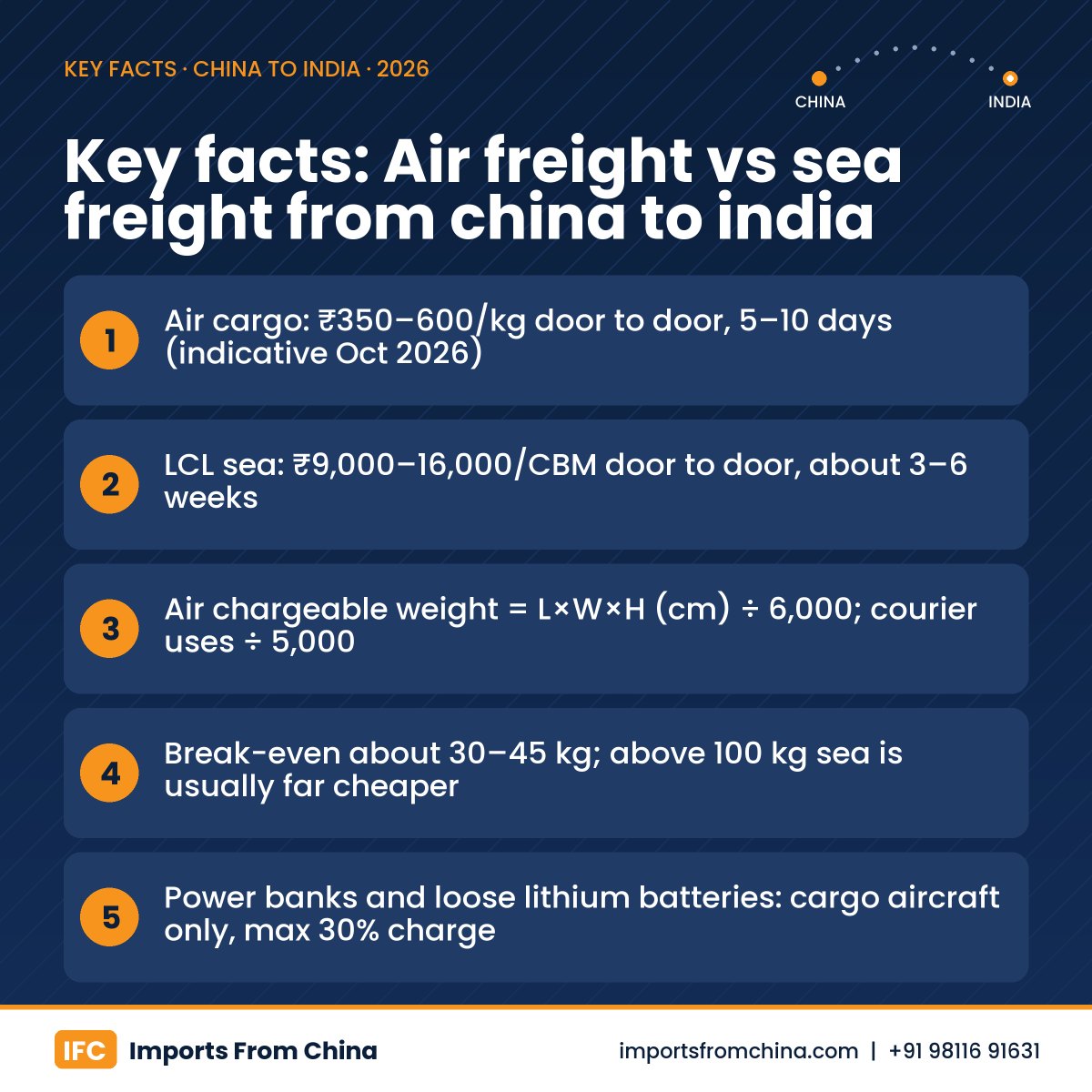
Air shipping from China to India takes about 5 to 7 hours of flight time, but 5 to 12 days door to door once you add pickup, export clearance, Indian customs and delivery. You have three choices: air express (DHL, FedEx, UPS), consolidated air cargo, and direct air cargo. Cost is charged per kg on the higher of actual or volumetric weight.

This guide explains which air option is cheapest for your shipment size, indicative per-kg rates, real door-to-door timelines, the airports involved, goods that need special handling, how courier and commercial customs clearance differ in India, and a full worked example in ₹.

Key takeaways

  • Three air modes: air express (courier) is fastest for small parcels; consolidated air cargo is usually cheapest from about 45-100 kg; direct air cargo suits large, urgent loads.
  • Flight vs door to door: the flight is only 5-7 hours, but plan for 5-12 days door to door including customs.
  • Volumetric weight rules the bill: air cargo charges on (L x W x H in cm) / 6000. Light, bulky goods cost more than their scale weight suggests.
  • Batteries, magnets and liquids: these need documents (MSDS, UN38.3, magnetic test) or a special service. Declare them before booking.
  • Customs value tip: for duty, air freight counted in the assessable value is capped at 20% of the FOB value. On light, high-value goods this cap does not help; on heavy, low-value goods it lowers your duty.
  • Commercial goods need IEC and GSTIN: whether by courier or air cargo, business imports are cleared against your IEC, and the IGST you pay can be claimed as input tax credit.

What is the cheapest air shipping from China to India?

The cheapest air option depends on how many kilograms you send. The price per kg falls as the shipment gets heavier, so a 5 kg sample and a 500 kg stock order should not travel the same way.

Air express (courier): DHL, FedEx, UPS and similar

The express company picks up from your supplier, flies on its own network, clears customs at its courier terminal in India and delivers to your door. It is the fastest option for samples and small orders, but the most expensive per kg.

Consolidated air cargo

A forwarder combines cartons from many importers under one master air waybill. Each importer pays only for its own chargeable weight. From roughly 45-100 kg upwards, this is usually the cheapest air option.

Direct (own) air cargo

Your shipment moves on its own air waybill. It suits large loads (often 300-500 kg and above), cargo that must not be mixed, and urgent jobs needing a fixed flight.

OptionBest forTypical door-to-door timeCustoms route in IndiaCost per kg
Air express (courier)Samples, 0.5-45 kg3-6 daysCourier terminal (Courier Bill of Entry)Highest
Consolidated air cargoAbout 45-500 kg, mixed orders5-10 daysAir cargo complex (regular Bill of Entry on ICEGATE)Lowest air option for mid-size loads
Direct air cargo300 kg+, urgent or special cargo4-9 daysAir cargo complex (regular Bill of Entry)Low at high volumes, plus fixed charges
Sea LCL / FCL (for comparison)Above roughly 1-2 CBMAbout 20-40 daysSea port or ICDFar lower than air
Air shipping options from China to India (general guide; actual times depend on route, airline and customs).

If you are still deciding between air and sea at all, read our air freight vs sea freight from China to India comparison first. This guide assumes air is the right mode and focuses on doing it well.

How much does air shipping from China to India cost?

Air shipping cost from China to India is calculated as chargeable weight x rate per kg, plus fixed charges at both ends. Rates move with fuel prices, season and cargo space, so treat the ranges below as a planning guide only.

ModeIndicative airport-to-airport or express rateWhat is usually not included
Air express (courier), 21 kg and aboveAbout US$6-12 per kgCustoms duty and IGST, remote-area or oversize surcharges
Air express, small parcels under 5 kgOften US$50-100 for a 5 kg parcelDuty and IGST
Consolidated / direct air cargo, 100-1,000 kgAbout US$3.5-6 per kgChina pickup and export clearance, Indian airport handling, CHA, duty, IGST, delivery
Air cargo, 1,000 kg and aboveAbout US$3.5-5 per kgSame as above
Indicative market ranges, Oct 2026; rates change weekly. These are not IFC prices. Use the IFC calculator or call for a live quote.

Volumetric weight: the number that decides your bill

Airlines work out volumetric weight as length x width x height (in cm) / 6000. Many express companies use a divisor of 5000, which makes the volumetric weight even higher. You pay on whichever is higher, actual or volumetric weight. That figure is called the chargeable weight.

Example: a 60 x 40 x 40 cm carton weighing 8 kg has a volumetric weight of 60 x 40 x 40 / 6000 = 16 kg. You pay for 16 kg, not 8. In practice 1 CBM of cargo equals 166.67 kg of chargeable weight in air cargo. You can switch between weight and volume with our weight-to-CBM calculator.

Weight slabs (breakpoints) most guides skip

Air cargo rates are quoted in slabs such as +45, +100, +300, +500 and +1,000 kg. Sometimes 95 kg at the +45 rate costs more than 100 kg at the cheaper +100 rate, so ask your forwarder to check the next slab.

Other charges in an air cargo bill

  • China side: pickup from the supplier, warehouse handling, export customs declaration, airport security screening.
  • Freight: the per-kg rate, usually including fuel and security surcharges (always confirm).
  • India side: airline delivery order, air cargo terminal handling and storage, CHA (customs broker) fees, customs duty and IGST, and truck delivery to your city.

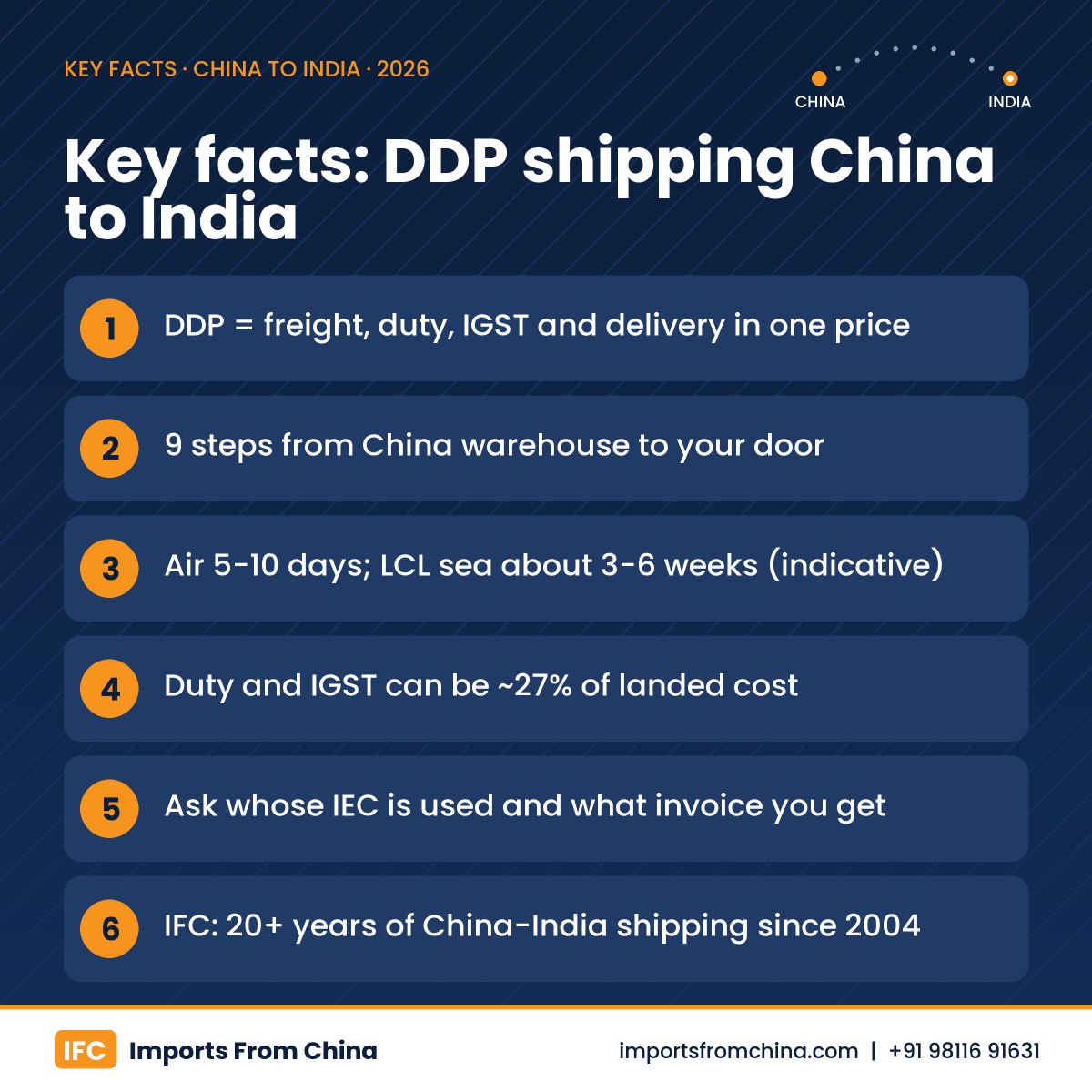
A cheap “per kg” quote that leaves out India-side charges is not cheap. Compare quotes only on a door-to-door, duty-paid basis. Our guide to DDP shipping from China to India explains how an all-in price works.

How long does air shipping take from China to India?

China to India flight time for cargo is short. A direct flight from Guangzhou, Shenzhen or Hong Kong to Delhi takes roughly 5 to 6 hours, and from Shanghai about 6 to 7 hours. Most of your waiting happens on the ground, not in the air.

StageTypical timeWhat can delay it
Supplier to China warehouse (pickup)1-2 daysSupplier not ready, wrong carton marks
Export clearance and airport screening1-2 daysBattery or liquid cargo without documents
Booking and flight (including any transit stop)1-3 daysPeak season, space shortages, indirect routing
Indian customs clearance1-3 daysHS code doubts, under-valuation queries, BIS or WPC checks
Delivery to your city1-2 daysDistance from arrival airport
Total door to doorAbout 5-12 daysExpress can be 3-6 days
Typical air cargo timeline from China to India.

Peak months (before Diwali and Chinese New Year) can add several days and raise rates, and Chinese factories close for two to four weeks around Chinese New Year. For comparison, sea transit times by port are in our guide on how long sea shipping from China to India takes.

Which airports handle air cargo from China to India?

Main departure airports in China

  • Guangzhou Baiyun (CAN): the natural hub for goods from Guangzhou, Foshan, Dongguan and the wider Pearl River Delta, with regular cargo routes to India.
  • Shenzhen Bao’an (SZX): electronics, gadgets and accessories from Shenzhen.
  • Hong Kong (HKG): one of the world’s busiest cargo airports, with very frequent flights and strong express networks. Goods from South China often move by truck to Hong Kong.
  • Shanghai Pudong (PVG): for East China suppliers (Zhejiang, Jiangsu, Shanghai).
  • Yiwu: Yiwu has its own airport, but most Yiwu market goods are trucked to Shanghai, Hangzhou or South China airports where there are more international cargo flights. Check the best gateway for your load.

Main arrival airports in India

The busiest gateways for China imports are Delhi IGI (DEL), Mumbai (BOM), Chennai (MAA) and Bengaluru (BLR), followed by Hyderabad (HYD), Kolkata (CCU) and Ahmedabad (AMD). Fly to the airport nearest your warehouse to avoid extra trucking.

What goods are restricted on air shipment from China to India?

  • Lithium batteries: power banks, products with built-in batteries (Bluetooth speakers, smart watches, e-toys) and loose cells need an MSDS, a UN38.3 test report and correct packing and labels. Loose batteries and power banks are often refused on normal cargo and need a special dangerous goods service.
  • Magnets: speakers, magnetic toys and motors may need a magnetic field test report before airlines accept them.
  • Liquids, gels, powders and aerosols: cosmetics, perfumes, inks, glue and paints usually need an MSDS. Flammable items are dangerous goods.
  • Not suitable for normal air cargo: compressed gas cylinders, flammable liquids in bulk and other hazardous chemicals. These normally go by sea as declared dangerous cargo.

Separately from airline rules, Indian import rules apply to every mode. Products under BIS compulsory registration, wireless items needing WPC approval, and food items under FSSAI must meet those rules before customs will release them. Check your product’s policy using the right HS code for China imports and the ITC(HS) policy on DGFT.

Air cargo China to India: courier vs commercial customs clearance

How your air shipment is cleared in India depends on whether it comes as a courier (express) shipment or as regular air cargo.

Courier (express) clearance

Express shipments are cleared by the authorised courier at its own customs terminal under the courier import regulations notified by CBIC. It is quick for documents, samples and small commercial parcels. Commercial imports still need your IEC, GSTIN and KYC on file with the courier, and duty plus IGST are charged before delivery.

  • The ₹10 lakh per-consignment cap that was removed from 1 April 2026 related to courier exports. Do not read it as a green light for large commercial imports by courier. Check current CBIC rules or ask your courier before sending high-value stock by express.
  • Goods that are restricted, need a licence or fail BIS/WPC rules can be held at the courier terminal and may need to be moved to regular cargo clearance, which costs extra time.
  • Under the 2026 amendments, courier goods left uncleared can be returned to the sender after 15 days on request, and goods uncleared for 30 days can be detained and disposed of after notice. Respond quickly to any customs query.

Commercial air cargo clearance

Consolidated and direct air cargo arrive at the airport’s air cargo complex. A licensed customs broker (CHA) files a regular Bill of Entry on ICEGATE with the commercial invoice, packing list and air waybill. This is the normal route for business stock of any value, and it gives you a clean Bill of Entry for GST input tax credit. The step-by-step process is in our customs clearance guide, and the paperwork is listed in documents required to import from China.

Worked example: air cargo landed cost in ₹

A Delhi retailer imports 600 handbags (HS 4202 99 00) from Guangzhou by consolidated air cargo. All figures are illustrative, using ₹100 = US$1.

  • 30 cartons, each 50 x 40 x 40 cm and 10 kg. Actual weight = 300 kg.
  • Volumetric weight per carton = 50 x 40 x 40 / 6000 = 13.33 kg. Total = 400 kg. Chargeable weight = 400 kg.
  • Goods value (FOB) = US$3,000 = ₹3,00,000.
  • Air freight at an assumed US$5 per kg x 400 kg = ₹2,00,000 (indicative, Oct 2026; changes weekly).

Step 1: Assessable value. Under the Customs Valuation Rules, air freight added to the value for duty cannot be more than 20% of FOB. 20% of ₹3,00,000 = ₹60,000, so ₹60,000 is used instead of the actual ₹2,00,000. Insurance (not known, so 1.125% of FOB) = ₹3,375. Assessable value (CIF) = 3,00,000 + 60,000 + 3,375 = ₹3,63,375.

ItemCalculationAmount (₹)
Assessable value (AV)FOB + capped freight + insurance3,63,375
Basic Customs Duty (BCD)15% of AV54,506
Social Welfare Surcharge (SWS)10% of BCD5,451
IGST18% of (AV + BCD + SWS) = 18% of 4,23,33276,200
Total duty + IGST1,36,157
Duty rates for HS 4202 99 00 as per IFC duty data checked Oct 2026; always confirm your exact HS code and rate before shipping.

Step 2: Landed cost. Goods ₹3,00,000 + actual air freight ₹2,00,000 + insurance ₹3,375 + duty and IGST ₹1,36,157 = ₹6,39,532, or about ₹1,066 per bag, before CHA, airport handling and local delivery. If you are GST registered, the ₹76,200 IGST comes back as input tax credit, so the real cost is about ₹5,63,332, or roughly ₹939 per bag.

What this example shows: freight is two-thirds of the goods value here because handbags are light and bulky. If the cartons had been packed to 45 x 35 x 35 cm (stuffing shapes, removing extra paper), the volumetric weight would fall to about 9.2 kg per carton and the chargeable weight would drop to 300 kg (actual weight), saving about ₹50,000 at the same rate. For a full duty explanation see our import duty from China to India guide.

How to get the cheapest air shipping from China to India

  1. Pick the mode by weight. Courier for samples, consolidated air cargo from about 45-100 kg, and compare with sea LCL once you cross roughly 300-500 kg or 1-2 CBM.
  2. Shrink the cartons. Ask suppliers to remove extra inner boxes, use vacuum packing for textiles and avoid half-empty cartons. Every cm counts in volumetric weight.
  3. Use the weight slabs. Check whether moving into the next slab (+100, +300, +500 kg) gives a lower total.
  4. Split by urgency. Fly only the fast-moving part of the order and send the rest by sea. See LCL vs FCL for the sea portion.
  5. Compare door-to-door quotes only. Airport-to-airport rates hide many charges at both ends.

How IFC helps

IFC – Imports From China has 20+ years of China-India import experience, since 2004. We have our own offices in Guangzhou and Yiwu, with English-speaking staff and translators, and our head office and warehouse are in Kirti Nagar, New Delhi.

  • Daily loading: we load mixed containers (LCL) and air cargo daily, so you can choose air or sea for each order.
  • Pickup and consolidation: we collect from your suppliers and combine goods in Guangzhou and Yiwu before shipping.
  • Before you ship: supplier search and verification, factory and quality inspection, and payment support.
  • Duty-paid delivery: customs clearance and door-to-door DDP delivery across India, including Delhi, Gurugram, Noida, Mumbai, Bengaluru, Hyderabad, Pune, Chennai and Ahmedabad.

We work with business importers. Learn more on our door-to-door shipping from China to India page, or read what importers say on IFC reviews.

Conclusion

Air shipping from China to India is the right choice when speed matters more than freight cost: samples, urgent stock, high-value or light products. Use courier for small parcels and consolidated air cargo for mid-size loads, watch volumetric weight, and compare only door-to-door, duty-paid quotes.

Get your real landed cost: enter your product, weight and CBM in the IFC shipment calculator, or call IFC on +91 98116 91631 for a door-to-door DDP quote from China to your city.

Frequently asked questions

How long does air shipping take from China to India?

The flight itself takes about 5 to 7 hours from Guangzhou, Shenzhen, Hong Kong or Shanghai to Indian airports. Door to door, plan for 5 to 12 days for air cargo and 3 to 6 days for express courier, because pickup, export clearance, booking, Indian customs and delivery all take time. Peak seasons can add a few days.

What is the cheapest air shipping from China to India?

For anything above about 45-100 kg, consolidated air cargo is usually the cheapest air option, because many importers share one master air waybill. Express courier is cheaper only for small parcels and samples. Above roughly 300-500 kg or 1-2 CBM, compare with sea LCL, which costs far less per kg if you can wait.

How is air shipping cost from China to India calculated?

Cost equals chargeable weight multiplied by the rate per kg, plus fixed charges in China and India. Chargeable weight is the higher of actual weight and volumetric weight, which is length x width x height in cm divided by 6000 for air cargo (often 5000 for express). Customs duty and IGST are added on top.

Can I send batteries by air from China to India?

Often yes, but with conditions. Products with lithium batteries need an MSDS, a UN38.3 test report and proper dangerous goods packing and labels. Loose batteries and power banks are frequently refused on normal air cargo and need a special dangerous goods service. Always declare batteries before booking to avoid rejection at the China airport.

Do I need an IEC for air shipments from China?

Yes, for commercial imports. Whether goods come by courier or by air cargo, business imports are cleared against your Importer Exporter Code and GSTIN. A regular Bill of Entry filed on ICEGATE also lets you claim the IGST paid at customs as input tax credit, which lowers your real landed cost.

Is air freight included in the customs value in India?

Yes, but with a cap. Under the Customs Valuation Rules, the air freight added to the assessable value cannot be more than 20% of the FOB value of the goods. For heavy, low-value goods this lowers the duty you pay. You still pay the full actual freight to your forwarder.

sea freight from china to india

Sea Freight from China to India: 2026 Rates & Guide

Sea freight from China to India is the cheapest way to move commercial cargo from Chinese ports such as Shanghai, Ningbo, Shenzhen and Guangzhou to Nhava Sheva, Mundra, Chennai or Kolkata. In October 2026, indicative ocean freight is roughly US$2,500-3,500 for a 20ft container and US$3,000-4,200 for a 40ft, before Indian local charges and duty.

This guide explains what a container really costs, which China ports serve which Indian ports, why sea freight charges from China to India go up and down, how to read a freight quote line by line, and how freight changes your final landed cost in rupees.

Key takeaways

  • Rates move weekly: China to India container rates roughly doubled between July and August 2026, so treat every price as a snapshot, not a fixed tariff.
  • Indicative range (Oct 2026): about US$2,500-3,500 per 20ft and US$3,000-4,200 per 40ft/40HC, ocean freight only.
  • Freight is not the full cost: Indian destination charges (THC, delivery order, CFS, documentation) and customs duty come on top.
  • Freight raises your duty: customs duty is charged on CIF value, so a US$1,500 freight increase also increases BCD, SWS and IGST.
  • Check the Incoterm: a “cheap” CIF quote from a supplier often hides high destination charges in India.
  • Book early around holidays: Chinese New Year and China’s October Golden Week squeeze space and push rates up.

What is the China to India container shipping cost in 2026?

Container rates on this lane are spot rates, set by shipping lines and forwarders every week. They depend on the loading port, the Indian port, the season, space on the vessel and surcharges. The table below gives indicative market ranges collected from published market reports and forwarder rate logs. They are not IFC prices.

Container typeApprox. usable volumeIndicative ocean freight, China to Nhava Sheva / Mundra (Oct 2026)Best for
20ft (20GP)25-28 CBMUS$2,500-3,500Heavy cargo: machinery parts, tiles, hardware
40ft (40GP)55-58 CBMUS$3,000-4,200Medium-weight mixed goods
40ft High Cube (40HC)65-68 CBMUS$3,000-4,200 (often the same as 40GP)Light, bulky goods: furniture, toys, home decor
LCL (shared container)Charged per CBM or per 1,000 kgOcean part can be as low as US$10-60 per CBM; origin and destination CFS charges add moreShipments below about 15 CBM
Indicative, Oct 2026; changes weekly. Chennai is often a little cheaper than Nhava Sheva; Kolkata usually costs more because of transhipment.

20ft vs 40ft vs 40HC: which is cheaper per CBM?

A 40ft container holds about twice the volume of a 20ft, but its freight is rarely twice the price. On this lane the gap between a 20ft and a 40ft is often only a few hundred dollars. So once your cargo goes above roughly 30 CBM, a 40ft or 40HC usually gives a much lower cost per CBM. A 20ft still makes sense for heavy cargo, because it reaches its weight limit before it is full.

Sea shipping cost from China to India for small loads (LCL)

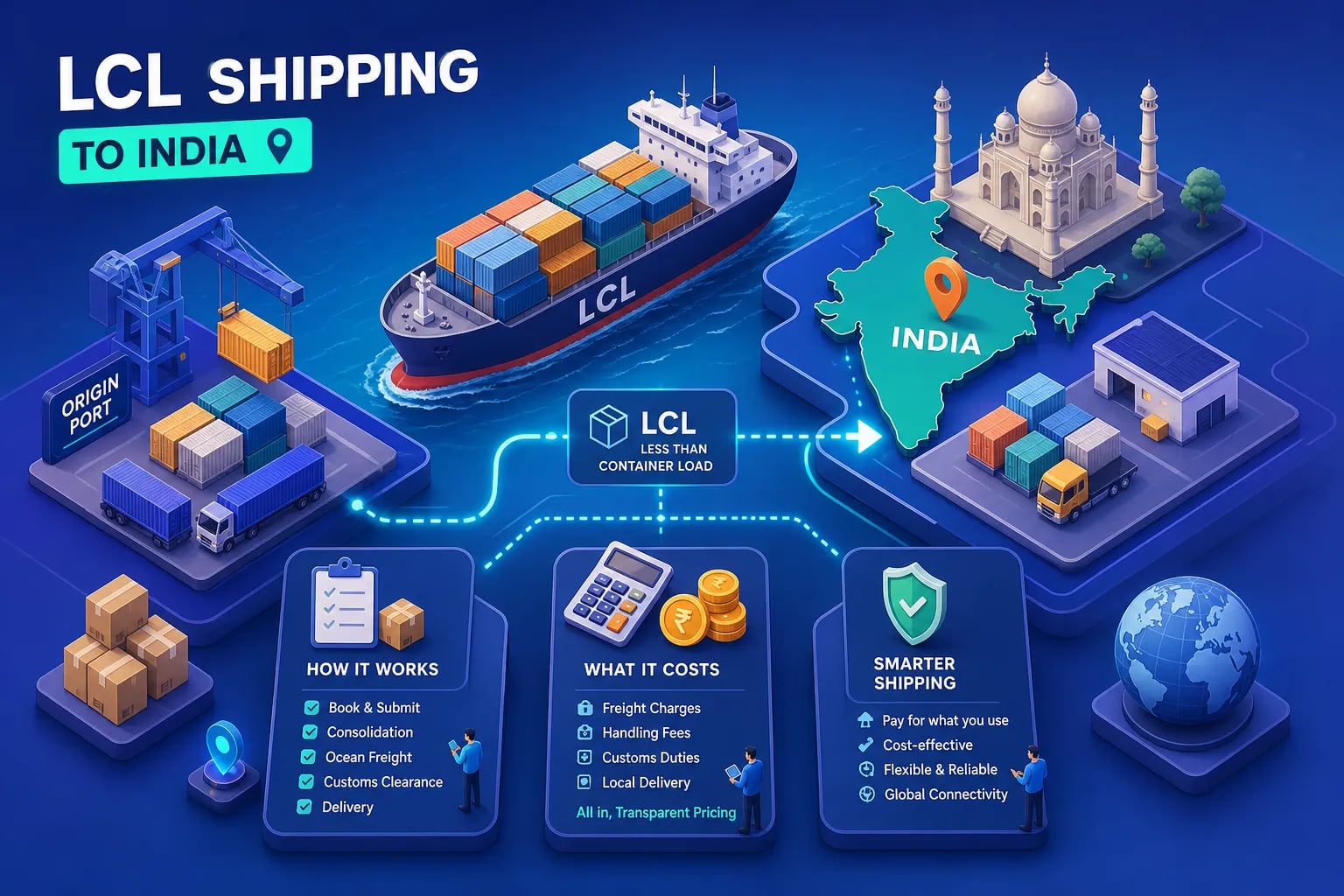
If you have only a few cartons, you share a container with other importers. LCL is billed per revenue tonne: 1 CBM or 1,000 kg, whichever is higher. The ocean freight part is small, but CFS handling, delivery order and documentation charges at both ends make up most of the bill. Always ask for an all-in figure per CBM up to your door. Not sure of your volume? Use the IFC weight-to-CBM calculator.

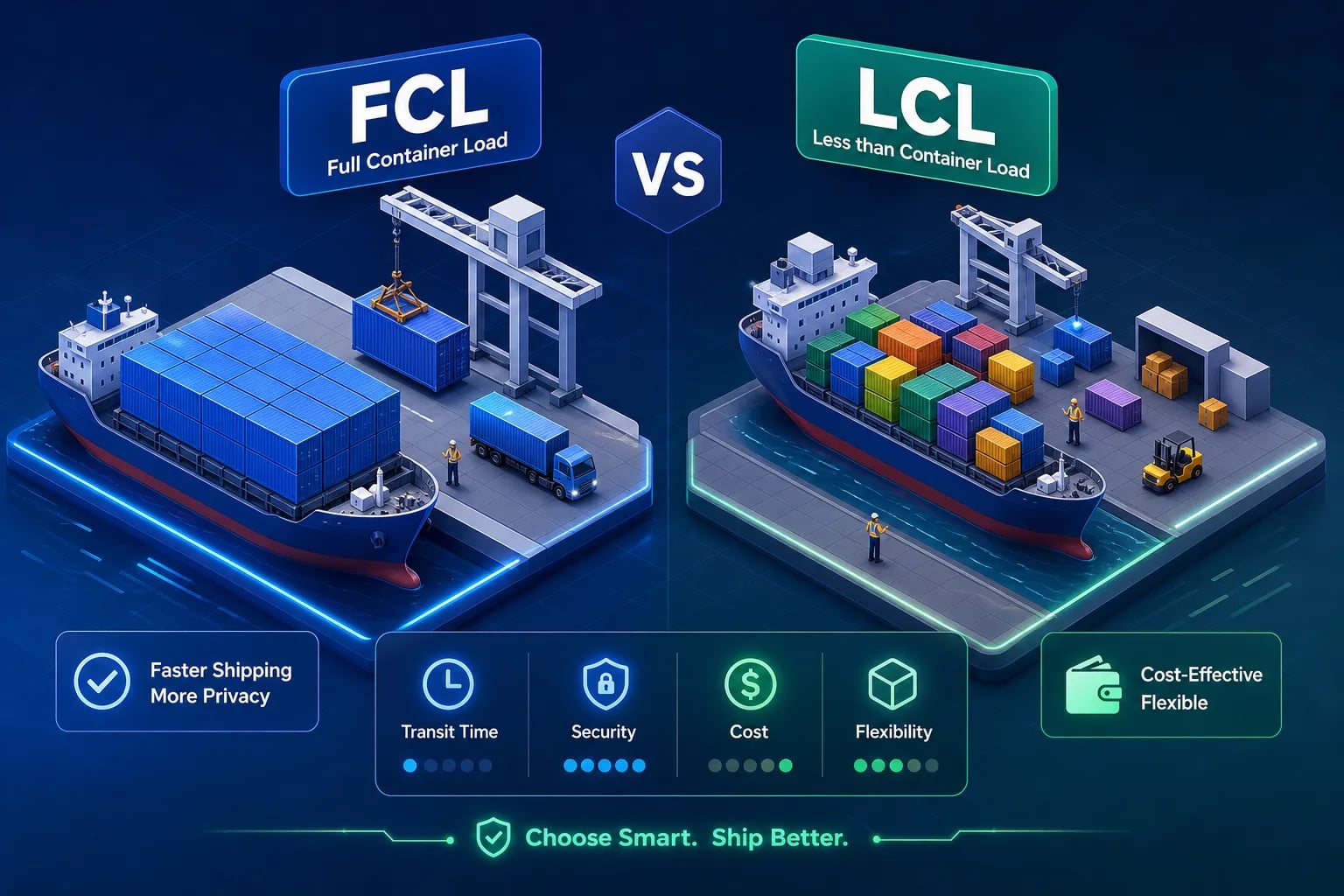
LCL or FCL? As a rule of thumb, LCL works for small and trial orders, and FCL starts to win somewhere between 13 and 18 CBM, depending on rates that week. We compare both in detail, with break-even maths, in our guide to LCL vs FCL from China to India.

Which China ports ship to which Indian ports?

Pick the Chinese port closest to your supplier’s factory. Trucking inside China costs money and time, so a supplier in Yiwu usually loads at Ningbo, and a supplier in Guangdong loads at Shenzhen or Nansha.

China portMain supplier regionsTypical goodsCommon Indian ports
ShanghaiShanghai, Jiangsu, AnhuiMachinery, electronics, chemicals, textilesNhava Sheva, Mundra, Chennai, Kolkata
NingboZhejiang (Yiwu, Ningbo, Hangzhou)General merchandise, hardware, small appliancesNhava Sheva, Mundra, Chennai
Shenzhen (Yantian / Shekou)Shenzhen, DongguanElectronics, LED, mobile accessoriesNhava Sheva, Mundra, Chennai
Guangzhou (Nansha / Huangpu)Guangzhou, FoshanFurniture, lighting, garments, building materialsNhava Sheva, Mundra, Chennai, Kolkata
QingdaoShandongTyres, auto parts, steel products, machineryNhava Sheva, Mundra, Chennai
XiamenFujianStone, ceramics, footwear, sportswearNhava Sheva, Mundra, Chennai

North Indian importers often route cargo from Nhava Sheva or Mundra by rail to an inland container depot such as ICD Tughlakabad or ICD Patparganj in Delhi, and clear customs there. That adds rail charges but saves a long truck journey.

How long does it take? Port-to-port sailing is only part of the time. Booking, loading, customs and inland delivery all add days, and transit differs a lot between west-coast and east-coast ports. See our port-by-port guide on how long sea shipping from China to India takes.

Why do sea freight charges from China to India increase?

Ocean freight rates from China to India are driven by supply (ship space) and demand (cargo). When either side moves, your rate moves. These are the main reasons for a sea freight increase from China to India.

GRI and peak season surcharges

A General Rate Increase (GRI) is an across-the-board hike that a shipping line announces, usually for the 1st or 15th of a month. A Peak Season Surcharge (PSS) is added when demand is high, typically from July to October, when Indian importers stock up for Diwali and the festive season.

Chinese New Year and Golden Week

Factories close for two to four weeks around Chinese New Year (January or February). Everyone rushes to ship before the holiday, so space gets tight and rates rise. China’s National Day “Golden Week” in early October has a smaller version of the same effect. Book at least three to four weeks ahead of both.

Red Sea, Suez and West Asia disruptions

China to India ships do not pass through the Red Sea. But when ships on the Asia-Europe route divert around Africa, the global fleet gets stretched, fewer vessels are free for Asia-India services, and rates rise everywhere. In 2026, tension around the Strait of Hormuz added war-risk and contingency surcharges and changed how lines deploy ships in the region.

BAF, currency and equipment

The Bunker Adjustment Factor (BAF) tracks fuel prices. Low-sulphur fuel rules add an LSS or similar surcharge. Empty container shortages at Chinese ports can add an equipment surcharge. And because freight is billed in US dollars, a weaker rupee raises your cost even when the dollar rate does not change.

Current sea freight from China to India: latest news

Here are dated facts from recent market reports, so you can see how fast the market moved in 2026.

  • 20 July 2026: Drewry’s World Container Index (a global average for a 40ft container) stood at US$4,547, its first weekly fall after ten straight weeks of increases.
  • 21 August 2026: India Seatrade News reported that Shanghai to Nhava Sheva spot rates had nearly doubled in August, to about US$3,100 per TEU and US$3,300 per 40ft, from about US$1,600 and US$1,700 in July. China to Chennai rose to about US$2,900 per TEU and US$3,100 per 40ft. The report linked the rise to the Strait of Hormuz crisis and changes in vessel deployment.
  • September 2026: forwarder rate logs showed Nansha and Shekou to Nhava Sheva or Mundra quotes of around US$3,400-3,650 per container, with peak-season surcharges and GRIs still applying.
  • 22 October 2026: Maritime Gateway, citing a Jefferies report, said global container freight rates had risen about 130% since February 2026, from roughly US$2,000-2,500 to US$4,000-4,500, on West Asia tensions. The same report said India’s containerised trade grew 23% year on year in September 2026, and named a return of shipping lines to the Suez Canal as the key factor to watch.

What this means for you: if lines return to Suez at scale, more ships become free and rates should soften. Until then, expect higher, more volatile rates, and ask for a fresh quote on the day you are ready to book.

How do you read an ocean freight quote from China to India?

Two quotes that look different may be the same cost, and a cheap-looking quote may be the most expensive. Split every quote into three parts.

1. Origin charges (in China)

Pickup from the factory, export customs declaration, origin THC (terminal handling), container stuffing or CFS charges, B/L (bill of lading) fee, VGM (verified gross mass) and seal. If you buy on FOB terms, the supplier pays these. If you buy EXW, you pay them.

2. Ocean freight and surcharges

Basic ocean freight plus BAF, PSS, GRI, LSS, war-risk or contingency surcharges. Check the validity date: most quotes are valid for a week or two, or until a stated sailing.

3. Destination local charges (in India)

These are paid at the Indian port no matter who paid the ocean freight:

  • Destination THC: terminal handling at Nhava Sheva, Mundra, Chennai or Kolkata.
  • Delivery order (DO) fee: charged by the shipping line or forwarder to release cargo.
  • CFS charges: handling and storage at the container freight station.
  • Documentation, IGM/EDI and cleaning fees.
  • Container deposit or detention: if you keep the container beyond free days.
  • CHA fees, customs duty and transport to your warehouse.

The CIF trap

Many Chinese suppliers offer “CIF Nhava Sheva” at a very attractive price. The supplier’s forwarder then recovers its margin through inflated destination charges in India, which you only see when the cargo arrives. If you buy CIF, ask in advance for the full list of destination charges in writing. Buying FOB with your own forwarder, or on DDP door-to-door terms, gives you one clear price.

Quick quote checklist

  • Is the price per container, per CBM or per kg?
  • Which surcharges are included, and which are “subject to”?
  • How many free days at destination for the container?
  • Is it port-to-port, door-to-port or door-to-door?
  • Does it include customs clearance and duty, or only freight?

How does sea freight change your landed cost? A worked ₹ example

Customs duty in India is charged on the assessable value, which is the CIF value: cost of goods + insurance + freight. So freight affects your duty, not just your shipping bill. Here is a simple example. All figures are assumptions for illustration only.

Shipment: one 20ft container of household plastic goods, Ningbo to Nhava Sheva, bought FOB at US$20,000. Ocean freight US$3,000 (indicative, Oct 2026). Exchange rate assumed at ₹88 per US$. Insurance taken at 1.125% of FOB. Duty assumed at BCD 10% and IGST 18%; check your actual rate by HS code.

ItemCalculationAmount (₹)
FOB value of goodsUS$20,000 × 8817,60,000
Ocean freightUS$3,000 × 882,64,000
Insurance1.125% of FOB19,800
Assessable value (CIF)FOB + freight + insurance20,43,800
Basic Customs Duty (BCD)10% of AV2,04,380
Social Welfare Surcharge (SWS)10% of BCD20,438
IGST18% of (AV + BCD + SWS) = 18% of 22,68,6184,08,351
Total customs dutyBCD + SWS + IGST6,33,169
Destination local charges, CHA fees and inland transport are extra. IGST is usually claimable as input tax credit if you are GST-registered.

What a freight increase really costs

Say freight jumps from US$1,600 to US$3,100, as Shanghai to Nhava Sheva did between July and August 2026. That is US$1,500, or ₹1,32,000 more freight. Because freight sits inside the assessable value, BCD and SWS rise by about ₹14,520 (11% of ₹1,32,000), and IGST rises by about ₹26,374. Your cash outflow goes up by roughly ₹1,72,900, not ₹1,32,000. The IGST part comes back as credit, but your money is still blocked until you use it.

Freight per CBM tells the real story

If those goods fill 26 CBM, freight works out to about ₹10,150 per CBM (₹2,64,000 ÷ 26). Divide that across your units to see how much freight adds to each piece. Light, bulky products feel freight increases far more than small, high-value goods. For a full estimate with duty for your product, use the IFC shipment calculator or read our guide on import duty from China to India.

How can you reduce sea shipping costs from China to India?

  1. Plan around the calendar: avoid shipping in the last two weeks before Chinese New Year and Golden Week if you can.
  2. Fill the box: combine orders from several suppliers into one container through consolidation, instead of paying LCL charges several times.
  3. Choose the right port: load at the port nearest the factory, and discharge at the port nearest your market.
  4. Get packing right: ask suppliers for carton sizes and weights early; better packing can cut CBM.
  5. Have documents ready: a correct invoice, packing list and HS code avoid demurrage and detention at the Indian port. See the documents required to import from China.
  6. Compare all-in prices: compare door-to-door totals, not ocean freight alone.

For the customs side, check your Bill of Entry status on ICEGATE and duty notifications on the CBIC website. Our customs clearance guide walks through each step.

How IFC helps with sea shipping from China to India

IFC – Imports From China has 20+ years of China-India import experience, since 2004. We work with business importers and handle the whole chain, so you get one price instead of three separate bills.

  • Own offices in Guangzhou and Yiwu with English-speaking staff, plus a pickup and sourcing network across other Chinese cities.
  • Daily loading of mixed containers (LCL consolidation) and air cargo, so small importers do not wait for a full container.
  • LCL and FCL sea freight, customs clearance with duty paid, and door-to-door DDP delivery to Delhi, Gurugram, Noida, Mumbai, Bengaluru, Hyderabad, Pune, Chennai, Ahmedabad and more.
  • Supplier search and verification, factory and quality inspection, and payment support before your goods are loaded.
  • Head office in Kirti Nagar, New Delhi, with a spacious warehouse.

Learn more about our door-to-door shipping from China to India.

Conclusion

Sea freight from China to India is still the most economical route for commercial cargo, but 2026 has shown how quickly rates can double. Treat every quote as a snapshot, split it into origin, ocean and destination charges, remember that freight also raises your customs duty, and plan big orders away from Chinese holidays. The safest way to protect your margin is to compare door-to-door landed cost, not just the ocean rate.

Get your real landed cost: enter your product, weight and CBM in the IFC shipment calculator, or call IFC on +91 98116 91631 for a door-to-door DDP quote from China to your city.

Frequently asked questions

How much does a 20ft container from China to India cost?

In October 2026, indicative ocean freight for a 20ft container from main China ports to Nhava Sheva or Mundra is about US$2,500-3,500. This covers ocean freight only. Indian destination charges, customs duty, CHA fees and inland transport are extra. Rates change weekly, so always get a fresh quote before booking.

Why did sea freight from China to India increase in 2026?

Rates rose mainly because of West Asia tensions, including the Strait of Hormuz crisis, which tightened ship capacity and changed vessel deployment. Peak-season demand before Diwali, general rate increases and surcharges added to it. Shanghai to Nhava Sheva spot rates nearly doubled between July and August 2026.

What is the LCL sea freight rate per CBM from China to India?

The ocean part of LCL can be as low as US$10-60 per CBM, but that is not the real cost. Origin and destination CFS, delivery order and documentation charges make up most of the bill. LCL is charged per CBM or per 1,000 kg, whichever is higher, so always ask for an all-in, door-to-door rate per CBM.

Which Indian port is cheapest for sea freight from China?

Chennai is often slightly cheaper than Nhava Sheva on direct China services, while Kolkata usually costs more because of transhipment. The cheapest choice overall is the port closest to your market, since inland trucking or rail from a distant port can cancel out any saving on ocean freight.

Does sea freight affect customs duty in India?

Yes. Indian customs duty is charged on the assessable value, which is the CIF value: goods cost plus insurance plus freight. When freight rises, BCD, Social Welfare Surcharge and IGST all rise too. A US$1,500 freight increase can add about ₹40,000 in extra duty on top of the higher freight itself.

When is the best time to book sea freight from China to India?

Book three to four weeks ahead, and avoid the rush just before Chinese New Year (January or February) and China’s Golden Week in early October. The July to October peak season before Diwali also brings surcharges. Shipping in quieter months, with goods ready and documents in order, usually gives better rates and space.

shipping agent china to india

Shipping Agent China to India: How to Choose the Right One

A shipping agent China to India is the company that books your cargo from a Chinese factory or warehouse to an Indian port, airport or your door. The best one for an MSME importer picks up in China, consolidates, ships by sea or air, clears Indian customs through a licensed CHA and delivers duty paid (DDP), with one clear quote covering every charge.

This guide explains what a shipping agent, freight forwarder, import agent and CHA each do, the types of China to India logistics companies you will meet, a checklist to choose the right one, red flags, the questions to ask before booking, and how it works if your business is in Delhi or Mumbai.

Key takeaways

  • Four different roles: a shipping agent or freight forwarder moves the cargo, a CHA (customs broker) files your Bill of Entry, and an end-to-end import agent manages all of it, often including the supplier side.
  • Match the agent to your shipment: small mixed cargo suits a consolidator or DDP import agent; a full container suits a forwarder or NVOCC with a CHA.
  • Check credentials yourself: ask for the CHA (customs broker) licence number, IATA/FIATA membership and MTO registration where they apply, plus GSTIN and a registered address.
  • Compare landed cost, not freight: a cheap ocean rate can hide destination, CFS, DO and clearance charges that appear only after the cargo lands.
  • A China warehouse matters: an agent with its own team in Guangzhou or Yiwu can check, count and consolidate goods before they leave China.
  • Get everything in writing: inclusions, exclusions, transit time, who pays duty and what happens if customs holds the goods.

What does a shipping agent from China to India actually do?

“Shipping agent”, “freight forwarder”, “import agent” and “CHA” are not the same thing. Knowing the difference tells you what you pay for and who is responsible when something goes wrong.

Shipping agent and freight forwarder

A freight forwarder (what most importers call a shipping agent) arranges transport. It books space with shipping lines or airlines, issues or arranges the Bill of Lading or Air Waybill, coordinates pickup from the supplier and handles export formalities in China. Many forwarders stop at the Indian port; delivery and clearance are then your problem unless you buy them as add-ons.

Shipping agent in China

A shipping agent in China works on the origin side: collecting cargo from factories, booking the vessel or flight, preparing export declarations and loading containers. Some Chinese agents quote very low ocean rates to Indian importers but have no team in India, so you still need a separate CHA and transporter at destination.

CHA (Customs Broker)

A Customs House Agent, now officially a Customs Broker, is licensed by Indian Customs under the Customs Brokers Licensing Regulations published by CBIC. The CHA files your Bill of Entry on ICEGATE, handles assessment, examination and out-of-charge, and is the person customs officers deal with. Only a licensed broker can do this on your behalf. Our customs clearance guide explains each step.

End-to-end import agent

An import agent (sometimes called a China importer company) covers the whole chain: finding and verifying suppliers, inspecting goods, supporting payment, consolidating cargo in China, shipping, customs clearance through a licensed CHA and door delivery. For first-time importers and small MSMEs, this is usually the simplest option because there is one point of contact. If you also need help buying, read about China buying agents in India.

What types of China to India logistics companies are there?

When you search for China to India logistics companies, the results mix very different business models. Here are the five you will meet most often.

1. Global freight forwarders

Large multinational networks with offices in many countries. Strong for big, regular FCL or project cargo and corporate accounts with fixed contracts. Small importers may face minimum volumes and slower response.

2. NVOCCs

A Non-Vessel Operating Common Carrier does not own ships but issues its own House Bill of Lading and buys space from shipping lines. NVOCCs are useful for FCL and LCL sea freight. In India, an NVOCC acting as a multimodal operator registers as an MTO with the Directorate General of Shipping.

3. Consolidators (LCL specialists)

Consolidators combine cargo from many importers into one container, so you pay only for your CBM. This is the most common route for MSMEs shipping 1 to 15 CBM. See LCL vs FCL from China to India to decide which fits your volume.

4. Courier aggregators

Aggregators resell express courier capacity for samples and small parcels. They are fast and easy for a few kilos, but courier clearance has value and category limits, and the per-kg cost climbs quickly for commercial quantities.

5. End-to-end import agents (DDP)

These companies handle sourcing support, pickup, consolidation, freight, clearance and delivery, often on a DDP basis where duty and taxes are paid before the goods reach you. Learn how DDP shipping from China to India works and how it compares with DAP.

Comparison table: which type of agent fits you?

Agent typeBest forCustoms clearance in IndiaDoor deliverySupplier-side helpWatch out for
Global freight forwarderLarge, regular FCL; corporatesUsually via own or partner CHA, extra costOn requestRarelyMinimum volumes, slow response for small shippers
NVOCCFCL and LCL port-to-portOften not includedOften not includedNoDestination charges billed separately
LCL consolidator1 to 15 CBM mixed cargoSometimes includedSometimesLimitedCFS, DO and handling fees at Indian port
Courier aggregatorSamples, parcels under about 100 kgCourier mode, with limitsYesNoHigh per-kg cost, category restrictions
End-to-end import agent (DDP)MSMEs, first-time and regular importersIncluded, through licensed CHAYesYes: verification, inspection, consolidationAsk for an itemised quote and duty basis

How do you choose the best logistics from China to India?

The best logistics from China to India is not the lowest freight rate. It is the partner that delivers your goods legally, on time, with no surprise bills. Use this checklist before you hand over a single shipment.

Licences and registrations to verify

  • CHA / Customs Broker licence: whoever files your Bill of Entry must hold one, or must name the licensed broker they use. Ask for the licence number and the customs station it covers.
  • IATA: relevant if the agent issues air waybills directly. If not, ask which IATA agent they use.
  • FIATA membership: shows the forwarder is part of the international forwarding network, usually through a national association.
  • MTO registration: needed in India for a company issuing multimodal transport documents.
  • GSTIN and company registration: check the GSTIN on the GST portal and match the legal name with the invoice you will receive.

Operational strengths to look for

  • Own team or warehouse in China: people who can receive, count, photograph and repack goods before loading. This catches short shipments and wrong items in China, not in India.
  • DDP capability: can they deliver duty paid to your door, and do they explain how duty is calculated for your HS code?
  • Transparent quote: freight, origin charges, destination charges, CHA fees, duty basis, GST and delivery all shown separately or clearly bundled.
  • Regular departures: frequent LCL loading means your cargo does not sit waiting for a container to fill.
  • References and reviews: speak to two or three current customers who import goods similar to yours.

For a deeper step-by-step check, read how to verify a China import agent in India.

What red flags should you watch for in logistics services from China to India?

Most problems in logistics services from China to India follow a few repeat patterns:

  • A “per kg all-inclusive” rate far below the market with no written explanation of how duty is handled. Very low all-in rates can mean under-invoicing, which puts the importer at risk of penalties and confiscation.
  • No invoice in your name, or no Bill of Entry copy. Without these you cannot claim GST input credit and cannot prove the goods were legally imported.
  • Refusal to share the CHA name or licence number.
  • Only a mobile number and a WhatsApp account, with no registered office or GSTIN you can verify.
  • Pressure to pay 100% freight in advance before the goods are even received in the China warehouse.
  • Vague answers about restricted goods such as items needing BIS, WPC or FSSAI approval. A good agent tells you upfront what certificates your product needs.

What questions should you ask a shipping agent before booking?

Send these questions in writing and compare the answers side by side.

  1. Is your quote port-to-port, door-to-port or door-to-door, and is it DDP or DAP?
  2. Which charges are excluded: origin handling, CFS, DO, THC, CHA fees, transport, insurance?
  3. Will the Bill of Entry be filed in my IEC and GSTIN? Will I get a copy?
  4. Which HS code and duty rate are you assuming, and what happens if customs reassesses it?
  5. Do you have your own warehouse or staff in China? Will you share photos and a packing check on receipt?
  6. How often do you load LCL containers or book air cargo, and what is the realistic door-to-door time?
  7. Is my product restricted, and which certificates (BIS, WPC, FSSAI, EPR) are needed?
  8. Who is my single point of contact, and how do I track the shipment?
  9. What happens if goods are damaged, short or held for examination?

If you are still setting up your IEC and GST, start with how to start importing from China to India and register your IEC on the DGFT portal.

How much does China to India import logistics cost? A worked example in ₹

China to India import logistics cost has two parts: the freight and handling the agent charges, and the customs duty the government charges. Agents compete on the first; the second is set by law and your HS code. Comparing quotes only on freight is the most common costing mistake.

Indicative freight ranges

Published market quotes in 2026 for a 20ft container from South China to Nhava Sheva or Mundra have ranged widely, from roughly USD 950 to around USD 3,600 ocean freight only, with origin and destination charges extra (indicative, Oct 2026; changes weekly). LCL is charged per CBM or per 1,000 kg, whichever is higher, plus fixed CFS and documentation fees. Always ask for a current written quote. For transit times by port, see how long sea shipping from China to India takes.

Worked duty example

Illustration only. Suppose you import goods with a CIF value (cost + insurance + freight to the Indian port) of ₹4,30,000, at a product with 10% Basic Customs Duty and 18% IGST.

ItemHow it is calculatedAmount (₹)
CIF valueGoods + freight + insurance4,30,000
Landing charge1% of CIF4,300
Assessable value (AV)CIF + 1%4,34,300
Basic Customs Duty10% of AV43,430
Social Welfare Surcharge10% of BCD4,343
IGST18% of (AV + BCD + SWS = 4,82,073)86,773
Total customs duty and taxBCD + SWS + IGST1,34,546

Now imagine two agents. Agent A quotes ₹8,000 less on freight but excludes CFS, DO and CHA charges. Agent B quotes a DDP door-to-door figure that includes all of these. When the bill arrives, Agent A’s “cheaper” shipment can easily cost more. The duty of ₹1,34,546 stays the same with both, because it depends on your goods, not your agent. IGST is generally claimable as input tax credit if the Bill of Entry is in your GSTIN. Check your rate on our import duty from China to India guide and HS code guide.

How do shipping agents in Delhi work for China imports?

Delhi NCR is landlocked, so most sea cargo for Delhi importers lands at Nhava Sheva (JNPT) or Mundra and then moves inland by rail to an Inland Container Depot, or is cleared at the port and trucked north.

  • ICD Tughlakabad: one of the busiest ICDs in the country, serving South and Central Delhi traders.
  • ICD Patparganj: serves East Delhi and parts of Noida and Ghaziabad.
  • ICD Dadri (Greater Noida): a large rail-linked hub for NCR and western Uttar Pradesh.
  • Delhi Air Cargo (IGI Airport): for urgent and high-value air shipments.

When comparing shipping agents in Delhi, ask whether clearance will happen at the port or at the ICD, because this changes the transit time, the CHA you deal with and the destination charges. Mixed LCL cargo for Delhi is often cleared at the port and delivered by road. Read more on our China import agent in Delhi page.

How do shipping agents in Mumbai handle China cargo?

Mumbai importers have the advantage of being next to Nhava Sheva (JNPT), India’s largest container port. Most China sea cargo for Mumbai, Thane, Bhiwandi and Pune arrives here and is cleared at a nearby Container Freight Station (CFS). Air cargo comes through Mumbai Air Cargo at the international airport.

Shipping agents in Mumbai compete heavily on ocean rates, so the destination side is where hidden costs usually sit: CFS handling, ground rent if clearance is slow, DO charges and local transport to Bhiwandi godowns. Ask for these in writing. See our China import agent in Mumbai page for city-specific details. Importers in other cities can check our pages for Ahmedabad, Surat and Kolkata.

How IFC helps as your China to India shipping partner

IFC – Imports From China is a door-to-door China to India import logistics company working with business importers. Here is what IFC offers, in plain terms:

  • 20+ years of experience, since 2004, in China to India imports.
  • Own offices in Guangzhou and Yiwu with translators and English-speaking staff, plus a pickup and sourcing network across other Chinese cities.
  • Daily loading of mixed containers (LCL consolidation) and air cargo.
  • Supplier side: supplier search and verification, factory and quality inspection, and payment support.
  • Shipping and clearance: LCL/FCL sea freight, air cargo, customs clearance (duty paid) and door-to-door DDP delivery to Delhi, Gurugram, Noida, Mumbai, Bengaluru, Hyderabad, Pune, Chennai, Ahmedabad and more.
  • Head office and warehouse in Kirti Nagar, New Delhi.
  • Free tools: the shipment (landed cost) calculator and the weight-to-CBM calculator.

You can read what other importers say on the IFC reviews page.

Shipping agent from China to India contact number

To speak to IFC about a shipment, call +91 98116 91631. This is IFC’s only customer number. Keep your product, supplier city, weight or CBM and delivery city ready.

Conclusion: choose the agent that owns the whole journey

A good shipping agent from China to India is the one that answers your questions clearly, shows every charge in writing, uses a licensed CHA, files the Bill of Entry in your name and has people on the ground in China. For most MSMEs, an end-to-end DDP partner closes the gaps where delays and surprise bills come from. Compare landed cost, not freight.

Get your real landed cost: enter your product, weight and CBM in the IFC shipment calculator, or call IFC on +91 98116 91631 for a door-to-door DDP quote from China to your city.

Frequently asked questions

What is the difference between a shipping agent and a CHA?

A shipping agent or freight forwarder arranges transport of your goods from China to India. A CHA, now called a Customs Broker, is licensed by Indian Customs to file your Bill of Entry and clear the goods. Some companies do both; others only one. Always ask who the licensed CHA on your shipment is.

Which type of shipping agent is best for small importers?

For small and mixed shipments, an LCL consolidator or an end-to-end import agent offering DDP door delivery is usually best. You pay only for your CBM, get one point of contact and avoid managing separate forwarders, CHAs and transporters. Large regular FCL shippers may prefer a forwarder or NVOCC with their own CHA.

How do I check if a China to India shipping agent is genuine?

Verify the GSTIN on the GST portal, ask for the CHA licence number and registered office address, check IATA, FIATA or MTO registration where relevant, and speak to existing customers. Insist on an invoice in your name and a copy of the Bill of Entry. Refusal to share any of these is a warning sign.

Does a cheap per-kg rate include customs duty?

Not always. Some all-inclusive rates include duty legally under DDP, while others rely on under-declared values, which exposes the importer to penalties. Ask the agent which HS code, assessable value and duty rate they used, and whether the Bill of Entry will be in your IEC and GSTIN.

Which port is used for China imports to Delhi?

Sea cargo for Delhi usually lands at Nhava Sheva (JNPT) or Mundra, then moves by rail to an inland container depot such as ICD Tughlakabad, ICD Patparganj or ICD Dadri, or is cleared at the port and trucked. Urgent cargo flies into Delhi Air Cargo at IGI Airport.

What is the IFC contact number for China to India shipping?

Call IFC on +91 98116 91631 for China to India shipping, customs clearance and door-to-door DDP quotes. Share your product, supplier city, approximate weight or CBM and delivery city. You can also estimate costs first with the IFC shipment calculator on importsfromchina.com.

china to india shipping cost per kg

China to India Shipping Cost per kg (2026): Air vs Sea

The China to India shipping cost per kg in October 2026 is roughly USD 7-12 per kg by express courier, USD 3.5-8 per kg by air cargo (airport to airport, lower rates for heavier shipments), and only a small fraction of that by sea LCL, which is priced per CBM, not per kg. Duty, GST and Indian local charges are extra unless your quote is DDP.

This guide explains how each mode is priced, how chargeable weight is calculated, what a “per kg” quote really includes, which hidden charges to ask about, and shows a worked ₹ example of 100 kg shipped by air and by sea.

Key takeaways

  • Three price bands: express courier is the costliest per kg, air cargo is in the middle, and sea LCL is the cheapest for anything above about 100-150 kg.
  • You pay on chargeable weight: the higher of actual weight and volumetric weight (1 CBM = 167 kg for air cargo; L x W x H in cm ÷ 6,000 for courier).
  • Sea is priced per CBM: LCL is charged per revenue tonne (1 CBM or 1,000 kg, whichever is more), usually with a 1 CBM minimum.
  • “Per kg” means different things: a freight-only rate excludes Indian port charges, CHA, duty and GST; a DDP door-to-door rate includes them.
  • Freight raises your duty: customs duty is charged on CIF value, so expensive air freight also increases BCD, SWS and IGST.
  • Always compare landed cost: use the IFC shipment calculator to see freight, duty and GST together before you choose a mode.

What is the China to India shipping cost per kg in 2026?

There is no single per-kg price. The rate depends on the mode, the weight slab, the size of your cartons, the season and what the quote includes. The table below shows indicative market ranges collected from published forwarder rate guides in August-October 2026. Treat them as a starting point for budgeting, not as a quote. Rates change every week.

ModeHow it is pricedIndicative market rate (Oct 2026, changes weekly)Typical transitBest for
Express courier (DHL/FedEx/UPS type)Per kg, volumetric ÷ 6,000 (some use 5,000)USD 50-100 per parcel up to 10 kg; about USD 7-12 per kg above that3-6 daysSamples, urgent spares, under 30-45 kg
Air cargo (airport to airport)Per kg by slab, 1 CBM = 167 kgAbout USD 6.5-8/kg for 100-300 kg; USD 5.5-6.5 for 300-500 kg; USD 4.5-5.5 for 500-1,000 kg; USD 3.5-4.5 above 1,000 kg3-7 days plus clearance45-500 kg of high-value or urgent goods
Sea LCL (shared container)Per CBM / revenue tonne, 1 CBM minimumBase ocean freight about USD 10-30 per CBM; origin and Indian destination charges extraPort to port about 11-18 days, more for ICDsAbout 1-15 CBM of regular stock
Sea FCL (full container)Per container20 ft / 40 ft to Nhava Sheva or Mundra quoted roughly USD 950-3,750 between Jan and Sep 2026, very volatileAbout 10-14 days port to port15 CBM and above
Indicative ranges from published 2026 forwarder rate guides (sino-shipping.com, tonlexing.com, goodhopefreight.com). Not IFC prices. Confirm with a live quote.

What is the shipping cost from China to India per kg by air?

Air has two very different products, and many importers mix them up.

Air express (courier)

Courier companies collect from the supplier’s door and deliver to yours. The per-kg price looks simple, but fuel surcharges, remote-area fees, duty and taxes are often added later. For small parcels you also face a minimum charge per shipment. Also note that courier clearance has its own rules and limits for commercial goods, so a large commercial shipment should normally move as cargo with a proper Bill of Entry.

Air cargo (freight)

Air cargo is booked on airline space from Guangzhou, Shenzhen, Hong Kong or Shanghai to Delhi, Mumbai, Chennai, Bengaluru or Kolkata. Rates are quoted in slabs (for example +45 kg, +100 kg, +300 kg, +500 kg, +1,000 kg). The published rate usually covers airport to airport only. China pickup, export handling, Indian airport charges, CHA fees, duty, GST and last-mile delivery are added separately unless you buy a door-to-door or DDP rate.

How does chargeable weight work for China to India shipments?

Airlines and couriers sell space, not just weight. So they charge on chargeable weight: the higher of your actual (gross) weight and your volumetric weight.

Air cargo: 1 CBM = 167 kg

For air cargo the standard ratio is 1:6, which means 1 cubic metre is treated as 167 kg. A 60 x 50 x 40 cm carton is 0.12 CBM, so its volumetric weight is 0.12 x 167 = about 20 kg. If the carton actually weighs 12 kg, you pay for 20 kg.

Express courier: divide by 6,000

Couriers use length x width x height in centimetres ÷ 6,000 (a few use 5,000, which makes light cartons even costlier). The same 60 x 50 x 40 cm carton is 120,000 ÷ 6,000 = 20 kg.

Sea LCL: 1 CBM = 1,000 kg

Sea freight uses the revenue tonne. You pay on CBM or on tonnes, whichever is higher. Since most consumer goods weigh far less than 1,000 kg per CBM, you nearly always pay on volume. That is why sea is so much cheaper for light, bulky items like bags, toys, home decor and plastic goods.

Minimum chargeable

  • Express: a minimum per parcel, often equal to the first 0.5-1 kg plus surcharges.
  • Air cargo: a minimum charge per air waybill, and the cheaper slabs only start at 45 kg or 100 kg.
  • Sea LCL: usually 1 CBM minimum, plus fixed per-shipment charges (DO, documentation, CHA) whether you ship 0.3 CBM or 3 CBM.

Not sure of your volume? Enter your weight in the IFC weight-to-CBM calculator to get an approximate CBM for your product type, then confirm the exact carton sizes with your supplier.

China to India logistics rates: what does a “per kg” quote include?

Two quotes of “₹X per kg” can be completely different products. Before you compare, ask what the price covers.

Cost itemFreight-only (port/airport to port/airport)Door-to-door, duty unpaid (DAP)DDP door-to-door (duty paid)
Pickup from supplier in ChinaUsually noYesYes
China export customs and origin handlingSometimesYesYes
Main air or sea freightYesYesYes
Indian THC, DO, CFS / airport handlingNoUsually yesYes
CHA / customs clearance feeNoSometimesYes
Customs duty (BCD, SWS) and IGSTNoNo – you payIncluded or billed with GST invoice
Delivery to your godownNoYesYes
Always ask the forwarder to fill this checklist before comparing per-kg prices.

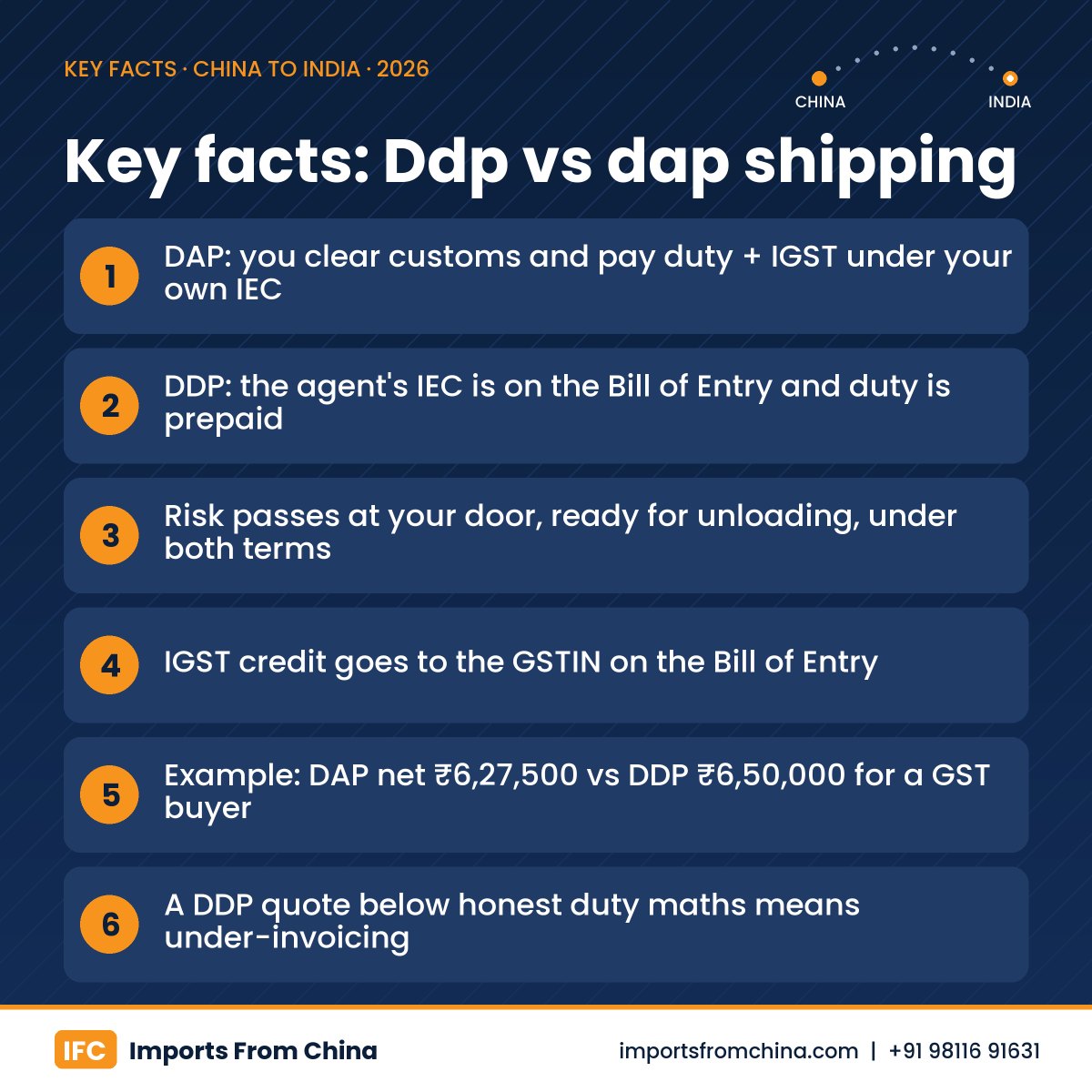
A low freight-only rate can end up costlier than a higher all-in rate once local charges and clearance are added. Read our guides to how DDP shipping from China to India works and DDP vs DAP before you sign off a quote.

What hidden charges add to the China to India shipping cost?

These are the charges most often missing from a cheap per-kg or per-CBM quote. Ask for each one in writing.

At the Indian port or airport

  • Delivery Order (DO) fee: charged by the shipping line or its agent to release the cargo to you.
  • Terminal Handling Charges (THC): for handling at the port terminal.
  • CFS charges: for de-stuffing an LCL container at the Container Freight Station, often per CBM with a minimum, plus storage after the free days.
  • Airport cargo terminal charges: handling and storage per kg at the air cargo complex.
  • Demurrage and detention: daily charges if documents or duty payment are delayed.

Clearance and taxes

  • CHA fees: the customs broker’s charge for filing the Bill of Entry on ICEGATE and handling examination.
  • GST on services: most Indian logistics and CHA service charges attract GST, so a ₹10,000 service bill is more than ₹10,000 in cash.
  • Customs duty and IGST: BCD, Social Welfare Surcharge and IGST on the goods, plus anti-dumping duty on some products.
  • Compliance costs: BIS, WPC, FSSAI, EPR or other certifications if your product needs them. Missing approvals can hold cargo at port and add storage.

Inside India

Transport from Nhava Sheva, Mundra, Chennai or Kolkata to your city, or from ICD Tughlakabad / Patparganj to your godown in Delhi NCR, plus loading and unloading. For timelines by port, see how long sea shipping from China to India takes.

Worked example: 100 kg from China to India by air vs sea in ₹

Let us take a real-world MSME order: textile handbags (HS 4202 22 90), invoice value USD 1,000, 100 kg gross weight, 0.5 CBM. The figures below are an IFC calculator estimate taken from the IFC landed-cost engine in October 2026 (exchange rate used by the calculator that day: ₹100 per USD; duty rates for this HS code: BCD 15%, SWS 10% of BCD, IGST 18%). They are estimates, not a final quote.

Step 1: chargeable weight

By air, 0.5 CBM x 167 = 83.5 kg volumetric. Actual weight is 100 kg, so chargeable weight is 100 kg. By sea, you pay on 0.5 CBM (the 1 CBM minimum may apply on a freight-only LCL quote; a consolidator who loads mixed containers can price smaller lots).

Step 2: landed cost comparison

LineSea (LCL)Air cargo
A. Invoice value (USD 1,000)₹1,00,000₹1,00,000
B. Freight + clearance + door delivery₹10,000₹57,500
C. Insurance₹1,125₹1,125
D. CIF / assessable value (A+B+C)₹1,11,125₹1,58,625
E. Basic Customs Duty 15%₹16,669₹23,794
F. SWS (10% of BCD)₹1,667₹2,379
G. Value for IGST (D+E+F)₹1,29,461₹1,84,798
H. IGST 18%₹23,303₹33,264
Total landed cost₹1,52,764₹2,18,062
Logistics cost per kg (B ÷ 100 kg)about ₹100/kgabout ₹575/kg
Landed cost per kgabout ₹1,528/kgabout ₹2,181/kg
IFC calculator estimate, Oct 2026. Exchange rate, freight and duty change; get a confirmed quote before ordering.

Step 3: what this tells you

  • Air cost ₹65,298 more for the same 100 kg – about 43% more landed cost.
  • Only ₹47,500 of that is extra freight. The rest (about ₹17,800) is extra duty and IGST, because duty is charged on CIF value, and CIF includes freight.
  • IGST is usually creditable. If you are GST registered and the goods are for business, the IGST paid can generally be claimed as input tax credit, so your true cost difference is lower – but you still need the cash on the day.
  • Pick air only when speed pays: for example a stock-out, a seasonal launch or a high-value item where 2-3 weeks of capital locked in sea transit costs more than the freight gap.

For the full comparison of speed, risk and cost, read air freight vs sea freight from China to India.

China to India import duty calculator: why duty is separate from freight

A per-kg freight rate never tells you the duty, because duty depends on your product’s HS code and invoice value, not on its weight. Two 100 kg shipments – one of plastic toys, one of LED lights – can have very different duty bills. The basic formula is:

  1. Assessable value = CIF value (cost + insurance + freight), with a 1% landing charge added where applicable.
  2. BCD = assessable value x BCD rate for your HS code.
  3. SWS = 10% of BCD.
  4. IGST = (assessable value + BCD + SWS) x IGST rate.

Check the current tariff on the CBIC website and import policy conditions on DGFT. For a full explanation with examples, read our guide to import duty from China to India and how to find the right HS code. To see freight, duty and GST together, use the IFC shipment calculator.

What is the cheapest logistics from China to India?

For most commercial goods, sea LCL through a consolidator is the cheapest per kg once you cross roughly 100-150 kg, and FCL becomes cheaper per CBM once you fill most of a container. Here is how to cut your per-kg cost without cutting corners.

  • Consolidate suppliers: collect goods from several suppliers into one shipment so you pay fixed charges (DO, CHA, documentation) once, not five times.
  • Fix your packing: ask the supplier to reduce carton size and empty space. Lower CBM means lower sea cost and lower volumetric weight by air.
  • Plan ahead: order early enough to use sea. Most air bills come from last-minute buying.
  • Hit the next slab: if you must fly, check whether 100 kg or 300 kg rates beat a smaller shipment’s total.
  • Get the HS code and paperwork right: wrong classification or missing import documents lead to port delays and storage – the most avoidable hidden cost.
  • Choose LCL or FCL by volume: see LCL vs FCL from China to India for the break-even point.

How do you compare a shipping agent’s China to India price?

The lowest number on WhatsApp is not always the lowest cost. Use this checklist when you compare shipping agent prices from China to India:

  • Is the rate per kg on actual weight or chargeable weight? Ask for the volumetric rule in writing.
  • Is it airport/port to airport/port, door-to-door, or DDP with duty paid?
  • Which Indian charges are included – DO, THC, CFS, CHA, delivery? Is GST on services extra?
  • Will goods be cleared in your name with a proper Bill of Entry so you can claim IGST credit?
  • What is the minimum chargeable weight or CBM?
  • Who pays if customs examines the cargo or re-assesses the value?

An agent who answers all six clearly is usually worth more than one who only sends a per-kg number. Our guide on how to verify a China import agent in India covers the warning signs.

How IFC helps

IFC – Imports From China has 20+ years of China-India import experience, since 2004. We have our own offices in Guangzhou and Yiwu with English-speaking staff and translators, and our head office and warehouse are in Kirti Nagar, New Delhi.

  • Daily loading: we load mixed containers (LCL consolidation) and air cargo daily, so smaller MSME lots can move without waiting for a full container.
  • Pickup and consolidation: goods from different suppliers are collected and consolidated in Guangzhou or Yiwu.
  • Customs clearance and DDP: duty-paid clearance and door-to-door delivery to Delhi, Gurugram, Noida, Mumbai, Bengaluru, Hyderabad, Pune, Chennai, Ahmedabad and more.
  • Before shipping: supplier search and verification, factory and quality inspection, and payment support.
  • Transparent estimates: the free shipment calculator shows freight, duty and GST line by line, like the example above.

Conclusion

The China to India shipping cost per kg is only one piece of your import cost. Express is the costliest per kg, air cargo sits in the middle, and sea LCL is the cheapest for most MSME orders – but you only see the true picture when you add chargeable weight, Indian local charges, CHA, duty and GST. Compare quotes on landed cost, not on the headline per-kg number, and plan early so you can ship by sea whenever speed is not critical.

Get your real landed cost: enter your product, weight and CBM in the IFC shipment calculator, or call IFC on +91 98116 91631 for a door-to-door DDP quote from China to your city.

Frequently asked questions

What is the cheapest way to ship 100 kg from China to India?

Sea LCL through a consolidator is usually the cheapest way to ship 100 kg from China to India. In the IFC calculator estimate above, 100 kg (0.5 CBM) cost about ₹10,000 by sea for freight, clearance and delivery, against about ₹57,500 by air. Sea takes longer, so plan your order two to four weeks earlier.

How is volumetric weight calculated for air cargo from China?

For air cargo, volumetric weight is CBM x 167, because airlines treat 1 cubic metre as 167 kg. For courier, it is length x width x height in centimetres divided by 6,000. You pay on whichever is higher, actual weight or volumetric weight, which is called chargeable weight.

Does the per kg shipping rate include customs duty?

Usually not. Most per-kg rates are freight-only or door-to-door without duty. Customs duty and IGST depend on your HS code and invoice value, not on weight. Only a DDP (delivered duty paid) quote includes duty and taxes. Always ask the agent in writing what the per-kg price covers.

Is sea freight from China to India charged per kg?

No. Sea LCL is charged per CBM or per revenue tonne (1 CBM or 1,000 kg, whichever is more), often with a 1 CBM minimum. FCL is charged per container. Some door-to-door agents convert this into a per-kg price for convenience, but the real cost driver is your volume.

Why does air freight increase my import duty?

Indian customs charges duty on the assessable value, which is based on CIF: cost, insurance and freight. Higher freight means a higher CIF value, so Basic Customs Duty, the Social Welfare Surcharge and IGST all rise. In our 100 kg example, air added about ₹17,800 of extra duty and IGST over sea.

What local charges are paid at the Indian port for LCL cargo?

Common destination charges for LCL are the Delivery Order (DO) fee, Terminal Handling Charges, CFS de-stuffing and storage charges, CHA clearance fees, and GST on these services. Demurrage applies if clearance is delayed. These fixed charges matter most on small shipments, so ask for them in writing before booking.

How long does sea shipping from china to india take

How Long Does Sea Shipping from China to India Take? Port-by-Port Transit Times (2026)

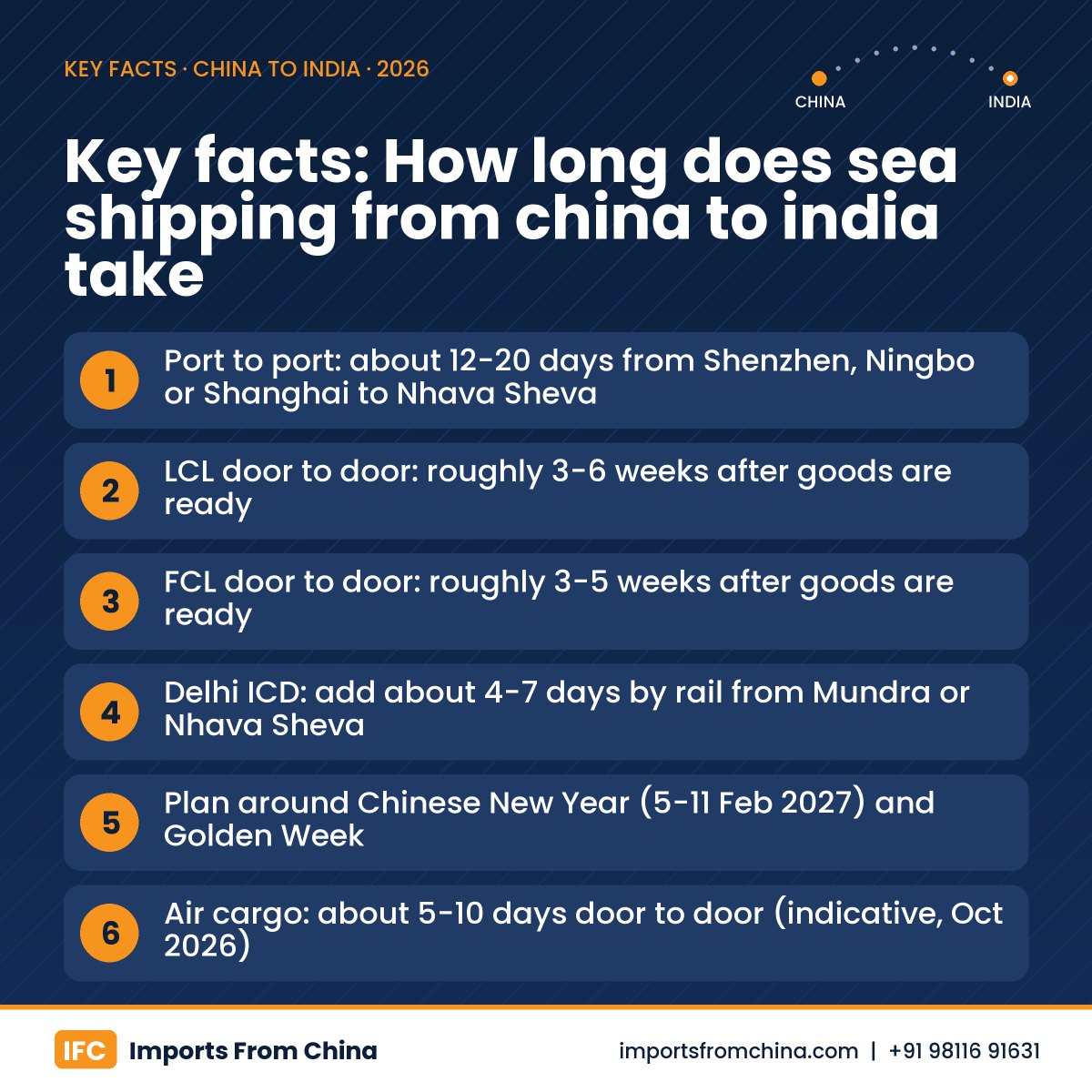
How long does sea shipping from China to India take? Port to port, most sailings from South and East China reach Nhava Sheva (JNPT), Mundra or Chennai in about 12 to 20 days. Door to door, after your goods are ready, plan on roughly 3 to 6 weeks for LCL and 3 to 5 weeks for a full container, including consolidation, customs clearance and delivery.

This guide breaks that time down port by port, shows every stage from the supplier’s factory to your warehouse, explains why shipments run late, and gives a worked rupee example of the duty money you must have ready when the ship arrives. All transit times are indicative, October 2026.

Key takeaways

  • Port to port: about 12 to 20 days from Shenzhen, Guangzhou, Ningbo or Shanghai to Nhava Sheva, Mundra or Chennai.
  • Door to door: roughly 3 to 6 weeks for LCL and 3 to 5 weeks for FCL, counted from the day goods are ready in China.
  • The sailing is only half the time: trucking in China, consolidation, port cut-offs, CFS handling, customs and inland delivery add 1 to 3 weeks.
  • Delhi and inland cities: add about 4 to 7 days for rail to an ICD such as Tughlakabad or Patparganj, or road from the port.
  • Biggest delays: late or wrong documents, missing BIS or other approvals, customs examination, transhipment and Chinese holidays.
  • Air is the fast option: about 5 to 10 days door to door, at a much higher cost per kg.

How long does sea shipping from China to India take, port to port?

The time on the water depends mainly on which Chinese port your cargo leaves from, which Indian port it arrives at, and whether the vessel sails direct or changes ship (transhipment) at a hub such as Singapore, Port Klang or Colombo. South China ports (Shenzhen, Guangzhou) are closest to India, so they usually give the shortest sailings. North China ports (Qingdao, Tianjin) add several days.

From (China)To (India)Typical port-to-port daysNotes
Shenzhen (Yantian, Shekou), Guangzhou (Nansha)Nhava Sheva (JNPT)12 to 18Most frequent direct services; Yiwu and Guangzhou cargo often leaves from here or Ningbo
Ningbo, ShanghaiNhava Sheva (JNPT)14 to 20Main ports for Yiwu, Zhejiang and Jiangsu suppliers
Shenzhen, GuangzhouMundra12 to 18Good for Gujarat, Rajasthan and North India by road or rail
Shenzhen, Shanghai, NingboChennai11 to 18East coast port; suits Chennai, Bengaluru and Hyderabad
Shenzhen, NingboKolkata or Haldia14 to 22Often transhipped; river port limits add time
Qingdao, TianjinNhava Sheva or Chennai18 to 26Longer route from North China; fewer direct sailings
Any main portICD Tughlakabad or Patparganj (Delhi)18 to 28Sea to Mundra or Nhava Sheva plus about 4 to 7 days by rail

These are vessel times, indicative for October 2026. Carriers change their schedules every season, and a sailing that is “16 days” on paper can become 20 if the ship waits at a busy transhipment hub. Treat any single number as a target, not a promise.

How long does sea shipping from china to india take infographic – key facts for Indian importers
How long does sea shipping from china to india take: key facts at a glance (IFC – Imports From China)

How long does it take door to door, from the supplier to your warehouse?

Importers often hear “15 days by sea” and plan their stock around it. In reality, the sailing is only one stage. Before the ship leaves, goods must move from the factory to a warehouse or port, be consolidated or stuffed, and clear Chinese export customs. After the ship arrives, the container is unloaded, destuffed at a Container Freight Station (CFS) if it is LCL, cleared by Indian customs and delivered.

StageLCL (shared container)FCL (full container)
Supplier to warehouse or factory loading1 to 3 days1 to 2 days (container goes to factory)
Consolidation and loading cut-off3 to 7 days, depends on the next sailing2 to 4 days to reach port before cut-off
China export clearance1 to 2 days1 to 2 days
Sea voyage to Indian port12 to 20 days12 to 20 days
Unloading and CFS destuffing2 to 4 days1 to 2 days
Indian customs clearance1 to 4 working days1 to 4 working days
Delivery to your city1 to 7 days1 to 7 days
Typical total after goods are readyabout 3 to 6 weeksabout 3 to 5 weeks

LCL usually takes about a week longer than FCL because your cartons wait for the consolidated container to close and are unloaded and sorted at a CFS in India. Our guide to LCL shipping from China to India explains consolidation in detail and when a full container becomes the better choice.

Do not forget production time

The door-to-door figures above start when goods are packed and ready. If your supplier still has to make them, add the production lead time, which is commonly 7 to 15 days for ready stock and 20 to 45 days for custom or branded goods. Ask your supplier for a written ready date, not “soon”.

What does a real sea shipment timeline look like?

Here is a realistic example for 4 CBM of plastic household goods bought from several suppliers in Yiwu and shipped LCL to a buyer in Delhi. Day 0 is the day the last supplier delivers to the China warehouse.

  1. Day 0 to 2: cartons received, counted, weighed and measured at the warehouse; packing list finalised.
  2. Day 3 to 6: cargo loaded into the next consolidated container and trucked to Ningbo port; export declaration filed.
  3. Day 7: vessel sails. The bill of lading is issued and the documents are shared for your Bill of Entry.
  4. Day 23: vessel arrives at Nhava Sheva after about 16 days at sea.
  5. Day 24 to 27: container moves to the CFS and is destuffed; the Bill of Entry is assessed, duty is paid and Out of Charge is given.
  6. Day 28 to 33: goods travel by road to Delhi and are delivered.

Total: about 4 to 5 weeks from goods-ready to delivery, which sits in the middle of the 3 to 6 week LCL range. If the cargo had missed the Day 6 cut-off, the whole plan would move back by the gap to the next sailing.

Worked example: the duty money you need when the ship arrives

Arrival is also when you must pay customs duty and IGST, and a delay in arranging funds is one of the most common reasons cargo sits at the port. For the same shipment, assume a supplier invoice of USD 5,000 FOB and USD 350 for sea freight and insurance to Nhava Sheva, so the CIF value is USD 5,350. We use the customs exchange rate of about ₹95.90 per USD notified for imports from 16 October 2026; check the current CBIC rate before filing. The assessable value is the CIF value (there is no separate 1% landing charge since 2017). Plastic household articles under HS 3924 90 90 carry 15% BCD and 18% IGST.

LineWorkingAmount (₹)
Assessable value (CIF)USD 5,350 × ₹95.905,13,065
Basic customs duty (BCD)15% of assessable value76,960
Social Welfare Surcharge (SWS)10% of BCD7,696
IGST18% of (5,13,065 + 76,960 + 7,696) = 18% of 5,97,7211,07,590
Total duty and IGST due at arrivalBCD + SWS + IGST1,92,246

Add the goods (USD 5,000 × ₹95.90 = ₹4,79,500) and an LCL door-to-door charge of roughly ₹9,000 to ₹16,000 per CBM (indicative, October 2026), or ₹36,000 to ₹64,000 for 4 CBM, which covers the freight assumed in the CIF value. The landed cost in Delhi comes to roughly ₹7,07,700 to ₹7,35,700. If you import under your own IEC and GSTIN, the IGST of ₹1,07,590 can normally be claimed as input tax credit. Rates as of October 2026; confirm for your exact HS code on our India import duty rates page, or run your own numbers in the IFC shipment calculator.

Why do sea shipments from China to India get delayed?

Most delays are not caused by the ship. They happen on land, before loading or after arrival, and many of them are avoidable.

  • Supplier not ready on time: the commonest delay. A few days late can mean missing the weekly sailing and losing a full week.
  • Missed cut-off or rolled cargo: in busy weeks, carriers can “roll” cargo to the next vessel if space is short.
  • Transhipment waits: if your box changes ship at a hub, it can wait several days for the connecting vessel.
  • Document mismatches: invoice, packing list and bill of lading that do not match on quantity, value or description lead to queries. Our checklist of documents required for import from China to India helps you get them right.
  • Compliance holds: goods that need BIS registration, WPC approval, FSSAI clearance or CDSCO registration cannot be cleared without them.
  • Customs examination and valuation queries: the Risk Management System selects some Bills of Entry for document checks or physical examination, which adds one or more days.
  • Duty not funded: the Bill of Entry cannot move to Out of Charge until duty is paid.

For a sense of scale, CBIC’s National Time Release Study 2025 reported that release times at seaports improved compared with 2023, yet only about half of seaport import cargo met its release-time benchmark. Clean documents and prompt duty payment are what put your shipment in the faster half. Our step-by-step guide on how customs clearance works for imports in India explains each stage.

Which seasons make China to India shipping slower?

PeriodWhat happensWhat to do
Chinese New Year (official holiday 5 to 11 February 2027)Factories close for a week or more; many workers return late, and production slows from mid-JanuaryPlace orders by early December and aim to ship before mid-January
Golden Week (1 to 7 October each year)Factories and many offices close; cargo bunches up before and afterLoad before late September or plan for the week after
Pre-Diwali peak in India (about August to October)Heavy import demand; containers and space fill upShip festive stock by August or early September
Indian monsoon (about June to September)Rain can slow port handling and road delivery on the west coastAdd a few days of buffer for Mumbai and Gujarat deliveries

Holiday dates change each year, so check the exact Chinese public holiday notice when you plan orders around them.

Is sea or air faster, and when is air worth it?

ModeDoor-to-door time (indicative, Oct 2026)Indicative costBest for
Sea LCL3 to 6 weeks₹9,000 to ₹16,000 per CBM door to door1 to about 15 CBM of regular stock
Sea FCL3 to 5 weeksPer container; quote neededLarger volumes, furniture, machinery
Air cargo5 to 10 days₹350 to ₹600 per kg door to doorUrgent, light or high-value goods
CourierUsually under a week₹450 to ₹900 per kgSamples and small parcels

Sea is far cheaper per kg for most goods, so the usual approach is to send the main stock by sea and use air only for samples, urgent top-ups or small, valuable items. See our comparison of air freight vs sea freight from China to India for chargeable weight and a cost comparison.

How can you track a sea shipment and shorten the total time?

Tracking

  • Before sailing: ask for the warehouse receipt (cartons, weight, CBM) and the booking details with the vessel name.
  • At sea: track the bill of lading or container number on the shipping line’s website.
  • In India: once the Bill of Entry is filed, its status can be checked on ICEGATE using the port code, Bill of Entry number and date.

Seven ways to save days

  1. Get a firm, written ready date from the supplier and confirm it a week before.
  2. Book space as soon as the ready date is known, especially before festivals.
  3. Choose the Indian port closest to your market: Chennai for South India, Mundra or Nhava Sheva for the West, and rail to an ICD for Delhi NCR.
  4. Check BIS, WPC, FSSAI or CDSCO needs before you order, not after the goods land.
  5. Make sure the invoice, packing list and bill of lading match exactly, with the correct HS code.
  6. File the Bill of Entry early; customs law allows advance filing before the vessel arrives, and late filing attracts charges.
  7. Keep the duty amount ready for e-payment on ICEGATE before the vessel arrives.

Official procedures and notifications are published by the Central Board of Indirect Taxes and Customs (CBIC). For a short answer on other modes, see our FAQ on how long goods take to reach India from China.

How IFC helps you ship from China to India on time

IFC, Imports From China Inc, has worked in China to India import and export since 2004, more than 20 years. IFC has its own offices in Guangzhou and Yiwu with translators and English-speaking staff, loads mixed containers and air cargo daily, and keeps a warehouse at its headquarters.

  • Daily loading: because mixed containers and air cargo are loaded daily, your cargo does not have to wait long for a consolidation to close.
  • One team end to end: sourcing, supplier verification, quality inspection, LCL and FCL sea freight, air cargo, customs clearance and DDP delivery.
  • Door-to-door DDP: delivery to major Indian cities including Delhi, Gurugram, Noida, Mumbai, Pune, Bengaluru, Hyderabad, Chennai and Ahmedabad. See our door-to-door shipping from China to India service.

If you want one price that covers freight, duty and delivery, ask IFC for a DDP quote with your product, HS code, weight and CBM.

Conclusion

Sea shipping from China to India takes about 12 to 20 days on the water, but your real planning number is the door-to-door time: roughly 3 to 6 weeks for LCL and 3 to 5 weeks for FCL after goods are ready, plus production time. Pick the right port for your city, keep documents and approvals ready, have duty funds in place before arrival, and plan around Chinese New Year and the pre-Diwali rush. Do that, and most shipments arrive close to plan.

Get your real landed cost: enter your product, weight and CBM in the IFC shipment calculator, check your HS code on the India import duty rates page, or call IFC on +91 98116 91631 for a door-to-door DDP quote from China to your city.

Frequently asked questions

How many days does a ship take from China to India?

Most sailings from Shenzhen, Guangzhou, Ningbo or Shanghai reach Nhava Sheva, Mundra or Chennai in about 12 to 20 days, port to port. North China ports such as Qingdao and Tianjin take longer, and transhipment at a hub like Singapore or Colombo can add several days. These are indicative times as of October 2026.

How long does LCL shipping from China to India take door to door?

Plan on roughly 3 to 6 weeks from the day your goods are ready in China. That covers warehouse receipt, consolidation and the loading cut-off, the sea voyage, CFS destuffing, customs clearance and delivery to your city. Production time at the factory comes on top of this.

How long does it take to ship from China to Delhi by sea?

Delhi has no seaport, so cargo lands at Mundra or Nhava Sheva and then moves by rail to an ICD such as Tughlakabad or Patparganj, or by road. Add about 4 to 7 days to the sea time. Door to door, LCL to Delhi usually takes about 4 to 6 weeks after goods are ready.

Why is my shipment from China taking longer than the quoted transit time?

The quoted figure is often only the sailing time. Common extra delays are a supplier missing the ready date, a missed loading cut-off, transhipment waits, document mismatches, missing BIS or other approvals, a customs examination, or duty not being paid on time.

Is Chennai or Nhava Sheva faster for goods from China?

Chennai is on the east coast, so sailings from China are often a few days shorter, and it is the natural choice for Chennai, Bengaluru and Hyderabad. Nhava Sheva has more direct services and suits Mumbai, Pune and West India. Choose the port closest to where the goods will be sold.

Can I get goods from China faster than by sea?

Yes. Air cargo usually takes about 5 to 10 days door to door and courier often under a week, but they cost far more per kg than sea freight. Many importers send the main stock by sea and use air only for samples, urgent stock or small, high-value items.

DDP shipping China to India

How DDP Shipping from China to India Works: Door-to-Door Guide (2026)

DDP shipping from China to India means the seller or forwarder delivers your goods to your door in India with freight, customs clearance, import duty and IGST already paid, so you receive one all-in price and no surprise bills at the port. The shipment moves from the Chinese supplier to a forwarder warehouse, onto a ship or aircraft, through Indian customs, and by truck to your address.

This guide explains each step of DDP door-to-door shipping, who legally imports the goods, what a DDP quote must include, a worked cost example in rupees, and the checks that protect you from weak quotes.

Key takeaways

  • One price: DDP bundles freight, customs duty, IGST, clearance and delivery to your door.
  • Importer of record: the forwarder usually clears under its own IEC and bills you on a GST invoice, so check how the invoice is raised.
  • Time: air is roughly 5 to 10 days door to door; LCL sea roughly 3 to 6 weeks (indicative, October 2026).
  • Duty is the big variable: it depends on your HS code, so confirm the code before you accept a per-kg or per-CBM rate.
  • Read the exclusions: BIS or other approvals, demurrage and detention, and examination charges are often not in a basic DDP rate.
  • 20+ years: IFC has run China to India door-to-door shipments since 2004.

What is DDP shipping from China to India?

DDP stands for Delivered Duty Paid, an Incoterms rule where the seller carries cost and risk until the goods reach the named place, with import clearance and duties paid. In China to India trade, the word is used a little more loosely. Most Indian buyers mean a door-to-door service: a forwarder collects from the supplier or from its Guangzhou or Yiwu warehouse, ships by sea or air, clears customs in India, pays duty, and delivers to the buyer.

That is different from DAP or CIF, where the buyer arranges Indian clearance and pays duty separately. If you are weighing the two models, read our comparison of DDP vs DAP shipping for Indian importers.

DDP shipping China to India infographic – key facts for Indian importers
DDP shipping China to India: key facts at a glance (IFC – Imports From China)

How does DDP door-to-door shipping work step by step?

  1. Fix the product and HS code. The forwarder confirms what the goods are, the 8-digit HS code, and whether BIS, WPC, FSSAI or another approval applies. This decides duty and whether the cargo can be cleared at all.
  2. Supplier delivers to the China warehouse. Your supplier sends the cartons to the forwarder’s warehouse in Guangzhou, Yiwu or another consolidation point, with an invoice and packing list.
  3. Receiving, weighing and measuring. The warehouse checks carton count, marks, weight and CBM, and photographs the goods. Chargeable weight or CBM is fixed here.
  4. Export paperwork in China. The forwarder prepares the export declaration, the bill of lading or air waybill, and the final commercial invoice and packing list for India.
  5. Main transport. Sea cargo moves port to port, for example Guangzhou or Shanghai to Nhava Sheva (JNPT), Mundra or Chennai. Air cargo flies to Delhi, Mumbai or another airport.
  6. Bill of Entry and duty payment. A customs broker (CHA) files the Bill of Entry on ICEGATE, customs assesses the value and HS code, and duty and IGST are paid.
  7. Examination and Out of Charge. Customs may inspect the goods. After clearance, customs issues the Out of Charge order. Our customs clearance guide walks through this stage.
  8. Port or CFS release and trucking. The forwarder pays the delivery order and CFS or terminal charges, collects the cartons and trucks them to your warehouse.
  9. Delivery and invoice. You receive the goods, sign the proof of delivery, and get a GST invoice that you can use for your accounts.

Where do delays usually happen?

Delays come from three places: a wrong or vague product description, a missing approval such as BIS registration, and a mismatch between invoice value and the value customs expects. A good forwarder catches these before the cargo sails, not after it lands.

Who is the importer of record in a DDP shipment?

The importer of record is the party whose Import Export Code (IEC) and GSTIN appear on the Bill of Entry. In many DDP arrangements the forwarder imports under its own IEC and sells the cleared goods to you on a GST invoice. In others, you import under your own IEC and the forwarder only arranges freight, clearance and delivery. See our guide to documents required for import from China to India if you plan to use your own IEC.

Ask in writing which model applies, because it changes who is responsible for compliance, how you claim input tax credit, and what happens if customs raises a query.

Point to confirmForwarder’s IECYour own IEC
Name on Bill of EntryForwarderYou
Invoice you receiveForwarder’s GST invoice for the cleared goodsSupplier invoice plus forwarder’s service invoice
Who answers customs queriesForwarder, with your product detailsYou, assisted by the CHA
IEC needed by youNoYes
Best forNew or small importers, mixed LCL cargoRegular importers with their own IEC and GST set-up

What does a DDP price include, and what does it leave out?

A real DDP price covers the whole chain. A cheap-looking rate that leaves out duty is not DDP, it is a freight quote. Use this table to test any offer.

Cost itemUsually in a DDP quoteOften excluded, ask first
China pickup and warehouse handlingYesSpecial packing or re-labelling
International freight (sea or air)YesPeak-season surcharge
Customs duty (BCD, SWS) and IGSTYes, at the declared HS codeAnti-dumping duty or duty from a re-assessment
CHA fees, DO, CFS and port chargesYesDemurrage, detention and examination or labour charges
Trucking to your doorYes, to the agreed cityWaiting time and remote-area surcharge
BIS, WPC, FSSAI or CDSCO approvalsNot normallyAlways confirm; the product may be held without them
Marine insuranceSometimesOften optional; ask for the cover in writing

What does DDP shipping from China to India cost? A worked example in rupees

Here is a simple sea shipment of plastic kitchenware, HS 3924 10 90. We assume a supplier invoice of USD 5,000 (FOB) and USD 600 for sea freight and insurance, which makes the CIF value USD 5,600. We use the customs exchange rate of about ₹96.80 per USD notified for 1 October 2026; check the current rate on ICEGATE before filing.

LineWorkingAmount (₹)
Assessable value (CIF)USD 5,600 × ₹96.805,42,080
Basic customs duty (BCD)15% of assessable value81,312
Social Welfare Surcharge (SWS)10% of BCD8,131
IGST18% of (value + BCD + SWS) = 18% of 6,31,5231,13,674
Total duty and taxBCD + SWS + IGST2,03,117
Goods + freight + duty4,84,000 + 58,080 + 2,03,1177,45,197

The ₹7,45,197 is before Indian clearance, CFS and trucking charges, which a DDP rate bundles in. Rates as of October 2026; confirm for your exact HS code on our India import duty rates page, or run your own numbers in the IFC shipment calculator.

Notice that duty and IGST are about 27% of the total in this example. That is why the HS code matters more than a few rupees of freight difference, and why a quote given without an HS code should not be trusted.

Sea vs air DDP: which should you choose?

Choose by the value and urgency of the goods, not only by freight rate. Our full comparison of air freight vs sea freight from China to India covers chargeable weight in detail. The short version is below. All figures are indicative, October 2026.

FactorSea (LCL or FCL)Air cargo
Door-to-door timeAbout 3 to 6 weeks for LCLAbout 5 to 10 days
Port-to-port sea transitRoughly 12 to 20 days to Nhava ShevaNot applicable
Indicative door-to-door costLCL roughly ₹9,000 to ₹16,000 per CBMRoughly ₹350 to ₹600 per kg
Best forBulky, lower-value-per-kg goodsSamples, urgent, high-value or light goods
Rate basisPer CBM or per containerChargeable weight (higher of actual and volumetric)

If you are unsure about LCL economics, read how LCL shipping from China to India is priced, and when a full container becomes cheaper in our FCL vs LCL guide.

What are the risks of DDP shipping, and how do you reduce them?

DDP is convenient, but convenience can hide weak spots. These are the ones we see most often with Indian buyers.

  • Under-declared value. A very low rate may rely on a low invoice value. If customs challenges it, the cargo is delayed and the cost lands on you.
  • Wrong HS code. A cheaper code can mean a re-assessment later. Check the code against the CBIC tariff and the India import duty rates page.
  • Restricted or approval-linked goods. Electronics, toys, footwear, furniture and food contact items can need BIS, WPC or FSSAI compliance. Confirm before you buy, not after the goods arrive.
  • Vague quote. If the quote says “all inclusive” without listing duty, clearance, CFS and delivery, ask for the line items.
  • No tracking. You should get the warehouse receipt, bill of lading or air waybill number, Bill of Entry number and delivery proof.

Official references worth bookmarking are the customs tariff and notifications on cbic.gov.in, Bill of Entry status on ICEGATE, and import policy on DGFT.

How to compare two DDP quotes

  1. Give both forwarders the same product description, HS code, carton count, weight, CBM and destination pincode.
  2. Ask each to list duty, IGST, clearance, port or CFS, freight and delivery as separate lines.
  3. Ask whose IEC will be used and what invoice you will receive.
  4. Ask for the validity of the rate and what happens if weight or CBM changes at the warehouse.
  5. Ask for the transit time from warehouse receipt, not from the day you pay.
  6. Compare the all-in landed cost per piece, not only the per-kg or per-CBM rate.

How IFC helps with DDP shipping from China to India

IFC, Imports From China Inc, has been moving cargo between China and India since 2004, which is more than 20 years of experience. IFC has its own offices in Guangzhou and Yiwu with translators and English-speaking staff, loads mixed containers and air cargo daily, and keeps a warehouse at its headquarters.

  • Services: sourcing, supplier verification, quality inspection, LCL and FCL sea freight, air cargo, customs clearance and door-to-door DDP delivery.
  • Delivery cities: major Indian cities including Delhi, Gurugram, Noida, Mumbai, Pune, Bengaluru, Hyderabad, Chennai and Ahmedabad.
  • Clear costing: share your product, HS code, weight and CBM and IFC can give a line-by-line landed cost before you commit.

You can see how IFC structures the service on the DDP shipments from China to India page or ask for a quote through Get a Quote.

Conclusion

DDP shipping from China to India works best when the product, HS code and approvals are settled first, the quote is itemised, and the importer of record is agreed in writing. Do those three things and door-to-door shipping saves time, paperwork and cost surprises.

Get your real landed cost: enter your product, weight and CBM in the IFC shipment calculator, check your HS code on the India import duty rates page, or call IFC on +91 98116 91631 for a door-to-door DDP quote from China to your city.

Frequently asked questions

What does DDP mean in shipping from China to India?

DDP means Delivered Duty Paid. The goods are delivered to your address in India with freight, customs clearance, import duty and IGST already paid, so you pay one agreed price and do not handle port formalities yourself.

Is DDP shipping from China to India legal?

Yes. Forwarders clear cargo through customs brokers and pay duty on the Bill of Entry. What matters is that the invoice value, HS code and importer details are declared correctly, and that any BIS or other approval is in place.

How long does DDP shipping from China to India take?

Air cargo is roughly 5 to 10 days door to door and LCL sea cargo roughly 3 to 6 weeks. These are indicative figures for October 2026 and depend on the route, customs examination and the final delivery city.

Do I need an IEC for DDP shipping?

Not always. If the forwarder imports under its own IEC and invoices you for the cleared goods, you do not need one. If you want to import in your own name, you need an IEC and a GSTIN. Confirm the model before you pay.

Is DDP cheaper than arranging freight and clearance separately?

It is not always cheaper, but it is simpler and the total is known upfront. Buying freight and clearance separately can be cheaper for regular importers with their own IEC and broker, but surprise port charges are more likely.

What can make a DDP shipment from China to India get stuck?

Common causes are a wrong HS code, an under-declared invoice value, missing BIS or WPC approval, and incomplete documents. Settling these before shipping avoids most holds, demurrage and re-assessment costs.

Ddp vs dap shipping

DDP vs DAP Shipping: Which Is Better for Indian Importers? (2026)

In DDP vs DAP shipping, the difference is who imports the goods into India. Under DAP, the seller delivers to your door, and you clear customs and pay duty and IGST under your own IEC. Under DDP, the seller or its agent clears customs and pays the duty, so you receive goods with all taxes paid. GST-registered businesses usually save more with DAP. Small buyers without an IEC usually find DDP simpler.

This guide covers the Incoterms 2020 rules, who pays for what, whose IEC and GSTIN go on the Bill of Entry, input tax credit, a worked ₹ example, and red flags in cheap “DDP” quotes.

Key takeaways

  • One real difference: under DAP the buyer handles Indian import clearance, duty and IGST. Under DDP the seller’s side does.
  • Same risk point: under both terms, risk passes to you when the goods reach your named place, ready for unloading.
  • Importer of record: the Bill of Entry carries the importer’s IEC and GSTIN. Only that party can claim the IGST paid at customs as credit.
  • GST-registered buyers: DAP under your own IEC gives you direct IGST credit and a lower net cost. With DDP, you can only claim credit if the provider gives you a proper GST tax invoice.
  • Small or unregistered buyers: DDP saves you from getting an IEC, hiring a CHA and dealing with port delays. You pay for that convenience.
  • Red flag: if a DDP quote is lower than the goods value plus honest duty and freight, someone is under-invoicing or misusing courier channels.

What is DDP shipping, and what is DAP?

DDP and DAP are two of the 11 Incoterms® 2020 rules published by the International Chamber of Commerce (ICC). They decide who pays for each step, who handles customs, and where risk passes from seller to buyer. They do not decide price or ownership; your contract does.

Ddp vs dap shipping infographic – key facts for Indian importers
Ddp vs dap shipping: key facts at a glance (IFC – Imports From China)

DAP: Delivered at Place

Under DAP, the seller arranges and pays for transport to a place you name, such as your warehouse in Bhiwandi or your shop in Karol Bagh. It also clears the goods for export in China. Delivery is complete when the goods arrive at that place on the truck, ready for unloading. You handle Indian import clearance and pay Basic Customs Duty (BCD), the Social Welfare Surcharge (SWS), IGST and any other import charges.

DDP: Delivered Duty Paid

DDP covers everything in DAP, plus import clearance and every import duty and tax. The ICC describes DDP as the term with the most obligations for the seller. A Chinese factory has no Indian IEC or GSTIN and cannot file a Bill of Entry, so in China-to-India trade, “DDP” almost always means an Indian import agent or forwarder imports the goods under its own IEC and then delivers them to you.

DDP vs DAP shipping: who pays for what?

Who handles each step on a typical Guangzhou or Ningbo to India shipment:

Step / costDAP (buyer imports)DDP (seller side imports)
Packing, loading at the factory in ChinaSellerSeller
China export clearanceSellerSeller
Sea or air freight to IndiaSellerSeller
Destination port/CFS charges, delivery orderUsually buyer (agree in writing)Seller
Bill of Entry filing on ICEGATE (CHA fee)BuyerSeller
BCD, SWS, AIDC, anti-dumping dutyBuyerSeller
IGST at customsBuyer (credit available if GST-registered)Seller (charged to you as GST on its invoice)
BIS, WPC, FSSAI, CDSCO, EPR complianceBuyer as importerImporter of record, but the goods must comply either way
Inland delivery to your doorSellerSeller
Unloading at your premisesBuyerBuyer
Demurrage if customs holds the goodsBuyerSeller

Where does risk pass to the buyer?

Under both DAP and DDP, risk passes to you only when the goods arrive at the named place, ready for unloading. Damage at sea or on the truck from Nhava Sheva to Pune is the seller’s risk. The practical difference is customs: under DAP, delays and port storage from an examination or valuation query are your problem; under DDP, they are the seller’s.

Who files the Bill of Entry, and whose IEC and GSTIN are used?

Every commercial import into India is cleared on a Bill of Entry. A licensed customs broker (CHA) files it on ICEGATE in the importer’s name. The Bill of Entry shows the importer’s IEC, GSTIN, invoice value, HS code and the duty assessed. Whoever’s name appears there is the importer of record in the eyes of Indian customs.

  • Under DAP: your IEC and GSTIN go on the Bill of Entry. You or your CHA pays duty through ICEGATE e-payment. You are responsible for correct value, HS code and product compliance.
  • Under DDP: the agent’s IEC and GSTIN go on the Bill of Entry. The agent pays the duty and owns the customs record, then sells or delivers the goods to you in India.
  • What you need for DAP: an IEC from DGFT (PAN-based, applied for online), a GSTIN if you want IGST credit, a CHA at the arrival port (Nhava Sheva/JNPT, Mundra, Chennai, Kolkata, or an ICD such as Tughlakabad or Patparganj for Delhi NCR), plus invoice, packing list, bill of lading and any BIS/WPC/FSSAI papers.

Always ask a DDP provider whose IEC the goods will clear under, and ask for a copy of the Bill of Entry or at least its number. If a provider won’t say, don’t use it.

DDP vs DAP in India: how does GST input tax credit change the cost?

For a GST-registered business, this question matters more than any other. IGST paid at customs is not a final cost if you can claim it back. CBIC’s GST guidance note for importers says the importer can claim IGST credit based on the GSTIN declared in the Bill of Entry. BCD is not creditable. The IGST appears in the import section of your GSTR-2B and is claimed in GSTR-3B.

  1. DAP under your own IEC: you pay IGST at customs and claim the full amount as credit. Only BCD, SWS (and AIDC or anti-dumping duty, where they apply) become real costs.
  2. DDP with a proper GST tax invoice: the agent claims the customs IGST and then charges you GST on its sale price. If the invoice shows your GSTIN and the agent files its returns, you claim that GST. You lose nothing on tax, but you pay the agent’s margin.
  3. DDP with no tax invoice (cash or “kachha” bill): you claim nothing. The goods also sit in your stock with no valid purchase record, a problem at GST audits or when Amazon or Flipkart asks for purchase invoices.

If you are not GST-registered, credit does not help you either way. You bear the IGST or GST in full, so compare total rupees out of your pocket and the hassle involved.

DDP vs DAP: a worked example in rupees

Take one LCL shipment of plastic kitchen storage containers (HS 3924 10 90) by sea from Ningbo to Nhava Sheva, delivered to a warehouse in Bhiwandi. In IFC’s duty data, this code carries BCD 15%, SWS 10% of BCD, no AIDC and IGST 18%, with no anti-dumping duty. These rates are as of October 2026; confirm them for your exact HS code on the India import duty rates page.

Assumptions: the CIF value at Nhava Sheva (goods, sea freight and insurance, converted at the customs exchange rate) is ₹5,00,000. The assessable value equals CIF, with no extra landing charges added. Port-to-door delivery is ₹15,000. Port, CFS, delivery order and CHA charges under DAP are ₹30,000. The ₹6,50,000 DDP price is an assumed figure for illustration, not an IFC price. Freight and port charges are indicative for October 2026.

Step 1: the duty maths (the same for every honest import)

  • Assessable value: ₹5,00,000
  • BCD at 15% of ₹5,00,000: ₹75,000
  • SWS at 10% of BCD: ₹7,500
  • IGST at 18% of (₹5,00,000 + ₹75,000 + ₹7,500 = ₹5,82,500): ₹1,04,850
  • Total paid at customs: ₹1,87,350, of which ₹82,500 is real cost and ₹1,04,850 is IGST

Step 2: compare the three ways to buy

ItemDAP, your own IECDDP with GST invoice“Cheap DDP”, cash, no invoice
Price to seller / provider₹5,15,000 (CIF + delivery)₹6,50,000 + GST ₹1,17,000₹6,10,000 all-in
BCD + SWS paid by you₹82,500Included“Included”
IGST paid by you at customs₹1,04,850NoneNone
Port, CFS, CHA charges₹30,000IncludedIncluded
Cash out₹7,32,350₹7,67,000₹6,10,000
Credit if GST-registered−₹1,04,850−₹1,17,000₹0
Net cost, GST-registered buyer₹6,27,500₹6,50,000₹6,10,000 plus legal risk
Net cost, unregistered buyer₹7,32,350 (needs IEC)₹7,67,000₹6,10,000 plus legal risk

What the numbers tell you

  • Registered business: in this example, DAP under your own IEC is ₹22,500 cheaper than proper DDP. The gap is the DDP provider’s margin and the clearance risk it takes on.
  • Unregistered buyer: DDP costs about ₹34,650 more here, because GST is charged on the provider’s full price. In return, you need no IEC, no CHA and no follow-up at the port.
  • The “cheap DDP” quote: an honest import of this cargo costs ₹6,27,500 before anyone earns a margin. A ₹6,10,000 all-in price can only work if duty was underpaid, usually through a lower declared value or a false description.

For a full breakdown of each duty component, read import duty from China to India. To get a door-to-door number for your own product, use the IFC shipment calculator.

When should you choose DDP, and when DAP?

DDP usually makes sense if you:

  • Are importing for the first time, or only a few times a year, and have no IEC or CHA.
  • Are not GST-registered: an interior designer buying fittings for one project, a hotel owner buying furniture for one property, or a start-up testing samples.
  • Buy mixed small lots from several suppliers (for example from Yiwu or Guangzhou markets) that are consolidated into one LCL shipment.
  • Want one fixed delivered price and no exposure to demurrage, examination delays or port follow-up.

DAP usually makes sense if you:

  • Are GST-registered and want IGST credit in your own name, straight from the Bill of Entry.
  • Import regularly, in full containers or large LCL lots, where the provider’s margin adds up.
  • Need import documents in your own name for government tenders, BIS licences, marketplace invoice checks or bank finance.
  • Can deal with customs queries quickly and have a reliable CHA at your port.

Many businesses start with DDP and move to DAP once volumes grow, often with the same forwarder clearing the goods under your own IEC. Transit time is the same either way. Sea freight from China to Nhava Sheva usually takes about 12 to 20 days port to port. LCL usually takes 3 to 6 weeks door to door, and air cargo 5 to 10 days door to door (indicative, October 2026).

What are the red flags in cheap “DDP” quotes from China?

Many “DDP India” quotes on WhatsApp and Alibaba chats are not DDP in any legal sense. Watch for these signs:

  • A price below the duty maths: if the all-in price per kg or per CBM is lower than goods value plus BCD, SWS and freight, the duty is not being paid in full.
  • Under-invoicing: the provider asks for a “customs invoice” at a fraction of your real price. Customs can reject a declared value under the valuation rules, and mis-declared goods can be confiscated under Section 111 of the Customs Act, and penalties can follow under Section 112.
  • Courier misuse: bulk commercial cargo is split into many parcels declared as samples or gifts to avoid regular assessment. When a consignment is held, you usually have no documents and no way to get the goods back.
  • Wrong product description or HS code: for example, electronics declared as plastic household goods to avoid BIS, WPC or a higher duty rate.
  • No IEC disclosure and no GST invoice: the provider will not say whose IEC the goods clear under and offers only cash or a non-GST bill.
  • “Compliance included”: DDP does not remove BIS, WPC, FSSAI or CDSCO requirements. If the product needs an ISI mark under a Quality Control Order, the goods can be stopped no matter who pays the duty.

Before you pay, ask any DDP provider four questions. Whose IEC will the goods clear under? Will you issue a GST tax invoice with my GSTIN? What declared value and HS code will you use? What costs are not included (unloading, storage, re-delivery, upstairs carry)? You can check customs rules and notifications on CBIC. Our guide to choosing a China buying agent for India lists more checks.

How IFC helps with DDP and DAP shipments from China

IFC – Imports From China has more than 15 years of experience in China–India import and export. The team has its own offices in Guangzhou and Yiwu, with translators and English-speaking staff who deal with suppliers for you. IFC loads mixed containers and air cargo daily and runs a warehouse at its headquarters.

  • Door-to-door DDP: DDP delivery to major Indian cities, including Delhi, Gurugram, Noida, Mumbai, Pune, Bengaluru, Hyderabad, Chennai and Ahmedabad.
  • Customs clearance: for buyers who prefer to clear goods in their own name.
  • Before shipping: sourcing, supplier verification and quality inspection in China.
  • Freight options: LCL and FCL sea freight, plus air cargo for urgent goods.

Share your product, quantity and GST status with IFC to compare DDP with clearing in your own name, or request a quote online.

Conclusion: which is better for Indian importers?

Neither term is better for everyone. DAP gives a GST-registered business the lowest net cost and an import record in its own name, but you take on customs work and port risk. DDP gives first-time and unregistered buyers one delivered price and no clearance work, at a margin. Whichever you choose, run the duty maths yourself: a quote that doesn’t cover goods value, freight, BCD, SWS and IGST is passing the risk to you.

Get your real landed cost: enter your product, weight and CBM in the IFC shipment calculator, check your HS code on the India import duty rates page, or call IFC on +91 98116 91631 for a door-to-door DDP quote from China to your city.

Frequently asked questions

Is DDP or DAP better for importing from China to India?

For a GST-registered business that imports regularly, DAP under its own IEC is usually cheaper, because it claims the customs IGST directly and pays no DDP margin. For a first-time or unregistered buyer, DDP is usually simpler, because the provider handles the IEC, the CHA, duty payment and port follow-up for one delivered price.

Can I claim GST input tax credit on a DDP shipment?

Not on the customs IGST, because that credit belongs to the importer whose GSTIN is on the Bill of Entry. You can claim the GST charged on the DDP provider’s tax invoice, if it shows your GSTIN and the provider files its returns. A cash or non-GST bill gives you no credit at all.

Who is the importer of record in DDP shipping to India?

The party whose IEC and GSTIN appear on the Bill of Entry filed on ICEGATE. In China-to-India DDP this is usually the Indian import agent or forwarder, not the Chinese factory, because a foreign seller cannot normally clear goods into India without an Indian IEC and GST registration.

Do I need an IEC to import under DAP?

Yes. Under DAP you are the importer, so the Bill of Entry needs your Import Export Code from DGFT, which is PAN-based and applied for online. You also need a GSTIN to claim IGST credit, and a customs broker (CHA) at the arrival port to file the Bill of Entry for you.

What is the difference between DDP and DDU?

DDU, or Delivered Duty Unpaid, was removed in Incoterms 2010 and replaced by DAP. Under both DDU and DAP, the buyer pays import duty and taxes. Under DDP, the seller side pays them. If a supplier quotes DDU, ask them to restate the term as DAP to your address under Incoterms 2020.

Is DDP shipping legal in India?

Yes, when the goods are imported under a valid IEC, declared at their true value and correct HS code, and all duties are paid on a proper Bill of Entry. It becomes illegal when a so-called DDP service under-invoices, mis-declares goods, or splits bulk cargo into courier parcels to avoid duty.

Why is a DDP quote cheaper than the duty I calculated?

An honest DDP price cannot be lower than goods value plus freight, BCD, SWS and clearance charges. A lower quote usually means under-invoicing, a wrong HS code or courier misuse. If customs catches it, the goods can be held or confiscated, and the buyer can lose both the goods and the money paid.

Air freight vs sea freight from china to india

Air Freight vs Sea Freight from China to India: Cost, Time and Which to Choose

In the air freight vs sea freight from China to India decision, sea freight is almost always cheaper and air freight is almost always faster. As a rough guide, air cargo costs 5–8 times more than LCL sea for the same cartons, but arrives in 5–10 days instead of 3–6 weeks. Below about 30–45 kg, air or courier usually wins; above about 100 kg, sea usually wins.

This guide covers chargeable weight, indicative October 2026 rupee rates, transit times, a worked example with duty, which goods suit which mode, battery limits, and courier vs air cargo.

Key takeaways

  • Air is charged by chargeable weight: the higher of actual kg or L×W×H (cm) ÷ 6,000 for air cargo (÷ 5,000 for express courier).
  • Sea LCL is charged by CBM: usually per cubic metre with a 1 CBM minimum, or per 1,000 kg if the cargo is very heavy.
  • Indicative costs (October 2026): air cargo ₹350–600 per kg door to door vs LCL ₹9,000–16,000 per CBM door to door, both before duty.
  • Transit: air 5–10 days door to door; sea 12–20 days port to port and roughly 3–6 weeks door to door for LCL.
  • Duty rises with air freight: customs duty is charged on CIF value, but Indian valuation rules cap air freight in the assessable value at 20% of FOB.
  • Batteries change everything: power banks and loose lithium batteries are cargo-aircraft-only and many air consolidators refuse them; plan these by sea with proper DG papers.

Air freight vs sea freight from China to India: how do costs compare?

Air bills per kg and sea per CBM, so convert both to the total door-to-door cost for your exact cartons. Indicative ranges for general cargo (no batteries or other dangerous goods) from South China or Yiwu to major Indian cities:

ModeHow you are chargedIndicative cost (October 2026, before duty and IGST)Typical door-to-door timeBest for
Express courier (DHL, FedEx, UPS type)Higher of actual kg or L×W×H ÷ 5,000₹450–900 per kg for 21 kg and above; small parcels cost more per kg4–7 working daysSamples, documents, under 20–30 kg
Air cargo (airline via forwarder)Higher of actual kg or L×W×H ÷ 6,000₹280–450 per kg airport to airport; ₹350–600 per kg door to door for 100 kg and above5–10 daysUrgent or high-value stock, 30–500 kg
LCL sea (shared container)Per CBM, 1 CBM minimum (or per 1,000 kg if heavier)₹9,000–16,000 per CBM door to door for 1–5 CBM3–6 weeksMost commercial orders from 1 to about 15 CBM
FCL sea (20ft or 40ft)Per containerQuoted per container; compare against LCL from roughly 12–15 CBMAbout 3–5 weeksLarge, heavy or bulky loads

These ranges are indicative, October 2026. Rates move with fuel, capacity and festive peaks (Diwali, Chinese New Year); they are not IFC prices. Compare written quotes with the same scope: pickup, China export clearance, freight, Indian clearance, CFS or airport charges and delivery. For past published air rate cards, see our note on air freight charges from China to India; for sea, read how LCL shipping from China to India is priced.

Air freight vs sea freight from china to india infographic – key facts for Indian importers
Air freight vs sea freight from china to india: key facts at a glance (IFC – Imports From China)

How is chargeable weight calculated for air and sea?

Most cost surprises come from chargeable weight, not the rate. Measure and weigh every carton before asking for quotes.

Air cargo: volumetric weight at 1:6,000

Volumetric kg per carton = length × width × height (cm) ÷ 6,000. You pay on whichever is higher: actual gross weight or volumetric weight. One CBM equals about 167 kg for air cargo. So if your goods weigh less than 167 kg per CBM (cushions, lampshades, plastic toys, shoes in boxes), you pay for space, not weight. Rates per kg fall at weight breaks such as 45, 100, 300 and 500 kg.

Express courier: volumetric weight at 1:5,000

Couriers divide by 5,000, so one CBM counts as 200 kg and bulky cartons cost more. Some door-to-door air services also use ÷ 5,000, so check the divisor on every quote.

Sea LCL: CBM or weight/measure

CBM = length × width × height (in metres) × number of cartons. A 50 × 40 × 40 cm carton is 0.08 CBM. LCL is billed per CBM, or per 1,000 kg where the cargo is heavier than 1 tonne per CBM (stone, metal parts). Most consolidators have a minimum of 1 CBM plus fixed per-shipment charges, which is why very small shipments do not save much by sea.

How long does air and sea shipping from China to India take?

StageAir cargoLCL sea
Supplier to China warehouse, booking1–3 days3–7 days (waiting for the consolidation cut-off)
Main transit1–3 days (Guangzhou, Shenzhen, Hong Kong or Shanghai to Delhi, Mumbai, Bengaluru, Chennai, Hyderabad)12–20 days port to port (Shenzhen, Nansha, Ningbo or Shanghai to Nhava Sheva/JNPT, Mundra, Chennai or Kolkata)
Unloading and customs clearance in India1–3 days at the air cargo complex3–7 days at the CFS (deconsolidation, delivery order, Bill of Entry)
Delivery to your city1–3 days2–7 days; add about a week if cargo moves by rail to ICD Tughlakabad or Patparganj for Delhi NCR
Total door to door5–10 daysAbout 3–6 weeks

Transit times are indicative, October 2026. A customs examination, a wrong HS code, a missing BIS licence or a document mismatch can add days in either mode.

Worked example: the same shipment by air vs LCL sea in rupees

An Amazon seller in Delhi buys 2,000 plastic mobile phone cases from a Shenzhen supplier. FOB value is ₹1,60,000 (₹80 per piece). Packing: 20 cartons of 50 × 40 × 40 cm, 12 kg each.

  1. Actual weight: 20 × 12 kg = 240 kg.
  2. Volume: 0.5 × 0.4 × 0.4 = 0.08 CBM per carton, so 1.6 CBM in total.
  3. Air chargeable weight: 50 × 40 × 40 ÷ 6,000 = 13.33 kg per carton, so about 267 kg. This is higher than 240 kg actual, so air bills 267 kg.
  4. Sea chargeable volume: 1.6 CBM (above the 1 CBM minimum and well under 1,000 kg per CBM).

Step 1: customs duty for each mode

HS code 39269099 (other articles of plastics): BCD 15%, SWS 10% of BCD, no AIDC, IGST 18%, no anti-dumping duty. Rates as of October 2026; confirm for your exact HS code on the India import duty rates page. Assumptions: no separate insurance, so customs adds 1.125% of FOB; no landing charges (removed from the valuation rules in 2017). For air, valuation rules count air freight only up to 20% of FOB.

ItemAir cargoLCL sea
FOB value₹1,60,000₹1,60,000
International freight (actual)₹85,440 (267 kg × ₹320)₹5,600 (1.6 CBM × ₹3,500)
Freight counted for customs₹32,000 (capped at 20% of FOB)₹5,600
Insurance (1.125% of FOB)₹1,800₹1,800
Assessable value (CIF)₹1,93,800₹1,67,400
BCD 15%₹29,070₹25,110
SWS 10% of BCD₹2,907₹2,511
IGST 18% on (AV + BCD + SWS)₹40,640₹35,104
Total duty and IGST paid at customs₹72,617₹62,725

Step 2: landed cost per piece

Door-to-door freight and clearance (before duty), using mid-range indicative rates: air 267 kg × ₹450 = ₹1,20,150; LCL 1.6 CBM × ₹12,000 = ₹19,200. If you are GST-registered, the IGST comes back as input tax credit, so your real cost is FOB + freight + BCD + SWS:

  • By air: ₹1,60,000 + ₹1,20,150 + ₹31,977 = ₹3,12,127, about ₹156 per piece, in stock in roughly a week.
  • By LCL sea: ₹1,60,000 + ₹19,200 + ₹27,621 = ₹2,06,821, about ₹103 per piece, in stock in roughly 4–5 weeks.

Air costs about ₹1,05,000 more, or ₹53 per piece, to save around three to four weeks. On ₹80 phone cases that wipes out most of the margin, so sea is the clear choice. Air makes sense only if the profit you would lose by being out of stock for those weeks is bigger than ₹1.05 lakh.

Step 3: try a split shipment

Send a few cartons by air to go live and the rest by sea. Here, 3 cartons (300 pieces, 40 kg chargeable) by air cost about ₹18,000, and the other 17 cartons (1.36 CBM) by LCL about ₹16,320. Total freight of about ₹34,300 is only ₹15,000 more than all-sea, and your listing goes live in a week. Small air lots can hit minimum charges, so confirm the figure.

Where is the break-even?

Because LCL has a minimum of about 1 CBM plus fixed per-shipment costs (roughly ₹12,000–16,000 door to door), and air cargo costs about ₹350–450 per kg, the pure cost break-even sits at about 30–45 kg chargeable weight. Below that, air or courier is often the same price or cheaper and much faster. From about 100 kg up, sea is usually far cheaper. Run your own numbers in the IFC shipment calculator.

Which is better, air or sea freight, for my products?

Quick test: divide goods value by air chargeable weight. If your goods are worth ₹4,000 per chargeable kg, an air bill of ₹450 per kg is about 11% of value and often acceptable. If they are worth ₹300 per kg, air freight would cost more than the goods. In the example above, phone cases work out at about ₹600 per chargeable kg, so air freight came to 75% of the product value.

Usually suits airUsually suits sea
Samples and pre-production approvalsFurniture, sofas, chairs and beds
Urgent restocks for Amazon or Flipkart best-sellersLighting fixtures, chandeliers, sanitaryware, tiles
Small, high-value items: watch parts, jewellery findings, electronic componentsHotel furnishings, linen in bulk, kitchen equipment
Machine spare parts when a production line is stoppedMachinery, tools, hardware, metal parts
Trial orders under about 45 kgAny repeat order above about 100 kg or 1 CBM

Interior designers and architects usually do best by sea with a 5–6 week buffer, using air only for a missing fitting. For large volumes, compare LCL against a full container in our FCL vs LCL guide.

Can batteries and dangerous goods go by air from China to India?

Often not by normal air cargo, and this decides the mode before price does. Under the IATA Dangerous Goods Regulations:

  • Loose lithium-ion batteries and power banks (UN 3480): forbidden on passenger aircraft, allowed only on cargo aircraft at a state of charge of no more than 30%, with full dangerous-goods documentation. Many air consolidators and couriers refuse them.
  • Batteries packed with equipment (UN 3481): from 1 January 2026, lithium-ion cells or batteries above 2.7 Wh packed with equipment must also ship at no more than 30% state of charge.
  • Batteries inside devices (Bluetooth speakers, smartwatches): usually accepted with a UN 38.3 test summary and MSDS, subject to the carrier’s own rules.
  • Other restricted items: perfumes, aerosols, nail polish, paints, strong magnets and many liquids need DG handling or are refused on consolidated air.

By sea, lithium batteries are Class 9 dangerous goods under the IMDG Code. They can travel with a DG declaration and proper packing, but some LCL consolidators restrict them or charge a DG surcharge, so declare them at booking. Separately, Indian rules apply whatever the mode: lithium batteries, power banks and many electronics need BIS registration under the Compulsory Registration Scheme (check the BIS website), and wireless devices may need WPC approval.

Express courier vs air cargo: which should you use?

Both fly, but the services and paperwork differ.

PointExpress courierAir cargo
Volumetric divisor÷ 5,000 (1 CBM = 200 kg)÷ 6,000 (1 CBM = 167 kg)
Sweet spotUnder 20–30 kg, samplesAbout 45–500 kg
Customs processCleared by the courier under CBIC’s courier import regulationsBill of Entry filed on ICEGATE by your CHA at the air cargo complex
LimitsValue caps per consignment and excluded goods apply; check the current CBIC notificationNo courier-type value cap; normal import rules apply

For commercial stock you need an IEC and GSTIN in either case, so the courier route is not a way around import rules. Courier rules and limits are set by the CBIC; regular cargo Bills of Entry are filed on ICEGATE. Once you cross about 30–45 kg, consolidated air cargo is usually cheaper per kg than courier.

How do I choose between air and sea? A 6-step checklist

  1. Get the packing list: carton count, outer size in cm and gross weight per carton from your supplier.
  2. Work out both units: total CBM for sea and chargeable kg (÷ 6,000) for air.
  3. Check restrictions: batteries, liquids, magnets, and Indian licences such as BIS, WPC, FSSAI or CDSCO for your HS code.
  4. Get two door-to-door quotes with the same scope, and ask whether duty is included (DDP) or extra.
  5. Compare freight as a % of goods value and the cost of waiting 3–4 extra weeks.
  6. Consider a split: a few cartons by air for launch, the rest by sea. To understand the duty side, read our import duty from China to India guide.

How IFC helps you choose and ship by air or sea

IFC – Imports From China has more than 15 years of experience in China–India import and export. We have our own offices in Guangzhou and Yiwu with translators and English-speaking staff, so suppliers can deliver to us and we can check, measure and repack cartons before they move. We load mixed containers and air cargo daily, so you can choose the mode per shipment or split one order across both.

Our services cover sourcing, supplier verification, quality inspection, LCL and FCL sea freight, air cargo, customs clearance and door-to-door DDP delivery. We have a warehouse at our headquarters and deliver to major Indian cities including Delhi, Gurugram, Noida, Mumbai, Pune, Bengaluru, Hyderabad, Chennai and Ahmedabad.

Conclusion

Choose sea for most commercial orders above about 100 kg or 1 CBM, and air for samples, urgent stock, high-value goods and lots under about 45 kg. Compare landed cost per piece including duty, check battery and compliance rules first, and consider a split shipment.

Get your real landed cost: enter your product, weight and CBM in the IFC shipment calculator, check your HS code on the India import duty rates page, or call IFC on +91 98116 91631 for a door-to-door DDP quote from China to your city.

Frequently asked questions

Which is better, air or sea freight from China to India?

For most commercial orders above about 100 kg or 1 CBM, sea freight is better because it costs a fraction of air. Air is better for samples, urgent restocks, high-value goods and shipments under about 45 kg, where the time saved is worth more than the extra freight.

How much does air cargo from China to India cost per kg?

As an indicative October 2026 range, air cargo costs about Rs 280 to 450 per chargeable kg airport to airport and about Rs 350 to 600 per kg door to door for 100 kg and above, before duty and IGST. Express courier is higher, about Rs 450 to 900 per kg. Always get a written quote.

How long does sea shipping from China to India take?

Port-to-port transit from Chinese ports such as Shenzhen, Nansha, Ningbo or Shanghai to Nhava Sheva, Mundra, Chennai or Kolkata is about 12 to 20 days. Door to door, LCL usually takes about 3 to 6 weeks once you add consolidation, customs clearance at the CFS and delivery.

Is air freight cheaper than sea freight for small shipments?

It can be. LCL sea usually has a minimum of 1 CBM plus fixed clearance and handling charges, so for shipments under about 30 to 45 kg chargeable weight, air cargo or courier often costs the same or less and arrives weeks earlier.

Can I ship power banks or lithium batteries from China to India by air?

Loose lithium-ion batteries and power banks are forbidden on passenger aircraft and can only fly on cargo aircraft at no more than 30% charge with full dangerous-goods papers. Sea freight as Class 9 dangerous goods is usually more practical. In India, lithium batteries and power banks also need BIS registration whatever the mode.

Is customs duty different for air and sea shipments?

The duty rates are the same, but duty is charged on CIF value, so the freight you pay is part of the assessable value. Higher air freight raises the duty, although Indian valuation rules cap air freight in the assessable value at 20% of FOB.

Should I use a courier like DHL or FedEx or air cargo for my China order?

Use courier for samples and parcels under about 20 to 30 kg, since it is door to door and simple. For larger commercial shipments, consolidated air cargo is cheaper per kg and uses a 6,000 volumetric divisor instead of 5,000. Courier imports also have value limits and excluded goods under CBIC rules.

LCL shipping from China to India

LCL Shipping from China to India: How It Works and What It Costs (2026)

LCL shipping from China to India lets smaller consignments share a container. Instead of reserving a dedicated container, you book a shared service with charges based on the provider’s volume, weight and minimum-charge rules. Confirm the complete delivered cost and service scope before placing an order.

How less-than-container-load shipping works

  1. Share your supplier details, goods description, quantities, value and packing information.
  2. Confirm product eligibility, the importer arrangement and required documents before dispatch.
  3. Receive the agreed warehouse instructions and shipping mark from IFC.
  4. Goods are received and recorded; arrange inspection or repacking where agreed.
  5. Approved cargo is consolidated for the booked sailing.
  6. At destination, cargo is separated, cleared through the applicable process and released for the agreed delivery.

What affects an LCL quotation?

Provide external packed dimensions, gross weight, carton count, stackability, supplier city and destination pincode. The quote may include supplier collection, warehouse handling, consolidation, international freight, documentation, destination handling, clearance support, storage and domestic transport. Check separately whether duties, taxes, insurance and unloading are included.

Ask for the chargeable basis and minimum charges. Heavy cargo may be billed by weight rather than physical volume. Non-stackable goods, oversized packages and special cargo can require a different arrangement. There is no single per-CBM rate that applies to every product or destination.

Calculate your packed CBM

For dimensions in metres, multiply length x width x height x carton quantity for each packing size, then add the results. For example, ten cartons measuring 0.60 x 0.40 x 0.50 metres total 1.20 CBM. Include pallets, crates and protective packaging in the final measurements. Confirm the warehouse measurement before booking.

Can I combine purchases from different suppliers?

Discuss consolidation before asking suppliers to dispatch. Keep a separate order and packing record for every supplier. Use the shipping mark provided for your shipment and retain delivery receipts. Goods that arrive late can affect the planned dispatch. Identify batteries, liquids, magnets and other handling needs so the team can assess whether items can travel together.

How long does LCL shipping take?

Request an estimate covering supplier readiness, collection, receiving, inspection, consolidation, departure, ocean transit, destination release and final delivery. A vessel transit estimate is not a complete door-to-door promise. Schedules, documentation queries, inspections and destination access can change timing. Ask what updates you will receive and what happens if a supplier misses the agreed cutoff.

LCL or a dedicated FCL container?

LCL can be practical for smaller shipments. A dedicated container may be worth comparing as volume increases or when handling requirements favour it. The crossover depends on current quotations and the cargo, rather than a universal CBM rule. Read our FCL vs LCL comparison for a clearly labelled illustrative calculation.

Packing, inspection and delivery

Agree carton strength, moisture protection, fragile-item protection and labelling before collection. Clarify the scope of any inspection: a carton count or external-condition check is different from product testing. Check insurance terms and the procedure for reporting shortages or damage. For delivery, provide unloading arrangements, floor access and any appointment requirements.

Request an IFC LCL quotation

IFC – Imports From China Inc coordinates sourcing, inspection, consolidation and suitable shipping options for Indian buyers. Share the product, supplier city, quantity, invoice value, gross weight, carton dimensions and delivery pincode on WhatsApp +91 99119 51631 or submit an enquiry. Try the shipment calculator for an initial estimate and confirm it against a written quote. Explore DDP shipping and our India delivery-city guides.

Frequently asked questions

Do I pay only for physical space?

Not necessarily. Ask about weight/volume rules, minimums, fixed fees and special handling.

Can I ship a small order?

Send the packing details for assessment. Compare LCL with suitable air options using the complete quote.

Will all suppliers use the same warehouse address?

Follow the current receiving instructions issued for your specific cargo and mode. Do not reuse an old address or shipping mark without confirmation.

Reviewed 18 October 2026. General reference: Maersk’s LCL explanation. Actual terms and eligibility depend on the booked service.

Related: door to door shipping from China to India · China buying agent in India · China sourcing agent for Indian importers

FCL vs LCL shipping from China to India

FCL vs LCL Shipping from China to India: Which Is Cheaper? (2026 Guide)

FCL vs LCL shipping from China to India: FCL reserves a container for your shipment, while LCL shares container space with other consignments. The better choice depends on total charges, packed volume, gross weight, cargo handling and your delivery deadline. There is no universal CBM threshold that makes one option cheaper on every shipment.

What is FCL shipping?

FCL means Full Container Load. You book a container for your cargo; it does not have to be filled to its maximum capacity. It can suit larger orders, project shipments or goods for which dedicated container space is useful. Equipment suitability, payload, access and packing must be checked before booking. Customs examinations and other handling can still occur.

What is LCL shipping?

LCL means Less than Container Load. Your goods share a container with other shipments. Cargo is received for consolidation at origin and separated at destination. This can suit smaller orders where a dedicated container would leave substantial unused space. Ask how volume, weight, minimum charges and handling are billed.

FCL and LCL compared

Factor FCL LCL
Container space Reserved for your shipment Shared with other consignments
Cost comparison Container rate plus agreed local charges Chargeable volume/weight, minimums and agreed local charges
Handling Dedicated container; inspections can still occur Consolidation and deconsolidation stages
Timing Depends on cargo readiness, route and booked service Also depends on consolidation and release schedules
Suitable orders Larger loads or shipments needing dedicated space Smaller loads where shared space is practical

Compare the complete quotation

Ask both providers to quote the same collection point, destination, packing list and service scope. Compare supplier collection, origin handling, international freight, documentation, destination handling, clearance support, storage allowances and domestic delivery. Confirm which duties, taxes, insurance and unloading charges are included or excluded. A low ocean-freight figure alone does not establish the lowest delivered cost.

An illustrative break-even calculation

Suppose a hypothetical LCL quote is INR 5,500 per CBM plus INR 12,000 fixed charges, and a comparable FCL quote totals INR 95,000 for the same scope. At 8 CBM, the LCL example totals INR 56,000; at 14 CBM, INR 89,000; at 18 CBM, INR 111,000. The arithmetic break-even is (95,000 – 12,000) / 5,500, or about 15.1 CBM.

These are illustrative numbers, not IFC rates or a market benchmark. The model excludes any costs not specified in those hypothetical quotes. Actual pricing can be non-linear and can include weight-based charges or minimums. Use current written quotations and item-specific tax treatment.

How to prepare your packing details

For dimensions in metres, CBM equals length x width x height x carton quantity. Add the result for each carton size. Provide external packed measurements, gross weight, stackability and any handling restrictions. Identify batteries, liquids, magnets and other special cargo. Pallets, crates and protective packing can change the final volume.

Which option suits furniture and mixed orders?

For furniture sourcing, consider packaging, loading arrangements and delivery access alongside freight. For a smaller mixed order from multiple suppliers, discuss consolidation and ask whether the items can travel together. Fragility does not create an automatic FCL rule: suitable packing, insurance terms, handling requirements and the actual service all matter.

Questions to ask before booking

  • What is the total cost for the same door-to-door scope?
  • What collection, departure, arrival and release estimates are included?
  • What free storage is allowed and what happens if documents are delayed?
  • Are insurance, duties, taxes, unloading and final delivery included?
  • Who provides shipment updates and handles a shortage or damage report?

Request an IFC comparison

IFC – Imports From China Inc can assess sourcing, inspection, consolidation and suitable air or sea options for your enquiry. Use the shipment calculator for an initial estimate, read about DDP shipping, or check our India delivery-city guides. Send product details, supplier city, quantity, value, packed dimensions, gross weight and delivery pincode on WhatsApp +91 99119 51631.

Frequently asked questions

Must an FCL container be completely full?

No. FCL describes the booking arrangement. Whether it is economical depends on the complete quote and shipment requirements.

Is LCL always slower?

No fixed difference applies to every route. Ask for estimates including consolidation, vessel schedules, clearance and final delivery.

Can the calculator replace a written quotation?

No. Confirm the estimate against actual packing, product eligibility, destination and agreed service scope before ordering.

Reviewed 18 October 2026. General reference: Maersk’s LCL explanation. Shipment pricing and suitability require an individual assessment.

Related: door to door shipping from China to India · China buying agent in India · China sourcing agent for Indian importers