



How Does Customs Clearance Work for Imports in India? Step-by-Step Guide for China Shipments (2026)
How does customs clearance work for imports in India? Your customs broker (CHA) files a Bill of Entry on ICEGATE before the ship arrives. Customs checks it through its risk system and faceless assessment. You pay duty online, the goods are examined if selected, and the officer gives Out of Charge. After that, the CFS or ICD releases your cargo against the delivery order.
This guide follows a China shipment through each stage. It covers Bill of Entry types and deadlines, a duty calculation in rupees, realistic timelines, indicative CHA, CFS and DO charges, and the mistakes that most often hold up Chinese cargo at Indian ports and ICDs.
Key takeaways
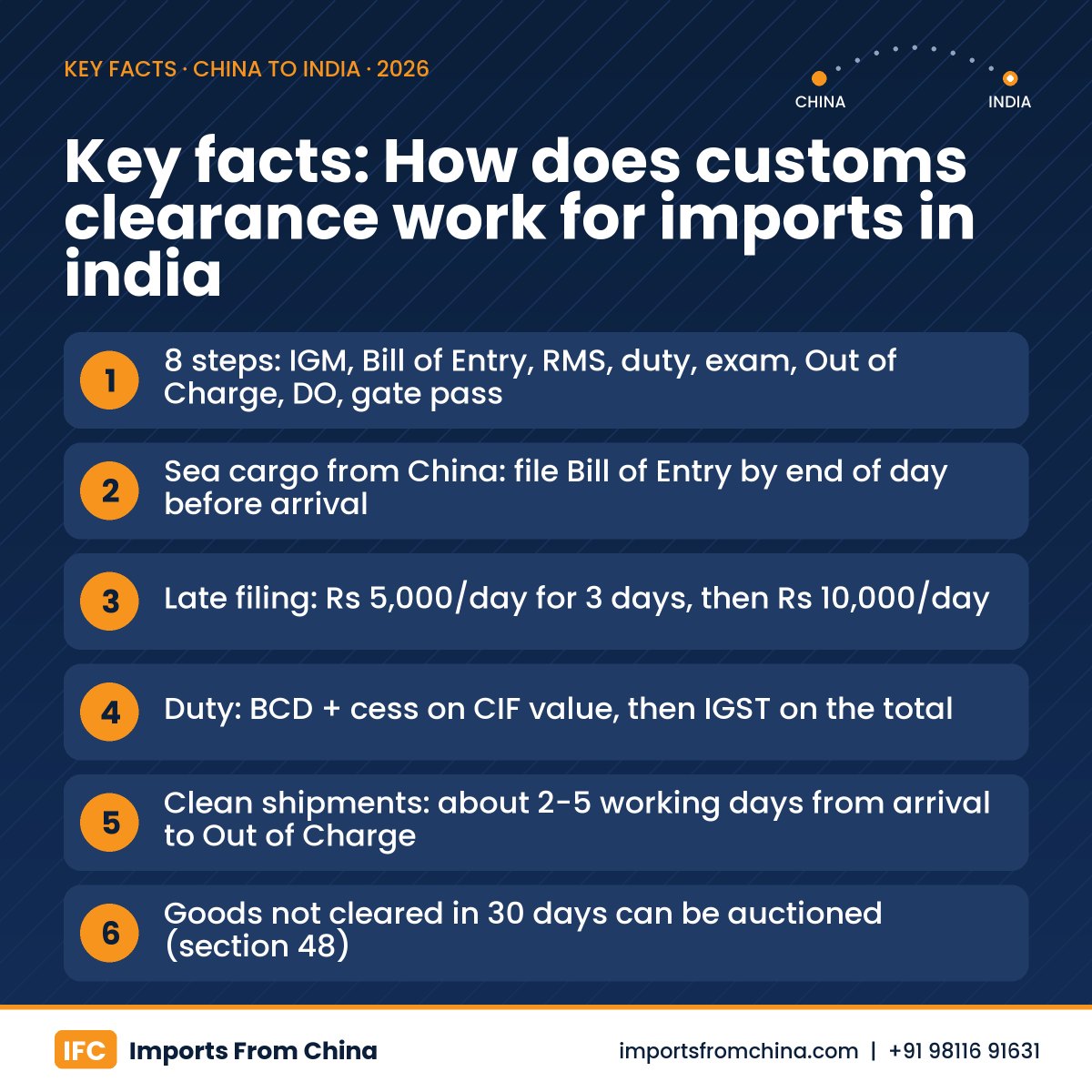
- File early: for sea cargo from China, the Bill of Entry is due by the end of the day before the vessel arrives. Late filing attracts charges.
- Have three things ready: IEC, GSTIN and the correct 8-digit HS code.
- Assessment is faceless: an officer anywhere in India may assess your Bill of Entry. The port handles examination.
- Duty is stacked: BCD and any cess are charged on the CIF value, then IGST on the total. GST-registered importers can usually claim the IGST back as input credit.
- Typical timeline: about 2–5 working days from arrival to Out of Charge with clean documents. LCL needs extra days for de-stuffing at the CFS.
- Biggest delays: document mismatches, wrong HS codes, missing BIS or WPC approval and undervalued invoices.
How does customs clearance work for imports in India, step by step?
Commercial imports are cleared under the Customs Act, 1962, and almost all paperwork goes through ICEGATE, the customs e-filing portal. For a sea shipment from Shenzhen, Ningbo or Shanghai to Nhava Sheva, the steps run in this order:
- Documents from the supplier: the commercial invoice, packing list and bill of lading reach you and your CHA before the vessel arrives.
- IGM filed: the shipping line (and the consolidator for LCL) files the Import General Manifest, the list of all cargo on board. Your Bill of Entry is linked to your cargo’s line on it.
- Bill of Entry filed: your CHA declares the HS code, value, quantity, IEC, GSTIN and any licence or BIS details. Supporting documents are uploaded on e-Sanchit.
- Risk check and assessment: the Risk Management System (RMS) decides whether the Bill of Entry is accepted as filed, sent for assessment, marked for examination, or both.
- Duty payment: you pay BCD, cess and IGST online on ICEGATE.
- Examination (if selected): officers at the CFS or ICD open and check the cargo against the declaration.
- Out of Charge (OOC): the officer releases the goods from customs control. Legally, customs clearance is now complete.
- Delivery order and CFS release: you collect the delivery order (DO) from the shipping line or forwarder and pay CFS charges. The CFS issues a gate pass and the truck leaves.
What documents and registrations do you need before the ship arrives?
Registrations on your side
- IEC: the Importer Exporter Code from DGFT, linked to your PAN. It is needed for any commercial import.
- GSTIN: it must be declared on the Bill of Entry so the IGST you pay is available as input tax credit.
- Product approvals: BIS registration or an ISI licence for goods under a Quality Control Order (many electronics, toys, furniture and steel items), WPC approval for Bluetooth and Wi-Fi devices, FSSAI for food and CDSCO for medical devices and cosmetics.
- A licensed customs broker: you may legally file your own Bill of Entry, but most small and mid-size importers use a CHA. The work needs ICEGATE access and staff at the port.
Documents for each shipment
- Commercial invoice: your name, address and GSTIN as consignee, the real price paid, the Incoterm and a clear description of each item. Vague words like “parts” or “accessories” invite queries.
- Packing list: carton count, net and gross weight and marks. These must match the invoice and bill of lading exactly.
- Bill of lading or air waybill: for LCL this is usually a house bill of lading. The original must be surrendered, or a telex release issued, before you get a delivery order in India.
- Freight and insurance details, plus a catalogue or technical sheet: these support the CIF value and the HS code.
- Certificate of origin: India has no free trade agreement with China. You need one only to claim an Asia-Pacific Trade Agreement (APTA) concession on an eligible item, following the CAROTAR origin rules.
Fix the HS code before you place the order, not when the cargo is at the port. You can check duty and compliance notes for any 8-digit code on IFC’s India import duty rates by HS code page.
Which Bill of Entry should you file, and by when?
The Bill of Entry is your formal declaration to customs. Its type depends on what you will do with the goods and when you file it.
| Bill of Entry type | When it is used | What it means for you |
|---|---|---|
| Home consumption | Goods will be sold or used in India now | The normal choice for traders, online sellers and project buyers. All duty is paid now. |
| Into-bond and ex-bond | Goods enter, then leave, a bonded warehouse | Duty is paid later, on each quantity taken out. |
| Advance filing | Up to 30 days before arrival | Recommended. Assessment can start before the vessel berths. |
| Filed after arrival | Once the cargo has landed | For sea cargo from China, this is late and attracts late presentation charges. |
The filing deadline most importers miss
Since the Finance Act 2021 change to section 46, the Bill of Entry for sea cargo from China must be filed before the end of the day before the vessel arrives, whether the cargo clears at the port or at an ICD. Air cargo can be filed until the end of the arrival day. So your CHA needs final documents 3–4 days before the ETA. Late filing attracts charges: currently ₹5,000 a day for the first three days and ₹10,000 a day after that, unless the officer accepts your reason. Check the current CBIC notification, because these amounts can change.
How does customs assess and examine your goods?
Self-assessment and the Risk Management System
Indian customs works on self-assessment: you declare the HS code, value and duty yourself through your CHA. The RMS then scores each Bill of Entry on importer history, product, origin and value. A facilitated Bill of Entry needs no assessment or examination. You pay duty and get Out of Charge. Others go for assessment, examination, or both.
Faceless assessment
Since October 2020, assessment has been faceless across India. A Bill of Entry for Nhava Sheva may be assessed by officers in another city. If they have doubts, a query is raised on ICEGATE asking for a catalogue, proof of payment, freight details or a BIS licence. Each query adds a day or two, so a clean first filing saves time.
If the officer disagrees with your value or HS code, the Bill of Entry is reassessed and you pay the difference. An invoice far below the price of similar recent imports is likely to be rejected.
Examination and Out of Charge
When examination is ordered, officers at the CFS, ICD or air cargo terminal open the cargo. They check quantity, description, markings, origin and BIS/ISI marks. For retail packs, they also check the Legal Metrology declaration: importer name and address, MRP and month of import. Your CHA arranges labour and pays the examination charges. When everything matches and duty is paid, the officer gives Out of Charge.
The cargo stays at the CFS until you collect the delivery order and pay the CFS charges. Under section 48, goods not cleared within 30 days of unloading can be auctioned by the custodian after notice. Do not leave cargo at the port while payments are sorted out.
How is import duty calculated and paid at customs?
Duty is charged on the assessable value. This is the CIF value (cost + insurance + freight to the Indian port), converted to rupees at the CBIC customs exchange rate. The old 1% landing charge was removed from the valuation rules in 2017. Customs adds Basic Customs Duty (BCD), the Social Welfare Surcharge (10% of BCD unless exempt), AIDC where applicable and any anti-dumping duty, then IGST on the total. Our guide to import duty from China to India explains each part.
Worked example: 200 office chairs from Foshan to Nhava Sheva
Assumptions: 200 swivel office chairs (HS 94013900) at FOB USD 25 each, or USD 5,000. Sea freight is USD 400 and insurance USD 50, so CIF is USD 5,450. The exchange rate is ₹96.95 per USD, the CBIC import rate notified on 2 October 2026. The IFC duty database shows BCD 20%, AIDC 5%, no SWS on this line, IGST 18% and no anti-dumping duty. Rates as of October 2026; confirm for your exact HS code.
| Item | How it is calculated | Amount (₹) |
|---|---|---|
| Assessable value (AV) | USD 5,450 × 96.95 | 5,28,378 |
| Basic Customs Duty | 20% of AV | 1,05,676 |
| AIDC | 5% of AV | 26,419 |
| Social Welfare Surcharge | Exempt on this line (normally 10% of BCD) | 0 |
| Value for IGST | AV + BCD + AIDC | 6,60,473 |
| IGST | 18% of 6,60,473 | 1,18,885 |
| Total paid at customs | BCD + AIDC + IGST | 2,50,980 |
The IGST of ₹1,18,885 is usually claimable as input tax credit when your GSTIN is on the Bill of Entry. Your real duty cost is the ₹1,32,095 of BCD and AIDC, about 25% of the assessable value. Office chairs also fall under a BIS furniture Quality Control Order, so check the current ISI requirement before shipping.
Duty is paid online on ICEGATE. For a self-assessed Bill of Entry it is due on the day of filing. After reassessment, it is due within one working day, and interest applies after that. Try your own product in the IFC shipment calculator.
How long does customs clearance take in India, and what does it cost?
These timelines are counted from the day of arrival for a shipment with clean documents. Indicative, October 2026.
| Shipment | Facilitated (no exam) | With assessment or examination | What adds time |
|---|---|---|---|
| FCL at Nhava Sheva, Mundra or Chennai | 1–3 working days | 3–6 working days | Moving the container to the CFS, scanning, queries |
| LCL at a port CFS | 3–5 working days | 5–8 working days | De-stuffing the shared container |
| Cargo for ICD Tughlakabad or Patparganj | As above, after the rail move | As above, after the rail move | Rail transfer from the port, often 4–10 days |
| Air cargo at Delhi, Mumbai or Bengaluru | Same day to 2 working days | 2–4 working days | Queries, WPC or BIS checks |
For the full journey, plan on roughly 12–20 days port to port by sea, 3–6 weeks door to door for LCL and 5–10 days door to door by air (indicative, October 2026). See how LCL shipping from China to India works for small cargo.
Indian-side clearance charges (besides duty)
| Charge | Who bills it | Indicative range, October 2026 |
|---|---|---|
| CHA agency fee | Customs broker | ₹3,000–₹10,000 per Bill of Entry, more with queries or licences |
| Delivery order and documentation | Shipping line or LCL consolidator | ₹2,500–₹8,000 per bill of lading |
| Terminal handling (FCL) | Shipping line | Roughly ₹8,000–₹15,000 per 20ft container |
| CFS handling and storage | CFS operator | LCL: about ₹4,000–₹15,000 for a small lot; FCL: ₹10,000–₹25,000, plus storage after free days |
| Examination and labour | CFS, through the CHA | ₹1,000–₹5,000 when examination is ordered |
| Transport to your warehouse | Transporter | Depends on distance and truck size |
These vary by port, line and CFS, and GST is added to most. Ask for an itemised estimate before shipping.
Why do China shipments get stuck in Indian customs?
- Undervalued invoice: a low invoice meant to save duty is compared with similar imports, rejected and raised, and penalties are possible. Declare the real price.
- Wrong or vague HS code: a code chosen for a lower rate, or a description like “household items”, leads to reassessment. Classify each product separately.
- Missing BIS, WPC or other approvals: goods under a Quality Control Order cannot be cleared without the licence, and some must be re-exported.
- Documents that do not match the cargo: a different carton count, weight or marks triggers examination. Mixed-supplier LCL lots are prone to this.
- Anti-dumping duty not budgeted: many Chinese products carry it. Check the current notification for your HS code on the CBIC website.
- No telex release or unpaid freight: no delivery order is issued, even after Out of Charge.
Pre-shipment checklist
- IEC active, and your GSTIN correct on the invoice.
- 8-digit HS code agreed with your CHA, with anti-dumping duty checked.
- BIS, WPC, FSSAI or CDSCO approval in hand if needed.
- Invoice, packing list and bill of lading checked against each other before loading.
- Documents with your CHA 3–4 days before ETA.
- Funds ready for duty, DO and CFS charges on arrival.
How IFC helps with customs clearance in India
IFC – Imports From China has more than 15 years in China–India import and export. Our own offices in Guangzhou and Yiwu have translators and English-speaking staff who can check supplier invoices, packing lists and markings before goods leave China, which is where most clearance problems can be stopped. We load mixed containers and air cargo daily and have a warehouse at our headquarters.
We handle sourcing, supplier verification, quality inspection, LCL and FCL sea freight, air cargo and customs clearance in India. If you prefer not to handle Bills of Entry, CFS charges and duty payments yourself, our DDP shipments from China to India deliver door to door to major cities, including Delhi, Gurugram, Noida, Mumbai, Pune, Bengaluru, Hyderabad, Chennai and Ahmedabad.
Bottom line
Customs clearance in India is predictable when the work is done before the cargo lands: a correct HS code, the real value, matching documents, the right approvals and an early Bill of Entry. Get those right and most China shipments reach Out of Charge within a few working days.
Related guide: Air Freight vs Sea Freight from China to India: Cost, Time and Which to Choose
Get your real landed cost: enter your product, weight and CBM in the IFC shipment calculator, check your HS code on the India import duty rates page, or call IFC on +91 98116 91631 for a door-to-door DDP quote from China to your city.
Frequently asked questions
How many days does customs clearance take in India for goods from China?
With clean documents and an early Bill of Entry, FCL sea cargo usually gets Out of Charge in 1 to 3 working days after arrival and LCL in 3 to 5, because LCL is de-stuffed at the CFS first. Examination adds 2 to 4 days. Indicative, October 2026.
Can I do customs clearance myself without a CHA?
Yes. An importer can register on ICEGATE and file the Bill of Entry in their own name. Most small and mid-size importers still use a licensed customs broker, because the work needs daily ICEGATE handling, query replies and someone at the CFS or ICD for examination and release.
What is the difference between an advance and a regular Bill of Entry?
An advance Bill of Entry is filed up to 30 days before the vessel or flight arrives, so assessment can start early. For sea cargo from China, the law requires filing by the end of the day before arrival, so early filing is effectively the norm. Filing later attracts late presentation charges.
What happens if customs selects my shipment for examination?
Officers at the CFS, ICD or air cargo terminal open the packages and check quantity, description, markings, origin and BIS or Legal Metrology labelling against your Bill of Entry. Your CHA arranges labour and pays examination charges. If everything matches, Out of Charge is given; if not, the goods may be reassessed or held.
Is the IGST paid at customs refundable?
It is not refunded in cash, but a GST-registered importer can usually claim the IGST paid at customs as input tax credit, provided the correct GSTIN is on the Bill of Entry. Basic Customs Duty, AIDC, Social Welfare Surcharge and anti-dumping duty are not creditable.
What happens if I do not clear my goods within 30 days?
Under section 48 of the Customs Act, goods not cleared within 30 days of unloading can be sold by the custodian after notice to the importer. Long before that, CFS storage, demurrage and detention charges add up every day, so arrange duty and freight payments before the cargo arrives.
Do I need an IEC to import a small shipment from China?
Yes, commercial imports need an IEC from DGFT, even for a small shipment. Goods for personal use are exempt. Small buyers who prefer not to manage clearance themselves often use a DDP service, where the logistics provider handles clearance and delivery.
Comments for this post are closed.