





Is Importing from China to India Profitable? Margins, Costs and a ₹ Worked Example (2026)
Is importing from China to India profitable? Yes, for many products it is, but only when you work out the full landed cost first. Customs duty, IGST, freight, bank charges, marketplace fees and returns can turn a product that looks 60% cheaper in China into a 5–10% margin in India. The channel you sell through matters as much as the product.
This guide shows where profit really comes from, the costs most beginners miss, a full rupee example with real duty maths, a sensitivity table showing what can wipe out your margin, and a checklist to test any product before you order.
Key takeaways
- Profit is decided before you order: compare your selling price with the landed cost per piece, not with the China factory price.
- Duty is a real cost, IGST usually is not: if you are GST-registered, the import IGST comes back as input tax credit; BCD and SWS do not.
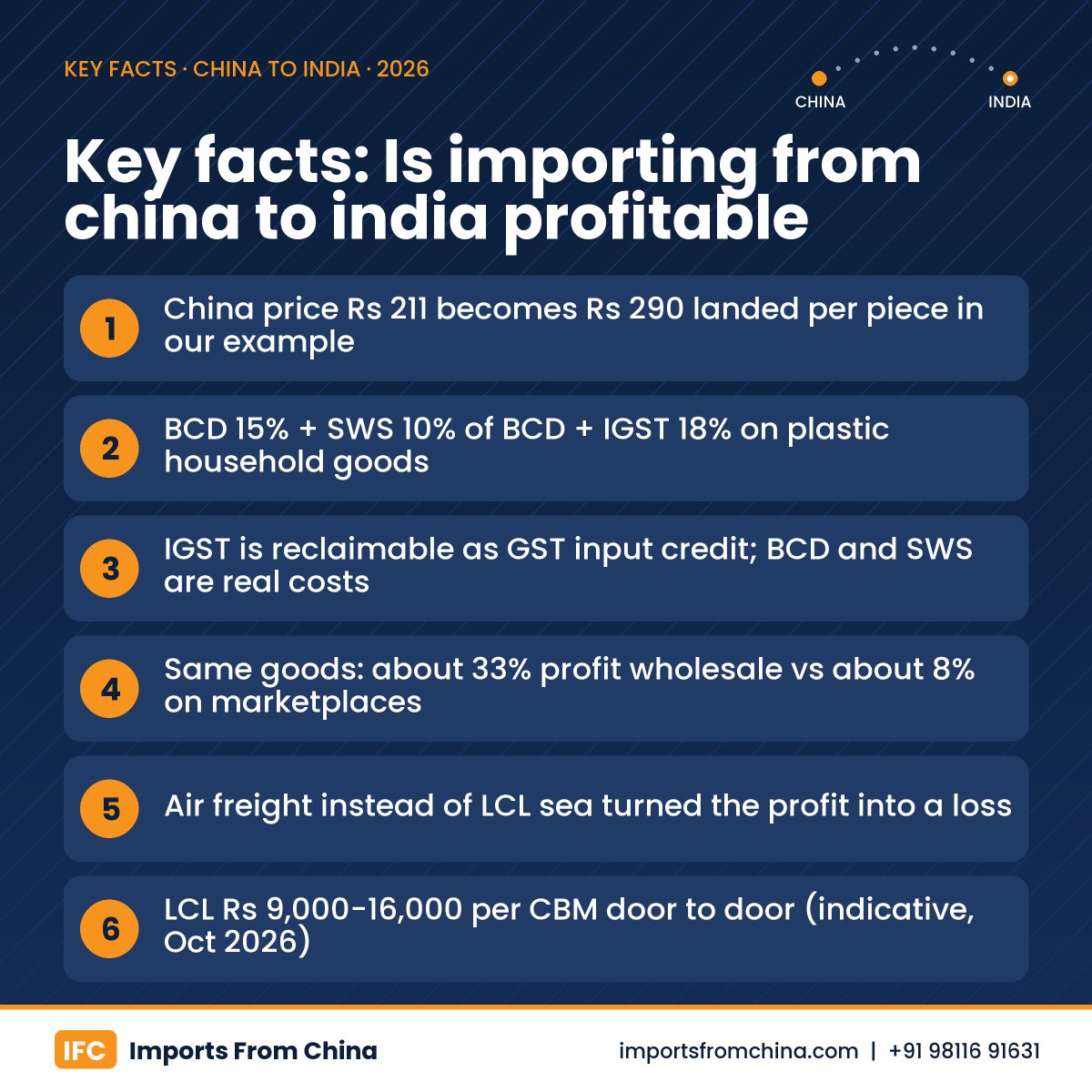
- Channel changes everything: in our example the same product earns about 33% selling wholesale but only about 8% on a marketplace after fees, returns and ads.
- Air freight kills margins on cheap goods: the same order shipped by air instead of LCL sea turned a profit into a loss.
- Compliance can stop a product: items needing BIS, WPC, FSSAI or CDSCO approval, or carrying anti-dumping duty, need extra cost and time.
- Test small, then scale: a trial lot of 1–3 CBM by LCL shows real demand and real costs before you commit lakhs.
Is importing from China to India profitable in 2026?
China is still India’s biggest source of manufactured goods, and the reason is simple: factories in Guangdong, Zhejiang and Fujian make huge volumes at low unit cost, with a choice of designs that Indian wholesale markets often cannot match. That price gap is where import profit starts.
But the gap is smaller than it looks. A ₹200 factory price becomes ₹280–300 by the time the goods are cleared and delivered to your godown, and that is before you sell a single piece. Importing is profitable when three things are true:
- Your selling price is at least 2–2.5 times the China price for marketplace selling, or about 1.5 times for wholesale, after GST.
- The product is light or compact for its value, so freight per piece stays small.
- The product is “free” to import under the ITC-HS policy and does not need a licence or a certificate you cannot get in time.
If any one of these fails, margins shrink fast. Most first-import losses come from buyers who compared the Alibaba price with the Indian retail price and skipped everything in between.
What costs decide your profit when importing from China?
Your landed cost is everything you pay to get one sellable piece into your warehouse. Here is what goes into it.
| Cost item | What it is | Typical size (indicative, October 2026) | Recoverable? |
|---|---|---|---|
| Product price (FOB or EXW) | What the supplier charges, usually in USD | 50–70% of landed cost for most consumer goods | No |
| Bank and forex charges | Exchange margin, wire fees, GST on currency conversion | About 1–2% of the payment | GST part only |
| Freight and clearance | China pickup, sea or air, Indian CFS, CHA, delivery | LCL ₹9,000–16,000 per CBM door to door; air ₹350–600 per kg door to door | GST on services usually yes |
| Basic Customs Duty (BCD) | Charged on assessable value (CIF) | 0–70% depending on HS code; 10–20% is common for consumer goods | No |
| Social Welfare Surcharge (SWS) | 10% of BCD, unless exempt | 1.5–2% of value on most goods | No |
| IGST | On assessable value + BCD + SWS | 5%, 12% or 18% in most cases; check your HS code | Yes, as input tax credit if GST-registered |
| Selling costs | Marketplace fees, shipping to customer, ads, returns | 25–45% of selling price on marketplaces | GST on fees usually yes |
Duty depends on the exact 8-digit HS code, so look yours up on the India import duty rates page before you calculate anything. Our import duty from China to India guide explains each duty in more detail.
Worked example: is this China import profitable? (₹ calculation)
A Delhi trader imports 2,000 plastic drawer organisers from a Yiwu supplier at USD 2.20 FOB per piece. The order packs into 100 cartons, about 6 CBM and 900 kg, shipped LCL to Nhava Sheva and delivered door to door.
Assumptions: CBIC customs exchange rate ₹95.90 per USD (import rate effective 16 October 2026; it is revised twice a month); ocean freight to the Indian port about ₹4,500 per CBM; cargo insurance about 1.125% of FOB; no landing charge (removed from the valuation rules in 2017). HS code 39249090 (other plastic household articles): BCD 15%, SWS 10% of BCD, no AIDC, IGST 18%, no anti-dumping duty. Rates as of October 2026; confirm for your exact HS code.
Step 1: customs duty
| Item | Calculation | Amount (₹) |
|---|---|---|
| FOB value | USD 4,400 × ₹95.90 | 4,21,960 |
| Ocean freight to Indian port | 6 CBM × ₹4,500 | 27,000 |
| Insurance | 1.125% of FOB | 4,747 |
| Assessable value (CIF) | FOB + freight + insurance | 4,53,707 |
| BCD | 15% of AV | 68,056 |
| SWS | 10% of BCD | 6,806 |
| IGST | 18% of (AV + BCD + SWS = 5,28,569) | 95,142 |
| Total paid at customs | BCD + SWS + IGST | 1,70,004 |
Step 2: landed cost per piece
Door-to-door LCL freight and clearance at a mid-range ₹12,000 per CBM is ₹72,000 (this already includes the ocean freight used for customs). Add about ₹6,000 for bank charges and forex margin. Because the trader is GST-registered, the ₹95,142 IGST comes back as input tax credit, so the real cost is:
₹4,21,960 (goods) + ₹72,000 (freight and clearance) + ₹4,747 (insurance) + ₹74,862 (BCD + SWS) + ₹6,000 (bank) = ₹5,79,569, or about ₹290 per piece. The China price was about ₹211 per piece, so 37% was added on the way.
Note the cash flow: you pay ₹6.75 lakh before you sell anything, because IGST is paid at customs and claimed back later through your GST return.
Step 3: profit by sales channel
| Per piece (₹) | Marketplace (Amazon or Flipkart) | Wholesale to retailers |
|---|---|---|
| Selling price | 799 incl. 18% GST | 450 + GST |
| Net of GST | 677 | 450 |
| Landed cost | 290 | 290 |
| Marketplace fees and shipping (assumed) | 230 | – |
| Returns and damage allowance (5%) | 34 | – |
| Ads (10% of net sale) | 68 | – |
| Local delivery | – | 10 |
| Profit per piece | 55 (about 8%) | 150 (about 33%) |
| Profit on 2,000 pieces | about ₹1.1 lakh | about ₹3 lakh |
Marketplace fees here are an assumption for illustration; check your category’s current fee card. The lesson: the same container can be a good business or a weak one depending on how you sell it. Marketplace sellers need either a higher price (a brand, a bundle, better packaging) or a lower landed cost (bigger order, cheaper freight per piece) to make it worthwhile.
What can wipe out your import profit?
We re-ran the same example with one thing going wrong at a time. This is the table most import guides never show.
| What changes | Landed cost per piece | Marketplace profit per piece | Wholesale profit per piece |
|---|---|---|---|
| Base case | ₹290 | ₹55 (8%) | ₹150 (33%) |
| Rupee weakens 3% before you pay | ₹297 | ₹48 (7%) | ₹143 (32%) |
| Freight rates double (peak season) | ₹328 | ₹17 (2.5%) | ₹112 (25%) |
| 10% of goods arrive defective | ₹322 | ₹23 (3%) | ₹118 (26%) |
| Shipped by air instead of sea | ₹484 | Loss of ₹139 | Loss of ₹44 |
Each figure is indicative, October 2026, built on the assumptions above. Other margin killers:
- Wrong HS code: customs can reassess at a higher rate and add interest or penalty. Classify the product carefully before you order.
- Undervalued invoices: a low invoice to “save duty” often leads to customs rejecting the value and holding cargo, plus demurrage at the CFS.
- Missing approvals: goods under a BIS Quality Control Order, or needing WPC, FSSAI or CDSCO approval, cannot be cleared without them. Check the BIS website early.
- Anti-dumping duty: some Chinese goods carry anti-dumping duty on top of BCD, which can make them uncompetitive.
- Dead stock: unsold seasonal goods tie up cash. Diwali stock must be ordered by about August; orders placed late in the year also run into the Chinese New Year shutdown (6 February 2027), when factories close for 2–4 weeks.
Which products are most profitable to import from China to India?
There is no single “most profitable product”, but some types of product clear the margin test far more often than others.
| Usually profitable | Usually difficult |
|---|---|
| Light, compact, design-led goods: home organisers, decor, gift items, fashion accessories | Heavy, low-value goods: plain tiles, cement-type products, basic furniture in small lots |
| Products Indian factories do not make in that design or finish: hotel lighting, specialty fittings, project furniture | Goods sold on price alone that Indian factories also make cheaply |
| Spare parts and components with steady repeat demand | Electronics needing BIS registration for each model, unless you plan for it |
| Goods with low or moderate BCD and no licence needed | Toys and other goods with very high BCD (around 70% for toys) plus BIS certification |
| Private-label goods where you control the brand and price | Restricted goods such as drones, or goods under anti-dumping duty |
Interior designers, architects and hotel owners can see strong returns, because project goods (lighting, furniture, sanitary fittings, decor) carry high value per CBM and Indian alternatives can cost much more. Read our guide on the cost of importing furniture from China to see how duty and freight change the numbers for bulky goods.
How much money do you need to start a profitable import business?
For a first commercial LCL shipment, plan for the goods value plus roughly 40–60% more in cash for freight, duty and IGST, even though the IGST comes back later. A trial order of ₹1.5–3 lakh in goods typically needs ₹2.2–4.5 lakh in total cash.
- Registrations: IEC from the DGFT (online, ₹500 fee) and GSTIN, plus any product approvals.
- Minimum sensible order: LCL has a minimum of about 1 CBM plus fixed charges, so tiny orders cost more per piece. 2–5 CBM is a common first shipment.
- Working capital cycle: deposit to supplier, about 3–6 weeks door to door by LCL, then selling time. Plan for money to be tied up for 2–4 months.
If you are completely new, start with our beginner’s step-by-step guide to importing from China.
How do you check if a product will be profitable before you order?
Use this 8-step test on every product idea. It takes an hour and can save a container.
- Find your real selling price in India: check marketplaces and wholesale markets, and use the price you can sell at in volume, not the highest listing.
- Get the HS code and duty for the exact product and note any BIS, WPC, FSSAI, CDSCO or anti-dumping rule.
- Get 3 supplier quotes with FOB price, MOQ, carton size, carton weight and pieces per carton.
- Calculate CBM and weight for your order quantity.
- Get a door-to-door quote or use the IFC shipment calculator for freight, duty and IGST.
- Add selling costs: fees, shipping, ads, returns, warehouse and packaging.
- Stress-test it: add 3% for currency, 30% for freight and 5–10% for defects. If profit is still positive, the product is worth a trial.
- Verify the supplier before paying, and inspect goods before the balance payment. Pay only to a bank account in the supplier company’s own name.
How IFC helps you import profitably from China
IFC – Imports From China has more than 20 years of experience in China–India import and export, since 2004. We have our own offices in Guangzhou and Yiwu, with translators and English-speaking staff who can find and compare suppliers, check that a supplier is real, and inspect goods before you pay the balance.
We load mixed containers and air cargo daily, so even a small trial order can move by LCL at a sensible cost per piece. Our services cover sourcing, supplier verification, quality inspection, LCL and FCL sea freight, air cargo, customs clearance and door-to-door DDP delivery. We have a warehouse at our headquarters and deliver to major Indian cities including Delhi, Gurugram, Noida, Mumbai, Pune, Bengaluru, Hyderabad, Chennai and Ahmedabad. A DDP quote gives you one landed figure to put into your margin sheet.
Conclusion
Importing from China to India is profitable when the numbers are done before the order, not after. Pick light, design-led products that are free to import, check the HS code and approvals, calculate landed cost per piece including duty, choose a channel that leaves room for fees, and start with a trial lot by sea. Do that, and China remains one of the best margin sources for Indian businesses.
Get your real landed cost: enter your product, weight and CBM in the IFC shipment calculator, check your HS code on the India import duty rates page, or call IFC on +91 98116 91631 for a door-to-door DDP quote from China to your city.
Frequently asked questions
Is importing from China to India still profitable in 2026?
Yes, for the right products. Light, design-led goods that are free to import and sell well above their landed cost still give good margins. Profit falls quickly when freight per piece is high, duty is high, approvals like BIS are needed, or the goods are sold through channels with heavy fees. Calculate landed cost per piece before ordering.
What profit margin can I expect when importing from China?
There is no fixed margin. In our worked example, plastic organisers bought at about Rs 211 per piece cost about Rs 290 landed, and earned about 33% selling wholesale but only about 8% on a marketplace after fees, ads and returns. Your margin depends on product, duty, freight and sales channel.
Is it cheaper to buy from China or from Indian wholesalers?
The China factory price is usually lower, but after freight, customs duty, bank charges and time, the gap narrows. For small quantities, buying from an Indian wholesaler can be cheaper and less risky. Importing makes sense when your volume is large enough and the product is light or high in value for its size.
Do I lose the IGST paid on imports?
Not if you are GST-registered and the goods are for your business. The IGST paid at customs on the Bill of Entry can be claimed as input tax credit. Basic Customs Duty and Social Welfare Surcharge cannot be claimed back, so they are a real cost in your margin calculation.
How much money do I need to start importing from China?
A practical first LCL shipment of Rs 1.5 to 3 lakh in goods usually needs about Rs 2.2 to 4.5 lakh in total cash, because freight, duty and IGST are paid before you sell. You also need an IEC and GSTIN. Keep money aside for 2 to 4 months of working capital.
Which products should beginners avoid importing from China?
Avoid heavy low-value goods, toys and other items with very high duty plus BIS certification, electronics that need BIS registration for each model, restricted items like drones, and goods under anti-dumping duty. These are not always unprofitable, but they need more money, time and compliance work than a first import should carry.
Can I import from China in small quantities and still make a profit?
Yes, by shipping LCL with a consolidator that loads mixed containers regularly. Very small orders under about 1 CBM pay minimum charges, so 2 to 5 CBM is a sensible first shipment. Avoid air freight for cheap goods, because it can turn a profitable product into a loss.
Comments for this post are closed.