





How to Start Importing from China to India: Beginner’s Step-by-Step Guide (2026)
How to start importing from China to India: get an IEC from DGFT and a GSTIN, choose a product that is legal to import and needs no licence you cannot get, verify a Chinese supplier, pay through your bank, then ship by courier, air or LCL sea and clear Indian customs through a CHA. A first sea-freight order usually takes 2 to 3 months from first enquiry to delivery.
This beginner’s guide covers each step, the registrations and compliance checks new importers miss, indicative freight costs and a worked rupee example of a first LCL order.
Key takeaways
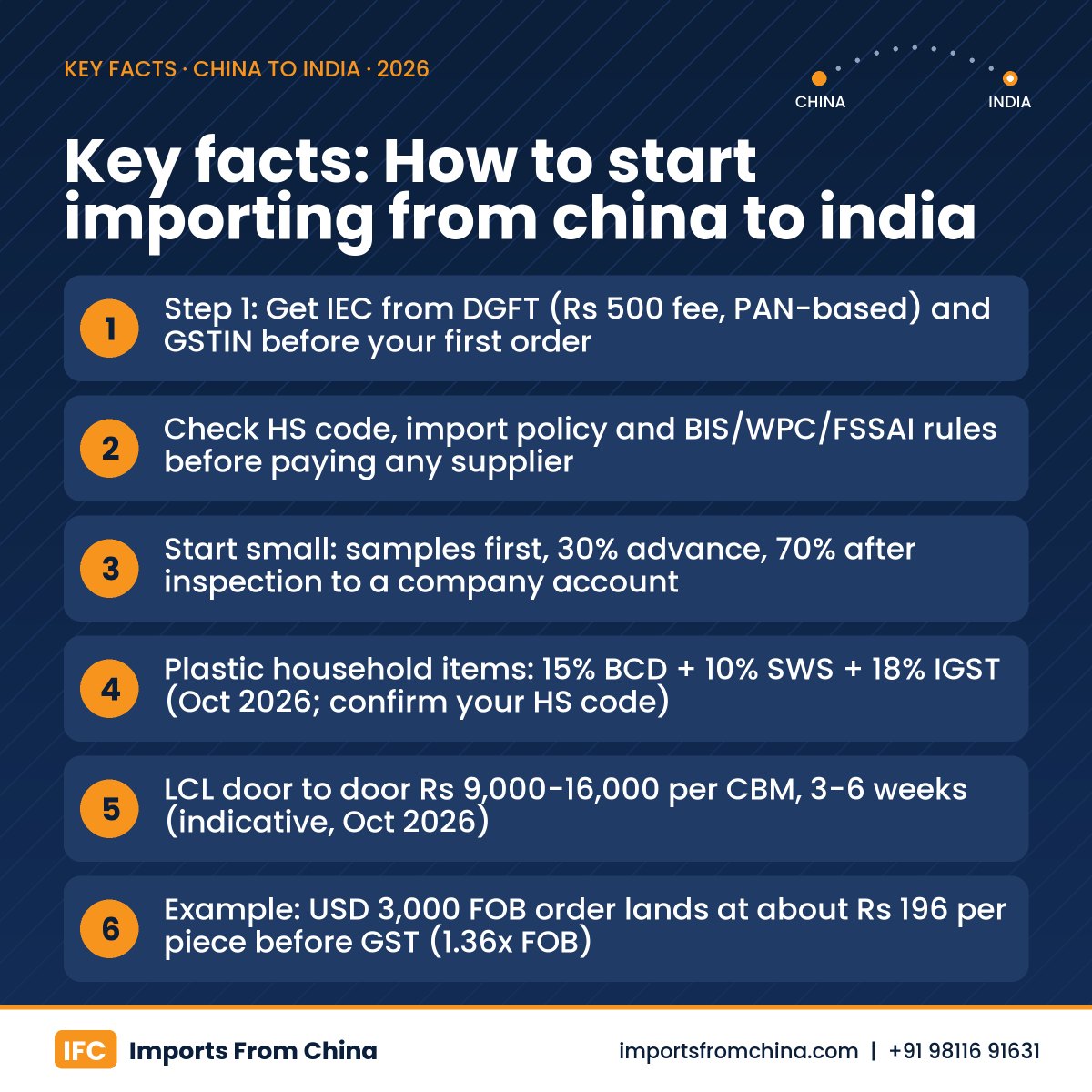
- Register first: IEC from DGFT (Rs 500 fee, linked to your PAN, update it every April to June) plus GSTIN to claim back import IGST.
- Check the product before the supplier: find the HS code, import policy and any BIS, WPC, FSSAI, CDSCO or EPR requirement.
- Start small: one or two products, samples first, 30% advance and 70% after inspection, paid only to the supplier’s company bank account.
- Duty is on CIF: plastic household items, for example, pay 15% BCD + 10% SWS on BCD + 18% IGST, about 37.5% of CIF (rates as of October 2026).
- Ship by volume: courier for samples, air for urgent goods, LCL at about Rs 9,000 to 16,000 per CBM door to door for 1 to 15 CBM (indicative, October 2026).
- Worked example: a USD 3,000 FOB order of 2,000 pieces lands at about Rs 196 per piece before GST, around 1.36 times the FOB price.
How to start importing from China to India: the 9-step process
Follow these steps in order. Paying a supplier before checking whether the product needs BIS certification is the most expensive beginner mistake.
- Register your business: PAN, a current bank account, GSTIN and an Importer Exporter Code (IEC).
- Shortlist a product and find its 8-digit HS code.
- Check import rules for that HS code: import policy, BIS, WPC, FSSAI, CDSCO, labelling and EPR.
- Estimate landed cost (product + freight + duty + local charges) and compare with your Indian selling price.
- Find and verify suppliers on Alibaba, 1688, in Yiwu or Guangzhou markets, or at trade fairs.
- Order samples, agree specifications, packing and Incoterm (EXW, FOB or CIF) in a written proforma invoice.
- Pay the advance through your bank, then inspect goods before paying the balance.
- Ship by courier, air cargo, LCL or FCL sea freight to an Indian port or ICD.
- Clear customs and deliver: your CHA files the Bill of Entry on ICEGATE, you pay duty and IGST, and the goods are trucked to your warehouse.
IFC’s own step-by-step guide on importing from China shows how this flow works when IFC handles the China side for you. The sections below explain each step for a first-time importer.
What registrations do you need before your first import?
A sole proprietorship is enough to start; you do not need a private limited company. You need three things in place before goods leave China:
| Registration | Where | Why you need it |
|---|---|---|
| PAN and current account | Income Tax dept, your bank | IEC is issued against PAN; your bank sends the foreign payment |
| IEC (Importer Exporter Code) | DGFT portal, online, Rs 500 fee | Required for commercial imports; quoted on the Bill of Entry |
| GSTIN | GST portal | Lets you claim the IGST paid at customs as input tax credit |
Apply for the IEC on the DGFT website; it is often issued online the same day once your PAN, address proof and bank details match. DGFT requires every IEC holder to update or confirm IEC details each year between April and June, otherwise the IEC can be deactivated. Our documents required for import from China to India checklist lists every paper you will need.
How do you choose a product that is legal and profitable to import?
Start with the HS code, not the supplier. The 8-digit Indian ITC-HS code decides your duty, whether the item can be imported freely and which approvals apply. Search your product on IFC’s India import duty rates by HS code page, then confirm with your CHA.
The compliance checks beginners miss
- Import policy: most goods are “Free”, but some are “Restricted” (need a DGFT authorisation) or “Prohibited”. Check the ITC-HS schedule for your code.
- BIS (Quality Control Orders): many electronics, toys, footwear, furniture, cookware and electrical items need the Chinese factory to hold a BIS licence or CRS registration. Customs can hold goods without it.
- WPC: Bluetooth, Wi-Fi and other wireless products need WPC equipment type approval.
- FSSAI and CDSCO: food products need FSSAI clearance; cosmetics and medical devices need CDSCO registration.
- Legal Metrology: pre-packed retail goods need importer registration and labels showing importer name and address, MRP, net quantity and country of origin.
- EPR: importers of goods in plastic packaging, and of electronics, may need Extended Producer Responsibility registration with CPCB. Ask your CA.
- Anti-dumping duty: some Chinese products carry extra duty on top of BCD, which can kill your margin. Check before you order.
For a first import, pick a product with “Free” import policy, no BIS or WPC requirement, no anti-dumping duty and a simple HS code: for example plastic household organisers, bags, home decor, gym accessories or stationery. Leave electronics, toys, cosmetics and food until you have one clean shipment behind you.
Where do you find and verify Chinese suppliers?
| Channel | Typical MOQ | Language and payment | Best for |
|---|---|---|---|
| Alibaba.com | Low to medium | English, USD, Trade Assurance | First orders, custom branding |
| 1688.com | Low, domestic prices | Chinese, RMB, needs an agent | Lower prices on stock items |
| Yiwu market | Low per design, many products | Chinese, RMB, cash or transfer | Mixed small orders, general goods |
| Guangzhou markets and Canton Fair | Medium | Some English | Seeing products and factories in person |
Whichever channel you use, verify before you pay:
- Ask for the business licence and check the company name and registration on China’s official National Enterprise Credit Information Publicity System (gsxt.gov.cn).
- Confirm the bank account name on the proforma invoice matches the licensed company. Never pay a personal account.
- Order samples by courier and compare them against your written specification.
- Ask for BIS, test reports or certificates if your product needs them, and check them independently.
Read our China buying agent for India guide if you would rather have someone on the ground, and the Yiwu market guide for Indian importers if you plan to buy small quantities across many products.
How do you pay a Chinese supplier safely from India?
Import payments go through your bank (an authorised dealer bank), usually by telegraphic transfer (TT) in USD. The bank asks for the proforma invoice and its import payment form; keep the remittance advice for your records.
- Common terms: 30% advance to start production, 70% balance after inspection and before loading.
- Alibaba Trade Assurance: pay through the platform for added protection if the order is placed and paid on Alibaba.
- Costs: budget for your bank’s remittance charges and its exchange-rate margin over the market rate.
If a supplier suddenly changes bank details by email or chat, call them on a known number before paying.
Which shipping method should a first-time importer choose?
Choose by weight, volume and urgency. Most first commercial orders from China to India fit LCL sea freight, where your cartons share a container with other importers’ cargo.
| Mode | Indicative cost (October 2026) | Door-to-door time | Best for |
|---|---|---|---|
| Courier (express) | Rs 450 to 900 per kg | About 4 to 8 days | Samples and very small parcels |
| Air cargo | Rs 280 to 450 per kg airport to airport; Rs 350 to 600 per kg door to door | 5 to 10 days | Urgent or high-value goods, roughly 50 to 500 kg |
| LCL sea freight | Rs 9,000 to 16,000 per CBM door to door | Roughly 3 to 6 weeks | 1 to 15 CBM, most first orders |
| FCL (20ft or 40ft container) | Quoted per container | Port to port about 12 to 20 days to Nhava Sheva, plus clearance and trucking | Above about 15 CBM |
All rates are indicative, October 2026, and move with season and fuel prices; always take a written quote. Sea cargo usually arrives at Nhava Sheva (JNPT), Mundra, Chennai or Kolkata, or travels by rail to ICD Tughlakabad or Patparganj for Delhi NCR. Our air freight vs sea freight from China to India guide shows how to compare chargeable weight and volume.
What happens at Indian customs, and how is duty calculated?
Once the ship or flight is on its way, your customs broker (CHA) prepares the Bill of Entry from your commercial invoice, packing list and bill of lading or airway bill, and files it on ICEGATE, ideally before the cargo arrives. Customs assesses the entry, you pay duty online, the goods may be examined, and customs gives “Out of Charge”. You then pay port or CFS and delivery order charges and truck the goods out. Our customs clearance guide for imports in India explains each stage and the usual timelines.
The duty formula
- Assessable value (AV) = CIF value (cost + ocean freight + insurance) in rupees, converted at the CBIC-notified import exchange rate in force when the Bill of Entry is filed. There is no separate 1% landing charge.
- BCD (Basic Customs Duty) = rate for your HS code x AV.
- SWS (Social Welfare Surcharge) = 10% of BCD, unless exempt for your code.
- AIDC, where it applies to your code, is charged on AV instead of part of the BCD.
- IGST = 5%, 18% or 40% (as per the GST rate for the goods) of AV + BCD + SWS + AIDC. Anti-dumping duty, if any, is added before IGST.
For plastic household articles (HS 39249090) the rates in the IFC duty database are 15% BCD, 10% SWS on BCD, nil AIDC and 18% IGST. On Rs 100 of CIF that is Rs 15 BCD, Rs 1.50 SWS and Rs 20.97 IGST, or about Rs 37.50 in total. The IGST part comes back as input tax credit if you are GST-registered. Rates as of October 2026; confirm for your exact HS code. See our import duty from China to India guide for more product examples.
How much money do you need to start importing? A worked example in rupees
Assume a Delhi-based home-goods seller places a first order of 2,000 plastic kitchen and wardrobe organisers (HS 39249090) from a Yiwu supplier at USD 1.50 each, FOB Ningbo. Packed volume is 4 CBM and about 600 kg, shipped LCL. The exchange rate used is the CBIC-notified import rate of Rs 95.90 per USD in force from 16 October 2026; customs will use the rate in force when you file.
| Cost line | How it is worked out | Amount (Rs) |
|---|---|---|
| FOB value | USD 3,000 x 95.90 | 2,87,700 |
| Ocean freight (for customs value) | Assumed USD 200 x 95.90 | 19,180 |
| Marine insurance | Actual premium | 1,500 |
| CIF = assessable value | FOB + ocean freight + insurance | 3,08,380 |
| BCD | 15% of 3,08,380 | 46,257 |
| SWS | 10% of BCD | 4,626 |
| IGST (creditable) | 18% of 3,59,263 (AV + BCD + SWS) | 64,667 |
| LCL door to door (freight, CFS, CHA, delivery) | 4 CBM x Rs 12,000 (indicative mid-range; already includes the ocean freight above) | 48,000 |
| Samples by courier | About 2 kg x Rs 900 per kg | 1,800 |
| Bank remittance charges | Indicative | 2,000 |
| Landed cost before GST | FOB + LCL door to door + insurance + BCD + SWS + samples + bank | 3,91,883 |
| Total cash needed | Including IGST of 64,667 | 4,56,550 |
Duty rates as of October 2026; confirm for your exact HS code. Freight and local costs are indicative, October 2026. The landed cost is about Rs 196 per piece before GST against an FOB price of Rs 143.85, roughly 1.36 times FOB. You need about Rs 4.6 lakh of working capital for this order, of which Rs 64,667 IGST returns as credit when you file GST returns. If you plan to sell at Rs 399 to Rs 499 on Amazon or Flipkart, the margin covers fees and returns; at Rs 249, it does not. Run your own product in the IFC shipment calculator before you order.
What mistakes should beginners avoid?
- Paying before checking BIS or WPC. Goods without the required approval can be held at the port, re-exported or destroyed.
- Accepting a “low invoice”. Under-declaring value to save duty risks reassessment, penalties and seizure. Declare the real price.
- Comparing only the FOB price. Two quotes on different Incoterms (EXW vs FOB vs CIF) are not comparable. Always work out landed cost.
- Skipping inspection. A short pre-shipment check before the balance payment is far cheaper than fighting a dispute later.
- Weak packing and labels. Insist on export cartons, carton marks and Legal Metrology labels before loading.
- Ignoring Chinese holidays. Chinese New Year and Golden Week (early October) can stop factories for one to four weeks.
First-import checklist
- IEC active and GSTIN in the same business name
- HS code, import policy, BIS/WPC/FSSAI/CDSCO status and duty confirmed
- Landed cost per piece calculated and margin checked
- Supplier licence verified, samples approved, proforma invoice with specifications, packing and Incoterm
- Payment to the supplier’s company account only, balance after inspection
- Freight booked, insurance arranged, CHA briefed with invoice, packing list and bill of lading
How IFC helps you start importing from China to India
IFC (Imports From China) has 20+ years in China–India import and export. If you are new to importing, IFC can handle the parts that usually go wrong:
- Own offices in Guangzhou and Yiwu with translators and English-speaking staff for supplier communication.
- Sourcing, supplier verification and quality inspection before you pay the balance.
- LCL and FCL sea freight and air cargo, with daily loading of mixed containers and air cargo, so a small first order can ship without waiting.
- Customs clearance and door-to-door DDP delivery to Delhi, Gurugram, Noida, Mumbai, Pune, Bengaluru, Hyderabad, Chennai, Ahmedabad and other major cities, with a warehouse at IFC’s headquarters.
Conclusion
Starting to import from China to India is a sequence, not a gamble: register IEC and GST, check the HS code and approvals, verify the supplier, pay through your bank, ship by volume and clear customs with a good CHA. Work out landed cost first, start small and scale once the numbers work.
Get your real landed cost: enter your product, weight and CBM in the IFC shipment calculator, check your HS code on the India import duty rates page, or call IFC on +91 98116 91631 for a door-to-door DDP quote from China to your city.
Frequently asked questions
How do I start importing from China to India as a beginner?
Register your business with PAN, a current account, GSTIN and an IEC from DGFT. Then pick a product, check its HS code, import policy and BIS or WPC rules, estimate landed cost, verify a supplier, order samples, pay through your bank, ship by courier, air or LCL sea, and have a CHA file the Bill of Entry on ICEGATE.
Can I import from China to India without an IEC?
You can import goods for genuine personal use without an IEC. For goods you plan to sell, an IEC is required, and a GSTIN lets you claim back the IGST paid at customs. Some buyers use a door-to-door DDP service where the provider handles the import formalities, so ask how the goods will be invoiced to you.
How much money do I need to start importing from China?
It depends on product and quantity, but a small first LCL order is often a few lakh rupees. In our example, a USD 3,000 FOB order of 2,000 plastic organisers needed about Rs 4.6 lakh in total, including Rs 64,667 IGST that comes back as GST credit. Courier sample orders can start much smaller.
Do I need a licence to import from China to India?
Most goods have Free import policy and need only an IEC. Restricted items need a DGFT authorisation, and many products need approvals such as BIS certification or CRS registration, WPC approval for wireless devices, FSSAI for food or CDSCO for cosmetics and medical devices. Check the rules for your exact HS code before ordering.
Can I import small quantities from China to India?
Yes. Samples and parcels can come by courier, and small commercial orders from about 1 CBM can ship by LCL sea freight, where your cartons share a container with other cargo. Buying from Yiwu or 1688 suppliers and consolidating several suppliers into one shipment helps keep minimum order quantities and freight costs low.
How long does it take to import goods from China to India?
Plan 2 to 3 months for a first sea-freight order. Supplier search and samples take 1 to 3 weeks, production often 2 to 6 weeks, LCL roughly 3 to 6 weeks door to door and air cargo 5 to 10 days door to door. Chinese New Year and Golden Week can add one to four weeks.
Comments for this post are closed.