




How to Pay Chinese Suppliers from India Safely: TT, Trade Assurance, LC and RBI Rules (2026)
How to pay Chinese suppliers from India: most Indian businesses pay by bank wire (telegraphic transfer or TT) from their current account through an authorised bank, usually in US dollars, straight to the supplier company’s own account, quoting purpose code S0101 for an advance or S0102 for the balance. Alibaba Trade Assurance, RBI-licensed payment platforms and letters of credit are the main alternatives.
This guide compares every method, walks through a TT payment step by step, explains the RBI rules Indian importers must follow, shows the real cost of a USD 10,000 payment in rupees, and lists the checks that stop payment fraud.
Key takeaways
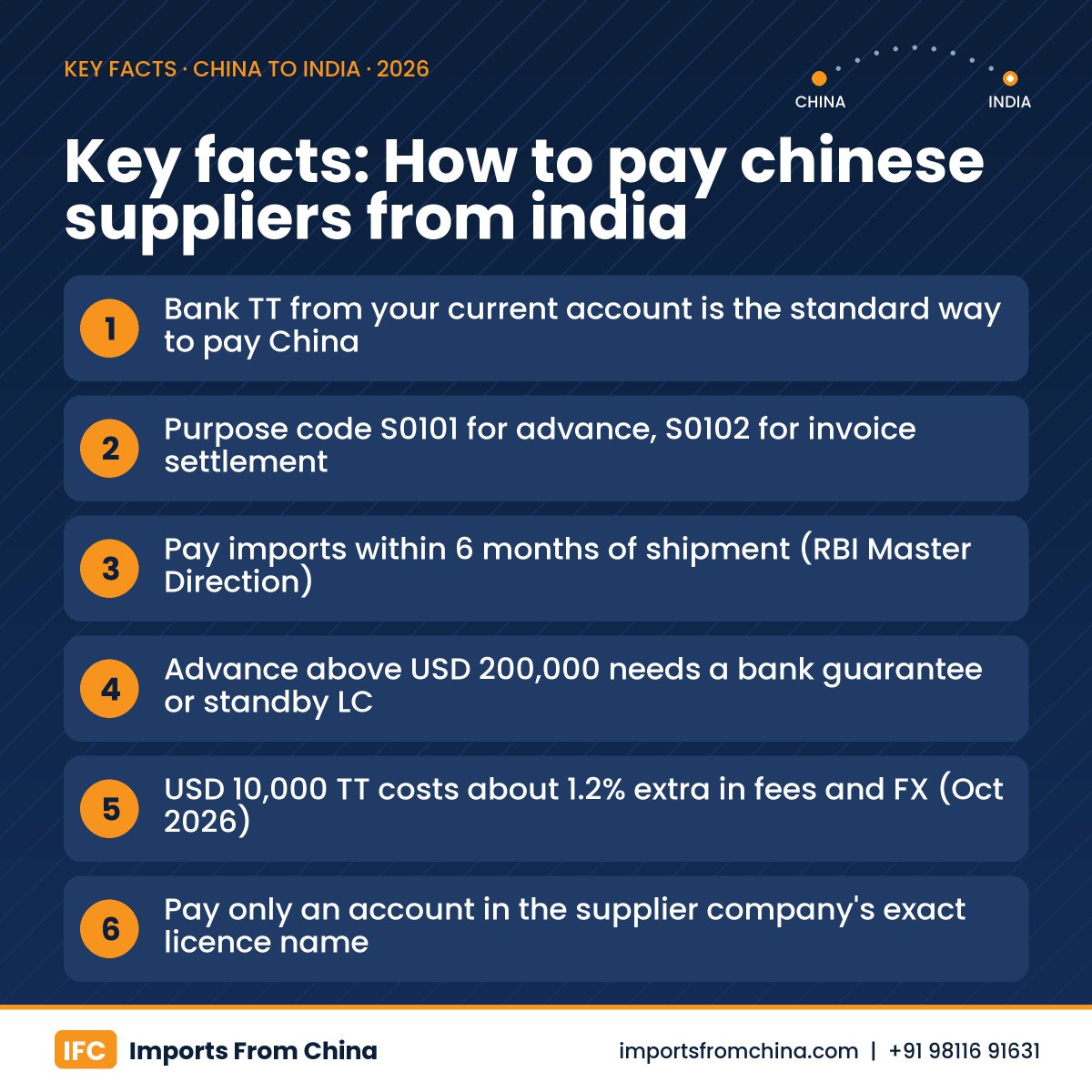
- Bank TT is the standard: a SWIFT transfer from your business current account, in USD or CNY, to the supplier company’s account.
- Use the right purpose code: S0101 for advance payment against imports, S0102 for settling an invoice after shipment.
- RBI time limits apply: import payments are normally due within six months of shipment, and goods paid in advance must arrive within six months.
- Advances above USD 200,000 need cover: a bank guarantee or standby LC is required, unless your bank grants an exemption.
- A USD 10,000 TT costs about 1–1.5% extra in exchange margin, bank fees, GST on currency conversion and correspondent charges (indicative, October 2026).
- Name match is your best protection: pay only an account in the exact name on the supplier’s Chinese business licence, and call to confirm any change of bank details.
What are the ways to pay Chinese suppliers from India?
There are five legal routes for a business. Each suits a different order size and level of trust.
| Method | How it works | Indicative cost (October 2026) | Speed | Buyer protection | Best for |
|---|---|---|---|---|---|
| Bank TT (SWIFT wire) | Your AD Category-I bank sends USD or CNY to the supplier’s bank | About 0.5–1% exchange margin + fixed fees + USD 20–50 correspondent charges | 1–3 working days | None built in; depends on supplier checks and terms | Most regular orders |
| Alibaba Trade Assurance | You pay through Alibaba.com; the order is covered by Alibaba’s terms | Card around 3%; bank transfer fees vary | Card 2–3 days; transfer 3–7 days | Refund claims for late shipment or quality not as agreed | First orders with Alibaba suppliers |
| RBI-licensed payment platforms (PA-CB) | A licensed cross-border payment aggregator converts and pays | Often lower than banks; compare the full rate | Same day to 3 days | Limited | Payments up to ₹25 lakh per transaction |
| Letter of credit (LC) | Your bank pays only when the supplier presents the agreed shipping documents | Opening, amendment and document charges; costly for small orders | Set up in days, paid on document presentation | Strong on documents, not on quality | Large orders, new suppliers, machinery |
| Business credit card | Card payment on a platform or supplier gateway | Card forex markup plus platform fee | Instant | Chargeback rules may help | Samples and very small orders |
Avoid paying a supplier’s personal Alipay or WeChat account, cash through “agents”, or any informal channel. These payments leave you no bank record for customs or GST, no FEMA trail, and no way to recover money if goods never arrive.
How do you make a TT payment to China from India? (step by step)
- Get a proforma invoice (PI) with the supplier’s full company name, address, product details, price, Incoterm, payment terms and bank details.
- Verify the beneficiary. The account name must match the company name on the PI and on the supplier’s business licence. Check the company on China’s official National Enterprise Credit Information Publicity System (GSXT).
- Fill your bank’s import remittance request in its trade or net-banking portal (some banks still call it Form A1). Use your business current account and IEC.
- Choose the purpose code: S0101 for an advance against imports, S0102 for paying an invoice for goods already shipped.
- Attach documents: PI for an advance; commercial invoice and bill of lading or airway bill copy for a balance payment.
- Pick the charges option: OUR (you pay all bank charges, supplier receives the full amount), SHA (charges shared) or BEN (supplier pays). Chinese suppliers usually ask for OUR or for you to add USD 30–50 to cover deductions.
- Book the exchange rate and confirm. Ask your bank for a better rate on larger amounts; the card rate is negotiable.
- Send the SWIFT copy (MT103) to the supplier so they can trace the money.
- After the goods arrive, give your bank the Bill of Entry details so the payment is matched in RBI’s IDPMS system.
Bank details to ask your Chinese supplier for
- Beneficiary name, exactly as on the business licence (in English, and the Chinese name if possible)
- Beneficiary address
- Account number and currency (USD account or CNY account)
- Bank name, branch address and SWIFT/BIC code
- Intermediary bank details, if the supplier’s bank needs one for USD
What RBI rules apply when paying Chinese suppliers from India?
Import payments fall under FEMA and the RBI Master Direction on Import of Goods and Services (updated January 2026). The points that matter most to an SMB importer:
| Rule | What it means for you |
|---|---|
| Settlement within six months | Pay for normal imports within six months of the shipment date. Extensions are possible through your bank. |
| Advance payments | No upper limit, but above USD 200,000 you need a bank guarantee or standby LC from the supplier’s bank, unless your bank exempts you (allowed up to USD 5 million based on its assessment). |
| Goods must follow the advance | Goods paid in advance should be imported within six months of the remittance (three years for capital goods). |
| Evidence of import | Your bank matches each payment with the Bill of Entry in IDPMS. If evidence is not received within three months, the bank will follow up with you. |
| Third-party payments | Paying a party other than the supplier is allowed only with conditions, including the invoice naming that party. Ask why before you agree. |
Business import payments are current-account remittances made by an IEC holder, not personal remittances under the Liberalised Remittance Scheme (LRS). Do not use a personal LRS transfer to pay for business stock; the payment will not match your Bill of Entry and GST records. Confirm the exact documentation with your bank.
Payment platforms licensed by RBI as cross-border payment aggregators (PA-CB) can handle import payments of up to ₹25 lakh per transaction under the 2025 Payment Aggregator Directions. Bigger invoices go through your bank.
Should you pay Chinese suppliers in USD or Chinese yuan?
Most Chinese exporters quote and receive US dollars, so USD is the default. Some suppliers, especially smaller factories and 1688 sellers, prefer yuan (CNY or RMB).
- Pay USD when the PI is in USD and the supplier has a USD account. It is accepted everywhere and easy for your bank.
- Pay CNY when the price is in yuan. Paying CNY directly can avoid one conversion, but check that your bank offers CNY remittance and that the supplier’s account accepts it.
- Never mix them up: sending USD to a CNY-only account can cause a forced conversion at a poor rate, or a return of funds weeks later.
As a reference, market rates in late October 2026 were about ₹94.9 per USD and ¥6.67 per USD, which puts one yuan at roughly ₹14.2. Your bank’s selling rate will be a little higher. For customs, the duty is calculated at the CBIC-notified rate (₹95.90 per USD for imports from 16 October 2026), not your bank rate.
How much does it cost to send money to China from India? (₹ example)
An interior designer in Bengaluru pays a Foshan lighting supplier USD 10,000 by bank TT under the OUR option. Assumptions: interbank rate ₹94.94, bank selling rate ₹95.60, bank remittance fee ₹1,000 plus 18% GST, and USD 30 correspondent charges. All figures are indicative, October 2026; your bank’s charges may differ.
| Item | Calculation | Amount (₹) |
|---|---|---|
| Amount debited for USD 10,000 | 10,000 × ₹95.60 | 9,56,000 |
| Of which exchange margin | (₹95.60 − ₹94.94) × 10,000 | 6,600 |
| Bank remittance fee + GST | ₹1,000 + 18% | 1,180 |
| GST on currency conversion | 18% of (₹1,000 + 0.5% of amount above ₹1 lakh = ₹5,280) | 950 |
| Correspondent charges (OUR) | USD 30 × ₹95.60 | 2,868 |
| Total paid | Debit + fees + GST + charges | 9,60,998 |
| Extra over the interbank value | ₹9,60,998 − ₹9,49,400 | 11,598 (about 1.2%) |
The GST on the bank fee and on currency conversion can usually be claimed as input tax credit if the bank invoices your GSTIN. If the same order were paid by card on a platform charging about 3%, the fee alone would be around ₹28,000. Splitting a payment into a 30% deposit and 70% balance doubles the fixed fees, so negotiate the exchange rate on both.
Bank charges are only one part of your landed cost. Add freight, duty and IGST in the IFC shipment calculator before you confirm the order.
Is Alibaba Trade Assurance a safe way to pay from India?
Trade Assurance is Alibaba.com’s order-protection programme. If you pay through Alibaba’s checkout and the supplier ships late or the goods do not match the agreed specifications, you can raise a dispute and claim a refund. It is a sensible option for a first order with a new Alibaba supplier.
- Protection only applies when you pay through the Alibaba order. A TT sent straight to the supplier outside the platform is not covered.
- Write the details into the order: specifications, packing, inspection terms and ship date. Claims are judged against what is written.
- It does not cover India-side issues: BIS registration, wrong HS codes, customs holds or damage after delivery to the forwarder.
- Fees vary by method: card payments cost more than bank transfers; check the current fee at checkout.
More detail is in our guide to Alibaba sourcing for Indian buyers.
Which payment terms protect Indian importers best?
The method moves the money; the terms decide your risk. Common terms with Chinese suppliers:
| Payment terms | Your risk | When to use |
|---|---|---|
| 100% advance | Highest: you have paid before anything is made | Samples and very small orders only, or a supplier you know well |
| 30% deposit, 70% before shipment | Medium: keep 70% until goods pass inspection | The most common term for production orders |
| 30% deposit, 70% against bill of lading copy | Lower: balance paid once goods are on the ship | Repeat suppliers who agree to it |
| Letter of credit at sight | Low on documents, but the bank does not check quality | Large orders, machinery, new suppliers |
Whatever the term, link the balance payment to a passed pre-shipment inspection. If a new supplier insists on full payment upfront, read what to check when a Chinese supplier asks for 100% advance.
How do you avoid payment fraud with Chinese suppliers?
Most payment losses are not “bad quality” cases. They are payments sent to the wrong account. Use these checks every time:
- Bank details changed by email? Treat it as fraud until proven otherwise. Hackers copy supplier emails and send “new account” letters. Confirm by phone or video call with the person you know.
- Name mismatch: the beneficiary must be the company on your PI and contract, not an individual or a different company.
- Account in a different place: a mainland factory asking you to pay a Hong Kong or overseas company needs an explanation and a written invoice from that company. Verify both.
- Pressure and discounts: “pay today for a special price” is a classic push. Real suppliers wait for your checks.
- No contract: agree specifications, delivery date and penalties in writing before the deposit.
How IFC helps before you pay a Chinese supplier
IFC – Imports From China has more than 20 years of experience in China–India import and export, since 2004. Our own offices in Guangzhou and Yiwu, with translators and English-speaking staff, can verify a supplier before you send a deposit and run a quality inspection before you release the balance, so your money moves only when the goods are right.
We also handle what happens after payment: daily loading of mixed containers and air cargo, LCL and FCL sea freight, customs clearance and door-to-door DDP delivery from our warehouse at headquarters to major Indian cities including Delhi, Gurugram, Noida, Mumbai, Pune, Bengaluru, Hyderabad, Chennai and Ahmedabad.
Conclusion
To pay Chinese suppliers from India safely, use a bank TT from your business account for regular orders, Trade Assurance for first Alibaba orders, a licensed payment platform for smaller invoices if it is cheaper, and an LC for large risky orders. Quote the right purpose code, keep the balance until inspection, match the beneficiary name every time, and give your bank the Bill of Entry once goods land.
Get your real landed cost: enter your product, weight and CBM in the IFC shipment calculator, check your HS code on the India import duty rates page, or call IFC on +91 98116 91631 for a door-to-door DDP quote from China to your city.
Frequently asked questions
What is the best way to pay a Chinese supplier from India?
For most business orders, a bank telegraphic transfer (TT) from your current account through an authorised bank is the standard and safest way, because it creates a clear FEMA and customs record. For a first order on Alibaba, paying through Trade Assurance adds refund protection. For large orders with a new supplier, a letter of credit reduces risk.
Which purpose code should I use to pay a Chinese supplier?
Use S0101 when you pay an advance against imports before the goods are shipped, and S0102 when you settle an invoice for goods already shipped. Your bank asks for the purpose code in its import remittance form. Using the right code helps the bank match the payment with your Bill of Entry later.
Can I pay a Chinese supplier through Alipay or WeChat from India?
Paying a supplier’s personal Alipay or WeChat account is risky and leaves no proper bank record for customs, GST or RBI rules. Indian businesses should pay the supplier company’s bank account by bank transfer or use a regulated platform. Some licensed payment providers can pay Chinese accounts formally; check that they are RBI-authorised.
How long does a bank transfer from India to China take?
A SWIFT transfer from India to a Chinese bank usually reaches the supplier in 1 to 3 working days, sometimes longer if an intermediary bank is involved or details are wrong. Send the SWIFT copy, also called MT103, to the supplier so they can trace the payment with their bank.
Is there a limit on advance payment to Chinese suppliers?
There is no upper limit on advance payment for imports, but under RBI rules an advance above USD 200,000 needs a bank guarantee or standby letter of credit from the supplier’s bank, unless your bank exempts it. Goods paid for in advance should normally be imported within six months.
Should I pay my Chinese supplier in dollars or yuan?
Pay in the currency on the proforma invoice and to an account that accepts it. Most Chinese exporters use US dollars. If the supplier quotes in yuan, paying CNY directly can save one conversion, but confirm that your bank can send CNY and that the supplier’s account can receive it.
What documents does my bank need to pay a supplier in China?
For an advance, banks usually ask for the proforma invoice, your IEC and the import remittance application. For a balance payment, add the commercial invoice and bill of lading or airway bill copy. After the goods arrive, give the bank the Bill of Entry details so the payment is closed in the IDPMS system.
Comments for this post are closed.