





RMB or USD: Best Currency to Pay China Suppliers (2026 Guide)
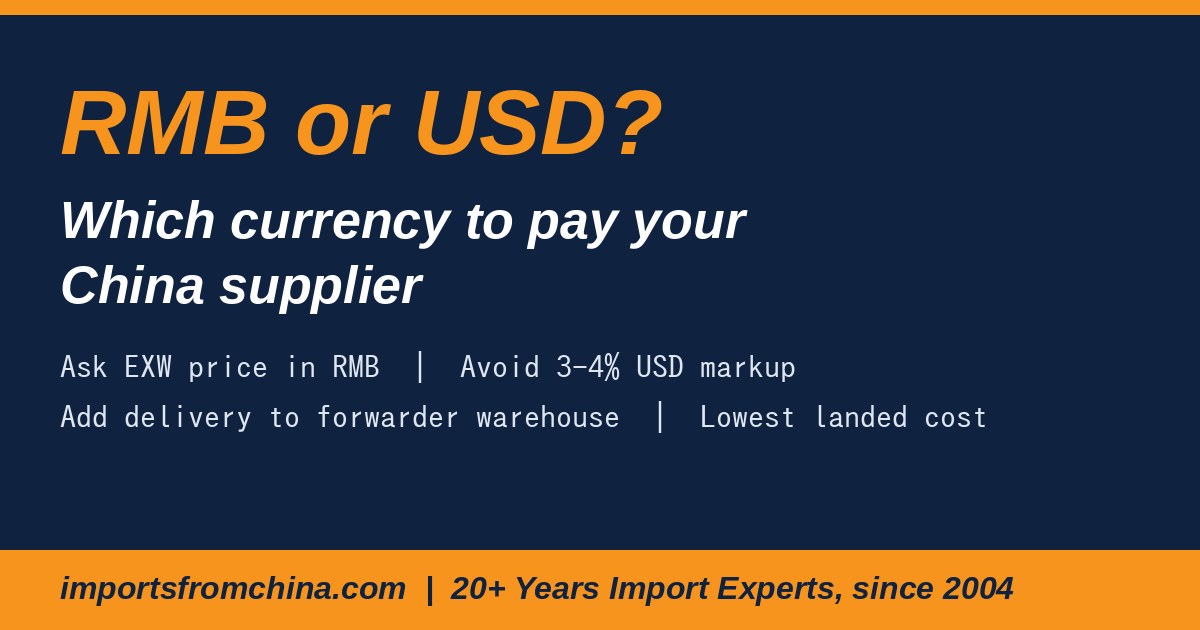
RMB or USD: which currency is better to pay your China supplier? In our experience, RMB wins almost every time. A USD price usually carries a 3-4% buffer for currency changes plus FOB charges. Ask your supplier for an EXW (ex-works) price in RMB, add only the local delivery cost up to your forwarder’s warehouse, and you get the lowest real price for your goods.
Indian importers ask us this question every week. This guide explains why the RMB price is cheaper, how to ask for it, a worked example in rupees, and the few cases where paying in USD still makes sense.
Key takeaways
- RMB is the supplier’s home currency: their raw material, labour and rent are all paid in RMB, so an RMB price is their real cost plus margin.
- USD prices carry a buffer: suppliers usually add around 3-4% to a USD quote to protect themselves from exchange-rate changes.
- FOB adds hidden extras: a FOB price includes trucking to port, export documents and port charges that the supplier often rounds up.
- Best method: ask for an EXW price in RMB, then add delivery up to your forwarder’s warehouse in China.
- Ask about the VAT invoice: confirm whether the RMB price includes a Chinese VAT invoice (fapiao), which an export order usually does not need.
- USD still fits some cases, such as a supplier with only a USD account or an Alibaba Trade Assurance order.
Why is an RMB price cheaper than a USD price?
Think of yourself as the supplier. A factory in Yiwu or Guangzhou buys plastic, steel, fabric and packaging in RMB. It pays workers, rent and electricity in RMB. The owner knows his cost of every piece in RMB, to the last fen. When he quotes in RMB, he is quoting his real cost plus his profit. Nothing else.
When the same supplier quotes in USD, he takes a risk. He will receive dollars weeks or months later, and the USD-RMB rate can move in that time. To protect himself, he adds a cushion to the price. In our experience across many orders, this cushion is usually around 3-4%. He also has to convert the dollars back to RMB, and his bank charges for that too.
Ask yourself: if you were selling in India, would you feel more comfortable quoting in rupees or in a foreign currency? Every business owner gives his sharpest price in his home currency. A Chinese supplier is no different.
What is the difference between an EXW and a FOB price?
EXW and FOB are Incoterms, the standard trade terms published by the International Chamber of Commerce. They decide which costs are included in the supplier’s price.
| Point | EXW (Ex-Works) in RMB | FOB (Free On Board) in USD |
|---|---|---|
| What the price covers | Goods packed and ready at the factory | Goods, trucking to the port, export documents and loading on the ship |
| Currency buffer | None; the supplier’s own currency | Usually around 3-4% added |
| Local delivery and export charges | You add the actual cost (or your forwarder arranges it) | Included, often rounded up by the supplier |
| Transparency | You see the product price and the logistics cost separately | Product and logistics mixed in one number |
| Best for | Buyers who use a China forwarder or consolidator | Buyers who book their own full container from the port |
For most Indian buyers who ship LCL or air with a forwarder like IFC, the supplier does not need to deliver to the port at all. The goods only need to reach the forwarder’s warehouse in China. Paying the supplier for FOB means paying for a service you do not use.
How much can you save by paying in RMB? A worked example
Here is a simple example with assumed numbers. Exchange rates change every day, so use the live rate when you calculate your own order. We assume 7.10 RMB per USD and ₹12 per RMB.
| Step | RMB route (EXW + delivery) | USD route (FOB quote) |
|---|---|---|
| Factory price of goods | RMB 70,000 | RMB 70,000 |
| Delivery / port and export charges | RMB 1,000 to forwarder’s warehouse | RMB 1,500 to port, with export documents |
| Currency buffer (about 3.5%) | None | RMB 2,500 |
| Total in RMB | RMB 71,000 | RMB 74,000 (quoted as about USD 10,420) |
| Approximate cost in rupees | ₹8,52,000 | ₹8,88,000 |
| Difference | About ₹36,000 saved on one order of goods, roughly 4% | |
On a margin business, 4% can be a large part of your profit. Over a year of regular orders, the difference adds up fast.
How do you ask a Chinese supplier for an RMB price?
Keep the request short and clear. Ask for:
- EXW price in RMB per piece, for your exact quantity, packing and specification.
- Whether the price includes a VAT invoice (fapiao). Domestic Chinese prices often include VAT. An export order usually does not need a fapiao, so ask for the price without it.
- Delivery cost to your forwarder’s warehouse as a separate line (for IFC, our warehouse in China).
- Carton details: carton size, gross weight and pieces per carton, so you can calculate freight.
- Production time and payment terms, for example a deposit and the balance before dispatch.
Many factories in Yiwu, Guangzhou and Foshan quote local buyers in RMB every day, so they understand this request well. IFC’s staff in our Guangzhou and Yiwu offices speak Chinese and can negotiate the RMB price for you.
How do Indian buyers pay a supplier in RMB?
There are two common ways:
- Through your own bank: some Indian banks can send an import remittance in CNY. You will need your IEC, the supplier’s proforma invoice and the bank’s import forms, and you must later submit the Bill of Entry to close the entry in the RBI’s IDPMS.
- Through IFC on a DDP basis: you pay IFC in rupees, IFC pays the supplier in RMB from its company account, imports the goods on its own IEC and gives you a local GST invoice. Read why many buyers choose this in our guide on importing on IFC’s IEC vs your own IEC.
Whichever way you pay, check the supplier first. Never send money to a personal account that does not match the company on the invoice. Our guide on how to verify a China import agent lists the checks to make.
When is paying in USD still the better choice?
RMB is not right for every order. USD can make sense when:
- The seller is a trading company with only an offshore USD account and cannot receive RMB.
- You order through Alibaba Trade Assurance, where the order and payment are normally in USD.
- You book your own full container from the Chinese port and want the supplier to handle export to the ship (FOB).
- You have a long-term contract with a fixed USD price, and both sides have agreed on how to handle rate changes.
Even in these cases, ask for the RMB EXW price as well. It shows you the supplier’s real product price and helps you negotiate the USD quote.
How does IFC help you buy in RMB?
IFC (Imports From China) has helped Indian businesses import from China for more than 20 years, since 2004. With our own offices in Guangzhou and Yiwu, we:
- Ask suppliers for EXW prices in RMB and negotiate in Chinese.
- Pay suppliers in RMB on your behalf, as part of a DDP shipment on IFC’s IEC.
- Collect goods at our China warehouse and load them in our daily mixed containers and air shipments.
- Clear customs in India and deliver to your door with a GST invoice. See how DDP shipping from China to India works and our China import service fee guide.
The cheapest way to buy from China is simple: price in RMB, terms EXW, delivery to your forwarder’s warehouse, and one partner to bring it home.
Get your real landed cost: enter your product, weight and CBM in the IFC shipment calculator, or call IFC on +91 98116 91631 for a door-to-door DDP quote from China to your city.
Frequently asked questions
Is it better to pay a Chinese supplier in RMB or USD?
In most cases RMB is better. A USD price usually includes a buffer of around 3-4% for exchange-rate risk, plus FOB charges. An EXW price in RMB shows the supplier’s real price.
Why do Chinese suppliers add extra to USD prices?
Their costs are in RMB. If they quote in USD and the rate moves before they are paid, they lose money. The extra amount protects them from that risk and covers conversion costs.
Should I ask for an EXW or FOB price?
If you ship through a forwarder or consolidator, ask for EXW in RMB and add delivery to the forwarder’s warehouse. FOB is useful mainly when you book your own full container from the port.
Does the RMB price include Chinese VAT?
It may. Many domestic prices include a VAT invoice (fapiao). Ask the supplier for the price without fapiao, because an export order usually does not need one.
Can IFC pay my supplier in RMB?
Yes. In a DDP shipment, you pay IFC in rupees and IFC pays the supplier in RMB, imports the goods on its IEC and delivers them to you with a GST invoice.
Comments for this post are closed.