





How to Verify a China Import Agent in India Before You Pay (2026 Checklist)
Here is how to verify a China import agent in India: check the company’s GSTIN and IEC on the government portals, confirm the China office through its business registration, match the bank account to the invoicing company, test the all-in quote against the real duty, and start with a small trial shipment. If an agent fails any one of these checks, do not pay yet.
This guide gives you a ten-point checklist, the exact things to look for on each portal, a worked rupee example that exposes impossible quotes, the red flags Indian importers report most often, and the documents a genuine agent hands over on every shipment.
Key takeaways
- Indian identity first: the GSTIN, IEC and company name should all point to the same legal entity that invoices you.
- China office proof: ask for the Chinese company name and its 18-character Unified Social Credit Code, then check it on the GSXT portal.
- Quote sanity test: an “all-inclusive” price that is lower than the duty and IGST alone is not a bargain, it is a warning.
- Payment trail: pay only the current account of the company named on the invoice, never a personal account or cash.
- Paper trail: every shipment should come with a warehouse receipt, a bill of lading or air waybill number, a Bill of Entry number and a GST invoice.
- Trial first: a small shipment shows you the real process before you send a large order.
Why do you need to verify a China import agent before paying?
An import agent sits between your money and your goods. You usually pay the agent for the products, the freight and often the duty, weeks before anything reaches you. If the agent is not who they claim to be, you can lose the advance, receive goods cleared under a false value, or find your cargo held at the port with nobody answering the phone.
The risk is higher in China to India trade: many “agents” are individuals reselling another forwarder’s space, some offers rely on under-invoicing or unbilled clearance, and from 1 October 2025, China’s tax authority stopped the practice of exporting goods on borrowed export documents, so an agent’s China-side set-up now matters more than before. If you are new to the roles involved, our guide to choosing a China buying agent for India explains what agents, sourcing agents and forwarders each do.
How to verify a China import agent in India: the 10-point checklist
Work through these checks in order; the first five take under an hour online.
- Get the full legal details in writing. Ask for the registered company name, GSTIN, IEC, registered address and the name of the person you will deal with. A genuine business sends these in one message without hesitation.
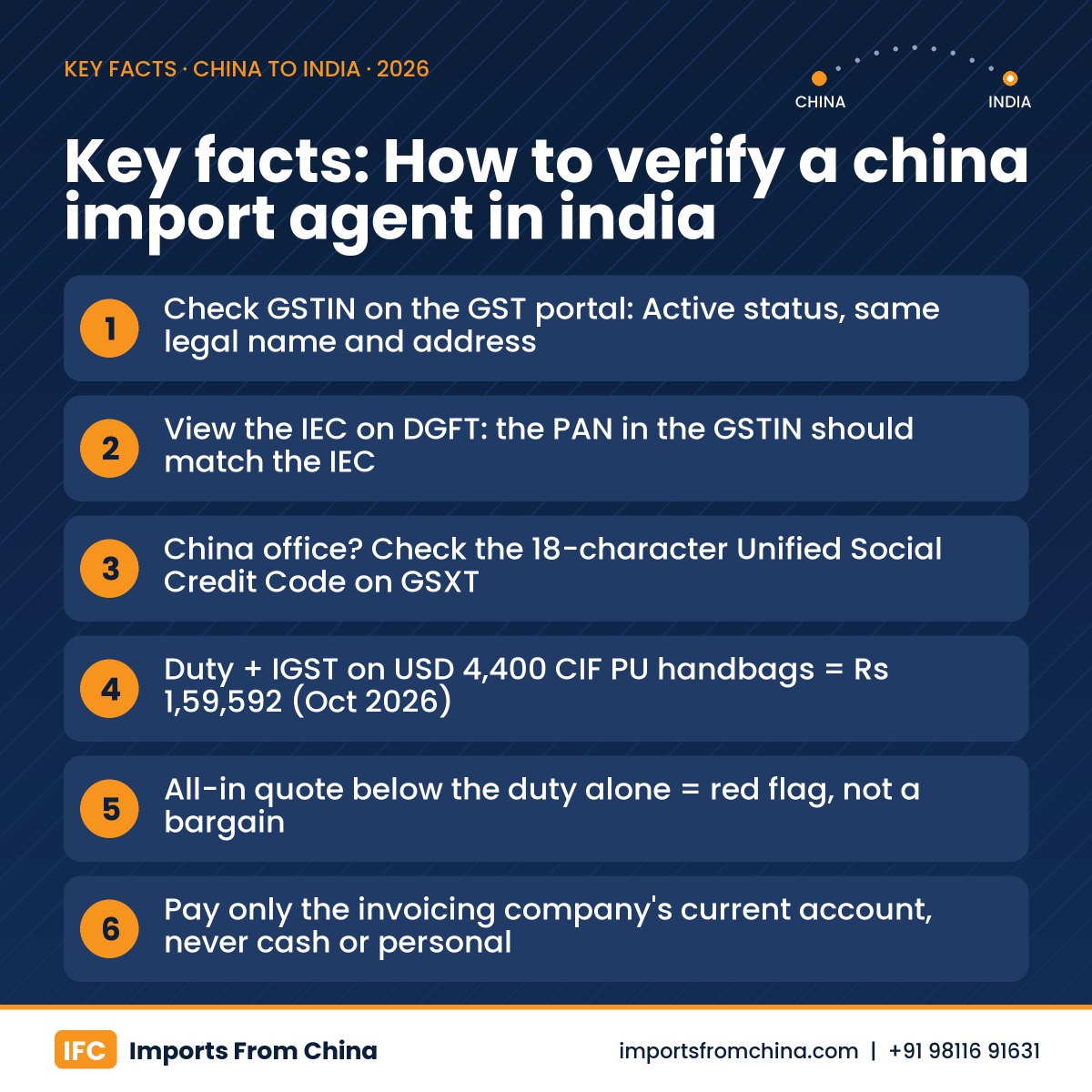
- Check the GSTIN on the GST portal. Use “Search Taxpayer” on the GST portal. The status should be Active, the legal name should match the quote and invoice, and the principal place of business should match the address you were given.
- Check the IEC on DGFT. The DGFT portal lets you view IEC details. Since the IEC is PAN-based, the PAN inside the GSTIN (characters 3 to 12) should match the IEC. An agent that offers to import “under our IEC” must have an active one.
- Check the company record. For a private limited company or LLP, the company master data on the MCA portal shows the incorporation date, status and directors. A very new company claiming decades of experience needs an explanation.
- Verify the China office. If the agent claims its own office or warehouse in China, ask for the Chinese company name and its Unified Social Credit Code, an 18-character number printed on every Chinese business licence. Search it on the National Enterprise Credit Information Publicity System (GSXT) and check the status, registered address and business scope.
- Ask for a live video walk-through. A short video call from the China office or warehouse, showing live cargo and the street outside, is hard to fake; chat photos are easy to copy.
- Ask who clears customs in India. Customs brokers (CHAs) are licensed under the Customs Brokers Licensing Regulations, 2018. Ask for the broker’s name and licence number, and whose IEC will appear on the Bill of Entry.
- Get an itemised written quote. Product cost, freight, duty, IGST, clearance, port or CFS charges and delivery should be separate lines, with the HS code stated.
- Talk to two or three real customers. Ask for references in your product category or city, and prefer detailed reviews that describe a real shipment over one-line ratings.
- Run a trial shipment. Start with samples or one small LCL or air shipment. Check that the documents arrive and the final bill matches the quote.
Where to check each detail
| What to verify | Where to check | What a good result looks like |
|---|---|---|
| GST registration | GST portal, Search Taxpayer | Active, same legal name and address as the invoice |
| Import Export Code | DGFT portal, IEC details | Active IEC, PAN matches the GSTIN |
| Indian company age and status | MCA company master data | Active, incorporation date fits the experience claimed |
| China office or warehouse | GSXT, using the Unified Social Credit Code | Registered, active, address in the city claimed |
| Customs broker | Broker name and licence number from the agent | A licensed broker that files on ICEGATE |
| Bank account | The invoice and your bank’s beneficiary check | Current account in the same company name |
| Past shipments | References and detailed reviews | Real customers who can describe the process |
How do you test whether an agent’s all-in quote is even possible?
The fastest way to catch a risky agent is to compare the quote with the duty and IGST customs will actually charge. If the “all-inclusive” figure is lower than the tax alone, the agent is either declaring a much lower value, using a different product description, or not filing a proper Bill of Entry. All three come back to you.
Worked example: 1,000 PU handbags by LCL sea
Assume 1,000 PU handbags (HS 4202 22 10) at USD 4.00 each, so a supplier invoice of USD 4,000 FOB, packed in about 3 CBM. We assume USD 400 for sea freight and insurance to the Indian port, which makes the CIF value USD 4,400. The customs exchange rate used is about ₹96.80 per USD, notified for 1 October 2026; check the current rate before filing. Assessable value is the CIF value (there is no separate 1% landing charge since 2017).
| Line | Working | Amount (₹) |
|---|---|---|
| Assessable value (CIF) | USD 4,400 × ₹96.80 | 4,25,920 |
| Basic customs duty (BCD) | 15% of assessable value | 63,888 |
| Social Welfare Surcharge (SWS) | 10% of BCD | 6,389 |
| IGST | 18% of (4,25,920 + 63,888 + 6,389) = 18% of 4,96,197 | 89,315 |
| Total duty and IGST | BCD + SWS + IGST | 1,59,592 |
Now add the goods and a door-to-door LCL rate. The goods cost USD 4,000 × ₹96.80 = ₹3,87,200. LCL door to door is roughly ₹9,000 to ₹16,000 per CBM (indicative, October 2026), so about ₹27,000 to ₹48,000 for 3 CBM. A realistic landed cost is therefore roughly ₹5,73,800 to ₹5,94,800, or about ₹574 to ₹595 per bag.
| Quote you receive | Freight + duty + clearance quoted | What it tells you |
|---|---|---|
| Agent A, “all inclusive, no tension” | ₹45,000 for 3 CBM | Below the ₹1,59,592 duty and IGST alone. The value or description is being changed, or there is no proper Bill of Entry. |
| Agent B, itemised DDP quote | About ₹1,87,000 to ₹2,08,000 | Duty and IGST plus a normal LCL door-to-door range. Plausible; check the lines and the HS code. |
There is a second benefit to the honest route. When goods are imported properly under your own IEC and GSTIN, the IGST of about ₹89,315 can normally be claimed as input tax credit, which brings your effective cost down to roughly ₹4,84,500 to ₹5,05,500. A cash “no bill” deal gives you no credit and no legal proof of import. Rates as of October 2026; confirm for your exact HS code on our India import duty rates page, and run your own product in the IFC shipment calculator.
What are the red flags of a fake or risky import agent?
- Personal bank account or cash. The beneficiary name differs from the company on the quote, or the agent asks for UPI to an individual “for faster processing”.
- Bank details change by message. A new account sent by WhatsApp or email just before payment is a classic diversion trick. Confirm by phone with a number you already had.
- Price below the duty. As the example shows, an all-in price below the tax is not possible on a correct declaration.
- “No BIS needed” for BIS items. Electronics, toys, footwear, many electrical goods and some furniture fall under BIS rules. An agent who waves this away is gambling with your cargo.
- Promises of “no customs check” or a “setting”. No genuine agent can promise that customs will not examine a shipment.
- No video call, no visit. Excuses every time you ask to see the office or warehouse.
- No HS code on the quote. A duty-paid price without an HS code is a guess.
- Pressure to pay today. “Rate valid only for one hour” or “container closing tonight” before you have even shared the packing list.
Genuine agent vs risky agent: how do they compare?
| Point | Genuine agent | Risky agent |
|---|---|---|
| Company details | GSTIN, IEC and legal name shared upfront and they match | Only a WhatsApp number and a brand name |
| Quote | Itemised, with HS code, CBM or weight and validity | One round figure, “all inclusive” |
| Importer of record | Clearly states whose IEC is used | Vague or avoids the question |
| Payment | Company current account against an invoice | Personal account, cash or changing accounts |
| China presence | Registered entity you can check, video walk-through | Stock photos, refuses video |
| Compliance | Asks about BIS, WPC, FSSAI or CDSCO before you order | Says approvals are “not needed” or “will be managed” |
| Documents | Warehouse receipt, BL or AWB, Bill of Entry, GST invoice | Delivery only, no paperwork |
How do you check an agent’s China side after the October 2025 rule change?
Since 1 October 2025, China’s State Taxation Administration Announcement No. 17 of 2025 ended the use of third-party or “bought” export documents. The exporter on the Chinese customs declaration now has to be the party that actually owns the goods, or an agent that reports the real exporter. For you, this means an agent’s China-side process should be clean and explainable.
- Ask who exports the goods. Is it your supplier under its own export rights, or an entrusted export where the real producer is disclosed?
- Ask for the supplier’s details. The supplier’s company name and credit code should match the commercial invoice and packing list.
- Check consistency. The invoice value you paid, the value on the export documents and the value on the Indian Bill of Entry should tell the same story.
What documents should a genuine import agent give you?
Ask for these on your trial shipment and keep them on file for every order.
| Stage | Document | How you can use it |
|---|---|---|
| Before payment | Supplier proforma invoice and itemised agent quote | Match product, quantity, price and HS code |
| China warehouse | Warehouse receipt with carton count, weight, CBM and photos | Confirms the cargo exists and fixes the chargeable volume |
| After loading | Bill of lading or air waybill number | Track the vessel or flight on the carrier’s site |
| Indian customs | Bill of Entry number, date and port | Shows the declared value and duty paid; track it on ICEGATE when you are the importer |
| Delivery | GST invoice and proof of delivery | Your books, input tax credit and proof of legal import |
If you want to understand what happens between arrival and Out of Charge, read our step-by-step guide on how customs clearance works for imports in India. For the full door-to-door chain, see how DDP shipping from China to India works.
What questions should you ask an agent on the first call?
- Which company will invoice me, and can you share its GSTIN and IEC?
- Do you have your own office or warehouse in China? In which city, and under which registered company?
- Whose IEC will be on the Bill of Entry, and which licensed customs broker files it?
- Which HS code and duty rate have you used in this quote?
- Does my product need BIS, WPC, FSSAI, CDSCO or any other approval?
- What is excluded from the quote: demurrage, examination charges, anti-dumping duty, remote-area delivery?
- What happens if the weight or CBM at your warehouse differs from the supplier’s packing list?
- Which documents will I receive, and at which stage?
Compare the answers from two or three agents on the same shipment. Our overview of import agents from China to India explains the services you can expect to compare.
How IFC helps you verify and work with a China import agent
We suggest you run every check in this guide on IFC too. IFC, Imports From China Inc, has worked in China to India import and export since 2004, which is more than 20 years. IFC has its own offices in Guangzhou and Yiwu with translators and English-speaking staff, loads mixed containers and air cargo daily, and keeps a warehouse at its headquarters.
- Services under one roof: sourcing, supplier verification, quality inspection, LCL and FCL sea freight, air cargo, customs clearance and door-to-door DDP delivery.
- Delivery cities: major Indian cities including Delhi, Gurugram, Noida, Mumbai, Pune, Bengaluru, Hyderabad, Chennai and Ahmedabad.
- Itemised costing: share your product, HS code, weight and CBM, and IFC will set out the cost lines so you can run the duty test yourself.
You can find IFC’s services on the China import agent in India home page.
Conclusion
Verifying a China import agent takes an hour of checks and one small trial order, which is far less than the cost of one bad shipment. Match the GSTIN, IEC and bank account to one company, confirm the China office on GSXT, test the quote against the real duty, and insist on a Bill of Entry and GST invoice every time. An agent who welcomes these checks is usually one worth working with.
Get your real landed cost: enter your product, weight and CBM in the IFC shipment calculator, check your HS code on the India import duty rates page, or call IFC on +91 98116 91631 for a door-to-door DDP quote from China to your city.
Frequently asked questions
How do I know if a China import agent is genuine?
Check that the GSTIN, IEC and legal name all belong to the company that invoices you, confirm any China office on the GSXT portal using its Unified Social Credit Code, ask for a live video of the warehouse, speak to two or three past customers and start with a small trial shipment before a large order.
Can I check an import agent’s IEC and GST number online?
Yes. Use Search Taxpayer on the GST portal to see whether the GSTIN is active and which legal name and address it belongs to, and view the IEC on the DGFT portal. The PAN inside the GSTIN should match the IEC, and both should match the name on your invoice.
Is it safe to pay an import agent in cash or into a personal account?
No. Pay only into the current account of the company named on the quote and invoice. Cash or personal-account payments leave you with no proof, no GST invoice and no input tax credit. If bank details change by message, confirm by phone on a number you already had.
Why is one agent’s all-inclusive rate so much cheaper than the others?
Usually because the value or product description is being changed, or the goods are not cleared on a proper Bill of Entry. Compare the quote with the real duty and IGST for your HS code. If the all-in price is lower than the tax alone, it is not a genuine offer.
How can I verify that an agent really has an office in China?
Ask for the Chinese company name and its 18-character Unified Social Credit Code from the business licence, then search it on the National Enterprise Credit Information Publicity System (GSXT). Check the status and address, and ask for a live video call from the office or warehouse.
What documents should I get from a China import agent for each shipment?
You should get the supplier invoice and packing list, a warehouse receipt with carton count, weight and CBM, the bill of lading or air waybill number, the Bill of Entry number with date and port, and a GST invoice with proof of delivery.
Comments for this post are closed.