




How DDP Shipping from China to India Works: Door-to-Door Guide (2026)
DDP shipping from China to India means the seller or forwarder delivers your goods to your door in India with freight, customs clearance, import duty and IGST already paid, so you receive one all-in price and no surprise bills at the port. The shipment moves from the Chinese supplier to a forwarder warehouse, onto a ship or aircraft, through Indian customs, and by truck to your address.
This guide explains each step of DDP door-to-door shipping, who legally imports the goods, what a DDP quote must include, a worked cost example in rupees, and the checks that protect you from weak quotes.
Key takeaways
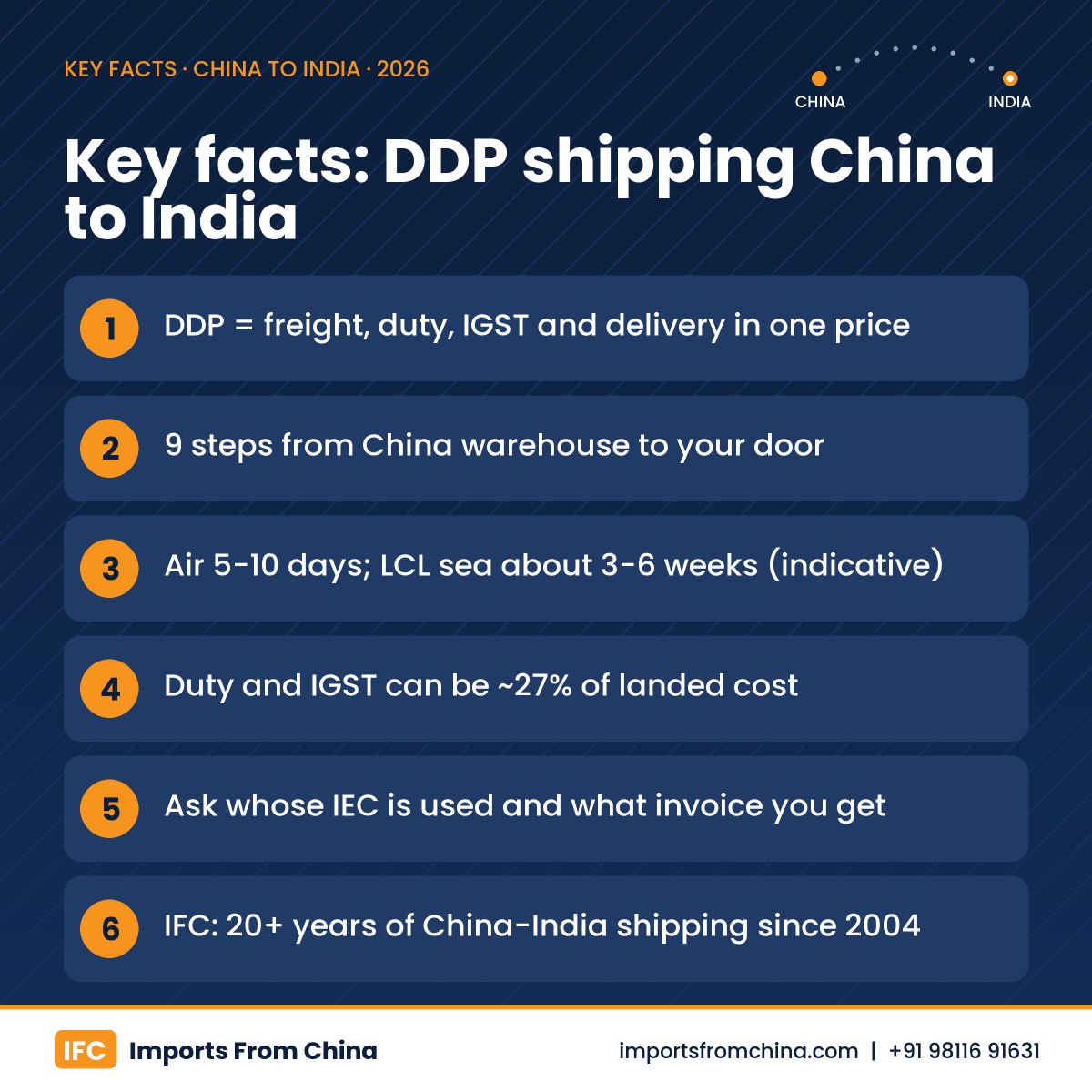
- One price: DDP bundles freight, customs duty, IGST, clearance and delivery to your door.
- Importer of record: the forwarder usually clears under its own IEC and bills you on a GST invoice, so check how the invoice is raised.
- Time: air is roughly 5 to 10 days door to door; LCL sea roughly 3 to 6 weeks (indicative, October 2026).
- Duty is the big variable: it depends on your HS code, so confirm the code before you accept a per-kg or per-CBM rate.
- Read the exclusions: BIS or other approvals, demurrage and detention, and examination charges are often not in a basic DDP rate.
- 20+ years: IFC has run China to India door-to-door shipments since 2004.
What is DDP shipping from China to India?
DDP stands for Delivered Duty Paid, an Incoterms rule where the seller carries cost and risk until the goods reach the named place, with import clearance and duties paid. In China to India trade, the word is used a little more loosely. Most Indian buyers mean a door-to-door service: a forwarder collects from the supplier or from its Guangzhou or Yiwu warehouse, ships by sea or air, clears customs in India, pays duty, and delivers to the buyer.
That is different from DAP or CIF, where the buyer arranges Indian clearance and pays duty separately. If you are weighing the two models, read our comparison of DDP vs DAP shipping for Indian importers.
How does DDP door-to-door shipping work step by step?
- Fix the product and HS code. The forwarder confirms what the goods are, the 8-digit HS code, and whether BIS, WPC, FSSAI or another approval applies. This decides duty and whether the cargo can be cleared at all.
- Supplier delivers to the China warehouse. Your supplier sends the cartons to the forwarder’s warehouse in Guangzhou, Yiwu or another consolidation point, with an invoice and packing list.
- Receiving, weighing and measuring. The warehouse checks carton count, marks, weight and CBM, and photographs the goods. Chargeable weight or CBM is fixed here.
- Export paperwork in China. The forwarder prepares the export declaration, the bill of lading or air waybill, and the final commercial invoice and packing list for India.
- Main transport. Sea cargo moves port to port, for example Guangzhou or Shanghai to Nhava Sheva (JNPT), Mundra or Chennai. Air cargo flies to Delhi, Mumbai or another airport.
- Bill of Entry and duty payment. A customs broker (CHA) files the Bill of Entry on ICEGATE, customs assesses the value and HS code, and duty and IGST are paid.
- Examination and Out of Charge. Customs may inspect the goods. After clearance, customs issues the Out of Charge order. Our customs clearance guide walks through this stage.
- Port or CFS release and trucking. The forwarder pays the delivery order and CFS or terminal charges, collects the cartons and trucks them to your warehouse.
- Delivery and invoice. You receive the goods, sign the proof of delivery, and get a GST invoice that you can use for your accounts.
Where do delays usually happen?
Delays come from three places: a wrong or vague product description, a missing approval such as BIS registration, and a mismatch between invoice value and the value customs expects. A good forwarder catches these before the cargo sails, not after it lands.
Who is the importer of record in a DDP shipment?
The importer of record is the party whose Import Export Code (IEC) and GSTIN appear on the Bill of Entry. In many DDP arrangements the forwarder imports under its own IEC and sells the cleared goods to you on a GST invoice. In others, you import under your own IEC and the forwarder only arranges freight, clearance and delivery. See our guide to documents required for import from China to India if you plan to use your own IEC.
Ask in writing which model applies, because it changes who is responsible for compliance, how you claim input tax credit, and what happens if customs raises a query.
| Point to confirm | Forwarder’s IEC | Your own IEC |
|---|---|---|
| Name on Bill of Entry | Forwarder | You |
| Invoice you receive | Forwarder’s GST invoice for the cleared goods | Supplier invoice plus forwarder’s service invoice |
| Who answers customs queries | Forwarder, with your product details | You, assisted by the CHA |
| IEC needed by you | No | Yes |
| Best for | New or small importers, mixed LCL cargo | Regular importers with their own IEC and GST set-up |
What does a DDP price include, and what does it leave out?
A real DDP price covers the whole chain. A cheap-looking rate that leaves out duty is not DDP, it is a freight quote. Use this table to test any offer.
| Cost item | Usually in a DDP quote | Often excluded, ask first |
|---|---|---|
| China pickup and warehouse handling | Yes | Special packing or re-labelling |
| International freight (sea or air) | Yes | Peak-season surcharge |
| Customs duty (BCD, SWS) and IGST | Yes, at the declared HS code | Anti-dumping duty or duty from a re-assessment |
| CHA fees, DO, CFS and port charges | Yes | Demurrage, detention and examination or labour charges |
| Trucking to your door | Yes, to the agreed city | Waiting time and remote-area surcharge |
| BIS, WPC, FSSAI or CDSCO approvals | Not normally | Always confirm; the product may be held without them |
| Marine insurance | Sometimes | Often optional; ask for the cover in writing |
What does DDP shipping from China to India cost? A worked example in rupees
Here is a simple sea shipment of plastic kitchenware, HS 3924 10 90. We assume a supplier invoice of USD 5,000 (FOB) and USD 600 for sea freight and insurance, which makes the CIF value USD 5,600. We use the customs exchange rate of about ₹96.80 per USD notified for 1 October 2026; check the current rate on ICEGATE before filing.
| Line | Working | Amount (₹) |
|---|---|---|
| Assessable value (CIF) | USD 5,600 × ₹96.80 | 5,42,080 |
| Basic customs duty (BCD) | 15% of assessable value | 81,312 |
| Social Welfare Surcharge (SWS) | 10% of BCD | 8,131 |
| IGST | 18% of (value + BCD + SWS) = 18% of 6,31,523 | 1,13,674 |
| Total duty and tax | BCD + SWS + IGST | 2,03,117 |
| Goods + freight + duty | 4,84,000 + 58,080 + 2,03,117 | 7,45,197 |
The ₹7,45,197 is before Indian clearance, CFS and trucking charges, which a DDP rate bundles in. Rates as of October 2026; confirm for your exact HS code on our India import duty rates page, or run your own numbers in the IFC shipment calculator.
Notice that duty and IGST are about 27% of the total in this example. That is why the HS code matters more than a few rupees of freight difference, and why a quote given without an HS code should not be trusted.
Sea vs air DDP: which should you choose?
Choose by the value and urgency of the goods, not only by freight rate. Our full comparison of air freight vs sea freight from China to India covers chargeable weight in detail. The short version is below. All figures are indicative, October 2026.
| Factor | Sea (LCL or FCL) | Air cargo |
|---|---|---|
| Door-to-door time | About 3 to 6 weeks for LCL | About 5 to 10 days |
| Port-to-port sea transit | Roughly 12 to 20 days to Nhava Sheva | Not applicable |
| Indicative door-to-door cost | LCL roughly ₹9,000 to ₹16,000 per CBM | Roughly ₹350 to ₹600 per kg |
| Best for | Bulky, lower-value-per-kg goods | Samples, urgent, high-value or light goods |
| Rate basis | Per CBM or per container | Chargeable weight (higher of actual and volumetric) |
If you are unsure about LCL economics, read how LCL shipping from China to India is priced, and when a full container becomes cheaper in our FCL vs LCL guide.
What are the risks of DDP shipping, and how do you reduce them?
DDP is convenient, but convenience can hide weak spots. These are the ones we see most often with Indian buyers.
- Under-declared value. A very low rate may rely on a low invoice value. If customs challenges it, the cargo is delayed and the cost lands on you.
- Wrong HS code. A cheaper code can mean a re-assessment later. Check the code against the CBIC tariff and the India import duty rates page.
- Restricted or approval-linked goods. Electronics, toys, footwear, furniture and food contact items can need BIS, WPC or FSSAI compliance. Confirm before you buy, not after the goods arrive.
- Vague quote. If the quote says “all inclusive” without listing duty, clearance, CFS and delivery, ask for the line items.
- No tracking. You should get the warehouse receipt, bill of lading or air waybill number, Bill of Entry number and delivery proof.
Official references worth bookmarking are the customs tariff and notifications on cbic.gov.in, Bill of Entry status on ICEGATE, and import policy on DGFT.
How to compare two DDP quotes
- Give both forwarders the same product description, HS code, carton count, weight, CBM and destination pincode.
- Ask each to list duty, IGST, clearance, port or CFS, freight and delivery as separate lines.
- Ask whose IEC will be used and what invoice you will receive.
- Ask for the validity of the rate and what happens if weight or CBM changes at the warehouse.
- Ask for the transit time from warehouse receipt, not from the day you pay.
- Compare the all-in landed cost per piece, not only the per-kg or per-CBM rate.
How IFC helps with DDP shipping from China to India
IFC, Imports From China Inc, has been moving cargo between China and India since 2004, which is more than 20 years of experience. IFC has its own offices in Guangzhou and Yiwu with translators and English-speaking staff, loads mixed containers and air cargo daily, and keeps a warehouse at its headquarters.
- Services: sourcing, supplier verification, quality inspection, LCL and FCL sea freight, air cargo, customs clearance and door-to-door DDP delivery.
- Delivery cities: major Indian cities including Delhi, Gurugram, Noida, Mumbai, Pune, Bengaluru, Hyderabad, Chennai and Ahmedabad.
- Clear costing: share your product, HS code, weight and CBM and IFC can give a line-by-line landed cost before you commit.
You can see how IFC structures the service on the DDP shipments from China to India page or ask for a quote through Get a Quote.
Conclusion
DDP shipping from China to India works best when the product, HS code and approvals are settled first, the quote is itemised, and the importer of record is agreed in writing. Do those three things and door-to-door shipping saves time, paperwork and cost surprises.
Get your real landed cost: enter your product, weight and CBM in the IFC shipment calculator, check your HS code on the India import duty rates page, or call IFC on +91 98116 91631 for a door-to-door DDP quote from China to your city.
Frequently asked questions
What does DDP mean in shipping from China to India?
DDP means Delivered Duty Paid. The goods are delivered to your address in India with freight, customs clearance, import duty and IGST already paid, so you pay one agreed price and do not handle port formalities yourself.
Is DDP shipping from China to India legal?
Yes. Forwarders clear cargo through customs brokers and pay duty on the Bill of Entry. What matters is that the invoice value, HS code and importer details are declared correctly, and that any BIS or other approval is in place.
How long does DDP shipping from China to India take?
Air cargo is roughly 5 to 10 days door to door and LCL sea cargo roughly 3 to 6 weeks. These are indicative figures for October 2026 and depend on the route, customs examination and the final delivery city.
Do I need an IEC for DDP shipping?
Not always. If the forwarder imports under its own IEC and invoices you for the cleared goods, you do not need one. If you want to import in your own name, you need an IEC and a GSTIN. Confirm the model before you pay.
Is DDP cheaper than arranging freight and clearance separately?
It is not always cheaper, but it is simpler and the total is known upfront. Buying freight and clearance separately can be cheaper for regular importers with their own IEC and broker, but surprise port charges are more likely.
What can make a DDP shipment from China to India get stuck?
Common causes are a wrong HS code, an under-declared invoice value, missing BIS or WPC approval, and incomplete documents. Settling these before shipping avoids most holds, demurrage and re-assessment costs.
Comments for this post are closed.