





Air Freight vs Sea Freight from China to India: Cost, Time and Which to Choose
In the air freight vs sea freight from China to India decision, sea freight is almost always cheaper and air freight is almost always faster. As a rough guide, air cargo costs 5–8 times more than LCL sea for the same cartons, but arrives in 5–10 days instead of 3–6 weeks. Below about 30–45 kg, air or courier usually wins; above about 100 kg, sea usually wins.
This guide covers chargeable weight, indicative October 2026 rupee rates, transit times, a worked example with duty, which goods suit which mode, battery limits, and courier vs air cargo.
Key takeaways
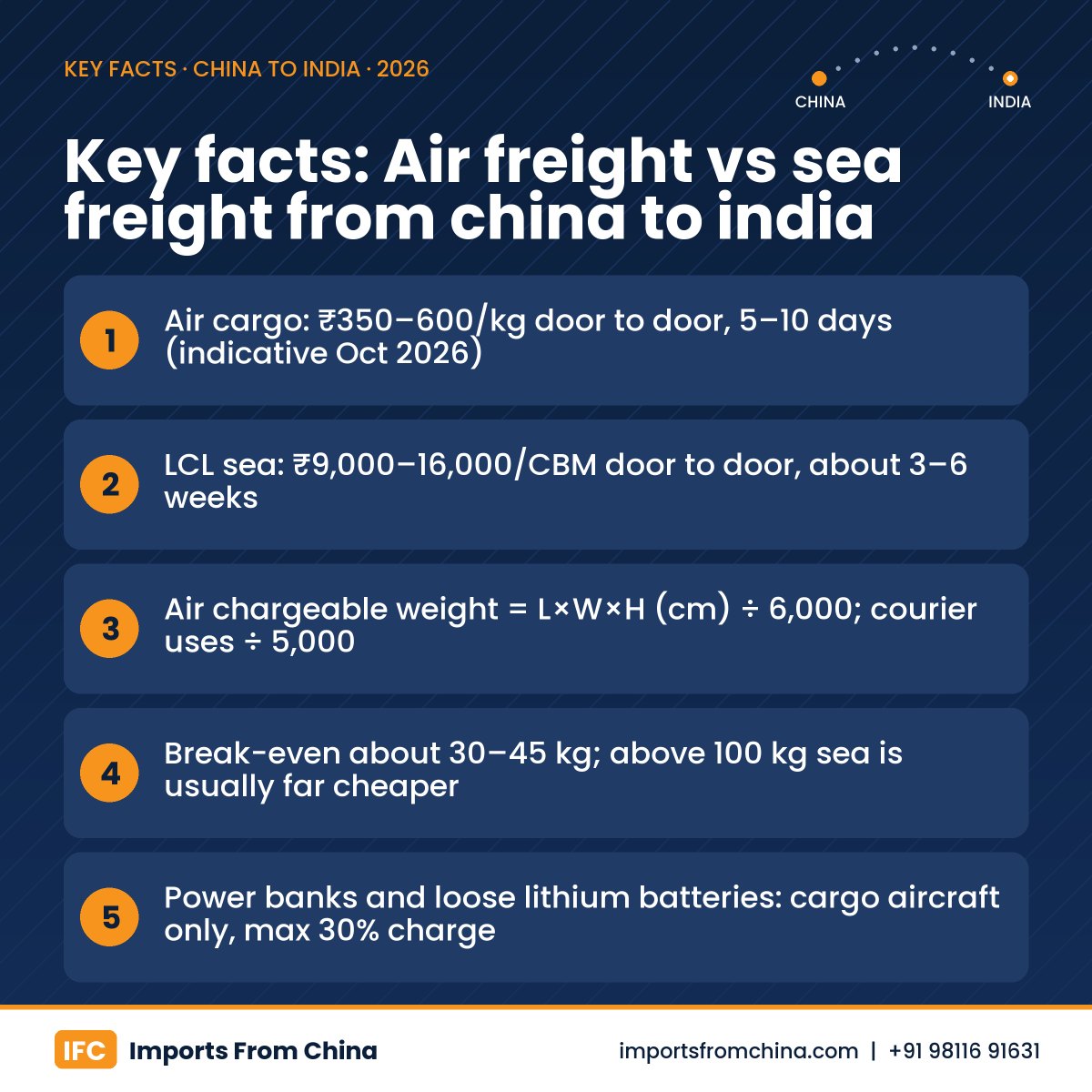
- Air is charged by chargeable weight: the higher of actual kg or L×W×H (cm) ÷ 6,000 for air cargo (÷ 5,000 for express courier).
- Sea LCL is charged by CBM: usually per cubic metre with a 1 CBM minimum, or per 1,000 kg if the cargo is very heavy.
- Indicative costs (October 2026): air cargo ₹350–600 per kg door to door vs LCL ₹9,000–16,000 per CBM door to door, both before duty.
- Transit: air 5–10 days door to door; sea 12–20 days port to port and roughly 3–6 weeks door to door for LCL.
- Duty rises with air freight: customs duty is charged on CIF value, but Indian valuation rules cap air freight in the assessable value at 20% of FOB.
- Batteries change everything: power banks and loose lithium batteries are cargo-aircraft-only and many air consolidators refuse them; plan these by sea with proper DG papers.
Air freight vs sea freight from China to India: how do costs compare?
Air bills per kg and sea per CBM, so convert both to the total door-to-door cost for your exact cartons. Indicative ranges for general cargo (no batteries or other dangerous goods) from South China or Yiwu to major Indian cities:
| Mode | How you are charged | Indicative cost (October 2026, before duty and IGST) | Typical door-to-door time | Best for |
|---|---|---|---|---|
| Express courier (DHL, FedEx, UPS type) | Higher of actual kg or L×W×H ÷ 5,000 | ₹450–900 per kg for 21 kg and above; small parcels cost more per kg | 4–7 working days | Samples, documents, under 20–30 kg |
| Air cargo (airline via forwarder) | Higher of actual kg or L×W×H ÷ 6,000 | ₹280–450 per kg airport to airport; ₹350–600 per kg door to door for 100 kg and above | 5–10 days | Urgent or high-value stock, 30–500 kg |
| LCL sea (shared container) | Per CBM, 1 CBM minimum (or per 1,000 kg if heavier) | ₹9,000–16,000 per CBM door to door for 1–5 CBM | 3–6 weeks | Most commercial orders from 1 to about 15 CBM |
| FCL sea (20ft or 40ft) | Per container | Quoted per container; compare against LCL from roughly 12–15 CBM | About 3–5 weeks | Large, heavy or bulky loads |
These ranges are indicative, October 2026. Rates move with fuel, capacity and festive peaks (Diwali, Chinese New Year); they are not IFC prices. Compare written quotes with the same scope: pickup, China export clearance, freight, Indian clearance, CFS or airport charges and delivery. For past published air rate cards, see our note on air freight charges from China to India; for sea, read how LCL shipping from China to India is priced.
How is chargeable weight calculated for air and sea?
Most cost surprises come from chargeable weight, not the rate. Measure and weigh every carton before asking for quotes.
Air cargo: volumetric weight at 1:6,000
Volumetric kg per carton = length × width × height (cm) ÷ 6,000. You pay on whichever is higher: actual gross weight or volumetric weight. One CBM equals about 167 kg for air cargo. So if your goods weigh less than 167 kg per CBM (cushions, lampshades, plastic toys, shoes in boxes), you pay for space, not weight. Rates per kg fall at weight breaks such as 45, 100, 300 and 500 kg.
Express courier: volumetric weight at 1:5,000
Couriers divide by 5,000, so one CBM counts as 200 kg and bulky cartons cost more. Some door-to-door air services also use ÷ 5,000, so check the divisor on every quote.
Sea LCL: CBM or weight/measure
CBM = length × width × height (in metres) × number of cartons. A 50 × 40 × 40 cm carton is 0.08 CBM. LCL is billed per CBM, or per 1,000 kg where the cargo is heavier than 1 tonne per CBM (stone, metal parts). Most consolidators have a minimum of 1 CBM plus fixed per-shipment charges, which is why very small shipments do not save much by sea.
How long does air and sea shipping from China to India take?
| Stage | Air cargo | LCL sea |
|---|---|---|
| Supplier to China warehouse, booking | 1–3 days | 3–7 days (waiting for the consolidation cut-off) |
| Main transit | 1–3 days (Guangzhou, Shenzhen, Hong Kong or Shanghai to Delhi, Mumbai, Bengaluru, Chennai, Hyderabad) | 12–20 days port to port (Shenzhen, Nansha, Ningbo or Shanghai to Nhava Sheva/JNPT, Mundra, Chennai or Kolkata) |
| Unloading and customs clearance in India | 1–3 days at the air cargo complex | 3–7 days at the CFS (deconsolidation, delivery order, Bill of Entry) |
| Delivery to your city | 1–3 days | 2–7 days; add about a week if cargo moves by rail to ICD Tughlakabad or Patparganj for Delhi NCR |
| Total door to door | 5–10 days | About 3–6 weeks |
Transit times are indicative, October 2026. A customs examination, a wrong HS code, a missing BIS licence or a document mismatch can add days in either mode.
Worked example: the same shipment by air vs LCL sea in rupees
An Amazon seller in Delhi buys 2,000 plastic mobile phone cases from a Shenzhen supplier. FOB value is ₹1,60,000 (₹80 per piece). Packing: 20 cartons of 50 × 40 × 40 cm, 12 kg each.
- Actual weight: 20 × 12 kg = 240 kg.
- Volume: 0.5 × 0.4 × 0.4 = 0.08 CBM per carton, so 1.6 CBM in total.
- Air chargeable weight: 50 × 40 × 40 ÷ 6,000 = 13.33 kg per carton, so about 267 kg. This is higher than 240 kg actual, so air bills 267 kg.
- Sea chargeable volume: 1.6 CBM (above the 1 CBM minimum and well under 1,000 kg per CBM).
Step 1: customs duty for each mode
HS code 39269099 (other articles of plastics): BCD 15%, SWS 10% of BCD, no AIDC, IGST 18%, no anti-dumping duty. Rates as of October 2026; confirm for your exact HS code on the India import duty rates page. Assumptions: no separate insurance, so customs adds 1.125% of FOB; no landing charges (removed from the valuation rules in 2017). For air, valuation rules count air freight only up to 20% of FOB.
| Item | Air cargo | LCL sea |
|---|---|---|
| FOB value | ₹1,60,000 | ₹1,60,000 |
| International freight (actual) | ₹85,440 (267 kg × ₹320) | ₹5,600 (1.6 CBM × ₹3,500) |
| Freight counted for customs | ₹32,000 (capped at 20% of FOB) | ₹5,600 |
| Insurance (1.125% of FOB) | ₹1,800 | ₹1,800 |
| Assessable value (CIF) | ₹1,93,800 | ₹1,67,400 |
| BCD 15% | ₹29,070 | ₹25,110 |
| SWS 10% of BCD | ₹2,907 | ₹2,511 |
| IGST 18% on (AV + BCD + SWS) | ₹40,640 | ₹35,104 |
| Total duty and IGST paid at customs | ₹72,617 | ₹62,725 |
Step 2: landed cost per piece
Door-to-door freight and clearance (before duty), using mid-range indicative rates: air 267 kg × ₹450 = ₹1,20,150; LCL 1.6 CBM × ₹12,000 = ₹19,200. If you are GST-registered, the IGST comes back as input tax credit, so your real cost is FOB + freight + BCD + SWS:
- By air: ₹1,60,000 + ₹1,20,150 + ₹31,977 = ₹3,12,127, about ₹156 per piece, in stock in roughly a week.
- By LCL sea: ₹1,60,000 + ₹19,200 + ₹27,621 = ₹2,06,821, about ₹103 per piece, in stock in roughly 4–5 weeks.
Air costs about ₹1,05,000 more, or ₹53 per piece, to save around three to four weeks. On ₹80 phone cases that wipes out most of the margin, so sea is the clear choice. Air makes sense only if the profit you would lose by being out of stock for those weeks is bigger than ₹1.05 lakh.
Step 3: try a split shipment
Send a few cartons by air to go live and the rest by sea. Here, 3 cartons (300 pieces, 40 kg chargeable) by air cost about ₹18,000, and the other 17 cartons (1.36 CBM) by LCL about ₹16,320. Total freight of about ₹34,300 is only ₹15,000 more than all-sea, and your listing goes live in a week. Small air lots can hit minimum charges, so confirm the figure.
Where is the break-even?
Because LCL has a minimum of about 1 CBM plus fixed per-shipment costs (roughly ₹12,000–16,000 door to door), and air cargo costs about ₹350–450 per kg, the pure cost break-even sits at about 30–45 kg chargeable weight. Below that, air or courier is often the same price or cheaper and much faster. From about 100 kg up, sea is usually far cheaper. Run your own numbers in the IFC shipment calculator.
Which is better, air or sea freight, for my products?
Quick test: divide goods value by air chargeable weight. If your goods are worth ₹4,000 per chargeable kg, an air bill of ₹450 per kg is about 11% of value and often acceptable. If they are worth ₹300 per kg, air freight would cost more than the goods. In the example above, phone cases work out at about ₹600 per chargeable kg, so air freight came to 75% of the product value.
| Usually suits air | Usually suits sea |
|---|---|
| Samples and pre-production approvals | Furniture, sofas, chairs and beds |
| Urgent restocks for Amazon or Flipkart best-sellers | Lighting fixtures, chandeliers, sanitaryware, tiles |
| Small, high-value items: watch parts, jewellery findings, electronic components | Hotel furnishings, linen in bulk, kitchen equipment |
| Machine spare parts when a production line is stopped | Machinery, tools, hardware, metal parts |
| Trial orders under about 45 kg | Any repeat order above about 100 kg or 1 CBM |
Interior designers and architects usually do best by sea with a 5–6 week buffer, using air only for a missing fitting. For large volumes, compare LCL against a full container in our FCL vs LCL guide.
Can batteries and dangerous goods go by air from China to India?
Often not by normal air cargo, and this decides the mode before price does. Under the IATA Dangerous Goods Regulations:
- Loose lithium-ion batteries and power banks (UN 3480): forbidden on passenger aircraft, allowed only on cargo aircraft at a state of charge of no more than 30%, with full dangerous-goods documentation. Many air consolidators and couriers refuse them.
- Batteries packed with equipment (UN 3481): from 1 January 2026, lithium-ion cells or batteries above 2.7 Wh packed with equipment must also ship at no more than 30% state of charge.
- Batteries inside devices (Bluetooth speakers, smartwatches): usually accepted with a UN 38.3 test summary and MSDS, subject to the carrier’s own rules.
- Other restricted items: perfumes, aerosols, nail polish, paints, strong magnets and many liquids need DG handling or are refused on consolidated air.
By sea, lithium batteries are Class 9 dangerous goods under the IMDG Code. They can travel with a DG declaration and proper packing, but some LCL consolidators restrict them or charge a DG surcharge, so declare them at booking. Separately, Indian rules apply whatever the mode: lithium batteries, power banks and many electronics need BIS registration under the Compulsory Registration Scheme (check the BIS website), and wireless devices may need WPC approval.
Express courier vs air cargo: which should you use?
Both fly, but the services and paperwork differ.
| Point | Express courier | Air cargo |
|---|---|---|
| Volumetric divisor | ÷ 5,000 (1 CBM = 200 kg) | ÷ 6,000 (1 CBM = 167 kg) |
| Sweet spot | Under 20–30 kg, samples | About 45–500 kg |
| Customs process | Cleared by the courier under CBIC’s courier import regulations | Bill of Entry filed on ICEGATE by your CHA at the air cargo complex |
| Limits | Value caps per consignment and excluded goods apply; check the current CBIC notification | No courier-type value cap; normal import rules apply |
For commercial stock you need an IEC and GSTIN in either case, so the courier route is not a way around import rules. Courier rules and limits are set by the CBIC; regular cargo Bills of Entry are filed on ICEGATE. Once you cross about 30–45 kg, consolidated air cargo is usually cheaper per kg than courier.
How do I choose between air and sea? A 6-step checklist
- Get the packing list: carton count, outer size in cm and gross weight per carton from your supplier.
- Work out both units: total CBM for sea and chargeable kg (÷ 6,000) for air.
- Check restrictions: batteries, liquids, magnets, and Indian licences such as BIS, WPC, FSSAI or CDSCO for your HS code.
- Get two door-to-door quotes with the same scope, and ask whether duty is included (DDP) or extra.
- Compare freight as a % of goods value and the cost of waiting 3–4 extra weeks.
- Consider a split: a few cartons by air for launch, the rest by sea. To understand the duty side, read our import duty from China to India guide.
How IFC helps you choose and ship by air or sea
IFC – Imports From China has more than 15 years of experience in China–India import and export. We have our own offices in Guangzhou and Yiwu with translators and English-speaking staff, so suppliers can deliver to us and we can check, measure and repack cartons before they move. We load mixed containers and air cargo daily, so you can choose the mode per shipment or split one order across both.
Our services cover sourcing, supplier verification, quality inspection, LCL and FCL sea freight, air cargo, customs clearance and door-to-door DDP delivery. We have a warehouse at our headquarters and deliver to major Indian cities including Delhi, Gurugram, Noida, Mumbai, Pune, Bengaluru, Hyderabad, Chennai and Ahmedabad.
Conclusion
Choose sea for most commercial orders above about 100 kg or 1 CBM, and air for samples, urgent stock, high-value goods and lots under about 45 kg. Compare landed cost per piece including duty, check battery and compliance rules first, and consider a split shipment.
Get your real landed cost: enter your product, weight and CBM in the IFC shipment calculator, check your HS code on the India import duty rates page, or call IFC on +91 98116 91631 for a door-to-door DDP quote from China to your city.
Frequently asked questions
Which is better, air or sea freight from China to India?
For most commercial orders above about 100 kg or 1 CBM, sea freight is better because it costs a fraction of air. Air is better for samples, urgent restocks, high-value goods and shipments under about 45 kg, where the time saved is worth more than the extra freight.
How much does air cargo from China to India cost per kg?
As an indicative October 2026 range, air cargo costs about Rs 280 to 450 per chargeable kg airport to airport and about Rs 350 to 600 per kg door to door for 100 kg and above, before duty and IGST. Express courier is higher, about Rs 450 to 900 per kg. Always get a written quote.
How long does sea shipping from China to India take?
Port-to-port transit from Chinese ports such as Shenzhen, Nansha, Ningbo or Shanghai to Nhava Sheva, Mundra, Chennai or Kolkata is about 12 to 20 days. Door to door, LCL usually takes about 3 to 6 weeks once you add consolidation, customs clearance at the CFS and delivery.
Is air freight cheaper than sea freight for small shipments?
It can be. LCL sea usually has a minimum of 1 CBM plus fixed clearance and handling charges, so for shipments under about 30 to 45 kg chargeable weight, air cargo or courier often costs the same or less and arrives weeks earlier.
Can I ship power banks or lithium batteries from China to India by air?
Loose lithium-ion batteries and power banks are forbidden on passenger aircraft and can only fly on cargo aircraft at no more than 30% charge with full dangerous-goods papers. Sea freight as Class 9 dangerous goods is usually more practical. In India, lithium batteries and power banks also need BIS registration whatever the mode.
Is customs duty different for air and sea shipments?
The duty rates are the same, but duty is charged on CIF value, so the freight you pay is part of the assessable value. Higher air freight raises the duty, although Indian valuation rules cap air freight in the assessable value at 20% of FOB.
Should I use a courier like DHL or FedEx or air cargo for my China order?
Use courier for samples and parcels under about 20 to 30 kg, since it is door to door and simple. For larger commercial shipments, consolidated air cargo is cheaper per kg and uses a 6,000 volumetric divisor instead of 5,000. Courier imports also have value limits and excluded goods under CBIC rules.
Comments for this post are closed.