

Ddp vs dap shipping

DDP vs DAP Shipping: Which Is Better for Indian Importers? (2026)

In DDP vs DAP shipping, the difference is who imports the goods into India. Under DAP, the seller delivers to your door, and you clear customs and pay duty and IGST under your own IEC. Under DDP, the seller or its agent clears customs and pays the duty, so you receive goods with all taxes paid. GST-registered businesses usually save more with DAP. Small buyers without an IEC usually find DDP simpler.

This guide covers the Incoterms 2020 rules, who pays for what, whose IEC and GSTIN go on the Bill of Entry, input tax credit, a worked ₹ example, and red flags in cheap “DDP” quotes.

Key takeaways

  • One real difference: under DAP the buyer handles Indian import clearance, duty and IGST. Under DDP the seller’s side does.
  • Same risk point: under both terms, risk passes to you when the goods reach your named place, ready for unloading.
  • Importer of record: the Bill of Entry carries the importer’s IEC and GSTIN. Only that party can claim the IGST paid at customs as credit.
  • GST-registered buyers: DAP under your own IEC gives you direct IGST credit and a lower net cost. With DDP, you can only claim credit if the provider gives you a proper GST tax invoice.
  • Small or unregistered buyers: DDP saves you from getting an IEC, hiring a CHA and dealing with port delays. You pay for that convenience.
  • Red flag: if a DDP quote is lower than the goods value plus honest duty and freight, someone is under-invoicing or misusing courier channels.

What is DDP shipping, and what is DAP?

DDP and DAP are two of the 11 Incoterms® 2020 rules published by the International Chamber of Commerce (ICC). They decide who pays for each step, who handles customs, and where risk passes from seller to buyer. They do not decide price or ownership; your contract does.
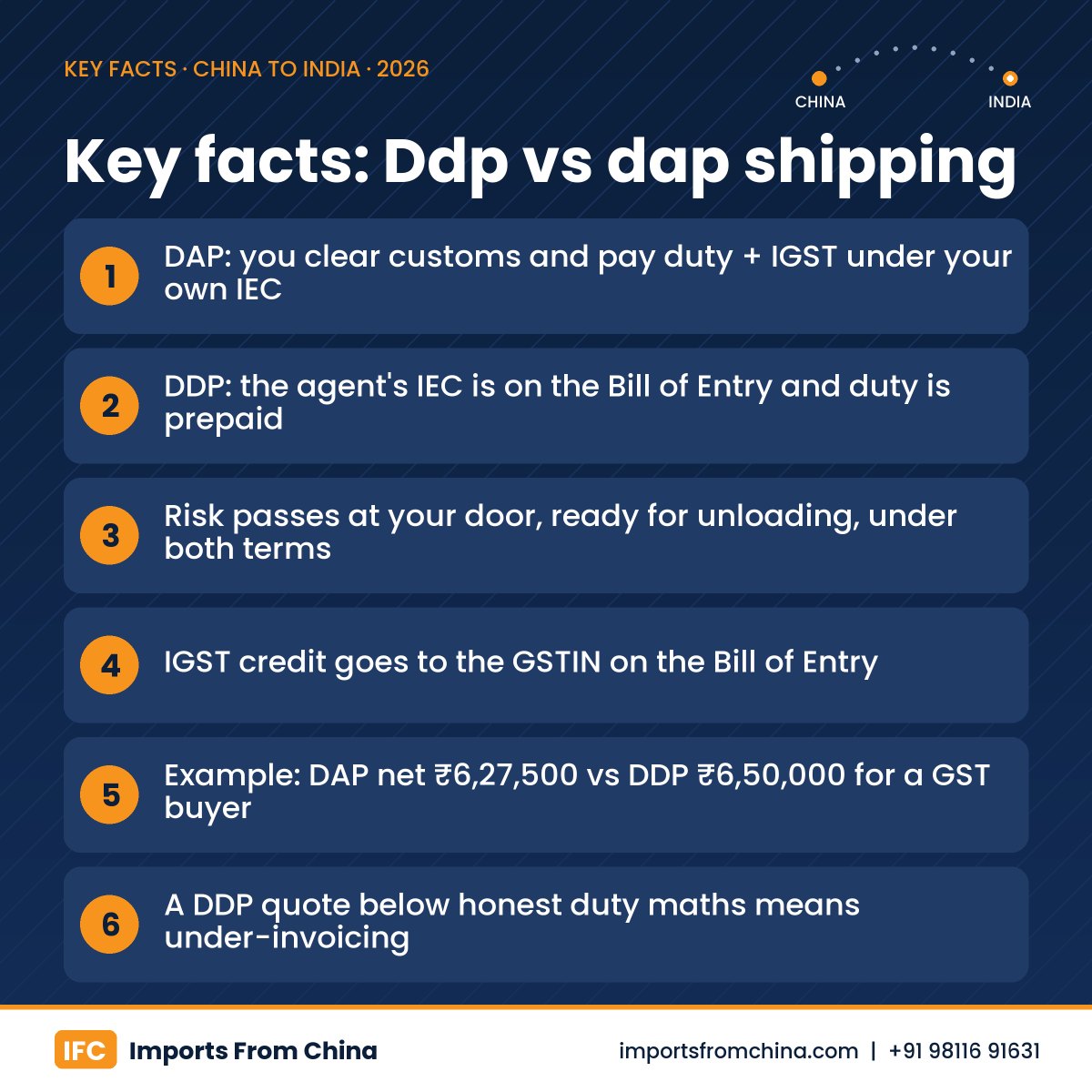
Ddp vs dap shipping infographic – key facts for Indian importers
Ddp vs dap shipping: key facts at a glance (IFC – Imports From China)

DAP: Delivered at Place

Under DAP, the seller arranges and pays for transport to a place you name, such as your warehouse in Bhiwandi or your shop in Karol Bagh. It also clears the goods for export in China. Delivery is complete when the goods arrive at that place on the truck, ready for unloading. You handle Indian import clearance and pay Basic Customs Duty (BCD), the Social Welfare Surcharge (SWS), IGST and any other import charges.

DDP: Delivered Duty Paid

DDP covers everything in DAP, plus import clearance and every import duty and tax. The ICC describes DDP as the term with the most obligations for the seller. A Chinese factory has no Indian IEC or GSTIN and cannot file a Bill of Entry, so in China-to-India trade, “DDP” almost always means an Indian import agent or forwarder imports the goods under its own IEC and then delivers them to you.

DDP vs DAP shipping: who pays for what?

Who handles each step on a typical Guangzhou or Ningbo to India shipment:

Step / costDAP (buyer imports)DDP (seller side imports)
Packing, loading at the factory in ChinaSellerSeller
China export clearanceSellerSeller
Sea or air freight to IndiaSellerSeller
Destination port/CFS charges, delivery orderUsually buyer (agree in writing)Seller
Bill of Entry filing on ICEGATE (CHA fee)BuyerSeller
BCD, SWS, AIDC, anti-dumping dutyBuyerSeller
IGST at customsBuyer (credit available if GST-registered)Seller (charged to you as GST on its invoice)
BIS, WPC, FSSAI, CDSCO, EPR complianceBuyer as importerImporter of record, but the goods must comply either way
Inland delivery to your doorSellerSeller
Unloading at your premisesBuyerBuyer
Demurrage if customs holds the goodsBuyerSeller

Where does risk pass to the buyer?

Under both DAP and DDP, risk passes to you only when the goods arrive at the named place, ready for unloading. Damage at sea or on the truck from Nhava Sheva to Pune is the seller’s risk. The practical difference is customs: under DAP, delays and port storage from an examination or valuation query are your problem; under DDP, they are the seller’s.

Who files the Bill of Entry, and whose IEC and GSTIN are used?

Every commercial import into India is cleared on a Bill of Entry. A licensed customs broker (CHA) files it on ICEGATE in the importer’s name. The Bill of Entry shows the importer’s IEC, GSTIN, invoice value, HS code and the duty assessed. Whoever’s name appears there is the importer of record in the eyes of Indian customs.

  • Under DAP: your IEC and GSTIN go on the Bill of Entry. You or your CHA pays duty through ICEGATE e-payment. You are responsible for correct value, HS code and product compliance.
  • Under DDP: the agent’s IEC and GSTIN go on the Bill of Entry. The agent pays the duty and owns the customs record, then sells or delivers the goods to you in India.
  • What you need for DAP: an IEC from DGFT (PAN-based, applied for online), a GSTIN if you want IGST credit, a CHA at the arrival port (Nhava Sheva/JNPT, Mundra, Chennai, Kolkata, or an ICD such as Tughlakabad or Patparganj for Delhi NCR), plus invoice, packing list, bill of lading and any BIS/WPC/FSSAI papers.

Always ask a DDP provider whose IEC the goods will clear under, and ask for a copy of the Bill of Entry or at least its number. If a provider won’t say, don’t use it.

DDP vs DAP in India: how does GST input tax credit change the cost?

For a GST-registered business, this question matters more than any other. IGST paid at customs is not a final cost if you can claim it back. CBIC’s GST guidance note for importers says the importer can claim IGST credit based on the GSTIN declared in the Bill of Entry. BCD is not creditable. The IGST appears in the import section of your GSTR-2B and is claimed in GSTR-3B.

  1. DAP under your own IEC: you pay IGST at customs and claim the full amount as credit. Only BCD, SWS (and AIDC or anti-dumping duty, where they apply) become real costs.
  2. DDP with a proper GST tax invoice: the agent claims the customs IGST and then charges you GST on its sale price. If the invoice shows your GSTIN and the agent files its returns, you claim that GST. You lose nothing on tax, but you pay the agent’s margin.
  3. DDP with no tax invoice (cash or “kachha” bill): you claim nothing. The goods also sit in your stock with no valid purchase record, a problem at GST audits or when Amazon or Flipkart asks for purchase invoices.

If you are not GST-registered, credit does not help you either way. You bear the IGST or GST in full, so compare total rupees out of your pocket and the hassle involved.

DDP vs DAP: a worked example in rupees

Take one LCL shipment of plastic kitchen storage containers (HS 3924 10 90) by sea from Ningbo to Nhava Sheva, delivered to a warehouse in Bhiwandi. In IFC’s duty data, this code carries BCD 15%, SWS 10% of BCD, no AIDC and IGST 18%, with no anti-dumping duty. These rates are as of October 2026; confirm them for your exact HS code on the India import duty rates page.

Assumptions: the CIF value at Nhava Sheva (goods, sea freight and insurance, converted at the customs exchange rate) is ₹5,00,000. The assessable value equals CIF, with no extra landing charges added. Port-to-door delivery is ₹15,000. Port, CFS, delivery order and CHA charges under DAP are ₹30,000. The ₹6,50,000 DDP price is an assumed figure for illustration, not an IFC price. Freight and port charges are indicative for October 2026.

Step 1: the duty maths (the same for every honest import)

  • Assessable value: ₹5,00,000
  • BCD at 15% of ₹5,00,000: ₹75,000
  • SWS at 10% of BCD: ₹7,500
  • IGST at 18% of (₹5,00,000 + ₹75,000 + ₹7,500 = ₹5,82,500): ₹1,04,850
  • Total paid at customs: ₹1,87,350, of which ₹82,500 is real cost and ₹1,04,850 is IGST

Step 2: compare the three ways to buy

ItemDAP, your own IECDDP with GST invoice“Cheap DDP”, cash, no invoice
Price to seller / provider₹5,15,000 (CIF + delivery)₹6,50,000 + GST ₹1,17,000₹6,10,000 all-in
BCD + SWS paid by you₹82,500Included“Included”
IGST paid by you at customs₹1,04,850NoneNone
Port, CFS, CHA charges₹30,000IncludedIncluded
Cash out₹7,32,350₹7,67,000₹6,10,000
Credit if GST-registered−₹1,04,850−₹1,17,000₹0
Net cost, GST-registered buyer₹6,27,500₹6,50,000₹6,10,000 plus legal risk
Net cost, unregistered buyer₹7,32,350 (needs IEC)₹7,67,000₹6,10,000 plus legal risk

What the numbers tell you

  • Registered business: in this example, DAP under your own IEC is ₹22,500 cheaper than proper DDP. The gap is the DDP provider’s margin and the clearance risk it takes on.
  • Unregistered buyer: DDP costs about ₹34,650 more here, because GST is charged on the provider’s full price. In return, you need no IEC, no CHA and no follow-up at the port.
  • The “cheap DDP” quote: an honest import of this cargo costs ₹6,27,500 before anyone earns a margin. A ₹6,10,000 all-in price can only work if duty was underpaid, usually through a lower declared value or a false description.

For a full breakdown of each duty component, read import duty from China to India. To get a door-to-door number for your own product, use the IFC shipment calculator.

When should you choose DDP, and when DAP?

DDP usually makes sense if you:

  • Are importing for the first time, or only a few times a year, and have no IEC or CHA.
  • Are not GST-registered: an interior designer buying fittings for one project, a hotel owner buying furniture for one property, or a start-up testing samples.
  • Buy mixed small lots from several suppliers (for example from Yiwu or Guangzhou markets) that are consolidated into one LCL shipment.
  • Want one fixed delivered price and no exposure to demurrage, examination delays or port follow-up.

DAP usually makes sense if you:

  • Are GST-registered and want IGST credit in your own name, straight from the Bill of Entry.
  • Import regularly, in full containers or large LCL lots, where the provider’s margin adds up.
  • Need import documents in your own name for government tenders, BIS licences, marketplace invoice checks or bank finance.
  • Can deal with customs queries quickly and have a reliable CHA at your port.

Many businesses start with DDP and move to DAP once volumes grow, often with the same forwarder clearing the goods under your own IEC. Transit time is the same either way. Sea freight from China to Nhava Sheva usually takes about 12 to 20 days port to port. LCL usually takes 3 to 6 weeks door to door, and air cargo 5 to 10 days door to door (indicative, October 2026).

What are the red flags in cheap “DDP” quotes from China?

Many “DDP India” quotes on WhatsApp and Alibaba chats are not DDP in any legal sense. Watch for these signs:

  • A price below the duty maths: if the all-in price per kg or per CBM is lower than goods value plus BCD, SWS and freight, the duty is not being paid in full.
  • Under-invoicing: the provider asks for a “customs invoice” at a fraction of your real price. Customs can reject a declared value under the valuation rules, and mis-declared goods can be confiscated under Section 111 of the Customs Act, and penalties can follow under Section 112.
  • Courier misuse: bulk commercial cargo is split into many parcels declared as samples or gifts to avoid regular assessment. When a consignment is held, you usually have no documents and no way to get the goods back.
  • Wrong product description or HS code: for example, electronics declared as plastic household goods to avoid BIS, WPC or a higher duty rate.
  • No IEC disclosure and no GST invoice: the provider will not say whose IEC the goods clear under and offers only cash or a non-GST bill.
  • “Compliance included”: DDP does not remove BIS, WPC, FSSAI or CDSCO requirements. If the product needs an ISI mark under a Quality Control Order, the goods can be stopped no matter who pays the duty.

Before you pay, ask any DDP provider four questions. Whose IEC will the goods clear under? Will you issue a GST tax invoice with my GSTIN? What declared value and HS code will you use? What costs are not included (unloading, storage, re-delivery, upstairs carry)? You can check customs rules and notifications on CBIC. Our guide to choosing a China buying agent for India lists more checks.

How IFC helps with DDP and DAP shipments from China

IFC – Imports From China has more than 15 years of experience in China–India import and export. The team has its own offices in Guangzhou and Yiwu, with translators and English-speaking staff who deal with suppliers for you. IFC loads mixed containers and air cargo daily and runs a warehouse at its headquarters.

  • Door-to-door DDP: DDP delivery to major Indian cities, including Delhi, Gurugram, Noida, Mumbai, Pune, Bengaluru, Hyderabad, Chennai and Ahmedabad.
  • Customs clearance: for buyers who prefer to clear goods in their own name.
  • Before shipping: sourcing, supplier verification and quality inspection in China.
  • Freight options: LCL and FCL sea freight, plus air cargo for urgent goods.

Share your product, quantity and GST status with IFC to compare DDP with clearing in your own name, or request a quote online.

Conclusion: which is better for Indian importers?

Neither term is better for everyone. DAP gives a GST-registered business the lowest net cost and an import record in its own name, but you take on customs work and port risk. DDP gives first-time and unregistered buyers one delivered price and no clearance work, at a margin. Whichever you choose, run the duty maths yourself: a quote that doesn’t cover goods value, freight, BCD, SWS and IGST is passing the risk to you.

Mayank Dang (CA Sahab), Founder and CEO of IFC

Guide reviewed by Mayank Dang (CA Sahab), Founder & CEO of IFC

Chartered Accountant (FCA, ICAI) who has helped 5000+ Indian businesses import from China since 2004 – sourcing, BIS, HSN classification, import duty, customs and GST compliance. mayankdang.in

Get your real landed cost: enter your product, weight and CBM in the IFC shipment calculator, check your HS code on the India import duty rates page, or call IFC on +91 98116 91631 for a door-to-door DDP quote from China to your city.

Frequently asked questions

Is DDP or DAP better for importing from China to India?

For a GST-registered business that imports regularly, DAP under its own IEC is usually cheaper, because it claims the customs IGST directly and pays no DDP margin. For a first-time or unregistered buyer, DDP is usually simpler, because the provider handles the IEC, the CHA, duty payment and port follow-up for one delivered price.

Can I claim GST input tax credit on a DDP shipment?

Not on the customs IGST, because that credit belongs to the importer whose GSTIN is on the Bill of Entry. You can claim the GST charged on the DDP provider’s tax invoice, if it shows your GSTIN and the provider files its returns. A cash or non-GST bill gives you no credit at all.

Who is the importer of record in DDP shipping to India?

The party whose IEC and GSTIN appear on the Bill of Entry filed on ICEGATE. In China-to-India DDP this is usually the Indian import agent or forwarder, not the Chinese factory, because a foreign seller cannot normally clear goods into India without an Indian IEC and GST registration.

Do I need an IEC to import under DAP?

Yes. Under DAP you are the importer, so the Bill of Entry needs your Import Export Code from DGFT, which is PAN-based and applied for online. You also need a GSTIN to claim IGST credit, and a customs broker (CHA) at the arrival port to file the Bill of Entry for you.

What is the difference between DDP and DDU?

DDU, or Delivered Duty Unpaid, was removed in Incoterms 2010 and replaced by DAP. Under both DDU and DAP, the buyer pays import duty and taxes. Under DDP, the seller side pays them. If a supplier quotes DDU, ask them to restate the term as DAP to your address under Incoterms 2020.

Is DDP shipping legal in India?

Yes, when the goods are imported under a valid IEC, declared at their true value and correct HS code, and all duties are paid on a proper Bill of Entry. It becomes illegal when a so-called DDP service under-invoices, mis-declares goods, or splits bulk cargo into courier parcels to avoid duty.

Why is a DDP quote cheaper than the duty I calculated?

An honest DDP price cannot be lower than goods value plus freight, BCD, SWS and clearance charges. A lower quote usually means under-invoicing, a wrong HS code or courier misuse. If customs catches it, the goods can be held or confiscated, and the buyer can lose both the goods and the money paid.

Pre-Shipment Inspection vs Factory Audit: What Indian Importers Need from China

Indian importers often use “factory audit” and “pre-shipment inspection” as if they meant the same thing. They are different checks done at different times, and each answers a different question. This guide explains both so you can choose the right one before paying a Chinese supplier.

Factory audit: is this supplier real?

A factory audit checks the supplier before you order. It confirms the business license, the company name and address, whether the supplier is a factory or a trader, the production and quality areas, and the bank account name against the license. It can be done by video call or by a visit from IFC staff in China.

Pre-shipment inspection: are these goods right?

A pre-shipment inspection checks the finished goods before they leave the factory. It compares quantity, specification, packing and visible quality with your order, and you receive a report with photos and video. It is done before you pay the balance.

Which one do you need?

For a new supplier found online, do the audit first. For any order of value, do an inspection before releasing the balance payment. First-time importers usually need both.

IFC – Imports From China has 20+ years of import experience since 2004 and its own offices in Guangzhou and Yiwu. IFC serves B2B importers only, not individual retail buyers.

Frequently Asked Questions

What is the difference between a factory audit and a pre-shipment inspection?

A factory audit checks the supplier before ordering. A pre-shipment inspection checks the finished goods before they ship.

When should I do an inspection?

Do it when production is finished and packed, and before you pay the balance to the supplier.

Can a factory audit be done remotely?

Yes. A live video call with the supplier can show the factory, license and production areas. If more proof is needed, IFC staff can visit in person.

What does an inspection report contain?

It lists quantity checked, specification match, packing condition and defects found, with photos and video as proof.

Does IFC serve individual buyers?

No. IFC works with B2B importers only.

How to Find the Right HS Code for Goods Imported from China to India

The HS code decides how much customs duty and GST you pay when goods arrive from China. A wrong code can mean a wrong duty estimate, a query from customs, or a delay at the port. This guide explains how Indian importers should approach HS classification before they place an order.

What an HS code is

The Harmonized System (HS) is an international product classification. India uses an 8-digit version for import tariff lines. The code sets the basic customs duty, any additional duties, and the IGST rate that applies to your shipment.

Steps to find the right code

Start with the exact product description: material, function, size and use. Check the supplier’s invoice wording against the Indian tariff description. Compare with Bills of Entry for similar goods you have already cleared. If two codes look possible, get the product specification sheet and ask your customs partner to confirm before shipping.

Common mistakes

Using the code written by the Chinese supplier without checking it is the most common mistake, because Chinese export codes and Indian import tariff lines do not always match. Other mistakes include classifying a set as separate items, and ignoring the material or function that decides the heading.

IFC – Imports From China, with 20+ years of import experience since 2004, helps B2B importers check classification and estimate landed cost before they pay a supplier.

Frequently Asked Questions

What is an HS code in import?

It is a standard product classification number used by customs to decide duty and tax on imported goods.

How many digits is an Indian import HS code?

India uses an 8-digit code for import tariff lines, built on the international 6-digit HS system.

Can I use the HS code my Chinese supplier gives me?

Do not rely on it alone. Chinese export codes can differ from Indian import tariff lines, so verify the code against the Indian tariff before shipping.

What happens if the HS code is wrong?

The duty may be calculated wrongly, customs may raise a query, and the shipment can be delayed or reassessed.

Does IFC help with HS code and duty estimates?

Yes. IFC helps B2B importers check classification and prepare a landed cost estimate before ordering. IFC does not serve individual retail buyers.

Yiwu Market Buying Agent for Indian Traders: Sourcing, Inspection and Shipping to India

Looking for a Yiwu market agent in India? IFC – Imports From China has its own office in Yiwu, with English-speaking staff and translators, so Indian traders get a local team for market visits, supplier selection, order follow-up, quality checks and door-to-door delivery to India.

Yiwu is one of China’s best-known wholesale hubs for small commodities, and many Indian traders go there to buy in mixed lots. A shop in a market looks real, but many Indian buyers still face language problems, MOQ confusion, goods that do not match samples, and the cost of consolidating cartons from many shops. IFC – Imports From China (20+ Years Import Experts, trusted since 2004) has its own office in Yiwu with English-speaking staff and translators. This guide is for B2B importers only.

What a Yiwu buying agent does

  • Accompanies you or works remotely to find suitable shops and factories for your products.
  • Translates and negotiates price and MOQ in Chinese.
  • Collects samples and sends photos and video.
  • Verifies the supplier: business licence, bank account name matching the licence name, and a video of the shop or factory.
  • Collects goods from many shops, checks them and consolidates into one shipment.

Checks before you pay a Yiwu shop

  1. Confirm who you are buying from: shop, trading company or factory.
  2. Match the supplier’s licence name with the name on the bank account.
  3. Get a written order with product, quantity, price and delivery date.
  4. Check goods against the approved sample before dispatch.
  5. Pack and label cartons for shipping to India.

From Yiwu to your door in India

IFC offers pickup and consolidation at Guangzhou and Yiwu, sea freight and air cargo to India, customs clearance with duty paid, and door-to-door delivery (DDP). If you cannot travel, a remote video audit costs about Rs 2,000, and an on-ground inspection by IFC staff costs Rs 10,000 to Rs 25,000 depending on location.

Frequently Asked Questions

Does IFC have an office in Yiwu?

Yes. IFC has its own offices in Guangzhou and Yiwu, with English-speaking staff and translators.

Can IFC consolidate goods from several Yiwu shops?

Yes. IFC provides pickup and consolidation at Guangzhou and Yiwu and ships by sea or air to India.

Can IFC check a Yiwu supplier before I pay?

Yes. IFC can check the business licence and bank account name and run a remote video audit (about Rs 2,000) or an on-ground inspection (Rs 10,000 to Rs 25,000).

Does IFC deliver to my door in India?

Yes. IFC handles customs clearance with duty paid and door-to-door delivery (DDP).

Who can use this service?

Indian business importers only. B2C and individual retail buyers are not served.

1688 Buying Agent for Indian Importers: How to Buy from the Chinese Version Safely

Need a 1688 agent in India? 1688 is China’s Chinese-language wholesale site with factory prices, but it needs a Chinese phone number, Chinese payment and a team on the ground. IFC – Imports From China (since 2004) searches, negotiates, pays and checks 1688 orders from its Guangzhou and Yiwu offices, then ships them door to door to India.

1688 is China’s domestic wholesale platform, where factories and wholesalers list products at local prices. The Chinese version is in Chinese, needs a China mobile number, and many suppliers expect Chinese-speaking buyers. IFC – Imports From China (20+ Years Import Experts, trusted since 2004) helps Indian business importers buy from 1688 through its China offices in Guangzhou and Yiwu. This guide is for B2B importers only.

Why Indian importers use a 1688 buying agent

  • Language: product pages, chats with suppliers and after-sales are in Chinese.
  • Access: the Chinese app and many features need a China mobile number and verification.
  • Payment: suppliers expect payment within China.
  • Logistics: most 1688 sellers deliver only inside China, so goods must be picked up and consolidated before shipping to India.

How IFC helps with 1688 orders

  1. Send IFC the 1688 link or product details.
  2. IFC’s China team talks to the supplier in Chinese and checks the details.
  3. For a new supplier, IFC can verify the business licence and bank account name, and run a remote video audit (about Rs 2,000) or a physical inspection (Rs 10,000 to Rs 25,000 depending on location).
  4. Payment is made in China through IFC’s process, with IFC’s China office making a contract with the supplier.
  5. Goods are picked up and consolidated at Guangzhou and Yiwu, then shipped to India by sea or air, with customs clearance, duty paid and door-to-door delivery (DDP).

Need the apps yourself?

IFC also offers a China number to verified Indian business owners so they can download China apps such as Alipay, a VPN and the Chinese version of 1688, strictly for business use. KYC (GST, Aadhaar) and a declaration are needed. The cost is about Rs 5,000, and a visit to the IFC Delhi office is preferred.

Frequently Asked Questions

What is 1688?

1688 is China’s domestic wholesale platform where factories and wholesalers sell to Chinese buyers, often at lower prices than export platforms.

Can an Indian importer buy from 1688 directly?

It is difficult. The platform is in Chinese, needs a China mobile number, and most sellers expect payment and delivery inside China. A buying agent in China handles this.

Can IFC check a 1688 supplier before I order?

Yes. IFC can verify the licence and bank account name and run a remote video audit (about Rs 2,000) or a physical inspection (Rs 10,000 to Rs 25,000).

Does IFC ship 1688 goods to India?

Yes. IFC picks up and consolidates goods at Guangzhou and Yiwu and ships by sea or air with customs clearance, duty paid and door-to-door delivery (DDP).

Who can use this service?

Indian business importers only. B2C and individual retail buyers are not served.

Pre-Shipment Inspection in China for Indian Importers: What to Check Before Goods Leave

Once goods leave a Chinese factory, fixing a problem is slow and expensive. A pre-shipment inspection checks the goods before dispatch, while the supplier can still correct mistakes. IFC – Imports From China (20+ Years Import Experts, trusted since 2004) has its own offices in Guangzhou and Yiwu and can inspect goods before they ship to India. This guide is for B2B importers only.

What a pre-shipment inspection checks

  • Quantity: the number of cartons and units match the order.
  • Quality: sample units from random cartons match the approved sample.
  • Specification: model, size, material and colour as agreed.
  • Packing and marking: cartons are strong enough for transport, with the right labels.
  • Loading: goods are loaded into the container or cargo as planned.

Why it matters for Indian importers

Wrong quantity, mixed models or poor packing discovered in India means disputes with a supplier thousands of kilometres away. Inspection in China, with photos and video, gives you evidence and a chance to fix problems before shipping and paying duty.

How IFC helps

IFC staff in China can inspect the supplier and goods on the ground. Physical inspection charges range from Rs 10,000 to Rs 25,000 depending on location, and the video of the inspection is provided to the Indian buyer. A remote video audit of the factory costs about Rs 2,000. After inspection, IFC handles pickup and consolidation at Guangzhou and Yiwu, sea freight or air cargo, customs clearance with duty paid and door-to-door delivery (DDP).

Frequently Asked Questions

What is a pre-shipment inspection?

It is a check of quantity, quality, specification, packing and loading before goods leave the supplier, so problems can be corrected before shipping.

How much does inspection in China cost with IFC?

Physical inspection by IFC staff in China ranges from Rs 10,000 to Rs 25,000 depending on location. A remote video audit costs about Rs 2,000.

Will I get proof of the inspection?

Yes. The video of the inspection is provided to the Indian buyer.

Can IFC ship the goods after inspection?

Yes. IFC handles pickup and consolidation at Guangzhou and Yiwu, sea freight and air cargo, customs clearance with duty paid and door-to-door delivery (DDP).

Who can use this service?

Indian business importers only. B2C and individual retail buyers are not served.

China Supplier Contract for Indian Importers: What to Put in the Agreement

Chat messages and a proforma invoice are not enough when you pay a Chinese supplier. A written contract sets what you ordered, when it ships and what happens if something goes wrong. IFC – Imports From China (20+ Years Import Experts, trusted since 2004) helps Indian business importers with supplier verification and contract support through its China office. This guide is for B2B importers only.

What a China supplier contract should include

  1. Full legal names and addresses of buyer and supplier, matching the supplier’s business licence.
  2. Product description: model, material, size, colour, packaging and approved sample reference.
  3. Quantity, unit price and total, with currency.
  4. Payment terms: advance, balance, and when each is due. The bank account holder name should match the supplier’s licence name.
  5. Production and delivery date and what happens if the supplier is late.
  6. Quality standard and inspection: who inspects, when, and what happens if goods fail.
  7. Packing and marking requirements for shipping to India.
  8. Dispute handling and which documents each side keeps.

Verify the supplier before you sign

A contract with a fake supplier is worth little. Verify first: business licence, bank account name, and a live video from the factory gate through production, QC, warehouse and office. IFC’s remote video audit costs about Rs 2,000, and a physical inspection by IFC staff in China costs Rs 10,000 to Rs 25,000 depending on location.

How IFC helps

IFC’s China office makes a contract with the Chinese supplier and verifies all the supplier’s details, giving payment security for all payments in China. IFC has its own offices in Guangzhou and Yiwu with English-speaking staff and translators.

Frequently Asked Questions

Do I need a written contract with a Chinese supplier?

Yes. A written contract records the product, price, payment terms and delivery date, and protects you better than chat messages alone.

Can IFC make the contract with my China supplier?

Yes. IFC’s China office makes a contract with the Chinese supplier and verifies all the supplier’s details.

Should the contract be signed before or after verification?

After verification. Check the licence, bank account name and factory by live video first, then sign.

How much does verification cost?

A remote video audit is about Rs 2,000. A physical inspection by IFC staff in China is Rs 10,000 to Rs 25,000 depending on location.

Who can use this service?

Indian business importers only. B2C and individual retail buyers are not served.

Fake Factory Check in China: How to Tell a Real Factory from a Trading Company

Many suppliers on Alibaba, 1688 and social media say they are factories but are really trading companies or even fake businesses. IFC – Imports From China (20+ Years Import Experts, trusted since 2004) helps Indian business importers check this before they pay. This service is for B2B importers only.

Factory vs trading company: why it matters

A trading company is not always bad, but it adds a margin and has no control over production. If you believe you are buying direct from a factory, you should be sure. A fake supplier is worse: they take the advance and disappear.

Signs to check

  • The business licence name and address match the factory gate and the bank account holder.
  • The supplier agrees to a live video call, not only recorded clips.
  • Production machines, workers, QC and warehouse match the products offered.
  • The supplier can show the product being made, not only finished goods.
  • Prices are in line with the market.

The IFC video audit

IFC makes a video call and asks the supplier to film from the factory gate, so the name and address of the factory or supplier is visible, then the production area, QC area, warehouse and office area. In the office the supplier shows the business licence and bank account details, with the name on the bank account matching the name on the licence. This costs about Rs 2,000. The complete video is provided to the Indian buyer.

If a physical inspection is needed, IFC staff on the ground in China can do it for Rs 10,000 to Rs 25,000, depending on the supplier’s location.

Frequently Asked Questions

How can I check if a China supplier is a real factory?

Ask for a live video call that starts at the factory gate showing the name and address, then production, QC, warehouse and office areas, plus the business licence and matching bank account details. IFC can run this for you.

Is buying from a trading company bad?

Not necessarily, but you should know who you are buying from, because a trader adds a margin and does not control production.

How much does a factory check cost?

A remote video audit costs about Rs 2,000. A physical inspection costs Rs 10,000 to Rs 25,000 depending on location.

Do I get the video?

Yes. The video of the complete inspection is provided to the Indian buyer.

Is this for individual buyers?

No. IFC serves business importers only. B2C and individual retail buyers are not served.

Chinese Supplier Asking 100% Advance Payment? How to Verify Before You Pay

A Chinese supplier asking for a 100% advance payment is one of the most common warning signs in China-India trade. It does not always mean a scam, but it means you must verify the supplier before a single rupee moves. IFC – Imports From China (20+ Years Import Experts, trusted since 2004) helps Indian business importers verify suppliers and pay safely. This guide is for B2B importers only.

Why suppliers ask for full advance

Real factories often ask for 30% advance and 70% before dispatch. A demand for 100% upfront, especially from a supplier found on Instagram, Facebook or a chat app, deserves a pause. Fraudsters use full-advance requests because they disappear after the money arrives.

Five checks before you pay any advance

  1. Business licence: ask for the licence and confirm the company name and address.
  2. Bank account name: it must match the name on the business licence. A personal account or a different company is a red flag.
  3. Live video: a live video call from the factory gate, showing the name and address, then production, QC, warehouse and office areas.
  4. Contract: agree the product, quantity, price, payment terms and delivery in writing.
  5. Sample: inspect a sample before placing the bulk order.

How IFC helps

IFC’s China office makes a contract with the Chinese supplier and verifies all the supplier’s details. A remote video audit costs about Rs 2,000. If a physical inspection is needed, IFC staff on the ground in China can do it for Rs 10,000 to Rs 25,000 depending on location. IFC has its own offices in Guangzhou and Yiwu with English-speaking staff and translators.

Frequently Asked Questions

Is a 100% advance request always a scam?

No, but it is a warning sign. Verify the supplier’s licence, bank account name and factory by live video before paying.

What payment terms are safer?

Verify the supplier first and agree terms in a written contract, for example an advance for production and the balance after inspection and before dispatch. IFC can help set up the contract and payment process.

What should the bank account name be?

It should match the name written on the supplier’s business licence. A personal account or a different company name is a red flag.

How much does supplier verification cost?

A remote video audit costs about Rs 2,000. A physical inspection by IFC staff in China costs Rs 10,000 to Rs 25,000 depending on location.

Who can use this service?

Indian business importers only. B2C and individual retail buyers are not served.

How to Avoid Scams by Chinese Suppliers: Payment Safety for Instagram, Facebook, Alibaba, 1688 and Yiwu Market Deals

IFC – Imports From China (20+ Years Import Experts, trusted since 2004) helps Indian business importers avoid scams by Chinese suppliers and keep every payment in China secure, whether the supplier was found on Instagram, Facebook, Alibaba, 1688 or in a Yiwu market shop. This service is for B2B importers only.

Where scams come from

Indian buyers find China suppliers everywhere: Instagram and Facebook ads, Alibaba and 1688 listings, WhatsApp referrals and market shops in Yiwu. The channel itself is not the problem. The risk is paying someone you have not verified. A friendly chat, a polished catalogue and low prices are easy to fake.

Common warning signs

  • Payment requested into a personal account or an account in a different company’s name.
  • Prices much lower than the market for the same product.
  • Pressure to pay a full advance quickly.
  • Refusal of a live video call, factory visit or inspection.
  • Business details that do not match the licence.

How IFC protects your payment

IFC’s China office makes a contract with the Chinese supplier and verifies all the supplier’s details before you pay. This gives payment security for all payments in China. IFC has its own offices in Guangzhou and Yiwu with English-speaking staff and translators.

Verification tools IFC can add

  • Remote video audit of the factory, licence and bank details, about Rs 2,000.
  • Physical inspection by IFC staff in China, about Rs 10,000 to Rs 25,000 depending on location.
  • Written contract with the supplier made through the IFC China office.

Safe payment habits for importers

  • Verify the supplier before paying any advance.
  • Check that the bank account name matches the business licence name.
  • Agree terms in a written contract.
  • Keep all chats, invoices and payment proofs.

Frequently Asked Questions

Can IFC help if I found my supplier on Instagram or Facebook?

Yes. Indian customers may find suppliers through Instagram, Facebook or anywhere else. IFC’s China office can verify the supplier before you pay.

How does IFC protect my payment?

IFC’s China office makes a contract with the Chinese supplier and verifies all the supplier’s details. This gives payment security for all payments in China.

What details does IFC verify?

IFC verifies the supplier’s identity and business details, including the business licence and bank account details, and can add a remote video audit of the factory (about Rs 2,000) or a physical inspection by IFC staff in China.

Does this work for Alibaba, 1688 and Yiwu market suppliers too?

Yes. The same verification and contract process applies to suppliers from Alibaba, 1688, Yiwu market shops, social media or any other source.

What are common signs of a China supplier scam?

Typical warning signs are requests to pay into a personal account or an account with a different company name, prices far below the market, pressure to pay a full advance quickly, and refusal of a video call or factory visit.

Should I pay a full advance to a new supplier?

It is safer to verify the supplier first and agree terms in a written contract. IFC can help you set up the contract and payment process.

Who can use this service?

Indian business importers only. B2C and individual retail buyers are not served.

How do I get started?

Contact IFC with your business name, the supplier’s contact details, the product and the order value, and our team will start the verification.