




Documents Required for Import from China to India: Complete 2026 Checklist
The documents required for import from China to India are an IEC, a GSTIN, the supplier’s commercial invoice and packing list, a bill of lading or airway bill, and the Bill of Entry your customs broker files on ICEGATE. Add an insurance certificate, a certificate of origin when you claim a lower duty, and product approvals such as BIS or WPC.
Below is the full checklist in one table, with who issues each document, when you need it and the mistakes that hold cargo at Nhava Sheva, Mundra or ICD Tughlakabad, plus a rupee example and what changes under DDP.
Key takeaways
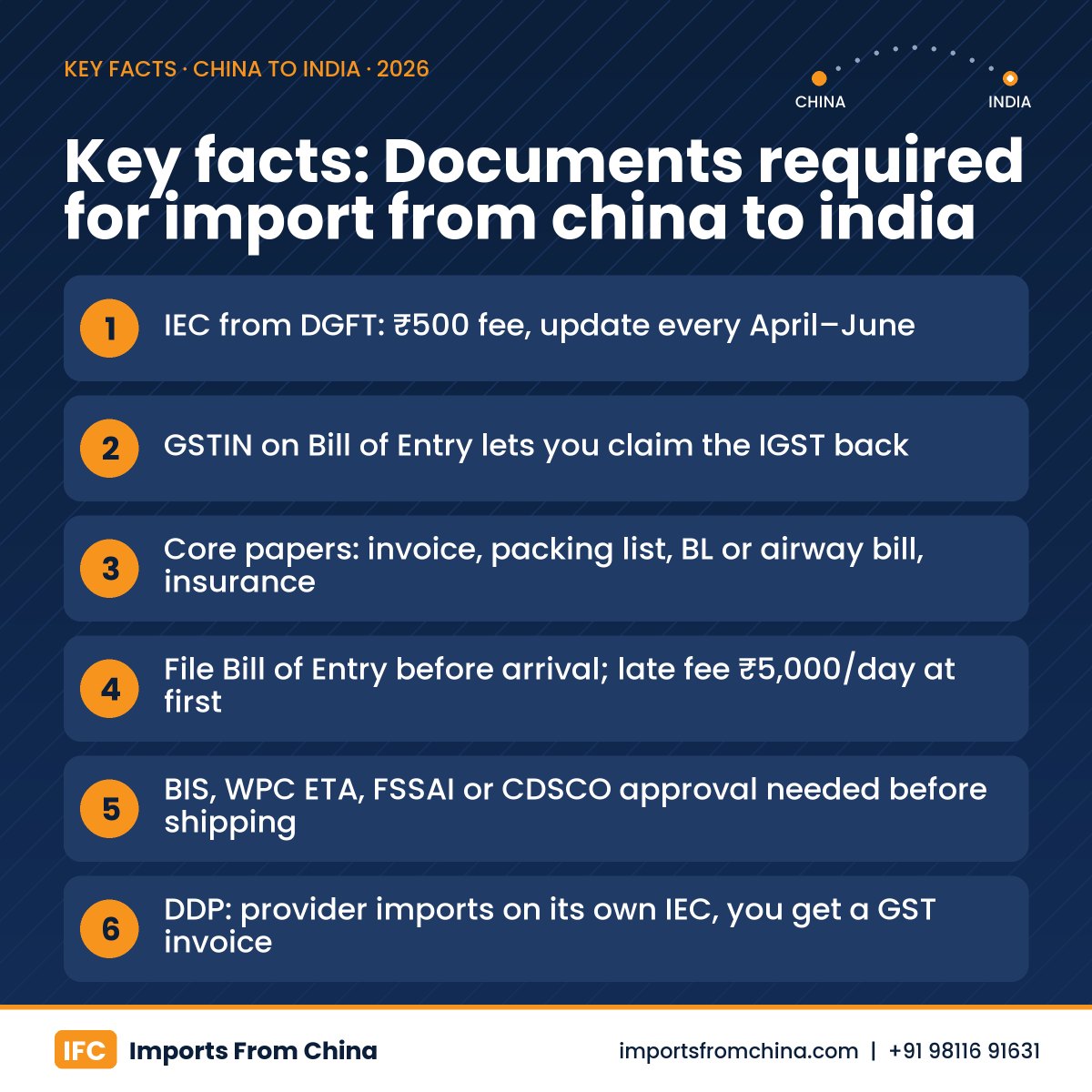
- Two registrations first: an IEC from DGFT and a GSTIN. Without a GSTIN on the Bill of Entry you cannot claim back the IGST paid at customs.
- Four core shipping papers: commercial invoice, packing list, bill of lading (sea) or airway bill (air), and an insurance certificate.
- The Bill of Entry is the key document: your CHA files it on ICEGATE, ideally before the ship arrives, and uploads supporting papers on e-Sanchit.
- Product approvals are checked at the port: BIS for many electronics and toys, WPC ETA for Bluetooth and Wi-Fi goods, FSSAI for food, CDSCO for medical devices and cosmetics.
- Small mismatches cause big delays: names, HS codes or weights that differ across invoice, packing list and BL trigger queries.
- DDP removes most of the paperwork: the DDP provider imports on its own IEC and delivers to you with a GST invoice.
What documents are required for import from China to India? (Complete checklist)
Some documents you arrange once, some your supplier sends with every shipment, and some are created in India during clearance.
| Document | Who issues it | When you need it | Common mistakes |
|---|---|---|---|
| IEC (Importer Exporter Code) | DGFT, online | Before your first commercial import | Missing the April–June yearly update, so the IEC is deactivated |
| GSTIN | GST department | Before import, if you will resell or use goods in business | GSTIN missing on the Bill of Entry, so no IGST credit |
| AD code (bank) | Your bank (Authorised Dealer) | Mainly exports; keep the letter ready for imports | Paying from an account not linked to your IEC |
| Commercial invoice | China supplier | Every shipment | Vague description, value not matching the payment |
| Packing list | China supplier | Every shipment | Carton count, gross weight or CBM different from the bill of lading |
| Bill of lading (sea) or airway bill (air) | Shipping line, NVOCC or airline | Every shipment | Consignee not matching IEC name; original BL not surrendered |
| Insurance certificate | Insurer (India or China) | Every shipment (strongly advised) | No policy: customs adds 1.125% of FOB and you have no cover |
| Certificate of origin | China CCPIT or customs authority | Only when claiming a preferential rate (for example under APTA) | Claim rejected for not meeting CAROTAR rules |
| Bill of Entry | Filed by your CHA on ICEGATE, assessed by Indian Customs | Every shipment, before or on arrival | Late filing, wrong HS code, value lower than the payment proof |
| Product approvals (BIS, WPC ETA, FSSAI, CDSCO, EPR) | BIS, DoT WPC wing, FSSAI, CDSCO, CPCB | Before the goods are shipped from China | Treating a CE or FCC report as an Indian approval |
| KYC and authorisation for CHA | You (the importer) | Before your first job with a customs broker | Missing authorisation or address proof |
| Delivery order and gate pass | Shipping line or CFS / airline terminal | After customs Out of Charge | Unpaid local charges adding demurrage |
Which registrations do you need before your first import?
IEC: the import licence most people mean
India does not issue a general import licence for normal goods. What you need is the 10-digit IEC, applied online on the DGFT website using your PAN. The government fee is ₹500. You must update your IEC every year between April and June, even if nothing has changed; an IEC that is not updated is deactivated and your CHA cannot file a Bill of Entry on it. Goods imported for personal use, not for trade, are exempt from IEC. If you are unsure whether you need one at all, read our guide on IEC and import licences.
GSTIN: needed to claim IGST back
Most commercial imports pay IGST at customs. With your GSTIN on the Bill of Entry, that IGST flows into your GSTR-2B as input tax credit; without it, the IGST becomes a cost. For resellers and Amazon/Flipkart sellers a GSTIN is effectively compulsory.
AD code, ICEGATE and Legal Metrology
AD code registration at the port is mandatory for exporters. For imports it is not a standard requirement at every port, but keep your bank’s AD code letter ready in case your CHA asks. You do not need your own ICEGATE login if your CHA files for you, though one helps you track filings and duty. To sell packaged goods at retail, you also need importer registration under the Legal Metrology (Packaged Commodities) Rules and labels showing importer name and address, MRP, net quantity and country of origin.
KYC for your customs broker (CHA)
Customs brokers must verify each client before filing. Expect to give: IEC copy, GST certificate, PAN, address proof of the business, an authorisation letter on letterhead naming the broker, and ID of the signatory. Send this pack before the goods leave China. IFC’s custom clearance service in India collects this once and keeps it on file for later shipments.
Which shipping documents must your China supplier send?
Commercial invoice
Customs values your goods mainly from this document, so check the draft before the supplier ships. It should show buyer name and address exactly as on your IEC, invoice number and date, Incoterm (FOB, CIF, EXW), currency, a clear description with model and material, quantity, unit price, total value and ideally the HS code. A description such as household items invites a query or examination. The value must match what you actually pay; customs compares it with remittance records and past imports of similar goods.
Packing list
The packing list shows how many cartons, what is in each, net and gross weight and dimensions or CBM. During examination, the officer checks cartons against this list, so carton marks should match it.
Bill of lading or airway bill
Sea cargo moves on a bill of lading (BL) from the shipping line or NVOCC; air cargo on an airway bill (AWB). The consignee must be you, in your IEC name (or your bank, under an LC). For sea shipments the supplier couriers the original BL or arranges a telex release after balance payment; until then the line will not issue a delivery order, even after customs clearance.
Insurance certificate and certificate of origin
If you buy on FOB or EXW terms, insure the cargo yourself. Under the Customs Valuation Rules, when actual insurance cost is not available, customs adds 1.125% of FOB value to the assessable value; when freight is not known it adds 20% of FOB. Since 2017, landing charges are no longer added. A certificate of origin is not needed for every China shipment. China and India are both in the Asia-Pacific Trade Agreement (APTA), and some tariff lines get a concession with a valid APTA certificate, claimed under CAROTAR 2020 rules (origin details in the Bill of Entry, records kept five years). Check the current APTA notification for your HS code.
How is the Bill of Entry filed and what does customs check?
The Bill of Entry is the import declaration. Your CHA prepares it from your invoice, packing list and BL, files it on ICEGATE and uploads supporting documents on e-Sanchit.
- Advance filing: the law requires filing before the end of the day preceding the vessel’s arrival (up to 30 days ahead is allowed). Late filing charges are currently ₹5,000 per day for the first three days and ₹10,000 per day after, with a cap; check the current notification.
- Assessment: accepted by the system or sent to an officer; queries usually concern HS code, value or a missing approval.
- Duty payment: paid online through ICEGATE. Late payment attracts interest.
- Examination: some shipments are opened and checked, especially electronics and first-time importers.
- Out of Charge (OOC): customs releases the goods; your CHA pays CFS charges, collects the delivery order and gate pass, and the cargo moves out.
With complete documents, clearance usually takes a few working days after arrival. Missing approvals or a valuation query can stretch this to weeks while demurrage adds up. Indicative, October 2026: sea port to port from China to Nhava Sheva about 12–20 days, LCL roughly 3–6 weeks door to door, and air cargo 5–10 days door to door.
Which products need extra approvals (BIS, WPC, FSSAI, CDSCO, EPR)?
Customs checks product approvals at the port, so they must be in place before goods are shipped. Check your 8-digit code on our India import duty rates page, which lists compliance notes for each code.
| Approval | Typical products | Who issues | What it means for you |
|---|---|---|---|
| BIS (CRS registration or ISI licence) | Power banks, adapters, LED lights, speakers, toys, many QCO items | Bureau of Indian Standards | Held by the Chinese factory per model; goods must carry the mark |
| WPC ETA | Bluetooth, Wi-Fi, RF remotes, smart watches | DoT WPC wing (Saral Sanchar portal) | Equipment Type Approval, often by self-declaration |
| FSSAI | Food, beverages, supplements | FSSAI | Central licence plus clearance of each consignment |
| CDSCO | Medical devices, cosmetics, drugs | CDSCO (SUGAM portal) | Import licence or registration certificate before shipping |
| EPR registration | Plastic packaging, electronics (e-waste), batteries | CPCB portal | Importers count as producers and must register |
| Import monitoring (e.g. SIMS) | Iron and steel items in chapters 72, 73, 86 | DGFT / Ministry of Steel portal | Registration number before arrival |
Check the BIS website for whether your product is under a Quality Control Order. A supplier’s CE or FCC test report is not a BIS registration. If the model is not registered, change the model or supplier before paying the deposit.
How do your import documents change the duty you pay? (Worked example in ₹)
Example: 500 Bluetooth speakers, HS code 85182110, LCL from Shenzhen to Nhava Sheva. Rates as of October 2026: BCD 20%, SWS 10% of BCD, no AIDC, IGST 18%, no anti-dumping duty; the product needs BIS (CRS), WPC ETA and e-waste EPR. Assumptions: values converted at the customs exchange rate; no landing charges (removed in 2017). Confirm rates for your exact HS code.
| Item | Calculation | Amount (₹) |
|---|---|---|
| FOB value (invoice) | 500 × ₹480 | 2,40,000 |
| Sea freight to Nhava Sheva | Freight invoice | 36,000 |
| Insurance | Insurance policy | 1,000 |
| Assessable value (CIF) | FOB + freight + insurance | 2,77,000 |
| Basic Customs Duty | 20% of 2,77,000 | 55,400 |
| Social Welfare Surcharge | 10% of 55,400 | 5,540 |
| IGST | 18% of (2,77,000 + 55,400 + 5,540 = 3,37,940) | 60,829 |
| Total paid to customs | BCD + SWS + IGST | 1,21,769 |
| Cost after IGST credit (GSTIN on BoE) | 2,77,000 + 55,400 + 5,540 | 3,37,940 (about ₹676 per speaker) |
| Cost without IGST credit (no GSTIN) | 3,37,940 + 60,829 | 3,98,769 (about ₹798 per speaker) |
Lessons: the GSTIN on your Bill of Entry is worth ₹60,829 here, about ₹122 per speaker. Without an insurance certificate customs would add ₹2,700 (1.125% of FOB) instead of ₹1,000, and you would have no cover for lost cartons. A missing BIS registration or ETA would stop clearance completely, and CFS storage would cost far more than any duty difference. Local charges (CFS, DO, CHA fees, transport) come on top; see our import duty guide for China to India for how each duty works, or enter your own numbers in the IFC shipment calculator.
What changes for DDP vs self-import?
Under self-import, you handle every document above on your IEC. Under DDP shipping from China to India, the provider is the importer on record, pays duty on its own IEC and delivers with a GST invoice.
| Point | Self-import (your IEC) | DDP (provider’s IEC) |
|---|---|---|
| IEC needed | Yes | No |
| GSTIN needed | Yes, to claim IGST | Yes, if you want input credit on the GST invoice you receive |
| CHA KYC and authorisation | Yes, from you | Handled by provider |
| Invoice, packing list, BL checks | You and your CHA | Provider, with your supplier |
| Bill of Entry and duty payment | On your IEC; you pay duty | On provider’s IEC; duty included in the DDP price |
| Product approvals (BIS, WPC, FSSAI) | Your responsibility | Still needed for regulated goods |
| Best for | Regular high-volume importers | First-timers, small mixed orders, no IEC |
DDP does not make a non-compliant product legal: BIS or ETA is still needed, whoever files the Bill of Entry.
What should you have ready before the shipment leaves China?
Save this checklist and tick it off for every order.
- Registrations: IEC active and updated this year; GSTIN active; Legal Metrology importer registration if selling packaged goods.
- CHA pack: KYC documents and signed authorisation letter sent to your customs broker.
- HS code: agreed 8-digit code, duty rate and any anti-dumping duty checked.
- Approvals: BIS, WPC ETA, FSSAI, CDSCO, EPR or SIMS in place, where your product needs them.
- Drafts checked: invoice, packing list and draft BL match on consignee, description, quantity, weight and CBM.
- Payment proof: bank remittance copies match the invoice value and currency.
- Insurance: policy or certificate issued before departure.
- Release: original BL couriered or telex release arranged after balance payment.
- Labels: origin, importer details and MRP ready for retail goods.
How IFC helps with documents required for import from China to India
IFC – Imports From China has worked in China–India import and export for more than 15 years. Our own offices in Guangzhou and Yiwu have translators and English-speaking staff who coordinate with suppliers on invoices, packing lists and carton marks. We load mixed containers and air cargo daily and run a warehouse at our headquarters.
Our services cover sourcing, supplier verification, quality inspection, LCL and FCL sea freight, air cargo and customs clearance on your IEC. With DDP, we deliver door to door to major cities including Delhi, Gurugram, Noida, Mumbai, Pune, Bengaluru, Hyderabad, Chennai and Ahmedabad.
Conclusion
Importing from China to India needs fewer documents than most people fear, but each must be correct and consistent. Sort out IEC and GSTIN, confirm product approvals before paying the supplier, match the draft invoice, packing list and BL, and file the Bill of Entry early. If you would rather not manage the paperwork, a DDP shipment moves most of it to the provider.
Get your real landed cost: enter your product, weight and CBM in the IFC shipment calculator, check your HS code on the India import duty rates page, or call IFC on +91 98116 91631 for a door-to-door DDP quote from China to your city.
Frequently asked questions
Can I import goods from China to India without an IEC?
For personal use, yes: goods not meant for trade are exempt from IEC. For any commercial import you need an IEC from DGFT, or you can use a DDP service where the provider imports on its own IEC and sells the goods to you in India on a GST invoice.
Is GST registration mandatory to import from China?
Customs collects IGST on most commercial imports. If your GSTIN is on the Bill of Entry, that IGST shows in your GSTR-2B and you can claim it as input tax credit. Without a GSTIN the IGST becomes a cost, and you will usually need GST registration anyway to resell the goods.
When should the Bill of Entry be filed?
The law requires the Bill of Entry to be filed before the end of the day before the vessel arrives, and advance filing up to 30 days ahead is allowed. Late filing attracts per-day charges, currently 5,000 rupees a day for the first three days and 10,000 rupees a day after that. Check the current notification.
Do I need a certificate of origin for goods from China?
Not for every shipment. You need it only when you claim a preferential duty rate, for example under the Asia-Pacific Trade Agreement, and you must meet CAROTAR rules for that claim. Customs may also ask for origin proof where anti-dumping duty depends on the country or producer.
What is the difference between telex release and an original bill of lading?
An original bill of lading is a paper document the supplier couriers to you, and you hand it to the shipping line to get a delivery order. A telex release means the supplier surrenders the original in China, so the line releases cargo in India without paper. Suppliers usually arrange either one only after balance payment.
Do I need BIS certification to import electronics from China?
Many electronics such as power banks, adapters, LED lights and speakers are under BIS compulsory registration. The registration is held by the Chinese manufacturer for each model, and the goods must carry the BIS mark. Customs can hold the shipment if the model is not registered, so check before you pay the supplier.
Comments for this post are closed.