





Import Electronics from China to India: BIS Registration (CRS) Guide 2026
Do you need BIS registration to import electronics from China to India? For most everyday electronics, yes. Chargers, power banks, LED lights, laptops, Bluetooth speakers and CCTV cameras fall under BIS’s Compulsory Registration Scheme (CRS). The Chinese factory must hold a BIS registration (R-number) for that brand and model, and the goods must carry the BIS Standard Mark before they leave China.
If you plan to import electronics from China to India, BIS registration is the first thing to check, before price or freight. This guide explains which products are covered, who registers, the step-by-step process, indicative costs and timelines, how customs checks compliance at the port, and a worked duty example in rupees for 1,000 mobile chargers.
Key takeaways
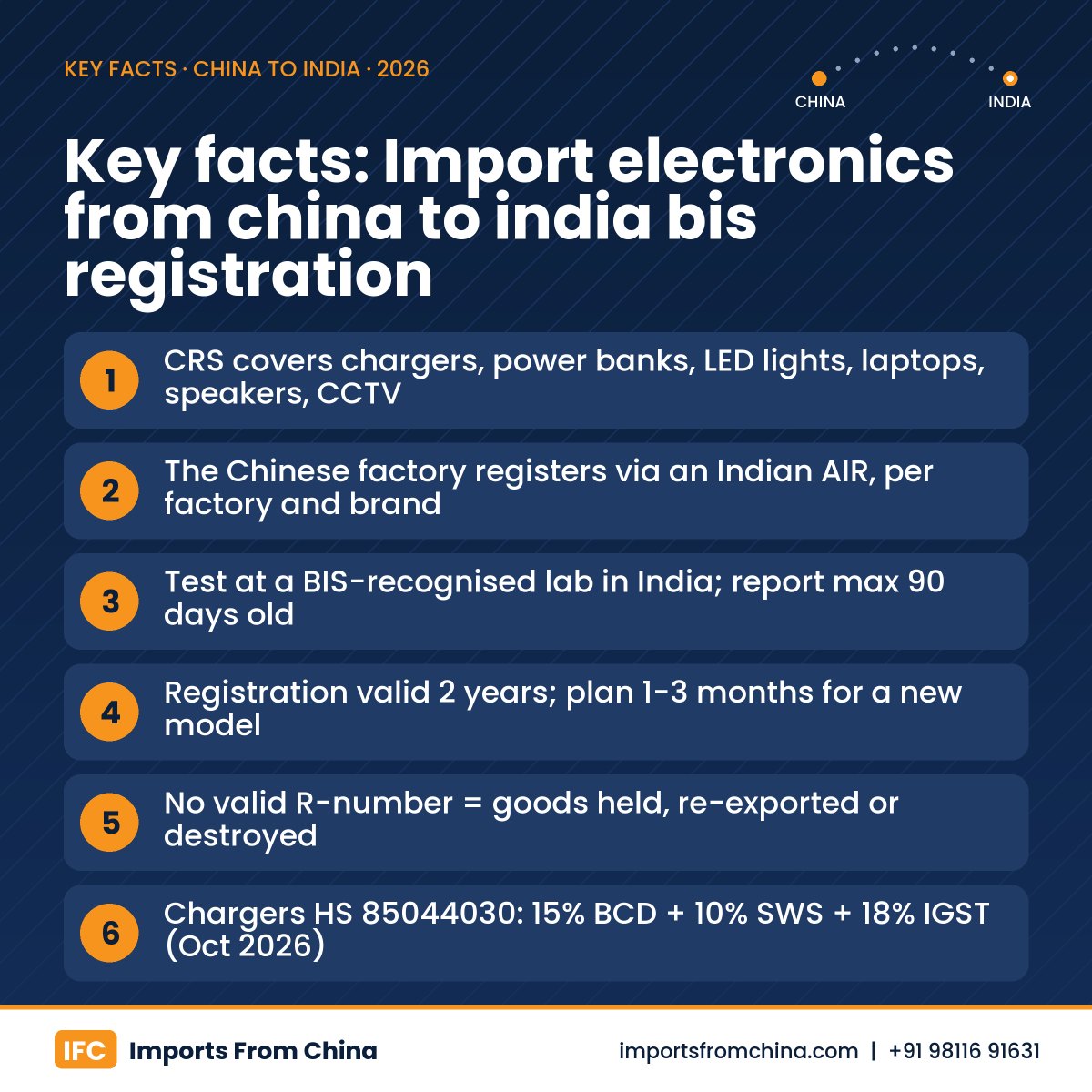
- The factory registers, not you: BIS CRS registration is granted to the manufacturer for each factory and brand, through an Authorised Indian Representative (AIR).
- No R-number, no clearance: covered electronics without a valid registration and Standard Mark can be held, sent back or destroyed at the Indian port.
- Testing is in India: samples must be tested at a BIS-recognised lab, and the test report must not be older than 90 days when the application is filed.
- Plan 1–3 months: lab testing plus BIS processing usually takes several weeks for a new model, so start before you place the bulk order.
- BIS is not the only check: wireless items need WPC approval, importers of electronics need EPR registration under the E-Waste Rules, and retail packs need Legal Metrology labels.
- Duty still applies: mobile chargers (HS 85044030) attract 15% BCD, 10% SWS and 18% IGST (as of October 2026).
What is BIS CRS registration and who needs it?
The Compulsory Registration Scheme is run by the Bureau of Indian Standards (BIS) for the Ministry of Electronics and IT (MeitY). It is notified under the Electronics and Information Technology Goods (Requirements for Compulsory Registration) Order. Any product on the CRS list cannot be manufactured, imported, sold or distributed in India unless it is registered with BIS and carries the Standard Mark.
Three points confuse most first-time importers:
- The applicant is the manufacturer. A trader or importer in India cannot register a Chinese factory’s product in its own name as the manufacturer. The Chinese factory applies, and appoints an Authorised Indian Representative (AIR) based in India.
- Registration is factory-wise and brand-wise. Each manufacturing location gets its own registration number. Each brand is registered separately, although one test report can cover several brands when the product and factory are the same.
- It is valid for two years. The registration must be renewed before expiry, and BIS can draw market samples for surveillance at any time.
Which electronics from China need BIS registration?
The CRS list covers several dozen categories of electronics and IT goods, and MeitY adds items from time to time. The table shows the products Indian importers ask IFC about most often. Always confirm the current list on the BIS CRS portal before ordering, because the standard number and scope can change.
| Product | Typical HS code | BIS standard (CRS) | Other approvals to check |
|---|---|---|---|
| Mobile chargers and adapters | 85044030 | IS 13252 (Part 1) | EPR (e-waste), Legal Metrology label |
| Power banks and lithium battery packs | 85076000 | IS 13252 (Part 1) and IS 16046 (Part 2) | EPR, battery rules, dangerous-goods shipping |
| LED lamps and luminaires | 8539 / 9405 | IS 16102 / IS 10322 series | EPR, Legal Metrology |
| Bluetooth speakers and audio amplifiers | 8518 | IS 616 | WPC approval (Bluetooth), EPR |
| Laptops, tablets, monitors | 8471 / 8528 | IS 13252 (Part 1) | WPC (Wi-Fi), EPR |
| CCTV cameras and DVRs | 8525 / 8521 | IS 13252 (Part 1) | Check current CCTV security requirements, EPR |
Some electrical goods, such as switches, cables, fans and many household appliances, fall under separate BIS Quality Control Orders that need an ISI licence under the Foreign Manufacturers Certification Scheme (FMCS) instead of CRS. FMCS involves a factory audit and takes much longer. If you deal in a mix of products, see our electrical products from China page and check each item separately. You can look up the duty and compliance notes for any 8-digit code on the India import duty rates by HS code page.
Import electronics from China to India: BIS registration step by step
This is the usual sequence for a product that the Chinese factory has not yet registered for India.
- Confirm the product is on the CRS list and identify the Indian Standard that applies. Use the exact model and its technical sheet, not a marketplace title.
- Ask the factory for its existing R-number. Many large Chinese factories that already sell to India have one. Check that it covers your model, your brand and the factory address on your purchase order.
- Appoint an AIR. If a new registration is needed, the factory nominates an Authorised Indian Representative. For private-label goods this is often the Indian brand owner or importer, or a BIS consultant.
- Send samples to a BIS-recognised lab in India. Your own or the factory’s in-house test reports are not accepted. For a model series, the highest configuration is usually tested under MeitY’s series guidelines.
- Apply online on the BIS portal with the test report (not older than 90 days), the factory’s business licence, brand authorisation, AIR documents, label artwork and the fee.
- BIS grants the registration and issues the R-number for that factory and brand.
- Print the Standard Mark with the IS number and R-number on the product and its packaging (packaging alone only if the product is too small) before mass production.
- Keep the file ready for customs: registration letter, test report, photos of the marking and the brand authorisation travel with your shipping documents.
Who should be the AIR for your product?
The AIR answers to BIS and MeitY for the registration, so choose with care. If you sell under your own brand on Amazon or Flipkart, being the AIR yourself gives you control: the registration cannot be withdrawn by an agent you no longer work with. If you only buy a factory’s own branded goods, it is normally the factory’s existing AIR who holds the registration, and you simply verify it.
How much does BIS CRS registration cost and how long does it take?
Costs depend on the product, the standard and the lab. BIS publishes its own fee schedule, and labs and consultants quote separately. The figures below are indicative ranges for a single new model (indicative, October 2026).
| Cost or time item | Who pays | Indicative range |
|---|---|---|
| Lab testing at a BIS-recognised lab | Factory or AIR | Roughly ₹25,000 to ₹1,50,000+ per model, more for complex products |
| BIS application and registration fees | Factory or AIR | As per the current BIS fee schedule; check the BIS portal |
| Sample courier from China and customs for samples | Factory or importer | Courier at about ₹450–900/kg plus duty on the samples |
| Consultant fee (optional) | Whoever hires them | Varies widely; ask for a written scope |
| Lab testing time | – | Usually 2–6 weeks, depending on lab workload |
| BIS processing after a complete application | – | Usually a few weeks if documents are in order |
Add it up and a new registration commonly takes one to three months from sample dispatch. That is why the order of work matters: confirm the R-number or start registration first, approve the marked sample next, and only then pay the deposit for bulk production. Registration is also per factory, so if your supplier quietly moves your order to a different plant, the existing R-number may not cover it.
How does customs check BIS compliance when electronics land in India?
BIS compliance is checked as part of normal customs clearance in India. Your customs broker declares the goods on the Bill of Entry on ICEGATE, and for CRS products the registration details and documents are uploaded with it. If the shipment is selected for examination, officers at the CFS, ICD or air cargo terminal open cartons and look for:
- The Standard Mark with the correct IS number and R-number on the product and the box.
- A brand and model that match the registration, the invoice and the packing list.
- Legal Metrology details on retail packs: importer name and address, MRP, net quantity, month and year of import and customer care details.
- WPC approval for anything with Bluetooth or Wi-Fi.
If a covered product arrives without valid registration, customs can refuse clearance. In practice the importer then faces re-export at its own cost, or destruction, plus port storage and demurrage while the case is decided. Penalties under the BIS Act, 2016 are also possible. Mixed shipments are a common trap: one unregistered model in a container of registered goods can hold up the whole Bill of Entry. Our documents required for import from China checklist shows the full file your broker needs.
How to verify a supplier’s R-number
Ask the supplier for the registration letter, then search the R-number on the BIS CRS portal or in the BIS Care app. Match four things: factory name and address, brand, model numbers and the validity date. A screenshot of a certificate on WhatsApp is not proof. If the factory name on the BIS record differs from the company on your proforma invoice, ask why before paying; it often means you are dealing with a trading company. See also how to verify a China import agent.
Worked example: duty and compliance cost for 1,000 mobile chargers
Assumptions: 1,000 USB-C mobile chargers from a Shenzhen factory that already holds a valid BIS R-number for your brand. FOB price USD 2.20 each (USD 2,200). Sea freight to Nhava Sheva USD 120 and insurance USD 12, so CIF is USD 2,332. Exchange rate ₹96 per USD, the CBIC import rate under Notification 29/2026-Customs (N.T.), effective 16 October 2026. The IFC duty database shows HS 85044030 at 15% BCD (for chargers of cellular mobile phones), 10% SWS, no AIDC, 18% IGST and no anti-dumping duty. Rates as of October 2026; confirm for your exact HS code.
| Item | How it is calculated | Amount (₹) |
|---|---|---|
| Assessable value (AV) | CIF USD 2,332 × 95.90 | 2,23,639 |
| Basic Customs Duty | 15% of AV | 33,546 |
| Social Welfare Surcharge | 10% of BCD | 3,355 |
| Value for IGST | AV + BCD + SWS | 2,60,540 |
| IGST | 18% of 2,60,540 | 46,897 |
| Total paid at customs | BCD + SWS + IGST | 83,798 |
The IGST of ₹46,897 is normally available as input tax credit if your GSTIN is on the Bill of Entry. Your real duty cost is the BCD and SWS of ₹36,901, about ₹37 per charger. Add freight and Indian charges: this lot is about 1.2 CBM, and door-to-door LCL from China typically costs ₹9,000–16,000 per CBM (indicative, October 2026), with a minimum charge on small lots.
Now compare the cost of getting BIS wrong. If the factory had no valid registration for your brand, you would first spend roughly ₹25,000 or more on testing and wait several weeks. If you shipped anyway, the ₹3 lakh of goods could be refused entry, and you would still pay freight, storage and either re-export or destruction. Run your own product through the IFC shipment calculator, and read our import duty from China to India guide for how each duty is worked out.
What mistakes do Indian importers make with BIS for electronics?
- Trusting a “CE” or “FCC” mark. European and US marks mean nothing for Indian customs. Only the BIS Standard Mark with a valid R-number counts.
- Buying a registered model under a new brand. If you add your own logo, the registration must cover your brand too.
- Ignoring the factory address. Registration is tied to the manufacturing location, not to the trading company that sends the invoice.
- Forgetting accessories inside the box. A registered speaker shipped with an unregistered adapter can still be stopped, because the adapter needs its own registration.
- Letting the registration lapse. Registrations are valid for two years. Check the expiry date against your shipment date.
- Skipping EPR registration. Under the E-Waste (Management) Rules, 2022, importers of covered electrical and electronic equipment are treated as producers and must register on the CPCB EPR portal.
Pre-order checklist for electronics from China
- HS code and duty confirmed for each model.
- CRS coverage and the Indian Standard confirmed on the BIS portal.
- R-number verified for this factory, brand and model, with validity beyond your arrival date.
- WPC approval in hand for Bluetooth or Wi-Fi products.
- EPR registration and Legal Metrology label artwork ready.
- Marked golden sample approved before bulk production, and inspection booked before loading.
How IFC helps you import electronics from China with BIS compliance
IFC – Imports From China has more than 20 years (since 2004) in China–India import and export, and has served 5000+ businesses. The company is founded and led by Mayank Dang (CA Sahab), a Chartered Accountant (FCA, ICAI). Our own offices in Guangzhou and Yiwu have translators and English-speaking staff who can ask a factory for its BIS registration, check the marking on samples and cartons, and run a quality inspection before goods are loaded.
We give BIS, HSN, duty and customs/GST compliance guidance before you order, then handle sourcing, supplier verification, LCL and FCL sea freight, air cargo and customs clearance in India. We load mixed containers and air cargo daily and have a warehouse at our headquarters. With our DDP shipments from China to India, goods are delivered door to door to major cities including Delhi, Gurugram, Noida, Mumbai, Pune, Bengaluru, Hyderabad, Chennai and Ahmedabad.
Bottom line
For electronics from China, BIS registration decides whether your goods can enter India at all. Confirm the product’s CRS status, verify the factory’s R-number for your brand and model, add WPC and EPR where needed, and only then pay for bulk production. Done in that order, BIS becomes a routine check instead of a container stuck at the port.

Guide on BIS registration for electronics imports reviewed by Mayank Dang (CA Sahab), Founder & CEO of IFC
Chartered Accountant (FCA, ICAI) who has helped 5000+ Indian businesses import from China since 2004 – sourcing, BIS, HSN classification, import duty, customs and GST compliance. mayankdang.in
Get your real landed cost: enter your product, weight and CBM in the IFC shipment calculator, check your HS code on the India import duty rates page, or call IFC on +91 98116 91631 for a door-to-door DDP quote from China to your city.
Frequently asked questions
Is BIS registration mandatory for importing electronics from China to India?
Yes, for every product on the BIS Compulsory Registration Scheme list, such as chargers, power banks, LED lights, laptops, Bluetooth speakers and CCTV cameras. The Chinese manufacturer must hold a valid registration for that factory, brand and model, and the goods must carry the BIS Standard Mark with the R-number before they reach an Indian port.
Can an Indian importer apply for BIS CRS registration?
The applicant is the manufacturer, not the trader. An Indian importer or brand owner can act as the Authorised Indian Representative (AIR) for the Chinese factory and handle the testing and application, but the registration is granted for the manufacturing location. Private-label sellers often take the AIR role to keep control of the registration.
How long does BIS registration take for electronics?
For a new model, lab testing at a BIS-recognised lab in India usually takes 2 to 6 weeks, and BIS processing a few more weeks if documents are complete. Plan roughly one to three months from sample dispatch. If the factory already has a valid R-number covering your brand and model, no new registration is needed.
What happens if electronics arrive at Indian customs without BIS registration?
Customs can refuse clearance for covered goods without valid registration and marking. The importer usually has to re-export the goods or have them destroyed, while paying port storage and demurrage. Penalties under the BIS Act, 2016 are also possible. One unregistered model can hold up an entire mixed shipment.
How do I check if a Chinese supplier’s BIS R-number is genuine?
Search the R-number on the BIS CRS portal or in the BIS Care app and match the factory name and address, brand, model numbers and validity date with your purchase order. Do not rely on a certificate image alone. If the BIS record shows a different company from your invoice, you may be dealing with a trading company.
Do I need WPC approval as well as BIS for Bluetooth products?
Yes. Products with Bluetooth, Wi-Fi or other wireless modules need WPC approval in addition to BIS registration where the product is on the CRS list. Importers of electronics also need EPR registration under the E-Waste (Management) Rules, 2022, and retail packs need Legal Metrology labelling.
Does BIS registration change the import duty on electronics?
No. BIS registration is a compliance requirement and does not reduce duty. Customs duty depends on the HS code. For example, mobile chargers under HS 85044030 attract 15% BCD, 10% SWS and 18% IGST as of October 2026. Confirm the rate for your exact code before ordering.
Comments for this post are closed.