






Anti Dumping Duty on Chinese Goods in India: What Importers Must Check (2026)
What is anti dumping duty on Chinese goods in India? It is an extra customs duty, on top of Basic Customs Duty and IGST, charged on specific Chinese products that India’s trade remedies authority finds are being sold below fair value. It applies only to the exact product, origin and producers named in a Finance Ministry notification, usually for five years, and is often a fixed amount in US dollars per tonne.
Because it is product-specific, many importers only discover it when their Bill of Entry is assessed. This guide explains how the duty works, current examples on Chinese goods, how it is calculated, how to check your HS code before ordering, and a worked example in rupees showing how anti-dumping duty can almost double the duty on a shipment.
Key takeaways
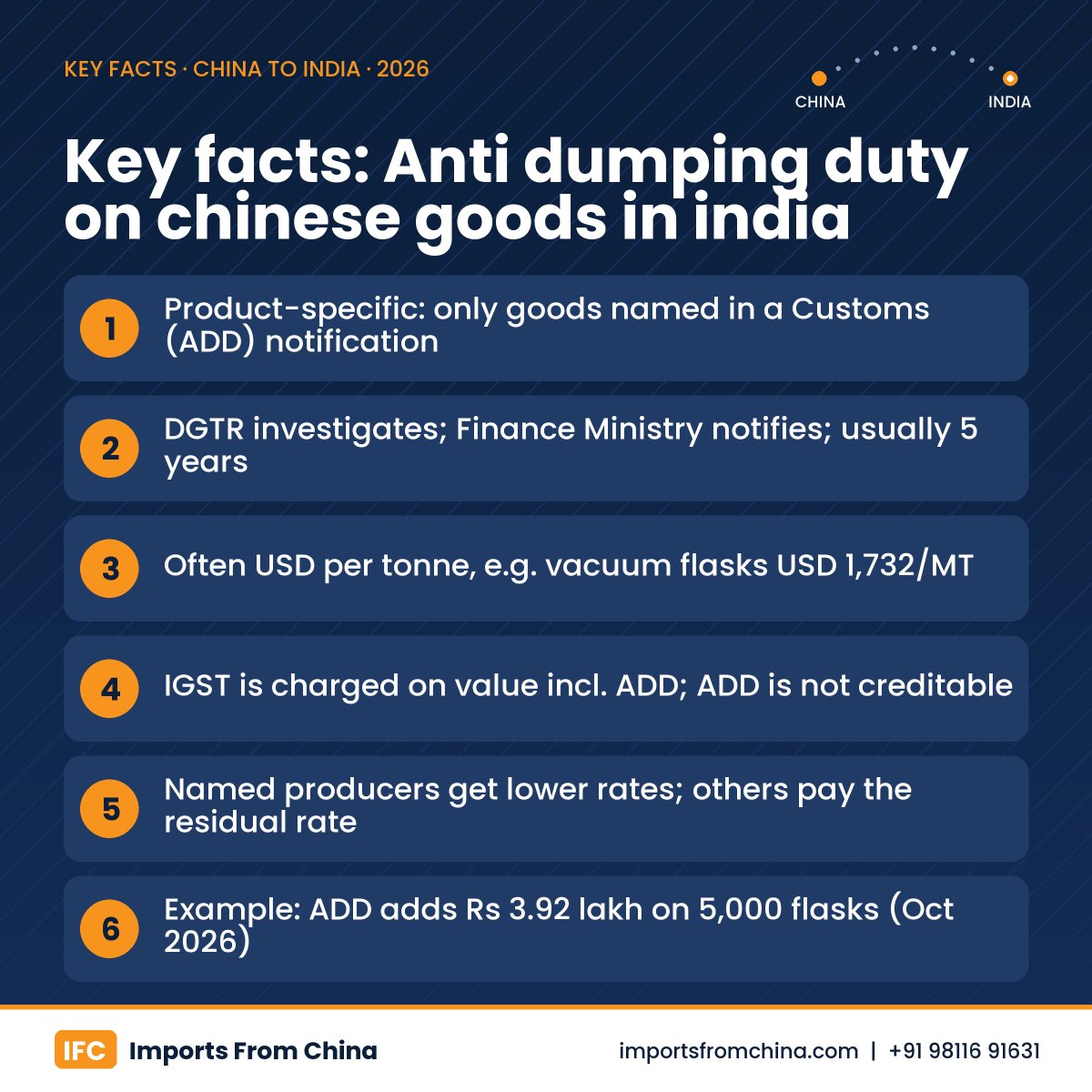
- Product-specific, not country-wide: there is no general anti-dumping duty on all Chinese goods. Each duty covers a defined product, often only some HS codes.
- DGTR investigates, Finance Ministry imposes: the duty starts only when a “Customs (ADD)” notification is published, normally for five years.
- Often per tonne: many duties are fixed USD amounts per metric tonne, paid in rupees at the CBIC exchange rate.
- Producer-wise rates: named Chinese producers may get lower rates; all others pay the highest “residual” rate.
- It raises IGST too: IGST is charged on a value that includes anti-dumping duty, and the anti-dumping duty itself is not creditable.
- Check before you pay the supplier: a new duty can be notified while your goods are at sea. The rate on the Bill of Entry date applies.
How does anti dumping duty on Chinese goods in India work?
“Dumping” means an exporter sells goods to India at a price lower than its normal value, usually the price in its home market, and this hurts Indian manufacturers. Under Section 9A of the Customs Tariff Act, 1975 and the Anti-Dumping Rules, India can impose a duty to offset that price gap. The process has two separate authorities:
- DGTR (Directorate General of Trade Remedies, under the Commerce Ministry) receives an application from Indian industry, starts an investigation, collects data from Chinese exporters and Indian importers, and recommends a duty in its final findings.
- The Ministry of Finance decides whether to accept the recommendation and, if so, issues a notification numbered like “26/2026-Customs (ADD)”. Only that notification creates a legal duty that customs can collect.
A DGTR recommendation alone does not change your duty. Some recommendations are never notified, and a notification may differ from what DGTR proposed. Always work from the notification published by CBIC, and treat a DGTR investigation as an early warning.
Anti-dumping vs other duties on Chinese imports
| Duty | Applies to | Who decides | Creditable as GST input? |
|---|---|---|---|
| Basic Customs Duty (BCD) | All imports, by HS code | Customs Tariff and Budget | No |
| Social Welfare Surcharge (SWS) | 10% of BCD unless exempt | Finance Ministry | No |
| Anti-dumping duty (ADD) | Specific product, origin and producers | DGTR recommends, Finance Ministry notifies | No |
| Countervailing (anti-subsidy) duty | Subsidised products from a named country | DGTR and Finance Ministry | No |
| Safeguard duty | A sudden import surge from all countries | DGTR and Finance Ministry | No |
| IGST | All imports | GST law | Yes, usually |
Which Chinese products attract anti-dumping duty in 2026?
Anti-dumping measures on Chinese goods are concentrated in chemicals, steel and metals, glass, rubber, plastics and some consumer goods. The examples below show how varied the duties are. This is not a complete list; check the current notification for your exact product.
| Product from China | HS codes (indicative) | Notification | Duty |
|---|---|---|---|
| Titanium dioxide | 2823 00 10, 3206 11 10, 3206 11 90 | 26/2026-Customs (ADD), 24 Oct 2026 | USD 460 to 681 per MT, producer-wise, for five years |
| Mica-based pearl industrial pigments | Chapter 32 (see notification) | 21/2026-Customs (ADD), 21 Aug 2026 | USD 214 to 5,529 per MT, producer-wise |
| Textured tempered solar glass (China, Vietnam) | 7007 19 00 | 11/2025-Customs (ADD), 8 May 2025 | USD 570 to 664 per MT |
| Vacuum insulated flasks of stainless steel | 9617 | 03/2025-Customs (ADD), March 2025 | USD 1,732 per MT, for five years |
| Soft ferrite cores | Chapter 85 (see notification) | Notified March 2025 | Up to 35% of CIF value |
| Aluminium foil up to 80 micron | 7607 | Duty notified in 2025; DGTR recommended continuation in September 2026 | Check the current notification |
Rates as of October 2026. Each duty has a precise product description and exclusions, so an HS code match alone is not enough; read the description in the notification. Our guide to finding the right HS code explains why the classification must be right first.
New investigations to watch
In late September 2026, DGTR opened seven new anti-dumping investigations on Chinese products: Penicillin G and its salts, 6-aminopenicillanic acid, amoxycillin trihydrate, montelukast sodium, a tackifying resin used in tyres, T-section guide rails for lifts, and copolymer polyol used in mattress and bedding foam. If you import any of these, plan for the possibility of a duty within the next year. You can track cases on the DGTR website.
How is anti-dumping duty calculated on a Bill of Entry?
The notification states the form of the duty. You will see three common types:
- Fixed amount per unit, usually USD per metric tonne. This is the most common form for Chinese goods. It is converted to rupees at the CBIC exchange rate on the date the Bill of Entry is filed.
- Percentage of the CIF (landed) value, for example “up to 35% of CIF value”.
- Reference price: the duty equals the gap between a reference price and your landed value, so it is zero if you pay above that price.
The duty then stacks with the normal duties. Assessable value is the CIF value in rupees (no 1% landing charge since 2017). BCD is charged on the assessable value. SWS is 10% of BCD and is not charged on anti-dumping duty. IGST is charged on the assessable value plus BCD, SWS and the anti-dumping duty. That last point is often missed: anti-dumping duty also raises your IGST outflow, even though that extra IGST is creditable and the anti-dumping duty is not. See our import duty from China to India guide for the basic formula.
Producer-specific rates and the invoice declaration
Most notifications list named Chinese producers and exporters with their own, lower rates, and a higher rate for “any other” producer. The lower rate applies only when the goods are made by that producer and exported by the named exporter. For titanium dioxide, for example, the producer-wise rate needs a valid commercial invoice carrying the prescribed signed declaration; without it, the highest rate of USD 681 per MT applies. Ask your supplier, before you order, which producer makes the goods and whether their invoice will carry the declaration.
Worked example: 5,000 vacuum flasks with and without anti-dumping duty
Assumptions: 5,000 stainless steel vacuum insulated bottles from Zhejiang, net weight 0.4 kg each (2.0 MT in total). FOB price USD 2.40 each (USD 12,000). Sea freight to Nhava Sheva USD 600 and insurance USD 60, so CIF is USD 12,660. Exchange rate ₹96 per USD, the CBIC import rate under Notification 29/2026-Customs (N.T.), effective 16 October 2026. The IFC duty database shows HS 96170011 at 20% BCD, 10% SWS and 18% IGST, with anti-dumping duty of USD 1,732 per MT on vacuum insulated flasks of stainless steel from China. Rates as of October 2026; confirm for your exact HS code and how the notification measures quantity.
| Item | How it is calculated | With ADD (₹) | Without ADD (₹) |
|---|---|---|---|
| Assessable value (AV) | CIF USD 12,660 × 95.90 | 12,14,094 | 12,14,094 |
| Basic Customs Duty | 20% of AV | 2,42,819 | 2,42,819 |
| Social Welfare Surcharge | 10% of BCD | 24,282 | 24,282 |
| Anti-dumping duty | 2.0 MT × USD 1,732 × 95.90 | 3,32,198 | 0 |
| Value for IGST | AV + BCD + SWS + ADD | 18,13,393 | 14,81,195 |
| IGST | 18% of value for IGST | 3,26,411 | 2,66,615 |
| Total paid at customs | BCD + SWS + ADD + IGST | 9,25,710 | 5,33,716 |
| Non-creditable cost | BCD + SWS + ADD | 5,99,299 | 2,67,101 |
Anti-dumping duty adds ₹3,91,994 to the cash you pay at customs, and ₹3,32,198 of that is a permanent cost. Per bottle, your non-creditable duty rises from about ₹53 to about ₹120. On a product that sells for ₹350–500 online, that can wipe out the margin. Because the duty is per tonne, it hurts cheaper and heavier products the most. Run your own numbers in the IFC shipment calculator.
How do you check if your product attracts anti-dumping duty?
- Fix the 8-digit HS code from the product’s material, function and specifications. Check it on the India import duty rates by HS code page, which shows anti-dumping notes where IFC has them.
- Search the CBIC “Customs (ADD)” notifications for your product name and HS heading. Read the full product description, technical scope and exclusions.
- Check the dates. Duties normally run for five years from notification. Note whether a sunset review is under way, because the duty continues during the review.
- Check the producer and exporter. Match the factory and exporter names on your proforma invoice with the table in the notification.
- Check DGTR for open investigations on your product, so a new duty does not surprise you mid-season.
- Get a written duty estimate from your customs broker or import agent that shows anti-dumping duty as a separate line.
What happens if you ignore or avoid anti-dumping duty?
Customs officers check anti-dumping duty during assessment. If your Bill of Entry leaves it out, it will be reassessed and you pay the duty, with interest if it is found later in an audit. Deliberate tricks make it worse:
- Wrong HS code or vague description to escape the duty can lead to confiscation, penalties and a demand for the duty on past shipments.
- Routing goods through a third country does not change origin if the goods are Chinese. Customs can ask for origin proof under the CAROTAR rules, and some notifications cover named routing cases directly, as the titanium dioxide notification does.
- Using a named producer’s lower rate for goods made by another factory is misdeclaration.
- Under-invoicing does not help with per-tonne duties and invites a valuation dispute.
The safe approach is to budget anti-dumping duty honestly, or change the product or supplier before you order. Our step-by-step guide to customs clearance in India shows where assessment and reassessment happen.
▶ Watch our step-by-step guide video
How long does a DGTR anti-dumping case take, and how should importers plan?
| Stage | Typical timing | What it means for you |
|---|---|---|
| Initiation notice by DGTR | Day 0 | Early warning. Importers can register as interested parties and give comments. |
| Provisional duty (optional) | Possible after a preliminary finding | Can apply for up to six months, extendable in some cases. |
| Final findings | Normally within 12 months, extendable by up to 6 months | DGTR recommends a duty, or none. |
| Finance Ministry notification | Normally within 3 months of final findings | The duty becomes payable from the notification date. |
| Duty period and sunset review | Five years, can be extended after review | Plan sourcing for the full period. |
For importers, the practical rule is to price long contracts with the duty risk in mind once an investigation starts. If a product is under investigation, keep stock levels moderate, ask the supplier whether they are cooperating with DGTR (cooperating producers usually get lower individual rates), and compare alternative sources. Our article on whether shipping from China is banned in India explains how restrictions differ from extra duties.
How IFC helps you plan for anti-dumping duty on China imports
IFC – Imports From China has more than 20 years (since 2004) in China–India import and export and has served 5000+ businesses. The company is founded and led by Mayank Dang (CA Sahab), a Chartered Accountant (FCA, ICAI), and gives HSN, duty, BIS and customs/GST compliance guidance before you order, so anti-dumping duty shows up in your landed cost on day one, not at the port.
Our own offices in Guangzhou and Yiwu have translators and English-speaking staff who can confirm which factory actually makes your goods, check invoices and declarations, and run supplier verification and quality inspection. We load mixed containers and air cargo daily, have a warehouse at our headquarters, and handle LCL and FCL sea freight, air cargo and customs clearance. With DDP shipments from China to India, we deliver door to door to major cities including Delhi, Gurugram, Noida, Mumbai, Pune, Bengaluru, Hyderabad, Chennai and Ahmedabad.
Bottom line
Anti-dumping duty is not a blanket tax on Chinese goods, but where it applies it can be the biggest line in your duty sheet. Fix the HS code, read the notification’s product scope and producer table, watch DGTR for new cases, and build the duty and its IGST effect into your price before you pay the supplier.

Guide on anti-dumping duty reviewed by Mayank Dang (CA Sahab), Founder & CEO of IFC
Chartered Accountant (FCA, ICAI) who has helped 5000+ Indian businesses import from China since 2004 – sourcing, BIS, HSN classification, import duty, customs and GST compliance. mayankdang.in
Get your real landed cost: enter your product, weight and CBM in the IFC shipment calculator, check your HS code on the India import duty rates page, or call IFC on +91 98116 91631 for a door-to-door DDP quote from China to your city.
Frequently asked questions
Is there anti-dumping duty on all goods imported from China to India?
No. Anti-dumping duty applies only to specific products named in a Finance Ministry Customs (ADD) notification, such as titanium dioxide, solar glass or vacuum flasks. Most Chinese products pay only the normal BCD, SWS and IGST. Check your exact HS code and product description against current notifications before ordering.
How do I find out if my product has anti-dumping duty in India?
Fix the 8-digit HS code, then search CBIC Customs (ADD) notifications for that heading and product name, and read the product scope and exclusions. Check the DGTR website for open investigations. IFC’s HS code pages show anti-dumping notes where available, and a customs broker can confirm before you order.
Is anti-dumping duty included in the value for IGST?
Yes. IGST on imports is charged on the assessable value plus Basic Customs Duty, Social Welfare Surcharge and the anti-dumping duty. So anti-dumping duty also increases your IGST outflow. The extra IGST is usually creditable for GST-registered importers, but the anti-dumping duty itself is a permanent cost.
Can I claim input tax credit on anti-dumping duty?
No. Anti-dumping duty is a customs duty, not GST, so it cannot be claimed as input tax credit. Only the IGST paid at customs is normally creditable when your GSTIN is on the Bill of Entry. Add anti-dumping duty to your product cost when you set prices.
How long does anti-dumping duty last in India?
Usually five years from the date of the Finance Ministry notification, unless revoked or amended earlier. Before expiry, DGTR can hold a sunset review, and the duty can be extended for another five years if dumping and injury are likely to continue.
Does shipping Chinese goods through another country avoid anti-dumping duty?
No. Duty depends on the country of origin, not the route. Customs can ask for origin proof under the CAROTAR rules, and some notifications specifically cover goods routed through third countries. Misdeclaring origin can lead to confiscation, penalties and demands on past shipments.
Why does my supplier’s factory name matter for anti-dumping duty?
Many notifications give named Chinese producers lower individual rates, while all other producers pay the highest residual rate. The lower rate applies only if the named producer made the goods and the invoice meets the notification’s conditions. Confirm the producer and exporter before you order.
Comments for this post are closed.