






How Bad Is Life in China? Daily Life, Costs & Work Culture vs India (2026)
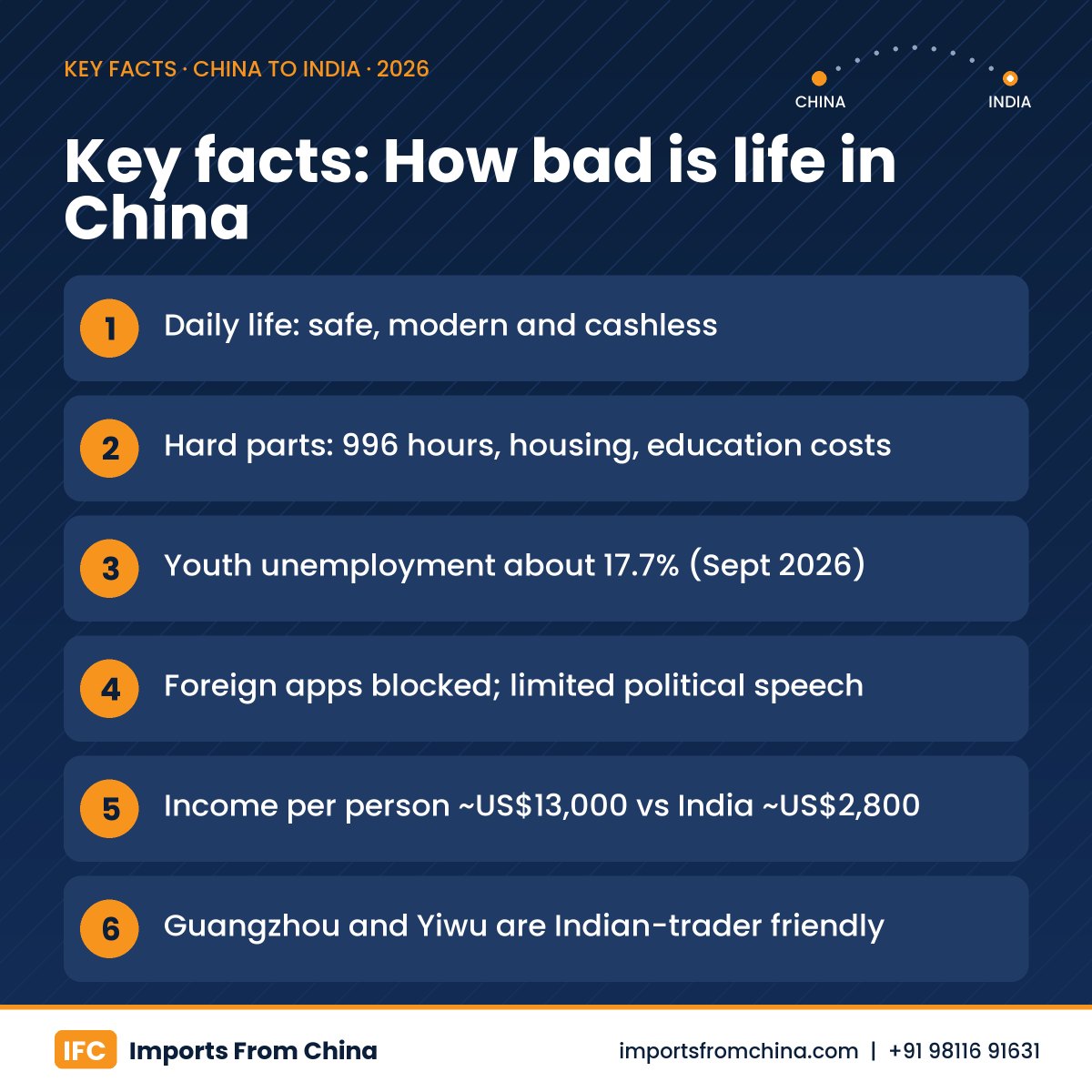
How bad is life in China? For most people it is not “bad”, but it is demanding. Daily life is safe, convenient and modern: fast trains, cashless payments, instant delivery and clean cities. The hard parts are long working hours, high housing and education costs in big cities, tough competition for young graduates, internet restrictions and limited freedom of political expression. Life is much easier for the well-educated urban middle class than for migrant workers and rural families.
IFC’s founder, CA Mayank Dang, has lived and worked in China and speaks Mandarin, and IFC has run offices in Guangzhou and Yiwu for years. This is a balanced, practical picture of everyday life in China today, and what it is like for Indians who visit or work there.
Key takeaways
- Convenience: cashless payments, food delivery, high-speed rail and efficient public services.
- Safety: low street crime; most people feel safe at night.
- Pressure: long hours (“996”), costly housing and intense competition for jobs and schools.
- Young people: youth unemployment about 17.7% (Sept 2026); many delay marriage and children.
- Restrictions: Google, WhatsApp and many foreign sites blocked; limited political expression.
- For Indians: safe and business-friendly, but language, food and apps need preparation.
What is good about life in China?
- Safety: heavy policing and CCTV mean low street crime.
- Infrastructure: the world’s largest high-speed rail network, modern metros, airports and highways.
- Convenience: almost everything is paid by phone through Alipay or WeChat; food, groceries and parcels arrive within hours.
- Cleanliness and order in most cities.
- Affordable everyday goods, especially outside the biggest cities.
What is difficult about life in China?
- Work pressure: long hours, the “996” culture (9 am to 9 pm, 6 days a week) in many private companies, and few holidays.
- Housing costs: flats in Shanghai, Beijing and Shenzhen cost many years of income, even after the property slump.
- Education pressure: the gaokao (university entrance exam) drives intense, expensive coaching from early childhood.
- Jobs for youth: youth unemployment was about 17.7% in September 2026; many graduates take jobs below their skills.
- Hukou system: household registration rules can limit migrant workers’ access to city schools and services.
- Internet and speech: foreign apps and sites are blocked, and criticism of the government is restricted.
- Ageing families: many only children support two parents and four grandparents.
How difficult is life in mainland China now (2026)?
Life has become harder for many families since the pandemic. The property slump has reduced household wealth, salaries are growing more slowly, and young people face a tough job market. Marriages fell 7.5% in the first half of 2026 and births hit a record low of 7.92 million in 2025, partly because young people feel financially insecure. At the same time, incomes are still far higher than a generation ago, and China’s cities remain among the most modern in the world. See how bad is China’s economy right now.
Life in China vs India: quick comparison
| Aspect | China | India |
|---|---|---|
| Income per person | Roughly US$13,000 | Roughly US$2,700–2,900 |
| Infrastructure | Very advanced | Improving fast |
| Street safety | Very high | Varies by city |
| Work hours | Long in private sector | Long in many sectors |
| Digital payments | Alipay / WeChat Pay everywhere | UPI everywhere |
| Internet freedom | Many foreign sites blocked | Open internet |
| Political freedom | Limited | Democratic, free press |
| Population trend | Ageing and shrinking | Young and growing |
What is life like for Indians in China?
- Business-friendly: Guangzhou and Yiwu have large communities of Indian traders and buyers.
- Language: English is limited outside hotels and big companies; translation apps and local staff help a lot.
- Food: vegetarian food takes planning, but Indian restaurants exist in Guangzhou, Yiwu, Shanghai and Beijing.
- Apps and payments: set up WeChat, Alipay and a roaming plan before travel.
- Visas: tourist visas for Indians resumed in 2025; business visas need an invitation letter.
Planning a visit? Read how safe is China for Indian travellers and our Canton Fair guide.
How IFC helps Indian businesses in China
IFC (Imports From China) has worked in China–India imports for 20+ years, since 2004, and has served 5000+ Indian businesses. Our own offices in Guangzhou and Yiwu help Indian buyers with sourcing, supplier verification, quality inspection, shipping and customs clearance, door to door. Check your landed cost on the IFC shipment calculator or call +91 98116 91631.
Frequently asked questions
How bad is life in China really?
Daily life is safe, modern and convenient, but many people face long working hours, costly housing and education, a tough job market for young people, and restrictions on internet use and political expression.
Is life in China better than in India?
Average incomes and infrastructure are higher in China, and cities are very safe. India offers more political and internet freedom, a younger population and faster growth. Which is better depends on what you value.
Why is life difficult for young people in China?
Youth unemployment was about 17.7% in September 2026, housing is expensive, and work pressure is high. Many young people delay marriage and children.
Is it easy for Indians to live or do business in China?
It is safe and business-friendly, especially in Guangzhou and Yiwu, but you need to prepare for the language, vegetarian food, blocked apps and mobile payments.
Can foreigners use WhatsApp and Google in China?
Not on local Chinese networks. International roaming or a roaming eSIM usually works. Local life runs on WeChat and Alipay.
Comments for this post are closed.