






What Is Life Really Like in China for an Indian? Is It as Bad as People Say? (2026)
What is life really like in China for an Indian? Safer, more convenient and more business-friendly than most Indians expect. Street crime is rare, phones replace wallets, trains run at 300 km/h, and Indian traders are valued customers in Guangzhou and Yiwu. The hard parts are the language, vegetarian food, blocked apps like Google and WhatsApp, long working hours and business fraud. China is not as bad as social media shows, and not as perfect as some travel vlogs claim.
I have lived and worked in China, I speak Mandarin, and for 20+ years my company IFC has run offices in Guangzhou and Yiwu, hosting thousands of Indian buyers. Here is an honest, first-hand picture for Indian businessmen, visitors and anyone curious.
Key takeaways
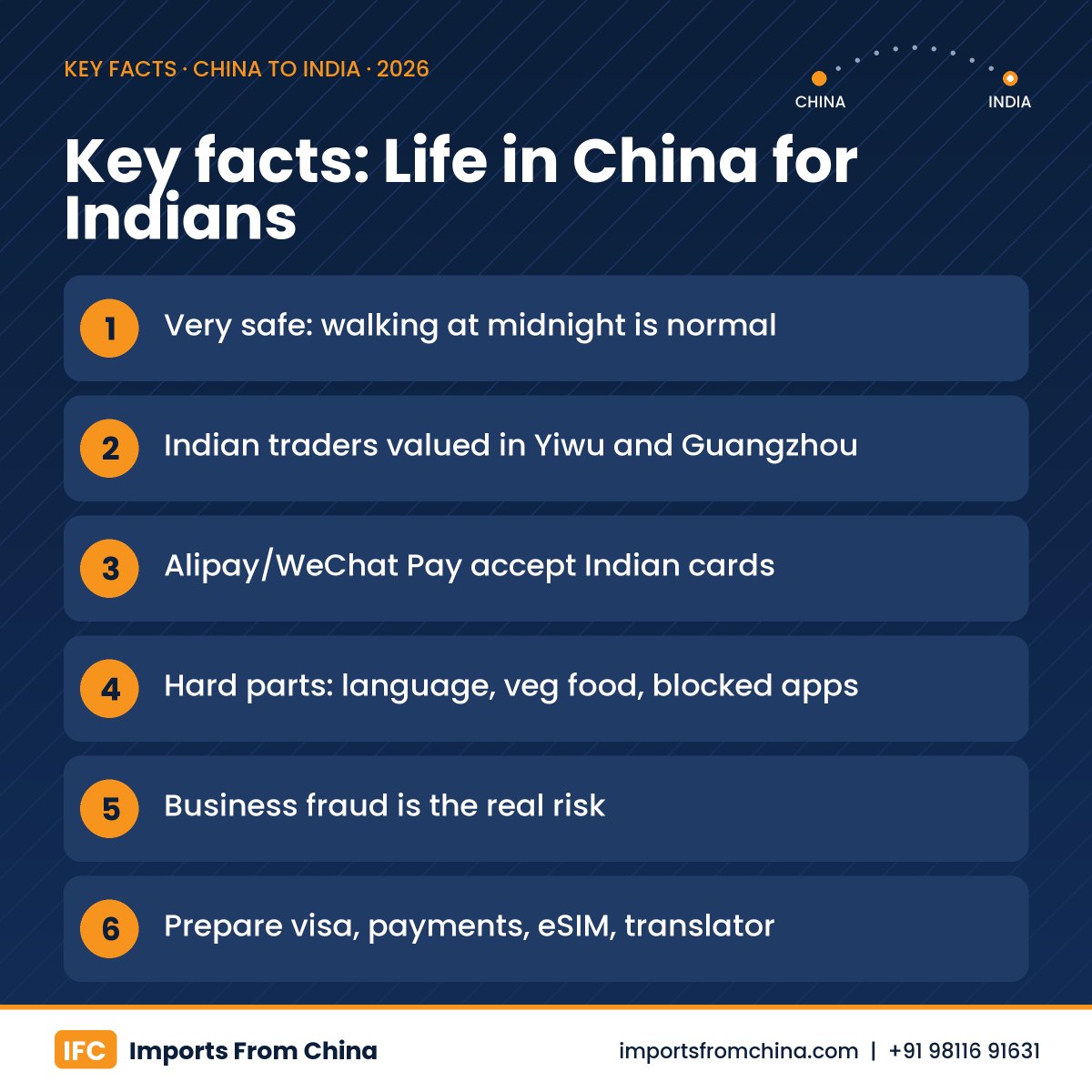
- Safety: one of the safest places to live; walking alone at midnight in Guangzhou or Yiwu is normal.
- Indian traders: valued customers in Yiwu and Guangzhou, with Indian restaurants nearby.
- Payments: Alipay and WeChat Pay accept Indian Visa/Mastercard.
- Hard parts: language, vegetarian food, blocked apps, long hours and business fraud.
- Chinese society: comfortable daily life, but young people face job and housing pressure.
- Prepare: business visa, mobile payments, roaming/eSIM, translator, verified suppliers.
The surprising good parts of life in China
- Safety: China is one of the safest places I have lived. Walking alone at midnight in Guangzhou or Yiwu is completely normal.
- Respect for Indian traders: in Yiwu and Guangzhou, Indian buyers are valued customers. Many shopkeepers know a few Hindi words, and Indian restaurants are easy to find.
- Convenience: your phone is your wallet. Alipay and WeChat Pay now accept Indian Visa and Mastercard cards, and food or parcels arrive within an hour.
- Infrastructure: high-speed trains at 300 km/h, spotless metros and airports that feel like malls.
- Business speed: you can visit a factory in the morning, approve a sample in the afternoon and ship a container within a few weeks.
The genuinely hard parts
- Language: outside hotels and big companies there is very little English. A translation app and a local contact are essential.
- Food: pure vegetarian food takes planning. Many dishes use meat stock or lard, even when they look vegetarian.
- Apps: Google, WhatsApp, Instagram and YouTube are blocked on local networks. Life runs on WeChat, or you keep Indian roaming on.
- Work culture: Chinese suppliers work very long hours and expect fast replies, even on Sundays.
- Business risk: the country is safe, but business fraud is real: fake factories, bait-and-switch samples and “change of bank account” emails. Never pay 100% advance to an unverified supplier. Read how to avoid China supplier scams.
Life in China for an Indian: quick comparison with home
| Aspect | In China | Tip for Indians |
|---|---|---|
| Safety | Very high | Still carry your passport and use official taxis |
| Payments | Almost cashless | Set up Alipay / WeChat Pay with your card before you fly |
| Internet | Google, WhatsApp blocked locally | Use Indian roaming or a roaming eSIM |
| Food | Meat-heavy cuisine | Use Indian restaurants in Guangzhou, Yiwu, Shanghai |
| Language | Little English | Translation app + local contact |
| Business | Very fast, very competitive | Verify suppliers and inspect before final payment |
Is life bad for the Chinese themselves?
Not bad, but under pressure. Housing in big cities costs many years of income, youth unemployment was about 17.7% in September 2026, and births fell to a record low of 7.92 million in 2025 as young people delay marriage. Daily life is comfortable; the future feels uncertain for many young people. More in how bad is life in China and China’s economy vs India.
My honest verdict for Indians
China is not as bad as social media shows, and not as perfect as some travel vlogs claim. For an Indian businessman it is one of the best places in the world to learn how manufacturing works, and to find products for your business back home.
5 things to prepare before your first China trip
- Business (M) visa with an invitation letter from a Chinese company or the Canton Fair.
- Alipay and WeChat Pay linked to your international card, plus some yuan in cash.
- Indian international roaming or a roaming eSIM, and WeChat installed.
- A translator or local contact for markets and factory visits.
- A verified supplier list, so you visit real factories, not just showrooms.
Planning the trip: China safety guide for Indian travellers, Canton Fair guide and Yiwu market guide.
How IFC helps Indians in China
IFC (Imports From China) has worked in China–India imports for 20+ years, since 2004, and has served 5000+ Indian businesses. Our own offices in Guangzhou and Yiwu, with English-speaking staff and translators, help Indian buyers with market visits, factory checks, supplier verification, quality inspection, shipping and customs clearance back to India. Call +91 98116 91631 before you plan your trip.

Written by Mayank Dang (CA Sahab), Founder & CEO of IFC
Chartered Accountant (FCA, ICAI) who has lived and worked in China, speaks Mandarin, and has helped 5000+ Indian businesses import from China since 2004. mayankdang.in
Frequently asked questions
What is life like in China for an Indian?
Safe, convenient and business-friendly. Street crime is rare, payments are mobile, and Indian traders are welcome in Guangzhou and Yiwu. The challenges are language, vegetarian food, blocked apps and long working hours.
Is China safe for Indians?
Yes. China is generally very safe, including at night in cities like Guangzhou and Yiwu. The main risk for Indian businessmen is supplier fraud, not physical danger.
Can Indians get vegetarian food in China?
Yes, but it takes planning. Many Chinese dishes use meat stock or lard. Indian restaurants are common in Guangzhou, Yiwu, Shanghai and Beijing.
Do WhatsApp and Google work in China?
Not on local Chinese networks. Indian international roaming or a roaming eSIM usually works. Most people in China use WeChat.
Is China a good place for Indian businessmen?
Yes. It is one of the best places to find products and factories, from small commodities in Yiwu to electronics in Shenzhen, as long as you verify suppliers and inspect goods before final payment.
Comments for this post are closed.