







How Bad Is China’s Economy Right Now? Property, Business, Birth Rate & Economy vs India (2026)
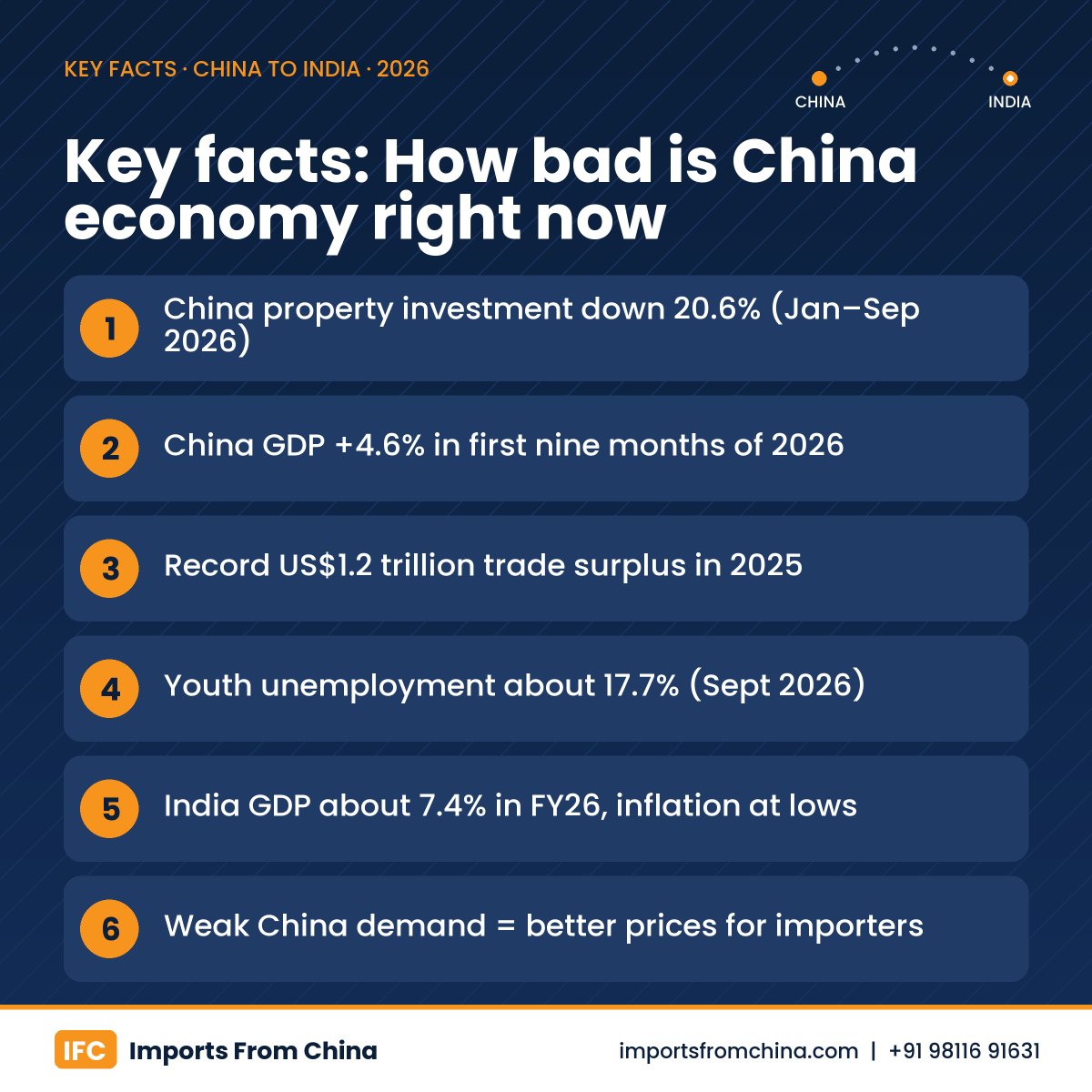
How bad is China’s economy right now? China is not collapsing, but it is clearly weaker at home than before. Its property sector is in a long slump, with real-estate investment down 20.6% in January–September 2026 and new home prices falling for more than three years. Consumer spending is soft and youth unemployment is around 17.7%. Yet GDP still grew 4.6% in the first nine months of 2026, driven by record exports and factories. India is growing faster, at about 7.4% in FY 2025-26, but from an economy roughly a quarter of China’s size.
This article compares China and India on three fronts: property, business and the overall economy, using the latest 2026 data, and explains what it means for Indian businesses that buy from China.
Key takeaways
- Property: China’s real-estate investment fell 20.6% in Jan–Sep 2026; new construction fell 24.9%.
- Growth: China grew 4.5% in Q3 2026 and 4.6% in the first nine months, within its 4.5–5% target.
- Exports: China posted a record US$1.2 trillion trade surplus in 2025, and exports kept rising in 2026.
- Consumers: retail sales grew only 2.6% in Jan–Sep 2026; youth unemployment about 17.7% in September.
- India: fastest-growing major economy: about 7.4% GDP growth in FY26 with inflation at historic lows.
- Demographics: births fell to a record-low 7.92 million in 2025 and marriages dropped 7.5% in H1 2026; the population is shrinking and ageing.
- For importers: weak demand at home makes Chinese factories hungry for export orders, so buyers get better prices.
How bad is China’s property crisis?
Property was once about a quarter of China’s economy when related industries are included. Since developers such as Evergrande and Country Garden ran into debt trouble from 2021, the sector has shrunk year after year.
| Indicator (China, 2026) | Latest data |
|---|---|
| Real-estate development investment, Jan–Sep 2026 | Down 20.6% year on year |
| New construction starts, Jan–Sep 2026 | Down 24.9% |
| New home prices | Fell again in September 2026, extending a slump of more than three years |
| Household impact | Most household wealth is in property, so falling prices hurt spending |
India’s housing market, by contrast, has been in an upcycle since 2021, with strong demand in major cities, although affordability is a growing concern. The key difference: Indian property is driven by first-time buyers and urbanisation, while China has a large stock of unsold and empty homes.
How are Chinese businesses doing?
- Factories are strong: industrial output grew 5.3% in the first three quarters of 2026.
- Exports are booming: China recorded a record US$1.2 trillion trade surplus in 2025, despite US tariffs, and kept growing exports in 2026.
- Overcapacity: in steel, solar panels, EVs, batteries and many consumer goods, China produces far more than it can sell at home, so it pushes exports and cuts prices.
- Price wars: heavy competition squeezes factory profits, especially in autos, solar and e-commerce.
- Private sector caution: fixed-asset investment fell 7.2% in Jan–Sep 2026 as businesses held back.
China vs India economy: 2026 comparison
| Indicator | China | India |
|---|---|---|
| GDP size | About US$19 trillion | About US$4 trillion |
| Real GDP growth | 4.6% (Jan–Sep 2026); target 4.5–5% | About 7.4% in FY 2025-26; 6.8–7.2% projected for FY27 |
| Inflation | Near zero, with deflation pressure | Historic lows (about 1.7% average in Apr–Dec 2025) |
| Property | Long slump, investment down 20.6% | Upcycle in major cities |
| Consumer demand | Weak: retail sales +2.6% (Jan–Sep 2026) | Strong domestic demand |
| Youth unemployment | About 17.7% (Sept 2026, ages 16–24 excl. students) | A challenge, measured differently |
| Manufacturing share of world | Nearly 32% | About 3.2% |
| Trade | Record surplus (US$1.2 trillion in 2025) | Trade deficit, including about US$99 billion with China in FY25 |
Falling marriages and births: China’s demographic crisis
Beyond property and jobs, China’s biggest long-term problem is people. Fewer young Chinese are marrying, fewer babies are being born, and the population is shrinking and ageing fast.
| Indicator | Latest data |
|---|---|
| Births in 2025 | 7.92 million, the lowest on record (birth rate 5.63 per 1,000) |
| Deaths in 2025 | 11.31 million |
| Population change 2025 | Down 3.39 million to 1.405 billion, the fourth straight yearly fall |
| Marriages | About 13.5 million at the 2013 peak; 6.1 million in 2024; 6.76 million in 2025 after a small rebound |
| Marriages, first half of 2026 | 3.275 million, down 7.5% year on year; divorces up 3.9% |
| People aged 60+ | 23% of the population (323 million) |
Why young Chinese don’t want to marry or have children
- High costs: housing, education and childcare are very expensive, especially in big cities; a bride price and buying a flat are often expected before marriage.
- Job insecurity: with youth unemployment near 17–18%, many young people delay marriage until they feel financially stable.
- Long working hours: the “996” culture (9 am to 9 pm, 6 days a week) leaves little time for family life.
- Changing values: more educated women are choosing careers and independence; “lying flat” (tang ping) reflects a wider rejection of the pressure to marry, buy property and raise children.
- Legacy of the one-child policy: decades of small families and a gender imbalance mean fewer potential couples.
How the government is fighting back
- Childcare subsidy: a national subsidy of 3,600 yuan per year for each child under three, introduced in 2025.
- Free preschool: the final year of kindergarten made free from autumn 2025, benefiting about 24 million children.
- Childbirth costs: a push for no out-of-pocket costs for childbirth from 2026.
- Easier marriage registration: since 2025, couples can register their marriage anywhere in the country, not only in their home town.
- Later retirement: the retirement age is being raised gradually from 2025 to keep older workers in the labour force.
So far, these incentives have produced only small changes. Marriages rose slightly in 2025 but fell again in the first half of 2026, and births kept falling.
What this means for China’s labour force vs India’s
China’s working-age population (16–59) was about 851 million in 2025, or 60.6% of the population, and it is shrinking every year as fewer young people enter work and more retire. That means rising wages, labour shortages in factories and more automation and robots. India is on the opposite path: a median age of roughly 28–29 years and a working-age population that will keep growing for years. This demographic dividend is one of India’s biggest advantages, but only if young Indians get skills and manufacturing jobs.
For Indian importers: China will keep making things competitively for years thanks to automation and scale, but labour-intensive products (garments, footwear, simple assembly) are slowly becoming costlier there. That is an opening for Indian manufacturing, and a reason to watch prices and diversify suppliers.
So, is China’s economy really in trouble?
China’s domestic economy is in a difficult phase: falling property, weak consumers, low prices and fewer jobs for young graduates. But its industrial and export machine is stronger than ever, and the government still has room to support growth. It is a slowdown, not a collapse.
India is the brighter growth story, with faster GDP growth, low inflation and rising domestic demand. But China’s economy is about five times bigger, and India still relies on China for electronics, machinery, chemicals and components. See what India imports from China.
What China’s slowdown means for Indian importers
- Better prices: with weak home demand and overcapacity, many Chinese factories accept lower prices and smaller orders from Indian buyers.
- More negotiating power: MOQs, payment terms and samples are easier to negotiate.
- Watch supplier health: some factories are under financial stress, so verify suppliers and avoid 100% advance payments. Read how to avoid supplier scams.
- Anti-dumping risk: cheap Chinese goods attract more Indian anti-dumping duties, so check before ordering. See anti-dumping duty on Chinese goods.
- Machinery opportunity: Indian manufacturers can buy Chinese machines and inputs at good prices to grow local production.
How IFC helps Indian businesses source smartly from China
IFC (Imports From China) has worked in China–India imports for 20+ years, since 2004, and has served 5000+ Indian businesses. From our own offices in Guangzhou and Yiwu we track factory conditions on the ground, verify suppliers, negotiate prices, inspect quality and ship door to door with customs clearance. Check your landed cost on the IFC shipment calculator or call +91 98116 91631.
Frequently asked questions
How bad is China’s economy right now?
China is in a domestic slowdown, not a collapse. Property investment fell 20.6% in January to September 2026, consumer spending is weak and youth unemployment is about 17.7%, but GDP still grew 4.6% in the first nine months of 2026 thanks to strong exports and factories.
Is China’s property market still falling?
Yes. Real-estate development investment fell 20.6% in January to September 2026, new construction fell 24.9%, and new home prices kept falling in September 2026, extending a slump of more than three years.
Is India’s economy growing faster than China’s?
Yes. India grew about 7.4% in FY 2025-26, while China grew 4.6% in the first nine months of 2026. But China’s economy is still about five times larger.
Why are Chinese exports still strong if the economy is weak?
Weak demand at home and overcapacity push Chinese factories to sell abroad. China posted a record US$1.2 trillion trade surplus in 2025 and kept growing exports in 2026.
Is now a good time for Indian businesses to import from China?
Prices and terms are often favourable because Chinese factories need export orders. But verify suppliers carefully, avoid full advance payments and check anti-dumping duty before ordering.
Comments for this post are closed.