





Cost to Start an Import Business from China to India: ₹ Budget Guide (2026)
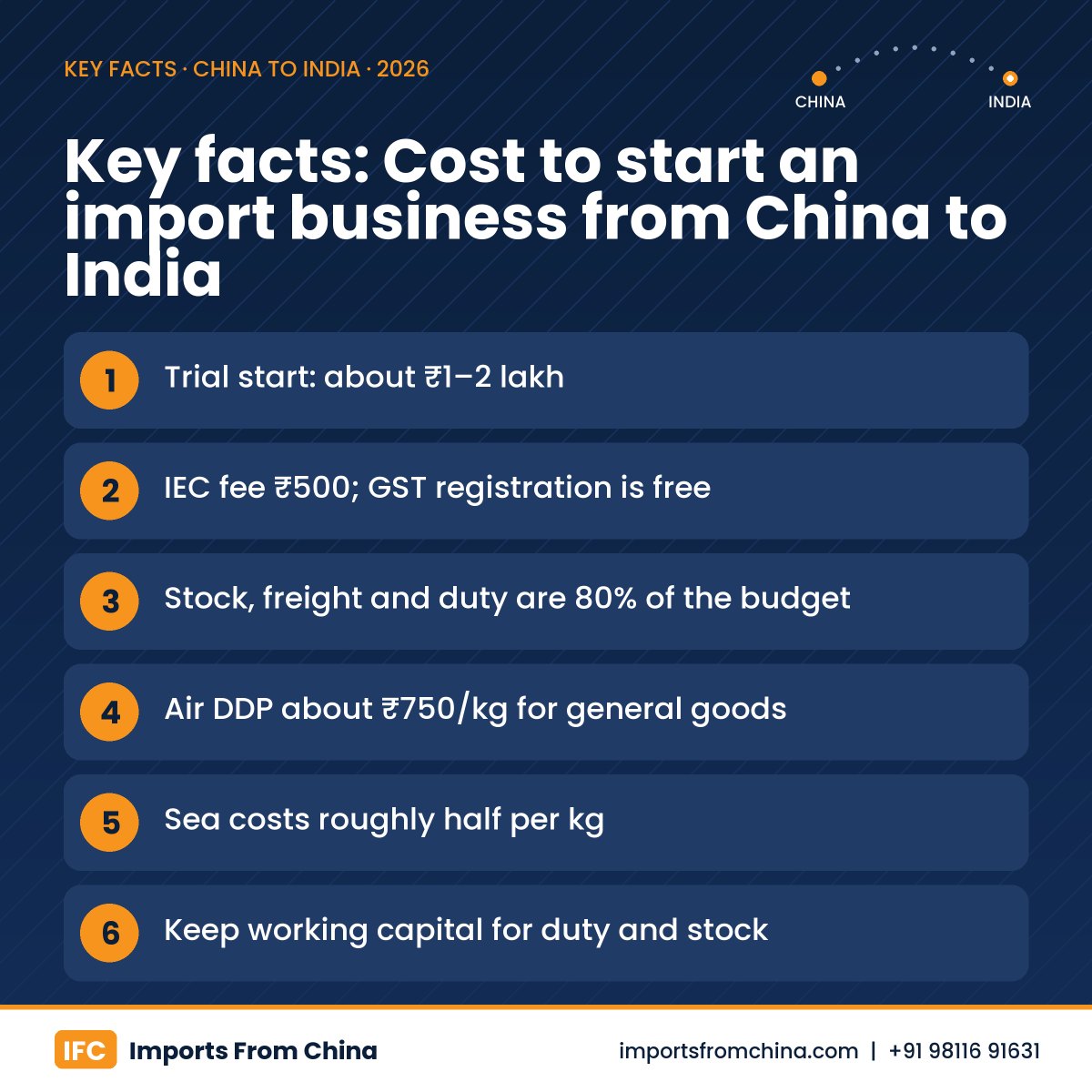
How much does it cost to start an import business from China to India? You can start with about ₹1–2 lakh: roughly ₹500 for an IEC, a free GST registration, ₹10,000–20,000 for samples, and ₹75,000–1.5 lakh for a first 50–100 kg trial stock shipped door to door. A serious trading start with sea cargo needs about ₹5–10 lakh, mostly for stock and working capital.
This guide breaks down every cost in rupees: registrations, product cost, freight, duty, checks and working capital, with three sample budgets.
Key takeaways
- Registrations are cheap: IEC costs ₹500; GST registration is free on the GST portal.
- Stock is the main cost: product cost plus freight and duty usually take 80% of the budget.
- Start with a trial: test 50–100 kg by air DDP before ordering a container.
- Plan for duty: duty can add 20–45% of the goods value depending on the HS code.
- Keep working capital: new importers often run out of cash between paying the supplier and getting paid.
- Check before you pay: use the IFC shipment calculator for the full landed cost.
What registrations do you need, and what do they cost?
| Registration | Needed for | Indicative cost |
|---|---|---|
| GSTIN | Selling in India, claiming IGST credit | Free on the GST portal |
| IEC (Import Export Code) | Commercial imports | ₹500 government fee on DGFT |
| Business entity | Proprietorship (simplest), LLP or company | Proprietorship: no separate fee; company/LLP: roughly ₹7,000–20,000 with professional fees |
| Current bank account | Payments to China | Bank charges as applicable |
| Product approvals | BIS, WPC, FSSAI, CDSCO for some products | Product-specific; check before ordering |
If you do not want your own IEC at the start, an import agent can import on its IEC under DDP terms. Compare both in agent IEC vs your own IEC.
What does the first shipment cost?
Your landed cost has five parts: product price + China-side charges + international freight + Indian duty and IGST + clearance and delivery. With DDP shipping, the last four come as one per kg price.
| Cost item | Typical amount |
|---|---|
| Samples (3–5 suppliers, courier) | ₹10,000–20,000 |
| Supplier check | Remote factory audit about ₹1,500; physical factory visit ₹15,000–25,000 |
| Air DDP freight + duty + clearance (general goods, 50 kg+) | About ₹750/kg |
| Air DDP for battery, liquid, cosmetic, magnet or high-value goods | About ₹1,350/kg |
| Sea DDP | Roughly half the air rate; ₹50–150/kg above 5,000 kg |
Three sample budgets for a China import business
| Budget | What it buys | Best for |
|---|---|---|
| ₹1–2 lakh (trial) | Samples + 50–100 kg of stock by air DDP | Testing a product, Amazon/Flipkart trial, local shops |
| ₹5–10 lakh (small trader) | 300–1,000 kg of stock, mostly by sea, with a quality check | Retailers, B2B suppliers, e-commerce sellers |
| ₹20 lakh+ (growth) | LCL or FCL shipments, several products, own brand | Wholesalers, brands, interior and project businesses |
Worked example: a ₹2 lakh first import
- Samples from 3 suppliers: ₹15,000
- Remote factory audit of the chosen supplier: ₹1,500
- Goods: 100 kg of home and kitchen items worth about ₹55,000
- Air DDP door to door at about ₹750/kg: ₹75,000 (freight, duty and clearance included for general goods under ₹2,000/kg)
- Buffer for packaging, listing and marketing: about ₹5,000
Total: about ₹2 lakh. If those goods sell at 2x to 2.5x the landed cost, the trial pays for itself and shows whether to scale by sea. Read Is importing from China profitable?
Hidden costs new importers forget
- Duty differences by HS code (from 0% to 70% BCD).
- BIS testing for notified products.
- Storage and demurrage if documents are wrong.
- Returns and damaged pieces.
- Currency changes between order and payment. See how to pay Chinese suppliers.
- Marketplace fees and advertising when you sell.
How to start an import business from China: step by step
- Pick a product you can sell and check its HS code and compliance.
- Register GST and IEC (or use an agent’s IEC).
- Order samples and verify the supplier.
- Calculate landed cost on the IFC shipment calculator.
- Ship a trial order by air DDP.
- Scale the winners by sea.
More detail: how to start importing from China to India.
How IFC helps new importers start small
IFC (Imports From China) has worked in China–India imports for 20+ years, since 2004, and has served 5000+ Indian businesses. From our own offices in Guangzhou and Yiwu we help first-time importers with sourcing, supplier checks, quality inspection, consolidated air and sea shipping, customs clearance and door-to-door DDP delivery, so even a 50 kg trial order is simple.
Conclusion
Starting an import business from China does not need crores. Registrations cost very little; the real budget is stock, freight and duty. Start with a ₹1–2 lakh trial, prove the product sells, keep cash for working capital, and scale by sea once demand is clear.

Guide reviewed by Mayank Dang (CA Sahab), Founder & CEO of IFC
Chartered Accountant (FCA, ICAI) who has helped 5000+ Indian businesses import from China since 2004 – sourcing, BIS, HSN classification, import duty, customs and GST compliance. mayankdang.in
Get your real landed cost: enter your product, weight and CBM in the IFC shipment calculator, check your HS code on the India import duty rates page, or call IFC on +91 98116 91631 for a door-to-door DDP quote from China to your city.
Frequently asked questions
How much money do I need to start importing from China to India?
A trial import can start at about ₹1–2 lakh, covering samples and 50–100 kg of stock by air DDP. A small trading business usually needs ₹5–10 lakh for stock, sea freight, duty and working capital.
What is the cost of an IEC in India?
The government fee for an Import Export Code on the DGFT website is ₹500. GST registration is free.
Can I start importing without an IEC?
For commercial imports you need an IEC, or you can import through an agent that imports on its own IEC under DDP terms.
What is the biggest cost in an import business?
Stock is usually the largest cost, followed by freight and customs duty. Duty depends on the HS code and can add 20–45% of the goods value for many consumer products.
Should I start with air or sea shipping?
Start with a small air DDP trial to test the product quickly, then move repeat orders to sea, which costs roughly half per kg.
Comments for this post are closed.