





Import Robots from China to India: Duty, Landed Cost (2026 Guide)
Yes, you can import robots from China to India legally, and most robots need no import licence. Industrial robot arms and service robots pay about 7.5% basic customs duty plus 18% IGST, while robot toys pay about 70% duty and need a BIS licence. Your real cost is the landed cost: price + freight + duty + GST + clearance.
This 2026 guide covers every kind of robot Indian buyers ask us about: 6-axis robotic arms for factories, collaborative robots (cobots), warehouse robots, humanoid and “servant” service robots for hotels, restaurants and homes, robot vacuum cleaners and robot toys for kids. You will learn the HS code and duty for each, the BIS and WPC rules, how to calculate landed cost with the IFC shipment calculator, how big this industry will become in the next 10 years, and the honest answer to the big question: will robots take our jobs?
Key takeaways
- Free to import: industrial and service robots are “Free” under India’s import policy. You need an IEC and GSTIN, not a special licence.
- Duty depends on the robot: robotic arms (HS 8479 50 00) and most service robots pay about 7.5% BCD + 10% SWS + 18% IGST. Robot toys (HS 9503 00 10) pay 70% BCD + 18% IGST.
- Compliance matters: robot toys need a BIS licence (ISI mark), robot vacuums need BIS, and anything with Wi-Fi or Bluetooth needs a WPC ETA.
- China leads the world: China installed 59% of all new factory robots in 2025, and Chinese companies make over 80% of the world’s humanoid robots.
- Landed cost is the real price: a USD 15,000 robotic arm costs about Rs 19 lakh at your door, of which about Rs 3 lakh is GST you can claim back.
- Jobs will change, not vanish: the World Economic Forum expects 170 million jobs created and 92 million displaced worldwide by 2030, a net gain of 78 million.
Can you import robots from China to India?
Yes. India does not ban or restrict robots. Any business with an Importer Exporter Code (IEC) and a GST number can import them. What changes from product to product is the HS code, the duty rate and the product-safety rules. Before you place an order, put your robot in one of these groups:
- Industrial robotic arms: 4-axis and 6-axis arms for welding, painting, palletising, CNC loading and packing.
- Collaborative robots (cobots): lighter arms that work safely next to people. Popular with MSMEs because they are easy to program.
- Warehouse and logistics robots: AGVs and AMRs that move pallets and trolleys, plus sorting robots for e-commerce.
- Humanoid and service robots (“robot servants”): waiter robots for restaurants, reception robots for hotels and showrooms, cleaning robots, and the new generation of small humanoids used for research, education and demos.
- Home robots: robot vacuum cleaners, floor-mopping robots, pool and window cleaning robots.
- Robot toys and STEM kits: remote-control robots, transforming robots and programmable kits for children.
Why buy robots from China?
China is now the factory of the robot world. According to the International Federation of Robotics (IFR) World Robotics 2026 report, China installed 354,000 industrial robots in 2025, which is 59% of all new installations in the world, and Chinese brands now supply more than half of their own home market. In humanoid robots, Chinese makers such as AgiBot and Unitree together held more than half of global installations in 2025.
Prices have fallen fast. Unitree’s R1 humanoid was launched at about USD 5,900 and its bigger G1 model sells for above USD 13,000. Chinese cobots and robot arms are often 30–50% cheaper than European or Japanese brands for similar payloads. For an Indian MSME, that is the difference between “too expensive” and “pays back in two years”.
What is the HS code and import duty on robots in India?
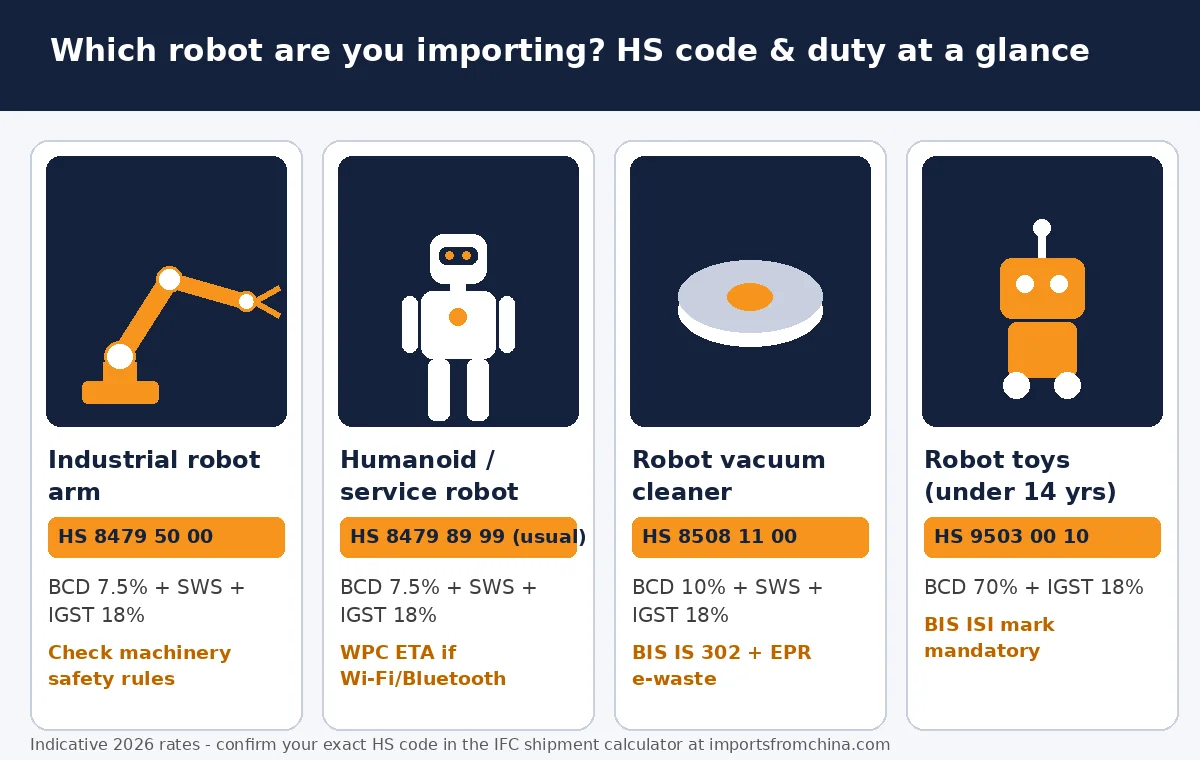
Customs duty in India has three parts: Basic Customs Duty (BCD), Social Welfare Surcharge (SWS, 10% of BCD where it applies) and IGST. IGST is charged on the CIF value plus BCD plus SWS, and GST-registered importers can claim it back as input tax credit. Here are the usual codes for robots imported from China:
| Robot type | Usual HS code | BCD | SWS | IGST | Key compliance |
|---|---|---|---|---|---|
| Industrial robot arm / cobot | 8479 50 00 | 7.5% | 10% of BCD | 18% | Check machinery safety rules, CE/test reports |
| Humanoid / service / waiter robot | 8479 89 99 (if no specific heading fits) | 7.5% | 10% of BCD | 18% | WPC ETA if Wi-Fi/Bluetooth; lithium battery papers |
| Robot vacuum cleaner | 8508 11 00 | 10% | 10% of BCD | 18% | BIS (IS 302), WPC ETA, EPR e-waste |
| Electronic robot toys | 9503 00 10 | 70% | Nil | 18% | BIS licence + ISI mark (mandatory) |
Classification is where many first-time importers lose money. A robot that is “for industry” in the supplier’s catalogue can still be classified differently by customs if it has a specific function, for example a robot that is really a vacuum cleaner or a toy. Always describe the function, power, controller and use clearly on the invoice. You can check codes on our Know Your HSN Code page, the HS 8479 89 99 duty page and the electronic toys HS 9503 00 10 page. For the official tariff, see CBIC.
Which licences and certificates do you need to import robots?
- IEC and GSTIN: needed for every commercial import. The Bill of Entry is filed on ICEGATE in your name.
- BIS licence for robot toys: under the Toys Quality Control Order, every toy for children under 14 must carry the ISI mark. The Chinese factory must hold a BIS licence under the Foreign Manufacturers Certification Scheme (IS 9873 for toy safety and IS 15644 for electric toys). Without it, customs will not release the goods. Read our full guide to importing toys from China.
- BIS for household robots: robot vacuum cleaners and many home appliances fall under BIS rules, and power adapters or chargers sold with the robot may need BIS CRS registration. Check the latest list on bis.gov.in.
- WPC Equipment Type Approval (ETA): any robot with Wi-Fi, Bluetooth or another radio module needs an ETA from the WPC wing of the Department of Telecommunications.
- Lithium battery documents: most service robots, humanoids and robot toys run on lithium batteries. Ask the supplier for the MSDS and UN38.3 test report. Air cargo with batteries is shipped as special cargo and costs more.
- EPR for e-waste: electronic robots sold in India may need Extended Producer Responsibility registration with the CPCB.
- Used or refurbished robots: second-hand robot arms are popular, but carry a chartered engineer certificate showing the year of make, residual life and fair value, and check the current DGFT policy before you buy.
How to calculate the landed cost of robots imported from China
Landed cost is the total cost of the robot when it reaches your factory or shop. The formula used by Indian customs is simple:
- CIF value = supplier price (FOB) + international freight + insurance, converted to rupees at the customs exchange rate.
- BCD = CIF value × BCD rate.
- SWS = 10% of BCD (where it applies).
- IGST = (CIF + BCD + SWS) × IGST rate.
- Landed cost = CIF + BCD + SWS + IGST + port, CHA and delivery charges.
Example 1: a 6-axis robotic arm by sea
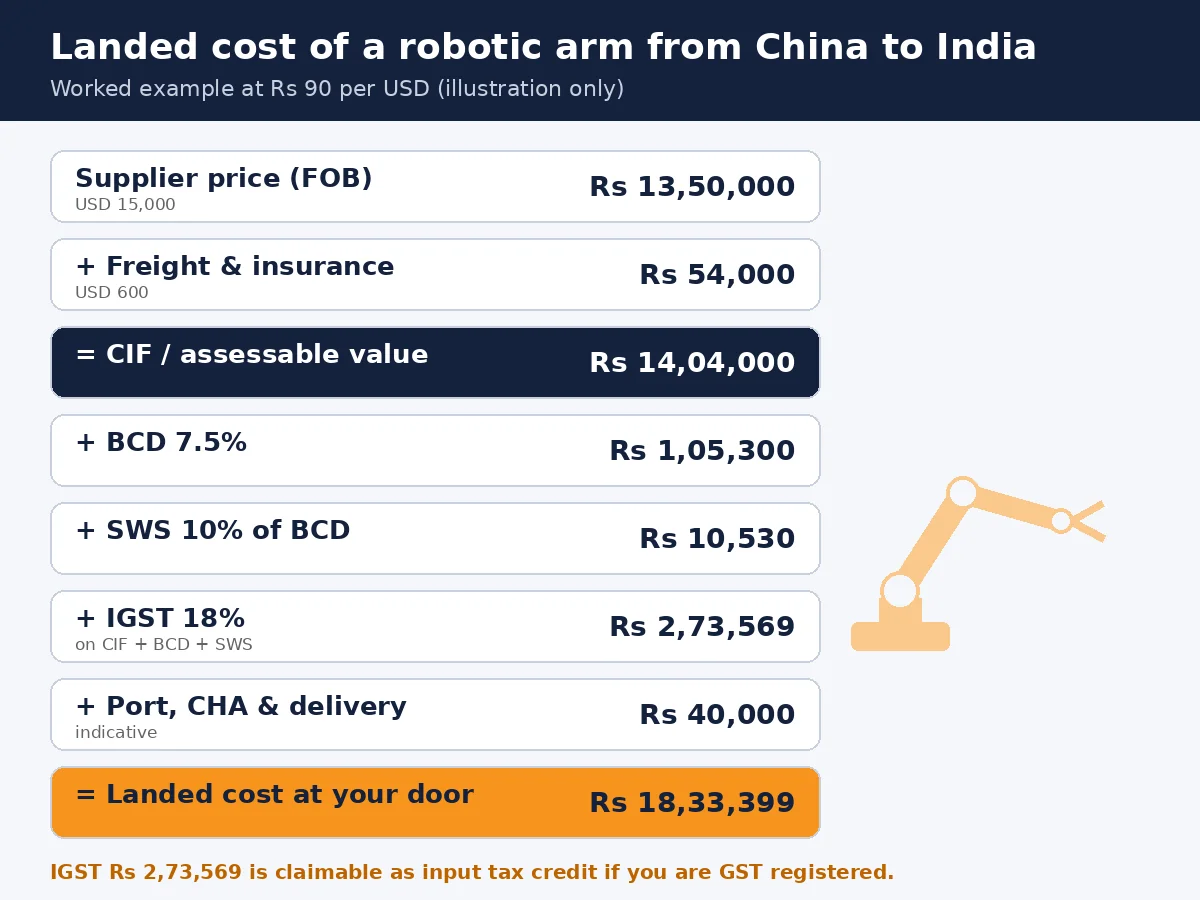
A factory in Pune buys a 6-axis welding robot with controller for USD 15,000 FOB. Sea freight and insurance add USD 600. At an illustrative rate of Rs 90 per USD, the CIF value is Rs 14,04,000. BCD at 7.5% is Rs 1,05,300, SWS is Rs 10,530 and IGST at 18% is Rs 2,73,569. With about Rs 40,000 for port, CHA and delivery, the robot lands at about Rs 18,33,399. If the factory is GST-registered, it claims back the IGST, so the real cost is close to Rs 16 lakh.
Example 2: 500 robot toys vs one humanoid robot
| Cost line | 500 electronic robot toys (sea, LCL) | 1 small humanoid robot (air) |
|---|---|---|
| Supplier price (FOB) | USD 3,000 (USD 6 each) | USD 5,900 |
| Freight + insurance | USD 300 | USD 400 (battery cargo) |
| CIF value at Rs 90/USD | Rs 2,97,000 | Rs 5,67,000 |
| BCD | 70% = Rs 2,07,900 | 7.5% = Rs 42,525 |
| SWS | Nil | Rs 4,253 |
| IGST 18% | Rs 90,882 | Rs 1,10,480 |
| Port, CHA and delivery (indicative) | Rs 25,000 | Rs 15,000 |
| Landed cost | Rs 6,20,782 (about Rs 1,242 per toy) | Rs 7,39,258 |
Look at the difference. The toy costs USD 6 in China but over Rs 1,200 at your warehouse, because 70% duty is charged on top of freight. The humanoid robot pays only 7.5% BCD. This is why the right HS code and the right product category decide whether your business makes money.
How to use the IFC shipment calculator for robots
- Open the IFC shipment calculator.
- Type the product name, for example “robotic arm” or “robot toy”. The calculator suggests the HS code and shows the BCD, SWS, IGST and any BIS rule for that code.
- Enter the invoice value from your supplier in USD, CNY or INR.
- Enter the gross weight and CBM from the supplier’s packing list. Robot arms are heavy; toys are light but bulky, so CBM matters more.
- Choose sea or air. The calculator gives a door-to-door cost sheet: freight, insurance, CIF, duty, GST and the total you pay.
- Call IFC to confirm the final quote before you pay your supplier.
Step-by-step: how to import robots from China to India safely
- Define the job, not the robot. Write the payload, reach, speed, cycle time and the task. A supplier can then suggest the right model instead of the most expensive one.
- Shortlist and verify suppliers. Check the business licence on China’s official company registry (gsxt.gov.cn), export history and whether they are a real maker or a trader.
- Ask for test reports and a demo video of your exact model doing a task like yours. For robots with radios or batteries, ask for WPC-ready reports, MSDS and UN38.3.
- Fix after-sales support in writing: warranty, spare parts list with prices, remote support hours, software updates and English manuals. This is the most ignored step and the most expensive one to get wrong.
- Inspect before shipment. Test the robot running at the factory and check the packing, because a dropped arm loses its calibration.
- Ship and clear customs. Heavy arms usually go by sea (LCL or FCL); small service robots often go by air. Your CHA files the Bill of Entry, pays duty and gets Out of Charge. See how customs clearance works for imports in India.
- Install, train and claim GST credit. Book installation and operator training, and claim the IGST in your GST return.
How will the robotics industry grow in the next 10 years?
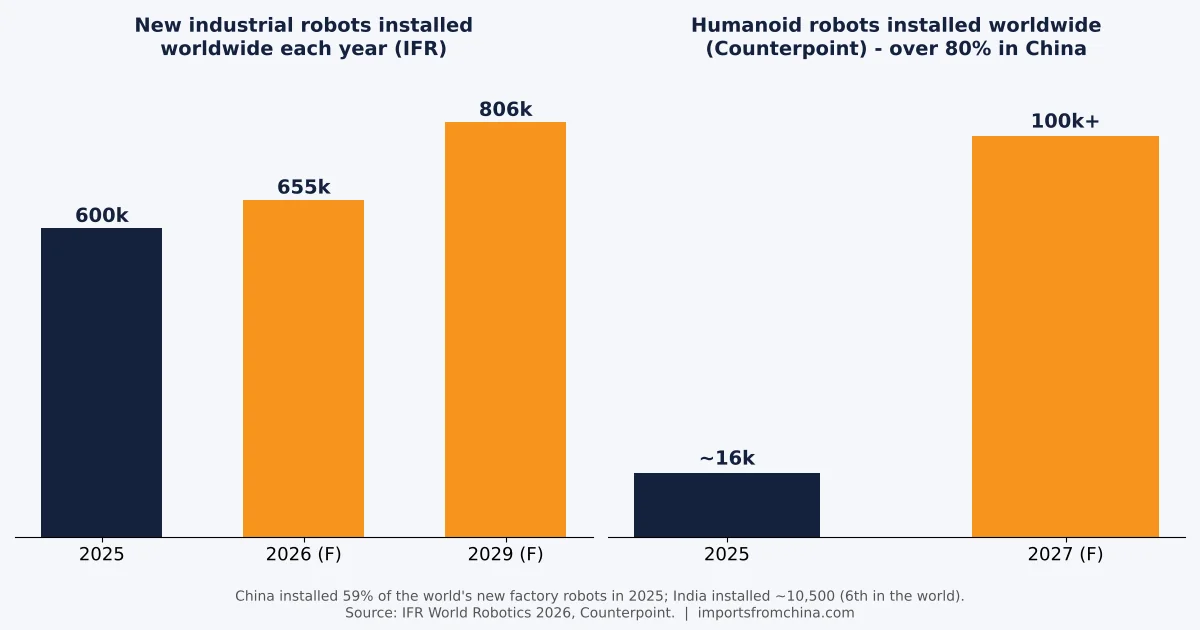
The numbers show an industry that is growing every year, with humanoids as the next big wave:
- Factory robots: more than 600,000 industrial robots were installed worldwide in 2025, and 5 million now work in factories. IFR expects 655,000 installations in 2026 and 806,000 a year by 2029.
- India is rising fast: India installed almost 10,500 industrial robots in 2025 and is now 6th in the world. Installations grew about 27% a year from 2020 to 2025, led by cars, auto parts, electronics and metal work.
- Humanoids are taking off: about 16,000 humanoid robots were installed worldwide in 2025, over 80% in China. Counterpoint Research expects more than 100,000 by 2027.
- Long-term forecasts: Goldman Sachs has estimated the humanoid robot market could reach USD 38 billion by 2035, and Morgan Stanley has projected a USD 5 trillion market by 2050. Forecasts this far ahead differ a lot, but every major study points the same way: up.
Three things drive this growth over the next decade. First, prices keep falling as Chinese factories make robots at scale. Second, AI gives robots a “brain”: robots can now see, understand spoken instructions and learn a task from a demo instead of months of coding. Third, labour is getting scarce in China, Japan, Korea and Europe because populations are ageing. India’s opportunity is to use robots to raise quality and export more, and to become a big market for robot sales, service and integration.
What changes will robots bring to the world?
- Factories: smaller “lights-out” lines that run at night, with fewer defects. Even 10–20 person MSMEs will use cobots for packing, welding and machine loading.
- Warehouses and e-commerce: robots will pick, sort and move goods, making same-day delivery cheaper.
- Hotels, restaurants and shops: waiter, reception and cleaning robots are already common in China and are arriving in Indian malls, cafés and showrooms.
- Homes and elder care: robot vacuums are just the start. Home helper robots that fold clothes, fetch items and keep an eye on elderly parents are the long-term goal of most humanoid companies.
- Healthcare: surgical robots, pharmacy robots and rehabilitation robots will spread from big city hospitals to tier-2 cities.
- Agriculture and construction: spraying drones, fruit-picking robots and bricklaying robots will take on heavy and risky work.
- Education: robot kits will make coding and engineering hands-on in schools, creating a big market for STEM robots.
Will robots take jobs in India?
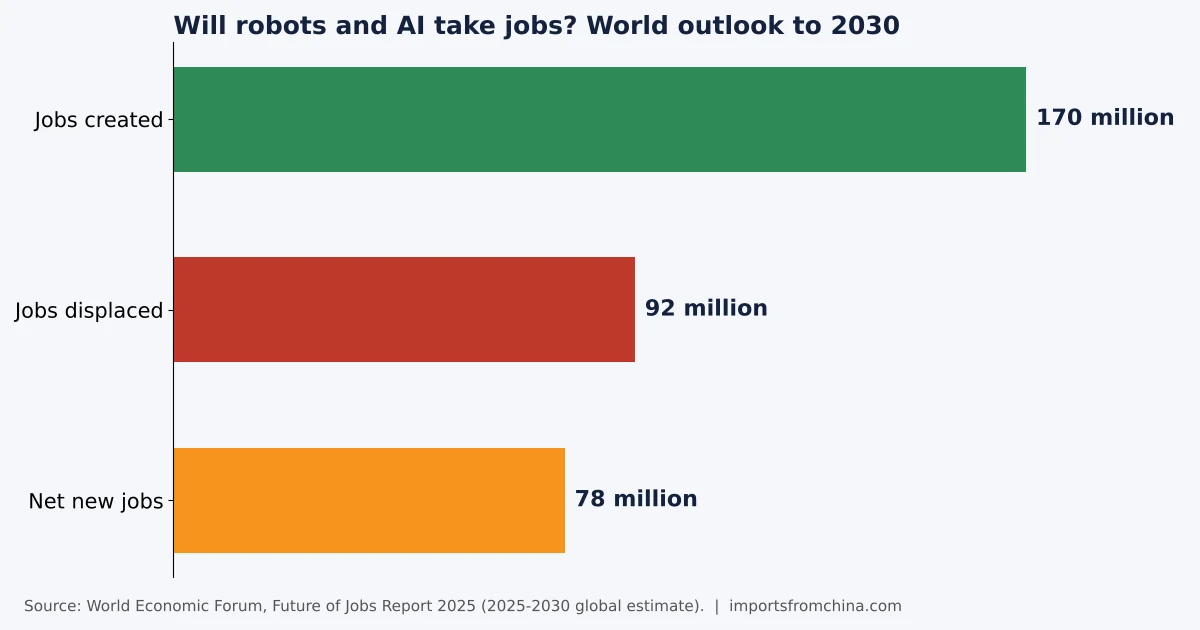
Some jobs will be affected, yes. But history and the latest data say robots and AI change jobs more than they wipe them out. The World Economic Forum’s Future of Jobs Report 2025 expects about 170 million new jobs and 92 million jobs displaced worldwide between 2025 and 2030, a net gain of 78 million jobs.
| Jobs most at risk | Jobs that will grow |
|---|---|
| Repetitive assembly and packing | Robot operators and programmers |
| Spot welding and spray painting | Maintenance and service technicians |
| Warehouse picking and loading | Automation integrators and installers |
| Basic quality checks by eye | Robot sales, import and distribution |
| Simple cleaning and serving roles | AI, data and vision engineers |
India is in a different position from China or Japan. We have a young workforce, so robots here will mostly do the dangerous, dirty and precise work while people move to supervision, service and sales. The risk is real for workers who do not reskill, so ITIs, polytechnics and companies need to train operators and technicians now. For proud MSME owners, the bigger opportunity is to become the robot seller, installer and service partner in your city before the market gets crowded.
How IFC helps you import robots from China
IFC (Imports From China) has worked in China–India import since 2004, with its own offices in Guangzhou and Yiwu and staff who speak Chinese and English. For robot buyers, IFC can:
- Find and verify robot manufacturers in China and compare quotes.
- Arrange factory checks and quality inspection before shipment.
- Ship by sea (LCL/FCL) or air, including battery-powered robots.
- Handle customs clearance and help with BIS and WPC paperwork.
- Deliver door to door (DDP) to major Indian cities such as Delhi, Mumbai, Bengaluru, Pune, Chennai, Hyderabad and Ahmedabad.
See more about importing machinery and machinery parts from China, and watch practical import tips on the IFC YouTube channel.
Conclusion
Robots are no longer only for big car plants. Chinese prices have made robotic arms, cobots, service robots and even humanoids affordable for Indian MSMEs, schools, hotels and traders. Before you order, fix the HS code, check BIS and WPC rules, and work out the landed cost, not just the supplier price. Do that, and importing robots from China to India can be one of the best business decisions of the next 10 years.
Get your real landed cost: enter your product, weight and CBM in the IFC shipment calculator, or call IFC on +91 98116 91631 for a door-to-door DDP quote from China to your city.
Frequently asked questions
Is a licence required to import robots from China to India?
No special import licence is needed for industrial or service robots; they are freely importable with an IEC and GSTIN. Product rules still apply: robot toys need a BIS licence and ISI mark, robot vacuums need BIS, and robots with Wi-Fi or Bluetooth need a WPC Equipment Type Approval.
What is the customs duty on a robotic arm in India?
Industrial robotic arms are usually classified under HS 8479 50 00, with 7.5% Basic Customs Duty, 10% Social Welfare Surcharge on the BCD and 18% IGST. The total tax is about 27.7% of the CIF value, of which the IGST can be claimed back as input tax credit.
What is the import duty on robot toys from China?
Electronic robot toys under HS 9503 00 10 pay 70% Basic Customs Duty and 18% IGST, about 100.6% of the CIF value in total. The Chinese factory must also hold a BIS licence and the toys must carry the ISI mark, or customs will not release them.
How much does a humanoid robot from China cost in India?
Entry-level Chinese humanoids start at about USD 5,900 (Unitree R1) and bigger models cost USD 13,000 and more. After air freight, 7.5% BCD, SWS and 18% IGST, a USD 5,900 robot lands at roughly Rs 8 lakh at Rs 90 per USD. Use the IFC shipment calculator for your exact model.
Should robots be shipped by air or sea from China?
Heavy robot arms, AGVs and bulk orders are cheaper by sea (LCL or FCL). Single service robots, samples and urgent spare parts usually go by air. Robots with lithium batteries need MSDS and UN38.3 papers and are shipped as special cargo.
Will robots take away jobs in India?
Some repetitive jobs in packing, welding, painting and warehouse picking will be automated, but new jobs grow in robot operation, programming, maintenance, integration and sales. The World Economic Forum expects 170 million jobs created and 92 million displaced worldwide by 2030, a net gain of 78 million.
Comments for this post are closed.