






Why Has China Developed So Much Faster Than India? 6 Real Reasons (2026)
Why has China developed so much faster than India? China started market reforms in 1978, 13 years before India’s 1991 liberalisation, and bet everything on export manufacturing: special economic zones, massive infrastructure, foreign investment, and a huge, literate factory workforce with many women at work. In 1990 the two countries had similar incomes per person; today China’s is roughly four to five times India’s. India grew mainly through services, which created fewer mass jobs.
This article explains the main reasons for the gap, where India is now catching up, and what the China story teaches Indian MSMEs.
Key takeaways
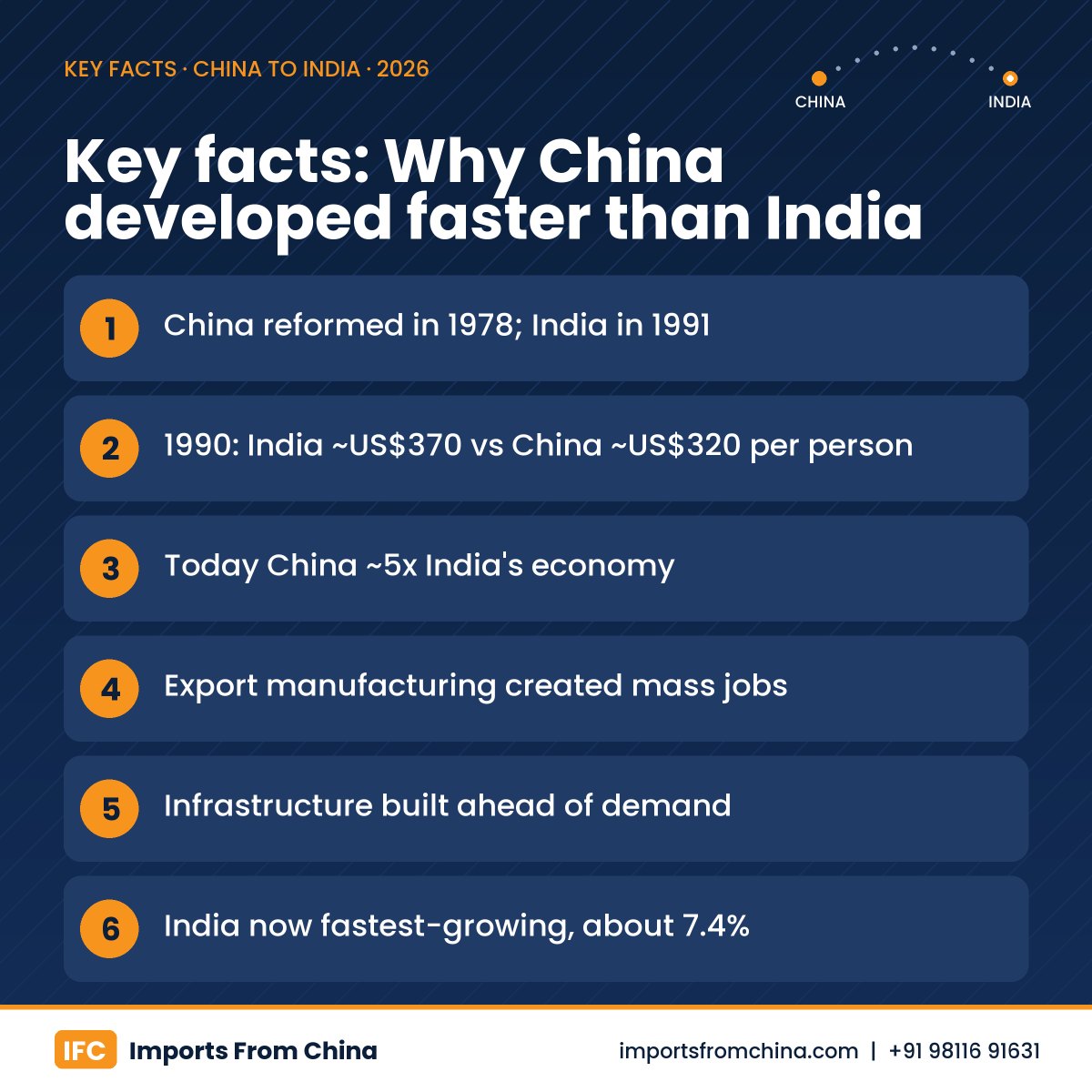
- Early start: China opened up in 1978; India in 1991.
- Manufacturing first: China became the world’s factory; India grew through IT and services.
- Infrastructure: China built ports, power, highways and rail ahead of demand.
- People: earlier gains in literacy, health and women’s workforce participation.
- Execution: fast, top-down decisions on land, projects and policy.
- India now: the fastest-growing major economy, about 7.4% in FY26, with a young workforce.
India vs China: how the gap opened
| Milestone | China | India |
|---|---|---|
| Start of market reforms | 1978 (Deng Xiaoping) | 1991 (economic liberalisation) |
| Special economic zones | From 1980 (Shenzhen and others) | SEZ Act in 2005 |
| Income per person in 1990 (World Bank) | About US$320 | About US$370 |
| Income per person today | Roughly US$13,000 | Roughly US$2,700–2,900 |
| Growth model | Export manufacturing + infrastructure | Services, IT and domestic consumption |
| Share of global manufacturing (2023) | Nearly 32% | About 3.2% |
Figures are approximate and rounded; income per person is nominal GDP per capita in US dollars.
6 reasons China grew faster than India
1. It started reforms 13 years earlier
Thirteen extra years of 9–10% growth compound into an enormous difference. By the time India opened up in 1991, China already had a working export machine in its coastal provinces.
2. Export manufacturing created mass jobs
China moved hundreds of millions of farmers into factories making toys, clothes, electronics and furniture for the world. Factory jobs raise incomes quickly for low-skilled workers. India’s growth came more from IT, finance and services, which are highly productive but employ far fewer people.
3. Infrastructure built ahead of demand
China invested heavily in ports, power plants, expressways, high-speed rail and industrial parks, often before they were needed. Cheap, reliable infrastructure lowered costs for every factory. India is now investing at record levels, but started later.
4. Health, education and women at work
China achieved near-universal primary education and basic healthcare early, giving factories a literate, healthy workforce. A much higher share of Chinese women joined the paid workforce, effectively doubling the labour available for industry.
5. Land, labour and fast decisions
China’s system allowed rapid land acquisition and project approvals. Democracy in India means more consultation, legal checks and slower execution. This has costs, but also protects rights and avoids some of China’s excesses, such as ghost cities and heavy local-government debt.
6. Foreign investment and technology
Hong Kong, Taiwanese and overseas Chinese businesses invested heavily in mainland factories from the 1980s, bringing capital, technology and export contacts. India attracted large FDI mainly after 2000.
Is India catching up?
- India is the fastest-growing major economy, at about 7.4% in FY 2025-26, while China grew about 4.6% in the first nine months of 2026.
- India’s workforce is young and growing; China’s is ageing and shrinking.
- PLI schemes have made India a major smartphone exporter and are expanding into electronics, solar and auto parts.
- Infrastructure spending in India is at record levels: expressways, freight corridors, ports and airports.
But the gap is large: China’s economy is still about five times India’s. Read how China’s economy compares with India’s today and why India can’t yet manufacture as cheaply as China.
What Indian MSMEs can learn from China’s growth
- Think scale: Chinese factories won by producing large volumes of a few products extremely well.
- Specialise in clusters: work with suppliers near you and share logistics.
- Export early: even small exporters learn quality and pricing faster.
- Use the best machines: import productive machinery and moulds where needed to raise output per worker.
How IFC helps Indian businesses grow with China
IFC (Imports From China) has worked in China–India imports for 20+ years, since 2004, and has served 5000+ Indian businesses. Our own offices in Guangzhou and Yiwu help Indian buyers with sourcing, supplier verification, quality inspection, shipping and customs clearance, door to door. Check your landed cost on the IFC shipment calculator or call +91 98116 91631.
Frequently asked questions
Why has China developed faster than India?
China started reforms in 1978, 13 years before India, and focused on export manufacturing, infrastructure, foreign investment and a literate workforce with high female participation. India grew mainly through services, which created fewer mass jobs.
Was India richer than China in the past?
Around 1990, India’s income per person was slightly higher than China’s, about US$370 against US$320 by World Bank data. China then grew much faster.
How much bigger is China’s economy than India’s?
China’s economy is roughly US$19 trillion and India’s about US$4 trillion, so China’s is around five times larger.
Is India catching up with China?
India is now the fastest-growing major economy and has a younger workforce, but China’s lead in size and manufacturing is very large and will take decades to close.
What can India learn from China’s development?
Build infrastructure ahead of demand, focus on manufacturing scale and exports, invest in skills and bring more women into the workforce.
Comments for this post are closed.