






Why Can’t India Manufacture Cheaper Products Than China? 7 Real Reasons (2026)
Why can’t India manufacture products as cheaply as China? Mainly because of scale and supply chains. China makes nearly 32% of the world’s manufactured value, against India’s 3.2%, so its factories buy materials in huge volumes, sit inside dense clusters of suppliers, and run on world-class ports, power and logistics. Indian factories are usually smaller, depend on imported components, and pay more for land, power, finance and freight.
This article explains the seven real cost gaps between Chinese and Indian manufacturing, and what Indian MSMEs can do to compete, including when it makes sense to import and when to make locally.
Key takeaways
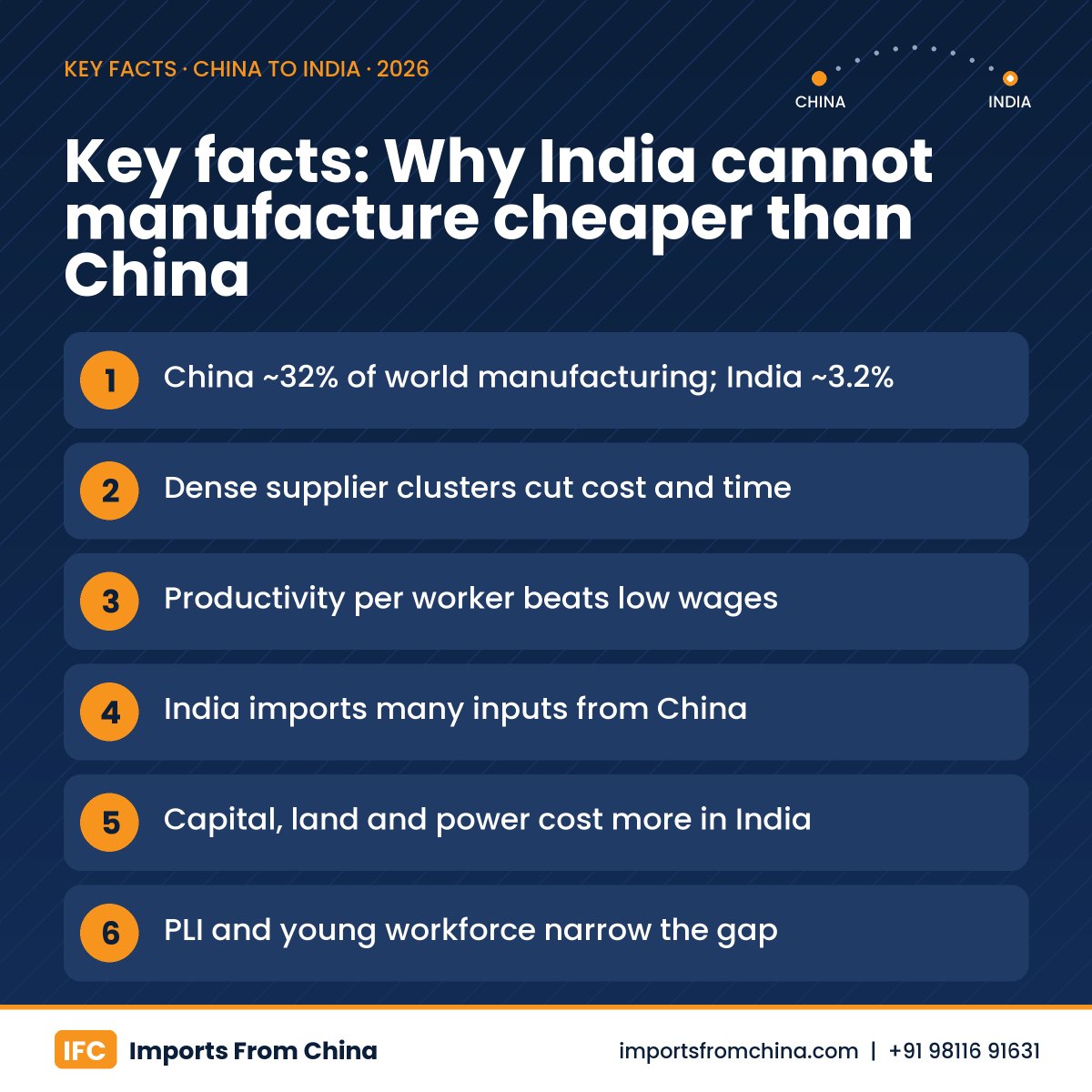
- Scale: China has nearly 32% of world manufacturing value; India about 3.2% (NITI Aayog, 2023 data).
- Clusters: in China, every part a factory needs is often available within a few kilometres.
- Infrastructure: decades of investment in ports, highways, rail and power cut costs per unit.
- Inputs: India still imports many components and machines, often from China.
- Cost of capital and land: borrowing, land and compliance usually cost more in India.
- Opportunity: PLI schemes, a young workforce and rising Chinese wages are narrowing the gap.
7 reasons Chinese products are cheaper than Indian products
1. Massive scale
A Chinese factory making phone cases or LED bulbs may produce millions of pieces a month for buyers worldwide. Fixed costs such as moulds, machines and design are spread over huge volumes, so the cost per piece drops sharply. Most Indian units produce for the domestic market at far smaller volumes.
2. Industrial clusters and supply chains
China built specialised clusters: Yiwu for small commodities, Foshan for furniture, Shenzhen for electronics, Ningbo for appliances, Guangzhou for garments. Raw materials, components, packaging, moulds and testing labs are all nearby, often available the same day. An Indian manufacturer may wait weeks for an imported part.
3. Infrastructure and logistics
China invested heavily for four decades in deep-water ports, expressways, rail freight and reliable industrial power. Containers move quickly from factory to port. India has improved fast, with new expressways, freight corridors and ports, but logistics are still slower and costlier for many factories.
4. Labour productivity, not cheap labour
Chinese wages are now higher than Indian wages in most sectors. China stays cheaper because each worker produces more, thanks to automation, training, long production runs and experienced supervisors. Productivity per worker matters more than the wage.
5. Cost of capital, land and power
Chinese manufacturers have had access to cheaper credit, ready industrial land and stable power. In India, interest rates, land acquisition, approvals and industrial power tariffs (which often cross-subsidise other users) add to the cost of every product.
6. Dependence on imported inputs
Many Indian products use components, chemicals or machines imported from China. India imported about US$113.5 billion of goods from China in FY 2024-25. When you import the inputs and add duty and freight, it is hard to beat the finished Chinese product on price. See what India imports from China.
7. Government support and export focus
China supported exporters with tax rebates, cheap land and infrastructure for decades, and today has overcapacity in many sectors, so factories cut prices to keep running. India’s export push is more recent, through Production Linked Incentive (PLI) schemes and Make in India.
China vs India manufacturing: quick comparison
| Factor | China | India |
|---|---|---|
| Share of global manufacturing value (2023) | Nearly 32% | About 3.2% |
| Supplier clusters | Very dense, product-specific | Growing (Tiruppur, Morbi, Ludhiana, Noida, Chennai) |
| Typical factory scale | Large, export-oriented | Mostly small and medium, domestic |
| Wages | Higher than India | Lower |
| Productivity per worker | High | Improving |
| Workforce trend | Shrinking and ageing | Young and growing |
Where India can already compete with China
- Mobile phone assembly: India became a major smartphone exporter under the PLI scheme.
- Pharmaceuticals and generic medicines.
- Textiles, garments and home textiles in clusters such as Tiruppur and Panipat.
- Ceramics and tiles from Morbi.
- Auto components and two-wheelers.
- Labour-intensive goods as Chinese wages rise.
What Indian MSMEs should do: import, make or both?
- Import finished goods where China’s scale is unbeatable (many electronics, small commodities, decor).
- Import machinery and moulds from China to make locally: many machines carry just 7.5% BCD and the IGST is claimable.
- Import components, assemble in India and build your own brand.
- Make locally where freight, duty, BIS and speed favour India (bulky, heavy or fast-changing products).
Check the duty side in legal ways to reduce import duty and the bigger picture in China’s economy vs India.
How IFC helps Indian manufacturers and traders
IFC (Imports From China) has worked in China–India imports for 20+ years, since 2004, and has served 5000+ Indian businesses. Our own offices in Guangzhou and Yiwu help Indian buyers with sourcing, supplier verification, quality inspection, shipping and customs clearance, door to door. Check your landed cost on the IFC shipment calculator or call +91 98116 91631.
Frequently asked questions
Why are Chinese products so cheap?
Because of huge scale, dense supplier clusters, efficient ports and logistics, high labour productivity, cheaper capital and decades of export support. Overcapacity also pushes Chinese factories to cut prices.
Is Chinese labour cheaper than Indian labour?
No, not any more in most sectors. Chinese wages are generally higher than Indian wages. China stays cheaper because each worker produces much more.
Why can’t India manufacture cheaper than China?
Indian factories are usually smaller, depend on imported inputs, and face higher costs for land, power, finance and logistics. Scale and supply chains are the biggest gaps.
Can India beat China in manufacturing?
In some sectors India already competes, such as smartphones, generic medicines, textiles and auto parts. With PLI schemes, a young workforce and rising Chinese wages, India can grow its share, but overtaking China will take decades.
Should Indian businesses import from China or make locally?
Often both: import where China’s scale is unbeatable, import machines and components to make locally, and manufacture in India where freight, duty and speed favour local production.
Comments for this post are closed.