






Can India Defeat China in a Full-Fledged War? Military, Technology, Manufacturing & Labour Compared (2026)
Can India defeat China in a full-fledged war? Most defence analysts say neither country could achieve a clear, decisive victory. China has big advantages in defence spending, navy, missiles, nuclear warheads and, above all, manufacturing capacity. India has strong advantages in mountain warfare, defensive terrain, combat experience, the Indian Ocean and a younger workforce. With both sides nuclear-armed, a full-scale war would be catastrophic for both, which is why the real contest is economic and industrial.
This article compares India and China across four areas that decide modern wars: military strength, technology, manufacturing and labour, using the latest 2026 data. It is an analysis, not a prediction or a call for conflict.
Key takeaways
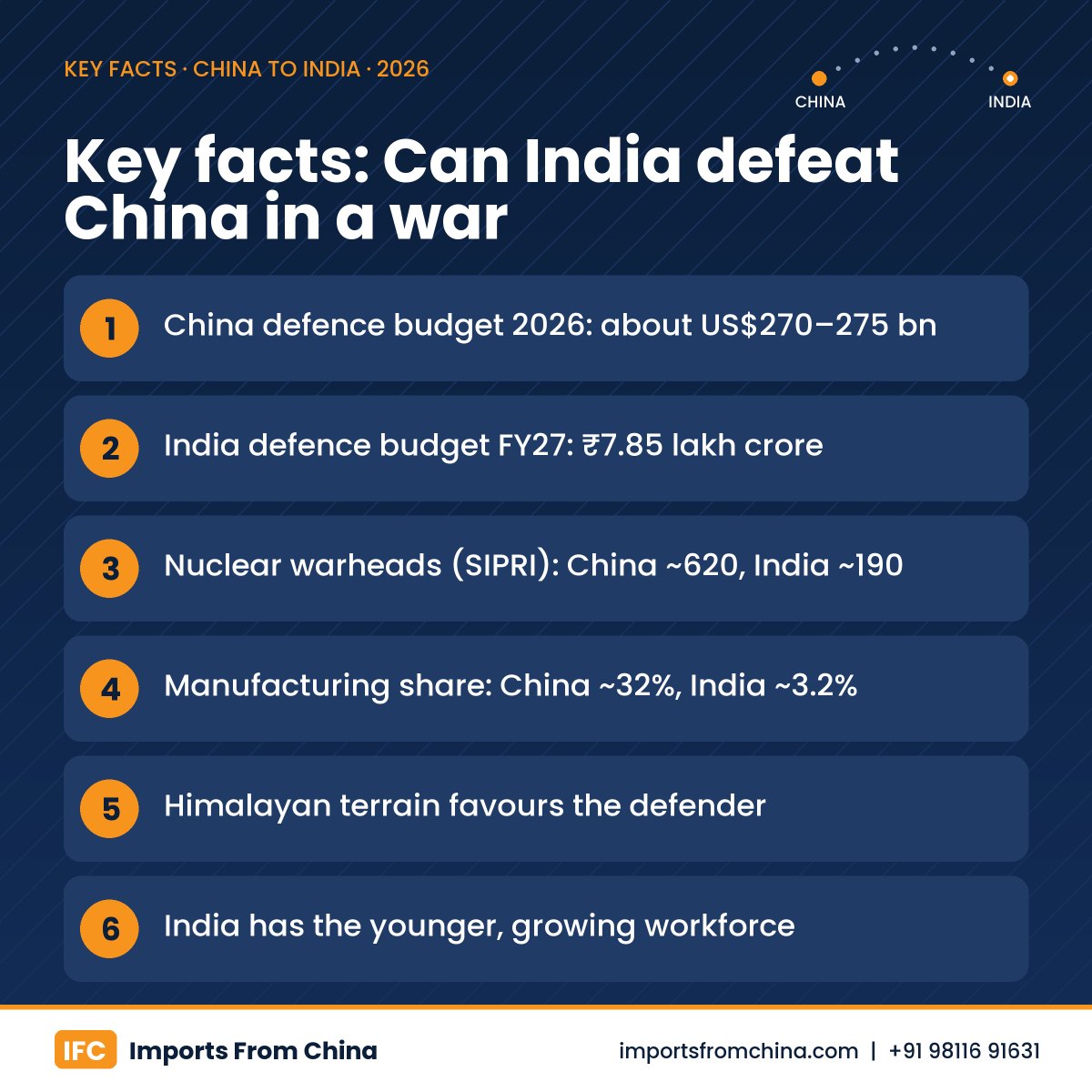
- Defence budget: China 1.91 trillion yuan (about US$270–275 billion) in 2026 vs India ₹8 lakh crore (about US$90 billion) for FY 2026-27.
- Nuclear: SIPRI estimates about 620 Chinese warheads vs about 190 Indian warheads (January 2026). Both keep a no-first-use policy.
- Manufacturing: China makes nearly 32% of the world’s manufactured value; India about 3.2% (NITI Aayog, 2023 data).
- Terrain: the Himalayan border strongly favours the defender, which limits any quick offensive.
- Labour: India has a younger, growing workforce; China’s is ageing but far more industrially skilled.
- Bottom line: deterrence makes full war unlikely; the long-term race is in factories, technology and supply chains.
India vs China: military strength compared (2026)
| Factor | China | India |
|---|---|---|
| Defence budget 2026 | 1.91 trillion yuan (about US$270–275 bn), up 7% | ₹8 lakh crore (about US$90 bn) |
| Active troops | About 2 million | About 1.4–1.5 million |
| Nuclear warheads (SIPRI, Jan 2026) | About 620 | About 190 |
| Navy | World’s largest navy by number of ships; 3 aircraft carriers | 2 aircraft carriers; strong position in the Indian Ocean |
| Missiles | Very large rocket and missile force | Agni, BrahMos and growing missile defence |
| Recent combat experience | Limited | Extensive, including high-altitude operations |
On paper, China’s armed forces are larger and better funded: its defence budget is about three times India’s. But a war between them would not be fought “on paper”. It would be shaped by geography, logistics and the risk of escalation.
Would geography decide an India–China war?
- The Himalayas favour defenders. High altitude, thin air and few roads make large offensives slow and costly. The 2020 Galwan clash showed how hard it is to push forward in Ladakh.
- India has mountain experience. Indian troops have operated for decades in Siachen, Kargil and Ladakh, among the hardest terrains in the world.
- China has better border infrastructure. Roads, rail and airbases in Tibet and Xinjiang let it move troops faster, although India has been building roads and tunnels quickly.
- The Indian Ocean matters. Much of China’s energy and trade passes through the Indian Ocean and the Strait of Malacca, where the Indian Navy has a natural advantage.
Technology: who is ahead?
China leads in many dual-use technologies: drones, electronics, batteries, satellites, shipbuilding, 5G and artificial intelligence hardware. Its defence industry can design and mass-produce fighter jets, warships and missiles largely on its own.
India is strong in space (ISRO), missiles (BrahMos, Agni), software and IT services, and is growing its domestic defence production under Make in India. But it still imports key items such as engines, some semiconductors and many electronic components, and a large share of those inputs come from China.
Manufacturing: the biggest gap
Modern wars are won by whoever can produce shells, drones, vehicles, ships and spare parts fastest. Here China’s lead is enormous. According to a NITI Aayog report, China accounted for nearly 32% of global manufacturing value in 2023, while India’s share was about 3.2%. China is the world’s largest producer of steel, ships, electronics and batteries.
India also depends heavily on Chinese inputs: it imported about US$113.5 billion of goods from China in FY 2024-25, including electronics, machinery, chemicals and solar components. A long war would cut those supply chains on both sides, but India would feel the shortage of components and machinery faster. Read: what India imports from China.
Labour and population: India’s long-term edge
- Younger population: India’s median age is roughly 28–29 years, China’s about 39–40. India’s working-age population is still growing, while China’s is shrinking.
- Skills gap: China’s workforce is far more experienced in factory production, with dense industrial clusters and suppliers.
- Military manpower: both countries have more than enough people; the limit is training, equipment and logistics, not numbers.
India’s demographic dividend is a real strategic asset, but only if it is turned into skilled manufacturing jobs.
So, can India defeat China in a full-fledged war?
A full-scale war is very unlikely to produce a clear winner. China would hold advantages in money, equipment, missiles and industrial output; India would hold the defender’s advantage in the mountains, a strong position at sea and battle-hardened troops. Above all, both are nuclear powers with no-first-use policies, so a total war would carry unacceptable costs for both. Most experts expect limited border standoffs rather than all-out war, with diplomacy and deterrence keeping the peace.
The decisive contest is therefore economic: who builds more factories, technology and skilled jobs over the next 20 years.
What this means for Indian businesses and MSMEs
For Indian MSME owners, the lesson is practical: stronger manufacturing makes India stronger. Many Indian factories today import machinery, moulds, components and raw materials from China to start producing locally, often at low duty. Importing the right machines and inputs smartly, and building your own brand in India, is part of growing India’s manufacturing base. See legal ways to import machinery at low or zero duty (EPCG) and BIS registration for electronics from China.
IFC (Imports From China) has helped 5000+ Indian businesses source machinery, components and products from China since 2004. Questions about sourcing for your factory? Call +91 98116 91631 or check your landed cost on the IFC shipment calculator.
Frequently asked questions
Can India defeat China in a war?
Most analysts say neither side could win a decisive victory. China is stronger in budget, equipment and manufacturing, while India has terrain, experience and naval advantages. Both have nuclear weapons, which makes a full-scale war very unlikely.
Who has a bigger military budget, India or China?
China. Its 2026 defence budget is about 1.91 trillion yuan, roughly US$270 to 275 billion, about three times India’s FY 2026-27 defence budget of ₹8 lakh crore.
How many nuclear weapons do India and China have?
SIPRI estimated in January 2026 that China has about 620 nuclear warheads and India about 190. Both countries follow a declared no-first-use policy.
Why is manufacturing important in a war?
Wars consume huge amounts of ammunition, vehicles, drones and spare parts. The country that can produce them faster can sustain a longer conflict. China makes nearly a third of the world’s manufactured value, India about 3%.
What is India’s biggest advantage over China?
India’s main advantages are defensive mountain terrain, troops experienced in high-altitude warfare, its strategic position in the Indian Ocean and a younger, growing workforce.
Comments for this post are closed.