

How bad is China economy right now

How Bad Is China’s Economy Right Now? Property, Business, Birth Rate & Economy vs India (2026)

How bad is China’s economy right now? China is not collapsing, but it is clearly weaker at home than before. Its property sector is in a long slump, with real-estate investment down 20.6% in January–September 2026 and new home prices falling for more than three years. Consumer spending is soft and youth unemployment is around 17.7%. Yet GDP still grew 4.6% in the first nine months of 2026, driven by record exports and factories. India is growing faster, at about 7.4% in FY 2025-26, but from an economy roughly a quarter of China’s size.

This article compares China and India on three fronts: property, business and the overall economy, using the latest 2026 data, and explains what it means for Indian businesses that buy from China.

Key takeaways

  • Property: China’s real-estate investment fell 20.6% in Jan–Sep 2026; new construction fell 24.9%.
  • Growth: China grew 4.5% in Q3 2026 and 4.6% in the first nine months, within its 4.5–5% target.
  • Exports: China posted a record US$1.2 trillion trade surplus in 2025, and exports kept rising in 2026.
  • Consumers: retail sales grew only 2.6% in Jan–Sep 2026; youth unemployment about 17.7% in September.
  • India: fastest-growing major economy: about 7.4% GDP growth in FY26 with inflation at historic lows.
  • Demographics: births fell to a record-low 7.92 million in 2025 and marriages dropped 7.5% in H1 2026; the population is shrinking and ageing.
  • For importers: weak demand at home makes Chinese factories hungry for export orders, so buyers get better prices.

How bad is China’s property crisis?

Property was once about a quarter of China’s economy when related industries are included. Since developers such as Evergrande and Country Garden ran into debt trouble from 2021, the sector has shrunk year after year.

Indicator (China, 2026)Latest data
Real-estate development investment, Jan–Sep 2026Down 20.6% year on year
New construction starts, Jan–Sep 2026Down 24.9%
New home pricesFell again in September 2026, extending a slump of more than three years
Household impactMost household wealth is in property, so falling prices hurt spending

India’s housing market, by contrast, has been in an upcycle since 2021, with strong demand in major cities, although affordability is a growing concern. The key difference: Indian property is driven by first-time buyers and urbanisation, while China has a large stock of unsold and empty homes.
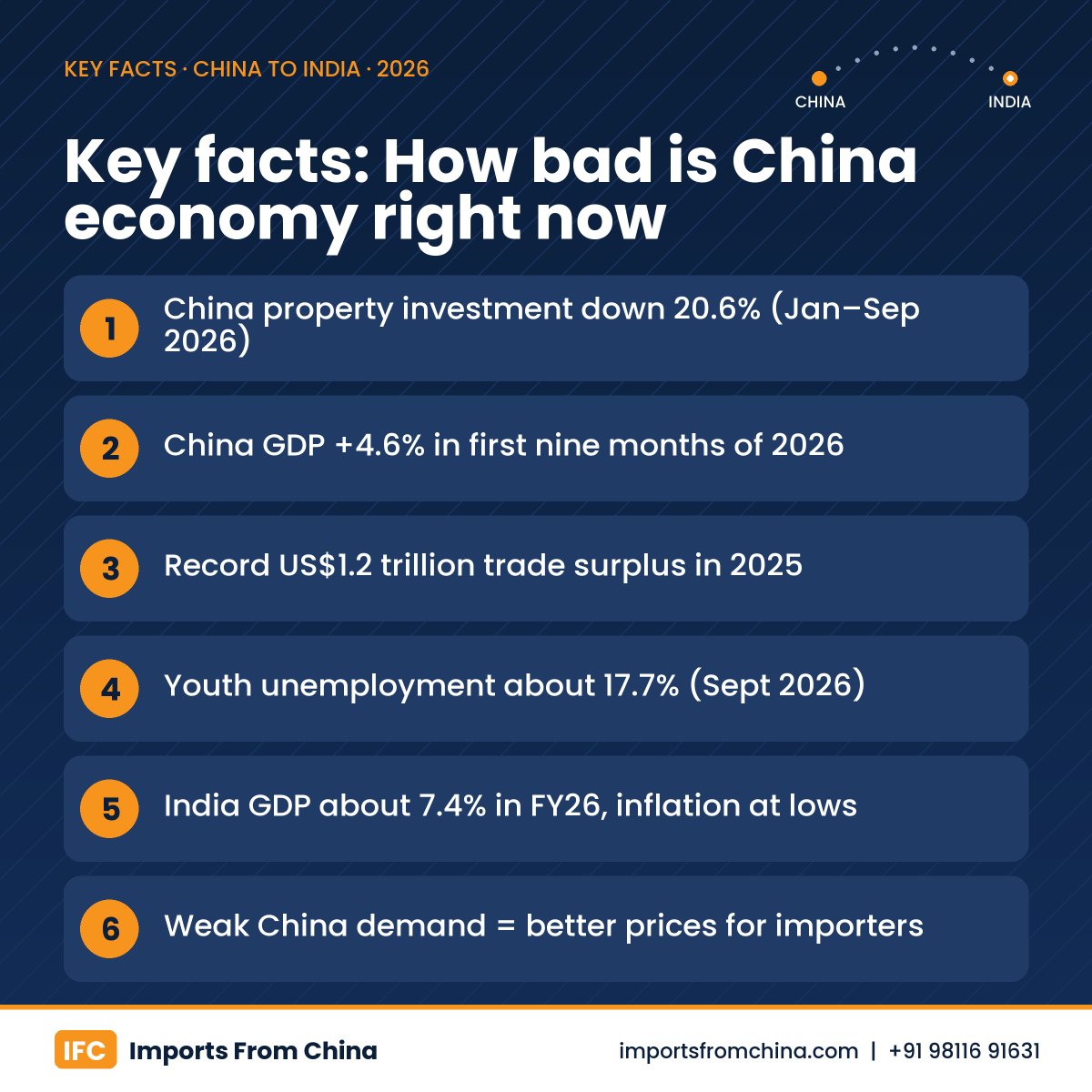
How bad is China economy right now infographic – key facts for Indian importers
How bad is China economy right now: key facts at a glance (IFC – Imports From China)

How are Chinese businesses doing?

  • Factories are strong: industrial output grew 5.3% in the first three quarters of 2026.
  • Exports are booming: China recorded a record US$1.2 trillion trade surplus in 2025, despite US tariffs, and kept growing exports in 2026.
  • Overcapacity: in steel, solar panels, EVs, batteries and many consumer goods, China produces far more than it can sell at home, so it pushes exports and cuts prices.
  • Price wars: heavy competition squeezes factory profits, especially in autos, solar and e-commerce.
  • Private sector caution: fixed-asset investment fell 7.2% in Jan–Sep 2026 as businesses held back.

China vs India economy: 2026 comparison

IndicatorChinaIndia
GDP sizeAbout US$19 trillionAbout US$4 trillion
Real GDP growth4.6% (Jan–Sep 2026); target 4.5–5%About 7.4% in FY 2025-26; 6.8–7.2% projected for FY27
InflationNear zero, with deflation pressureHistoric lows (about 1.7% average in Apr–Dec 2025)
PropertyLong slump, investment down 20.6%Upcycle in major cities
Consumer demandWeak: retail sales +2.6% (Jan–Sep 2026)Strong domestic demand
Youth unemploymentAbout 17.7% (Sept 2026, ages 16–24 excl. students)A challenge, measured differently
Manufacturing share of worldNearly 32%About 3.2%
TradeRecord surplus (US$1.2 trillion in 2025)Trade deficit, including about US$99 billion with China in FY25

Falling marriages and births: China’s demographic crisis

Beyond property and jobs, China’s biggest long-term problem is people. Fewer young Chinese are marrying, fewer babies are being born, and the population is shrinking and ageing fast.

IndicatorLatest data
Births in 20257.92 million, the lowest on record (birth rate 5.63 per 1,000)
Deaths in 202511.31 million
Population change 2025Down 3.39 million to 1.405 billion, the fourth straight yearly fall
MarriagesAbout 13.5 million at the 2013 peak; 6.1 million in 2024; 6.76 million in 2025 after a small rebound
Marriages, first half of 20263.275 million, down 7.5% year on year; divorces up 3.9%
People aged 60+23% of the population (323 million)

Why young Chinese don’t want to marry or have children

  • High costs: housing, education and childcare are very expensive, especially in big cities; a bride price and buying a flat are often expected before marriage.
  • Job insecurity: with youth unemployment near 17–18%, many young people delay marriage until they feel financially stable.
  • Long working hours: the “996” culture (9 am to 9 pm, 6 days a week) leaves little time for family life.
  • Changing values: more educated women are choosing careers and independence; “lying flat” (tang ping) reflects a wider rejection of the pressure to marry, buy property and raise children.
  • Legacy of the one-child policy: decades of small families and a gender imbalance mean fewer potential couples.

How the government is fighting back

  • Childcare subsidy: a national subsidy of 3,600 yuan per year for each child under three, introduced in 2025.
  • Free preschool: the final year of kindergarten made free from autumn 2025, benefiting about 24 million children.
  • Childbirth costs: a push for no out-of-pocket costs for childbirth from 2026.
  • Easier marriage registration: since 2025, couples can register their marriage anywhere in the country, not only in their home town.
  • Later retirement: the retirement age is being raised gradually from 2025 to keep older workers in the labour force.

So far, these incentives have produced only small changes. Marriages rose slightly in 2025 but fell again in the first half of 2026, and births kept falling.

What this means for China’s labour force vs India’s

China’s working-age population (16–59) was about 851 million in 2025, or 60.6% of the population, and it is shrinking every year as fewer young people enter work and more retire. That means rising wages, labour shortages in factories and more automation and robots. India is on the opposite path: a median age of roughly 28–29 years and a working-age population that will keep growing for years. This demographic dividend is one of India’s biggest advantages, but only if young Indians get skills and manufacturing jobs.

For Indian importers: China will keep making things competitively for years thanks to automation and scale, but labour-intensive products (garments, footwear, simple assembly) are slowly becoming costlier there. That is an opening for Indian manufacturing, and a reason to watch prices and diversify suppliers.

So, is China’s economy really in trouble?

China’s domestic economy is in a difficult phase: falling property, weak consumers, low prices and fewer jobs for young graduates. But its industrial and export machine is stronger than ever, and the government still has room to support growth. It is a slowdown, not a collapse.

India is the brighter growth story, with faster GDP growth, low inflation and rising domestic demand. But China’s economy is about five times bigger, and India still relies on China for electronics, machinery, chemicals and components. See what India imports from China.

What China’s slowdown means for Indian importers

  • Better prices: with weak home demand and overcapacity, many Chinese factories accept lower prices and smaller orders from Indian buyers.
  • More negotiating power: MOQs, payment terms and samples are easier to negotiate.
  • Watch supplier health: some factories are under financial stress, so verify suppliers and avoid 100% advance payments. Read how to avoid supplier scams.
  • Anti-dumping risk: cheap Chinese goods attract more Indian anti-dumping duties, so check before ordering. See anti-dumping duty on Chinese goods.
  • Machinery opportunity: Indian manufacturers can buy Chinese machines and inputs at good prices to grow local production.

How IFC helps Indian businesses source smartly from China

IFC (Imports From China) has worked in China–India imports for 20+ years, since 2004, and has served 5000+ Indian businesses. From our own offices in Guangzhou and Yiwu we track factory conditions on the ground, verify suppliers, negotiate prices, inspect quality and ship door to door with customs clearance. Check your landed cost on the IFC shipment calculator or call +91 98116 91631.

Frequently asked questions

How bad is China’s economy right now?

China is in a domestic slowdown, not a collapse. Property investment fell 20.6% in January to September 2026, consumer spending is weak and youth unemployment is about 17.7%, but GDP still grew 4.6% in the first nine months of 2026 thanks to strong exports and factories.

Is China’s property market still falling?

Yes. Real-estate development investment fell 20.6% in January to September 2026, new construction fell 24.9%, and new home prices kept falling in September 2026, extending a slump of more than three years.

Is India’s economy growing faster than China’s?

Yes. India grew about 7.4% in FY 2025-26, while China grew 4.6% in the first nine months of 2026. But China’s economy is still about five times larger.

Why are Chinese exports still strong if the economy is weak?

Weak demand at home and overcapacity push Chinese factories to sell abroad. China posted a record US$1.2 trillion trade surplus in 2025 and kept growing exports in 2026.

Is now a good time for Indian businesses to import from China?

Prices and terms are often favourable because Chinese factories need export orders. But verify suppliers carefully, avoid full advance payments and check anti-dumping duty before ordering.
Can India defeat China in a war

Can India Defeat China in a Full-Fledged War? Military, Technology, Manufacturing & Labour Compared (2026)

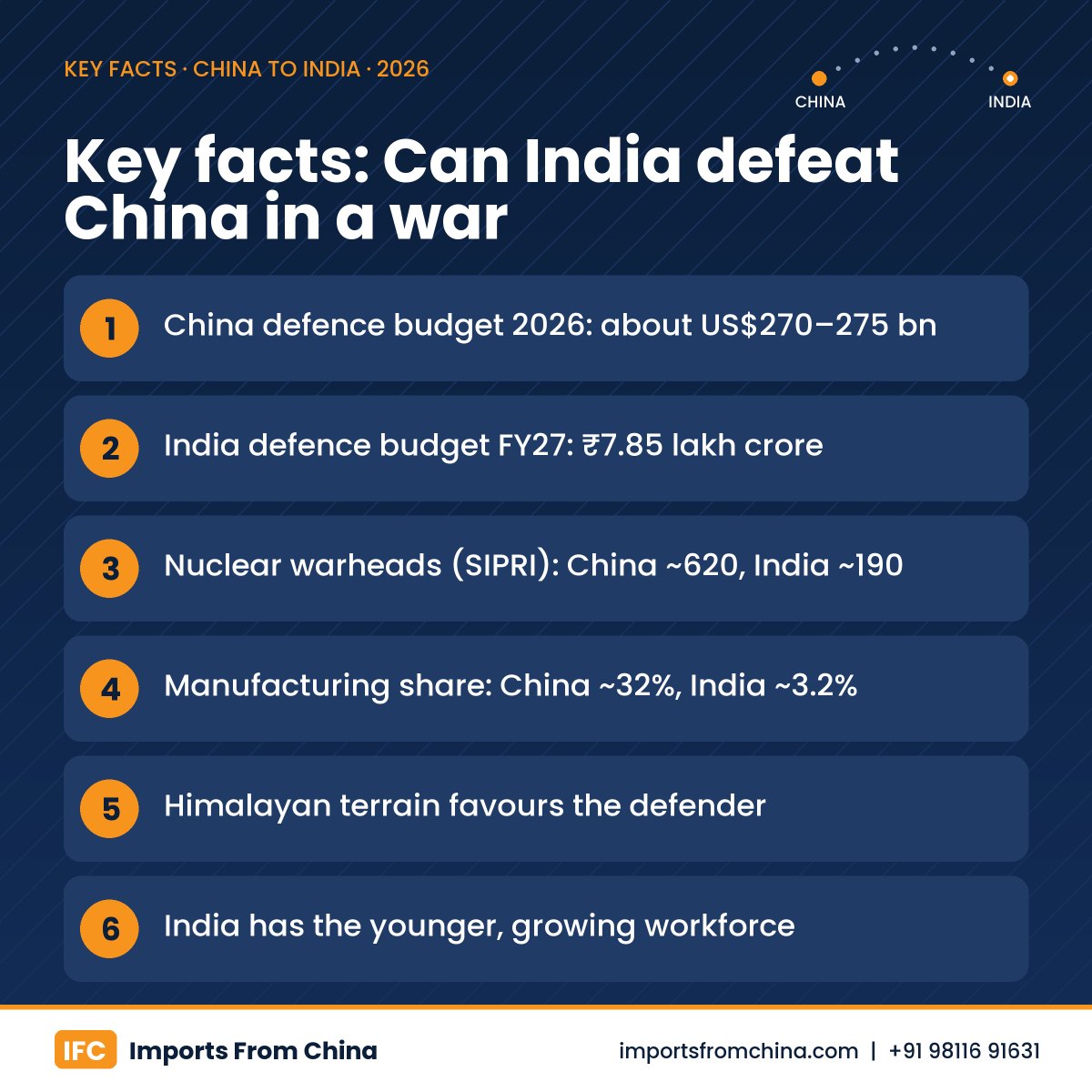
Can India defeat China in a full-fledged war? Most defence analysts say neither country could achieve a clear, decisive victory. China has big advantages in defence spending, navy, missiles, nuclear warheads and, above all, manufacturing capacity. India has strong advantages in mountain warfare, defensive terrain, combat experience, the Indian Ocean and a younger workforce. With both sides nuclear-armed, a full-scale war would be catastrophic for both, which is why the real contest is economic and industrial.

This article compares India and China across four areas that decide modern wars: military strength, technology, manufacturing and labour, using the latest 2026 data. It is an analysis, not a prediction or a call for conflict.

Key takeaways

  • Defence budget: China 1.91 trillion yuan (about US$270–275 billion) in 2026 vs India ₹8 lakh crore (about US$90 billion) for FY 2026-27.
  • Nuclear: SIPRI estimates about 620 Chinese warheads vs about 190 Indian warheads (January 2026). Both keep a no-first-use policy.
  • Manufacturing: China makes nearly 32% of the world’s manufactured value; India about 3.2% (NITI Aayog, 2023 data).
  • Terrain: the Himalayan border strongly favours the defender, which limits any quick offensive.
  • Labour: India has a younger, growing workforce; China’s is ageing but far more industrially skilled.
  • Bottom line: deterrence makes full war unlikely; the long-term race is in factories, technology and supply chains.

India vs China: military strength compared (2026)

FactorChinaIndia
Defence budget 20261.91 trillion yuan (about US$270–275 bn), up 7%₹8 lakh crore (about US$90 bn)
Active troopsAbout 2 millionAbout 1.4–1.5 million
Nuclear warheads (SIPRI, Jan 2026)About 620About 190
NavyWorld’s largest navy by number of ships; 3 aircraft carriers2 aircraft carriers; strong position in the Indian Ocean
MissilesVery large rocket and missile forceAgni, BrahMos and growing missile defence
Recent combat experienceLimitedExtensive, including high-altitude operations

On paper, China’s armed forces are larger and better funded: its defence budget is about three times India’s. But a war between them would not be fought “on paper”. It would be shaped by geography, logistics and the risk of escalation.

Can India defeat China in a war infographic – key facts for Indian importers
Can India defeat China in a war: key facts at a glance (IFC – Imports From China)

Would geography decide an India–China war?

  • The Himalayas favour defenders. High altitude, thin air and few roads make large offensives slow and costly. The 2020 Galwan clash showed how hard it is to push forward in Ladakh.
  • India has mountain experience. Indian troops have operated for decades in Siachen, Kargil and Ladakh, among the hardest terrains in the world.
  • China has better border infrastructure. Roads, rail and airbases in Tibet and Xinjiang let it move troops faster, although India has been building roads and tunnels quickly.
  • The Indian Ocean matters. Much of China’s energy and trade passes through the Indian Ocean and the Strait of Malacca, where the Indian Navy has a natural advantage.

Technology: who is ahead?

China leads in many dual-use technologies: drones, electronics, batteries, satellites, shipbuilding, 5G and artificial intelligence hardware. Its defence industry can design and mass-produce fighter jets, warships and missiles largely on its own.

India is strong in space (ISRO), missiles (BrahMos, Agni), software and IT services, and is growing its domestic defence production under Make in India. But it still imports key items such as engines, some semiconductors and many electronic components, and a large share of those inputs come from China.

Manufacturing: the biggest gap

Modern wars are won by whoever can produce shells, drones, vehicles, ships and spare parts fastest. Here China’s lead is enormous. According to a NITI Aayog report, China accounted for nearly 32% of global manufacturing value in 2023, while India’s share was about 3.2%. China is the world’s largest producer of steel, ships, electronics and batteries.

India also depends heavily on Chinese inputs: it imported about US$113.5 billion of goods from China in FY 2024-25, including electronics, machinery, chemicals and solar components. A long war would cut those supply chains on both sides, but India would feel the shortage of components and machinery faster. Read: what India imports from China.

Labour and population: India’s long-term edge

  • Younger population: India’s median age is roughly 28–29 years, China’s about 39–40. India’s working-age population is still growing, while China’s is shrinking.
  • Skills gap: China’s workforce is far more experienced in factory production, with dense industrial clusters and suppliers.
  • Military manpower: both countries have more than enough people; the limit is training, equipment and logistics, not numbers.

India’s demographic dividend is a real strategic asset, but only if it is turned into skilled manufacturing jobs.

So, can India defeat China in a full-fledged war?

A full-scale war is very unlikely to produce a clear winner. China would hold advantages in money, equipment, missiles and industrial output; India would hold the defender’s advantage in the mountains, a strong position at sea and battle-hardened troops. Above all, both are nuclear powers with no-first-use policies, so a total war would carry unacceptable costs for both. Most experts expect limited border standoffs rather than all-out war, with diplomacy and deterrence keeping the peace.

The decisive contest is therefore economic: who builds more factories, technology and skilled jobs over the next 20 years.

What this means for Indian businesses and MSMEs

For Indian MSME owners, the lesson is practical: stronger manufacturing makes India stronger. Many Indian factories today import machinery, moulds, components and raw materials from China to start producing locally, often at low duty. Importing the right machines and inputs smartly, and building your own brand in India, is part of growing India’s manufacturing base. See legal ways to import machinery at low or zero duty (EPCG) and BIS registration for electronics from China.

IFC (Imports From China) has helped 5000+ Indian businesses source machinery, components and products from China since 2004. Questions about sourcing for your factory? Call +91 98116 91631 or check your landed cost on the IFC shipment calculator.

Frequently asked questions

Can India defeat China in a war?

Most analysts say neither side could win a decisive victory. China is stronger in budget, equipment and manufacturing, while India has terrain, experience and naval advantages. Both have nuclear weapons, which makes a full-scale war very unlikely.

Who has a bigger military budget, India or China?

China. Its 2026 defence budget is about 1.91 trillion yuan, roughly US$270 to 275 billion, about three times India’s FY 2026-27 defence budget of ₹8 lakh crore.

How many nuclear weapons do India and China have?

SIPRI estimated in January 2026 that China has about 620 nuclear warheads and India about 190. Both countries follow a declared no-first-use policy.

Why is manufacturing important in a war?

Wars consume huge amounts of ammunition, vehicles, drones and spare parts. The country that can produce them faster can sustain a longer conflict. China makes nearly a third of the world’s manufactured value, India about 3%.

What is India’s biggest advantage over China?

India’s main advantages are defensive mountain terrain, troops experienced in high-altitude warfare, its strategic position in the Indian Ocean and a younger, growing workforce.

What does India import from China

What Does India Import from China? Top Products & MSME Guide (2026)

What does India import from China? India imported goods worth about US$113.5 billion from China in FY 2024-25, led by electronics and electrical equipment, machinery, organic chemicals, plastics, solar cells, batteries, steel products and consumer goods. China is India’s largest source of imports, and the trade deficit hit a record US$99.2 billion.

Most lists online stop at big national categories. This guide goes further: it explains which of these products Indian MSMEs can realistically import, what duty and compliance (BIS, WPC, CDSCO) each needs, and how to pick a profitable product for your own business.

Key takeaways

  • Size: India imported about US$113.5 billion from China in FY25, up from US$101.7 billion in FY24.
  • Biggest category: electronics and electrical equipment, followed by machinery and organic chemicals.
  • MSME sweet spot: LED and electrical items, home and kitchen goods, hardware, furniture, auto parts, packaging and machinery.
  • Compliance first: many items need BIS, WPC, CDSCO or import authorisation before shipping.
  • Duty varies: from 0% BCD (laptops) to 70% BCD (toys), so check your HS code first.
  • Landed cost decides profit: use the IFC shipment calculator before you order.

How much does India import from China?

According to Commerce Ministry data reported in April 2025, India’s imports from China rose about 11.5% to US$113.46 billion in FY 2024-25, while India’s exports to China fell to US$14.25 billion. That left a trade deficit of about US$99.2 billion, the highest ever. Electronics, EV batteries, solar cells and industrial inputs drove the increase.

YearImports from ChinaExports to ChinaTrade deficit
FY 2023-24US$101.7 bnUS$16.7 bnabout US$85 bn
FY 2024-25US$113.5 bnUS$14.3 bnUS$99.2 bn

For exact figures by HS code, check the Department of Commerce trade data (TradeStat), which lists imports country-wise and product-wise.

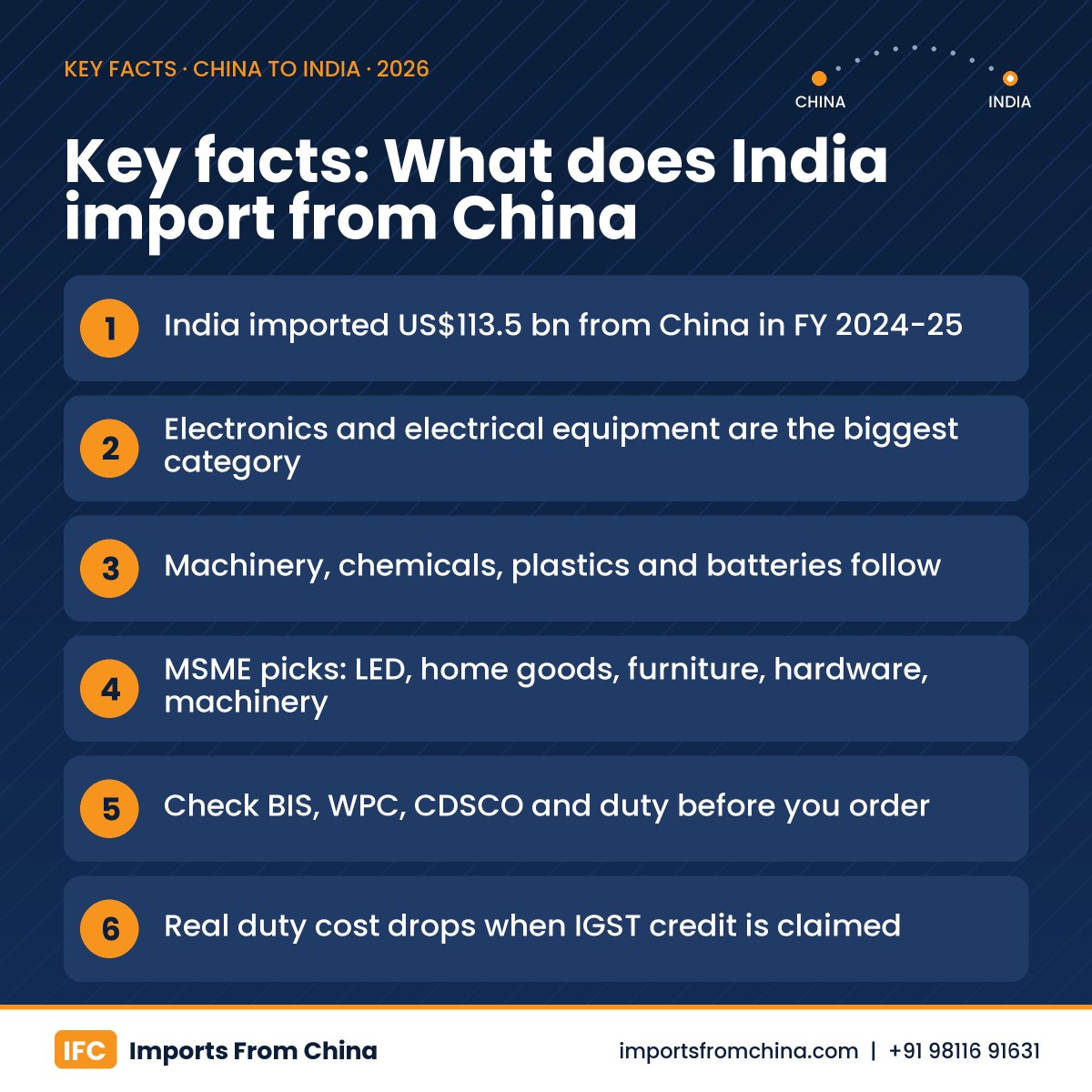
What does India import from China infographic – key facts for Indian importers
What does India import from China: key facts at a glance (IFC – Imports From China)

What are the main products India imports from China?

CategoryTypical productsWho imports them
Electronics and electrical equipmentMobile phone parts, ICs, PCBs, LED lights, chargers, telecom gear, solar cellsManufacturers, assemblers, traders
Machinery and equipmentIndustrial machines, pumps, motors, CNC and packaging machines, spare partsFactories and MSME units
Organic and inorganic chemicalsAPIs, dyes, pigments, specialty chemicalsPharma, textile and chemical units
Plastics and rubberPolymers, plastic goods, packagingPackaging and consumer brands
Iron, steel and metal productsFasteners, hardware, tools, fittingsHardware traders, builders
Batteries and EV partsLithium-ion cells, battery packs, EV componentsEV makers, energy storage
Consumer and home goodsKitchenware, home decor, furniture, toys, stationery, giftsRetailers, e-commerce sellers, interior designers
Medical devices and suppliesDiagnostic kits, disposables, equipmentHospitals, distributors
Textiles and fibresSynthetic yarn, fabrics, garment accessoriesGarment manufacturers
Auto componentsLighting, sensors, wiring harnesses, accessoriesAuto parts dealers and workshops

Large companies import intermediate goods (chips, APIs, chemicals) for manufacturing. MSMEs and traders mostly import finished goods, spare parts and machinery, and that is where most small importers find good margins.

Which products from China can Indian MSMEs import profitably?

From the big categories above, these are the ones small and medium businesses import most often, with steady demand and manageable compliance:

  1. LED lights and electrical fittings for contractors, shops and projects. BIS registration is needed for LED lamps.
  2. Home and kitchen products such as organisers, storage, cookware accessories and decor. Light, easy to ship and in demand on Amazon and Flipkart.
  3. Furniture and interior products from Foshan for showrooms, hotels and interior designers. Ship by sea; furniture now falls under a BIS quality control order.
  4. Hardware, tools and fittings for hardware stores and builders.
  5. Machinery and spare parts such as packaging, printing and CNC machines. Fewer competitors and high order value.
  6. Mobile and computer accessories such as cases, stands, cables and holders. Chargers, power banks and wireless items need BIS and sometimes WPC approval.
  7. Packaging material for brands and e-commerce sellers.
  8. Auto accessories and parts for dealers and workshops.
  9. Gifts, stationery and festive items from Yiwu, ideal before Diwali and wedding season.

For margin ideas and how to test a product, read our guide Is importing from China to India profitable?

What duty and compliance apply to popular China imports?

Duty and approvals depend on the 8-digit HS code. A few examples from the IFC duty database (rates as of October 2026; confirm for your exact HS code):

Product (HS code)BCDIGSTKey compliance
Laptops and tablets (8471 30 10)0%18%DGFT import authorisation, BIS CRS, WPC for Wi-Fi/Bluetooth
LED lamps (8539 52 00)20% + SWS18%BIS CRS registration mandatory
Wooden furniture (9403 60 00)20% + 5% AIDC18%BIS furniture QCO, plant quarantine for wood
Toys (Chapter 95)70%As per GST slabBIS mandatory

Check any product’s duty on the India import duty rates page, and read our import duty guide to understand BCD, SWS and IGST. Electronics importers should read BIS registration for electronics from China.

How do you choose the right product to import from China?

  1. Start with your market. Pick products you can sell: your shop, B2B clients, Amazon or Flipkart.
  2. Check rules before price. Find the HS code and confirm BIS, WPC, FSSAI, CDSCO or import authorisation needs.
  3. Compare China prices on Alibaba, 1688 or wholesale markets in Yiwu and Guangzhou.
  4. Calculate landed cost: product price + freight + duty + clearance + delivery. Air DDP is about ₹750/kg for general goods (50 kg+), and sea is roughly half.
  5. Compare with the Indian selling price. For retail, aim for at least 2x landed cost.
  6. Start with a sample order, then scale.

Worked example: landed cost of LED lamps from China

Suppose you import LED lamps with a CIF value of ₹1,00,000 (BCD 20%, SWS 10% of BCD, IGST 18%):

Assessable value (CIF)₹1,00,000
BCD 20%₹20,000
SWS 10% of BCD₹2,000
IGST 18% on ₹1,22,000₹21,960
Total duty₹43,960
Less IGST credit (if GST registered)– ₹21,960
Real duty cost₹22,000

This is why a GSTIN matters: the IGST part can usually be claimed as input tax credit, so your real duty cost is the BCD and SWS.

Which China imports are restricted or risky for small importers?

  • Branded copies: seized at customs under IPR rules.
  • Toys: 70% BCD plus mandatory BIS, so not ideal for beginners. See our toy import guide.
  • Laptops, tablets and PCs: need DGFT import authorisation.
  • Medical devices, drugs and cosmetics: need CDSCO registration or import licence.
  • Batteries and liquids: costlier to ship by air and need special handling.
  • Goods under anti-dumping duty: some Chinese products carry extra duty, so always check before ordering.

How IFC helps Indian businesses import from China

IFC (Imports From China) has worked in China–India imports for 20+ years, since 2004, and has served 5000+ Indian businesses. We have our own offices in Guangzhou and Yiwu with translators and English-speaking staff. We help with product sourcing, supplier verification, quality inspection, BIS/HSN/duty guidance, LCL/FCL sea and air cargo, customs clearance and door-to-door DDP delivery to major Indian cities. Start with our China product sourcing service.

Conclusion

India imports everything from chips to chairs from China, worth over US$113 billion a year. For an MSME, the opportunity lies in finished goods, parts and machinery where you control the selling price. Check the HS code and compliance first, calculate your full landed cost, start with a sample, and scale what sells.

Mayank Dang (CA Sahab), Founder and CEO of IFC

Guide reviewed by Mayank Dang (CA Sahab), Founder & CEO of IFC

Chartered Accountant (FCA, ICAI) who has helped 5000+ Indian businesses import from China since 2004 – sourcing, BIS, HSN classification, import duty, customs and GST compliance. mayankdang.in

Get your real landed cost: enter your product, weight and CBM in the IFC shipment calculator, check your HS code on the India import duty rates page, or call IFC on +91 98116 91631 for a door-to-door DDP quote from China to your city.

Frequently asked questions

What does India import most from China?

Electronics and electrical equipment are the largest category, including mobile phone parts, integrated circuits, telecom equipment, solar cells and LED products. Machinery and organic chemicals come next.

How much does India import from China every year?

India imported about US$113.5 billion of goods from China in FY 2024-25, up from about US$101.7 billion in FY 2023-24, according to Commerce Ministry data.

What is the best product to import from China to India for a small business?

There is no single best product. Good options for MSMEs include LED lights, home and kitchen goods, hardware, furniture, packaging, auto accessories and machinery. Choose a product you can sell, check its compliance and calculate the landed cost first.

Do I need a licence to import products from China to India?

For commercial imports you need an IEC and usually a GSTIN. Some products also need BIS, WPC, FSSAI, CDSCO or DGFT import authorisation. Check the rules for your HS code before ordering.

Why does India import so much from China?

China offers large-scale production, lower prices and a complete supply chain for electronics, chemicals and machinery. Many Indian manufacturers depend on Chinese components, although government schemes are working to increase local production.

Is importing from china to india profitable

Is Importing from China to India Profitable? Margins, Costs and a ₹ Worked Example (2026)

Is importing from China to India profitable? Yes, for many products it is, but only when you work out the full landed cost first. Customs duty, IGST, freight, bank charges, marketplace fees and returns can turn a product that looks 60% cheaper in China into a 5–10% margin in India. The channel you sell through matters as much as the product.

This guide shows where profit really comes from, the costs most beginners miss, a full rupee example with real duty maths, a sensitivity table showing what can wipe out your margin, and a checklist to test any product before you order.

Key takeaways

  • Profit is decided before you order: compare your selling price with the landed cost per piece, not with the China factory price.
  • Duty is a real cost, IGST usually is not: if you are GST-registered, the import IGST comes back as input tax credit; BCD and SWS do not.
  • Channel changes everything: in our example the same product earns about 33% selling wholesale but only about 8% on a marketplace after fees, returns and ads.
  • Air freight kills margins on cheap goods: the same order shipped by air instead of LCL sea turned a profit into a loss.
  • Compliance can stop a product: items needing BIS, WPC, FSSAI or CDSCO approval, or carrying anti-dumping duty, need extra cost and time.
  • Test small, then scale: a trial lot of 1–3 CBM by LCL shows real demand and real costs before you commit lakhs.

Is importing from China to India profitable in 2026?

China is still India’s biggest source of manufactured goods, and the reason is simple: factories in Guangdong, Zhejiang and Fujian make huge volumes at low unit cost, with a choice of designs that Indian wholesale markets often cannot match. That price gap is where import profit starts.

But the gap is smaller than it looks. A ₹200 factory price becomes ₹280–300 by the time the goods are cleared and delivered to your godown, and that is before you sell a single piece. Importing is profitable when three things are true:

  1. Your selling price is at least 2–2.5 times the China price for marketplace selling, or about 1.5 times for wholesale, after GST.
  2. The product is light or compact for its value, so freight per piece stays small.
  3. The product is “free” to import under the ITC-HS policy and does not need a licence or a certificate you cannot get in time.

If any one of these fails, margins shrink fast. Most first-import losses come from buyers who compared the Alibaba price with the Indian retail price and skipped everything in between.

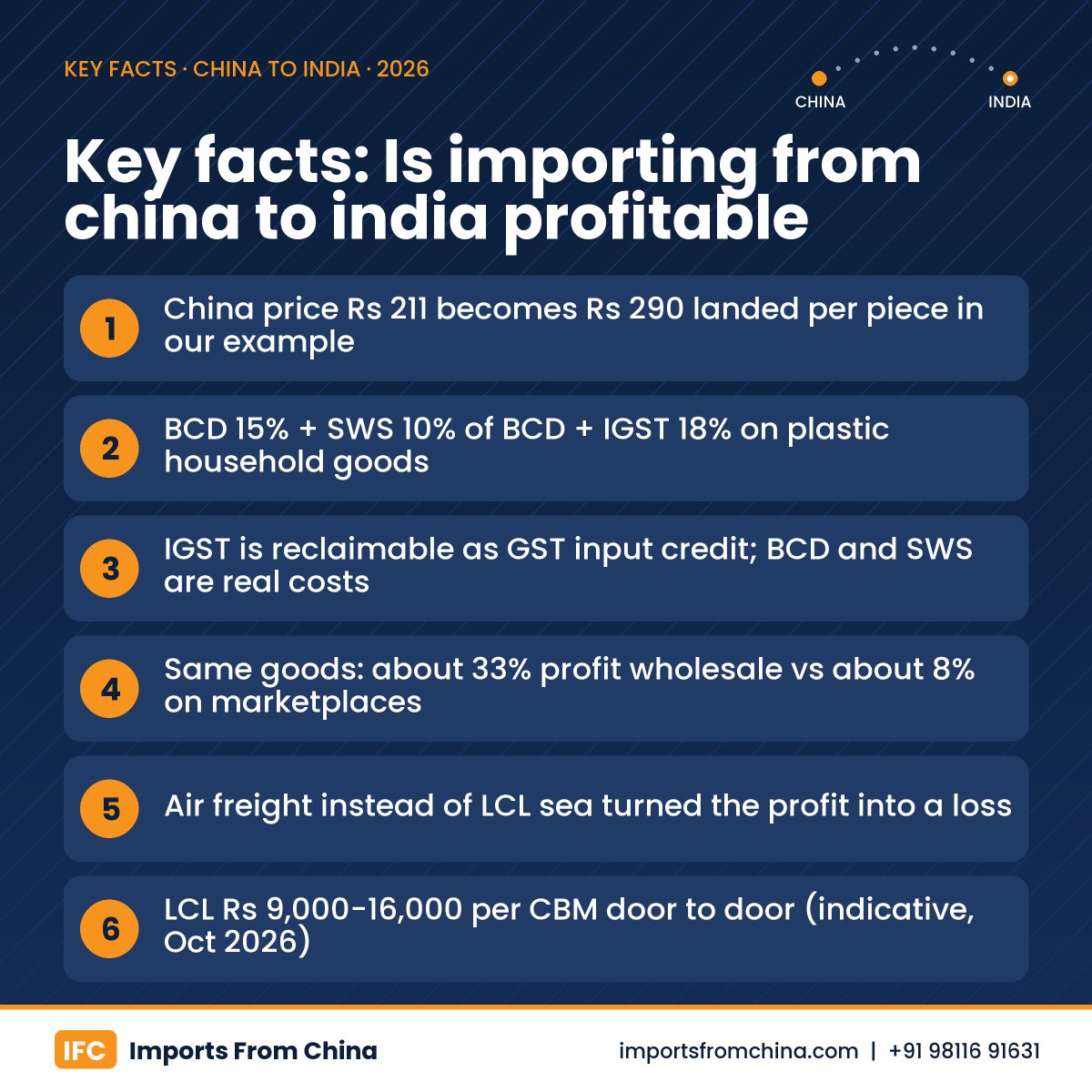
Is importing from china to india profitable infographic – key facts for Indian importers
Is importing from china to india profitable: key facts at a glance (IFC – Imports From China)

What costs decide your profit when importing from China?

Your landed cost is everything you pay to get one sellable piece into your warehouse. Here is what goes into it.

Cost itemWhat it isTypical size (indicative, October 2026)Recoverable?
Product price (FOB or EXW)What the supplier charges, usually in USD50–70% of landed cost for most consumer goodsNo
Bank and forex chargesExchange margin, wire fees, GST on currency conversionAbout 1–2% of the paymentGST part only
Freight and clearanceChina pickup, sea or air, Indian CFS, CHA, deliveryLCL ₹9,000–16,000 per CBM door to door; air ₹350–600 per kg door to doorGST on services usually yes
Basic Customs Duty (BCD)Charged on assessable value (CIF)0–70% depending on HS code; 10–20% is common for consumer goodsNo
Social Welfare Surcharge (SWS)10% of BCD, unless exempt1.5–2% of value on most goodsNo
IGSTOn assessable value + BCD + SWS5%, 12% or 18% in most cases; check your HS codeYes, as input tax credit if GST-registered
Selling costsMarketplace fees, shipping to customer, ads, returns25–45% of selling price on marketplacesGST on fees usually yes

Duty depends on the exact 8-digit HS code, so look yours up on the India import duty rates page before you calculate anything. Our import duty from China to India guide explains each duty in more detail.

Worked example: is this China import profitable? (₹ calculation)

A Delhi trader imports 2,000 plastic drawer organisers from a Yiwu supplier at USD 2.20 FOB per piece. The order packs into 100 cartons, about 6 CBM and 900 kg, shipped LCL to Nhava Sheva and delivered door to door.

Assumptions: CBIC customs exchange rate ₹96 per USD (import rate effective 16 October 2026; it is revised twice a month); ocean freight to the Indian port about ₹4,500 per CBM; cargo insurance about 1.125% of FOB; no landing charge (removed from the valuation rules in 2017). HS code 39249090 (other plastic household articles): BCD 15%, SWS 10% of BCD, no AIDC, IGST 18%, no anti-dumping duty. Rates as of October 2026; confirm for your exact HS code.

Step 1: customs duty

ItemCalculationAmount (₹)
FOB valueUSD 4,400 × ₹964,21,960
Ocean freight to Indian port6 CBM × ₹4,50027,000
Insurance1.125% of FOB4,747
Assessable value (CIF)FOB + freight + insurance4,53,707
BCD15% of AV68,056
SWS10% of BCD6,806
IGST18% of (AV + BCD + SWS = 5,28,569)95,142
Total paid at customsBCD + SWS + IGST1,70,004

Step 2: landed cost per piece

Door-to-door LCL freight and clearance at a mid-range ₹12,000 per CBM is ₹72,000 (this already includes the ocean freight used for customs). Add about ₹6,000 for bank charges and forex margin. Because the trader is GST-registered, the ₹95,142 IGST comes back as input tax credit, so the real cost is:

₹4,21,960 (goods) + ₹72,000 (freight and clearance) + ₹4,747 (insurance) + ₹74,862 (BCD + SWS) + ₹6,000 (bank) = ₹5,79,569, or about ₹290 per piece. The China price was about ₹211 per piece, so 37% was added on the way.

Note the cash flow: you pay ₹7 lakh before you sell anything, because IGST is paid at customs and claimed back later through your GST return.

Step 3: profit by sales channel

Per piece (₹)Marketplace (Amazon or Flipkart)Wholesale to retailers
Selling price799 incl. 18% GST450 + GST
Net of GST677450
Landed cost290290
Marketplace fees and shipping (assumed)230–
Returns and damage allowance (5%)34–
Ads (10% of net sale)68–
Local delivery–10
Profit per piece55 (about 8%)150 (about 33%)
Profit on 2,000 piecesabout ₹2 lakhabout ₹3 lakh

Marketplace fees here are an assumption for illustration; check your category’s current fee card. The lesson: the same container can be a good business or a weak one depending on how you sell it. Marketplace sellers need either a higher price (a brand, a bundle, better packaging) or a lower landed cost (bigger order, cheaper freight per piece) to make it worthwhile.

What can wipe out your import profit?

We re-ran the same example with one thing going wrong at a time. This is the table most import guides never show.

What changesLanded cost per pieceMarketplace profit per pieceWholesale profit per piece
Base case₹290₹55 (8%)₹150 (33%)
Rupee weakens 3% before you pay₹297₹48 (7%)₹143 (32%)
Freight rates double (peak season)₹328₹17 (2.5%)₹112 (25%)
10% of goods arrive defective₹322₹23 (3%)₹118 (26%)
Shipped by air instead of sea₹484Loss of ₹139Loss of ₹44

Each figure is indicative, October 2026, built on the assumptions above. Other margin killers:

  • Wrong HS code: customs can reassess at a higher rate and add interest or penalty. Classify the product carefully before you order.
  • Undervalued invoices: a low invoice to “save duty” often leads to customs rejecting the value and holding cargo, plus demurrage at the CFS.
  • Missing approvals: goods under a BIS Quality Control Order, or needing WPC, FSSAI or CDSCO approval, cannot be cleared without them. Check the BIS website early.
  • Anti-dumping duty: some Chinese goods carry anti-dumping duty on top of BCD, which can make them uncompetitive.
  • Dead stock: unsold seasonal goods tie up cash. Diwali stock must be ordered by about August; orders placed late in the year also run into the Chinese New Year shutdown (6 February 2027), when factories close for 2–4 weeks.

Which products are most profitable to import from China to India?

There is no single “most profitable product”, but some types of product clear the margin test far more often than others.

Usually profitableUsually difficult
Light, compact, design-led goods: home organisers, decor, gift items, fashion accessoriesHeavy, low-value goods: plain tiles, cement-type products, basic furniture in small lots
Products Indian factories do not make in that design or finish: hotel lighting, specialty fittings, project furnitureGoods sold on price alone that Indian factories also make cheaply
Spare parts and components with steady repeat demandElectronics needing BIS registration for each model, unless you plan for it
Goods with low or moderate BCD and no licence neededToys and other goods with very high BCD (around 70% for toys) plus BIS certification
Private-label goods where you control the brand and priceRestricted goods such as drones, or goods under anti-dumping duty

Interior designers, architects and hotel owners can see strong returns, because project goods (lighting, furniture, sanitary fittings, decor) carry high value per CBM and Indian alternatives can cost much more. Read our guide on the cost of importing furniture from China to see how duty and freight change the numbers for bulky goods.

How much money do you need to start a profitable import business?

For a first commercial LCL shipment, plan for the goods value plus roughly 40–60% more in cash for freight, duty and IGST, even though the IGST comes back later. A trial order of ₹2–3 lakh in goods typically needs ₹3–4.5 lakh in total cash.

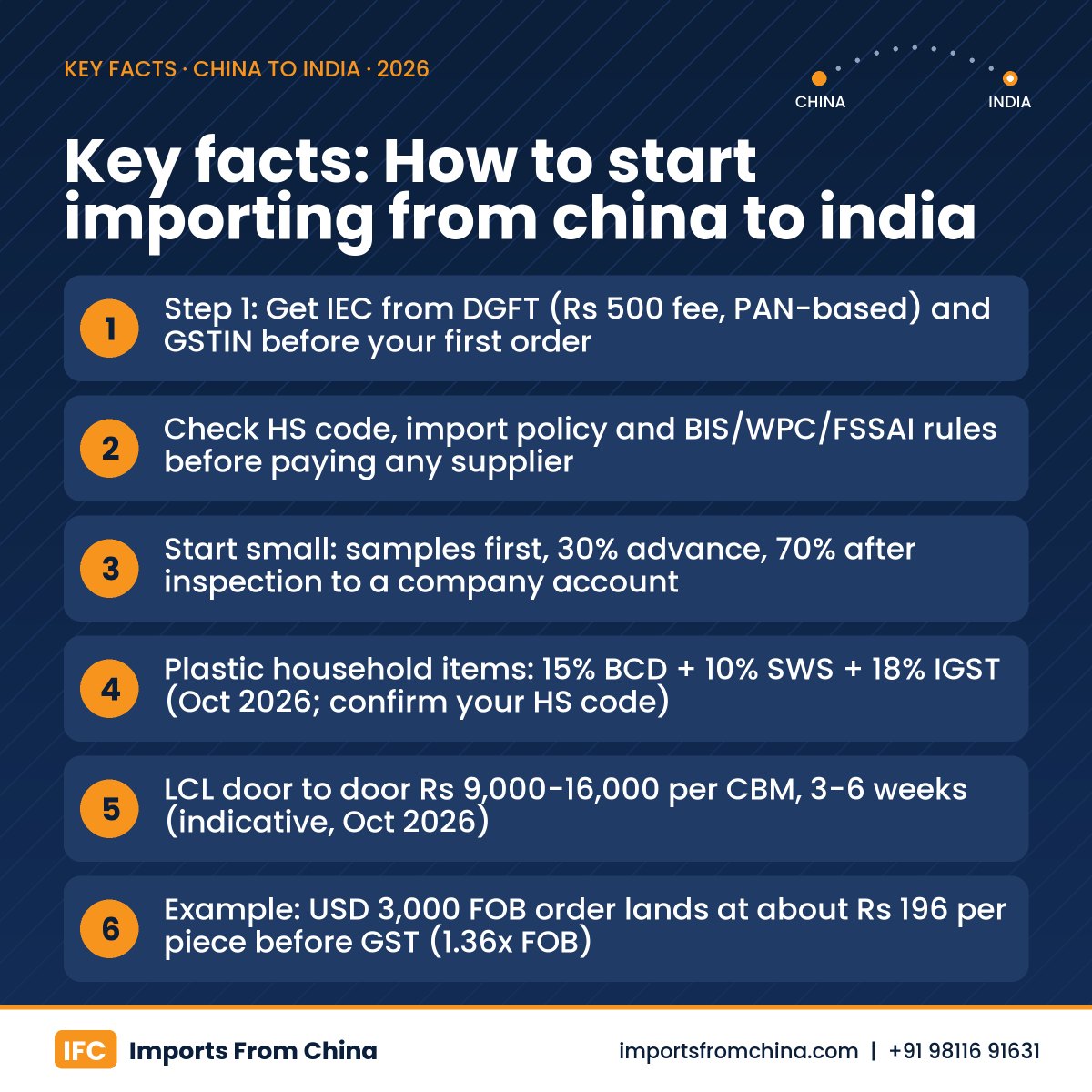
  • Registrations: IEC from the DGFT (online, ₹500 fee) and GSTIN, plus any product approvals.
  • Minimum sensible order: LCL has a minimum of about 1 CBM plus fixed charges, so tiny orders cost more per piece. 2–5 CBM is a common first shipment.
  • Working capital cycle: deposit to supplier, about 3–6 weeks door to door by LCL, then selling time. Plan for money to be tied up for 2–4 months.

If you are completely new, start with our beginner’s step-by-step guide to importing from China.

▶ Watch our step-by-step guide video

How do you check if a product will be profitable before you order?

Use this 8-step test on every product idea. It takes an hour and can save a container.

  1. Find your real selling price in India: check marketplaces and wholesale markets, and use the price you can sell at in volume, not the highest listing.
  2. Get the HS code and duty for the exact product and note any BIS, WPC, FSSAI, CDSCO or anti-dumping rule.
  3. Get 3 supplier quotes with FOB price, MOQ, carton size, carton weight and pieces per carton.
  4. Calculate CBM and weight for your order quantity.
  5. Get a door-to-door quote or use the IFC shipment calculator for freight, duty and IGST.
  6. Add selling costs: fees, shipping, ads, returns, warehouse and packaging.
  7. Stress-test it: add 3% for currency, 30% for freight and 5–10% for defects. If profit is still positive, the product is worth a trial.
  8. Verify the supplier before paying, and inspect goods before the balance payment. Pay only to a bank account in the supplier company’s own name.

How IFC helps you import profitably from China

IFC – Imports From China has more than 20 years of experience in China–India import and export, since 2004. We have our own offices in Guangzhou and Yiwu, with translators and English-speaking staff who can find and compare suppliers, check that a supplier is real, and inspect goods before you pay the balance.

We load mixed containers and air cargo daily, so even a small trial order can move by LCL at a sensible cost per piece. Our services cover sourcing, supplier verification, quality inspection, LCL and FCL sea freight, air cargo, customs clearance and door-to-door DDP delivery. We have a warehouse at our headquarters and deliver to major Indian cities including Delhi, Gurugram, Noida, Mumbai, Pune, Bengaluru, Hyderabad, Chennai and Ahmedabad. A DDP quote gives you one landed figure to put into your margin sheet.

Conclusion

Importing from China to India is profitable when the numbers are done before the order, not after. Pick light, design-led products that are free to import, check the HS code and approvals, calculate landed cost per piece including duty, choose a channel that leaves room for fees, and start with a trial lot by sea. Do that, and China remains one of the best margin sources for Indian businesses.

Get your real landed cost: enter your product, weight and CBM in the IFC shipment calculator, check your HS code on the India import duty rates page, or call IFC on +91 98116 91631 for a door-to-door DDP quote from China to your city.

Frequently asked questions

Is importing from China to India still profitable in 2026?

Yes, for the right products. Light, design-led goods that are free to import and sell well above their landed cost still give good margins. Profit falls quickly when freight per piece is high, duty is high, approvals like BIS are needed, or the goods are sold through channels with heavy fees. Calculate landed cost per piece before ordering.

What profit margin can I expect when importing from China?

There is no fixed margin. In our worked example, plastic organisers bought at about Rs 211 per piece cost about Rs 290 landed, and earned about 33% selling wholesale but only about 8% on a marketplace after fees, ads and returns. Your margin depends on product, duty, freight and sales channel.

Is it cheaper to buy from China or from Indian wholesalers?

The China factory price is usually lower, but after freight, customs duty, bank charges and time, the gap narrows. For small quantities, buying from an Indian wholesaler can be cheaper and less risky. Importing makes sense when your volume is large enough and the product is light or high in value for its size.

Do I lose the IGST paid on imports?

Not if you are GST-registered and the goods are for your business. The IGST paid at customs on the Bill of Entry can be claimed as input tax credit. Basic Customs Duty and Social Welfare Surcharge cannot be claimed back, so they are a real cost in your margin calculation.

How much money do I need to start importing from China?

A practical first LCL shipment of Rs 2 to 3 lakh in goods usually needs about Rs 3 to 4.5 lakh in total cash, because freight, duty and IGST are paid before you sell. You also need an IEC and GSTIN. Keep money aside for 2 to 4 months of working capital.

Which products should beginners avoid importing from China?

Avoid heavy low-value goods, toys and other items with very high duty plus BIS certification, electronics that need BIS registration for each model, restricted items like drones, and goods under anti-dumping duty. These are not always unprofitable, but they need more money, time and compliance work than a first import should carry.

Can I import from China in small quantities and still make a profit?

Yes, by shipping LCL with a consolidator that loads mixed containers regularly. Very small orders under about 1 CBM pay minimum charges, so 2 to 5 CBM is a sensible first shipment. Avoid air freight for cheap goods, because it can turn a profitable product into a loss.

china import service fee

China Import Service Fee in India: 5 Pricing Models Explained

A China import service fee in India is usually charged in one of four ways: a commission on order value (the typical market range quoted is 3-10%), a fixed fee per order, an all-in DDP rate per kg or per CBM, or separate charges for inspection and payment handling. The right model depends on your order size and how much of the job you hand over.

This guide explains each pricing model, what is normally included and what is billed extra, a ₹5 lakh worked example comparing the models side by side, the hidden costs to watch for, and when paying for a China import service is cheaper than doing it yourself.

Key takeaways

  • Four common models: commission on order value, fixed per-order fee, all-in DDP per kg/CBM, and pay-per-service (inspection, payment, freight).
  • Typical commission range: sourcing agents are commonly quoted at 3-10% of order value; smaller orders usually pay a higher percentage. This is a market range, not a fixed rule.
  • Compare landed cost, not the fee: a low fee with a weak exchange rate, extra handling charges or a bad customs valuation can cost more than a higher fee.
  • GST matters: service fees in India attract GST, and you should confirm whose IEC the Bill of Entry is filed under so you can claim IGST input tax credit.
  • Get it in writing: ask for a written, itemised quote that lists every charge from the supplier’s door in China to your warehouse in India.
  • Check the agent first: verify the provider’s company details, GSTIN and IEC before you pay anything.

What is a China import service fee?

A China import service fee is what you pay a company to handle some or all of the work between finding a product in China and receiving it at your door in India. That work can include supplier search, price negotiation, sample handling, factory checks, paying the supplier, pickup and consolidation, freight, customs clearance and final delivery.

The fee is not the same as your total import cost. Your landed cost still includes the goods, freight, insurance, customs duty, IGST, CHA (customs broker) charges, port and CFS charges and local transport. Some providers bundle many of these into one rate; others charge only for their own service and pass the rest through at actual cost.

How do China import services in India charge? The 5 pricing models

1. Commission on order value

This is the classic China sourcing agent fee. The agent charges a percentage of the purchase order (PO) value, usually the factory price before freight. Published industry guides commonly quote a typical market range of about 3-10% of order value, with smaller orders paying the upper end and large repeat orders paying the lower end. Some agents charge more for very small or very complex orders. Treat these as typical market figures, not a standard rate.

Good for: buyers who need real sourcing work: finding factories, negotiating, following up on production (see our guide to China buying agents for Indian importers). Watch for: agents who also take a hidden “kickback” from the factory, which means they are paid twice and may not push for your best price.

2. Fixed fee per order

Some providers charge a flat amount per order or per supplier, regardless of order value. This works well for larger orders where a percentage would become expensive. It can be costly for small trial orders, because the fee is the same whether you buy ₹50,000 or ₹10 lakh of goods.

3. All-in DDP rate per kg or per CBM

Under DDP (Delivered Duty Paid), the provider quotes one rate per kg or per CBM that covers freight from China, customs clearance, duty and delivery to your city. You pay the supplier for the goods (often through the provider) and then pay the DDP rate on weight or volume. It is simple to budget, and it is popular with small and mid-size traders. Read how DDP shipping from China to India works before you compare DDP quotes.

Watch for: a per-kg rate that assumes light cargo when your goods are bulky (CBM-based billing then applies), and a rate that does not mention minimum chargeable weight, GST invoice or how duty is calculated for your product’s HS code.

4. Pay-per-service: inspection fee per man-day

Quality inspection is normally billed separately, per man-day (one inspector, one day at the factory). International sourcing guides commonly quote a few hundred US dollars per man-day in China, with travel sometimes added for remote factories. A small or mid-size order usually needs one man-day for a pre-shipment check. Our pre-shipment inspection guide explains what an inspector actually checks.

5. Payment handling and forex margin

Many Indian buyers pay Chinese suppliers through their service provider. The provider may charge a visible handling fee, or it may earn through the exchange rate: you are quoted a rupee rate for USD or RMB that is higher than the market rate. A 1-2% gap on the exchange rate looks small, but on a ₹5 lakh order that is ₹5,000-10,000. Always ask: “What exchange rate are you using, and what is the market rate today?”

China import service pricing models compared

Pricing modelHow it is chargedBest forUsually extraMain risk
Commission on order value% of factory price (typical market range 3-10%)New products, new suppliers, sourcing workFreight, duty, CHA, inspection, deliveryHidden factory kickbacks; % grows with order size
Fixed fee per orderFlat ₹ amount per order or supplierLarger or repeat ordersFreight, duty, CHA, inspectionExpensive on small trial orders
All-in DDP per kg / CBMOne rate on weight or volume, door-to-doorMixed small orders, traders, LCL cargoGoods value; sometimes sourcing, inspectionUnclear duty basis, GST invoice and IEC
Inspection per man-dayPer inspector per dayAny order where quality mattersTravel to remote factories, re-inspectionSkipping it to save a small amount
Payment handling / forexFee or margin on USD/RMB rateBuyers without direct overseas payment setupBank chargesMargin hidden inside the exchange rate
Commission range is a typical market range quoted in industry guides, not any specific company’s price.

What does a China import agent charge on a ₹5 lakh order? A worked example

Let us compare the models on one realistic order. All figures below are assumptions for illustration only; they are not any company’s price and not current market rates. Freight and duty change with your product, HS code, port and week of shipping.

The order

  • Goods value (factory price): ₹5,00,000
  • Shipment: about 1,000 kg, 4 CBM, LCL sea freight to Nhava Sheva, delivered to Delhi
  • Assumed freight to Indian port: ₹40,000; insurance: ₹2,500
  • Assumed duty: 20% BCD (check your own HS code), SWS 10% of BCD, IGST 18%
  • Assumed CHA, port and CFS charges: ₹18,000; local delivery: ₹6,000

Step 1: Customs duty (same for every model)

  1. CIF = ₹5,00,000 + ₹40,000 + ₹2,500 = ₹5,42,500
  2. Assessable value (CIF + 1% landing charge) = ₹5,47,925
  3. BCD at 20% of AV = ₹1,09,585
  4. SWS at 10% of BCD = ₹10,958
  5. IGST at 18% of (AV + BCD + SWS = ₹6,68,468) = ₹1,20,324
  6. Total duty and IGST = ₹2,40,867

Base landed cost before any service fee (goods + freight + insurance + duty + CHA + delivery) = ₹8,07,367. Learn more about duty in our import duty from China to India guide.

Step 2: Add each model’s service charges

Cost lineModel A: 7% commissionModel B: fixed feeModel C: all-in DDP
Goods₹5,00,000₹5,00,000₹5,00,000
Freight, insurance, duty, CHA, delivery₹3,07,367₹3,07,367Included in DDP rate
Service fee₹35,000 (7% of goods)₹20,000 (assumed flat)₹3,30,000 (assumed ₹330/kg × 1,000 kg)
GST 18% on service fee₹6,300₹3,600Ask: included or extra?
Inspection (1 man-day, assumed)₹25,000₹25,000₹25,000 if not included
Forex margin (assumed 1.5%)₹7,500₹7,500₹7,500
Total cash out₹8,81,167₹8,63,467₹8,62,500
IGST credit you can claim*₹1,20,324 + ₹6,300₹1,20,324 + ₹3,600Depends on invoice and IEC
*Only if the Bill of Entry is filed in your own IEC/GSTIN and you hold valid GST invoices. All rates are illustrative assumptions.

What the example teaches

  • The totals are close. The visible fee differs by thousands, but the gap in total cash out is small. Decide on service quality and transparency, not just the headline fee.
  • IGST credit can swing the result. If the Bill of Entry is under your IEC, ₹2 lakh of IGST comes back as input tax credit. If a DDP quote does not give you that credit, its real cost to a GST-registered business is much higher than it looks.
  • Commission grows with order size. At ₹20 lakh, 7% becomes ₹2 lakh, while a fixed fee stays flat.

To run this maths on your own product, weight and CBM, use the IFC shipment calculator. If you only know the weight, the weight-to-CBM calculator gives you an estimated volume.

What is included in a China import service, and what costs extra?

There is no standard package, so ask the provider to mark each line below as included, extra (with amount) or not offered. Compliance such as BIS is the line buyers most often forget.

Service lineOften included inOften billed extra
Supplier search and shortlistingCommission or fixed-fee sourcingUnder pure DDP freight quotes
Price negotiationCommission model–
Samples and sample courierRarelyAlmost always
Factory audit / quality inspectionSome premium packagesUsually, per man-day
Supplier paymentPayment-support servicesHandling fee or forex margin
Pickup and consolidation in ChinaDDP and door-to-door servicesRemote-city pickups
Sea or air freightDDPCommission and fixed-fee models
Customs clearance and dutyDDPCommission and fixed-fee models
BIS, WPC, FSSAI or other complianceRarelyUsually, at actual plus service
Delivery to your cityDoor-to-door DDPPort-only quotes

How do you avoid hidden costs with a China importer company?

Ask these 8 questions before you pay

  1. Is this quote door-to-door? Ask for pickup city in China and delivery address in India to be written on it.
  2. Is billing on weight or CBM? Ask what happens if your cargo is bulkier than expected, and what the minimum chargeable quantity is.
  3. How is duty calculated? Ask which HS code and duty rate they have assumed.
  4. Whose IEC is the Bill of Entry filed under? This decides whether you can claim IGST credit and whether the import is on your record. Filing happens on ICEGATE.
  5. Will I get a GST tax invoice? For both the service fee and, under DDP, for the import cost.
  6. What exchange rate are you using? Compare it with the day’s market rate.
  7. What is not included? Samples, inspection, storage, demurrage, re-packing, compliance, unloading.
  8. What if customs raises the value or holds the goods? Ask who pays extra duty, storage and penalty.

Red flags in a China import service quote

  • A per-kg rate far below everyone else, with no mention of duty basis or invoice.
  • A request to under-declare invoice value “to save duty”. This is illegal under the Customs Act and puts your goods and your IEC at risk. The CBIC publishes the rules on valuation and duty.
  • No company name, GSTIN or office you can visit, or payment asked into a personal account.

Before you sign with anyone, use our checklist on how to verify a China import agent in India, and read how to avoid China supplier scams.

When is a China import service cheaper than doing it yourself?

Doing it yourself (DIY) means you find the supplier, pay them directly, book your own forwarder, hire a CHA and arrange delivery. You save the service fee, but you take on every risk and all the time involved. You also need your own IEC from DGFT and a GSTIN.

A service usually wins when

  • Your order is small or mixed. Buying from several suppliers in Guangzhou or Yiwu means many small parcels. A provider who consolidates them into one shipment saves you separate freight and clearance on each.
  • It is your first order or a new supplier. One bad batch costs more than any fee. Verification and inspection pay for themselves here.
  • You cannot travel to China. Someone on the ground can visit the factory, check goods and talk to the supplier in Chinese.
  • Your time is worth more. If you spend days on follow-up, paperwork and port visits, that is time away from selling.

DIY can make sense for repeat FCL orders from one proven supplier when you already have a trusted CHA and forwarder. Many Indian MSMEs use a mix: they handle sourcing themselves on 1688 or at trade fairs, then hand pickup, consolidation, freight and clearance to a door-to-door provider. If you are just starting out, our guide on how to start importing from China to India covers the basics.

Choosing a China importer in India

Beyond price, compare providers on an itemised written quote, their own staff in China, years of China-India experience, how often they load cargo, and who handles customs queries. Real customer proof matters too; see IFC reviews for an example.

How IFC helps

IFC – Imports From China has handled China-India imports for 20+ years, since 2004, working with business importers across India. IFC has its own offices in Guangzhou and Yiwu with English-speaking staff and translators, and its head office and warehouse at Kirti Nagar, New Delhi.

  • End-to-end service: supplier search and verification, factory and quality inspection, payment support, pickup and consolidation in Guangzhou and Yiwu.
  • Shipping: daily loading of mixed containers (LCL consolidation) and air cargo, plus FCL sea freight.
  • Customs and delivery: customs clearance with duty paid and door-to-door DDP delivery to Delhi, Gurugram, Noida, Mumbai, Bengaluru, Hyderabad, Pune, Chennai, Ahmedabad and more.
  • Written quote: IFC gives you a written quote for your shipment, so you can compare it line by line with any other China import service.

Learn more about the IFC door-to-door shipping service from China to India.

Conclusion: compare the landed cost, not the fee

A China import service fee can be a commission, a fixed fee, an all-in DDP rate or a set of separate charges. The headline number tells you very little on its own. What matters is the final landed cost in your warehouse, the GST invoice and IGST credit you receive, and the risk you avoid. Get two or three written, itemised quotes, check each provider’s credentials, run the numbers on the calculator, and then choose. Proud MSME owners who plan imports this way protect their margins on every order.

Get your real landed cost: enter your product, weight and CBM in the IFC shipment calculator, or call IFC on +91 98116 91631 for a door-to-door DDP quote from China to your city.

Frequently asked questions

What is a typical China import service fee in India?

There is no fixed rate. Sourcing agents commonly charge a commission that industry guides put at a typical market range of 3-10% of order value. Others charge a fixed fee per order or an all-in DDP rate per kg or CBM. Inspection and payment handling are often extra, so always compare full written quotes.

What does a China sourcing agent fee usually cover?

A sourcing agent fee usually covers supplier search, price negotiation and order follow-up with the factory. Samples, quality inspection, freight, customs duty, clearance and delivery to India are normally charged separately unless the agent offers a door-to-door package. Ask the agent to list exactly what the fee includes before you agree.

Is DDP per kg pricing cheaper than paying commission?

Not always. DDP per kg is simpler to budget, but the total can be similar to or higher than a commission model once freight and duty are added. The key check is whether DDP gives you a GST invoice and a Bill of Entry under your IEC, because without that you may lose IGST input tax credit.

Do I pay GST on a China import service fee?

Yes. An Indian service provider’s fee for import services normally attracts GST, and you should receive a proper tax invoice. If you are GST-registered, you can usually claim that GST as input tax credit. Separately, IGST on the imported goods is paid at customs and can be claimed if the Bill of Entry is in your GSTIN.

How much does a quality inspection in China cost?

Inspections are usually billed per man-day, meaning one inspector for one day at the factory. International sourcing guides commonly quote a few hundred US dollars per man-day, with travel sometimes extra for remote locations. A small or mid-size order typically needs one man-day for a pre-shipment inspection.

How can I avoid hidden charges from a China importer company?

Ask for a written, itemised door-to-door quote. Confirm weight or CBM billing, the HS code and duty rate assumed, the exchange rate used, whose IEC the Bill of Entry uses, and what is not included, such as samples, inspection, storage or compliance. Verify the company’s GSTIN and office before paying.

Does IFC charge a fixed percentage?

IFC gives each customer a written quote based on the product, weight, CBM, pickup city and delivery city, so you can see your door-to-door cost before you ship. For a first estimate, use the IFC shipment calculator, or call IFC on +91 98116 91631 for a DDP quote from China to your city.

How to verify a china import agent in india

How to Verify a China Import Agent in India Before You Pay (2026 Checklist)

Here is how to verify a China import agent in India: check the company’s GSTIN and IEC on the government portals, confirm the China office through its business registration, match the bank account to the invoicing company, test the all-in quote against the real duty, and start with a small trial shipment. If an agent fails any one of these checks, do not pay yet.

This guide gives you a ten-point checklist, the exact things to look for on each portal, a worked rupee example that exposes impossible quotes, the red flags Indian importers report most often, and the documents a genuine agent hands over on every shipment.

Key takeaways

  • Indian identity first: the GSTIN, IEC and company name should all point to the same legal entity that invoices you.
  • China office proof: ask for the Chinese company name and its 18-character Unified Social Credit Code, then check it on the GSXT portal.
  • Quote sanity test: an “all-inclusive” price that is lower than the duty and IGST alone is not a bargain, it is a warning.
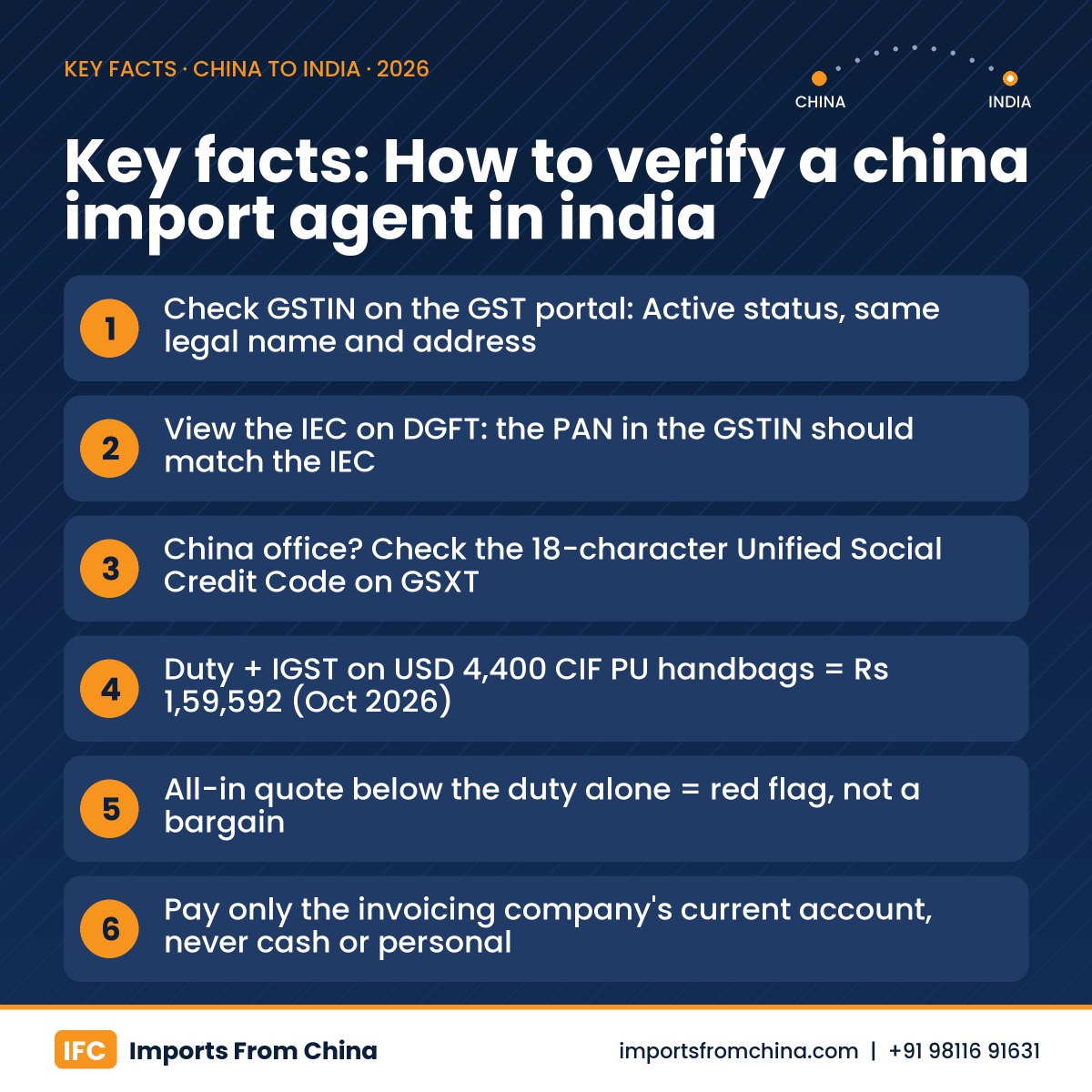
  • Payment trail: pay only the current account of the company named on the invoice, never a personal account or cash.
  • Paper trail: every shipment should come with a warehouse receipt, a bill of lading or air waybill number, a Bill of Entry number and a GST invoice.
  • Trial first: a small shipment shows you the real process before you send a large order.

Why do you need to verify a China import agent before paying?

An import agent sits between your money and your goods. You usually pay the agent for the products, the freight and often the duty, weeks before anything reaches you. If the agent is not who they claim to be, you can lose the advance, receive goods cleared under a false value, or find your cargo held at the port with nobody answering the phone.

The risk is higher in China to India trade: many “agents” are individuals reselling another forwarder’s space, some offers rely on under-invoicing or unbilled clearance, and from 1 October 2025, China’s tax authority stopped the practice of exporting goods on borrowed export documents, so an agent’s China-side set-up now matters more than before. If you are new to the roles involved, our guide to choosing a China buying agent for India explains what agents, sourcing agents and forwarders each do.

How to verify a china import agent in india infographic – key facts for Indian importers
How to verify a china import agent in india: key facts at a glance (IFC – Imports From China)

How to verify a China import agent in India: the 10-point checklist

Work through these checks in order; the first five take under an hour online.

  1. Get the full legal details in writing. Ask for the registered company name, GSTIN, IEC, registered address and the name of the person you will deal with. A genuine business sends these in one message without hesitation.
  2. Check the GSTIN on the GST portal. Use “Search Taxpayer” on the GST portal. The status should be Active, the legal name should match the quote and invoice, and the principal place of business should match the address you were given.
  3. Check the IEC on DGFT. The DGFT portal lets you view IEC details. Since the IEC is PAN-based, the PAN inside the GSTIN (characters 3 to 12) should match the IEC. An agent that offers to import “under our IEC” must have an active one.
  4. Check the company record. For a private limited company or LLP, the company master data on the MCA portal shows the incorporation date, status and directors. A very new company claiming decades of experience needs an explanation.
  5. Verify the China office. If the agent claims its own office or warehouse in China, ask for the Chinese company name and its Unified Social Credit Code, an 18-character number printed on every Chinese business licence. Search it on the National Enterprise Credit Information Publicity System (GSXT) and check the status, registered address and business scope.
  6. Ask for a live video walk-through. A short video call from the China office or warehouse, showing live cargo and the street outside, is hard to fake; chat photos are easy to copy.
  7. Ask who clears customs in India. Customs brokers (CHAs) are licensed under the Customs Brokers Licensing Regulations, 2018. Ask for the broker’s name and licence number, and whose IEC will appear on the Bill of Entry.
  8. Get an itemised written quote. Product cost, freight, duty, IGST, clearance, port or CFS charges and delivery should be separate lines, with the HS code stated.
  9. Talk to two or three real customers. Ask for references in your product category or city, and prefer detailed reviews that describe a real shipment over one-line ratings.
  10. Run a trial shipment. Start with samples or one small LCL or air shipment. Check that the documents arrive and the final bill matches the quote.

Where to check each detail

What to verifyWhere to checkWhat a good result looks like
GST registrationGST portal, Search TaxpayerActive, same legal name and address as the invoice
Import Export CodeDGFT portal, IEC detailsActive IEC, PAN matches the GSTIN
Indian company age and statusMCA company master dataActive, incorporation date fits the experience claimed
China office or warehouseGSXT, using the Unified Social Credit CodeRegistered, active, address in the city claimed
Customs brokerBroker name and licence number from the agentA licensed broker that files on ICEGATE
Bank accountThe invoice and your bank’s beneficiary checkCurrent account in the same company name
Past shipmentsReferences and detailed reviewsReal customers who can describe the process

How do you test whether an agent’s all-in quote is even possible?

The fastest way to catch a risky agent is to compare the quote with the duty and IGST customs will actually charge. If the “all-inclusive” figure is lower than the tax alone, the agent is either declaring a much lower value, using a different product description, or not filing a proper Bill of Entry. All three come back to you.

Worked example: 1,000 PU handbags by LCL sea

Assume 1,000 PU handbags (HS 4202 22 10) at USD 4.00 each, so a supplier invoice of USD 4,000 FOB, packed in about 3 CBM. We assume USD 400 for sea freight and insurance to the Indian port, which makes the CIF value USD 4,400. The customs exchange rate used is about ₹97 per USD, notified for 1 October 2026; check the current rate before filing. Assessable value is the CIF value (there is no separate 1% landing charge since 2017).

LineWorkingAmount (₹)
Assessable value (CIF)USD 4,400 × ₹974,25,920
Basic customs duty (BCD)15% of assessable value63,888
Social Welfare Surcharge (SWS)10% of BCD6,389
IGST18% of (4,25,920 + 63,888 + 6,389) = 18% of 4,96,19789,315
Total duty and IGSTBCD + SWS + IGST1,59,592

Now add the goods and a door-to-door LCL rate. The goods cost USD 4,000 × ₹97 = ₹3,87,200. LCL door to door is roughly ₹9,000 to ₹16,000 per CBM (indicative, October 2026), so about ₹27,000 to ₹48,000 for 3 CBM. A realistic landed cost is therefore roughly ₹5,73,800 to ₹5,94,800, or about ₹574 to ₹595 per bag.

Quote you receiveFreight + duty + clearance quotedWhat it tells you
Agent A, “all inclusive, no tension”₹45,000 for 3 CBMBelow the ₹1,59,592 duty and IGST alone. The value or description is being changed, or there is no proper Bill of Entry.
Agent B, itemised DDP quoteAbout ₹1,87,000 to ₹2,08,000Duty and IGST plus a normal LCL door-to-door range. Plausible; check the lines and the HS code.

There is a second benefit to the honest route. When goods are imported properly under your own IEC and GSTIN, the IGST of about ₹89,315 can normally be claimed as input tax credit, which brings your effective cost down to roughly ₹4,84,500 to ₹5,05,500. A cash “no bill” deal gives you no credit and no legal proof of import. Rates as of October 2026; confirm for your exact HS code on our India import duty rates page, and run your own product in the IFC shipment calculator.

What are the red flags of a fake or risky import agent?

  • Personal bank account or cash. The beneficiary name differs from the company on the quote, or the agent asks for UPI to an individual “for faster processing”.
  • Bank details change by message. A new account sent by WhatsApp or email just before payment is a classic diversion trick. Confirm by phone with a number you already had.
  • Price below the duty. As the example shows, an all-in price below the tax is not possible on a correct declaration.
  • “No BIS needed” for BIS items. Electronics, toys, footwear, many electrical goods and some furniture fall under BIS rules. An agent who waves this away is gambling with your cargo.
  • Promises of “no customs check” or a “setting”. No genuine agent can promise that customs will not examine a shipment.
  • No video call, no visit. Excuses every time you ask to see the office or warehouse.
  • No HS code on the quote. A duty-paid price without an HS code is a guess.
  • Pressure to pay today. “Rate valid only for one hour” or “container closing tonight” before you have even shared the packing list.

Genuine agent vs risky agent: how do they compare?

PointGenuine agentRisky agent
Company detailsGSTIN, IEC and legal name shared upfront and they matchOnly a WhatsApp number and a brand name
QuoteItemised, with HS code, CBM or weight and validityOne round figure, “all inclusive”
Importer of recordClearly states whose IEC is usedVague or avoids the question
PaymentCompany current account against an invoicePersonal account, cash or changing accounts
China presenceRegistered entity you can check, video walk-throughStock photos, refuses video
ComplianceAsks about BIS, WPC, FSSAI or CDSCO before you orderSays approvals are “not needed” or “will be managed”
DocumentsWarehouse receipt, BL or AWB, Bill of Entry, GST invoiceDelivery only, no paperwork

How do you check an agent’s China side after the October 2025 rule change?

Since 1 October 2025, China’s State Taxation Administration Announcement No. 17 of 2025 ended the use of third-party or “bought” export documents. The exporter on the Chinese customs declaration now has to be the party that actually owns the goods, or an agent that reports the real exporter. For you, this means an agent’s China-side process should be clean and explainable.

  • Ask who exports the goods. Is it your supplier under its own export rights, or an entrusted export where the real producer is disclosed?
  • Ask for the supplier’s details. The supplier’s company name and credit code should match the commercial invoice and packing list.
  • Check consistency. The invoice value you paid, the value on the export documents and the value on the Indian Bill of Entry should tell the same story.

What documents should a genuine import agent give you?

Ask for these on your trial shipment and keep them on file for every order.

StageDocumentHow you can use it
Before paymentSupplier proforma invoice and itemised agent quoteMatch product, quantity, price and HS code
China warehouseWarehouse receipt with carton count, weight, CBM and photosConfirms the cargo exists and fixes the chargeable volume
After loadingBill of lading or air waybill numberTrack the vessel or flight on the carrier’s site
Indian customsBill of Entry number, date and portShows the declared value and duty paid; track it on ICEGATE when you are the importer
DeliveryGST invoice and proof of deliveryYour books, input tax credit and proof of legal import

If you want to understand what happens between arrival and Out of Charge, read our step-by-step guide on how customs clearance works for imports in India. For the full door-to-door chain, see how DDP shipping from China to India works.

▶ Watch our step-by-step guide video

What questions should you ask an agent on the first call?

  1. Which company will invoice me, and can you share its GSTIN and IEC?
  2. Do you have your own office or warehouse in China? In which city, and under which registered company?
  3. Whose IEC will be on the Bill of Entry, and which licensed customs broker files it?
  4. Which HS code and duty rate have you used in this quote?
  5. Does my product need BIS, WPC, FSSAI, CDSCO or any other approval?
  6. What is excluded from the quote: demurrage, examination charges, anti-dumping duty, remote-area delivery?
  7. What happens if the weight or CBM at your warehouse differs from the supplier’s packing list?
  8. Which documents will I receive, and at which stage?

Compare the answers from two or three agents on the same shipment. Our overview of import agents from China to India explains the services you can expect to compare.

How IFC helps you verify and work with a China import agent

We suggest you run every check in this guide on IFC too. IFC, Imports From China Inc, has worked in China to India import and export since 2004, which is more than 20 years. IFC has its own offices in Guangzhou and Yiwu with translators and English-speaking staff, loads mixed containers and air cargo daily, and keeps a warehouse at its headquarters.

  • Services under one roof: sourcing, supplier verification, quality inspection, LCL and FCL sea freight, air cargo, customs clearance and door-to-door DDP delivery.
  • Delivery cities: major Indian cities including Delhi, Gurugram, Noida, Mumbai, Pune, Bengaluru, Hyderabad, Chennai and Ahmedabad.
  • Itemised costing: share your product, HS code, weight and CBM, and IFC will set out the cost lines so you can run the duty test yourself.

You can find IFC’s services on the China import agent in India home page.

Conclusion

Verifying a China import agent takes an hour of checks and one small trial order, which is far less than the cost of one bad shipment. Match the GSTIN, IEC and bank account to one company, confirm the China office on GSXT, test the quote against the real duty, and insist on a Bill of Entry and GST invoice every time. An agent who welcomes these checks is usually one worth working with.

Related guide: Is Importing from China to India Profitable? Margins, Costs and a ₹ Worked Example (2026)

Get your real landed cost: enter your product, weight and CBM in the IFC shipment calculator, check your HS code on the India import duty rates page, or call IFC on +91 98116 91631 for a door-to-door DDP quote from China to your city.

Frequently asked questions

How do I know if a China import agent is genuine?

Check that the GSTIN, IEC and legal name all belong to the company that invoices you, confirm any China office on the GSXT portal using its Unified Social Credit Code, ask for a live video of the warehouse, speak to two or three past customers and start with a small trial shipment before a large order.

Can I check an import agent’s IEC and GST number online?

Yes. Use Search Taxpayer on the GST portal to see whether the GSTIN is active and which legal name and address it belongs to, and view the IEC on the DGFT portal. The PAN inside the GSTIN should match the IEC, and both should match the name on your invoice.

Is it safe to pay an import agent in cash or into a personal account?

No. Pay only into the current account of the company named on the quote and invoice. Cash or personal-account payments leave you with no proof, no GST invoice and no input tax credit. If bank details change by message, confirm by phone on a number you already had.

Why is one agent’s all-inclusive rate so much cheaper than the others?

Usually because the value or product description is being changed, or the goods are not cleared on a proper Bill of Entry. Compare the quote with the real duty and IGST for your HS code. If the all-in price is lower than the tax alone, it is not a genuine offer.

How can I verify that an agent really has an office in China?

Ask for the Chinese company name and its 18-character Unified Social Credit Code from the business licence, then search it on the National Enterprise Credit Information Publicity System (GSXT). Check the status and address, and ask for a live video call from the office or warehouse.

What documents should I get from a China import agent for each shipment?

You should get the supplier invoice and packing list, a warehouse receipt with carton count, weight and CBM, the bill of lading or air waybill number, the Bill of Entry number with date and port, and a GST invoice with proof of delivery.

How to start importing from china to india

How to Start Importing from China to India: Beginner’s Step-by-Step Guide (2026)

How to start importing from China to India: get an IEC from DGFT and a GSTIN, choose a product that is legal to import and needs no licence you cannot get, verify a Chinese supplier, pay through your bank, then ship by courier, air or LCL sea and clear Indian customs through a CHA. A first sea-freight order usually takes 2 to 3 months from first enquiry to delivery.

This beginner’s guide covers each step, the registrations and compliance checks new importers miss, indicative freight costs and a worked rupee example of a first LCL order.

Key takeaways

  • Register first: IEC from DGFT (Rs 500 fee, linked to your PAN, update it every April to June) plus GSTIN to claim back import IGST.
  • Check the product before the supplier: find the HS code, import policy and any BIS, WPC, FSSAI, CDSCO or EPR requirement.
  • Start small: one or two products, samples first, 30% advance and 70% after inspection, paid only to the supplier’s company bank account.
  • Duty is on CIF: plastic household items, for example, pay 15% BCD + 10% SWS on BCD + 18% IGST, about 37.5% of CIF (rates as of October 2026).
  • Ship by volume: courier for samples, air for urgent goods, LCL at about Rs 9,000 to 16,000 per CBM door to door for 1 to 15 CBM (indicative, October 2026).
  • Worked example: a USD 3,000 FOB order of 2,000 pieces lands at about Rs 196 per piece before GST, around 1.36 times the FOB price.

How to start importing from China to India: the 9-step process

Follow these steps in order. Paying a supplier before checking whether the product needs BIS certification is the most expensive beginner mistake.

  1. Register your business: PAN, a current bank account, GSTIN and an Importer Exporter Code (IEC).
  2. Shortlist a product and find its 8-digit HS code.
  3. Check import rules for that HS code: import policy, BIS, WPC, FSSAI, CDSCO, labelling and EPR.
  4. Estimate landed cost (product + freight + duty + local charges) and compare with your Indian selling price.
  5. Find and verify suppliers on Alibaba, 1688, in Yiwu or Guangzhou markets, or at trade fairs.
  6. Order samples, agree specifications, packing and Incoterm (EXW, FOB or CIF) in a written proforma invoice.
  7. Pay the advance through your bank, then inspect goods before paying the balance.
  8. Ship by courier, air cargo, LCL or FCL sea freight to an Indian port or ICD.
  9. Clear customs and deliver: your CHA files the Bill of Entry on ICEGATE, you pay duty and IGST, and the goods are trucked to your warehouse.

IFC’s own step-by-step guide on importing from China shows how this flow works when IFC handles the China side for you. The sections below explain each step for a first-time importer.

▶ Watch our step-by-step guide video

How to start importing from china to india infographic – key facts for Indian importers
How to start importing from china to india: key facts at a glance (IFC – Imports From China)

What registrations do you need before your first import?

A sole proprietorship is enough to start; you do not need a private limited company. You need three things in place before goods leave China:

RegistrationWhereWhy you need it
PAN and current accountIncome Tax dept, your bankIEC is issued against PAN; your bank sends the foreign payment
IEC (Importer Exporter Code)DGFT portal, online, Rs 500 feeRequired for commercial imports; quoted on the Bill of Entry
GSTINGST portalLets you claim the IGST paid at customs as input tax credit

Apply for the IEC on the DGFT website; it is often issued online the same day once your PAN, address proof and bank details match. DGFT requires every IEC holder to update or confirm IEC details each year between April and June, otherwise the IEC can be deactivated. Our documents required for import from China to India checklist lists every paper you will need.

How do you choose a product that is legal and profitable to import?

Start with the HS code, not the supplier. The 8-digit Indian ITC-HS code decides your duty, whether the item can be imported freely and which approvals apply. Search your product on IFC’s India import duty rates by HS code page, then confirm with your CHA.

The compliance checks beginners miss

  • Import policy: most goods are “Free”, but some are “Restricted” (need a DGFT authorisation) or “Prohibited”. Check the ITC-HS schedule for your code.
  • BIS (Quality Control Orders): many electronics, toys, footwear, furniture, cookware and electrical items need the Chinese factory to hold a BIS licence or CRS registration. Customs can hold goods without it.
  • WPC: Bluetooth, Wi-Fi and other wireless products need WPC equipment type approval.
  • FSSAI and CDSCO: food products need FSSAI clearance; cosmetics and medical devices need CDSCO registration.
  • Legal Metrology: pre-packed retail goods need importer registration and labels showing importer name and address, MRP, net quantity and country of origin.
  • EPR: importers of goods in plastic packaging, and of electronics, may need Extended Producer Responsibility registration with CPCB. Ask your CA.
  • Anti-dumping duty: some Chinese products carry extra duty on top of BCD, which can kill your margin. Check before you order.

For a first import, pick a product with “Free” import policy, no BIS or WPC requirement, no anti-dumping duty and a simple HS code: for example plastic household organisers, bags, home decor, gym accessories or stationery. Leave electronics, toys, cosmetics and food until you have one clean shipment behind you.

Where do you find and verify Chinese suppliers?

ChannelTypical MOQLanguage and paymentBest for
Alibaba.comLow to mediumEnglish, USD, Trade AssuranceFirst orders, custom branding
1688.comLow, domestic pricesChinese, RMB, needs an agentLower prices on stock items
Yiwu marketLow per design, many productsChinese, RMB, cash or transferMixed small orders, general goods
Guangzhou markets and Canton FairMediumSome EnglishSeeing products and factories in person

Whichever channel you use, verify before you pay:

  • Ask for the business licence and check the company name and registration on China’s official National Enterprise Credit Information Publicity System (gsxt.gov.cn).
  • Confirm the bank account name on the proforma invoice matches the licensed company. Never pay a personal account.
  • Order samples by courier and compare them against your written specification.
  • Ask for BIS, test reports or certificates if your product needs them, and check them independently.

Read our China buying agent for India guide if you would rather have someone on the ground, and the Yiwu market guide for Indian importers if you plan to buy small quantities across many products.

How do you pay a Chinese supplier safely from India?

Import payments go through your bank (an authorised dealer bank), usually by telegraphic transfer (TT) in USD. The bank asks for the proforma invoice and its import payment form; keep the remittance advice for your records.

  • Common terms: 30% advance to start production, 70% balance after inspection and before loading.
  • Alibaba Trade Assurance: pay through the platform for added protection if the order is placed and paid on Alibaba.
  • Costs: budget for your bank’s remittance charges and its exchange-rate margin over the market rate.

If a supplier suddenly changes bank details by email or chat, call them on a known number before paying.

Which shipping method should a first-time importer choose?

Choose by weight, volume and urgency. Most first commercial orders from China to India fit LCL sea freight, where your cartons share a container with other importers’ cargo.

ModeIndicative cost (October 2026)Door-to-door timeBest for
Courier (express)Rs 450 to 900 per kgAbout 4 to 8 daysSamples and very small parcels
Air cargoRs 280 to 450 per kg airport to airport; about Rs 750 per kg door to door with duty paid (IFC, 50+ kg general cargo)5 to 10 daysUrgent or high-value goods, roughly 50 to 500 kg
LCL sea freightRs 9,000 to 16,000 per CBM door to doorRoughly 3 to 6 weeks1 to 15 CBM, most first orders
FCL (20ft or 40ft container)Quoted per containerPort to port about 12 to 20 days to Nhava Sheva, plus clearance and truckingAbove about 15 CBM

All rates are indicative, October 2026, and move with season and fuel prices; always take a written quote. Sea cargo usually arrives at Nhava Sheva (JNPT), Mundra, Chennai or Kolkata, or travels by rail to ICD Tughlakabad or Patparganj for Delhi NCR. Our air freight vs sea freight from China to India guide shows how to compare chargeable weight and volume.

What happens at Indian customs, and how is duty calculated?

Once the ship or flight is on its way, your customs broker (CHA) prepares the Bill of Entry from your commercial invoice, packing list and bill of lading or airway bill, and files it on ICEGATE, ideally before the cargo arrives. Customs assesses the entry, you pay duty online, the goods may be examined, and customs gives “Out of Charge”. You then pay port or CFS and delivery order charges and truck the goods out. Our customs clearance guide for imports in India explains each stage and the usual timelines.

The duty formula

  • Assessable value (AV) = CIF value (cost + ocean freight + insurance) in rupees, converted at the CBIC-notified import exchange rate in force when the Bill of Entry is filed. There is no separate 1% landing charge.
  • BCD (Basic Customs Duty) = rate for your HS code x AV.
  • SWS (Social Welfare Surcharge) = 10% of BCD, unless exempt for your code.
  • AIDC, where it applies to your code, is charged on AV instead of part of the BCD.
  • IGST = 5%, 18% or 40% (as per the GST rate for the goods) of AV + BCD + SWS + AIDC. Anti-dumping duty, if any, is added before IGST.

For plastic household articles (HS 39249090) the rates in the IFC duty database are 15% BCD, 10% SWS on BCD, nil AIDC and 18% IGST. On Rs 100 of CIF that is Rs 15 BCD, Rs 2 SWS and Rs 21 IGST, or about Rs 38 in total. The IGST part comes back as input tax credit if you are GST-registered. Rates as of October 2026; confirm for your exact HS code. See our import duty from China to India guide for more product examples.

How much money do you need to start importing? A worked example in rupees

Assume a Delhi-based home-goods seller places a first order of 2,000 plastic kitchen and wardrobe organisers (HS 39249090) from a Yiwu supplier at USD 1.50 each, FOB Ningbo. Packed volume is 4 CBM and about 600 kg, shipped LCL. The exchange rate used is the CBIC-notified import rate of Rs 96 per USD in force from 16 October 2026; customs will use the rate in force when you file.

Cost lineHow it is worked outAmount (Rs)
FOB valueUSD 3,000 x 95.902,87,700
Ocean freight (for customs value)Assumed USD 200 x 95.9019,180
Marine insuranceActual premium1,500
CIF = assessable valueFOB + ocean freight + insurance3,08,380
BCD15% of 3,08,38046,257
SWS10% of BCD4,626
IGST (creditable)18% of 3,59,263 (AV + BCD + SWS)64,667
LCL door to door (freight, CFS, CHA, delivery)4 CBM x Rs 12,000 (indicative mid-range; already includes the ocean freight above)48,000
Samples by courierAbout 2 kg x Rs 900 per kg1,800
Bank remittance chargesIndicative2,000
Landed cost before GSTFOB + LCL door to door + insurance + BCD + SWS + samples + bank3,91,883
Total cash neededIncluding IGST of 64,6674,56,550

Duty rates as of October 2026; confirm for your exact HS code. Freight and local costs are indicative, October 2026. The landed cost is about Rs 196 per piece before GST against an FOB price of Rs 144, roughly 1.36 times FOB. You need about Rs 5 lakh of working capital for this order, of which Rs 64,667 IGST returns as credit when you file GST returns. If you plan to sell at Rs 399 to Rs 499 on Amazon or Flipkart, the margin covers fees and returns; at Rs 249, it does not. Run your own product in the IFC shipment calculator before you order.

What mistakes should beginners avoid?

  1. Paying before checking BIS or WPC. Goods without the required approval can be held at the port, re-exported or destroyed.
  2. Accepting a “low invoice”. Under-declaring value to save duty risks reassessment, penalties and seizure. Declare the real price.
  3. Comparing only the FOB price. Two quotes on different Incoterms (EXW vs FOB vs CIF) are not comparable. Always work out landed cost.
  4. Skipping inspection. A short pre-shipment check before the balance payment is far cheaper than fighting a dispute later.
  5. Weak packing and labels. Insist on export cartons, carton marks and Legal Metrology labels before loading.
  6. Ignoring Chinese holidays. Chinese New Year and Golden Week (early October) can stop factories for one to four weeks.

First-import checklist

  • IEC active and GSTIN in the same business name
  • HS code, import policy, BIS/WPC/FSSAI/CDSCO status and duty confirmed
  • Landed cost per piece calculated and margin checked
  • Supplier licence verified, samples approved, proforma invoice with specifications, packing and Incoterm
  • Payment to the supplier’s company account only, balance after inspection
  • Freight booked, insurance arranged, CHA briefed with invoice, packing list and bill of lading

How IFC helps you start importing from China to India

IFC (Imports From China) has 20+ years in China–India import and export. If you are new to importing, IFC can handle the parts that usually go wrong:

  • Own offices in Guangzhou and Yiwu with translators and English-speaking staff for supplier communication.
  • Sourcing, supplier verification and quality inspection before you pay the balance.
  • LCL and FCL sea freight and air cargo, with daily loading of mixed containers and air cargo, so a small first order can ship without waiting.
  • Customs clearance and door-to-door DDP delivery to Delhi, Gurugram, Noida, Mumbai, Pune, Bengaluru, Hyderabad, Chennai, Ahmedabad and other major cities, with a warehouse at IFC’s headquarters.

Conclusion

Starting to import from China to India is a sequence, not a gamble: register IEC and GST, check the HS code and approvals, verify the supplier, pay through your bank, ship by volume and clear customs with a good CHA. Work out landed cost first, start small and scale once the numbers work.

Related guide: How to Verify a China Import Agent in India Before You Pay (2026 Checklist)

Mayank Dang (CA Sahab), Founder and CEO of IFC

Guide on starting to import from China reviewed by Mayank Dang (CA Sahab), Founder & CEO of IFC

Chartered Accountant (FCA, ICAI) who has helped 5000+ Indian businesses import from China since 2004 – sourcing, BIS, HSN classification, import duty, customs and GST compliance. mayankdang.in

Get your real landed cost: enter your product, weight and CBM in the IFC shipment calculator, check your HS code on the India import duty rates page, or call IFC on +91 98116 91631 for a door-to-door DDP quote from China to your city.

Frequently asked questions

How do I start importing from China to India as a beginner?

Register your business with PAN, a current account, GSTIN and an IEC from DGFT. Then pick a product, check its HS code, import policy and BIS or WPC rules, estimate landed cost, verify a supplier, order samples, pay through your bank, ship by courier, air or LCL sea, and have a CHA file the Bill of Entry on ICEGATE.

Can I import from China to India without an IEC?

You can import goods for genuine personal use without an IEC. For goods you plan to sell, an IEC is required, and a GSTIN lets you claim back the IGST paid at customs. Some buyers use a door-to-door DDP service where the provider handles the import formalities, so ask how the goods will be invoiced to you.

How much money do I need to start importing from China?

It depends on product and quantity, but a small first LCL order is often a few lakh rupees. In our example, a USD 3,000 FOB order of 2,000 plastic organisers needed about Rs 5 lakh in total, including Rs 64,667 IGST that comes back as GST credit. Courier sample orders can start much smaller.

Do I need a licence to import from China to India?

Most goods have Free import policy and need only an IEC. Restricted items need a DGFT authorisation, and many products need approvals such as BIS certification or CRS registration, WPC approval for wireless devices, FSSAI for food or CDSCO for cosmetics and medical devices. Check the rules for your exact HS code before ordering.

Can I import small quantities from China to India?

Yes. Samples and parcels can come by courier, and small commercial orders from about 1 CBM can ship by LCL sea freight, where your cartons share a container with other cargo. Buying from Yiwu or 1688 suppliers and consolidating several suppliers into one shipment helps keep minimum order quantities and freight costs low.

How long does it take to import goods from China to India?

Plan 2 to 3 months for a first sea-freight order. Supplier search and samples take 1 to 3 weeks, production often 2 to 6 weeks, LCL roughly 3 to 6 weeks door to door and air cargo 5 to 10 days door to door. Chinese New Year and Golden Week can add one to four weeks.

Imports From China (IFC)

How do I trust Imports From China Inc for importing my products

 How do I trust you

(Why do Clients trust Imports From China Inc (IFC))

 Imports From China (IFC)

 IFC is a Justdial Trusted Supplier and an IndiaMART Industry Leader, with hundreds of verified customer reviews. READ IFC REVIEWS ON JUSTDIAL | VISIT IFC ON INDIAMART

IFC started in 2004 is a top brand in door to door services from china to India with 20+ years of experience (since 2004).

We serve to the top importers in India for furniture, shoes, gift items, cosmetics, electronicsetc and they have their testimonials on our website. ImportsFromChina

There is 90% chance that we and you will find a common reference because we have offices & popular clients in almost all metro cities in India.

search on who.is website importsfromchina.com and it shall show you our website domain registration date of 2002 that was the opening point of china to india trade or just CLICK HERE

Your welcome to visit our head office in Delhi.

IMPORTS FROM CHINA INC.

E-41A, Block E, Bhimsen Dhingra Marg, Kirti Nagar, New Delhi, Delhi 110015


How do I proceed next with IFC? Click Here to Know More

Is Buying on Alibaba Safe? Click Here Know More


Still have questions about Import? Click here for answers

Made in China quality check by IFC team before shipping to India

Why is importing from China bad? Explained by IFC Professionals

Why isimporting from China bad? Explained by IFC Professionals

Imports From China (IFC)

Importing from china is bad, Products Scams, Payments Fraud are all old school at IFC we encourage buyer to deal Chinese supplier only via alibaba.com and paying supplier via Alibaba Trust Pay, AlibabaPayments Assurance Program.

When you get in touch with IFC along with Alibaba Payments Assurance Program you gets an upper hand on Chinese supplier as IFCteam provides QC and Quality check of your product inside china so if supplier tries to cheat you with product quality or quantity IFC team prominently informs you to raise dispute via Alibaba Payments Assurance Program and that’s make you 100% secure either you get product replaced or full refund from alibaba.com

Qc 2bfrom


Whether you are importing single quantity or full container your products are QC Checked by IFC so sit back, relax and enjoy your hassle free import.


hot selling products to import from china cost of import

Imports From China (IFC)
hot selling products to import from china cost of import for air cargo from china guangzhou to delhi over 100kgs = rs.550-650 per kg including air freight/duty/door delivery -all include costs
(how much time it takes for shipping from china to india : 5-6 days by air door delivery )
#DDP shipping service from china to india Amazon fba
#readymade garment import from china to india
#handbags import from china to india
#imitation jewellery import from china
#smartwatch import from china
#airpods made in china
#import ladies shoes from china
#bluetooth headphones import from china
#import women’s clothes from china
#import designer clothes from china
#import clothes from china
#how much does it cost to import clothes from china
#import watches from china
#import jacket from china
#how to import ladies bags from china
#how to import bags and shoes from china
#import electronics from china to india How to proceed ?
How it works? ——————————————————–
Your Part ——————————————————–
01. Download Alibaba App
02. Find Your Product
03. Send Enquiry to the Suppliers
04. Chat & Negotiate with China Supplier
05. Get the Performa Invoice , packing list & Send to IFC
06. Negotiate Your Duty Paid Delivery Cost with IFC.
Sit Back & Relax! Leave the Rest on Us.
Our Part ————————————————————
7. IFC collects / airship /custom clear/ships your products to your doorstep