Do you pay customs duty on a single AliExpress or online order from China to India? Yes, usually. Goods ordered for personal use and delivered by courier or post are dutiable. Budget 2026 cut the tariff rate on dutiable personal imports (heading 9804) from 20% to 10%, and IGST is added on top. Only genuine low-value gifts within the notified limit are exempt.
This guide explains how duty works on single online orders from China, when a “personal” parcel becomes a commercial import, and the cheaper legal route if you want to buy in bulk for resale.
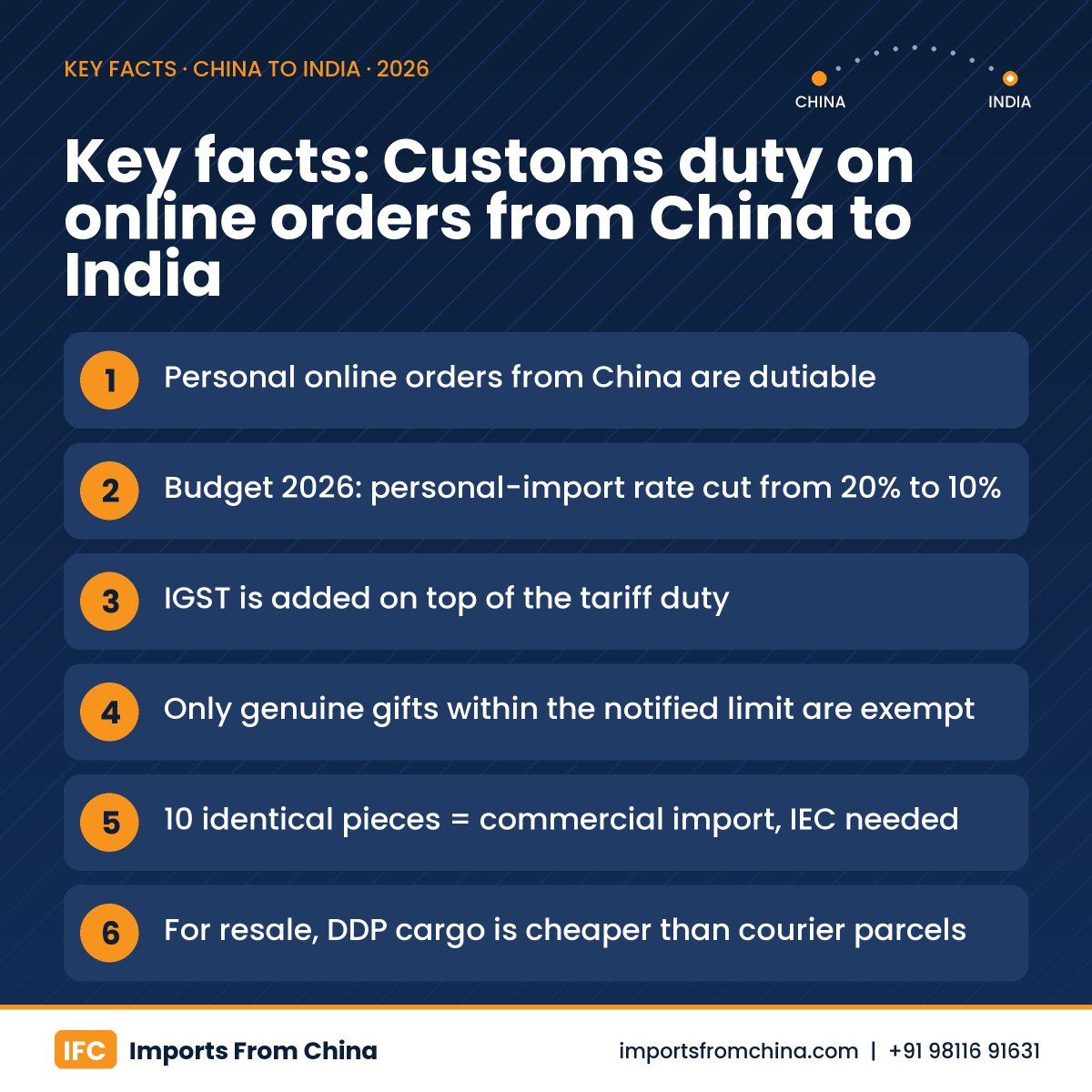
Key takeaways
Personal orders are dutiable: courier and postal parcels for personal use attract duty under heading 9804.
Lower rate from 2026: Budget 2026 cut the personal-import tariff rate from 20% to 10%; IGST still applies.
Gifts: only genuine gifts within the notified value limit are exempt, not purchases.
Commercial quantity: 10 identical items is trade, not personal use: you need an IEC and normal duty rates.
KYC: couriers ask for Aadhaar/PAN before clearing parcels.
For resale: consolidated DDP cargo is far cheaper per kg than single courier parcels.
Do I have to pay customs duty on an AliExpress order to India?
Yes, in most cases. Indian customs treats any purchase delivered from abroad as an import. For goods meant for your personal use, customs applies the special tariff heading 9804 (all dutiable articles imported for personal use). In Budget 2026 the government reduced this tariff rate from 20% to 10%. IGST and any applicable surcharge are charged on top, so the total you pay is higher than 10%. The courier (DHL, FedEx, Blue Dart, India Post) collects the duty from you before delivery.
Note: the AliExpress app was blocked in India in 2020, and many sellers on Chinese marketplaces limit shipping to India. Most single orders now come through other marketplaces or direct from suppliers on Alibaba.
Customs duty on online orders from China to India: key facts at a glance (IFC – Imports From China)
How is customs duty calculated on a personal online order?
10% for personal-use imports from Budget 2026 (earlier 20%)
IGST
Added on the value plus duty, as per the GST rate of the item
Courier handling
Couriers often add a small duty-processing or clearance fee
Payment
Paid online or at delivery before the parcel is released
Example: a ₹4,000 smartwatch ordered for yourself. The tariff duty at 10% is ₹400, then IGST is added on ₹4,400 at the applicable rate (for example 18% = ₹792). Your total duty is about ₹1,192, plus any courier fee. Always check the final amount shown by the courier, since rates depend on the exact item and the current notification.
Are gifts from China duty free in India?
Only genuine gifts sent free of cost by a person abroad, within the value limit notified by CBIC, are exempt. A product you paid for online is a purchase, not a gift, even if the seller writes “gift” on the parcel. Misdeclaring a purchase as a gift can lead to the parcel being held, reassessed or confiscated.
When does a personal order become a commercial import?
You order several identical pieces (for example 10 phone cases or 20 watches).
The parcel value or frequency suggests resale.
The goods need product approvals such as BIS or WPC for sale in India.
In these cases customs can treat the parcel as a commercial import. You then need an IEC (or an importer who imports on their IEC), normal duty rates by HS code apply instead of heading 9804, and product compliance must be in place. Read documents required to import from China.
What items should you not order from China by courier?
Drones, walkie-talkies and many wireless devices without WPC approval.
Medicines, supplements and cosmetics in commercial quantity (CDSCO rules).
Branded replicas: seized under IPR rules.
Batteries and power banks in quantity: shipping restrictions and BIS rules.
E-cigarettes and other prohibited goods.
Courier parcels vs DDP cargo: what is cheaper for business buyers?
Factor
Single courier parcel
IFC DDP cargo
Best for
1 to 5 personal items
50 kg+ business stock
Cost
High per kg + duty collected at door
About ₹750/kg air DDP for general goods (50 kg+), sea roughly half
How IFC helps online buyers move to bulk importing
IFC (Imports From China) has handled China–India imports for 20+ years, since 2004, and has served 5000+ Indian businesses. From our own offices in Guangzhou and Yiwu we buy from Alibaba, 1688 and wholesale markets for you, check quality, consolidate your orders and deliver door to door in India with duty and customs included. Start with our China product sourcing service.
Conclusion
A single online order from China for your own use is dutiable, but the personal-import rate is now lower at 10% plus IGST. Do not call purchases gifts, and do not order commercial quantities as personal parcels. If you are buying to sell, a consolidated DDP shipment is cheaper, safer and fully legal.
Chartered Accountant (FCA, ICAI) who has helped 5000+ Indian businesses import from China since 2004 – sourcing, BIS, HSN classification, import duty, customs and GST compliance. mayankdang.in
Do I need to pay customs duty on AliExpress orders in India?
Yes. Goods bought online from abroad for personal use are dutiable under heading 9804. Budget 2026 cut that tariff rate from 20% to 10%, and IGST is added on top. The courier collects the duty before delivery.
Is there a duty-free limit for online orders to India?
There is no general duty-free limit for purchases. Only genuine gifts sent free by a person abroad within the CBIC notified value limit are exempt. A paid order is not a gift.
Who pays the customs duty on a courier parcel from China?
The receiver in India. DHL, FedEx, Blue Dart or India Post will ask you to pay the duty, often online, before they deliver the parcel.
Can I order 10 pieces from China by courier for resale?
Customs may treat it as a commercial import. You then need an IEC, normal duty rates apply and the product must meet BIS or other rules. For resale, consolidated DDP cargo is usually cheaper.
Why was my China parcel held by customs?
Common reasons are missing KYC, a value that looks too low, commercial quantities, or restricted items such as wireless devices, medicines or branded replicas.
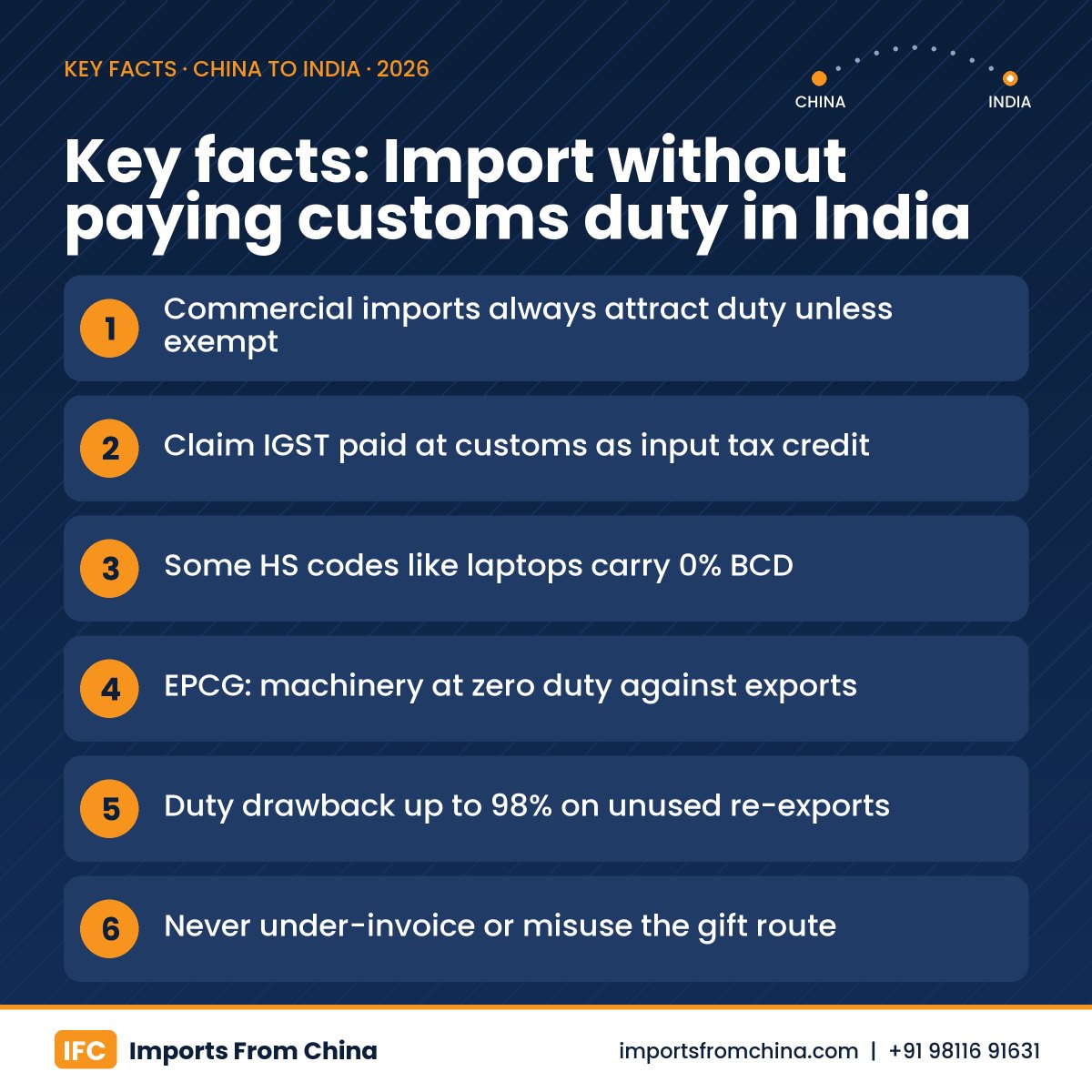
Can you import without paying customs duty in India? For normal commercial imports, no: customs duty must be paid. But you can legally pay zero or much lower duty by importing products with 0% BCD, claiming IGST as input tax credit, using export schemes like Advance Authorisation or EPCG, bonded warehousing, duty drawback on re-export, and genuine sample or gift exemptions.
Many online answers to this question suggest under-invoicing or calling goods “gifts”. That is customs fraud and leads to seizure and penalties. This guide covers only the legal routes Indian importers use, with a worked example in rupees.
Key takeaways
No duty-free shortcut: commercial imports always attract duty unless an exemption or scheme applies.
IGST credit is the biggest saving: GST-registered importers can usually claim the IGST paid at customs.
Some goods have 0% BCD: for example laptops (8471 30 10), though they still need IGST and import authorisation.
Exporters save most: Advance Authorisation, EPCG, SEZ/EOU and drawback can cut duty to nil.
Correct HS code: the right classification is legal; misclassification is not.
Never under-invoice: penalties, confiscation and a customs record cost far more than the duty.
Is it legal to import without paying customs duty in India?
Under the Customs Act, 1962, duty is payable on all imports unless a notification exempts the goods or you import under an approved scheme. So “import without paying duty” is legal only in specific cases: goods with nil duty rates, notified exemptions (such as bona fide samples or small gifts within limits), and schemes under the Foreign Trade Policy. Everything else, such as undervaluing the invoice or splitting a commercial order into gift parcels, is illegal.
Import without paying customs duty in India: key facts at a glance (IFC – Imports From China)
9 legal ways to pay less (or zero) import duty
1. Claim IGST as input tax credit
IGST is often the largest part of the duty bill. If you have a GSTIN and the Bill of Entry is in your name, the IGST paid at customs can usually be used as input tax credit against your GST output. Your real cost then becomes only BCD, SWS/AIDC and any anti-dumping duty.
2. Import products that carry 0% BCD
Some HS codes have nil basic customs duty, many of them IT products. For example, laptops and tablets (8471 30 10) carry 0% BCD with 18% IGST, but they also need DGFT import authorisation and BIS registration. Check your code on the India import duty rates page.
3. Classify the product correctly
Two similar products can sit under different HS codes with different duty. Choosing the code that genuinely describes your product, based on its material, function and use, is legal and can save money. Choosing a wrong code to pay less is misdeclaration. Read our HS code guide.
4. Use APTA concessions where available
India and China are both members of the Asia-Pacific Trade Agreement (APTA). For a limited list of tariff lines, goods with a valid APTA certificate of origin get a concessional duty rate. India has no full free trade agreement with China, so check whether your exact HS code is covered before relying on it.
5. Advance Authorisation for exporters
If you use imported inputs to make goods for export, an Advance Authorisation from DGFT lets you import those inputs duty-free, against an export obligation.
6. EPCG for machinery
Under the Export Promotion Capital Goods (EPCG) scheme, manufacturers and exporters can import capital goods such as machinery at zero customs duty, against an export obligation of six times the duty saved, to be met within six years.
7. SEZ, EOU and bonded warehousing
Units in a Special Economic Zone or registered as Export Oriented Units import duty-free for their authorised operations. Under the Manufacturing and Other Operations in Warehouse Regulations (MOOWR), goods can be kept in a customs-bonded warehouse with duty deferred, and no duty is paid if the finished goods are exported.
8. Duty drawback on re-export
Under Section 74 of the Customs Act, if imported goods are re-exported (for example rejected or unsold stock), you can claim back most of the duty paid, up to 98% if the goods were not used, subject to conditions and time limits.
9. Genuine samples and gifts (small quantities only)
Bona fide commercial samples and small personal gifts can be cleared duty-free within limits notified by CBIC. These exemptions are for genuine samples and gifts only, not for goods you will sell. Customs checks quantity, value and frequency.
Which products are duty free for import to India?
Very few products are fully duty free. Most “duty free” items have 0% BCD but still attract IGST. Common cases include certain IT products under the Information Technology Agreement, some life-saving drugs and medical equipment notified by the government, goods imported under export schemes, and goods for SEZ/EOU units. Always confirm the current rate for your 8-digit HS code on the CBIC tariff or with IFC.
Worked example: how much duty can you really save?
Compare ₹1,00,000 CIF of LED lamps (BCD 20%) with ₹1,00,000 CIF of laptops (BCD 0%), for a GST-registered importer (rates as of October 2026; confirm for your HS code):
Item
LED lamps
Laptops
CIF value
₹1,00,000
₹1,00,000
BCD
₹20,000
₹0
SWS (10% of BCD)
₹2,000
₹0
IGST 18%
₹21,960
₹18,000
Total paid at customs
₹43,960
₹18,000
Less IGST credit
– ₹21,960
– ₹18,000
Real duty cost
₹22,000
₹0
The laptop import is effectively duty-free for a GST-registered business, but only with DGFT import authorisation and BIS compliance in place.
What happens if you under-declare value or misuse the gift route?
Customs can reject the declared value and reassess duty on the correct value.
Goods can be confiscated, with redemption fines and penalties under the Customs Act.
Your IEC gets flagged, so future shipments face more checks and delays.
Port storage and demurrage keep adding up while the case is open.
IFC (Imports From China) has handled China–India imports for 20+ years, since 2004, and has served 5000+ Indian businesses. Founded and led by Chartered Accountant Mayank Dang, our team guides you on HSN classification, BIS and duty before you order, then handles sourcing from our own offices in Guangzhou and Yiwu, quality inspection, shipping, customs clearance and door-to-door DDP delivery.
Conclusion
You cannot skip customs duty on commercial imports, but you can legally pay much less: claim IGST credit, use the correct HS code, check 0% BCD and APTA lines, and use export schemes if you export. Avoid under-invoicing and fake gift parcels. They are the most expensive mistakes an importer can make.
Chartered Accountant (FCA, ICAI) who has helped 5000+ Indian businesses import from China since 2004 – sourcing, BIS, HSN classification, import duty, customs and GST compliance. mayankdang.in
Can I import goods into India without paying customs duty?
Only in specific legal cases: products with nil duty, notified exemptions such as genuine samples or small gifts within limits, and Foreign Trade Policy schemes like Advance Authorisation, EPCG, SEZ or EOU. Normal commercial imports attract customs duty.
Which products are duty free for import to India?
Very few are fully duty free. Some IT products such as laptops have 0% basic customs duty but still attract 18% IGST. Certain notified medical items and goods under export schemes can also be exempt. Check the current rate for your HS code.
Can I claim the IGST paid on imports?
Yes. If you have a GSTIN and the Bill of Entry is in your name, the IGST paid at customs can usually be claimed as input tax credit, which reduces your real duty cost.
Is importing as a gift to save duty legal?
Only genuine personal gifts within the notified value limit are exempt. Sending commercial goods as gifts or splitting an order into gift parcels is misdeclaration and can lead to confiscation and penalties.
How can a manufacturer import machinery from China at zero duty?
Under the EPCG scheme, manufacturers and exporters can import capital goods at zero customs duty against an export obligation of six times the duty saved within six years.
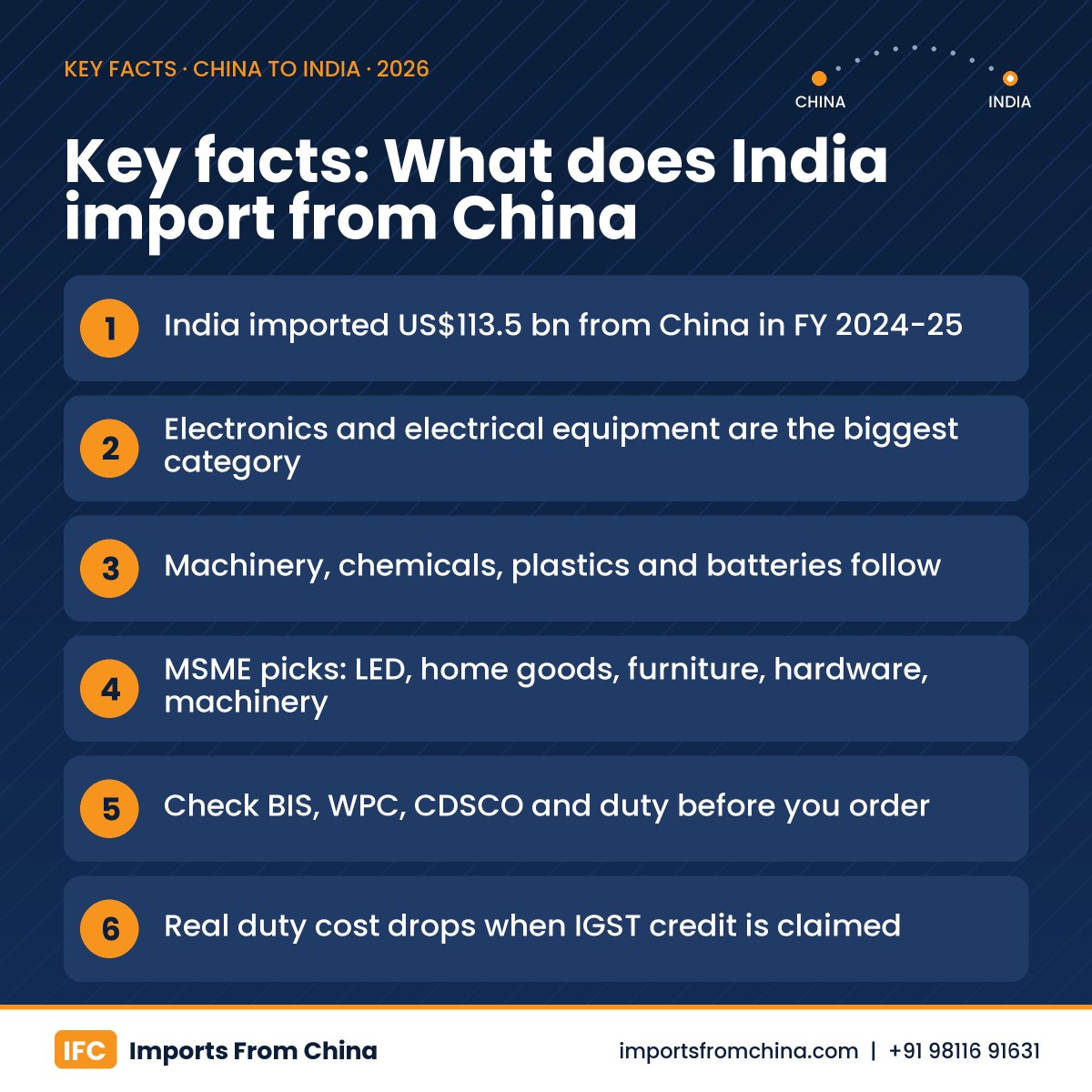
What does India import from China? India imported goods worth about US$113.5 billion from China in FY 2024-25, led by electronics and electrical equipment, machinery, organic chemicals, plastics, solar cells, batteries, steel products and consumer goods. China is India’s largest source of imports, and the trade deficit hit a record US$99.2 billion.
Most lists online stop at big national categories. This guide goes further: it explains which of these products Indian MSMEs can realistically import, what duty and compliance (BIS, WPC, CDSCO) each needs, and how to pick a profitable product for your own business.
Key takeaways
Size: India imported about US$113.5 billion from China in FY25, up from US$101.7 billion in FY24.
Biggest category: electronics and electrical equipment, followed by machinery and organic chemicals.
MSME sweet spot: LED and electrical items, home and kitchen goods, hardware, furniture, auto parts, packaging and machinery.
Compliance first: many items need BIS, WPC, CDSCO or import authorisation before shipping.
Duty varies: from 0% BCD (laptops) to 70% BCD (toys), so check your HS code first.
According to Commerce Ministry data reported in April 2025, India’s imports from China rose about 11.5% to US$113.46 billion in FY 2024-25, while India’s exports to China fell to US$14.25 billion. That left a trade deficit of about US$99.2 billion, the highest ever. Electronics, EV batteries, solar cells and industrial inputs drove the increase.
Year
Imports from China
Exports to China
Trade deficit
FY 2023-24
US$101.7 bn
US$16.7 bn
about US$85 bn
FY 2024-25
US$113.5 bn
US$14.3 bn
US$99.2 bn
For exact figures by HS code, check the Department of Commerce trade data (TradeStat), which lists imports country-wise and product-wise.
What does India import from China: key facts at a glance (IFC – Imports From China)
What are the main products India imports from China?
Category
Typical products
Who imports them
Electronics and electrical equipment
Mobile phone parts, ICs, PCBs, LED lights, chargers, telecom gear, solar cells
Manufacturers, assemblers, traders
Machinery and equipment
Industrial machines, pumps, motors, CNC and packaging machines, spare parts
Factories and MSME units
Organic and inorganic chemicals
APIs, dyes, pigments, specialty chemicals
Pharma, textile and chemical units
Plastics and rubber
Polymers, plastic goods, packaging
Packaging and consumer brands
Iron, steel and metal products
Fasteners, hardware, tools, fittings
Hardware traders, builders
Batteries and EV parts
Lithium-ion cells, battery packs, EV components
EV makers, energy storage
Consumer and home goods
Kitchenware, home decor, furniture, toys, stationery, gifts
Retailers, e-commerce sellers, interior designers
Medical devices and supplies
Diagnostic kits, disposables, equipment
Hospitals, distributors
Textiles and fibres
Synthetic yarn, fabrics, garment accessories
Garment manufacturers
Auto components
Lighting, sensors, wiring harnesses, accessories
Auto parts dealers and workshops
Large companies import intermediate goods (chips, APIs, chemicals) for manufacturing. MSMEs and traders mostly import finished goods, spare parts and machinery, and that is where most small importers find good margins.
Which products from China can Indian MSMEs import profitably?
From the big categories above, these are the ones small and medium businesses import most often, with steady demand and manageable compliance:
LED lights and electrical fittings for contractors, shops and projects. BIS registration is needed for LED lamps.
Home and kitchen products such as organisers, storage, cookware accessories and decor. Light, easy to ship and in demand on Amazon and Flipkart.
Furniture and interior products from Foshan for showrooms, hotels and interior designers. Ship by sea; furniture now falls under a BIS quality control order.
Hardware, tools and fittings for hardware stores and builders.
Machinery and spare parts such as packaging, printing and CNC machines. Fewer competitors and high order value.
Mobile and computer accessories such as cases, stands, cables and holders. Chargers, power banks and wireless items need BIS and sometimes WPC approval.
Packaging material for brands and e-commerce sellers.
Auto accessories and parts for dealers and workshops.
Gifts, stationery and festive items from Yiwu, ideal before Diwali and wedding season.
What duty and compliance apply to popular China imports?
Duty and approvals depend on the 8-digit HS code. A few examples from the IFC duty database (rates as of October 2026; confirm for your exact HS code):
Product (HS code)
BCD
IGST
Key compliance
Laptops and tablets (8471 30 10)
0%
18%
DGFT import authorisation, BIS CRS, WPC for Wi-Fi/Bluetooth
How do you choose the right product to import from China?
Start with your market. Pick products you can sell: your shop, B2B clients, Amazon or Flipkart.
Check rules before price. Find the HS code and confirm BIS, WPC, FSSAI, CDSCO or import authorisation needs.
Compare China prices on Alibaba, 1688 or wholesale markets in Yiwu and Guangzhou.
Calculate landed cost: product price + freight + duty + clearance + delivery. Air DDP is about ₹750/kg for general goods (50 kg+), and sea is roughly half.
Compare with the Indian selling price. For retail, aim for at least 2x landed cost.
Start with a sample order, then scale.
Worked example: landed cost of LED lamps from China
Suppose you import LED lamps with a CIF value of ₹1,00,000 (BCD 20%, SWS 10% of BCD, IGST 18%):
Assessable value (CIF)
₹1,00,000
BCD 20%
₹20,000
SWS 10% of BCD
₹2,000
IGST 18% on ₹1,22,000
₹21,960
Total duty
₹43,960
Less IGST credit (if GST registered)
– ₹21,960
Real duty cost
₹22,000
This is why a GSTIN matters: the IGST part can usually be claimed as input tax credit, so your real duty cost is the BCD and SWS.
Which China imports are restricted or risky for small importers?
Branded copies: seized at customs under IPR rules.
Toys: 70% BCD plus mandatory BIS, so not ideal for beginners. See our toy import guide.
Laptops, tablets and PCs: need DGFT import authorisation.
Medical devices, drugs and cosmetics: need CDSCO registration or import licence.
Batteries and liquids: costlier to ship by air and need special handling.
Goods under anti-dumping duty: some Chinese products carry extra duty, so always check before ordering.
How IFC helps Indian businesses import from China
IFC (Imports From China) has worked in China–India imports for 20+ years, since 2004, and has served 5000+ Indian businesses. We have our own offices in Guangzhou and Yiwu with translators and English-speaking staff. We help with product sourcing, supplier verification, quality inspection, BIS/HSN/duty guidance, LCL/FCL sea and air cargo, customs clearance and door-to-door DDP delivery to major Indian cities. Start with our China product sourcing service.
Conclusion
India imports everything from chips to chairs from China, worth over US$113 billion a year. For an MSME, the opportunity lies in finished goods, parts and machinery where you control the selling price. Check the HS code and compliance first, calculate your full landed cost, start with a sample, and scale what sells.
Chartered Accountant (FCA, ICAI) who has helped 5000+ Indian businesses import from China since 2004 – sourcing, BIS, HSN classification, import duty, customs and GST compliance. mayankdang.in
Electronics and electrical equipment are the largest category, including mobile phone parts, integrated circuits, telecom equipment, solar cells and LED products. Machinery and organic chemicals come next.
How much does India import from China every year?
India imported about US$113.5 billion of goods from China in FY 2024-25, up from about US$101.7 billion in FY 2023-24, according to Commerce Ministry data.
What is the best product to import from China to India for a small business?
There is no single best product. Good options for MSMEs include LED lights, home and kitchen goods, hardware, furniture, packaging, auto accessories and machinery. Choose a product you can sell, check its compliance and calculate the landed cost first.
Do I need a licence to import products from China to India?
For commercial imports you need an IEC and usually a GSTIN. Some products also need BIS, WPC, FSSAI, CDSCO or DGFT import authorisation. Check the rules for your HS code before ordering.
Why does India import so much from China?
China offers large-scale production, lower prices and a complete supply chain for electronics, chemicals and machinery. Many Indian manufacturers depend on Chinese components, although government schemes are working to increase local production.
China to India shipping cost per kg in 2026 is about ₹750 per kg for door-to-door (DDP) air cargo of general goods above 50 kg, and about ₹1,350 per kg for batteries, liquids, cosmetics, magnets or high-value goods. Sea cargo costs roughly half the air rate, and bulk sea shipments above 5,000 kg can come down to ₹50–150 per kg.
This guide explains what those per kg rates include, how air and sea compare, how volumetric weight and customs duty change your final price, and how to work out your own landed cost in two minutes with the free IFC shipment calculator.
Key takeaways
Air DDP, general cargo: about ₹750/kg for 50 kg+ shipments with value under ₹2,000/kg.
Air DDP, special goods: about ₹1,350/kg for battery, liquid, cosmetic, magnet, rare-earth or high-value items.
Sea DDP: roughly half the air rate; ₹50–150/kg once you cross 5,000 kg.
DDP means all-in: China pickup, freight, Indian customs duty, clearance and delivery to your door in one per kg price.
Volumetric weight matters: light but bulky cartons are charged on size, not actual weight.
Check before you pay the supplier: use the IFC shipment calculator for your real landed cost.
What is the China to India shipping cost per kg in 2026?
Most freight websites quote only the freight part, often in US dollars, and leave out customs duty, IGST, clearance and last-mile delivery. Indian buyers then get a surprise bill at the port. The rates below are DDP (Delivered Duty Paid) rates in rupees, which means the price per kg already includes everything up to your door.
Mode
Cargo type
Indicative DDP rate
Typical transit
Air cargo
General goods, 50 kg+, value under ₹2,000/kg
₹750 per kg
7–12 days
Air cargo
Battery, liquid, cosmetic, magnet, rare-earth or high-value goods
₹1,350 per kg
7–12 days
Sea cargo (LCL)
Small and medium shipments
About half the air rate
25–40 days
Sea cargo (bulk)
Above 5,000 kg
₹50–150 per kg
25–40 days
Indicative 2026 DDP rates from China to major Indian cities. Final price depends on product, HS code, value and volume.
Transit times are door to door and depend on the pickup city in China (for example Guangzhou, Yiwu, Shenzhen or Ningbo), the Indian port or airport, and how quickly customs clears the shipment.
What does a DDP per kg rate include?
A DDP shipping rate from China to India is a single price that covers the full journey. With IFC it includes:
Pickup from your supplier’s factory or warehouse in China
Consolidation at the IFC warehouse and export clearance in China
Air or sea freight to India
Indian customs duty, IGST and customs clearance
Delivery to your shop, warehouse or home in India
You do not need to hire a separate CHA, file the Bill of Entry on ICEGATE yourself or handle the port. This is why DDP is the easiest option for first-time importers, Amazon and Flipkart sellers, interior designers and small businesses buying from Alibaba or 1688.
DDP vs freight-only quotes
Cost item
Freight-only quote
IFC DDP quote
China pickup
Often extra
Included
Air or sea freight
Included
Included
Customs duty + IGST
You pay at port
Included
CHA and clearance charges
You pay separately
Included
Delivery in India
Extra
Included
Surprise charges risk
High
Low
Air cargo vs sea cargo: which is cheaper per kg?
Sea cargo is always cheaper per kg, but air cargo is faster. The right choice depends on weight, urgency and the value of the goods. For more detail on air, read our guide to air shipping from China to India.
Factor
Air cargo
Sea cargo
Cost per kg
Higher (about ₹750–1,350/kg DDP)
About half of air; ₹50–150/kg in bulk
Door-to-door time
7–12 days
25–40 days
Best for
Urgent orders, samples, small high-value goods
Heavy goods, furniture, machinery, bulk stock
Minimum practical size
Around 50 kg for the best rate
Better value from a few hundred kg upward
Charged on
Actual or volumetric weight, whichever is higher
Weight or CBM, depending on cargo
A simple rule: if your shipment is under about 100–200 kg and you need it fast, choose air. If it is heavier, bulky, or you can wait a month, choose sea and save roughly half.
How is chargeable weight calculated (volumetric weight)?
Air cargo is charged on chargeable weight, which is the higher of actual weight and volumetric weight. The common air formula is:
Example: a carton of 60 × 50 × 50 cm weighs 12 kg. Its volumetric weight is 60 × 50 × 50 ÷ 6,000 = 25 kg. You pay for 25 kg, not 12 kg. Ten such cartons are charged as 250 kg.
This is why light, bulky products such as plastic items, soft toys, lampshades and furniture usually go by sea. Asking your supplier for compact packing can cut your air bill a lot.
Worked example: how much will 100 kg from China cost?
Here is how the per kg rates turn into a real bill for general cargo (value under ₹2,000/kg):
Shipment
Mode
Rate
Approx. DDP cost
100 kg general goods
Air DDP
₹750/kg
₹75,000
100 kg cosmetics or battery items
Air DDP
₹1,350/kg
₹1,35,000
100 kg general goods
Sea DDP
About half of air
Around ₹37,500
6,000 kg bulk goods
Sea DDP
₹50–150/kg
₹3,00,000–₹9,00,000
Indicative only. Your exact figure depends on product, HS code, declared value and CBM.
If you import without DDP: the customs duty part
If you book freight only, you pay Indian customs duty yourself. Duty is calculated like this:
Assessable value = CIF value (cost + insurance + freight)
BCD (Basic Customs Duty) = assessable value × BCD rate for your HS code
SWS (Social Welfare Surcharge) = 10% of BCD
IGST = (assessable value + BCD + SWS) × IGST rate
Example with CIF value ₹1,00,000, an example BCD of 20% and IGST of 18%:
Assessable value (CIF)
₹1,00,000
BCD 20%
₹20,000
SWS 10% of BCD
₹2,000
IGST 18% on ₹1,22,000
₹21,960
Total duty payable
₹43,960
If you have a GSTIN, the IGST part can usually be claimed as input tax credit. BCD rates differ by HS code, and some Chinese goods also carry anti-dumping duty, so always check your code on the CBIC tariff or let IFC check it for you.
What changes your China to India shipping cost per kg?
Product type and HS code: decides your customs duty (BCD, SWS, IGST and any anti-dumping duty).
Declared value per kg: the general ₹750/kg air rate is for goods valued under ₹2,000/kg; higher-value goods pay more duty.
Special handling: batteries, liquids, cosmetics, magnets and rare-earth items need special airline handling, so they cost about ₹1,350/kg by air.
Weight and volume: bigger shipments get lower per kg rates; bulky goods are charged on volumetric weight or CBM.
Compliance: products that need BIS, WPC or other approvals must have them before shipping, or they can be held at customs. Check BIS rules for electronics, toys and footwear.
Pickup city and delivery city: remote pickups or deliveries can add a small cost.
How to reduce your shipping cost from China to India
Club your orders. Buying from three suppliers? Ship them together from one China warehouse to reach a better rate slab.
Switch to sea at the right weight. Once you cross a few hundred kg and the order is not urgent, sea saves about half.
Fix the packing. Ask the supplier to remove extra air and empty space from cartons to cut volumetric weight.
Declare the correct value and HS code. Wrong values cause delays, penalties and storage charges that cost far more than the duty saved.
Use DDP if you are new. One price, no port running, no surprise bills.
How IFC helps you ship from China to India
IFC (Imports From China) has worked in China–India imports for 20+ years, since 2004. We have our own offices in Guangzhou and Yiwu with translators and English-speaking staff, and we load mixed containers and air cargo daily.
Your own China agent: supplier search, supplier verification and quality inspection.
Air and sea cargo: LCL, FCL and air shipments with consolidation in China.
Customs clearance in India: handled by our team as part of DDP.
Door-to-door delivery: Delhi, Gurugram, Noida, Mumbai, Bengaluru, Hyderabad, Pune, Chennai, Ahmedabad and other major cities.
Conclusion
For 2026, plan around ₹750/kg for air DDP general cargo, ₹1,350/kg for special goods, about half that by sea, and ₹50–150/kg for bulk sea cargo above 5,000 kg. The cheapest per kg rate is not always the cheapest landed cost, so compare the total including duty and delivery. Before you pay your supplier, check your numbers and choose the mode that fits your timeline and margin.
Get your real landed cost: enter your product, weight and CBM in the IFC shipment calculator, or call IFC on +91 98116 91631 for a door-to-door DDP quote from China to your city.
Frequently asked questions
What is the cheapest way to ship from China to India per kg?
Sea cargo is the cheapest. It costs roughly half the air rate, and bulk shipments above 5,000 kg can come down to ₹50–150 per kg door to door.
How much is air cargo from China to India per kg?
Air DDP is about ₹750 per kg for general goods above 50 kg with value under ₹2,000/kg, and about ₹1,350 per kg for batteries, liquids, cosmetics, magnets and high-value goods.
Does the per kg rate include customs duty?
Yes, IFC’s DDP rates include Indian customs duty, IGST, clearance and delivery. Freight-only quotes from other companies usually do not.
How long does shipping from China to India take?
Air cargo usually takes 7–12 days door to door. Sea cargo usually takes 25–40 days, depending on the Chinese port, Indian port and customs clearance.
Can I ship less than 50 kg from China to India?
Yes, but the per kg rate is usually higher for very small shipments. Clubbing orders from several suppliers helps you reach 50 kg and the better rate.
How do I calculate my exact landed cost?
Use the free IFC shipment calculator. Enter your product, weight and CBM to see freight, duty and total landed cost, or call +91 98116 91631 for a confirmed quote.
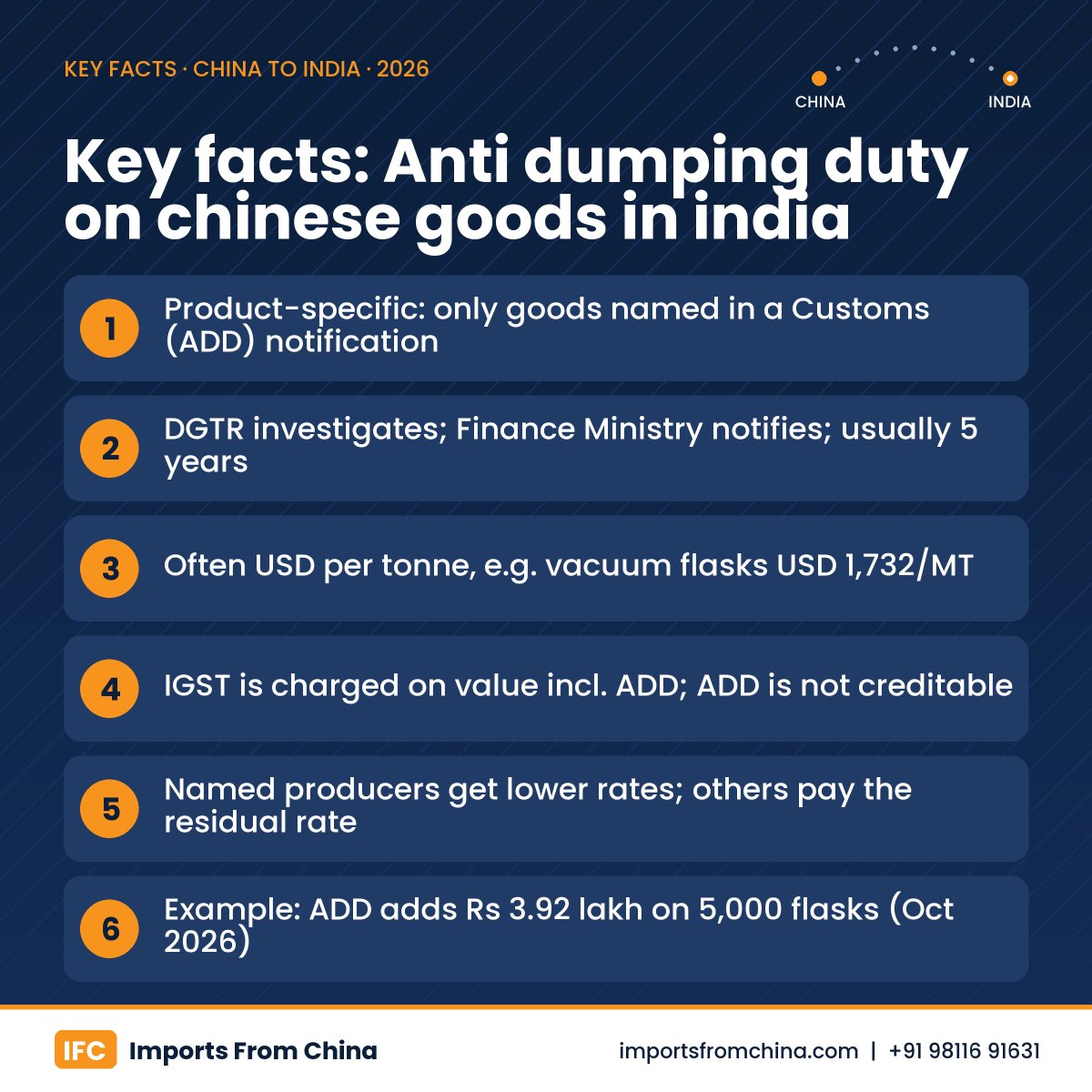
What is anti dumping duty on Chinese goods in India? It is an extra customs duty, on top of Basic Customs Duty and IGST, charged on specific Chinese products that India’s trade remedies authority finds are being sold below fair value. It applies only to the exact product, origin and producers named in a Finance Ministry notification, usually for five years, and is often a fixed amount in US dollars per tonne.
Because it is product-specific, many importers only discover it when their Bill of Entry is assessed. This guide explains how the duty works, current examples on Chinese goods, how it is calculated, how to check your HS code before ordering, and a worked example in rupees showing how anti-dumping duty can almost double the duty on a shipment.
Key takeaways
Product-specific, not country-wide: there is no general anti-dumping duty on all Chinese goods. Each duty covers a defined product, often only some HS codes.
DGTR investigates, Finance Ministry imposes: the duty starts only when a “Customs (ADD)” notification is published, normally for five years.
Often per tonne: many duties are fixed USD amounts per metric tonne, paid in rupees at the CBIC exchange rate.
Producer-wise rates: named Chinese producers may get lower rates; all others pay the highest “residual” rate.
It raises IGST too: IGST is charged on a value that includes anti-dumping duty, and the anti-dumping duty itself is not creditable.
Check before you pay the supplier: a new duty can be notified while your goods are at sea. The rate on the Bill of Entry date applies.
How does anti dumping duty on Chinese goods in India work?
“Dumping” means an exporter sells goods to India at a price lower than its normal value, usually the price in its home market, and this hurts Indian manufacturers. Under Section 9A of the Customs Tariff Act, 1975 and the Anti-Dumping Rules, India can impose a duty to offset that price gap. The process has two separate authorities:
DGTR (Directorate General of Trade Remedies, under the Commerce Ministry) receives an application from Indian industry, starts an investigation, collects data from Chinese exporters and Indian importers, and recommends a duty in its final findings.
The Ministry of Finance decides whether to accept the recommendation and, if so, issues a notification numbered like “26/2026-Customs (ADD)”. Only that notification creates a legal duty that customs can collect.
A DGTR recommendation alone does not change your duty. Some recommendations are never notified, and a notification may differ from what DGTR proposed. Always work from the notification published by CBIC, and treat a DGTR investigation as an early warning.
Anti dumping duty on chinese goods in india: key facts at a glance (IFC – Imports From China)
Anti-dumping vs other duties on Chinese imports
Duty
Applies to
Who decides
Creditable as GST input?
Basic Customs Duty (BCD)
All imports, by HS code
Customs Tariff and Budget
No
Social Welfare Surcharge (SWS)
10% of BCD unless exempt
Finance Ministry
No
Anti-dumping duty (ADD)
Specific product, origin and producers
DGTR recommends, Finance Ministry notifies
No
Countervailing (anti-subsidy) duty
Subsidised products from a named country
DGTR and Finance Ministry
No
Safeguard duty
A sudden import surge from all countries
DGTR and Finance Ministry
No
IGST
All imports
GST law
Yes, usually
Which Chinese products attract anti-dumping duty in 2026?
Anti-dumping measures on Chinese goods are concentrated in chemicals, steel and metals, glass, rubber, plastics and some consumer goods. The examples below show how varied the duties are. This is not a complete list; check the current notification for your exact product.
Product from China
HS codes (indicative)
Notification
Duty
Titanium dioxide
2823 00 10, 3206 11 10, 3206 11 90
26/2026-Customs (ADD), 24 Oct 2026
USD 460 to 681 per MT, producer-wise, for five years
Mica-based pearl industrial pigments
Chapter 32 (see notification)
21/2026-Customs (ADD), 21 Aug 2026
USD 214 to 5,529 per MT, producer-wise
Textured tempered solar glass (China, Vietnam)
7007 19 00
11/2025-Customs (ADD), 8 May 2025
USD 570 to 664 per MT
Vacuum insulated flasks of stainless steel
9617
03/2025-Customs (ADD), March 2025
USD 1,732 per MT, for five years
Soft ferrite cores
Chapter 85 (see notification)
Notified March 2025
Up to 35% of CIF value
Aluminium foil up to 80 micron
7607
Duty notified in 2025; DGTR recommended continuation in September 2026
Check the current notification
Rates as of October 2026. Each duty has a precise product description and exclusions, so an HS code match alone is not enough; read the description in the notification. Our guide to finding the right HS code explains why the classification must be right first.
New investigations to watch
In late September 2026, DGTR opened seven new anti-dumping investigations on Chinese products: Penicillin G and its salts, 6-aminopenicillanic acid, amoxycillin trihydrate, montelukast sodium, a tackifying resin used in tyres, T-section guide rails for lifts, and copolymer polyol used in mattress and bedding foam. If you import any of these, plan for the possibility of a duty within the next year. You can track cases on the DGTR website.
How is anti-dumping duty calculated on a Bill of Entry?
The notification states the form of the duty. You will see three common types:
Fixed amount per unit, usually USD per metric tonne. This is the most common form for Chinese goods. It is converted to rupees at the CBIC exchange rate on the date the Bill of Entry is filed.
Percentage of the CIF (landed) value, for example “up to 35% of CIF value”.
Reference price: the duty equals the gap between a reference price and your landed value, so it is zero if you pay above that price.
The duty then stacks with the normal duties. Assessable value is the CIF value in rupees (no 1% landing charge since 2017). BCD is charged on the assessable value. SWS is 10% of BCD and is not charged on anti-dumping duty. IGST is charged on the assessable value plus BCD, SWS and the anti-dumping duty. That last point is often missed: anti-dumping duty also raises your IGST outflow, even though that extra IGST is creditable and the anti-dumping duty is not. See our import duty from China to India guide for the basic formula.
Producer-specific rates and the invoice declaration
Most notifications list named Chinese producers and exporters with their own, lower rates, and a higher rate for “any other” producer. The lower rate applies only when the goods are made by that producer and exported by the named exporter. For titanium dioxide, for example, the producer-wise rate needs a valid commercial invoice carrying the prescribed signed declaration; without it, the highest rate of USD 681 per MT applies. Ask your supplier, before you order, which producer makes the goods and whether their invoice will carry the declaration.
Worked example: 5,000 vacuum flasks with and without anti-dumping duty
Assumptions: 5,000 stainless steel vacuum insulated bottles from Zhejiang, net weight 0.4 kg each (2.0 MT in total). FOB price USD 2.40 each (USD 12,000). Sea freight to Nhava Sheva USD 600 and insurance USD 60, so CIF is USD 12,660. Exchange rate ₹95.90 per USD, the CBIC import rate under Notification 29/2026-Customs (N.T.), effective 16 October 2026. The IFC duty database shows HS 96170011 at 20% BCD, 10% SWS and 18% IGST, with anti-dumping duty of USD 1,732 per MT on vacuum insulated flasks of stainless steel from China. Rates as of October 2026; confirm for your exact HS code and how the notification measures quantity.
Item
How it is calculated
With ADD (₹)
Without ADD (₹)
Assessable value (AV)
CIF USD 12,660 × 95.90
12,14,094
12,14,094
Basic Customs Duty
20% of AV
2,42,819
2,42,819
Social Welfare Surcharge
10% of BCD
24,282
24,282
Anti-dumping duty
2.0 MT × USD 1,732 × 95.90
3,32,198
0
Value for IGST
AV + BCD + SWS + ADD
18,13,393
14,81,195
IGST
18% of value for IGST
3,26,411
2,66,615
Total paid at customs
BCD + SWS + ADD + IGST
9,25,710
5,33,716
Non-creditable cost
BCD + SWS + ADD
5,99,299
2,67,101
Anti-dumping duty adds ₹3,91,994 to the cash you pay at customs, and ₹3,32,198 of that is a permanent cost. Per bottle, your non-creditable duty rises from about ₹53 to about ₹120. On a product that sells for ₹350–500 online, that can wipe out the margin. Because the duty is per tonne, it hurts cheaper and heavier products the most. Run your own numbers in the IFC shipment calculator.
How do you check if your product attracts anti-dumping duty?
Fix the 8-digit HS code from the product’s material, function and specifications. Check it on the India import duty rates by HS code page, which shows anti-dumping notes where IFC has them.
Search the CBIC “Customs (ADD)” notifications for your product name and HS heading. Read the full product description, technical scope and exclusions.
Check the dates. Duties normally run for five years from notification. Note whether a sunset review is under way, because the duty continues during the review.
Check the producer and exporter. Match the factory and exporter names on your proforma invoice with the table in the notification.
Check DGTR for open investigations on your product, so a new duty does not surprise you mid-season.
Get a written duty estimate from your customs broker or import agent that shows anti-dumping duty as a separate line.
What happens if you ignore or avoid anti-dumping duty?
Customs officers check anti-dumping duty during assessment. If your Bill of Entry leaves it out, it will be reassessed and you pay the duty, with interest if it is found later in an audit. Deliberate tricks make it worse:
Wrong HS code or vague description to escape the duty can lead to confiscation, penalties and a demand for the duty on past shipments.
Routing goods through a third country does not change origin if the goods are Chinese. Customs can ask for origin proof under the CAROTAR rules, and some notifications cover named routing cases directly, as the titanium dioxide notification does.
Using a named producer’s lower rate for goods made by another factory is misdeclaration.
Under-invoicing does not help with per-tonne duties and invites a valuation dispute.
The safe approach is to budget anti-dumping duty honestly, or change the product or supplier before you order. Our step-by-step guide to customs clearance in India shows where assessment and reassessment happen.
How long does a DGTR anti-dumping case take, and how should importers plan?
Stage
Typical timing
What it means for you
Initiation notice by DGTR
Day 0
Early warning. Importers can register as interested parties and give comments.
Provisional duty (optional)
Possible after a preliminary finding
Can apply for up to six months, extendable in some cases.
Final findings
Normally within 12 months, extendable by up to 6 months
DGTR recommends a duty, or none.
Finance Ministry notification
Normally within 3 months of final findings
The duty becomes payable from the notification date.
Duty period and sunset review
Five years, can be extended after review
Plan sourcing for the full period.
For importers, the practical rule is to price long contracts with the duty risk in mind once an investigation starts. If a product is under investigation, keep stock levels moderate, ask the supplier whether they are cooperating with DGTR (cooperating producers usually get lower individual rates), and compare alternative sources. Our article on whether shipping from China is banned in India explains how restrictions differ from extra duties.
How IFC helps you plan for anti-dumping duty on China imports
IFC – Imports From China has more than 20 years (since 2004) in China–India import and export and has served 5000+ businesses. The company is founded and led by Mayank Dang (CA Sahab), a Chartered Accountant (FCA, ICAI), and gives HSN, duty, BIS and customs/GST compliance guidance before you order, so anti-dumping duty shows up in your landed cost on day one, not at the port.
Our own offices in Guangzhou and Yiwu have translators and English-speaking staff who can confirm which factory actually makes your goods, check invoices and declarations, and run supplier verification and quality inspection. We load mixed containers and air cargo daily, have a warehouse at our headquarters, and handle LCL and FCL sea freight, air cargo and customs clearance. With DDP shipments from China to India, we deliver door to door to major cities including Delhi, Gurugram, Noida, Mumbai, Pune, Bengaluru, Hyderabad, Chennai and Ahmedabad.
Bottom line
Anti-dumping duty is not a blanket tax on Chinese goods, but where it applies it can be the biggest line in your duty sheet. Fix the HS code, read the notification’s product scope and producer table, watch DGTR for new cases, and build the duty and its IGST effect into your price before you pay the supplier.
Chartered Accountant (FCA, ICAI) who has helped 5000+ Indian businesses import from China since 2004 – sourcing, BIS, HSN classification, import duty, customs and GST compliance. mayankdang.in
Is there anti-dumping duty on all goods imported from China to India?
No. Anti-dumping duty applies only to specific products named in a Finance Ministry Customs (ADD) notification, such as titanium dioxide, solar glass or vacuum flasks. Most Chinese products pay only the normal BCD, SWS and IGST. Check your exact HS code and product description against current notifications before ordering.
How do I find out if my product has anti-dumping duty in India?
Fix the 8-digit HS code, then search CBIC Customs (ADD) notifications for that heading and product name, and read the product scope and exclusions. Check the DGTR website for open investigations. IFC’s HS code pages show anti-dumping notes where available, and a customs broker can confirm before you order.
Is anti-dumping duty included in the value for IGST?
Yes. IGST on imports is charged on the assessable value plus Basic Customs Duty, Social Welfare Surcharge and the anti-dumping duty. So anti-dumping duty also increases your IGST outflow. The extra IGST is usually creditable for GST-registered importers, but the anti-dumping duty itself is a permanent cost.
Can I claim input tax credit on anti-dumping duty?
No. Anti-dumping duty is a customs duty, not GST, so it cannot be claimed as input tax credit. Only the IGST paid at customs is normally creditable when your GSTIN is on the Bill of Entry. Add anti-dumping duty to your product cost when you set prices.
How long does anti-dumping duty last in India?
Usually five years from the date of the Finance Ministry notification, unless revoked or amended earlier. Before expiry, DGTR can hold a sunset review, and the duty can be extended for another five years if dumping and injury are likely to continue.
Does shipping Chinese goods through another country avoid anti-dumping duty?
No. Duty depends on the country of origin, not the route. Customs can ask for origin proof under the CAROTAR rules, and some notifications specifically cover goods routed through third countries. Misdeclaring origin can lead to confiscation, penalties and demands on past shipments.
Why does my supplier’s factory name matter for anti-dumping duty?
Many notifications give named Chinese producers lower individual rates, while all other producers pay the highest residual rate. The lower rate applies only if the named producer made the goods and the invoice meets the notification’s conditions. Confirm the producer and exporter before you order.
Do you need BIS registration to import electronics from China to India? For most everyday electronics, yes. Chargers, power banks, LED lights, laptops, Bluetooth speakers and CCTV cameras fall under BIS’s Compulsory Registration Scheme (CRS). The Chinese factory must hold a BIS registration (R-number) for that brand and model, and the goods must carry the BIS Standard Mark before they leave China.
If you plan to import electronics from China to India, BIS registration is the first thing to check, before price or freight. This guide explains which products are covered, who registers, the step-by-step process, indicative costs and timelines, how customs checks compliance at the port, and a worked duty example in rupees for 1,000 mobile chargers.
Key takeaways
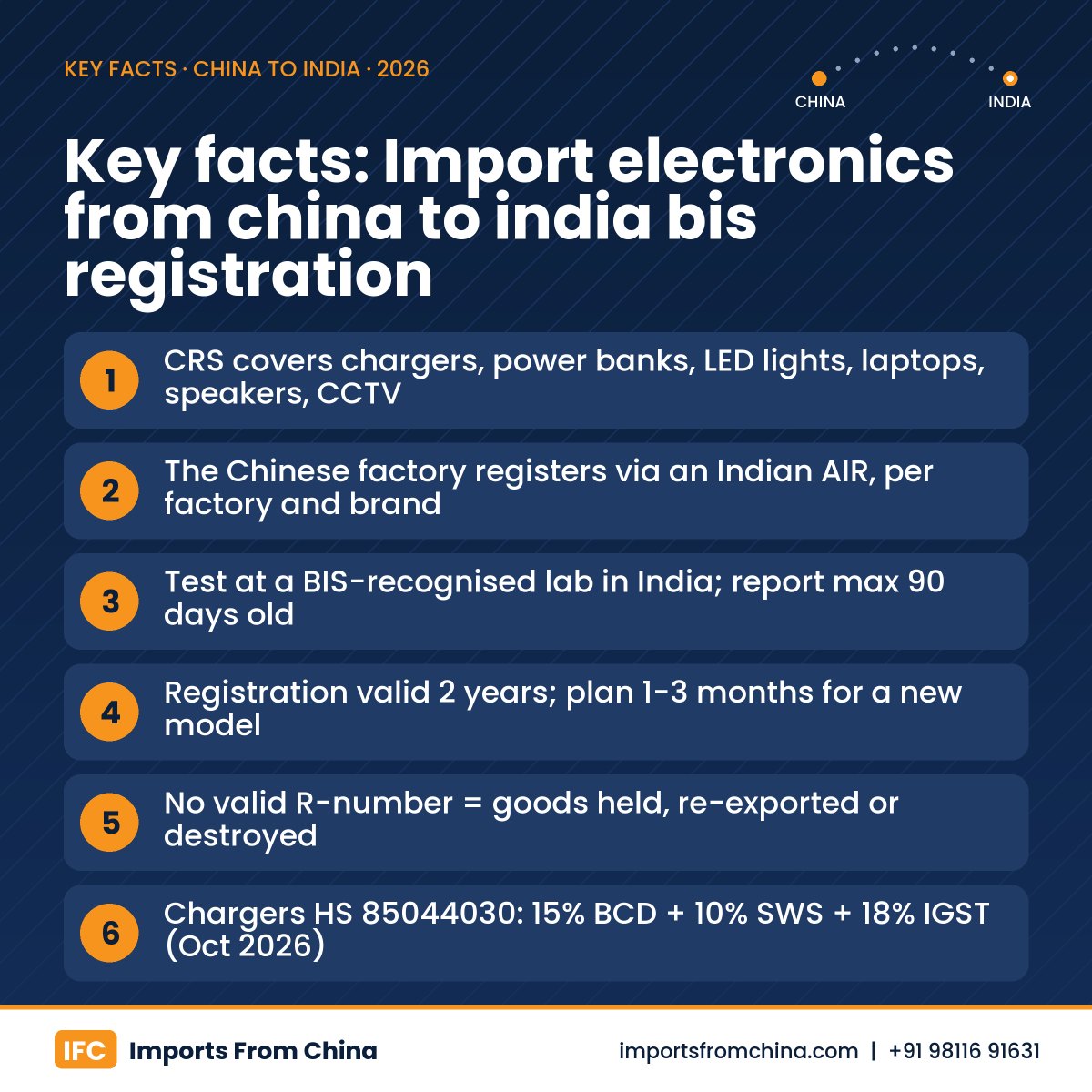
The factory registers, not you: BIS CRS registration is granted to the manufacturer for each factory and brand, through an Authorised Indian Representative (AIR).
No R-number, no clearance: covered electronics without a valid registration and Standard Mark can be held, sent back or destroyed at the Indian port.
Testing is in India: samples must be tested at a BIS-recognised lab, and the test report must not be older than 90 days when the application is filed.
Plan 1–3 months: lab testing plus BIS processing usually takes several weeks for a new model, so start before you place the bulk order.
BIS is not the only check: wireless items need WPC approval, importers of electronics need EPR registration under the E-Waste Rules, and retail packs need Legal Metrology labels.
Duty still applies: mobile chargers (HS 85044030) attract 15% BCD, 10% SWS and 18% IGST (as of October 2026).
What is BIS CRS registration and who needs it?
The Compulsory Registration Scheme is run by the Bureau of Indian Standards (BIS) for the Ministry of Electronics and IT (MeitY). It is notified under the Electronics and Information Technology Goods (Requirements for Compulsory Registration) Order. Any product on the CRS list cannot be manufactured, imported, sold or distributed in India unless it is registered with BIS and carries the Standard Mark.
Three points confuse most first-time importers:
The applicant is the manufacturer. A trader or importer in India cannot register a Chinese factory’s product in its own name as the manufacturer. The Chinese factory applies, and appoints an Authorised Indian Representative (AIR) based in India.
Registration is factory-wise and brand-wise. Each manufacturing location gets its own registration number. Each brand is registered separately, although one test report can cover several brands when the product and factory are the same.
It is valid for two years. The registration must be renewed before expiry, and BIS can draw market samples for surveillance at any time.
Import electronics from china to india bis registration: key facts at a glance (IFC – Imports From China)
Which electronics from China need BIS registration?
The CRS list covers several dozen categories of electronics and IT goods, and MeitY adds items from time to time. The table shows the products Indian importers ask IFC about most often. Always confirm the current list on the BIS CRS portal before ordering, because the standard number and scope can change.
Product
Typical HS code
BIS standard (CRS)
Other approvals to check
Mobile chargers and adapters
85044030
IS 13252 (Part 1)
EPR (e-waste), Legal Metrology label
Power banks and lithium battery packs
85076000
IS 13252 (Part 1) and IS 16046 (Part 2)
EPR, battery rules, dangerous-goods shipping
LED lamps and luminaires
8539 / 9405
IS 16102 / IS 10322 series
EPR, Legal Metrology
Bluetooth speakers and audio amplifiers
8518
IS 616
WPC approval (Bluetooth), EPR
Laptops, tablets, monitors
8471 / 8528
IS 13252 (Part 1)
WPC (Wi-Fi), EPR
CCTV cameras and DVRs
8525 / 8521
IS 13252 (Part 1)
Check current CCTV security requirements, EPR
Some electrical goods, such as switches, cables, fans and many household appliances, fall under separate BIS Quality Control Orders that need an ISI licence under the Foreign Manufacturers Certification Scheme (FMCS) instead of CRS. FMCS involves a factory audit and takes much longer. If you deal in a mix of products, see our electrical products from China page and check each item separately. You can look up the duty and compliance notes for any 8-digit code on the India import duty rates by HS code page.
Import electronics from China to India: BIS registration step by step
This is the usual sequence for a product that the Chinese factory has not yet registered for India.
Confirm the product is on the CRS list and identify the Indian Standard that applies. Use the exact model and its technical sheet, not a marketplace title.
Ask the factory for its existing R-number. Many large Chinese factories that already sell to India have one. Check that it covers your model, your brand and the factory address on your purchase order.
Appoint an AIR. If a new registration is needed, the factory nominates an Authorised Indian Representative. For private-label goods this is often the Indian brand owner or importer, or a BIS consultant.
Send samples to a BIS-recognised lab in India. Your own or the factory’s in-house test reports are not accepted. For a model series, the highest configuration is usually tested under MeitY’s series guidelines.
Apply online on the BIS portal with the test report (not older than 90 days), the factory’s business licence, brand authorisation, AIR documents, label artwork and the fee.
BIS grants the registration and issues the R-number for that factory and brand.
Print the Standard Mark with the IS number and R-number on the product and its packaging (packaging alone only if the product is too small) before mass production.
Keep the file ready for customs: registration letter, test report, photos of the marking and the brand authorisation travel with your shipping documents.
Who should be the AIR for your product?
The AIR answers to BIS and MeitY for the registration, so choose with care. If you sell under your own brand on Amazon or Flipkart, being the AIR yourself gives you control: the registration cannot be withdrawn by an agent you no longer work with. If you only buy a factory’s own branded goods, it is normally the factory’s existing AIR who holds the registration, and you simply verify it.
How much does BIS CRS registration cost and how long does it take?
Costs depend on the product, the standard and the lab. BIS publishes its own fee schedule, and labs and consultants quote separately. The figures below are indicative ranges for a single new model (indicative, October 2026).
Cost or time item
Who pays
Indicative range
Lab testing at a BIS-recognised lab
Factory or AIR
Roughly ₹25,000 to ₹1,50,000+ per model, more for complex products
BIS application and registration fees
Factory or AIR
As per the current BIS fee schedule; check the BIS portal
Sample courier from China and customs for samples
Factory or importer
Courier at about ₹450–900/kg plus duty on the samples
Consultant fee (optional)
Whoever hires them
Varies widely; ask for a written scope
Lab testing time
–
Usually 2–6 weeks, depending on lab workload
BIS processing after a complete application
–
Usually a few weeks if documents are in order
Add it up and a new registration commonly takes one to three months from sample dispatch. That is why the order of work matters: confirm the R-number or start registration first, approve the marked sample next, and only then pay the deposit for bulk production. Registration is also per factory, so if your supplier quietly moves your order to a different plant, the existing R-number may not cover it.
How does customs check BIS compliance when electronics land in India?
BIS compliance is checked as part of normal customs clearance in India. Your customs broker declares the goods on the Bill of Entry on ICEGATE, and for CRS products the registration details and documents are uploaded with it. If the shipment is selected for examination, officers at the CFS, ICD or air cargo terminal open cartons and look for:
The Standard Mark with the correct IS number and R-number on the product and the box.
A brand and model that match the registration, the invoice and the packing list.
Legal Metrology details on retail packs: importer name and address, MRP, net quantity, month and year of import and customer care details.
WPC approval for anything with Bluetooth or Wi-Fi.
If a covered product arrives without valid registration, customs can refuse clearance. In practice the importer then faces re-export at its own cost, or destruction, plus port storage and demurrage while the case is decided. Penalties under the BIS Act, 2016 are also possible. Mixed shipments are a common trap: one unregistered model in a container of registered goods can hold up the whole Bill of Entry. Our documents required for import from China checklist shows the full file your broker needs.
How to verify a supplier’s R-number
Ask the supplier for the registration letter, then search the R-number on the BIS CRS portal or in the BIS Care app. Match four things: factory name and address, brand, model numbers and the validity date. A screenshot of a certificate on WhatsApp is not proof. If the factory name on the BIS record differs from the company on your proforma invoice, ask why before paying; it often means you are dealing with a trading company. See also how to verify a China import agent.
Worked example: duty and compliance cost for 1,000 mobile chargers
Assumptions: 1,000 USB-C mobile chargers from a Shenzhen factory that already holds a valid BIS R-number for your brand. FOB price USD 2.20 each (USD 2,200). Sea freight to Nhava Sheva USD 120 and insurance USD 12, so CIF is USD 2,332. Exchange rate ₹95.90 per USD, the CBIC import rate under Notification 29/2026-Customs (N.T.), effective 16 October 2026. The IFC duty database shows HS 85044030 at 15% BCD (for chargers of cellular mobile phones), 10% SWS, no AIDC, 18% IGST and no anti-dumping duty. Rates as of October 2026; confirm for your exact HS code.
Item
How it is calculated
Amount (₹)
Assessable value (AV)
CIF USD 2,332 × 95.90
2,23,639
Basic Customs Duty
15% of AV
33,546
Social Welfare Surcharge
10% of BCD
3,355
Value for IGST
AV + BCD + SWS
2,60,540
IGST
18% of 2,60,540
46,897
Total paid at customs
BCD + SWS + IGST
83,798
The IGST of ₹46,897 is normally available as input tax credit if your GSTIN is on the Bill of Entry. Your real duty cost is the BCD and SWS of ₹36,901, about ₹37 per charger. Add freight and Indian charges: this lot is about 1.2 CBM, and door-to-door LCL from China typically costs ₹9,000–16,000 per CBM (indicative, October 2026), with a minimum charge on small lots.
Now compare the cost of getting BIS wrong. If the factory had no valid registration for your brand, you would first spend roughly ₹25,000 or more on testing and wait several weeks. If you shipped anyway, the ₹2.2 lakh of goods could be refused entry, and you would still pay freight, storage and either re-export or destruction. Run your own product through the IFC shipment calculator, and read our import duty from China to India guide for how each duty is worked out.
What mistakes do Indian importers make with BIS for electronics?
Trusting a “CE” or “FCC” mark. European and US marks mean nothing for Indian customs. Only the BIS Standard Mark with a valid R-number counts.
Buying a registered model under a new brand. If you add your own logo, the registration must cover your brand too.
Ignoring the factory address. Registration is tied to the manufacturing location, not to the trading company that sends the invoice.
Forgetting accessories inside the box. A registered speaker shipped with an unregistered adapter can still be stopped, because the adapter needs its own registration.
Letting the registration lapse. Registrations are valid for two years. Check the expiry date against your shipment date.
Skipping EPR registration. Under the E-Waste (Management) Rules, 2022, importers of covered electrical and electronic equipment are treated as producers and must register on the CPCB EPR portal.
Pre-order checklist for electronics from China
HS code and duty confirmed for each model.
CRS coverage and the Indian Standard confirmed on the BIS portal.
R-number verified for this factory, brand and model, with validity beyond your arrival date.
WPC approval in hand for Bluetooth or Wi-Fi products.
EPR registration and Legal Metrology label artwork ready.
Marked golden sample approved before bulk production, and inspection booked before loading.
How IFC helps you import electronics from China with BIS compliance
IFC – Imports From China has more than 20 years (since 2004) in China–India import and export, and has served 5000+ businesses. The company is founded and led by Mayank Dang (CA Sahab), a Chartered Accountant (FCA, ICAI). Our own offices in Guangzhou and Yiwu have translators and English-speaking staff who can ask a factory for its BIS registration, check the marking on samples and cartons, and run a quality inspection before goods are loaded.
We give BIS, HSN, duty and customs/GST compliance guidance before you order, then handle sourcing, supplier verification, LCL and FCL sea freight, air cargo and customs clearance in India. We load mixed containers and air cargo daily and have a warehouse at our headquarters. With our DDP shipments from China to India, goods are delivered door to door to major cities including Delhi, Gurugram, Noida, Mumbai, Pune, Bengaluru, Hyderabad, Chennai and Ahmedabad.
Bottom line
For electronics from China, BIS registration decides whether your goods can enter India at all. Confirm the product’s CRS status, verify the factory’s R-number for your brand and model, add WPC and EPR where needed, and only then pay for bulk production. Done in that order, BIS becomes a routine check instead of a container stuck at the port.
Guide on BIS registration for electronics imports reviewed by Mayank Dang (CA Sahab), Founder & CEO of IFC
Chartered Accountant (FCA, ICAI) who has helped 5000+ Indian businesses import from China since 2004 – sourcing, BIS, HSN classification, import duty, customs and GST compliance. mayankdang.in
Is BIS registration mandatory for importing electronics from China to India?
Yes, for every product on the BIS Compulsory Registration Scheme list, such as chargers, power banks, LED lights, laptops, Bluetooth speakers and CCTV cameras. The Chinese manufacturer must hold a valid registration for that factory, brand and model, and the goods must carry the BIS Standard Mark with the R-number before they reach an Indian port.
Can an Indian importer apply for BIS CRS registration?
The applicant is the manufacturer, not the trader. An Indian importer or brand owner can act as the Authorised Indian Representative (AIR) for the Chinese factory and handle the testing and application, but the registration is granted for the manufacturing location. Private-label sellers often take the AIR role to keep control of the registration.
How long does BIS registration take for electronics?
For a new model, lab testing at a BIS-recognised lab in India usually takes 2 to 6 weeks, and BIS processing a few more weeks if documents are complete. Plan roughly one to three months from sample dispatch. If the factory already has a valid R-number covering your brand and model, no new registration is needed.
What happens if electronics arrive at Indian customs without BIS registration?
Customs can refuse clearance for covered goods without valid registration and marking. The importer usually has to re-export the goods or have them destroyed, while paying port storage and demurrage. Penalties under the BIS Act, 2016 are also possible. One unregistered model can hold up an entire mixed shipment.
How do I check if a Chinese supplier’s BIS R-number is genuine?
Search the R-number on the BIS CRS portal or in the BIS Care app and match the factory name and address, brand, model numbers and validity date with your purchase order. Do not rely on a certificate image alone. If the BIS record shows a different company from your invoice, you may be dealing with a trading company.
Do I need WPC approval as well as BIS for Bluetooth products?
Yes. Products with Bluetooth, Wi-Fi or other wireless modules need WPC approval in addition to BIS registration where the product is on the CRS list. Importers of electronics also need EPR registration under the E-Waste (Management) Rules, 2022, and retail packs need Legal Metrology labelling.
Does BIS registration change the import duty on electronics?
No. BIS registration is a compliance requirement and does not reduce duty. Customs duty depends on the HS code. For example, mobile chargers under HS 85044030 attract 15% BCD, 10% SWS and 18% IGST as of October 2026. Confirm the rate for your exact code before ordering.
How to pay Chinese suppliers from India: most Indian businesses pay by bank wire (telegraphic transfer or TT) from their current account through an authorised bank, usually in US dollars, straight to the supplier company’s own account, quoting purpose code S0101 for an advance or S0102 for the balance. Alibaba Trade Assurance, RBI-licensed payment platforms and letters of credit are the main alternatives.
This guide compares every method, walks through a TT payment step by step, explains the RBI rules Indian importers must follow, shows the real cost of a USD 10,000 payment in rupees, and lists the checks that stop payment fraud.
Key takeaways
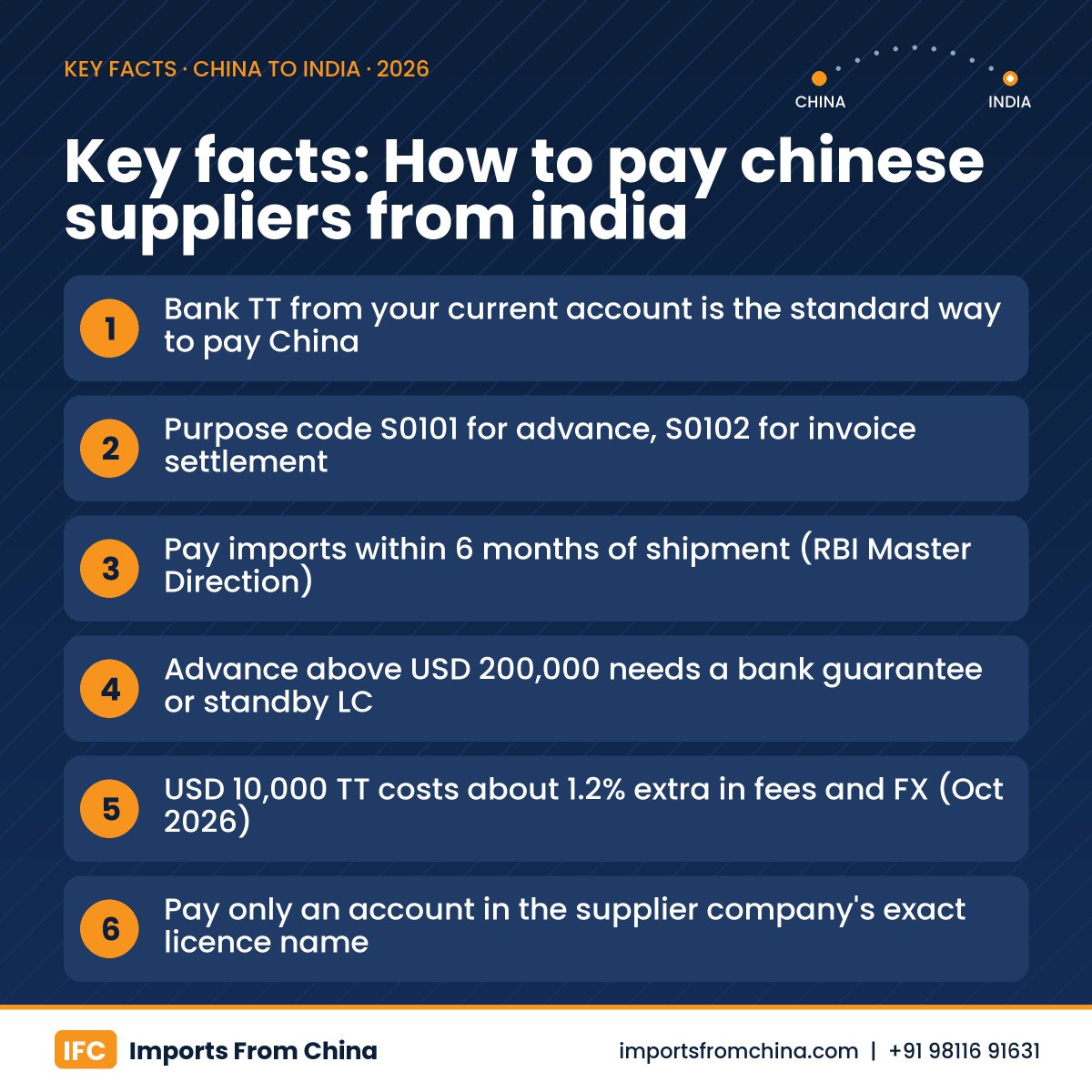
Bank TT is the standard: a SWIFT transfer from your business current account, in USD or CNY, to the supplier company’s account.
Use the right purpose code: S0101 for advance payment against imports, S0102 for settling an invoice after shipment.
RBI time limits apply: import payments are normally due within six months of shipment, and goods paid in advance must arrive within six months.
Advances above USD 200,000 need cover: a bank guarantee or standby LC is required, unless your bank grants an exemption.
A USD 10,000 TT costs about 1–1.5% extra in exchange margin, bank fees, GST on currency conversion and correspondent charges (indicative, October 2026).
Name match is your best protection: pay only an account in the exact name on the supplier’s Chinese business licence, and call to confirm any change of bank details.
What are the ways to pay Chinese suppliers from India?
There are five legal routes for a business. Each suits a different order size and level of trust.
Method
How it works
Indicative cost (October 2026)
Speed
Buyer protection
Best for
Bank TT (SWIFT wire)
Your AD Category-I bank sends USD or CNY to the supplier’s bank
None built in; depends on supplier checks and terms
Most regular orders
Alibaba Trade Assurance
You pay through Alibaba.com; the order is covered by Alibaba’s terms
Card around 3%; bank transfer fees vary
Card 2–3 days; transfer 3–7 days
Refund claims for late shipment or quality not as agreed
First orders with Alibaba suppliers
RBI-licensed payment platforms (PA-CB)
A licensed cross-border payment aggregator converts and pays
Often lower than banks; compare the full rate
Same day to 3 days
Limited
Payments up to ₹25 lakh per transaction
Letter of credit (LC)
Your bank pays only when the supplier presents the agreed shipping documents
Opening, amendment and document charges; costly for small orders
Set up in days, paid on document presentation
Strong on documents, not on quality
Large orders, new suppliers, machinery
Business credit card
Card payment on a platform or supplier gateway
Card forex markup plus platform fee
Instant
Chargeback rules may help
Samples and very small orders
Avoid paying a supplier’s personal Alipay or WeChat account, cash through “agents”, or any informal channel. These payments leave you no bank record for customs or GST, no FEMA trail, and no way to recover money if goods never arrive.
How to pay chinese suppliers from india: key facts at a glance (IFC – Imports From China)
How do you make a TT payment to China from India? (step by step)
Get a proforma invoice (PI) with the supplier’s full company name, address, product details, price, Incoterm, payment terms and bank details.
Fill your bank’s import remittance request in its trade or net-banking portal (some banks still call it Form A1). Use your business current account and IEC.
Choose the purpose code: S0101 for an advance against imports, S0102 for paying an invoice for goods already shipped.
Attach documents: PI for an advance; commercial invoice and bill of lading or airway bill copy for a balance payment.
Pick the charges option: OUR (you pay all bank charges, supplier receives the full amount), SHA (charges shared) or BEN (supplier pays). Chinese suppliers usually ask for OUR or for you to add USD 30–50 to cover deductions.
Book the exchange rate and confirm. Ask your bank for a better rate on larger amounts; the card rate is negotiable.
Send the SWIFT copy (MT103) to the supplier so they can trace the money.
After the goods arrive, give your bank the Bill of Entry details so the payment is matched in RBI’s IDPMS system.
Bank details to ask your Chinese supplier for
Beneficiary name, exactly as on the business licence (in English, and the Chinese name if possible)
Beneficiary address
Account number and currency (USD account or CNY account)
Bank name, branch address and SWIFT/BIC code
Intermediary bank details, if the supplier’s bank needs one for USD
What RBI rules apply when paying Chinese suppliers from India?
Pay for normal imports within six months of the shipment date. Extensions are possible through your bank.
Advance payments
No upper limit, but above USD 200,000 you need a bank guarantee or standby LC from the supplier’s bank, unless your bank exempts you (allowed up to USD 5 million based on its assessment).
Goods must follow the advance
Goods paid in advance should be imported within six months of the remittance (three years for capital goods).
Evidence of import
Your bank matches each payment with the Bill of Entry in IDPMS. If evidence is not received within three months, the bank will follow up with you.
Third-party payments
Paying a party other than the supplier is allowed only with conditions, including the invoice naming that party. Ask why before you agree.
Business import payments are current-account remittances made by an IEC holder, not personal remittances under the Liberalised Remittance Scheme (LRS). Do not use a personal LRS transfer to pay for business stock; the payment will not match your Bill of Entry and GST records. Confirm the exact documentation with your bank.
Payment platforms licensed by RBI as cross-border payment aggregators (PA-CB) can handle import payments of up to ₹25 lakh per transaction under the 2025 Payment Aggregator Directions. Bigger invoices go through your bank.
Should you pay Chinese suppliers in USD or Chinese yuan?
Most Chinese exporters quote and receive US dollars, so USD is the default. Some suppliers, especially smaller factories and 1688 sellers, prefer yuan (CNY or RMB).
Pay USD when the PI is in USD and the supplier has a USD account. It is accepted everywhere and easy for your bank.
Pay CNY when the price is in yuan. Paying CNY directly can avoid one conversion, but check that your bank offers CNY remittance and that the supplier’s account accepts it.
Never mix them up: sending USD to a CNY-only account can cause a forced conversion at a poor rate, or a return of funds weeks later.
As a reference, market rates in late October 2026 were about ₹94.9 per USD and ¥6.67 per USD, which puts one yuan at roughly ₹14.2. Your bank’s selling rate will be a little higher. For customs, the duty is calculated at the CBIC-notified rate (₹95.90 per USD for imports from 16 October 2026), not your bank rate.
How much does it cost to send money to China from India? (₹ example)
An interior designer in Bengaluru pays a Foshan lighting supplier USD 10,000 by bank TT under the OUR option. Assumptions: interbank rate ₹94.94, bank selling rate ₹95.60, bank remittance fee ₹1,000 plus 18% GST, and USD 30 correspondent charges. All figures are indicative, October 2026; your bank’s charges may differ.
Item
Calculation
Amount (₹)
Amount debited for USD 10,000
10,000 × ₹95.60
9,56,000
Of which exchange margin
(₹95.60 − ₹94.94) × 10,000
6,600
Bank remittance fee + GST
₹1,000 + 18%
1,180
GST on currency conversion
18% of (₹1,000 + 0.5% of amount above ₹1 lakh = ₹5,280)
950
Correspondent charges (OUR)
USD 30 × ₹95.60
2,868
Total paid
Debit + fees + GST + charges
9,60,998
Extra over the interbank value
₹9,60,998 − ₹9,49,400
11,598 (about 1.2%)
The GST on the bank fee and on currency conversion can usually be claimed as input tax credit if the bank invoices your GSTIN. If the same order were paid by card on a platform charging about 3%, the fee alone would be around ₹28,000. Splitting a payment into a 30% deposit and 70% balance doubles the fixed fees, so negotiate the exchange rate on both.
Bank charges are only one part of your landed cost. Add freight, duty and IGST in the IFC shipment calculator before you confirm the order.
Is Alibaba Trade Assurance a safe way to pay from India?
Trade Assurance is Alibaba.com’s order-protection programme. If you pay through Alibaba’s checkout and the supplier ships late or the goods do not match the agreed specifications, you can raise a dispute and claim a refund. It is a sensible option for a first order with a new Alibaba supplier.
Protection only applies when you pay through the Alibaba order. A TT sent straight to the supplier outside the platform is not covered.
Write the details into the order: specifications, packing, inspection terms and ship date. Claims are judged against what is written.
It does not cover India-side issues: BIS registration, wrong HS codes, customs holds or damage after delivery to the forwarder.
Fees vary by method: card payments cost more than bank transfers; check the current fee at checkout.
How do you avoid payment fraud with Chinese suppliers?
Most payment losses are not “bad quality” cases. They are payments sent to the wrong account. Use these checks every time:
Bank details changed by email? Treat it as fraud until proven otherwise. Hackers copy supplier emails and send “new account” letters. Confirm by phone or video call with the person you know.
Name mismatch: the beneficiary must be the company on your PI and contract, not an individual or a different company.
Account in a different place: a mainland factory asking you to pay a Hong Kong or overseas company needs an explanation and a written invoice from that company. Verify both.
Pressure and discounts: “pay today for a special price” is a classic push. Real suppliers wait for your checks.
No contract: agree specifications, delivery date and penalties in writing before the deposit.
How IFC helps before you pay a Chinese supplier
IFC – Imports From China has more than 20 years of experience in China–India import and export, since 2004. Our own offices in Guangzhou and Yiwu, with translators and English-speaking staff, can verify a supplier before you send a deposit and run a quality inspection before you release the balance, so your money moves only when the goods are right.
We also handle what happens after payment: daily loading of mixed containers and air cargo, LCL and FCL sea freight, customs clearance and door-to-door DDP delivery from our warehouse at headquarters to major Indian cities including Delhi, Gurugram, Noida, Mumbai, Pune, Bengaluru, Hyderabad, Chennai and Ahmedabad.
Conclusion
To pay Chinese suppliers from India safely, use a bank TT from your business account for regular orders, Trade Assurance for first Alibaba orders, a licensed payment platform for smaller invoices if it is cheaper, and an LC for large risky orders. Quote the right purpose code, keep the balance until inspection, match the beneficiary name every time, and give your bank the Bill of Entry once goods land.
What is the best way to pay a Chinese supplier from India?
For most business orders, a bank telegraphic transfer (TT) from your current account through an authorised bank is the standard and safest way, because it creates a clear FEMA and customs record. For a first order on Alibaba, paying through Trade Assurance adds refund protection. For large orders with a new supplier, a letter of credit reduces risk.
Which purpose code should I use to pay a Chinese supplier?
Use S0101 when you pay an advance against imports before the goods are shipped, and S0102 when you settle an invoice for goods already shipped. Your bank asks for the purpose code in its import remittance form. Using the right code helps the bank match the payment with your Bill of Entry later.
Can I pay a Chinese supplier through Alipay or WeChat from India?
Paying a supplier’s personal Alipay or WeChat account is risky and leaves no proper bank record for customs, GST or RBI rules. Indian businesses should pay the supplier company’s bank account by bank transfer or use a regulated platform. Some licensed payment providers can pay Chinese accounts formally; check that they are RBI-authorised.
How long does a bank transfer from India to China take?
A SWIFT transfer from India to a Chinese bank usually reaches the supplier in 1 to 3 working days, sometimes longer if an intermediary bank is involved or details are wrong. Send the SWIFT copy, also called MT103, to the supplier so they can trace the payment with their bank.
Is there a limit on advance payment to Chinese suppliers?
There is no upper limit on advance payment for imports, but under RBI rules an advance above USD 200,000 needs a bank guarantee or standby letter of credit from the supplier’s bank, unless your bank exempts it. Goods paid for in advance should normally be imported within six months.
Should I pay my Chinese supplier in dollars or yuan?
Pay in the currency on the proforma invoice and to an account that accepts it. Most Chinese exporters use US dollars. If the supplier quotes in yuan, paying CNY directly can save one conversion, but confirm that your bank can send CNY and that the supplier’s account can receive it.
What documents does my bank need to pay a supplier in China?
For an advance, banks usually ask for the proforma invoice, your IEC and the import remittance application. For a balance payment, add the commercial invoice and bill of lading or airway bill copy. After the goods arrive, give the bank the Bill of Entry details so the payment is closed in the IDPMS system.
Made in China quality today depends on the factory and the price you pay, not on the country. China builds most of the world’s electric vehicles, solar panels, lithium batteries and smartphones, and many premium global brands are made there. People still distrust “Made in China” because of old memories of cheap goods, buyers who chose the lowest price, and competition and politics between nations.
This guide explains why the “cheap China” image exists, what the reality is in 2026, why other countries criticise Chinese goods while still buying them, and how Indian MSME owners can get premium quality from China safely. It is written by the IFC (Imports From China) team, which has helped Indian businesses import from China since 2004.
Key takeaways
Quality follows price: the same Chinese market sells a ₹50 version and a world-class version of most products. You get what you order and pay for.
China leads in high-tech: EVs, solar, batteries, drones, electronics and machinery are now China’s strengths, not just toys and plastic goods.
Dislike is often about competition: nations protect their own industries with tariffs, anti-dumping duty and “buy local” campaigns.
People criticise, then buy: India imported goods worth over $110 billion from China in FY 2024-25 even while debating Chinese goods.
Bad quality is usually a sourcing mistake: unverified suppliers, no inspection and lowest-price buying cause most problems.
The fix is a process: verify the supplier, audit the factory, inspect before shipping and import legally with BIS where required.
Is Made in China quality good in 2026?
Yes, when you buy from the right factory at the right price. Twenty years ago “Made in China” mostly meant low-cost toys, plastic items and copies. Since then China has invested heavily in automation, research and supply chains. Today it is the world’s largest manufacturer, making close to a third of all manufactured goods on the planet.
China is now the leader in many high-value industries:
Electric vehicles and batteries: Chinese brands are among the top-selling carmakers in the world, and most EV batteries are made in China.
Solar energy: most of the world’s solar panels and their components come from Chinese factories.
Electronics: phones, laptops, chargers and smart devices of many global brands are assembled in China.
Drones, machinery and industrial equipment: Chinese brands lead in consumer drones and supply CNC machines, packaging machines and moulds worldwide.
Furniture and home goods: Foshan furniture and Chaozhou ceramics supply premium hotels and homes across the world, including India.
So the real answer is that China can make the cheapest version and the best version of almost anything. The quality you receive depends on what you specify, which factory you choose and whether anyone checks the goods before they leave China.
Why don’t people like Made in China products?
There are five common reasons. Some are fair, and some come from old memories or competition.
1. Old memories of cheap goods
In the 1990s and 2000s, a flood of low-price Chinese toys, torches and electronics reached Indian markets. Many broke quickly. That experience created the “chalega toh chalega” image that many people still carry, even though the industry has changed.
2. Buyers chose the lowest price
Chinese factories make goods to the buyer’s budget. When an importer asks for the lowest price, the factory reduces material thickness, uses cheaper components and skips checks. The product then fails in India and “China” gets the blame, although the order itself asked for low cost.
3. Competition with local industry
When one country can make a product better, faster and cheaper, factories in other countries come under pressure. Workers, industry groups and governments respond. That is why we see tariffs, anti-dumping duties and “buy local” campaigns in the USA, Europe and India. Part of this is a fair wish to protect jobs and security, and part of it is simply that others find it hard to compete.
4. Politics and security concerns
Border tensions, data security worries and strategic competition shape how people feel about any powerful country. These are real issues that governments handle through rules on investment, apps and sensitive equipment. They are a different question from whether a chair, a light or a machine is well made.
5. Human psychology
People often resent whoever is more powerful or more successful, while still depending on them. It is like a small shopkeeper who complains about the big wholesaler and still buys stock from him every month. Countries do the same: they criticise China in public and keep importing from China in private.
If people dislike Chinese goods, why does everyone still buy them?
Because on many products no one else offers the same mix of quality, price, variety and speed. India’s own numbers show this. In FY 2024-25 India imported over $110 billion of goods from China, and the trade deficit with China reached a record of about $99 billion, as reported by Business Today from official data. Electronics, machinery, chemicals, solar equipment and components lead that list.
China’s strength comes from things that took decades to build:
Scale: huge factories spread the cost of machines and moulds over millions of pieces.
Supply-chain clusters: cities like Yiwu, Guangzhou, Foshan and Ningbo have every part and supplier within a few kilometres.
Infrastructure: modern ports, highways and power make production and shipping fast.
Speed: samples in days and production in weeks.
Skilled workforce and automation: robots, precision machines and trained workers keep defects low in good factories.
Cheap China vs premium China: what is the difference?
Most quality problems come from buying in the wrong segment of the market. This table shows the difference Indian buyers should understand before ordering.
Point
Low-cost sourcing
Premium sourcing
Supplier type
Unknown trader, lowest quote online
Verified manufacturer with licence and export record
Materials
Thinner, recycled or mixed grade
Specified grade written into the order
Sample
Skipped or only photos
Physical sample approved before production
Inspection
None
Pre-shipment inspection against the approved sample
Certification
Ignored
BIS, WPC or other Indian approval arranged where required
Result in India
Returns, complaints, customs trouble
Repeat customers and a brand you can grow
How does India control the quality of Chinese imports?
India has moved from complaining about poor-quality imports to setting standards. Many products now fall under Quality Control Orders, so they need a valid Bureau of Indian Standards (BIS) licence or registration before they can be imported and sold. Toys, many electronics, footwear, some steel and chemical products and other categories are covered. Wireless products may also need WPC approval, and food products need FSSAI compliance.
This is good news for serious importers. It pushes out poor-quality goods and rewards buyers who work with certified factories. Before ordering, check the current rules for your product on the BIS website and the customs tariff on CBIC. Our guide Is shipping from China banned in India? explains which goods are restricted.
How can Indian importers get premium quality from China?
Follow these steps and most “Made in China quality” problems disappear:
Write a clear specification: material, size, thickness, colour, packaging, labelling and the standard the product must meet.
Verify the supplier: check the business licence, factory address and export history. Read our China supplier verification guide.
Audit the factory: a remote or physical factory audit in China confirms the factory is real and capable.
Approve a physical sample: keep one sealed sample as the reference for mass production.
Inspect before shipping: check a random sample of finished goods against the approved sample before final payment.
Arrange Indian certification: apply for BIS or other approvals well before shipment if your product needs them.
Import legally: pay proper customs duty with correct HS codes and documents so your goods clear without delays.
Worked example: why the cheapest quote costs more
Imagine an Indian seller importing 1,000 table lamps. These figures are only an illustration.
Item
Cheapest supplier
Verified quality supplier
Product cost per lamp
₹300
₹380
Product cost for 1,000 lamps
₹3,00,000
₹3,80,000
Defective or returned (assumed)
15% = 150 lamps
2% = 20 lamps
Good lamps to sell
850
980
Product cost per good lamp
about ₹353
about ₹388
Customer ratings and repeat orders
Falling
Rising
The gap of ₹80 per lamp shrinks to about ₹35 per good lamp once defects are counted, before you even add return shipping, refunds and lost marketplace ranking. Freight, customs duty and GST apply to both options, so use the IFC shipment calculator to see your full landed cost. Our article Is importing from China to India profitable? shows a complete margin calculation.
How IFC helps Indian MSMEs import quality goods from China
IFC (Imports From China) has worked between China and India for 20+ years, since 2004. We have our own offices in Guangzhou and Yiwu with translators and English-speaking staff, so Indian buyers can deal with Chinese factories without language problems.
Product sourcing and supplier verification
Factory audits and quality inspection before shipping
LCL and FCL sea freight and air cargo, with daily loading of mixed containers
Customs clearance in India
Door-to-door (DDP) delivery to Delhi, Mumbai, Bengaluru, Chennai, Hyderabad, Pune, Ahmedabad and other cities
We see IFC as more than a vendor. Our mission is to help proud MSME owners grow into high-profit businesses by using China’s manufacturing strength the right way.
Conclusion: learn from China instead of only complaining
China earned its position through scale, speed, infrastructure and hard work. Not liking that is human, but successful businesses learn from it. “Made in China” quality is now as good as the factory you choose and the checks you put in place. Indian MSMEs that source smartly, verify suppliers, inspect goods and import legally can build strong brands in India on top of China’s manufacturing power.
Get your real landed cost: enter your product, weight and CBM in the IFC shipment calculator, or call IFC on +91 98116 91631 for a door-to-door DDP quote from China to your city.
Frequently asked questions
Is Made in China quality good?
Yes, when you buy from a verified factory at a fair price and inspect goods before shipping. China makes both the cheapest and some of the best products in the world. Quality depends on the supplier and the order, not the country.
Why don’t people like Made in China products?
Mainly because of old memories of cheap goods, buyers choosing the lowest price, competition with local industries, politics and security concerns, and the human tendency to resent a more powerful competitor.
Why does India import so much from China if people dislike Chinese goods?
Because China offers a mix of quality, price, variety and speed that few other countries match. India imported over $110 billion of goods from China in FY 2024-25, led by electronics, machinery and components.
Are premium global brands made in China?
Yes. Many global brands in electronics, appliances, furniture and fashion manufacture fully or partly in China because of its skilled workforce, automation and supply chains.
How can I avoid poor quality when importing from China to India?
Write a clear specification, verify the supplier, audit the factory, approve a physical sample, inspect goods before final payment, arrange BIS or other Indian approvals where required, and import legally with correct HS codes.
Do Chinese products need BIS certification in India?
Many do. Products covered by Indian Quality Control Orders, such as toys, many electronics and footwear, need a valid BIS licence or registration before import. Check the current list on the BIS website before ordering.
Written by Mayank Dang (CA Sahab), Founder and CEO of IFC – Imports From China, who has lived and worked in China and helped Indian MSMEs import since 2004.
Is importing from China to India profitable? Yes, for many products it is, but only when you work out the full landed cost first. Customs duty, IGST, freight, bank charges, marketplace fees and returns can turn a product that looks 60% cheaper in China into a 5–10% margin in India. The channel you sell through matters as much as the product.
This guide shows where profit really comes from, the costs most beginners miss, a full rupee example with real duty maths, a sensitivity table showing what can wipe out your margin, and a checklist to test any product before you order.
Key takeaways
Profit is decided before you order: compare your selling price with the landed cost per piece, not with the China factory price.
Duty is a real cost, IGST usually is not: if you are GST-registered, the import IGST comes back as input tax credit; BCD and SWS do not.
Channel changes everything: in our example the same product earns about 33% selling wholesale but only about 8% on a marketplace after fees, returns and ads.
Air freight kills margins on cheap goods: the same order shipped by air instead of LCL sea turned a profit into a loss.
Compliance can stop a product: items needing BIS, WPC, FSSAI or CDSCO approval, or carrying anti-dumping duty, need extra cost and time.
Test small, then scale: a trial lot of 1–3 CBM by LCL shows real demand and real costs before you commit lakhs.
Is importing from China to India profitable in 2026?
China is still India’s biggest source of manufactured goods, and the reason is simple: factories in Guangdong, Zhejiang and Fujian make huge volumes at low unit cost, with a choice of designs that Indian wholesale markets often cannot match. That price gap is where import profit starts.
But the gap is smaller than it looks. A ₹200 factory price becomes ₹280–300 by the time the goods are cleared and delivered to your godown, and that is before you sell a single piece. Importing is profitable when three things are true:
Your selling price is at least 2–2.5 times the China price for marketplace selling, or about 1.5 times for wholesale, after GST.
The product is light or compact for its value, so freight per piece stays small.
The product is “free” to import under the ITC-HS policy and does not need a licence or a certificate you cannot get in time.
If any one of these fails, margins shrink fast. Most first-import losses come from buyers who compared the Alibaba price with the Indian retail price and skipped everything in between.
Is importing from china to india profitable: key facts at a glance (IFC – Imports From China)
What costs decide your profit when importing from China?
Your landed cost is everything you pay to get one sellable piece into your warehouse. Here is what goes into it.
Cost item
What it is
Typical size (indicative, October 2026)
Recoverable?
Product price (FOB or EXW)
What the supplier charges, usually in USD
50–70% of landed cost for most consumer goods
No
Bank and forex charges
Exchange margin, wire fees, GST on currency conversion
About 1–2% of the payment
GST part only
Freight and clearance
China pickup, sea or air, Indian CFS, CHA, delivery
LCL ₹9,000–16,000 per CBM door to door; air ₹350–600 per kg door to door
GST on services usually yes
Basic Customs Duty (BCD)
Charged on assessable value (CIF)
0–70% depending on HS code; 10–20% is common for consumer goods
No
Social Welfare Surcharge (SWS)
10% of BCD, unless exempt
1.5–2% of value on most goods
No
IGST
On assessable value + BCD + SWS
5%, 12% or 18% in most cases; check your HS code
Yes, as input tax credit if GST-registered
Selling costs
Marketplace fees, shipping to customer, ads, returns
Worked example: is this China import profitable? (₹ calculation)
A Delhi trader imports 2,000 plastic drawer organisers from a Yiwu supplier at USD 2.20 FOB per piece. The order packs into 100 cartons, about 6 CBM and 900 kg, shipped LCL to Nhava Sheva and delivered door to door.
Assumptions: CBIC customs exchange rate ₹95.90 per USD (import rate effective 16 October 2026; it is revised twice a month); ocean freight to the Indian port about ₹4,500 per CBM; cargo insurance about 1.125% of FOB; no landing charge (removed from the valuation rules in 2017). HS code 39249090 (other plastic household articles): BCD 15%, SWS 10% of BCD, no AIDC, IGST 18%, no anti-dumping duty. Rates as of October 2026; confirm for your exact HS code.
Step 1: customs duty
Item
Calculation
Amount (₹)
FOB value
USD 4,400 × ₹95.90
4,21,960
Ocean freight to Indian port
6 CBM × ₹4,500
27,000
Insurance
1.125% of FOB
4,747
Assessable value (CIF)
FOB + freight + insurance
4,53,707
BCD
15% of AV
68,056
SWS
10% of BCD
6,806
IGST
18% of (AV + BCD + SWS = 5,28,569)
95,142
Total paid at customs
BCD + SWS + IGST
1,70,004
Step 2: landed cost per piece
Door-to-door LCL freight and clearance at a mid-range ₹12,000 per CBM is ₹72,000 (this already includes the ocean freight used for customs). Add about ₹6,000 for bank charges and forex margin. Because the trader is GST-registered, the ₹95,142 IGST comes back as input tax credit, so the real cost is:
₹4,21,960 (goods) + ₹72,000 (freight and clearance) + ₹4,747 (insurance) + ₹74,862 (BCD + SWS) + ₹6,000 (bank) = ₹5,79,569, or about ₹290 per piece. The China price was about ₹211 per piece, so 37% was added on the way.
Note the cash flow: you pay ₹6.75 lakh before you sell anything, because IGST is paid at customs and claimed back later through your GST return.
Step 3: profit by sales channel
Per piece (₹)
Marketplace (Amazon or Flipkart)
Wholesale to retailers
Selling price
799 incl. 18% GST
450 + GST
Net of GST
677
450
Landed cost
290
290
Marketplace fees and shipping (assumed)
230
–
Returns and damage allowance (5%)
34
–
Ads (10% of net sale)
68
–
Local delivery
–
10
Profit per piece
55 (about 8%)
150 (about 33%)
Profit on 2,000 pieces
about ₹1.1 lakh
about ₹3 lakh
Marketplace fees here are an assumption for illustration; check your category’s current fee card. The lesson: the same container can be a good business or a weak one depending on how you sell it. Marketplace sellers need either a higher price (a brand, a bundle, better packaging) or a lower landed cost (bigger order, cheaper freight per piece) to make it worthwhile.
What can wipe out your import profit?
We re-ran the same example with one thing going wrong at a time. This is the table most import guides never show.
What changes
Landed cost per piece
Marketplace profit per piece
Wholesale profit per piece
Base case
₹290
₹55 (8%)
₹150 (33%)
Rupee weakens 3% before you pay
₹297
₹48 (7%)
₹143 (32%)
Freight rates double (peak season)
₹328
₹17 (2.5%)
₹112 (25%)
10% of goods arrive defective
₹322
₹23 (3%)
₹118 (26%)
Shipped by air instead of sea
₹484
Loss of ₹139
Loss of ₹44
Each figure is indicative, October 2026, built on the assumptions above. Other margin killers:
Wrong HS code: customs can reassess at a higher rate and add interest or penalty. Classify the product carefully before you order.
Undervalued invoices: a low invoice to “save duty” often leads to customs rejecting the value and holding cargo, plus demurrage at the CFS.
Missing approvals: goods under a BIS Quality Control Order, or needing WPC, FSSAI or CDSCO approval, cannot be cleared without them. Check the BIS website early.
Anti-dumping duty: some Chinese goods carry anti-dumping duty on top of BCD, which can make them uncompetitive.
Dead stock: unsold seasonal goods tie up cash. Diwali stock must be ordered by about August; orders placed late in the year also run into the Chinese New Year shutdown (6 February 2027), when factories close for 2–4 weeks.
Which products are most profitable to import from China to India?
There is no single “most profitable product”, but some types of product clear the margin test far more often than others.
Usually profitable
Usually difficult
Light, compact, design-led goods: home organisers, decor, gift items, fashion accessories
Heavy, low-value goods: plain tiles, cement-type products, basic furniture in small lots
Products Indian factories do not make in that design or finish: hotel lighting, specialty fittings, project furniture
Goods sold on price alone that Indian factories also make cheaply
Spare parts and components with steady repeat demand
Electronics needing BIS registration for each model, unless you plan for it
Goods with low or moderate BCD and no licence needed
Toys and other goods with very high BCD (around 70% for toys) plus BIS certification
Private-label goods where you control the brand and price
Restricted goods such as drones, or goods under anti-dumping duty
Interior designers, architects and hotel owners can see strong returns, because project goods (lighting, furniture, sanitary fittings, decor) carry high value per CBM and Indian alternatives can cost much more. Read our guide on the cost of importing furniture from China to see how duty and freight change the numbers for bulky goods.
How much money do you need to start a profitable import business?
For a first commercial LCL shipment, plan for the goods value plus roughly 40–60% more in cash for freight, duty and IGST, even though the IGST comes back later. A trial order of ₹1.5–3 lakh in goods typically needs ₹2.2–4.5 lakh in total cash.
Registrations: IEC from the DGFT (online, ₹500 fee) and GSTIN, plus any product approvals.
Minimum sensible order: LCL has a minimum of about 1 CBM plus fixed charges, so tiny orders cost more per piece. 2–5 CBM is a common first shipment.
Working capital cycle: deposit to supplier, about 3–6 weeks door to door by LCL, then selling time. Plan for money to be tied up for 2–4 months.
Add selling costs: fees, shipping, ads, returns, warehouse and packaging.
Stress-test it: add 3% for currency, 30% for freight and 5–10% for defects. If profit is still positive, the product is worth a trial.
Verify the supplier before paying, and inspect goods before the balance payment. Pay only to a bank account in the supplier company’s own name.
How IFC helps you import profitably from China
IFC – Imports From China has more than 20 years of experience in China–India import and export, since 2004. We have our own offices in Guangzhou and Yiwu, with translators and English-speaking staff who can find and compare suppliers, check that a supplier is real, and inspect goods before you pay the balance.
We load mixed containers and air cargo daily, so even a small trial order can move by LCL at a sensible cost per piece. Our services cover sourcing, supplier verification, quality inspection, LCL and FCL sea freight, air cargo, customs clearance and door-to-door DDP delivery. We have a warehouse at our headquarters and deliver to major Indian cities including Delhi, Gurugram, Noida, Mumbai, Pune, Bengaluru, Hyderabad, Chennai and Ahmedabad. A DDP quote gives you one landed figure to put into your margin sheet.
Conclusion
Importing from China to India is profitable when the numbers are done before the order, not after. Pick light, design-led products that are free to import, check the HS code and approvals, calculate landed cost per piece including duty, choose a channel that leaves room for fees, and start with a trial lot by sea. Do that, and China remains one of the best margin sources for Indian businesses.
Is importing from China to India still profitable in 2026?
Yes, for the right products. Light, design-led goods that are free to import and sell well above their landed cost still give good margins. Profit falls quickly when freight per piece is high, duty is high, approvals like BIS are needed, or the goods are sold through channels with heavy fees. Calculate landed cost per piece before ordering.
What profit margin can I expect when importing from China?
There is no fixed margin. In our worked example, plastic organisers bought at about Rs 211 per piece cost about Rs 290 landed, and earned about 33% selling wholesale but only about 8% on a marketplace after fees, ads and returns. Your margin depends on product, duty, freight and sales channel.
Is it cheaper to buy from China or from Indian wholesalers?
The China factory price is usually lower, but after freight, customs duty, bank charges and time, the gap narrows. For small quantities, buying from an Indian wholesaler can be cheaper and less risky. Importing makes sense when your volume is large enough and the product is light or high in value for its size.
Do I lose the IGST paid on imports?
Not if you are GST-registered and the goods are for your business. The IGST paid at customs on the Bill of Entry can be claimed as input tax credit. Basic Customs Duty and Social Welfare Surcharge cannot be claimed back, so they are a real cost in your margin calculation.
How much money do I need to start importing from China?
A practical first LCL shipment of Rs 1.5 to 3 lakh in goods usually needs about Rs 2.2 to 4.5 lakh in total cash, because freight, duty and IGST are paid before you sell. You also need an IEC and GSTIN. Keep money aside for 2 to 4 months of working capital.
Which products should beginners avoid importing from China?
Avoid heavy low-value goods, toys and other items with very high duty plus BIS certification, electronics that need BIS registration for each model, restricted items like drones, and goods under anti-dumping duty. These are not always unprofitable, but they need more money, time and compliance work than a first import should carry.
Can I import from China in small quantities and still make a profit?
Yes, by shipping LCL with a consolidator that loads mixed containers regularly. Very small orders under about 1 CBM pay minimum charges, so 2 to 5 CBM is a sensible first shipment. Avoid air freight for cheap goods, because it can turn a profitable product into a loss.
RMB or USD: which currency is better to pay your China supplier? In our experience, RMB wins almost every time. A USD price usually carries a 3-4% buffer for currency changes plus FOB charges. Ask your supplier for an EXW (ex-works) price in RMB, add only the local delivery cost up to your forwarder’s warehouse, and you get the lowest real price for your goods.
Indian importers ask us this question every week. This guide explains why the RMB price is cheaper, how to ask for it, a worked example in rupees, and the few cases where paying in USD still makes sense.
Key takeaways
RMB is the supplier’s home currency: their raw material, labour and rent are all paid in RMB, so an RMB price is their real cost plus margin.
USD prices carry a buffer: suppliers usually add around 3-4% to a USD quote to protect themselves from exchange-rate changes.
FOB adds hidden extras: a FOB price includes trucking to port, export documents and port charges that the supplier often rounds up.
Best method: ask for an EXW price in RMB, then add delivery up to your forwarder’s warehouse in China.
Ask about the VAT invoice: confirm whether the RMB price includes a Chinese VAT invoice (fapiao), which an export order usually does not need.
USD still fits some cases, such as a supplier with only a USD account or an Alibaba Trade Assurance order.
Why is an RMB price cheaper than a USD price?
Think of yourself as the supplier. A factory in Yiwu or Guangzhou buys plastic, steel, fabric and packaging in RMB. It pays workers, rent and electricity in RMB. The owner knows his cost of every piece in RMB, to the last fen. When he quotes in RMB, he is quoting his real cost plus his profit. Nothing else.
When the same supplier quotes in USD, he takes a risk. He will receive dollars weeks or months later, and the USD-RMB rate can move in that time. To protect himself, he adds a cushion to the price. In our experience across many orders, this cushion is usually around 3-4%. He also has to convert the dollars back to RMB, and his bank charges for that too.
Ask yourself: if you were selling in India, would you feel more comfortable quoting in rupees or in a foreign currency? Every business owner gives his sharpest price in his home currency. A Chinese supplier is no different.
What is the difference between an EXW and a FOB price?
EXW and FOB are Incoterms, the standard trade terms published by the International Chamber of Commerce. They decide which costs are included in the supplier’s price.
Point
EXW (Ex-Works) in RMB
FOB (Free On Board) in USD
What the price covers
Goods packed and ready at the factory
Goods, trucking to the port, export documents and loading on the ship
Currency buffer
None; the supplier’s own currency
Usually around 3-4% added
Local delivery and export charges
You add the actual cost (or your forwarder arranges it)
Included, often rounded up by the supplier
Transparency
You see the product price and the logistics cost separately
Product and logistics mixed in one number
Best for
Buyers who use a China forwarder or consolidator
Buyers who book their own full container from the port
For most Indian buyers who ship LCL or air with a forwarder like IFC, the supplier does not need to deliver to the port at all. The goods only need to reach the forwarder’s warehouse in China. Paying the supplier for FOB means paying for a service you do not use.
IFC video: what to check before paying your China supplier.
How much can you save by paying in RMB? A worked example
Here is a simple example with assumed numbers. Exchange rates change every day, so use the live rate when you calculate your own order. We assume 7.10 RMB per USD and ₹12 per RMB.
Step
RMB route (EXW + delivery)
USD route (FOB quote)
Factory price of goods
RMB 70,000
RMB 70,000
Delivery / port and export charges
RMB 1,000 to forwarder’s warehouse
RMB 1,500 to port, with export documents
Currency buffer (about 3.5%)
None
RMB 2,500
Total in RMB
RMB 71,000
RMB 74,000 (quoted as about USD 10,420)
Approximate cost in rupees
₹8,52,000
₹8,88,000
Difference
About ₹36,000 saved on one order of goods, roughly 4%
On a margin business, 4% can be a large part of your profit. Over a year of regular orders, the difference adds up fast.
How do you ask a Chinese supplier for an RMB price?
Keep the request short and clear. Ask for:
EXW price in RMB per piece, for your exact quantity, packing and specification.
Whether the price includes a VAT invoice (fapiao). Domestic Chinese prices often include VAT. An export order usually does not need a fapiao, so ask for the price without it.
Delivery cost to your forwarder’s warehouse as a separate line (for IFC, our warehouse in China).
Carton details: carton size, gross weight and pieces per carton, so you can calculate freight.
Production time and payment terms, for example a deposit and the balance before dispatch.
Many factories in Yiwu, Guangzhou and Foshan quote local buyers in RMB every day, so they understand this request well. IFC’s staff in our Guangzhou and Yiwu offices speak Chinese and can negotiate the RMB price for you.
How do Indian buyers pay a supplier in RMB?
There are two common ways:
Through your own bank: some Indian banks can send an import remittance in CNY. You will need your IEC, the supplier’s proforma invoice and the bank’s import forms, and you must later submit the Bill of Entry to close the entry in the RBI’s IDPMS.
Through IFC on a DDP basis: you pay IFC in rupees, IFC pays the supplier in RMB from its company account, imports the goods on its own IEC and gives you a local GST invoice. Read why many buyers choose this in our guide on importing on IFC’s IEC vs your own IEC.
Whichever way you pay, check the supplier first. Never send money to a personal account that does not match the company on the invoice. Our guide on how to verify a China import agent lists the checks to make.
When is paying in USD still the better choice?
RMB is not right for every order. USD can make sense when:
The seller is a trading company with only an offshore USD account and cannot receive RMB.
You order through Alibaba Trade Assurance, where the order and payment are normally in USD.
You book your own full container from the Chinese port and want the supplier to handle export to the ship (FOB).
You have a long-term contract with a fixed USD price, and both sides have agreed on how to handle rate changes.
Even in these cases, ask for the RMB EXW price as well. It shows you the supplier’s real product price and helps you negotiate the USD quote.
How does IFC help you buy in RMB?
IFC (Imports From China) has helped Indian businesses import from China for more than 20 years, since 2004. With our own offices in Guangzhou and Yiwu, we:
Ask suppliers for EXW prices in RMB and negotiate in Chinese.
Pay suppliers in RMB on your behalf, as part of a DDP shipment on IFC’s IEC.
Collect goods at our China warehouse and load them in our daily mixed containers and air shipments.
The cheapest way to buy from China is simple: price in RMB, terms EXW, delivery to your forwarder’s warehouse, and one partner to bring it home.
Get your real landed cost: enter your product, weight and CBM in the IFC shipment calculator, or call IFC on +91 98116 91631 for a door-to-door DDP quote from China to your city.
Frequently asked questions
Is it better to pay a Chinese supplier in RMB or USD?
In most cases RMB is better. A USD price usually includes a buffer of around 3-4% for exchange-rate risk, plus FOB charges. An EXW price in RMB shows the supplier’s real price.
Why do Chinese suppliers add extra to USD prices?
Their costs are in RMB. If they quote in USD and the rate moves before they are paid, they lose money. The extra amount protects them from that risk and covers conversion costs.
Should I ask for an EXW or FOB price?
If you ship through a forwarder or consolidator, ask for EXW in RMB and add delivery to the forwarder’s warehouse. FOB is useful mainly when you book your own full container from the port.
Does the RMB price include Chinese VAT?
It may. Many domestic prices include a VAT invoice (fapiao). Ask the supplier for the price without fapiao, because an export order usually does not need one.
Can IFC pay my supplier in RMB?
Yes. In a DDP shipment, you pay IFC in rupees and IFC pays the supplier in RMB, imports the goods on its IEC and delivers them to you with a GST invoice.